EcoFlow · DELTA Pro series
EcoFlow DELTA Pro
The DELTA Pro is the sourdough starter of EcoFlow’s big line: first of six; everything after it was grown from it. Ninety-nine pounds, 3.6 kilowatt-hours, a weekend camp or a blackout night. Of 211 owner reports, the twenty-seven serious ones are units that died; the rest run about the corpus norm, and some run twenty-one kilowatt-hours off two of them.
3.6 kWh · 3,600 W · 99 lb · 3,500 cycles · 57 head-to-heads
4,801
Power Score · Appliance Class
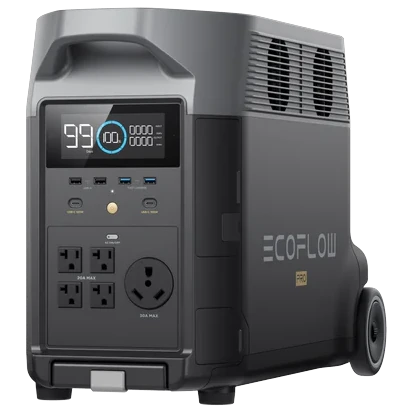
- 3.6 kWh
- capacity
- 3,600 W
- output
- 99 lb
- weight
- 3,500
- rated cycles
Should you buy it right now?
Fair price today: $1,899 is what it normally sells for. It clears 5 of 6 real-world jobs and wins 39 of 57 matchups.
Real-world jobs
5 of 6
Falls short only on Van Life Daily
Head-to-head record
39–18
57 adjudicated matchups

Verdicts by Gunner Gustafson and the Test Desk·Figures computed 2026-10-04
01 · Six real-world jobs
What the DELTA Pro actually runs
The load profiles every comparison on the site is scored on, computed for this unit alone: energy needed against the usable tank after inverter losses, and whether the inverter holds and starts the biggest single load.
Weekend Camping
Clears it2 nights · Two nights off-grid with essential comfort
2,100Wh needed · 69% of the tank · 960Wh spare
Peak 75W: starts and holds
8-Hour Blackout
Clears it8 hours · Keep the essentials running through a night without power
1,645Wh needed · 54% of the tank · 1,415Wh spare
Peak 150W: starts and holds
CPAP Overnight
Clears it8 hours · Sleep therapy without interruption — the #1 medical use case
320Wh needed · 10% of the tank · 2,740Wh spare
Peak 40W: starts and holds
Remote Workday
Clears it8 hours · Full work day off-grid without power anxiety
910Wh needed · 30% of the tank · 2,150Wh spare
Peak 60W: starts and holds
Tailgate Party
Clears it4 hours · Game day power for the crew
670Wh needed · 22% of the tank · 2,390Wh spare
Peak 400W: starts and holds
Van Life Daily
Falls short24 hours · A full day of mobile living — the ultimate endurance test
4,685Wh needed · 153% of the tank · 1,625Wh short
Peak 150W: starts and holds
02 · Head-to-head record
39 wins in 57 written matchups
Every matchup is a full verdict scored on the six jobs above plus price, longevity and portability. This is the set shoppers search for, not a random sample.
Win share
39–18
- vs EcoFlow11–6
- vs BLUETTI11–6
- vs Jackery4–4
- vs Anker5–2
- vs Goal Zero6–0
- vs DJI2–0
 loses
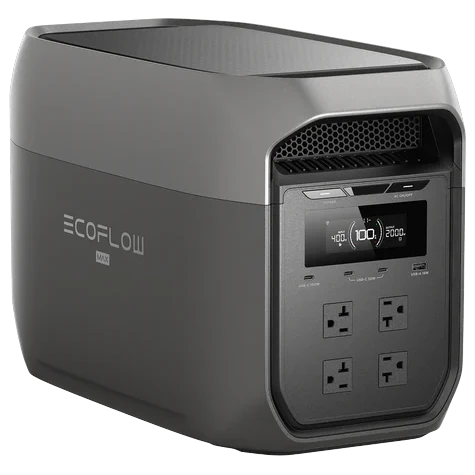
losesDELTA Pro vs EcoFlow DELTA 3 Max
640 searches reached this matchup
 loses
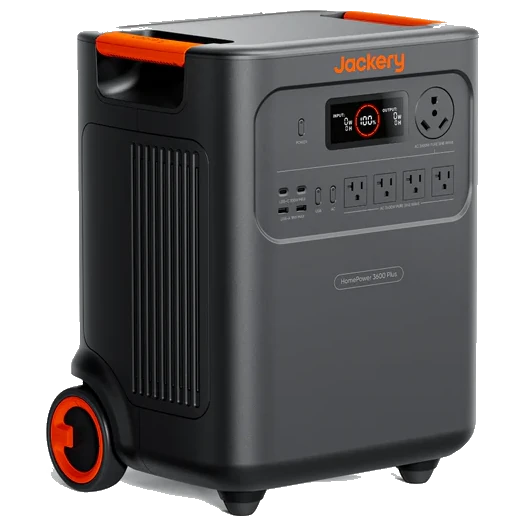
losesDELTA Pro vs Jackery HomePower 3600 Plus
482 searches reached this matchup
 wins
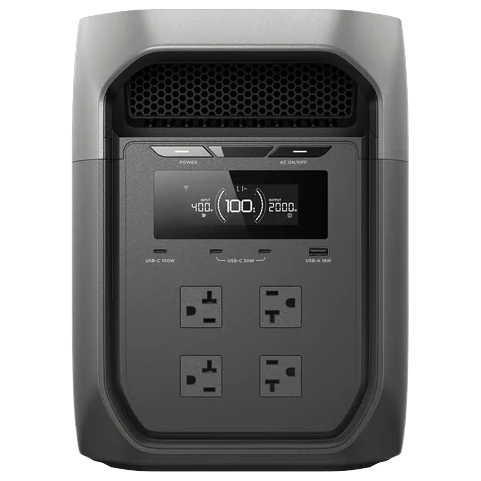
winsDELTA Pro vs EcoFlow DELTA 3 Max Plus
439 searches reached this matchup
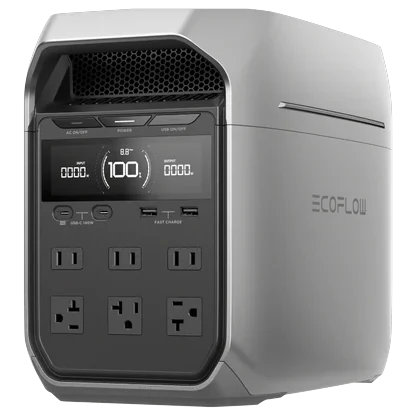 wins
winsDELTA Pro vs EcoFlow DELTA 3 Plus
219 searches reached this matchup
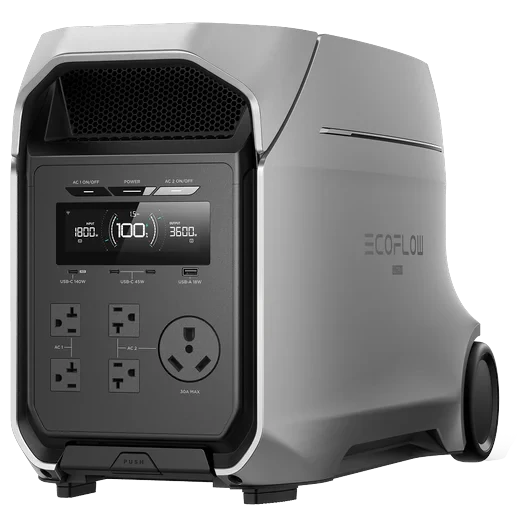 loses
losesDELTA Pro vs EcoFlow DELTA 3 Ultra Plus
217 searches reached this matchup
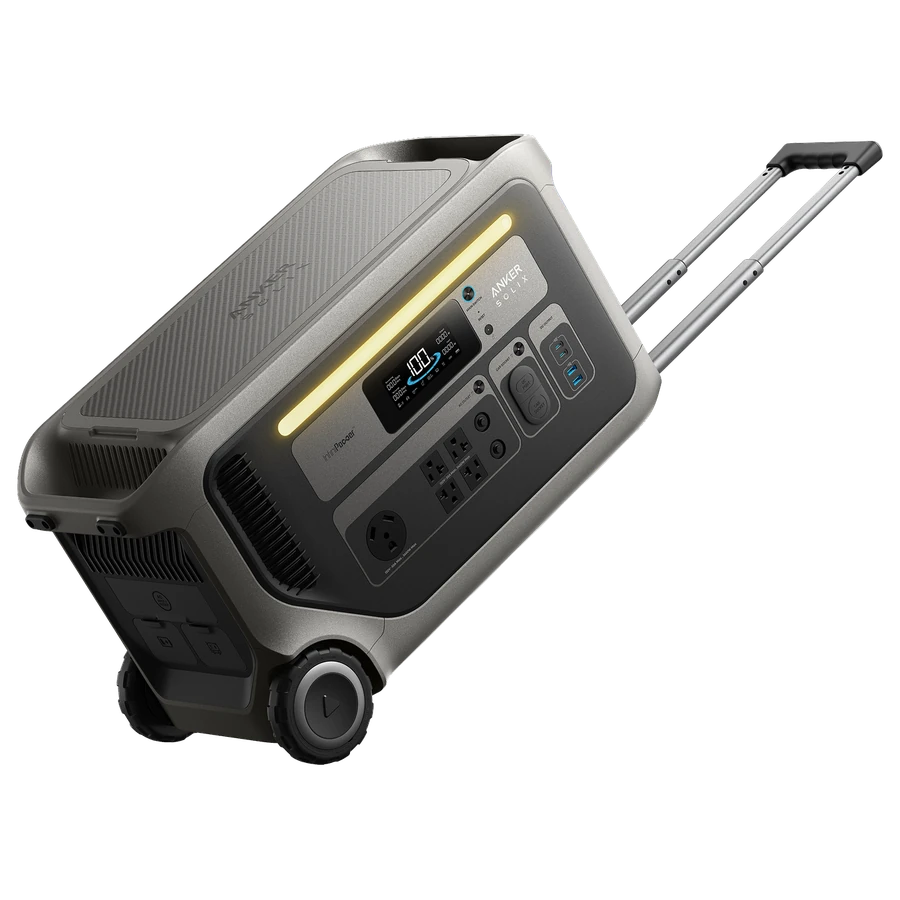 wins
winsDELTA Pro vs Anker SOLIX F3000
169 searches reached this matchup
03 · From the verdicts
Who it is for, and when a rival won instead
Each line is lifted from a written matchup where it decided the verdict, and links to the page it came from. Repeated across many matchups means it is the unit’s signature, not one author’s opinion.
Buy the DELTA Pro if…
You want the better lifetime cost per kWh and don't mind the extra weight or the louder fans to get it.
Decided 14 matchups · read one →
You're running a full weekend off-grid. It clears the 2,100Wh camping profile with 960Wh to spare, and the Explorer doesn't clear it at all.
Decided 4 matchups · read one →
You want a published noise number before you commit to a unit that'll sit in your living room during an outage.
Decided 4 matchups · read one →
The buyer who wants the longer track record, since reviews describe the DELTA Pro line carrying primary backup duty across months of outages [A3].
Decided 4 matchups · read one →
A rival won when…
You want the longer-lived battery — 500 more rated cycles — and the faster 10ms UPS switchover.
Decided 9 matchups · read one →
You want a desk UPS that won't wake you. 10ms switchover and a 45 dBA rating against the DELTA Pro's 20ms and 60 dBA, and it's back to full in about 70 minutes [B2].
Decided 5 matchups · read one →
You already own a big station and want a small one for the tent, so 518Wh is a supplement rather than the plan.
Decided 4 matchups · read one →
You want to save $500 up front ($1,399 vs $1,899) on the quieter (30dB vs 60), lighter unit — and the lower cost to own ($0.12 vs $0.13 per lifetime kWh).
Decided 3 matchups · read one →
04 · Price history
What the DELTA Pro actually sells for
The number on the buy button, read twice a day, one point per day. Never the sticker, never a “was” price.
Read from us.ecoflow.com twice a day since July 17 · 80 days
Carried on 76% of days tracked · dips reach $1,599
Built from the Oct 4, 7 PM UTC read.
$1,899
Usual price
76% of days tracked
$1,599
Best we've seen
August 4
$1,899
Today
at usual
$1,899
Highest seen
0 days above usual
How to read this
- Usual is the price the unit carried most of the time, tested for how long it held rather than how often we looked. A weekend promotion cannot move it.
- Best is the lowest price we have read on the store itself. Typed coupon codes, member-only prices and marketplace listings are not counted; anything applied automatically at checkout is.
- A gap in the line is a day we could not read a price. We never draw across one, and we never show the store’s own “was” price.
Method on the methodology page.
Share the numbers
EcoFlow DELTA Pro: usually $1,899, best $1,599 (Aug 4), today $1,899 on us.ecoflow.com. Tracked twice a day since Jul 17. https://stationarena.com/products/ecoflow-delta-pro#price-history
Alerts for the DELTA Pro
One email when it drops below $1,899, comes back in stock, or a newer model in this line appears. Nothing else.
By subscribing, you agree to our Privacy Policy.
Black Friday · 38 days out
Will the EcoFlow DELTA Pro go on sale for Black Friday?
Price to beat $1,599Nobody knows until EcoFlow moves, but we know what a real deal would be: anything under $1,599, the lowest price we have recorded (August 4). Last Black Friday it was reported at $1,329 at EcoFlow store. It has sat at least 5% under its usual $1,899 on 19 of the 80 days we have tracked. We read the store twice a day, and the moment it drops it shows on our Black Friday deals page.
05 · Voices
What 211 owner reports say about the DELTA Pro
Owner reports are paraphrased from public YouTube comments and each links to its source; reviewer consensus is counted from cited excerpts, never quoted; our own verdicts are quoted. Specs on this page never come from any of them.
- 44%
- positive
- 155
- self-declared owners
- 39
- measured reports
- 102
- videos
- 52%
- EcoFlow norm
- 2021–2026
- reporting period
84 for, 107 against
16 owned 6+ months
numbers, not impressions
10 channels
across 1,668 reports
2021-06-01 to 2026-09-01
Weighted read
49% positive weighted · corpus 51% · about typical
Raw counts reward whoever writes most, and people write when something breaks. Here each report is weighted by what the complaint costs a buyer (a failure outranks an app gripe) and by its evidence (a measured owner report outranks a shopper’s opinion), then compared with every report in the corpus.
- Failures, returns, support27 against · 9 for
- How it performs26 against · 42 for
- How it feels to use54 against · 33 for
By topic, against the EcoFlow norm
Bars count this unit’s reports; the tick is the share of positive reports for the same topic across every EcoFlow unit in the corpus.
- Price & value11 measured50% positive · brand 58%1818
- Durability & failures3 measured29% positive · brand 26%156
- Solar input6 measured45% positive · brand 51%119
- General3 measured38% positive · brand 63%106
- Capacity & runtime3 measured75% positive · brand 81%412
- Support & warranty20% positive · brand 33%123
- App & firmware1 measured36% positive · brand 54%95
- Weight & portability2 measured30% positive · brand 60%73
- Expandability3 measured56% positive · brand 65%45
- Build quality86% positive · brand 38%16
- Charging speed4 measured83% positive · brand 78%15
- Noise17% positive · brand 44%51
- Idle drain2 measured80% positive · brand 48%14
- Shipping & availability0% positive · brand 9%5
- Inverter & surge1 measured33% positive · brand 56%21
- UPS switchover0% positive · brand 56%2
left: negative · right: positive
When the reports were made
What owners compare it against
What owners praise
Expandabilitymeasuredowner
Two DELTA Pro units and four batteries give him 21,600Wh with 5000W of solar.
City Prepping· 9 likessource
Price & valuemeasuredowner
Got it at Costco for $2599 with EV plug and remote display, versus $3699.
DIY Solar Power with Will Prowse· 11 likessource
Solar inputmeasuredowner
Charges two DELTA Pros from two ~2,500W strings running at about 125V.
HOBOTECH· 13 likessource
What owners complain about
Durability & failuresmeasuredowner · 8 mo
Bought October 2023, died June 2024.
The Solar Lab· 25 likessource
Charging speedmeasuredowner · 2 mo
App caps DC input at 8A, so he gets only 100W from a 200Ah battery that could give far more.
DIY Solar Power with Will Prowse· 11 likessource
Expandabilitymeasuredowner
Expansion units cost $2799 for only 3600Wh; rack batteries give 5120Wh for $1000 less.
DIY Solar Power with Will Prowse· 8 likessource
Reviewer consensus
2/4 positive excerpts, 6 sources
Established home-backup platform with wheeled portability and massive expandability; the consistent knock is fan noise under heavy load.
backuppowerhub.com · us.ecoflow.com · outdoorgearlab.com · bobvila.com · powerstationadvisor.com · robbsutton.com · researched 2026-07-10
EcoFlow, brand-wide
52% positive across 1,668 reports. The brand-wide complaint is shipping & availability (91% negative); the brand-wide praise is capacity & runtime (81% positive).
From the test desk
“These are the same brand a generation apart, and the newer, cheaper unit wins most of the ways a buyer feels day to day.”
“Take the HomePower 3600 Plus.”
“DELTA Pro wins on real-world coverage, not on being the newer or fancier unit — DELTA 3 Max Plus is EcoFlow's more modern platform and it shows in switchover speed and noise.”
06 · Where each number comes from
Spec sheet, in four cards
Every field carries its source: green is the manufacturer’s own document, blue was adjudicated after sources disagreed, grey is the catalogue as imported. Then compare it line by line with the units people actually weigh it against.
Battery
3600
Capacity (Wh)
- ChemistryLiFePO4
- Charging Cycles3500
- Battery Expansion FeasibilityYes
Power out
3600
Output (W)
- Surge Peak7200W
- AC Outlets4
- 240V Outlets0
- 30A RV Outlets1
- 12V Car Outlets1
- USB-C Ports2
- USB-A Ports4
- USB-C Charging Outputs100W
Charging
1600
Solar Input (W)
- Solar Input TypeXT60
Living with it
99
Weight (lbs)
- Noise Level (db)<60
- UPSYes (<20ms)
- App ControlYes
- Warranty (Years)5
Compare it with
DELTA Pro vs
leads on 4 · trails on 4
| Spec | DELTA Pro | DELTA 3 Max | Gap |
|---|---|---|---|
| Usual price | $1,899 | $899 ● | +$1,000 |
| Capacity (Wh) | 3600 ● | 2048 | +1552 |
| Output (W) | 3600 ● | 2400 | +1200 |
| Surge (W) | 7200W ● | 4800W | +2400 |
| Rated cycles | 3500 | 4000 ● | -500 |
| Solar input (W) | 1600 ● | 500 | +1100 |
| Weight (lb) | 99 | 50.7 ● | +48.3 |
| Noise (dB) | <60 | 30 ● | +30 |
| AC outlets | 4 | 4 | 0 |
| USB-C ports | 2 | 2 | 0 |
| Warranty (yr) | 5 | 5 | 0 |
| Chemistry | LiFePO4 | LiFePO4 | |
| UPS | Yes (<20ms) | Yes (10ms) |
● marks the better figure where direction is clear. Price is each unit’s usual price.
Read the full verdict →Solar
Charge the DELTA Pro from the sun
Every panel we track, checked against its solar input: which ones fit, the adapter each needs, and what it really delivers.
- Solar input
- 1600 W
- Plug
- Panels that work
- 30 of 39
- Refill at full sun
- ~2.3 h
07 · EcoFlow DELTA Pro line
Where it sits in the line
Capacity bars are to scale across the line; prices are each unit’s usual price, not today’s.
DELTA Pro
3.6 kWh · $1,899
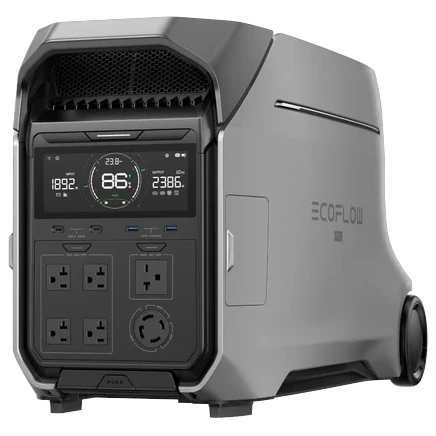
DELTA Pro 3
4.1 kWh · $2,799
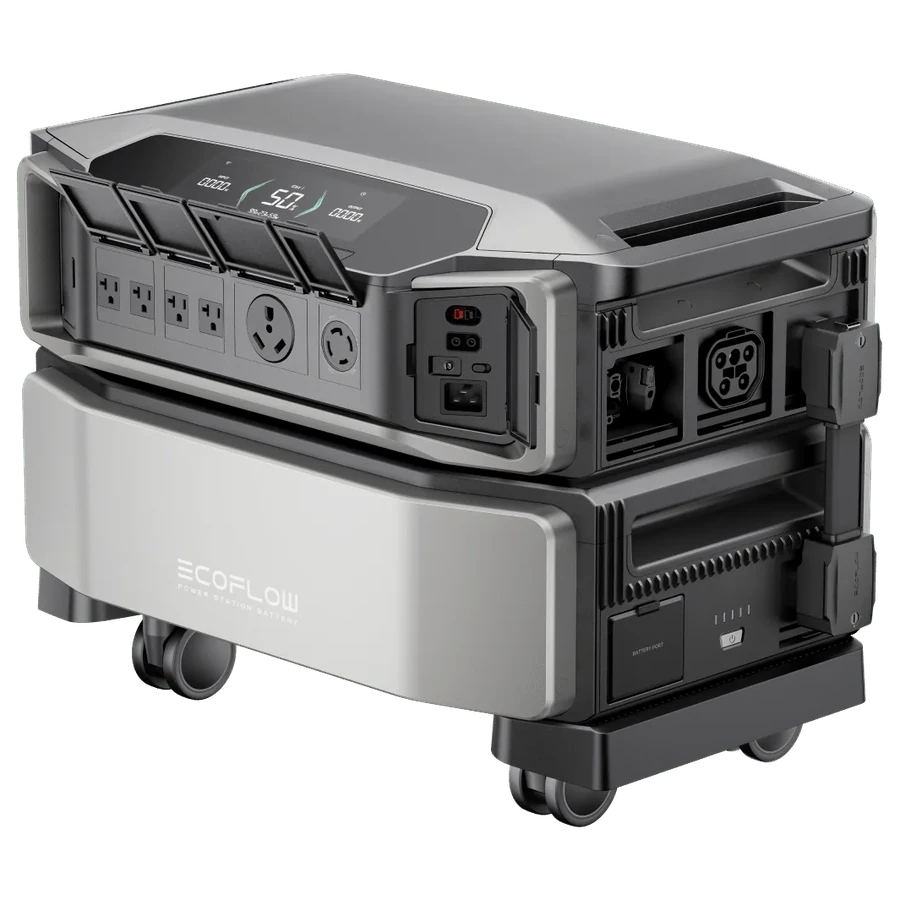
DELTA Pro Ultra
6.1 kWh · $4,199
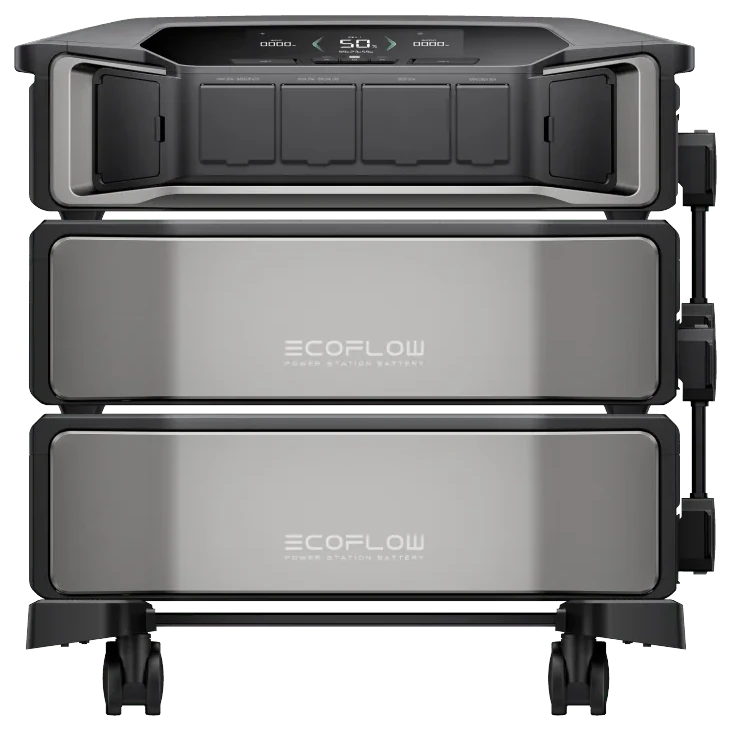
DELTA Pro Ultra + 1 Battery
12.3 kWh · $5,999
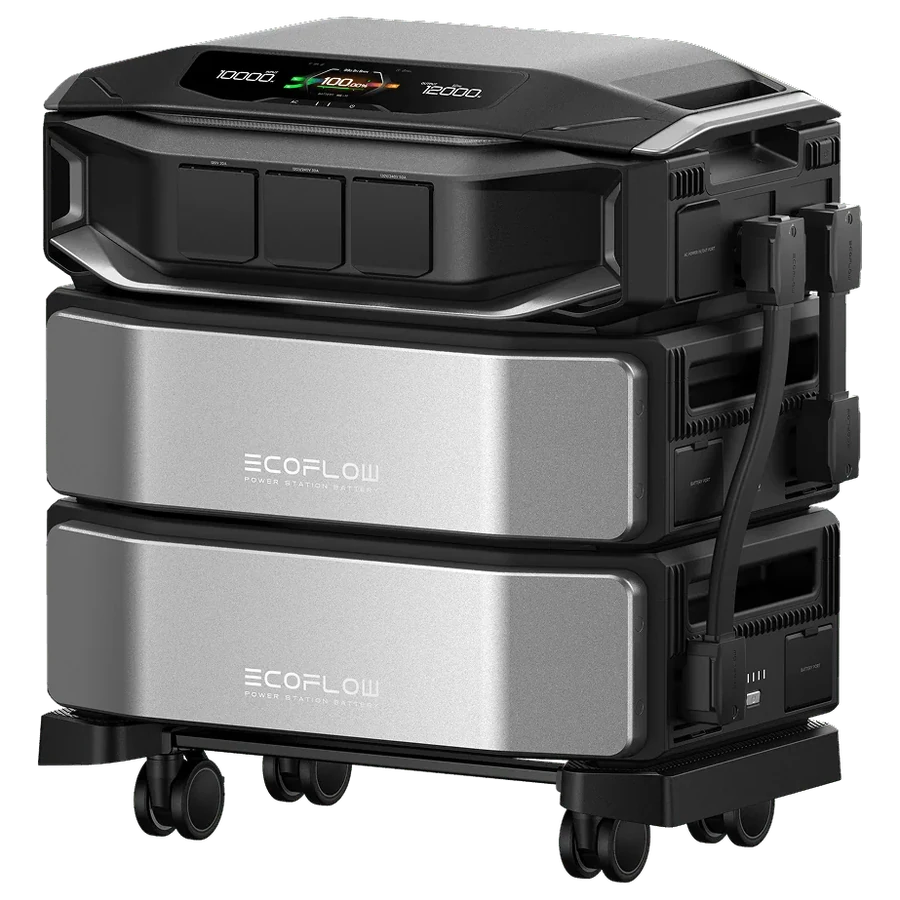
DELTA Pro Ultra X
12.3 kWh · $7,999
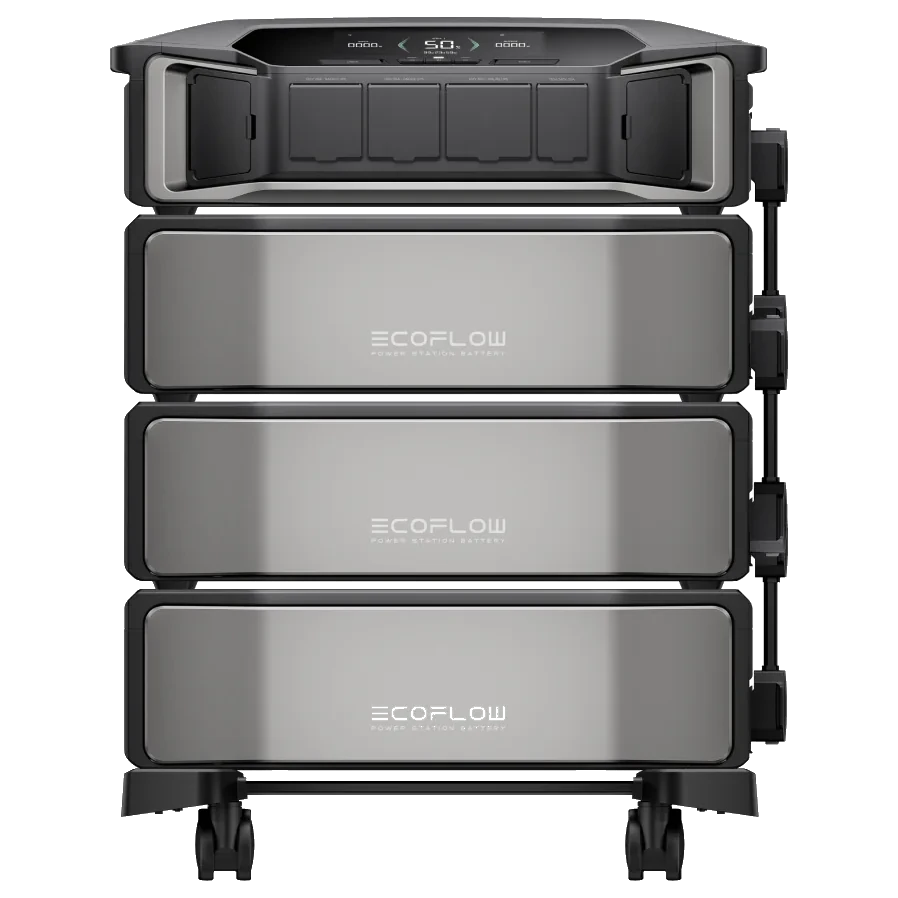
DELTA Pro Ultra + 2 Batteries
18.4 kWh · $7,999
Not yet on sale: A 4 kW, 3,072 Wh jobsite power station in a sealed metal body with a built-in RCD, aimed at the European contractor who cannot run a combustion generator. EcoFlow PowerRock 4000 Debuts: A 7.2 kW Battery for the Jobsite
08 · At its usual price
Cost of ownership
Cycle life is the manufacturer’s rating to 80% capacity; the lifetime figure is that rating times the nameplate capacity.
$0.53
per Wh
at $1,899
$0.15
per lifetime kWh
12,600 kWh over 3,500 cycles
9.6 yr
if cycled daily
34 yr at weekends only
5 yr
warranty
$380 per covered year
09 · From the matchups
Questions people ask
What solar panels work with the DELTA Pro?
Any panel between 11 V and 150 V, through its input, up to 1600 W. 30 of the 39 panels we track work with it. Our pick: the Anker SOLIX 440W Rigid Solar Panel. 3 panels deliver 950 W.
Is the DELTA Pro worth $1,000 more than the DELTA 3 Max?
Only if your loads cross what the Max holds or delivers. The $1,000 buys 1,552Wh more capacity and 1,200W more continuous output, but the Max is actually the newer unit — quieter at 30dB vs 60dB, lighter at 50.7 lbs vs 99, and rated for more cycles. If your draw fits under 2,048Wh and 2,400W, keep the $1,000.
Which EcoFlow is quieter, the DELTA 3 Max or the DELTA Pro?
The DELTA 3 Max, by a wide margin. It's rated at 30dB and testers call it essentially silent under moderate load [A1], while the DELTA Pro puts out a noticeable fan whine above 2,000W [B4]. If the unit shares a room you sleep or work in, that gap matters more than any spec on the box.
Is the Jackery HomePower 3600 Plus better than the EcoFlow DELTA Pro?
For home backup, yes. At the same typical price it carries a pack rated for 6,000 cycles against 3,500 and weighs 77.2 lbs against 99, with the same 3,600W inverter and 7,200W surge. The DELTA Pro wins on solar input (1,600W against 1,000W), a 12V car socket and USB-A count, so take it if one of those is on your list.
Which is quieter, the DELTA Pro or the HomePower 3600 Plus?
On paper, the Jackery: it's rated 30dB and the DELTA Pro 60dB. But each figure is its own maker's, measured its own way, so the gap isn't a like-for-like measurement. Reviews of the DELTA Pro line describe a high-pitched fan whine above 2,000W draws and quiet running at lighter loads, though that coverage may describe the DELTA Pro 3 [A4][A0]. For a bedroom, find a hands-on recording of either before you commit.
Does the DELTA Pro's 1,600W solar input make up for its shorter cycle life?
Only if you can feed it. With more than 1,000W of panels, the DELTA Pro refills from empty in about 2.3 hours at full rated input (3,600Wh ÷ 1,600W), where the Jackery needs about 3.6 (3,584Wh ÷ 1,000W). But daily solar cycling is exactly the use that spends cycles, and the DELTA Pro is rated for 3,500 against 6,000: 9.6 years at a cycle a day against 16.4.
Some links are affiliate links; they never change the price you pay or which price we show. Owner reports are paraphrased from public comments and link to their source.