Head-to-head test
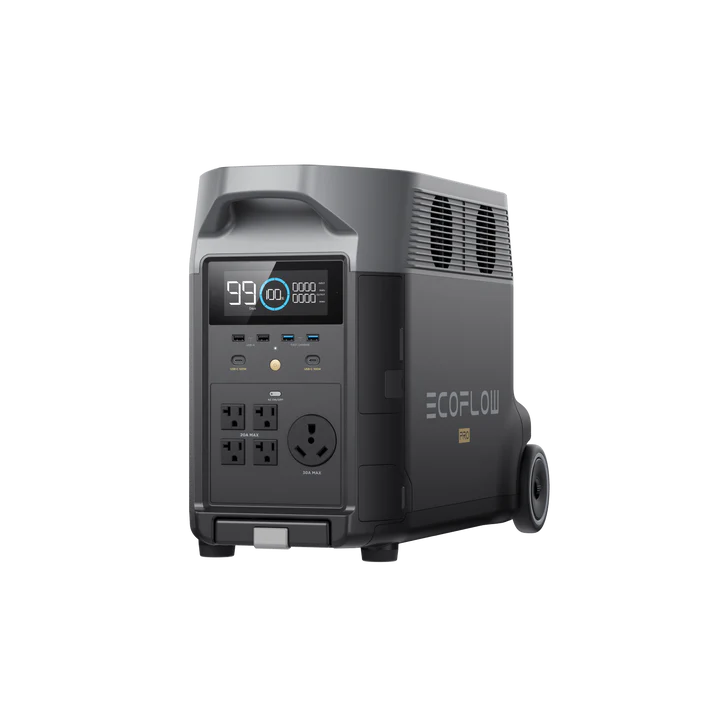
EcoFlow DELTA Pro vs Jackery HomePower 3600 Plus
Sixteen watt-hours and twenty dollars apart on paper, these two split hard on the three specs you actually live with: what it weighs, what it sounds like, and how long the cells last.
Full profiles: EcoFlow DELTA Pro → · Jackery HomePower 3600 Plus →

Written by Gunner GustafsonUpdated
Whole-Home Backup Tester, Station Arena Test Desk
$1,899.00 · direct from EcoFlow
Last checked 1 day ago. Prices move — check before you buy.

$1,899.00 · direct from Jackery
Last checked 1 day ago. Prices move — check before you buy.
Spec deltas
Buy the Jackery HomePower 3600 Plus. It's $1,619 against the DELTA Pro's $1,599, and that $20 is the last time price is relevant on this page. The two share a 3,600W inverter, a 7,200W surge ceiling, a 20ms switchover and a five-year warranty, and their capacities land 16Wh apart (3,600 against 3,584). On the row buyers actually read, this is a dead heat.
They separate on everything you live with. The DELTA Pro weighs 99 lbs and is rated 60dB under load; the HomePower is 77.2 lbs and rated 30dB. The EcoFlow's cells are good for 3,500 cycles, the Jackery's for 6,000. Three unrelated specs, all leaning the same direction, none of them printed on the front of the box.
The counterweight is real, and it isn't hardware. EcoFlow has the deepest ecosystem in portable power and by far the largest community in the category; Jackery has the smallest of the major brands. Warranty support is a sore spot at both companies, which makes the fix identical at either: buy from a retailer with a real return window instead of direct. Do that, and the strongest argument for the EcoFlow mostly dissolves.
What the Numbers Reveal
Each conclusion stated first — the numbers behind it on one line, the full analysis below.
And the DELTA Pro's noise is load-dependent, not constant: the whine arrives above 2,000W drawsA4. A fridge, some lamps and a router never get there, so at ordinary outage loads the EcoFlow is a quiet box. Where it bites is a space heater, a well pump, or a fast recharge, which are exactly the jobs people buy a 3,600W unit to do.
DELTA Pro rated 60dB under load; HomePower 3600 Plus rated 30dBThe 8-hour blackout profile draws 1,645Wh, 54% of either batteryReviewers describe a noticeable high-pitched fan whine from the DELTA Pro line above 2,000W draws, though it stays quiet at lighter loadsA4
Why it mattersIf your outage plan tops out at the fridge and the router, the noise gap won't touch you. If it includes heat or a hard recharge, it will, and that's the buyer who should take the Jackery.
rated cycles
Bring in the per-unit cost and the sticker stops meaning anything: 13 cents per lifetime kilowatt-hour on the EcoFlow against 8 on the Jackery. That's roughly 70% more energy out of the Jackery over its life (21,504 against 12,600) for roughly 1% more money. Nobody has to think about that trade.
$1,599 for the DELTA Pro against $1,619 for the HomePower 3600 Plus3,500 rated cycles against 6,000Total lifetime throughput 12,600 kWh against 21,504 kWh
Why it mattersAnyone cycling this more than a few times a month should stop comparing stickers. The cheaper unit here is the one with the bigger number on the tag.
solar input
That makes charge speed the load-bearing spec, and it belongs to the DELTA Pro by 600W of input (1,600W against 1,000W). At its own ceiling the Jackery's 3,584Wh needs about 3.6 hours of ideal sun, where the DELTA Pro's 3,600Wh takes about 2.3. The unit that drinks faster is the heavier one, so the two daily chores of an off-grid life, moving it and feeding it, land on opposite sides.
Solar input capped at 1,600W on the DELTA Pro, 1,000W on the HomePower 3600 PlusThe van-life profile needs 4,685Wh, which is 153% of the DELTA Pro and 154% of the Jackery99 lbs against 77.2 lbs
Why it mattersVan and overland buyers should size up or plan on two units. If you're buying one of these anyway, buy the one that gives you back part of an afternoon every day.
The specific dimensions that decide these two units — everything else is a tie.
Lifetime Value
Selected because: The stickers land $20 apart ($1,619 against $1,599), so the only price question worth asking is what each unit costs across the whole life of its cells.
cost / lifetime kWh
Priced per year of warranty, these two are $320 and $324. That's the tell. The warranty isn't what separates them, because the warranty is the same five years on both. What's sitting underneath it is not the same at all.
Cycled once a day, the EcoFlow's cells are rated to 9.6 years and the Jackery's to 16.4. Both run long past their coverage, which means whichever you buy, most of this unit's working life happens with nothing behind it. Given that, buy the one with more working life left to spend.
What the Specs Don't Tell You
Selected because: One warning card fires on this pair, and it's about how loud the DELTA Pro gets when you actually put it to work.
rated cycles
Only one of these cards is a warning rather than a note, and it's aimed at the sound of the DELTA Pro working. That's the right emphasis. Weight and cycle life are things you discover once and adjust to. Fan noise is something you rediscover every time the power goes out.
Read the weight card as the honest counterweight to this page's argument. The Jackery is the lighter unit and it is still not a unit you carry. The win it delivers is 'easier to reposition', not 'portable', and anyone picturing a clean two-hand lift into a truck bed should plan on a ramp either way.
Portability & Form Factor
Selected because: Near-identical capacity in two boxes 21.8 lbs apart (99 against 77.2), both of them wheeled, neither of them light.
weight
21.8 lbs is the gap (99 against 77.2), and it lands precisely where wheels stop helping. Both units roll well on flat, smooth ground and both come with a handleA2B2. On grass, on gravel, on the second step down to the basement, you're carrying it, and that's the moment the difference stops being a spec.
Reviewers note the DELTA Pro line's wheels want a cart once the ground gets unevenA2, while the Jackery's weight reads as manageable for this class with the wheels and pull handle doing the workB2. Neither of these is a backpacking decision. The question is whether it moves between a garage and a driveway twice a year, or between a vehicle and a campsite most weekends. The second reader should take the lighter box.
Your Life, Your Pick
Selected because: Four of the six load profiles come back 'both', which is the clearest proof on the page that capacity isn't what decides this one.
Four of the six profiles come back 'both', and that is the most useful thing this grid says: capacity is not the axis here. Two batteries 16Wh apart handle very nearly identical days, which is what you'd expect and what the table confirms.
The two that aren't ties are the interesting ones. The CPAP night goes to the Jackery on a load that uses about a tenth of either battery, so it's settled by fan behavior rather than watt-hours. The van-life day goes to nobody at all, which is worth knowing before you buy either box as an off-grid primary.
Brand Trust
Selected because: Two different companies with genuinely different strengths, and the section where the EcoFlow makes its best case.
EcoFlow's real advantage on this page is the crowd. Its subreddit runs around 31,000 members against Jackery's roughly 2,000, and there's an official forum on top of that. When your unit does something strange at 11 p.m., that difference is the difference between finding the answer already posted and opening a ticket.
Warranty support is the weak spot at both companies, so the practical move is the same either way: buy through a retailer with a real return window rather than direct, and keep the receipt. Costco and Amazon both give you a second path when a queue stalls. That advice matters more on the Jackery, whose retail distribution happens to be its genuine strength.
Strengths & trade-offs
EcoFlow DELTA Pro
Strengths
- +Larger battery capacity
- +Faster solar charging
Trade-offs
- –Significantly heavier (+21.8 lbs), making it harder to move.
- –Very heavy unit that may be difficult for one person to lift.
- –Can receive complaints about fan noise under heavy load.
- –Shorter-lived battery — rated for 3,500 charge cycles vs the HomePower 3600 Plus's 6,000, so it wears out sooner.
Jackery HomePower 3600 Plus
Strengths
- +Lighter by 21.8 lb
- +Rated for 6,000 charge cycles — much longer battery lifespan
Trade-offs
- –No major technical downsides compared to rival.
Will It Power Your Gear?
Scenario math and per-appliance runtimes, modeled from the spec record.
Scenario verdicts
We ran the math on six real-world scenarios. Here's which unit survives your actual life.
SCN-01 · 2 nights · needs 2,100Wh
Weekend Camping
Two nights off-grid with essential comfort
Either unit
Both handle two nights comfortably, each finishing at 69% used. With this little difference, pick based on weight and portability instead. The lighter unit wins for car camping.
Battery budget usedlower = more headroom
LOAD Phone Charger 15W×6h · LED Lights 40W×8h · Box Fan 75W×14h · CPAP Machine 40W×16h
SCN-02 · 8 hours · needs 1,645Wh
8-Hour Blackout
Keep the essentials running through a night without power
Either unit
Both clear it without strain. The profile takes a little over half of either battery, so you end the evening with a working unit and change to spare no matter which you bought. Which turns the real question from whether it lasts to what it sounds like while it lasts, and that's the DELTA Pro's one soft spot when the load climbs.
Battery budget usedlower = more headroom
LOAD Fridge 150W×8h · Router + Modem 20W×8h · LED Lights (4 bulbs) 40W×6h · Phone Charger 15W×3h
SCN-03 · 8 hours · needs 320Wh
CPAP Overnight
Sleep therapy without interruption — the #1 medical use case
HomePower 3600 Plus
The Jackery takes this one, and not on capacity. A CPAP night uses about a tenth of either battery, so you wake up with roughly 90% still in the tank either way. It's decided an arm's length from your head instead: the Jackery is rated at half the DELTA Pro's decibel figure, and at 3 a.m. that is the entire specification.
Battery budget usedlower = more headroom
LOAD CPAP Machine 40W×8h
SCN-04 · 8 hours · needs 910Wh
Remote Workday
Full work day off-grid without power anxiety
Either unit
Both power your workstation all day without strain, and their USB-C output is a wash — pick on weight, ports, or price.
Battery budget usedlower = more headroom
LOAD Laptop 60W×8h · External Monitor 30W×8h · Router + Modem 20W×8h · Phone Charger 15W×2h
SCN-05 · 4 hours · needs 670Wh
Tailgate Party
Game day power for the crew
Either unit
Both handle game day easily. Since capacity isn't the deciding factor, weight is: at 77.2 lbs the HomePower 3600 Plus is the one you'll be glad you brought. Fan noise under load is worth a listen too — it's audible in the lulls between songs.
Battery budget usedlower = more headroom
LOAD Blender 400W×0.5h · LED TV (55") 80W×4h · Bluetooth Speaker 15W×4h · Phone Charger (×3) 45W×2h
SCN-06 · 24 hours · needs 4,685Wh
Van Life Daily
A full day of mobile living — the ultimate endurance test
Neither unit
Neither, and it isn't close. A full off-grid day asks for roughly half again as much energy as either battery holds, so one of these cannot be your only power source. That's not a knock on either unit, it's the wrong tool for the day. Add a second battery, run enough solar to refill through the afternoon, or move up a capacity class.
Battery budget usedlower = more headroom
LOAD Mini-Fridge 150W×24h · Laptop 60W×4h · Phone Charger 15W×3h · LED Lights 40W×5h · Fan 75W×8h
The Load Test
RUNTIME = (Wh × 0.85) ÷ LOAD
None of the scenarios above exactly yours? Build it. Toggle what you'd plug in; both units are tested against the combined draw.
Essentials
Comfort & Convenience
High-Draw Appliances
Test duration
8h
Continuous draw
205W
Projected runtime
Dead heat — both run this 205W load for roughly 14.9h. Pick on price, weight, or ports.
Modeled from the spec record — same math as the tables below. Methodology
Runtime by appliance
Real-world runtime estimates for common appliances, modeled at 85% inverter efficiency.¹
Essentials
The basics you need runningscale 0–204hComfort & Convenience
Makes off-grid life actually enjoyablescale 0–40.8hHigh-Draw Appliances
These reveal the real limitsscale 0–3.1h¹ Runtime = (capacity × 0.85) ÷ appliance watts. Within each group, all bars share one time scale (the group's longest runtime), so lengths are comparable across appliances; identical runtimes collapse into a single blue/orange bar. Actual runtime varies with battery age, temperature, and simultaneous loads — see methodology.
Conclusion
August 9, 2026
Verdict: the Jackery HomePower 3600 Plus
Take the HomePower 3600 Plus. The two units share an inverter rating, a surge ceiling, a switchover time, a 100W USB-C port and a five-year warranty, and their capacities sit 16Wh apart (3,600 against 3,584), so nothing you'd notice is being traded away. What the Jackery adds is a pack rated for 6,000 cycles instead of 3,500, a box 21.8 lbs lighter (99 against 77.2), and a 30dB noise rating against 60dB; solar input is the DELTA Pro's column, 1,600W against 1,000W. The honest cost is the company behind it: Jackery has the smallest community of the major brands and the lowest-rated app, where EcoFlow has the deepest ecosystem in the category. Buy the Jackery through Costco or Amazon so a support queue is never your only option and that cost mostly evaporates. Go EcoFlow only if you're already invested in its panels and app, or if the unit lives somewhere nobody has to listen to it.
Editor-assigned confidence, based on cited owner research and spec analysis.
List prices as of August 9, 2026. The links below open EcoFlow's and Jackery's current prices.
$1,899.00 · direct from Jackery
Last checked 1 day ago. Prices move — check before you buy.
or check the DELTA Pro price$1,899.00 list
Written by Gunner Gustafson, Whole-Home Backup Tester · Station Arena Test Desk · Updated August 9, 2026
Measured Data
Benchmark scores and the full spec record, side by side.
Benchmark scores
Not rated for both units (minimum threshold unmet): Tailgating.
Full specifications
ᵈ Derived: price ÷ rated capacity. See the data behind our comparisons →
Comparison ToolAdd more power stations, side by sideOpen Tool →How these numbers are produced
Numeric verification
Every figure on this page traces to our spec database or arithmetic on it — no estimated numbers.
Owner claims
Statements about owner experience are cited to published reviews — see Sources & Research Notes below.
Runtime model
Runtime = (rated capacity × 0.85 inverter efficiency) ÷ device wattage. Solar recharge estimates assume panels deliver 70% of rated output. Cold weather, battery age, and stacked loads reduce real-world results.
Power Score
Computed from 14 published spec dimensions, weighted per use-case bench. Higher is better; a unit must meet a bench's minimum threshold to be rated.
See the full weight table and data sourcing on our methodology page →Class ranking (the star rating)
Each unit's star score is a category ranking, not customer reviews — no buyer opinions feed it. We score every station on size-independent quality (value, output, portability, endurance, ports, warranty, and more), then percentile-rank it against the other units in its capacity class, so a class-leading compact unit and a class-leading whole-home unit can both earn 5★. Here, DELTA Pro rates 3.9/5 (33rd percentile of 16 Home Backup-class units), and HomePower 3600 Plus rates 4.1/5 (47th percentile of 16 Home Backup-class units).
How the class ranking is computed →Test Notes & Caveats
Hidden gotchas and advantages we spotted that you won't find on the product page.
Two wheeled boxes, one bad staircase
Neither of these is a carry. 99 lbs and 77.2 lbs are both two-hands, bent-knees, plan-your-route lifts, and both ship with wheels because the makers know it. The 21.8 lbs between them matters at exactly one moment: the step, the tailgate, the basement landing, where the wheels stop helping and your back takes over. Buy the lighter one if that moment is in your week rather than your year.
DELTA Pro: loud when it's working, fine when it isn't
60dB is a full-load rating, not an idle hum. At a laptop, a router and a couple of lamps the DELTA Pro is a quiet box, and plenty of owners never hear the problem. Push it toward its 3,600W ceiling, or recharge it in a hurry, and the fans become the thing you notice about the outage. The Jackery's rating is half that figure, which is why it takes the CPAP scenario outright and why the EcoFlow is a better fit in a garage than a bedroom.
Warranty: No Difference
Both units carry the same 5-year warranty, so coverage isn't a tiebreaker here. The HomePower 3600 Plus's figure is a maximum rather than a guarantee — it depends on registering the unit with Jackery, which is what extends the base term to the full period.
Cycle ratings only matter once you say how often
On weekend duty, the EcoFlow's cells are rated to 33.7 years and the Jackery's to 57.7, which means both numbers are science fiction and the spec decides nothing. Daily cycling is the only case where the gap is real, and there it's 16.4 years against 9.6. Be honest with yourself about which user you are before you pay attention to this row.
Full record above — the Test Desk pick is the HomePower 3600 Plus.
Check HomePower 3600 Plus price →or check the DELTA Pro priceOwnership Analysis
What happens after you buy — true cost of ownership, brand trust, and growth potential.
Lifetime value
Service lifeyears at one full cycle per day
Lifetime energy delivered
Cost per delivered kWh
│ warranty ends · Reaching the cycle rating means ~80% capacity remains — degraded, not dead.
Analyst note
The DELTA Pro is cheaper to buy, but the HomePower 3600 Plus is cheaper to own. At $0.09/kWh over its lifetime vs $0.15/kWh, the HomePower 3600 Plus's higher cycle life and capacity make each dollar go further over the years.
Brand trust
EcoFlow
Ecosystem
The deepest catalogue in portable power: a dozen-plus models across the DELTA Pro, DELTA 3 and RIVER 3 lines, plus solar panels and smart home panels. If you expect to own three EcoFlow things, they're built to know about each other.
Support
US-based phone, email and chat. Experiences split hard: some claims close with a no-questions prepaid label, others turn into long waits and a refurbished unit against a new-unit claim. Buying through Costco or Amazon gives you a second path when the queue stalls.
Community
The biggest crowd in the category, roughly 31,000 on Reddit plus multiple Facebook groups and an official forum. Odd behavior at 11 p.m. usually has an answer already posted by someone who hit it first.
App experience
Rated 4.6/5 iOS (~8,400 ratings) · 4.2/5 Android (~17,000 ratings)
Unique strength
X-Stream fast charging and the most active innovation cadence in the space. The app is the best of the major brands at 4.6 on iOS and 4.2 on Android, which is not a small thing on a unit you'll mostly touch through a phone.
Worth knowing
The October 2025 DELTA Max 2000 recall for overheating (six incidents) was a different model, but it belongs on the record. EcoFlow also tested subscription paywalls for advanced app features in early 2025 and paused the plan after community backlash. There's no out-of-warranty parts or service program, so year six onward is on you.
Jackery
Ecosystem
A dozen-plus models across the Explorer and HomePower lines, plus the SolarSaga panel family and some genuinely odd swings like the Solar Gazebo. Narrower than EcoFlow's, and it isn't trying to be a whole-home energy platform.
Support
US-based and the weak link here: slow and scripted replies, strict receipt requirements on warranty claims, and refurbished replacements for units that failed new. The mitigation is easy and worth taking. Buy from Costco or Amazon, keep the receipt, and you have leverage that doesn't depend on the queue.
Community
The smallest of the major brands at around 2,000 on Reddit. YouTube coverage is broad thanks to sheer brand recognition, but there's no dense searchable forum when something goes sideways at midnight.
App experience
Rated 2.3-3.3/5 iOS and Android — the weakest app experience of the major brands. Multiple confusing apps (Jackery app vs Jackery Home) and mandatory login even offline.
Unique strength
Distribution. Costco, Home Depot, Best Buy and Amazon all stock Jackery, which quietly converts a weak support department into a returnable purchase. In practice that's worth more than a phone number.
Worth knowing
The app is the category's weakest at 2.3 to 3.3 across iOS and Android, split confusingly between a Jackery app and a Jackery Home app, with a mandatory login even when you're standing next to the unit offline. Separately, a couple of older Jackery models still ship NMC cells with shorter rated lifespans, but that caveat doesn't reach this unit: this one is LFP rated at 6,000 cycles.
Analyst note
EcoFlow wins the software and the crowd. Jackery wins the shelf. If your plan when something breaks is to call support, EcoFlow is the safer company to be dealing with. If your plan is to put it back in the car and drive it to Costco, the gap closes almost entirely, and honestly that plan beats the phone call at either company.
Growth path
DELTA Pro
EXPANDABLESupports EcoFlow expansion batteries, so you can add capacity later without replacing the base unit — useful if your needs may climb past 3,600Wh.
Accepts up to 1,600W of solar. Enough for a serious multi-panel array.
Generous port selection supports complex multi-device setups.
Expansion batteries are EcoFlow-specific. You're investing in the EcoFlow ecosystem.
HomePower 3600 Plus
EXPANDABLESupports Jackery expansion batteries, so you can add capacity later without replacing the base unit — useful if your needs may climb past 3,584Wh.
Accepts up to 1,000W of solar. Enough for a serious multi-panel array.
Adequate ports for most setups, but heavy users may want a power strip.
Expansion batteries are Jackery-specific. You're investing in the Jackery ecosystem.
Realistic full solar rechargeat 70% of rated panel output — see methodology
Analyst note
Both expand, but the DELTA Pro's higher solar ceiling (1,600W vs 1,000W) gives it the stronger off-grid growth path — more panels can feed a bigger bank as it grows.
What Owners Report
Patterns from published owner reports and long-term reviews — every claim cited to its source below.
EcoFlow DELTA Pro
The DELTA Pro's field record reads like a unit people trust and then stop thinking about. It has served as primary home backup across months of overnight outages, running household essentials simultaneously without dramaA3, and it's long been treated as a reference point for high-draw backup and full-scale battery expansion, carrying a fridge, lighting and a space heater through outagesA1. The consistent knock is acoustic: under heavy draw the fans put out a high-pitched whine described as distracting in a quiet room, though it stays unobtrusive at lighter loadsA4.
One caveat about that record, and it's worth stating plainly. Much of the available coverage blurs the original DELTA Pro with the newer, heavier DELTA Pro 3, so measured weights and decibel figures quoted in reviews of 'the DELTA Pro' may not belong to this unit at allA2A4. The behavioral patterns carry over: wheeled portability that prefers flat, smooth surfaces and wants a cart on rough groundA2, and fan noise under loadA4. Any specific measured number from those reviews should be treated with suspicion unless it matches the 99 lb, 60dB unit on this page.
“Long regarded as a gold standard for home backup — designed for high-draw appliances and full-scale battery expansion, running home essentials like a fridge, lighting, and a space heater through outages.”
Sources
backuppowerhub.com · us.ecoflow.co · outdoorgearlab.com · bobvila.com · powerstationadvisor.com · robbsutton.com
Jackery HomePower 3600 Plus
The HomePower 3600 Plus is praised for exactly the two things this comparison turns on. Coverage keeps returning to the EV-grade LiFePO4 pack rated at 6,000 cycles and the decade-plus of service that impliesB1, and to how manageable roughly 77 lbs is for this class once the built-in wheels and pull handle do the workB2. Amazon buyers have it at 4.5 out of 5, with quiet operation and ease of use named repeatedly among the reasonsB4.
The vivid entry is a three-day regional blackout in which one owner ran a fridge, a microwave, string lights, fans and a CPAP for two straight days on a single chargeB3. Worth doing the arithmetic on that one: 3,584Wh spread across 48 hours is about a 75W average, which tells you the microwave ran in minutes and the fridge cycled the way fridges do. It's a real result rather than a miracle, and it's a fair picture of what a 3.6kWh box does in an actual outage.
“EV-grade LiFePO4 battery rated for 6,000 cycles, giving well over a decade of service life.”
Sources
jackery.com · batteryskills.com · poweraic.com · tipselite3s.com · greattips3s.com · powerelectrichub.com
Sources & Research Notes
Every owner claim in this report is traceable to a published source. The bracketed references above resolve here.
Recurring owner themes
- Established home-backup platform with wheeled portability and massive expandability; the consistent knock is fan noise under heavy load. [DELTA Pro · 3 entries]
- Light weight (with wheels), a 6,000-cycle EV-grade battery, quiet reliable operation, and strong owner ratings are the standout praise. [HomePower 3600 Plus · 3 entries]
- A1
“Long regarded as a gold standard for home backup — designed for high-draw appliances and full-scale battery expansion, running home essentials like a fridge, lighting, and a space heater through outages.”
backuppowerhub.com / us.ecoflow.com — EcoFlow DELTA Pro review · 2025-2026 · [positive]
- A2
“Heavy but wheeled — integrated wheels and a telescoping handle help move its considerable weight, though they work best on flat, smooth surfaces; a cart is needed for uneven ground.”
outdoorgearlab.com / bobvila.com — DELTA Pro-line review · 2025-2026 · [mixed]
- A3
“Reliable through extended outage use — served as primary backup across multiple overnight outages over months, powering essentials simultaneously; LFP battery rated for thousands of cycles and 10+ years of daily use.”
powerstationadvisor.com / robbsutton.com — DELTA Pro-line review · 2025-2026 · [positive]
- A4
“Not silent under heavy load — under 2000W-plus draws the fans emit a noticeable high-pitched whine that's distracting in a quiet room, though it runs quietly enough at lighter loads.”
outdoorgearlab.com — DELTA Pro-line noise testing · 2025-2026 · [negative]
- B1
“EV-grade LiFePO4 battery rated for 6,000 cycles, giving well over a decade of service life.”
jackery.com / batteryskills.com — HomePower 3600 Plus review · 2026 · [positive]
- B2
“About 77 lbs with built-in wheels and a pull handle for easy mobility — light and manageable for a 3.6kWh-class unit.”
jackery.com / poweraic.com — HomePower 3600 Plus review · 2026 · [positive]
- B3
“In a three-day regional blackout, one owner ran a fridge, a microwave, string lights, fans, and a CPAP machine for two straight days on a single charge.”
tipselite3s.com / greattips3s.com — HomePower 3600 Plus owner review · 2026 · [positive]
- B4
“Holds a 4.5-out-of-5 rating on Amazon, with customers consistently praising ease of use, quiet operation, and reliable performance; expandable to a very large bank.”
batteryskills.com / powerelectrichub.com — HomePower 3600 Plus review · 2026 · [positive]
Research compiled August 9, 2026.
Who Should Buy Which
Buy the DELTA Pro if you…
- →You already own EcoFlow gear. Panels, a smart home panel, maybe a second unit later. Staying inside one app and one connector family is worth more than a weight difference you'll feel four times a year.
- →The unit lives in a garage, a basement or a shed, on concrete, and rarely moves more than the length of the room. Fan noise is nobody's problem out there, and the wheels only ever cross flat, smooth groundA2.
- →You want the bigger crowd behind the purchase. A 31,000-member subreddit plus an official forum answers questions at midnight that a 2,000-member one can't, and EcoFlow's app is the best-rated of the major brands.
Buy the HomePower 3600 Plus if you…
- →It's home backup and it lives in the house. The unit that runs your fridge through an outage is the same unit humming in your living room all evening, and 30dB against 60dB is what that evening sounds like.
- →It's running a CPAP, or sitting in a bedroom, or in an apartment with thin walls. You'll use about a tenth of the battery overnight, so the only spec that matters is the one running an arm's length from your head.
- →You'll cycle it often: weekends out most of the year, or a nightly load shift. This is where 6,000 cycles stops being a number on a page and turns into not buying a second one.
- →You'll be moving it. Both need their wheels, but only one of them is still in the seventies when the wheels run out of pavement.
If neither fits
Anyone who needs a full off-grid day rather than an evening should close this tab. The van-life profile wants 4,685Wh and both of these hold around 3,600, so you'd be at roughly 150% of capacity before dinner every day. That's not a flaw in either unit, it's the wrong class of product. Look at a larger home battery system, a pair of units wired together, or a proper house bank with alternator charging. And if the unit will genuinely be used four times a year in a garage, both of these are more battery than the job needs. Buy whichever is cheaper the week you order and don't think about cycle ratings at all.
The Bottom Line
The strongest line on this page is the throughput one: the Jackery's extra 8,904 lifetime kilowatt-hours (21,504 against 12,600) cost you twenty dollars. Nothing the EcoFlow wins stacks up against that. A marginally bigger battery, a marginally smaller price, a better app and a bigger forum are all real, and none of them is 8,904 kilowatt-hours real.
Two things to carry out the door with you. If the unit is going to live in a garage and get used four times a year, cycle life is a spec you'll never cash in, so buy whichever is cheaper that week. And if you need a full off-grid day rather than a long evening, neither of these is your answer. Everyone else: get the Jackery, and get it somewhere you can walk it back through the door.
Frequently Asked Questions
Answers drawn from the spec record and cited owner research.
Is the Jackery HomePower 3600 Plus worth $20 more than the EcoFlow DELTA Pro?
Yes, for anyone who'll use it regularly. The $20 ($1,619 against $1,599) buys a pack rated for 6,000 cycles instead of 3,500, 21.8 lbs off every lift, and a 30dB noise rating against 60dB. Going the other way are 16Wh of capacity, which on a 3,600Wh battery is under half a percent and will never show up in use, and 600W of solar input (1,000W against 1,600W).
Which one is quieter for running indoors overnight?
The Jackery, rated 30dB against the DELTA Pro's 60dB. Two things to keep straight: the EcoFlow's figure is a full-load rating, so at a laptop and a couple of lamps it isn't the problem the number suggests, and the whine reviewers describe shows up above 2,000W draws. But a backup unit doing backup work is precisely when it's loud, so for a bedroom, a nursery or a small apartment, take the Jackery.
Will either one start a fridge or a well pump?
Both are rated 3,600W continuous with a 7,200W surge, exactly double, so a compressor either one can run steady-state is a compressor either one can start. This part is a genuine tie. Both also switch over in 20ms, so a fridge or a desktop won't notice the handoff when grid power drops.
Does the DELTA Pro's expandability make it the better long-term buy?
No, because both expand. Each supports its own maker's expansion batteries, so neither one boxes you in and the expansion checkbox cancels out of the comparison entirely. Decide on the specs that don't cancel: weight, noise and cycle life. If you're certain you'll add batteries, the more useful question is which brand's expansion packs you can actually get hold of when you want one.
How many years will each of these actually last?
Cycled once a day, the EcoFlow's cells are rated to 9.6 years and the Jackery's to 16.4. Cycled on weekends, both are rated to 33.7 and 57.7 years respectively, which is to say the rating stops meaning anything for occasional use. Both carry five-year warranties, so the cycle spec matters most to the person running it daily and living outside warranty for the bulk of its life.
Brand matchup
EcoFlow vs Jackery: measured across every matchup →Where to buy
EcoFlow DELTA Pro
$1,899.00
$1,899.00 · direct from EcoFlow
Last checked 1 day ago. Prices move — check before you buy.
Jackery HomePower 3600 PlusPick
$1,899.00
$1,899.00 · direct from Jackery
Last checked 1 day ago. Prices move — check before you buy.
Prices may vary by retailer and are subject to change.