Head-to-head test
EcoFlow DELTA Pro vs Anker SOLIX F3000
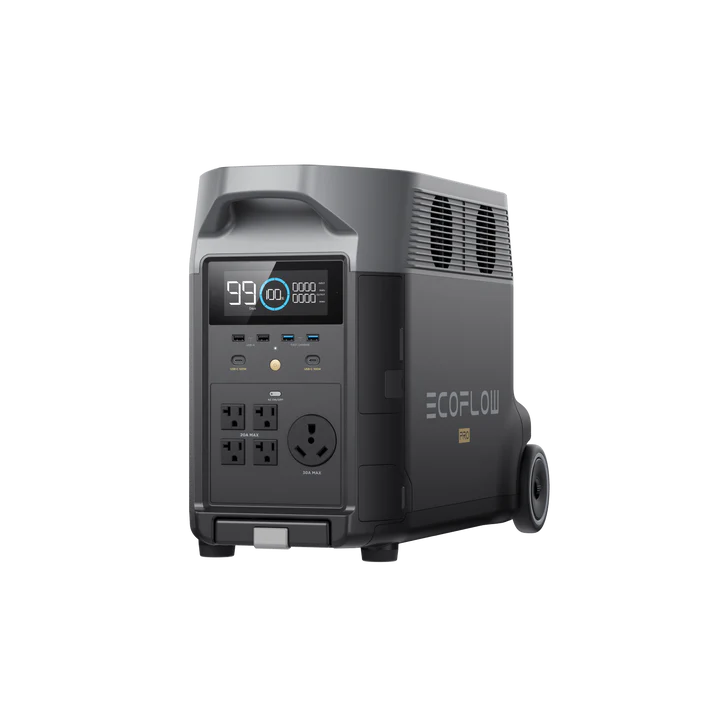
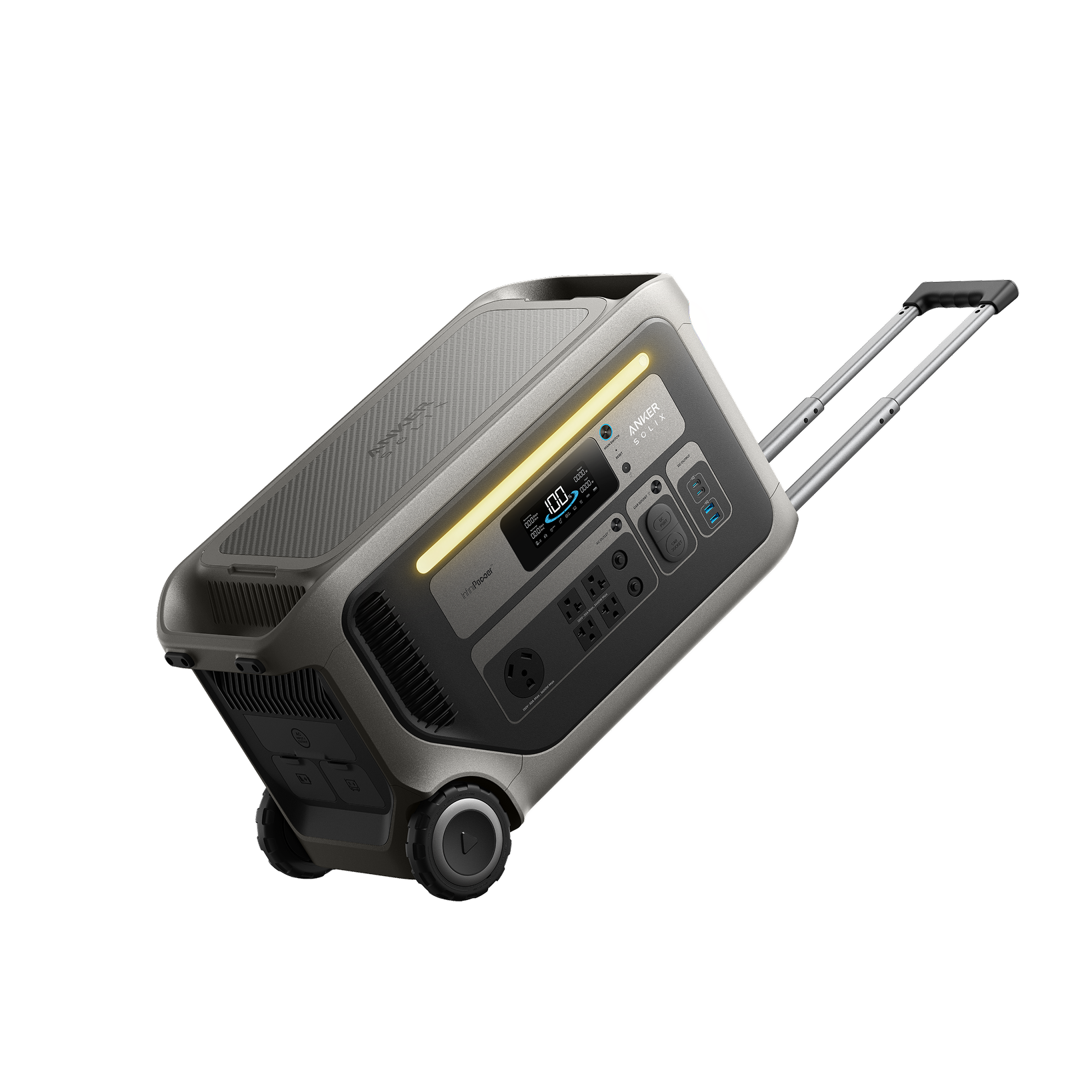
At a dollar apart, the DELTA Pro gives you 528Wh more battery and a longevity number the F3000 won't print — but it does it at 99 pounds and a rated 60dB of fan whine under load, so the real question is whether this box lives in a basement (buy the Pro) or your living room (buy the quieter Anker).
Full profiles: EcoFlow DELTA Pro → · Anker SOLIX F3000 →

Written by Gunner GustafsonUpdated
Whole-Home Backup Tester, Station Arena Test Desk
Spec deltas
Price barely enters into this one: the EcoFlow DELTA Pro is $1,399 and the Anker SOLIX F3000 is $1,399.99, a dollar apart. What that dollar buys is two different boxes. The DELTA Pro holds 3,600Wh to the F3000's 3,072 — 528Wh more — and posts the higher PowerScore, 5,483 to 4,899.
It also weighs 99 pounds to the Anker's 88, and it's the loud one. EcoFlow rates the DELTA Pro at 60dB, and under heavy load that shows up as a high-pitched fan whine reviewers hear across a quiet roomA4. The F3000 is eleven pounds lighter, and while Anker doesn't publish a noise figure, independent testers found it near-silent even working hardB5. So the extra capacity arrives with extra weight and real fan noise.
The DELTA Pro is the pick if this is a basement or garage backup box, where 528Wh of extra capacity and a rated 3,500-cycle life — $0.11 per lifetime kilowatt-hour, a number the F3000 doesn't publish — matter more than a fan you're not sitting beside. Make it a living-room or bedroom unit and it flips: the F3000's quiet and its eleven fewer pounds win the room. Same price, two answers, and where the box lives decides which one.
What the Numbers Reveal
Each conclusion stated first — the numbers behind it on one line, the full analysis below.
Capacity
The F3000 gives up that 528Wh and can't even post a cost-to-own, because its cycle rating is blank, so at a dollar's difference the Pro is the more capable and more accountable box on the two specs that touch your wallet.
DELTA Pro holds 3,600Wh; F3000 holds 3,072WhDELTA Pro is $1,399; F3000 is $1,399.99DELTA Pro is rated 3,500 cycles ($0.11 per lifetime kWh); Anker publishes no cycle life for the F3000
Why it mattersA capacity-first home-backup buyer who can house the Pro should take it — same price, more battery, a longevity number on record.
Two feet from a desk or a bed, a 60dB whine is the difference between a backup you forget and one you resent — so the moment the unit shares your space, the Pro's advantage inverts into a liability and the lighter, quieter F3000 is the one you actually want running.
DELTA Pro is rated 60dB with a fan whine under heavy loadA4F3000 was near-silent in testing even under loadB5DELTA Pro weighs 99 lbs; F3000 weighs 88 lbs
Why it mattersAnyone keeping the box in a living space should take the F3000, and trade the 528Wh for silence without much regret.
solar input
So the Anker isn't only the quiet, lighter one — it's the better off-grid grower, feeding 800 more watts of sun into an expandable system, which for a solar buyer offsets the Pro's raw capacity lead.
F3000 accepts 2,400W of solar; DELTA Pro accepts 1,600WBoth units take expansion batteriesThe F3000 is the lighter of the two at 88 lbs
Why it mattersOff-grid solar buyers should lean F3000; grid-tied home-backup buyers who value capacity should lean Pro.
The specific dimensions that decide these two units — everything else is a tie.
PowerScore Breakdown
Selected because: 5,483 vs 4,899 captures the DELTA Pro's capacity and longevity edge (3,600Wh, provable 3,500 cycles) at the same price — the core of the verdict.
overall power score
Our PowerScore gives the DELTA Pro 5,483 to the F3000's 4,899, and at a dollar's price difference the reasons are worth naming. The Pro carries 3,600Wh to the Anker's 3,072 — 528Wh more usable battery — and it's rated 3,500 cycles, which is what lets it post $0.11 per lifetime kilowatt-hour. The F3000 leaves that cost-to-own blank, because Anker doesn't publish a cycle count.
So for the same money you're choosing between a bigger battery with a documented lifespan and a smaller one whose longevity is unstated. On the numbers alone, that's the Pro's round. What the composite doesn't weigh is how much noise and weight ride along with those numbers, which is where the rest of this page comes in.
What the Specs Don't Tell You
Selected because: Noise is the decisive gotcha here — DELTA Pro 60dB under load — plus UPS speed and the F3000's undisclosed noise. The honest-catch section.
rated cycles
Here's the one thing to settle before buying the DELTA Pro: under heavy load, it's audible. EcoFlow rates it at 60dB, and that rating shows up in the field as a high-pitched fan whine reviewers notice across a quiet room, though it calms down at lighter loadsA4. In a garage that's a non-issue. In a bedroom it's the reason you'd return it.
The F3000 is the mirror image — no published noise number at all, yet testers found it near-silent even working hardB5. So the disclosed spec is the worse spec here: the Pro tells you it's loud, the Anker won't say and turns out quiet. On switchover both are quick enough for household backup, the Pro's 20 milliseconds edging the F3000's 25, neither a true zero-gap online UPS. If the unit shares your living space, noise is the gotcha that should decide this, and it points at the Anker.
Portability & Form Factor
Selected because: 99 vs 88 lbs — the Pro is the heaviest in the batch, and the F3000 is the lighter lift.
weight
At 99 pounds the DELTA Pro is the heaviest unit in this comparison, eleven pounds up on the F3000's 88. Both roll on wheels with a telescoping handle, and both need them — but the Pro's wheels want flat, smooth ground, and reviewers reach for a cart on anything unevenA2.
The F3000 is no featherweight either; its own tester said it barely passed a manual liftB8. But eleven pounds is eleven pounds, and if the box moves — between floors, out to a truck, across a yard — the Anker is the smaller ask. If it lives in one spot and never budges, this section barely matters and the Pro's other edges take over.
Growth Path
Selected because: The F3000's clear win: 2,400W solar vs 1,600W, both expandable — its off-grid case.
solar input
This is the F3000's section. It accepts 2,400W of solar to the DELTA Pro's 1,600W — 800 watts more sun — and both units take expansion batteries, so on the growth axis the Anker leads where it counts most: input. For an off-grid system that recharges from panels rather than a wall, more solar in is the spec that keeps a big bank actually full.
The Pro isn't shut out — it expands too, and its larger 3,600Wh base means you start with more before you add anything. But if the plan is a serious panel array, the F3000's higher input ceiling is the more future-proof foundation, and it's the clearest reason a solar-first buyer would take the Anker over the bigger, louder Pro.
Brand Trust
Selected because: Cross-brand: EcoFlow's proven DELTA Pro home-backup platform and a recall vs Anker's parent-brand trust and sliding SOLIX support.
The DELTA Pro is EcoFlow's proven home-backup workhorse — long treated as a gold standard for running household essentials through outages, with a deep expansion ecosystem behind itA1A3. The asterisks are an October 2025 recall of a different model over overheating and a support record that varies by customer, so a retailer with a solid return window is worth seeking out.
Anker leans on the trust it built in charging accessories and prices the SOLIX line to compete. The worry is direction: SOLIX-specific support seems to be slipping from Anker's once-excellent standard, firmware has removed features without warning, and the F3000 is new enough that its long-haul record is still forming. Established platform versus newer contender, in short.
Strengths & trade-offs
EcoFlow DELTA Pro
Strengths
- +Larger battery capacity
Trade-offs
- –Very heavy unit that may be difficult for one person to lift.
- –Can receive complaints about fan noise under heavy load.
Anker SOLIX F3000
Strengths
- +Costs $399 less
- +Lighter by 7.5 lb
- +Faster solar charging
Trade-offs
- –Very heavy unit that may be difficult for one person to lift.
Will It Power Your Gear?
Scenario math and per-appliance runtimes, modeled from the spec record.
Scenario verdicts
We ran the math on six real-world scenarios. Here's which unit survives your actual life.
SCN-01 · 2 nights · needs 2,100Wh
Weekend Camping
Two nights off-grid with essential comfort
DELTA Pro
The DELTA Pro takes the weekend on capacity: a 2,100Wh trip leaves it at 69% used against the F3000's 80%, so it comes home with more in reserve. The cost of that margin is hauling 99 pounds and a 60dB fan to the site. If the campsite is a short roll from the car, the Pro's headroom wins; if you're carrying it any distance, the lighter, quieter Anker is the friendlier trip.
Battery budget usedlower = more headroom
LOAD Phone Charger 15W×6h · LED Lights 40W×8h · Box Fan 75W×14h · CPAP Machine 40W×16h
SCN-02 · 8 hours · needs 1,645Wh
8-Hour Blackout
Keep the essentials running through a night without power
Either unit
Both survive the blackout with similar margin, and both list a UPS mode — compare their stated switchover classes, and remember those are manufacturer ratings, not measurements.
Battery budget usedlower = more headroom
LOAD Fridge 150W×8h · Router + Modem 20W×8h · LED Lights (4 bulbs) 40W×6h · Phone Charger 15W×3h
SCN-03 · 8 hours · needs 320Wh
CPAP Overnight
Sleep therapy without interruption — the #1 medical use case
Either unit
A CPAP is about 40W for eight hours, so both of these cover the night several times over — capacity isn't the question here. What would separate them is fan noise, but SOLIX F3000 doesn't publish a figure, so there's nothing to hold it to. Buy on price, weight, and whether you can live with a fan you haven't heard.
Battery budget usedlower = more headroom
LOAD CPAP Machine 40W×8h
SCN-04 · 8 hours · needs 910Wh
Remote Workday
Full work day off-grid without power anxiety
Either unit
Both power your workstation all day without strain, and their USB-C output is a wash — pick on weight, ports, or price.
Battery budget usedlower = more headroom
LOAD Laptop 60W×8h · External Monitor 30W×8h · Router + Modem 20W×8h · Phone Charger 15W×2h
SCN-05 · 4 hours · needs 670Wh
Tailgate Party
Game day power for the crew
Either unit
Both handle game day easily. Since capacity isn't the deciding factor, weight is: at 91.5 lbs the SOLIX F3000 is the one you'll be glad you brought. Fan noise under load is worth a listen too — it's audible in the lulls between songs.
Battery budget usedlower = more headroom
LOAD Blender 400W×0.5h · LED TV (55") 80W×4h · Bluetooth Speaker 15W×4h · Phone Charger (×3) 45W×2h
SCN-06 · 24 hours · needs 4,685Wh
Van Life Daily
A full day of mobile living — the ultimate endurance test
Neither unit
A 4,685Wh day outruns both — the DELTA Pro reaches about 153% of the need, the F3000 179%, so even the bigger battery falls short on its own. Both expand, so if this is your everyday draw, plan on a second battery from the start or step up to a system built for whole-day autonomy.
Battery budget usedlower = more headroom
LOAD Mini-Fridge 150W×24h · Laptop 60W×4h · Phone Charger 15W×3h · LED Lights 40W×5h · Fan 75W×8h
The Load Test
RUNTIME = (Wh × 0.85) ÷ LOAD
None of the scenarios above exactly yours? Build it. Toggle what you'd plug in; both units are tested against the combined draw.
Essentials
Comfort & Convenience
High-Draw Appliances
Test duration
8h
Continuous draw
205W
Projected runtime
For this load: DELTA Pro runs 14.9h vs 12.7h.
$1,899 list · direct from EcoFlow
Planning for more than this? Describe your whole setup and get it sized →
Modeled from the spec record — same math as the tables below. Methodology
Runtime by appliance
Real-world runtime estimates for common appliances, modeled at 85% inverter efficiency.¹
Essentials
The basics you need runningscale 0–204hComfort & Convenience
Makes off-grid life actually enjoyablescale 0–40.8hHigh-Draw Appliances
These reveal the real limitsscale 0–3.1h¹ Runtime = (capacity × 0.85) ÷ appliance watts. Within each group, all bars share one time scale (the group's longest runtime), so lengths are comparable across appliances; identical runtimes collapse into a single blue/orange bar. Actual runtime varies with battery age, temperature, and simultaneous loads — see methodology.
Conclusion
July 18, 2026
Verdict: the EcoFlow DELTA Pro
The prices are a dollar apart — $1,399 for the EcoFlow DELTA Pro, $1,399.99 for the Anker F3000 — so this is decided on what each does, not what it costs. The DELTA Pro holds 3,600Wh to the F3000's 3,072 (528Wh more), posts a higher PowerScore (5,483 vs 4,899), and is rated 3,500 cycles, which works out to $0.11 per lifetime kilowatt-hour — a figure the F3000 can't match because Anker publishes no cycle life. That's the case for the Pro as a home-backup box. The honest catch is real: the DELTA Pro is 99 pounds and rated 60dB, with an audible fan whine under heavy load, while the F3000 is eleven pounds lighter, quieter in testingB5, and feeds 800 more watts of solar. So the Pro wins for a basement or garage where noise doesn't reach you; the moment the unit shares your living space or heads off-grid, the F3000 is the better answer.
Today the DELTA Pro is $1,799, $100 under its typical $1,899. The verdict weighs typical prices, not today's. Prices checked 16 days ago.
Editor-assigned confidence, based on cited owner research and spec analysis.
List prices as of July 18, 2026. The links below open EcoFlow's and Anker's current prices.
$1,799.00 · direct from EcoFlow
down from $1,899 · 5% below usual
Last checked 16 days ago. Prices move — check before you buy.
Written by Gunner Gustafson, Whole-Home Backup Tester · Station Arena Test Desk · Updated July 18, 2026
Black Friday · 38 days out
Price to beat:DELTA Pro $1,599
The lowest we have recorded. A Black Friday price above it is a sale this unit has already had.
Measured Data
Benchmark scores and the full spec record, side by side.
Benchmark scores
Full specifications
ᵈ Derived: price ÷ rated capacity. See the data behind our comparisons →
Comparison ToolAdd more power stations, side by sideOpen Tool →How these numbers are produced
Numeric verification
Every figure on this page traces to our spec database or arithmetic on it — no estimated numbers.
Owner claims
Statements about owner experience are cited to published reviews — see Sources & Research Notes below.
Runtime model
Runtime = (rated capacity × 0.85 inverter efficiency) ÷ device wattage. Solar recharge estimates assume panels deliver 70% of rated output. Cold weather, battery age, and stacked loads reduce real-world results.
Power Score
Computed from 14 published spec dimensions, weighted per use-case bench. Higher is better; a unit must meet a bench's minimum threshold to be rated.
See the full weight table and data sourcing on our methodology page →Class ranking (the star rating)
Each unit's star score is a category ranking, not customer reviews — no buyer opinions feed it. We score every station on size-independent quality (value, output, portability, endurance, ports, warranty, and more), then percentile-rank it against the other units in its capacity class, so a class-leading compact unit and a class-leading whole-home unit can both earn 5★. Here, DELTA Pro rates 3.7/5 (26th percentile of 20 Home Backup-class units), and SOLIX F3000 rates 4.8/5 (88th percentile of 26 Large-class units).
How the class ranking is computed →Test Notes & Caveats
Hidden gotchas and advantages we spotted that you won't find on the product page.
Weight Reality Check
Neither unit is grab-and-go. The SOLIX F3000 (91.5 lbs) is manageable solo but heavier than a large checked suitcase. The DELTA Pro (99 lbs) is noticeably heavier. That's an 8 lb difference.
The one thing to know about the Pro
Before anything else: under heavy load the DELTA Pro is loud. EcoFlow rates it at 60 decibels, and that rating lands as a high-pitched fan whine that carries in a quiet room, easing off only at lighter loads. In a garage it's fine. In a bedroom it's the spec that sends the unit back. If the Pro is going to share your living space, this is the reason to pause — and the reason the quieter F3000 is even in this conversation.
Warranty: No Difference
Both units carry the same 5-year warranty, so coverage isn't a tiebreaker here. Worth saying because the per-dollar framing can suggest otherwise: the SOLIX F3000 works out at 3.3 years of cover per $1,000 spent against the DELTA Pro's 2.6, but that spread is the price gap, not the terms.
The blank spec is the better one here
There's an irony worth flagging: the DELTA Pro publishes its noise number and it's a loud one, while the F3000 publishes nothing and turns out quiet. So the disclosed figure is the worse figure. Don't read the F3000's blank as a warning in this matchup — everything about its behavior in the class points quiet. Read it as Anker skipping a number that would have helped its case, not hidden a problem.
Full record above — the Test Desk pick is the DELTA Pro.
Check DELTA Pro price →or check the SOLIX F3000 priceOwnership Analysis
What happens after you buy — true cost of ownership, brand trust, and growth potential.
Lifetime value
Service lifeyears at one full cycle per day
Lifetime energy delivered
Cost per delivered kWh
│ warranty ends · Reaching the cycle rating means ~80% capacity remains — degraded, not dead.
Analyst note
Both units have similar long-term ownership costs ($0.15/kWh vs $0.12/kWh). The price difference is what you see on the sticker — neither is a hidden bargain or rip-off. One caution on the lifespan row: the SOLIX F3000 takes longer to reach its cycle rating, but a cycle moves a different amount of energy on each unit — the DELTA Pro still delivers more over its shorter horizon (12,600 vs 12,288 kWh). Years measure wear, not usefulness.
Brand trust
EcoFlow
Ecosystem
The DELTA Pro anchors EcoFlow's home-backup line — a long-proven platform with one of the deepest expansion ecosystems in the category and the fastest charging in class.
Support
US-based but uneven by account, so buying from a retailer with a strong return window takes the risk off a heavy, hard-to-ship unit.
Community
Largest community in the space — Reddit r/Ecoflow_community (~31K members), multiple Facebook groups, and an official community forum
App experience
Rated 4.6/5 iOS (~8,400 ratings) · 4.2/5 Android (~17,000 ratings)
Unique strength
Fastest-charging technology (X-Stream), deepest product ecosystem, and most active innovation cadence. At the top of the range sit two whole-home paths: the TITAN line, one 5 kWh unit that grows to 30 kWh, and the DELTA Pro Ultra platform, which stacks batteries and inverters further — flagship paths, not line-wide features.
Worth knowing
An October 2025 recall of a separate model over overheating is on the record, and out-of-warranty service is limited.
Anker
Ecosystem
7-8 SOLIX portable power stations across C-series (compact) and F-series (flagship), plus the X1 home energy system
Support
US-based support. Historically known for incredible no-hassle replacements, but recent reports describe AI-driven support agents giving generic responses and complex return logistics for heavy units (hazmat shipping). The Anker brand reputation is still strong, but SOLIX-specific support quality is trending down.
Community
Moderate — active Reddit (r/Anker, r/AnkerSOLIXCommunity) and growing. Benefits from Anker's massive consumer electronics brand awareness.
App experience
Rated 4.5/5 iOS (~1,100 ratings) · 4.3/5 Android
Unique strength
Anker's charging-brand trust, InfiniPower cells, and pricing set to compete with the established players.
Worth knowing
SOLIX support looks to be sliding from its once-excellent level, firmware has removed features without warning, and as a newer SKU the F3000's long-term record is still thin.
Analyst note
EcoFlow brings the proven, bigger-battery home-backup platform, at the cost of weight and a genuinely loud fan; Anker brings a quieter, lighter, higher-solar box whose longevity it won't yet put a number on. Buy the Pro for a stationary backup, the F3000 for a living space or an off-grid array.
Growth path
DELTA Pro
EXPANDABLESupports EcoFlow expansion batteries, so you can add capacity later without replacing the base unit — useful if your needs may climb past 3,600Wh.
Accepts up to 1,600W of solar. Enough for a serious multi-panel array.
Generous port selection supports complex multi-device setups.
Expansion batteries are EcoFlow-specific. You're investing in the EcoFlow ecosystem.
SOLIX F3000
EXPANDABLESupports Anker expansion batteries, so you can add capacity later without replacing the base unit — useful if your needs may climb past 3,072Wh.
Accepts up to 2,400W of solar. Enough for a serious multi-panel array.
Limited ports. You'll likely need a power strip or splitter.
Expansion batteries are Anker-specific. You're investing in the Anker ecosystem.
Realistic full solar rechargeat 70% of rated panel output — see methodology
Analyst note
Both expand, but the SOLIX F3000's higher solar ceiling (2,400W vs 1,600W) gives it the stronger off-grid growth path — more panels can feed a bigger bank as it grows.
What Owners Report
Patterns from published owner reports and long-term reviews — every claim cited to its source below.
EcoFlow DELTA Pro
A sourcing note first: much of the available coverage blurs the original DELTA Pro with the newer, heavier Pro 3, so treat these as platform-level traits rather than serial-exact measurements. What's consistent is the role — reviewers describe the DELTA Pro as a gold-standard home-backup unit, built for high-draw appliances and full battery expansion, the kind of box that carries a fridge, lights, and a space heater through an outageA1. Owners report leaning on it across months of overnight outages, with LFP cells rated for thousands of cycles and a decade-plus of serviceA3.
Two honest debits recur. It's heavy and its wheels want flat ground — a cart comes out for anything unevenA2. And it isn't quiet under load: past heavy draws the fans emit a high-pitched whine that carries in a still room, though it settles at lighter loadsA4. None of that surprises anyone who buys it as a stationary backup, but it's exactly what a living-room buyer needs to hear first.
“Long regarded as a gold standard for home backup — designed for high-draw appliances and full-scale battery expansion, running home essentials like a fridge, lighting, and a space heater through outages.”
Sources
backuppowerhub.com · us.ecoflow.co · outdoorgearlab.com · bobvila.com · powerstationadvisor.com · robbsutton.com
Anker SOLIX F3000
Quiet is the word that follows the F3000 around. Reviewers called it practically silent even under heavy load, a clear step up from the fan noise that dogged earlier Anker unitsB5, and its idle draw sits under Anker's own 25-watt rating, so it can wait in standby for daysB4. It charges fast too — roughly two hours from the wall, about one on the TT-30 cableB3.
The limits testers hit are specific rather than general. It shuts itself off if you run an air fryer and a microwave together, so heavy loads need staggeringB2, and it couldn't charge a Cybertruck because that outlet isn't groundedB10. The four AC outlets sit close enough that a fat adapter blocks its neighborsB6, and the new twist-lock plug barely fits under the unitB7. It's a 2025 release carrying tester coverage, not yet years of owner reports — worth remembering next to the Pro's longer track record.
“Nothing feels cheap or loose — the handle doesn't wiggle and the wheels roll smoothly; the reviewer could lift it alone without straining after taking it to a family picnic two hours away.”
Sources
androidauthority.com · thesolarlab.com · cleantechnica.com
Sources & Research Notes
Every owner claim in this report is traceable to a published source. The bracketed references above resolve here.
Recurring owner themes
- Established home-backup platform with wheeled portability and massive expandability; the consistent knock is fan noise under heavy load. [DELTA Pro · 3 entries]
- Low idle draw and quiet operation are repeatedly cited as the biggest improvements over earlier Anker SOLIX models (F3800/F2600), which reviewers said struggled on both fronts. [SOLIX F3000 · 2 entries]
- Wheels and a deployable handle make the ~90 lb unit manageable to move, but reviewers still describe manually lifting it as a real effort. [SOLIX F3000 · 2 entries]
- Reviewers hit real-world output limits the spec sheet doesn't convey — simultaneous heavy appliance loads and ungrounded high-draw EV charging both triggered shutoffs/failures. [SOLIX F3000 · 2 entries]
- The outlet layout and the switch to a proprietary twist-lock AC charging plug are the most consistent physical-design complaints. [SOLIX F3000 · 2 entries]
- A1
“Long regarded as a gold standard for home backup — designed for high-draw appliances and full-scale battery expansion, running home essentials like a fridge, lighting, and a space heater through outages.”
backuppowerhub.com / us.ecoflow.com — EcoFlow DELTA Pro review · 2025-2026 · [positive]
- A2
“Heavy but wheeled — integrated wheels and a telescoping handle help move its considerable weight, though they work best on flat, smooth surfaces; a cart is needed for uneven ground.”
outdoorgearlab.com / bobvila.com — DELTA Pro-line review · 2025-2026 · [mixed]
- A3
“Reliable through extended outage use — served as primary backup across multiple overnight outages over months, powering essentials simultaneously; LFP battery rated for thousands of cycles and 10+ years of daily use.”
powerstationadvisor.com / robbsutton.com — DELTA Pro-line review · 2025-2026 · [positive]
- A4
“Not silent under heavy load — under 2000W-plus draws the fans emit a noticeable high-pitched whine that's distracting in a quiet room, though it runs quietly enough at lighter loads.”
outdoorgearlab.com — DELTA Pro-line noise testing · 2025-2026 · [negative]
- B2
“The battery will often turn itself off if you try to run an air fryer and a microwave at the same time, so simultaneous heavy loads need to be staggered rather than run together.”
androidauthority.com — Anker SOLIX F3000 review · 2025-08 · [mixed]
- B3
“Standard AC input charges 0-100% in about 2 hours; using the TT-30 cable cuts a full charge to about 1 hour.”
androidauthority.com — Anker SOLIX F3000 review · 2025-08 · [positive]
- B4
“Measured idle draw was 20.5W with only the inverter active — beating Anker's own 25W spec — so it can sit in standby for days without chewing through the battery.”
thesolarlab.com — Anker F3000 Review: Does It Finally Get It Right? · 2025 (exact date unknown) · [positive]
- B5
“Practically silent even under heavy loads — a marked improvement over earlier Anker models that struggled with fan noise.”
thesolarlab.com — Anker F3000 Review: Does It Finally Get It Right? · 2025 (exact date unknown) · [positive]
- B6
“The four standard AC outlets are a bit too close together — plugging in larger adapters or chargers can block the others.”
thesolarlab.com — Anker F3000 Review: Does It Finally Get It Right? · 2025 (exact date unknown) · [negative]
- B7
“Anker switched to a proprietary twist-lock AC charging plug; positioned upright, the bulky plug barely fits underneath the unit.”
thesolarlab.com — Anker F3000 Review: Does It Finally Get It Right? · 2025 (exact date unknown) · [negative]
- B8
“At 92 lbs the built-in wheels and extendable handle make it more portable, but it 'barely passed' the reviewer's own manual-lift test.”
thesolarlab.com — Anker F3000 Review: Does It Finally Get It Right? · 2025 (exact date unknown) · [mixed]
- B10
“Charging a Cybertruck from the F3000 was not successful because the outlet isn't grounded — a real-world limitation the spec sheet doesn't flag.”
cleantechnica.com — Anker SOLIX F3000 Portable Power Station: CleanTechnica Tested · 2025-08 · [negative]
Research compiled July 18, 2026.
What Owners Actually Report
Drawn from 171 comments on independent review channels — not from retailer reviews, which skew to the first week of ownership. Each line is our summary of one commenter's claim, linked to the original. We record what they said, including where it contradicts the spec sheet.
EcoFlow DELTA Pro
211 claims from 147 comments · 155 from owners · 39 with figures
- Price & value
- 37 · 26% negative
- Durability
- 22 · 73% negative
- Solar input
- 23 · 35% negative
- Runtime
- 18 · 23% negative
- Other
- 18 · 48% negative
What owners complain about
Bought October 2023, died June 2024.
Durabilitymeasuredownerafter 8 months25 agreedsource →
The 100 lb weight of the DELTA Pro is no joke.
Size & weightmeasuredowner14 agreedsource →
Even the 767's loudest fan state is far quieter than the DELTA Pro.
Noiseowner41 agreedsource →
What owners praise
Charges two DELTA Pros from two ~2,500W strings running at about 125V.
Solar inputmeasuredowner13 agreedsource →
Electric bill fell from $250 a month to between $26 and $44.
Price & valuemeasuredowner14 agreedsource →
Delta Pro with battery and 800W of solar keeps him fully off grid and happy.
Runtimeownerafter 8 months62 agreedsource →
Anker SOLIX F3000
37 claims from 24 comments · 28 from owners · 8 with figures
- Runtime
- 4 · 0% negative
- Solar input
- 7 · 0% negative
- Other
- 6 · 14% negative
- Price & value
- 4 · 74% negative
- Build quality
- 4 · 0% negative
What owners complain about
Bought near $2000 at launch in a panel bundle; price has since fallen to about $1200.
Price & valuemeasuredowner115 agreedsource →
Bidirectional adapter caps output at 15A on one phase, effectively halving the F3000.
Inverter & surgemeasuredowner10 agreedsource →
On grid loss the bidirectional adapter shuts down, so backup is not automatic.
UPS switchoverowner10 agreedsource →
What owners praise
One F3000 on an inlet switch ran everything but 240V loads for 5 days on one tank of generator gas.
Runtimemeasuredowner122 agreedsource →
F3000 has been great with a 3600W inverter and 1600W solar input.
Solar inputowner7 agreedsource →
Replaced the AC200L with an F3000 for its 30A in and 30A out capability.
Otherowner5 agreedsource →
Claims are weighted by how specific they are, whether the commenter owns the unit, and how many readers agreed. Comments that mention a product under a rival's review count for more, because the commenter had no reason to be there. This is what buyers report, not our test results — for measurements we ran ourselves, see the methodology.
Who Should Buy Which
Buy the DELTA Pro if you…
- →The basement or garage backup buyer: 528Wh more capacity, and a 60dB fan you're not sitting next to.
- →The capacity-per-dollar shopper: a bigger 3,600Wh battery at the same price as the F3000.
- →The proven-platform buyer: a home-backup workhorse owners have run through months of outagesA1A3.
- →The longest-runtime household: more usable battery before either unit needs expanding.
If neither fits
If your real target is a 4,685Wh van-life day, even the bigger DELTA Pro only reaches about 153% of the need and the F3000 179% — both come up short alone. They each expand, so plan a second battery from the start, or move up to a dedicated whole-day system.
The Bottom Line
At a dollar apart, the DELTA Pro is the bigger battery with the longer paper trail: 528Wh more capacity and a rated 3,500-cycle life the F3000 doesn't publish. For a basement or garage backup box, that's the more capable buy, and the fan noise stays where you can't hear it.
But the Pro earns this by where it lives, not by a landslide. It's 99 pounds and rated 60dB, with a whine reviewers pick up under loadA4; the F3000 is eleven pounds lighter, quieter in every testB5, and feeds 800 more watts of solar. Put the unit in a living space or take it off-grid and the Anker is the right call. Same price — so let the room, and the panels, decide.
Frequently Asked Questions
Answers drawn from the spec record and cited owner research.
Which has more capacity, the DELTA Pro or the Anker F3000?
The DELTA Pro, at 3,600Wh to the F3000's 3,072 — 528Wh more — for essentially the same price ($1,399 vs $1,399.99). It also posts a higher PowerScore, 5,483 to 4,899. If raw capacity per dollar is what you're after, the Pro is the bigger battery at the same money.
Which is quieter?
The F3000, and it can be decisive. Anker doesn't publish a noise figure, but independent testers found it near-silent even under heavy load. The DELTA Pro is rated 60dB and reviewers describe a high-pitched fan whine under load. If the unit lives anywhere near where you sleep or work, that gap matters more than the Pro's extra capacity.
Which is cheaper to own over its life?
The DELTA Pro, on the numbers available. It's rated 3,500 cycles, which works out to $0.11 per lifetime kilowatt-hour. Anker publishes no cycle life for the F3000, so its cost-to-own can't be calculated. At a dollar's price difference, the Pro is the one with a longevity figure you can actually hold it to.
Which is better for solar and off-grid use?
The F3000. It accepts 2,400W of solar input to the DELTA Pro's 1,600W — 800 watts more — and both can add expansion batteries. If you recharge mainly from panels, the Anker's higher input ceiling keeps a growing bank topped up faster, which is the main reason a solar buyer would pick it over the larger Pro.
Which is easier to move around?
The F3000, at 88 pounds to the DELTA Pro's 99. Both roll on built-in wheels, but the Pro is the heaviest unit here and its wheels want flat ground — reviewers grab a cart for rough terrain. For a box that stays put, it's a wash; for one that travels, the Anker is the lighter haul.
Where to buy
EcoFlow DELTA ProPick
$1,799.00
$1,799.00 · direct from EcoFlow
down from $1,899 · 5% below usual
Last checked 16 days ago. Prices move — check before you buy.
Anker SOLIX F3000
Sold on Amazon · today’s price is on the listing
Prices may vary by retailer and are subject to change.