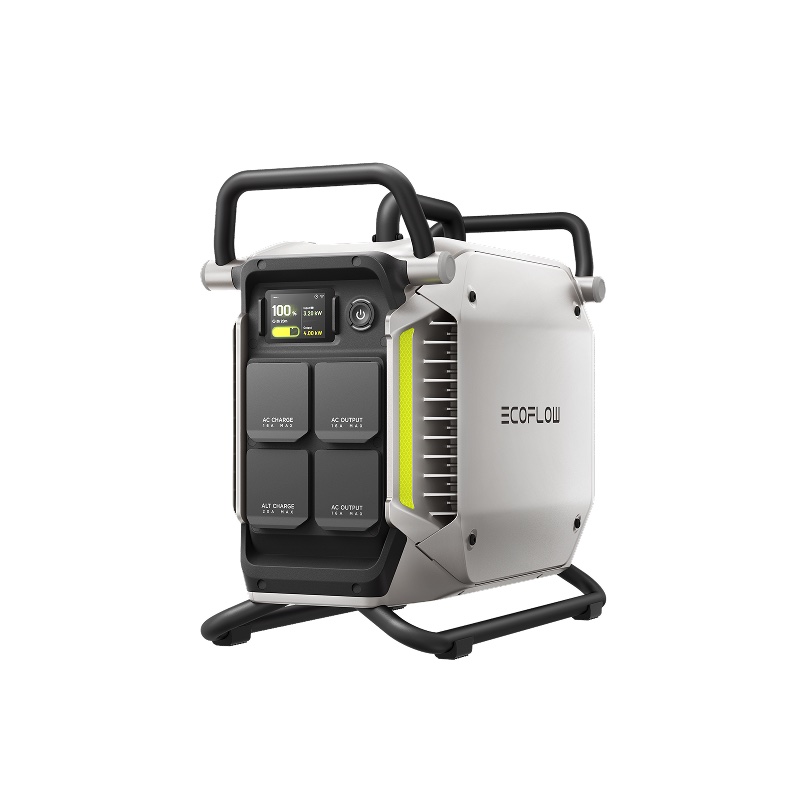
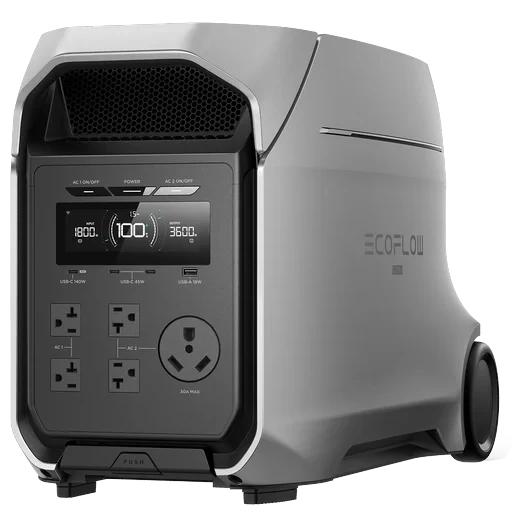
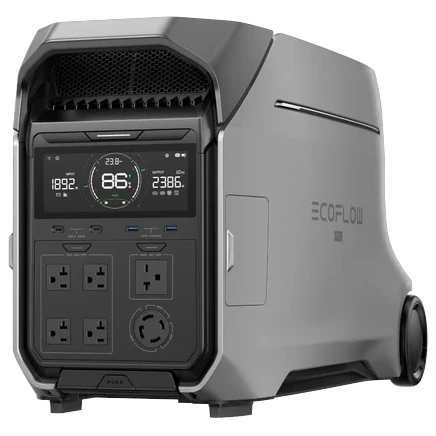
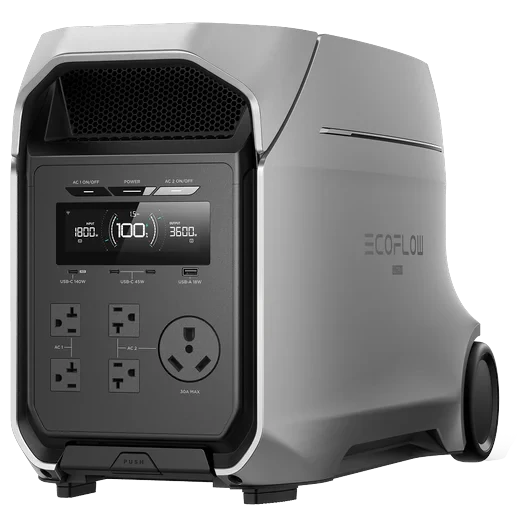
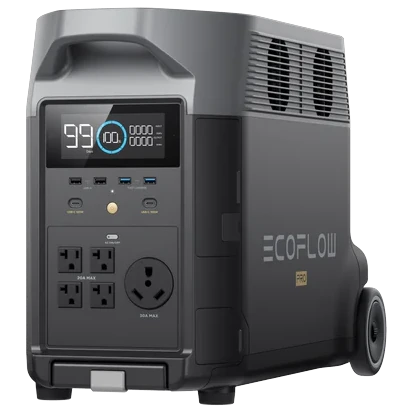
Start with the number EcoFlow already sells. 3,072 Wh is the DELTA 3 Ultra’s pack to the watt-hour, and that unit is on sale today with a 3,600 W inverter at 72.1 lb, and it charges from solar. So the PowerRock’s case cannot rest on capacity, and only barely on output — 4,000 W against 3,600 W. What the extra weight (83.8 lb against 72.1 lb) and the wait buy is everything around the pack: an all-metal IP65 housing in a roll cage with a 1 m drop claim, a 30 mA residual-current device that trips in under 300 ms, an alternator input, peaks rated in seconds rather than a single number, and a three-year warranty. Judge it on those lines, because the pack is not new.
The surge spec is the best thing on the sheet, and almost nobody has printed it. The press release stops at 7.2 kW; EcoFlow’s own spec page goes on: 7.2 kW for up to 100 s at 25 °C or 60 s at 35 °C, 9 kW for up to 10 s at 35 °C, 10 kW for 20 ms. A ladder with times and temperatures is what tells you whether a motor starts — a motor’s start is measured in seconds, not milliseconds, a welder’s run lasts the length of a rod, and a summer site is not 25 °C — and a single peak figure answers none of that. BLUETTI’s Pioneer 5000, announced the same day for the same buyer, prints 18 kW and no duration at all. The bigger number is not the better spec until BLUETTI says how long it is held; until then the PowerRock is the only one of the pair whose surge you can size a tool against.
Then the line most readers will fill in wrongly. The PowerRock does not charge from solar: EcoFlow says so in as many words, and the spec sheet has no PV row. It refills from 220–240 V mains at up to 16 A, from a vehicle alternator at 42–60 V DC and up to 20 A, or from a generator, and EcoFlow publishes a charge time only for mains. For a site that is a coherent choice — the pack is meant to be filled overnight in the yard or in the van between jobs, not from a panel leaning on a fence — but it is the opposite of what the category has trained buyers to expect, and it means a site with no mains, no vehicle and no generator has no way to top the unit up at all. If your work is remote, EcoFlow’s own DELTA 3 Ultra keeps this pack and adds the panel input.
EcoFlow’s stand wall gave two runtimes worth a minute’s arithmetic, which is ours. A breaker at 2,200 W for about 1 h 14 min draws roughly 2,700 Wh, about 88% of the 3,072 Wh pack — plausible for a tool held near flat out. A cut-off saw at 2,700 W for about 1 h 7 min would need about 3,000 Wh, 98% of the pack, which no inverter delivers; read that one as 54 cuts with the saw spinning down between them, not 2,700 W held for an hour. Our flat 85%-usable planning figure gives 1 h 11 min at a continuous 2,200 W and about 58 min at 2,700 W. The conditions behind EcoFlow’s two figures — ambient, tool, duty cycle — are not published, and neither figure appears anywhere but the stand.
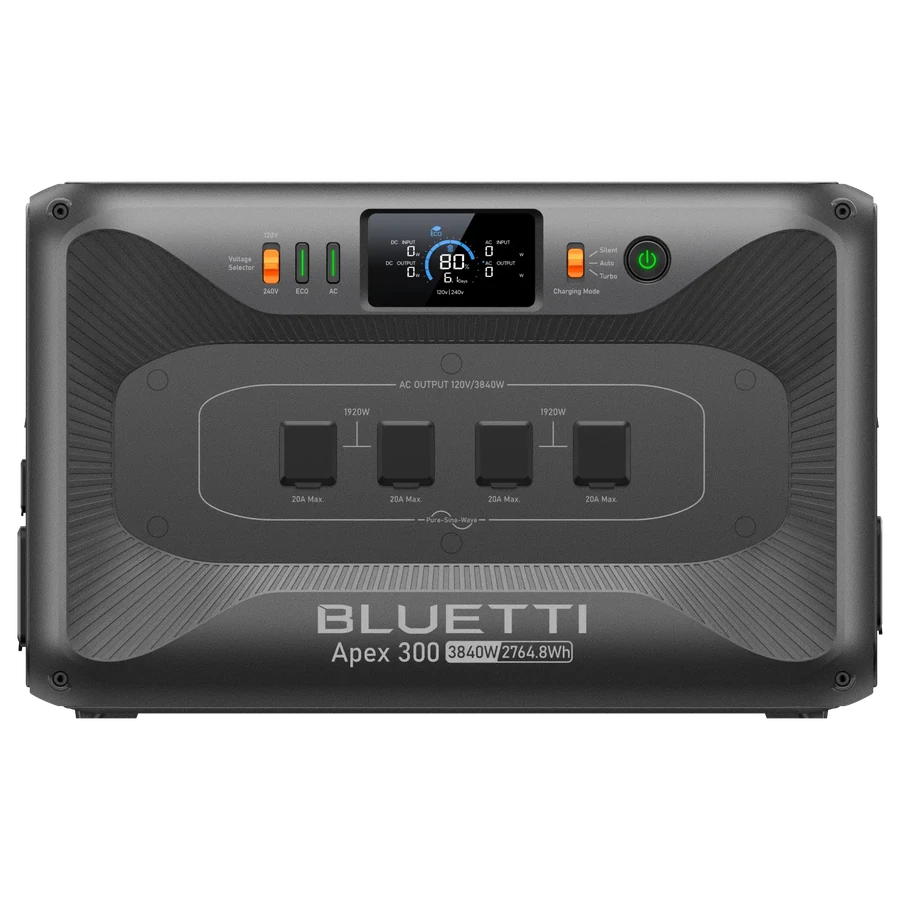
Wait or buy? If you are in one of the 26 launch countries and the job is indoor, below ground or noise-restricted — the site where a combustion generator is not allowed and an inspector will ask about residual-current protection — the PowerRock is built for exactly that, the RCD is aimed at exactly that inspector, and the sensible move is to register with EcoFlow’s enterprise channel and wait, because nothing about it can be priced yet. Everywhere else there is nothing to wait for: the UK is not on the list and no US launch has been announced. And if the problem is energy and output rather than sealing and compliance, the answer is already on the shelf — the DELTA 3 Ultra above, or BLUETTI’s Apex 300, which weighs what the PowerRock weighs, pushes 3,840 W and takes solar. Two things would change our read: a published price, and a socket panel that turns out to be CEE 16 A rather than domestic, which would make this site power rather than a very rugged power station.
The story behind the launch is that two makers opened the same category in one week. The Pioneer 5000 and the PowerRock 4000 were announced on the same day at the same show, for the same European contractor and rental yard, and they answer the brief differently. BLUETTI went bigger and wheeled: 5 kW, a 5.12 kWh pack, expansion, and a bare 18 kW peak. EcoFlow went sealed and carried: 4 kW, a 3,072 Wh pack, an RCD, and a peak spec written out in seconds. Neither has a price. The carry-on incumbent both are measured against, Instagrid’s ONE max, is 2.1 kWh, 3.6 kW and 20 kg with IP54 — so EcoFlow’s answer to it is more energy, a little more continuous power and a better ingress rating at 38 kg against 20 kg, and BLUETTI’s is to change the question with wheels. Which answer the yards prefer will turn on the two numbers nobody has published: the price, and the length of BLUETTI’s 18 kW.