Goal Zero Yeti Power Stations: Expert Reviews & Comparison 2026
Power. Anything. Anywhere.
Goal Zero empowers people with reliable, portable, and sustainable power solutions. Known for industrial-grade build quality and the 'Yeti' ecosystem.
Yeti Ecosystem
Goal Zero's Yeti ecosystem is built for expansion: Yeti Link lets you chain up to four 1.2kWh Tank batteries onto a compatible Lithium Yeti for an added 4.8kWh, and the Home Integration Kit — a 4-circuit manual transfer switch — wires a Yeti straight into your breaker panel for whole-circuit backup during an outage.
Vehicle Integration
Goal Zero's Yeti Link vehicle integration kit taps a vehicle's alternator to charge compatible Yeti units at up to 700W while you drive — real-world rates vary with your vehicle's alternator, but it's a popular setup among van-life and overlanding builders looking to reduce reliance on cloudy-day solar.
Humanitarian Roots
Goal Zero got its start supplying solar power to off-grid villages and disaster-relief efforts, and the company points to that field heritage as the inspiration for the Yeti line's rugged, industrial-style enclosures — the kind of durability story borne out by how often Yetis turn up in van-life and overlanding builds today.
Latest Goal Zero Gear
Future-Ready Energy. Discover the latest innovations.
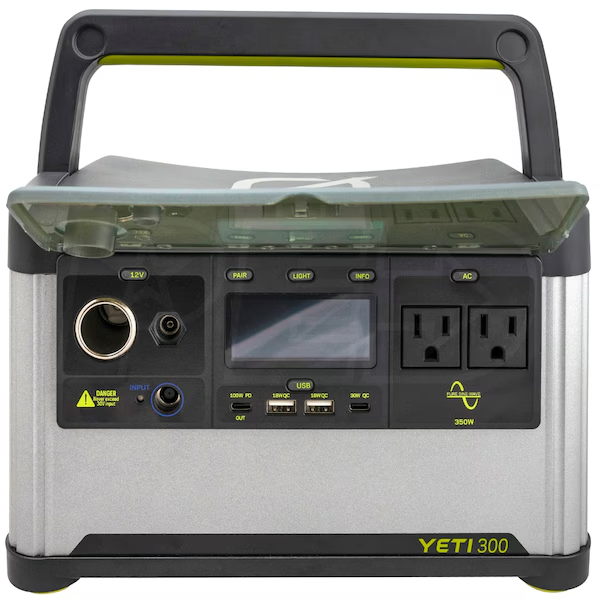
Yeti 300
Expert Take
"Ultimate portability. At 297Wh, it's perfect for keeping phones and cameras charged on the trail."
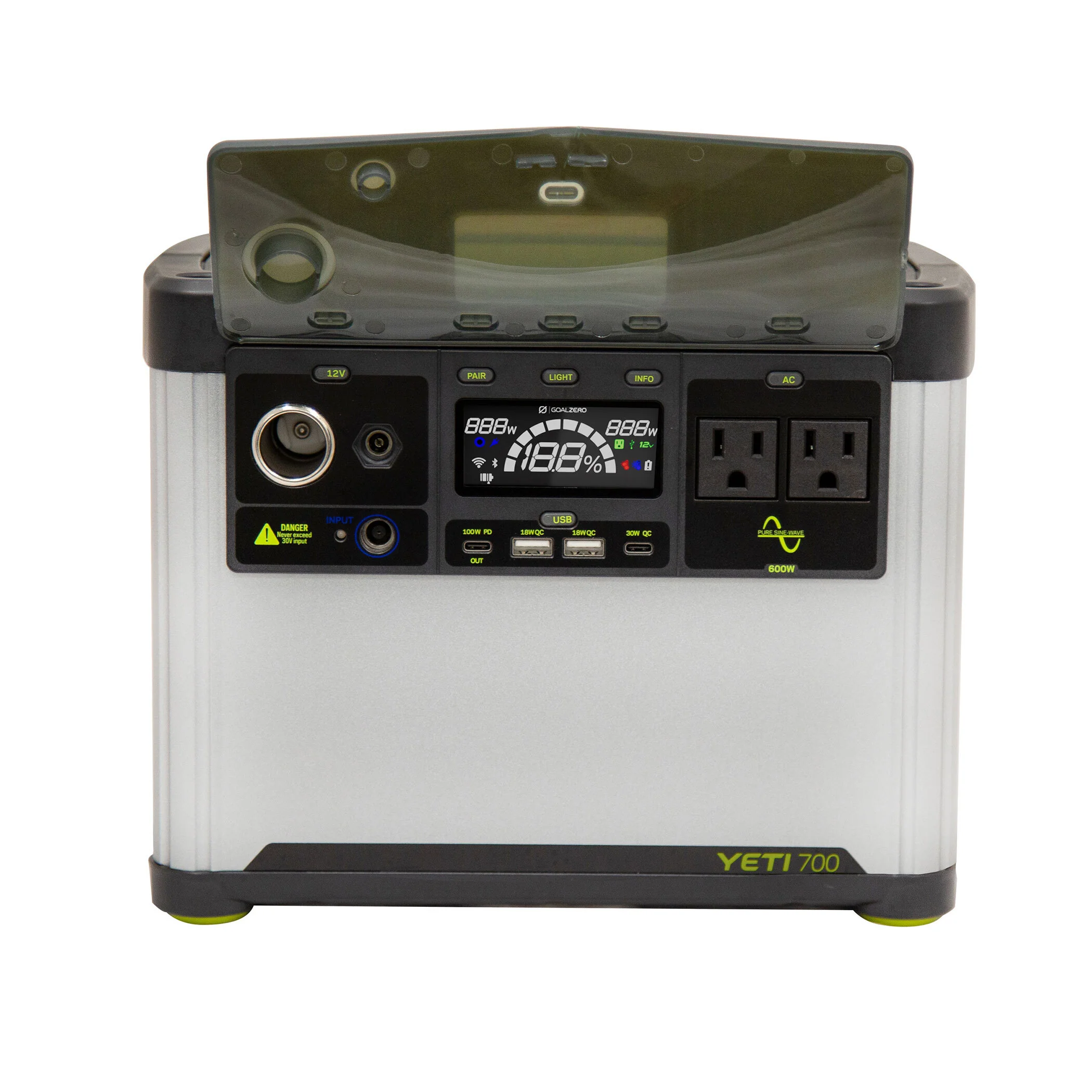
Yeti 700
Expert Take
"Ultimate portability. At 677Wh, it's perfect for keeping phones and cameras charged on the trail."
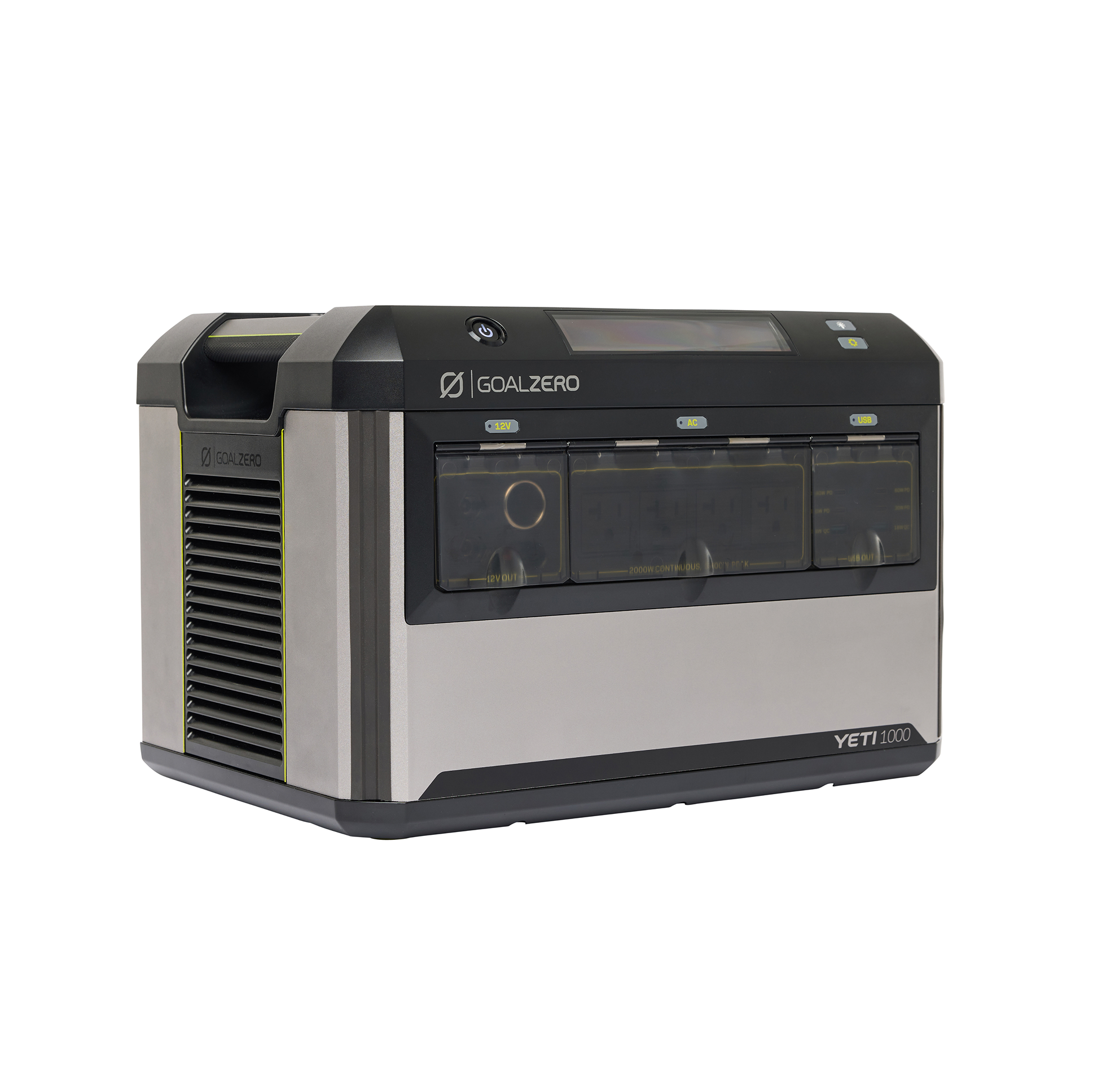
Yeti 1000 (6th Gen)
Expert Take
"The sweet spot for camping. 988Wh gives you plenty of juice without weighing you down."
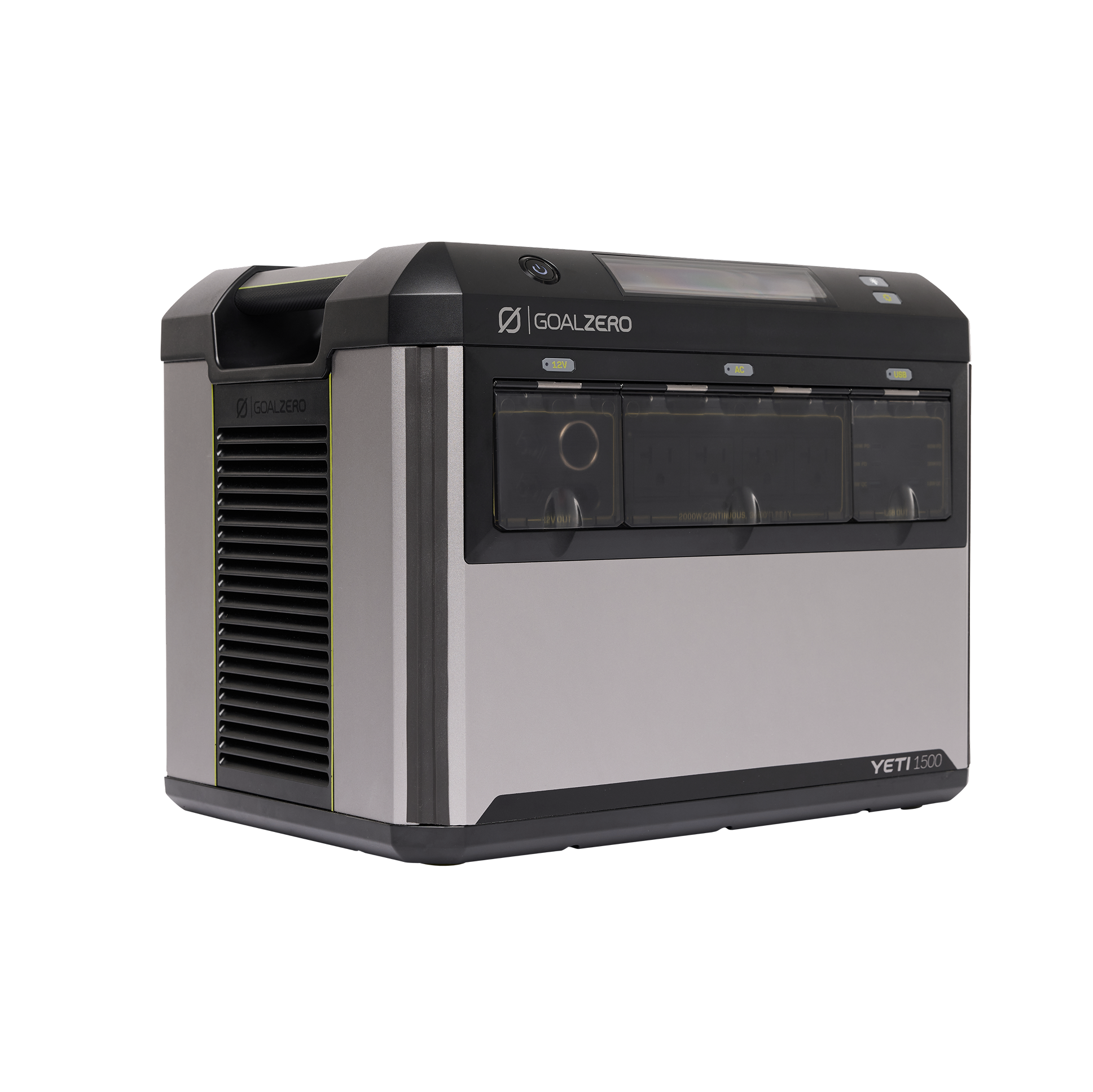
Yeti 1500 (6th Gen)
Expert Take
"The sweet spot for camping. 1505.28Wh gives you plenty of juice without weighing you down."
Transparency Matters
Power Station Arena is reader-supported. When you buy through links on our site, we may earn a commission. This supports our independent real world testing/reviews of usability and reliability at no cost to you.
The Arena: Goal Zero Model Comparison
- Yeti PRO 4000 + Tank PRO 4000 (Yeti PRO 8000)4000+ (LFP)7988 Wh$.753600W3000W
- Yeti PRO 40004000+ (LFP)3994 Wh$1.003600W3000W
- Yeti 6000X500 (NMC)6071 Wh$.662000W600W
- Yeti 3000X500 (NMC)3032 Wh$.992000W600W
| Compare | Model | Capacity (Wh) | $/Wh | Output (W) | Cycle Life | Solar Input |
|---|---|---|---|---|---|---|
| Yeti PRO 4000 + Tank PRO 4000 (Yeti PRO 8000) | 7988 Wh | $.75 | 3600W | 4000+ (LFP) | 3000W | |
| Yeti PRO 4000 | 3994 Wh | $1.00 | 3600W | 4000+ (LFP) | 3000W | |
| Yeti 6000X | 6071 Wh | $.66 | 2000W | 500 (NMC) | 600W | |
| Yeti 3000X | 3032 Wh | $.99 | 2000W | 500 (NMC) | 600W |
Not sure which Goal Zero line you want?
Picking the right line narrows the list far faster than comparing models one by one — it decides portability, expandability and how long the thing lasts before you ever look at a spec sheet.
Goal Zero line by line
Browse all series comparisons — every line-vs-line matchup we've written.
Competitive Landscape: The Big Four
| Brand | Relative Strength (The "Pro") | Consideration (The "Con") |
|---|---|---|
 | Relative strengthSpeed & Tech: Fastest charging (X-Stream) and best-in-class app ecosystem. | ConsiderationComplexity: The modular ecosystem can be overwhelming for casual users. |
 | Relative strengthSimplicity & Durability: Their "Explorer" series is famous for plug-and-play ease and rugged build quality. | ConsiderationCharging Speed: Generally slower AC recharge times compared to EcoFlow's X-Stream. |
 | Relative strengthValue & Stability: Often leads the market in "Price per Watt-Hour" and offers highly stable LFP builds. | ConsiderationThe App: While functional, the Bluetti app is often cited as less intuitive than EcoFlow’s. |
 | Relative strengthBuild Quality & Efficiency: Incredible industrial design and highly efficient inverters for long-term home backup. | ConsiderationFan Noise: Cooling fans are noticeable during fast charging or heavy loads, and top-tier units like the F3800 run heavier than modular rivals. |
Honest Considerations Before You Buy
No power station is perfect. Here are the trade-offs worth knowing about — each with the context that keeps it in perspective.
A Premium Price-per-Watt-Hour
Goal Zero rarely wins a straight-up cost comparison — flagship and mid-tier Yetis often land close to $1 per watt-hour, while value-focused rivals can undercut that by 30-40% at similar capacity.
Good to know
You're paying for one of the longest track records in the category, rugged industrial-grade construction, and genuinely fast solar and AC recharging on current-generation models — a fair premium if reliability and resale confidence matter more to you than the lowest sticker price.
Know Which Battery Chemistry You're Buying
Older Yeti X units (1000X, 1500X, 3000X, 6000X and similar) use NMC lithium-ion cells rated for roughly 500 cycles to 80% capacity — noticeably shorter-lived than the LiFePO4 packs now standard across the current lineup.
Good to know
Goal Zero has fully transitioned new production — the compact 300/500/700, the new Yeti 1500, and the flagship Yeti PRO 4000 — to LFP chemistry rated 4,000+ cycles (10+ years of daily use). Just confirm "LiFePO4"/LFP on the spec sheet if you're eyeing discounted older X-series stock.
The High-Capacity Models Are Genuinely Heavy
The flagship Yeti PRO 4000 weighs 116 lbs — reviewers consistently describe it as semi-portable, better suited to living in a van, garage, or fixed home-backup spot than being carried solo.
Good to know
Goal Zero ships it with a detachable wheeled cart to offset the weight, and the compact Yeti 300/500/700 line (13.7-21 lbs) stays genuinely grab-and-go if portability is your priority.
Warranty Coverage Still Varies Across the Lineup
Most of the Yeti catalog — including long-running favorites like the 1000X, 1500X, and 3000X — carries a standard 2-year warranty, shorter than the 5-year terms a few competitors now lead with.
Good to know
Coverage is trending up: the newest Yeti PRO 4000 and refreshed Yeti 1000 already ship with 5-year warranties, and Goal Zero holds a 4.2/5 "Great" rating on Trustpilot — a sign the shorter standard term hasn't been a major pain point in practice.
Frequently Asked Questions
How long does a Goal Zero Yeti last?
The new 'Yeti PRO 4000' and 'Yeti 500/700' (6th Gen) models use LiFePO4 batteries rated for 4,000+ cycles (10+ years). Older 'Yeti X' models use NCM batteries rated for 500 cycles. We recommend the newer LFP models for long-term home backup and van builds.
Can I use third-party solar panels with my Yeti?
Yes, but you'll likely need an adapter either way — that's true across the whole Yeti lineup, old and new. Legacy Yeti X models use an 8mm input, and current-generation Yetis (including the Yeti PRO 4000, on its HPP High Voltage Input) use Goal Zero's HPP (High Power Port) connector rather than native MC4. Goal Zero sells MC4-to-8mm and MC4-to-HPP adapter cables to bridge the gap, and they're often bundled into solar panel kits — just confirm one's included before you order panels separately.
What is the Goal Zero 'Home Integration Kit'?
It is a manual transfer switch that connects a Yeti power station directly to your home's breaker box. This allows you to back up up to 4 dedicated circuits (like lights, fridge, internet) during a blackout without running extension cords everywhere.
Is Goal Zero worth the premium price?
You are paying for the extensive ecosystem, US-based support, and industrial build quality. Goal Zero is the professional's choice for integrated home or vehicle systems where reliability is paramount. If you just need a simple battery for occasional camping, cheaper options exist, but for serious setups, the Yeti ecosystem is hard to beat.
Compare Goal Zero Against Rivals
Explore more brands and comparisons on our Home Page.