
DJI Power Stations: Reviews, Drone Charging & Comparison 2026
Power Your Creativity
DJI powers creativity with compact, high-performance energy solutions designed for the modern creator.
Drone-First Design
DJI's proprietary SDC ports fast-charge Mavic and Air drone batteries directly from the station instead of the separate AC charging hub — DJI's fast-charge cable is rated to take a Mavic 3 battery from 10% to 95% in about 30 minutes.
LFP Chemistry
DJI rates the LiFePO4 cells across the Power line for roughly 4,000 charge cycles while retaining over 70% of original capacity — durability in the same ballpark as other LFP power stations on the market.
Rapid Recharging
DJI's fast-charging mode is rated at up to 1200W, enough to take the Power 1000 from empty to full in about 70 minutes — a meaningful top-up on a lunch break rather than an overnight wait.
Latest DJI Gear
Future-Ready Energy. Discover the latest innovations.

Power 1000 V2
Expert Take
"A serious power station for serious creators. 1024Wh keeps your entire kit running all day."
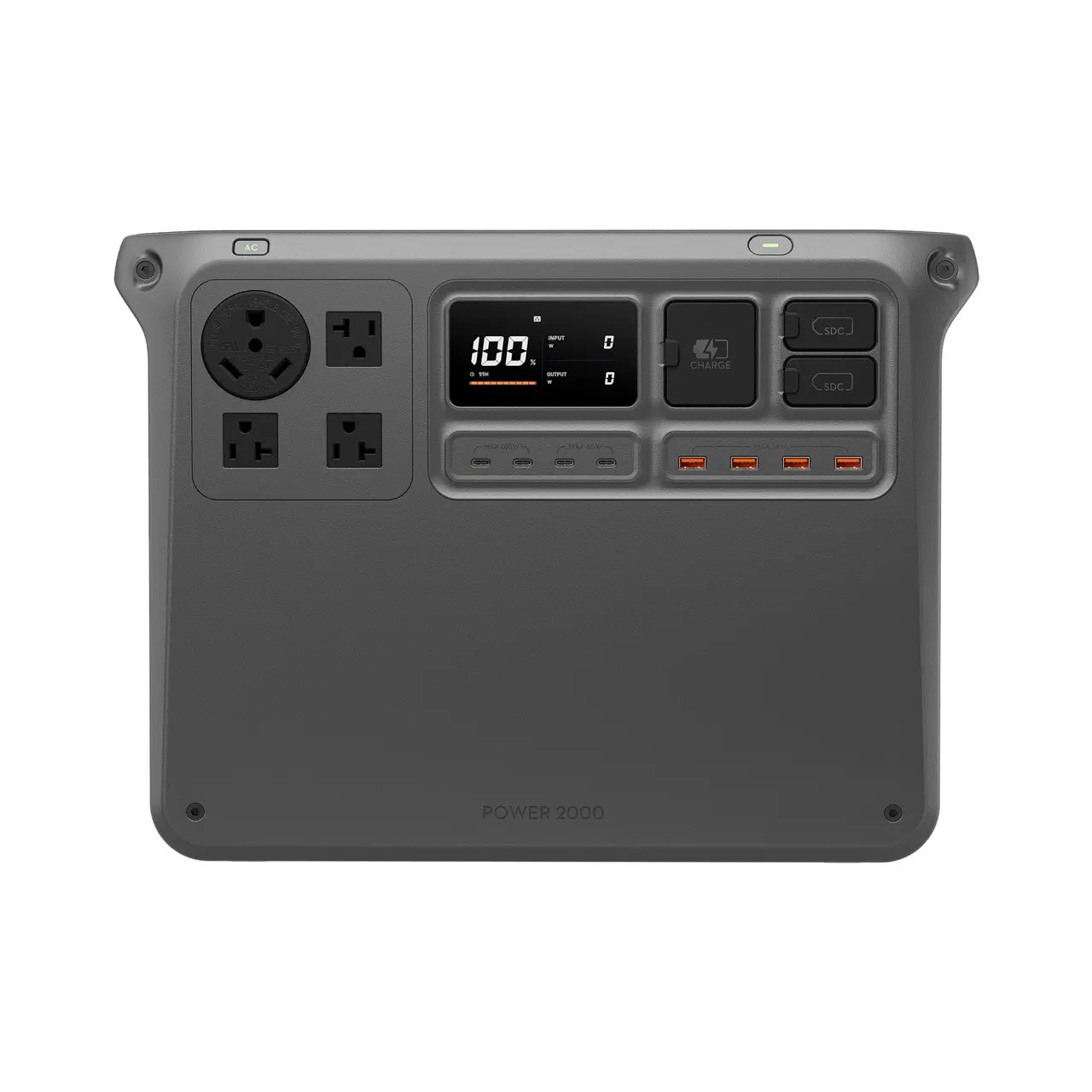
Power 2000
Expert Take
"A serious power station for serious creators. 2048Wh keeps your entire kit running all day."

Power 1000
Expert Take
"A serious power station for serious creators. 1024Wh keeps your entire kit running all day."
Transparency Matters
Power Station Arena is reader-supported. When you buy through links on our site, we may earn a commission. This supports our independent real world testing/reviews of usability and reliability at no cost to you.
The Arena: DJI Model Comparison
- Power 20004000 (LFP)2048 Wh$.633000W1800W
| Compare | Model | Capacity (Wh) | $/Wh | Output (W) | Cycle Life | Solar Input |
|---|---|---|---|---|---|---|
| Power 2000 | 2048 Wh | $.63 | 3000W | 4000 (LFP) | 1800W |
Competitive Landscape: The Big Four
| Brand | Relative Strength (The "Pro") | Consideration (The "Con") |
|---|---|---|
 | Relative strengthSpeed & Tech: Fastest charging (X-Stream) and best-in-class app ecosystem. | ConsiderationComplexity: The modular ecosystem can be overwhelming for casual users. |
 | Relative strengthSimplicity & Durability: Their "Explorer" series is famous for plug-and-play ease and rugged build quality. | ConsiderationCharging Speed: Generally slower AC recharge times compared to EcoFlow's X-Stream. |
 | Relative strengthValue & Stability: Often leads the market in "Price per Watt-Hour" and offers highly stable LFP builds. | ConsiderationThe App: While functional, the Bluetti app is often cited as less intuitive than EcoFlow’s. |
 | Relative strengthBuild Quality & Efficiency: Incredible industrial design and highly efficient inverters for long-term home backup. | ConsiderationFan Noise: Cooling fans are noticeable during fast charging or heavy loads, and top-tier units like the F3800 run heavier than modular rivals. |
Honest Considerations Before You Buy
No power station is perfect. Here are the trade-offs worth knowing about — each with the context that keeps it in perspective.
Newer to the Power Station Category
DJI only entered portable power stations in late 2023/2024 with the Power 500 and Power 1000, later adding the Power 2000 and 1000 V2 — a much shorter track record than rivals who've been refining designs for a decade or more.
Good to know
The Power line draws on engineering DJI already proved in its camera and drone batteries, and every model carries the same warranty structure — 3 years standard plus a 2-year extension on registration — that longer-tenured brands use to earn buyer trust.
Fewer Ports Than Some Rivals
The Power 500 and Power 1000 each have just two AC outlets and two SDC accessory ports, which reviewers have flagged as tight if you're running appliances, charging a drone battery, and using an expansion battery or solar input at the same time.
Good to know
Four USB ports — including a 140W USB-C output — pick up the slack for laptops, cameras, and drone batteries, and DJI doubled the AC outlet count to four on the newer Power 2000.
A Smaller US Retail & Accessory Footprint
DJI Power units sell mainly through DJI's own store, Amazon, and camera/drone specialty retailers rather than the big-box shelf space that Jackery, Anker, and EcoFlow have built out, and extras like the 12V car port and third-party solar input run through DJI's own proprietary adapters.
Good to know
DJI backs the Power line with the same global support network it runs for its camera and drone business, and an included MPPT/XT60 adapter still lets you run standard third-party solar panels — it just takes an extra adapter instead of a direct plug-in.
The Expansion Battery Isn't Clip-Locked
Hands-on reviewers pairing the Power 1000 with DJI's Expansion Battery 2000 note the units connect by cable with no screws or clips holding them together, so a stacked setup can feel a little wobbly.
Good to know
The connection is electrically solid and the pairing is officially supported by DJI — just set the stack on a shelf or flat surface rather than somewhere it's likely to get bumped.
Frequently Asked Questions
Can DJI Power stations charge my drone faster?
Yes. The DJI Power series features SDC (Smart DC) ports that can fast-charge select DJI drone batteries (like the Mavic 3 series, Air 3, and Inspire 3) significantly faster than standard chargers. Using the dedicated SDC-to-Drone cable, you can charge a Mavic 3 battery from 10% to 95% in roughly 30 minutes.
Is the DJI Power 1000 quiet?
Extremely. DJI has engineered these units to be whisper-quiet, often operating at noise levels as low as 23 dB during charging. This makes them ideal for video production sets or camping where silence is appreciated.
What battery chemistry does DJI use?
Both the DJI Power 1000 and Power 500 use Lithium Iron Phosphate (LiFePO4) battery cells. DJI rates these cells for 4,000 cycles while retaining over 70% of their original capacity, which works out to roughly a decade or more of typical daily use before you'd notice meaningful capacity loss.
Can I use third-party solar panels with DJI Power stations?
Yes. DJI offers an adapter module (MPPT) that allows you to connect universal solar panels via XT60 connectors. This gives you the flexibility to use existing solar setups, though DJI's own ZAP solar charging solution is optimized for the unit.
Does it support UPS mode?
Yes. The DJI Power 1000 supports UPS (Uninterruptible Power Supply) mode with a switchover time of 0.02 seconds. This is fast enough to keep most desktop computers and appliances running during a sudden blackout.
Compare DJI Against Rivals
Explore more brands and comparisons on our Home Page.