Head-to-head test
EcoFlow DELTA Pro vs BLUETTI Elite 10 Mini
Both units cap USB-C at 100W, which means the gap between $1,899 and $119 buys exactly one capability: the ability to run something with a plug on it.
Full profiles: EcoFlow DELTA Pro → · BLUETTI Elite 10 Mini →

Written by Ian SchneiderUpdated
Solar & Off-Grid Tester, Station Arena Test Desk
Spec deltas
A CPAP night takes 320Wh and the Elite 10 Mini holds 128Wh. It needs nearly three times its own capacity to reach morning, so it gets you about a third of the way there and then the mask goes quiet. The DELTA Pro covers that same night on 10% of its tank and doesn't notice it happened.
The DELTA Pro wins five of the six scenarios here and the Elite 10 Mini wins none, which is lopsided and mostly beside the point. The sixth, a full day of van life at 4,685Wh, beats both of them. Twenty-eight Elite 10 Minis at 128Wh each would just about equal the DELTA Pro's 3,600Wh, so these two were never really competing for the same buyer.
What makes this worth reading is the one spec they share. Both stop at 100W over USB-C. Charge a laptop off either and the cable can't tell which box it's plugged into, and the difference between $1,899 and $119 has bought you nothing on that cable. Everything that money buys sits downstream of the AC outlet: 3,600W continuous and 7,200W of surge against 200W and 300W. Whether you need that is the entire question, and it's a question about your appliances, not your budget.
What the Numbers Reveal
Each conclusion stated first — the numbers behind it on one line, the full analysis below.
continuous output
The DELTA Pro weighs 99 lbs against the Elite's 3.97, roughly twenty-five times the mass, so the money doesn't only buy AC capability. It buys the obligation to house and move that mass to get it. If nothing you own draws more than 200W, you are spending $1,780 and hauling 99 pounds for a capability you will never reach, and your laptop charges at identical speed either way.
Both units cap USB-C output at 100WDELTA Pro: $1,899. Elite 10 Mini: $119DELTA Pro: 3,600W continuous and 7,200W surge. Elite 10 Mini: 200W and 300WDELTA Pro: 99 lbs. Elite 10 Mini: 3.97 lbs
Why it mattersIf your honest load list is gadgets, buy the Elite 10 Mini and stop reading.
Only near-daily use turns that number into money, and near-daily use empties the cycle count in 9.6 years. Meanwhile the warranty runs 5 years, pricing warranted ownership at $320 a year against the Elite's $40. So the per-kWh win is real and almost nobody collects it. Cost per lifetime kWh rewards a repeating load: a house that loses power often, a van that lives on the battery, a job site. A big battery that mostly sits is an expensive battery that mostly sits.
DELTA Pro: $0.13 per lifetime kWh. Elite 10 Mini: $0.313,500 cycles across 3,600Wh comes to 12,600 kWh of lifetime energySpending those cycles takes 33.7 years at weekend use, or 9.6 years of daily cyclingDELTA Pro warranty: 5 years, or $320 per warranted year. Elite 10 Mini: 3 years, or $40
Why it mattersBuy the DELTA Pro because you have a load that repeats, not because its per-kWh math looks good on paper.
The DELTA Pro's surge is exactly double its continuous rating, which is the kind of margin a compressor needs. That reframes the Elite's 200W AC outlet honestly. It's a laptop brick with a wall socket on the face, not a small generator. Put one motor or one heating element on your list and the Elite is out at any price, which means price stops being an argument you get to make.
Elite 10 Mini: 200W continuous with 300W surge, so 100W of headroomDELTA Pro: 3,600W continuous with 7,200W surge, exactly doubleTailgate Party needs 670Wh, and the Elite 10 Mini can't bring the peak load up at all
Why it mattersIf you're shopping specifically for the AC outlet, a fridge or a kettle or a power tool, treat the Elite's $119 as irrelevant rather than tempting.
Capacity
Capacity buys all of that back. The Elite's 128Wh holds a modem through a flicker and charges a laptop once or twiceB3, but an 8-hour outage wants about fifteen times its capacity, so it covers roughly the first half hour and quits. The DELTA Pro does that whole outage on 54% of a tank. The inversion is real and narrow: the Elite is the better bridge, the DELTA Pro is the better outage, and those are two purchases people keep confusing for one.
Elite 10 Mini: 10ms switchover, rated 45 dBA, full charge in about 70 minutesB2DELTA Pro: 20ms switchover, rated 60 dBAElite 10 Mini: 128Wh. DELTA Pro: 3,600WhAn 8-hour blackout at 1,645Wh is 54% of the DELTA Pro and about fifteen times the Elite's capacity
Why it mattersIf what you actually want is something that keeps the modem alive through brownouts without a fan waking you, that's the Elite's job and it does it better than the big unit.
The specific dimensions that decide these two units — everything else is a tie.
Your Life, Your Pick
Selected because: Five of the six scenarios go to the DELTA Pro, the Elite 10 Mini clears none of them, and the sixth beats both, which is where a 3,600Wh pack and a 128Wh pack stop being comparable.
Five of six go to the DELTA Pro and the sixth goes to nobody. A day of van life wants 4,685Wh: the DELTA Pro lands at 153% of its capacity and the Elite 10 Mini at 4,306%, which is the difference between falling about a third short and not being in the conversation. Only one of them can be sent after the remainder, since the DELTA Pro accepts expansion batteries and the Elite is sealed at 128Wh.
The gentler scenarios are where the DELTA Pro's size stops looking like overkill. Eight hours of blackout costs it 54% of a tank, a remote workday 30%, a CPAP night 10%. Sit with that last one: about ten CPAP nights on a single charge, refilled in a bit over two hours of strong sun once you account for 3,600Wh going in at 1,600W. Multi-day outages are the job this unit was built for, and they're the only job that makes 99 pounds forgivable.
Portability & Form Factor
Selected because: Ninety-nine pounds against 3.97 is the Elite 10 Mini's entire case, and for plenty of buyers it's the winning one.
weight
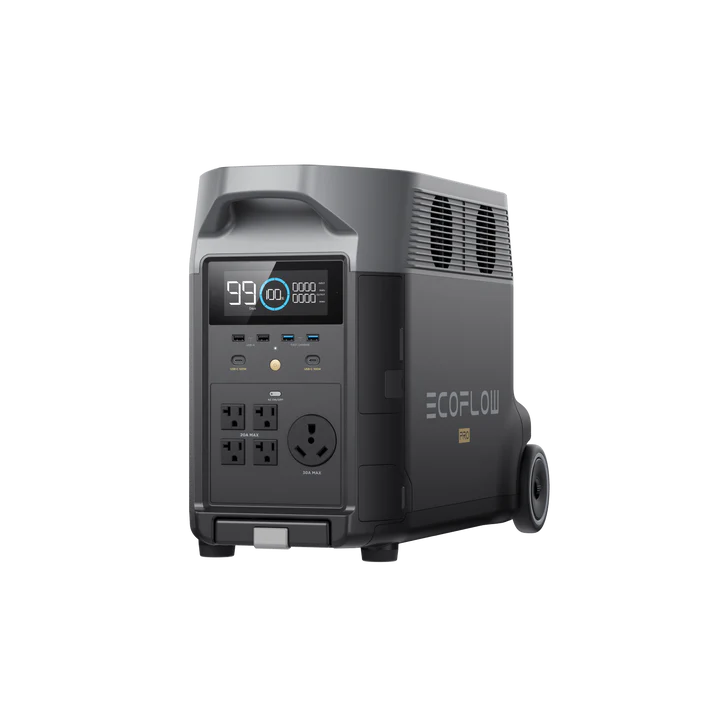
Ninety-nine pounds sets a hard ceiling on the word portable. The DELTA Pro line has integrated wheels and a telescoping handle, which owners report work well on flat, smooth ground and want a cart the moment the surface gets roughA2. It goes from the garage to the driveway. It does not go up a trail, and it does not go down basement stairs in one trip.
The Elite 10 Mini rides in a daypack pocket at 3.97 lbs, about a twenty-fifth of that mass, which is the whole reason it exists as a palm-sized travel companionB4. Weight isn't the tiebreaker between these two. It's the fork in the road: one of them is furniture you occasionally roll, and the other you forget is in the bag until someone needs an outlet.
Lifetime Value
Selected because: Thirteen cents per lifetime kWh against thirty-one looks decisive until you notice it takes 3,500 cycles to collect.
cost / lifetime kWh
Thirteen cents per lifetime kilowatt-hour against thirty-one is the DELTA Pro's strongest number and its most misleading one, because collecting it means spending all 3,500 cycles and all 12,600 kWh they represent. The Elite 10 Mini's 384 kWh of lifetime energy is small in the same proportion its price is small, and per warranted year it costs $40 against the DELTA Pro's $320.
Run the ownership math the way people actually own things and it flips by use case rather than by unit. A house that loses power regularly and a van that cycles nightly both collect the thirteen cents. A camper who takes it out on weekends is buying 33.7 years of cycle life and will own the box for a small fraction of that. Cheap per kilowatt-hour is only cheap if you buy the kilowatt-hours.
What the Specs Don't Tell You
Selected because: The $119 unit switches over in 10ms and the $1,899 unit takes 20, which is the kind of inversion a price tag hides.
rated cycles
The card worth reading twice goes against the expensive unit. The Elite switches over in 10ms and the DELTA Pro takes 20, which puts the $119 box in the line-interactive column and the $1,899 box in standby. That's not a scandal, it's a useful reminder that the price tag doesn't win every line on the sheet.
The rest of the stack is the size gap wearing different hats. 99 lbs and 60 dBA are what a 3,600W inverter charges you in mass and fan noise; 45 dBA and 3.97 lbs are what a 200W one hands back. The surge card is the one that decides purchases. 7,200W of headroom starts appliances, 300W charges things, and no price advantage moves a unit from the second list to the first.
Strengths & trade-offs
EcoFlow DELTA Pro
Strengths
- +Larger battery capacity
- +Higher AC output
- +Longer warranty
- +Faster solar charging
Trade-offs
- –Substantially more expensive (+$1,780) than the Elite 10 Mini.
- –Significantly heavier (+95 lbs), making it harder to move.
- –Very heavy unit that may be difficult for one person to lift.
- –Can receive complaints about fan noise under heavy load.
BLUETTI Elite 10 Mini
Strengths
- +Costs $1,780 less
- +Lighter by 95 lb
Trade-offs
- –Weaker inverter (-3,400W) limits appliance compatibility.
- –Sealed capacity — the DELTA Pro can add batteries to grow past 128Wh; this one can't.
Will It Power Your Gear?
Scenario math and per-appliance runtimes, modeled from the spec record.
Scenario verdicts
We ran the math on seven real-world scenarios. Here's which unit survives your actual life.
SCN-01 · 2 nights · needs 2,100Wh
Weekend Camping
Two nights off-grid with essential comfort
DELTA Pro
The Elite 10 Mini doesn't finish — 109Wh usable against the 2,100Wh this needs leaves it 1,991Wh short, about 5% of the scenario covered. The DELTA Pro covers it with 960Wh to spare.
Battery budget usedlower = more headroom
LOAD Phone Charger 15W×6h · LED Lights 40W×8h · Box Fan 75W×14h · CPAP Machine 40W×16h
SCN-02 · 8 hours · needs 1,645Wh
8-Hour Blackout
Keep the essentials running through a night without power
DELTA Pro
1,645Wh over eight hours puts the DELTA Pro at 54% of a tank, so one charge covers nearly two outages of that length, and 1,600W of solar input refills its 3,600Wh in a bit over two hours of strong sun. The Elite 10 Mini would need about fifteen times its 128Wh. It covers roughly the first half hour, which is long enough to shut a desktop down properly and nowhere near a night.
Battery budget usedlower = more headroom
LOAD Fridge 150W×8h · Router + Modem 20W×8h · LED Lights (4 bulbs) 40W×6h · Phone Charger 15W×3h
SCN-03 · 8 hours · needs 320Wh
CPAP Overnight
Sleep therapy without interruption — the #1 medical use case
DELTA Pro
The DELTA Pro takes this one without noticing: a 320Wh night is 10% of its capacity, roughly ten nights on a single charge. The Elite 10 Mini needs almost three times its own 128Wh for the same night, so it starts the machine fine and runs out somewhere in the small hours. For anything medical the margin is the point, and only one of these has any.
Battery budget usedlower = more headroom
LOAD CPAP Machine 40W×8h
SCN-04 · 8 hours · needs 910Wh
Remote Workday
Full work day off-grid without power anxiety
DELTA Pro
The Elite 10 Mini doesn't finish — 109Wh usable against the 910Wh this needs leaves it 801Wh short, about 12% of the scenario covered. The DELTA Pro covers it with 2,150Wh to spare.
Battery budget usedlower = more headroom
LOAD Laptop 60W×8h · External Monitor 30W×8h · Router + Modem 20W×8h · Phone Charger 15W×2h
SCN-05 · 4 hours · needs 670Wh
Tailgate Party
Game day power for the crew
DELTA Pro
The DELTA Pro handles a 670Wh tailgate on 22% of a tank. The Elite 10 Mini fails this one twice over: it would need 616% of its capacity for the energy, and with 200W continuous and 300W of surge it can't bring the peak load up at all. Griddles and blenders are exactly the appliances that 100W of surge headroom can't start.
Battery budget usedlower = more headroom
LOAD Blender 400W×0.5h · LED TV (55") 80W×4h · Bluetooth Speaker 15W×4h · Phone Charger (×3) 45W×2h
SCN-06 · 24 hours · needs 4,685Wh
Van Life Daily
A full day of mobile living — the ultimate endurance test
Neither unit
Nobody wins this. A full day of van life wants 4,685Wh, which is 153% of the DELTA Pro and 4,306% of the Elite 10 Mini, so the honest answer is that the DELTA Pro falls about a third short and the Elite isn't in the conversation. What separates them is what happens next: the DELTA Pro accepts expansion batteries and can be grown until it covers the day, while the Elite is sealed at 128Wh. If van life is the plan, budget the expansion at purchase instead of discovering the gap on the road.
Battery budget usedlower = more headroom
LOAD Mini-Fridge 150W×24h · Laptop 60W×4h · Phone Charger 15W×3h · LED Lights 40W×5h · Fan 75W×8h
SCN-07 · an afternoon · needs 100Wh
Afternoon Off-Grid
Phones and a speaker at the park, beach, or campsite — the small-unit job description
Either unit
This row is here for the Elite 10 Mini's class of job: phones and a speaker, 100Wh across an afternoon. Both cover it — the Elite 10 Mini finishes at 92% used, and the DELTA Pro barely notices it. For this job the DELTA Pro's extra capacity is dead weight, not headroom; at 4 lbs the Elite 10 Mini is the one you'll be glad you brought.
Battery budget usedlower = more headroom
LOAD Phone Charger (×2) 30W×2h · Bluetooth Speaker 10W×4h
The Load Test
RUNTIME = (Wh × 0.85) ÷ LOAD
None of the scenarios above exactly yours? Build it. Toggle what you'd plug in; both units are tested against the combined draw.
Essentials
Comfort & Convenience
High-Draw Appliances
Test duration
8h
Continuous draw
205W
Projected runtime
Only the DELTA Pro can start this 205W load.
$1,899 list · direct from EcoFlow
Planning for more than this? Describe your whole setup and get it sized →
Modeled from the spec record — same math as the tables below. Methodology
Runtime by appliance
Real-world runtime estimates for common appliances, modeled at 85% inverter efficiency.¹
Essentials
The basics you need runningscale 0–204hComfort & Convenience
Makes off-grid life actually enjoyablescale 0–40.8hHigh-Draw Appliances
These reveal the real limitsscale 0–3.1h¹ Runtime = (capacity × 0.85) ÷ appliance watts. Within each group, all bars share one time scale (the group's longest runtime), so lengths are comparable across appliances; identical runtimes collapse into a single blue/orange bar. Actual runtime varies with battery age, temperature, and simultaneous loads — see methodology.
Conclusion
August 1, 2026
Verdict: the DELTA Pro, on Power Score margin
Take the DELTA Pro if something in your life has a compressor in it. It clears five of the six scenarios on this page and the Elite 10 Mini clears none, and the important ones aren't close: an 8-hour blackout costs the DELTA Pro 54% of a tank, a CPAP night costs it 10%. But the Elite isn't losing this on quality. It's a 128Wh box against a 3,600Wh box, and at the USB-C port both stop at exactly 100W. If the honest list of what you need to power is a laptop, a phone and a lamp, the Elite does that for $119 and just under four pounds, one to two laptop charges and ten to twelve phones per fillB3, and the $1,780 you'd add to reach $1,899 buys 99 pounds of headroom you will never touch. Buy the DELTA Pro because you have appliances. Not because it beat a phone charger.
Today the DELTA Pro is $1,799, $100 under its typical $1,899. The verdict weighs typical prices, not today's. Prices checked 16 days ago.
Editor-assigned confidence, based on cited owner research and spec analysis.
List prices as of August 1, 2026. The links below open EcoFlow's and BLUETTI's current prices.
$1,799.00 · direct from EcoFlow
down from $1,899 · 5% below usual
Last checked 16 days ago. Prices move — check before you buy.
or check the Elite 10 Mini price$119.00 list
Written by Ian Schneider, Solar & Off-Grid Tester · Station Arena Test Desk · Updated August 1, 2026
Black Friday · 38 days out
Prices to beat:DELTA Pro $1,599Elite 10 Mini $113
The lowest we have recorded for each. A Black Friday price above it is a sale that unit has already had.
Measured Data
Benchmark scores and the full spec record, side by side.
Benchmark scores
Not rated for both units (minimum threshold unmet): RV Living, Home Backup, Solar Generator, Food Truck, Apartment Balcony.
Full specifications
ᵈ Derived: price ÷ rated capacity. See the data behind our comparisons →
Comparison ToolAdd more power stations, side by sideOpen Tool →How these numbers are produced
Numeric verification
Every figure on this page traces to our spec database or arithmetic on it — no estimated numbers.
Owner claims
Statements about owner experience are cited to published reviews — see Sources & Research Notes below.
Runtime model
Runtime = (rated capacity × 0.85 inverter efficiency) ÷ device wattage. Solar recharge estimates assume panels deliver 70% of rated output. Cold weather, battery age, and stacked loads reduce real-world results.
Power Score
Computed from 14 published spec dimensions, weighted per use-case bench. Higher is better; a unit must meet a bench's minimum threshold to be rated.
See the full weight table and data sourcing on our methodology page →Class ranking (the star rating)
Each unit's star score is a category ranking, not customer reviews — no buyer opinions feed it. We score every station on size-independent quality (value, output, portability, endurance, ports, warranty, and more), then percentile-rank it against the other units in its capacity class, so a class-leading compact unit and a class-leading whole-home unit can both earn 5★. Here, DELTA Pro rates 3.7/5 (26th percentile of 20 Home Backup-class units), and Elite 10 Mini rates 4.2/5 (52nd percentile of 24 Personal-class units).
How the class ranking is computed →Test Notes & Caveats
Hidden gotchas and advantages we spotted that you won't find on the product page.
99 lbs vs 3.97: The Fork in the Road
Ninety-nine pounds is a get-a-second-person lift, and once it's placed it tends to stay placed. The Elite 10 Mini is 3.97 lbs, about a twenty-fifth of that, and vanishes into a daypack pocket. Weight here isn't a tiebreaker, it's a definition. One of these lives in the garage and comes out when the power does; the other you forget you're carrying until someone needs an outlet.
Fan Noise: Two Published Ratings
The Elite 10 Mini is rated 45dB (like a running refrigerator), the DELTA Pro 60dB (like a normal conversation). Neither is a measurement on a shared bench — they are two makers' figures, each measured its own way, so a low number and a high one can describe the same machine at different moments. Take the pair as a prompt to find hands-on reports rather than as a gap you can act on. For most people, fan noise around 45dB and up is where sleep starts to suffer, and neither figure tells you what either unit does at a 40W draw.
Sealed at 128Wh, and That's the Format
The Elite 10 Mini can't grow, and holding that against it misses what it is. Nobody expands a four-pound box they throw in a bag; if you need more, you buy more unit. The expansion question actually earns its keep on the other side of this page, where the DELTA Pro's 3,600Wh is a floor rather than a ceiling because it takes expansion batteries. That's the only reason either unit could ever reach a 4,685Wh day of van life.
Elite 10 Mini: Power Lifting to 400W
The Elite 10 Mini has BLUETTI's Power Lifting mode, which runs a resistive appliance rated up to 400W from its 200W inverter. It does that by delivering less power than the appliance asks for, not more than the inverter has: the heater still works, it just heats more slowly. Two things follow. BLUETTI scopes the mode to purely resistive loads — a heater, a kettle, an incandescent lamp — so it does nothing for a fridge compressor, a pump or a power tool; for motor loads the figure to read is the Elite 10 Mini's separate 300W surge peak, not this one. And it is not a reason to size down, because running a load that big from 128Wh is a short session either way. Genuinely useful if a heater or a kettle is why you're buying; beside the point otherwise. The DELTA Pro publishes no equivalent.
7,200W of Headroom Against 100W
The DELTA Pro's surge is exactly double its 3,600W continuous rating, which is the margin a fridge or a compressor wants for the half second it spins up. The Elite 10 Mini gets 300W of surge over a 200W rating, so 100W of headroom, plenty for a laptop and nothing for a motor. This spec sorts the two into different categories more cleanly than capacity does, because capacity answers how long and surge answers whether.
The $119 Unit Has the Faster Switchover
The Elite 10 Mini catches a power drop in 10ms and the DELTA Pro takes 20, which puts the cheap one in the line-interactive column and the expensive one in standby. Worth knowing before you assume the bigger price tag wins every line. The catch is duration: the Elite bridges a flicker while the DELTA Pro rides out the evening, so the faster switchover matters most to someone protecting a desktop from brownouts, not someone waiting out a storm.
Warranty: 5 Years vs 3
The DELTA Pro is covered for 5 years against the Elite 10 Mini's 3 years. The cheaper Elite 10 Mini does buy more warranty per dollar (25.2 years per $1,000 against 2.6), but that is a statement about price, not about coverage — if a fault appears in year 4, only one of these is still covered. An underrated factor if you're keeping this unit for years.
Full record above — the Test Desk pick is the DELTA Pro.
Check DELTA Pro price →or check the Elite 10 Mini priceOwnership Analysis
What happens after you buy — true cost of ownership, brand trust, and growth potential.
Lifetime value
Service lifeyears at one full cycle per day
Lifetime energy delivered
Cost per delivered kWh
│ warranty ends · Reaching the cycle rating means ~80% capacity remains — degraded, not dead.
Analyst note
The Elite 10 Mini is cheaper to buy, but the DELTA Pro is cheaper to own. At $0.15/kWh over its lifetime vs $0.31/kWh, the DELTA Pro's higher cycle life and capacity make each dollar go further over the years.
Delivers each lifetime kWh for $0.16 less — check the DELTA Pro price →
Brand trust
EcoFlow
Ecosystem
The deepest catalog in portable power, 12 to 15 models across the DELTA Pro, DELTA 3 and RIVER 3 lines, plus panels and smart home panels. Whatever you buy, there is a bigger version of it here.
Support
US-based phone, email and chat, with experiences that split hard. Plenty of hassle-free prepaid-label replacements, and plenty of long waits and refurbished units sent against new-unit claims. Buying through Costco or Amazon gives you a second return path when the first one stalls.
Community
The largest community in the space: roughly 31,000 members on Reddit, several Facebook groups, and an official forum. That's practical value at 11 p.m. when something won't wake up.
App experience
Rated 4.6/5 iOS (~8,400 ratings) · 4.2/5 Android (~17,000 ratings)
Unique strength
X-Stream fast charging, the quickest innovation cadence in the category, and a modular expansion path that runs to 180kWh at the top of the line. The DELTA Pro sits on that path, which is what makes its 3,600Wh a floor.
Worth knowing
The October 2025 recall covered the DELTA Max 2000 over an overheating and fire risk across six incidents, a different model from this one, but worth knowing before you commit to the brand. EcoFlow also tested app subscription paywalls in early 2025 and paused the plan after pushback, and it offers no parts or service outside warranty.
BLUETTI
Ecosystem
15 to 20-plus models running from the budget AC2A to the 3,072Wh Apex 300, plus sodium-ion cold-weather units and vehicle solar hubs. Unusually wide, and the Elite 10 Mini sits at the entry end of it.
Support
The most inconsistent record in the category. Heavily email-based with China timezone delays. Some claims go smoothly; others turn into weeks of troubleshooting runaround, or an offer of a discount on a new unit instead of a repair, and third-party purchase claims are the messiest path. Buying direct from BLUETTI tends to produce better outcomes.
Community
Active and growing on Reddit, second only to EcoFlow in engagement.
App experience
Rated 4.5/5 iOS and Android — tied for best app experience in the category. V3.0 UI redesign was well-received.
Unique strength
Full LFP standardization across the lineup at 3,500 to 6,000-plus cycles, real product diversity including sodium-ion cold-weather units and dual solar-plus-alternator vehicle hubs, and the best-rated app in the category at 4.5 on both iOS and Android.
Worth knowing
Support inconsistency is the real risk, and older discontinued models can become unrepairable because spare parts aren't stocked for every unit. On a $119 purchase that exposure is small. It scales with the price of the box.
Analyst note
Neither support record is clean, and how much that should worry you scales with what you're spending. A bad claim on a $119 Elite 10 Mini costs you $119 and a week of annoyance. A bad claim on a $1,899 DELTA Pro costs you the backup you bought it for, during the outage you bought it for. One correction to the usual brand shorthand: BLUETTI's reputation for cheap watt-hours comes from its larger units, and the Elite 10 Mini runs $0.93 per watt-hour against the DELTA Pro's $0.44, which is simply what small costs. EcoFlow's real edge here is retail breadth, so buying the big unit somewhere with a genuine returns desk hedges the one risk worth hedging.
Growth path
DELTA Pro
EXPANDABLESupports EcoFlow expansion batteries, so you can add capacity later without replacing the base unit — useful if your needs may climb past 3,600Wh.
Accepts up to 1,600W of solar. Enough for a serious multi-panel array.
Generous port selection supports complex multi-device setups.
Expansion batteries are EcoFlow-specific. You're investing in the EcoFlow ecosystem.
Elite 10 Mini
FIXED CAPACITYFixed at 128Wh, with no expansion — so size it for your needs up front rather than planning to add capacity later.
Accepts up to 100W of solar. Limited to a single portable panel.
Limited ports. You'll likely need a power strip or splitter.
Realistic full solar rechargeat 70% of rated panel output — see methodology
Analyst note
The Elite 10 Mini is sealed at 128Wh, which is fine if that covers you. The DELTA Pro starts at 3,600Wh and can grow beyond it with EcoFlow expansion batteries — real headroom the Elite 10 Mini doesn't have if your needs climb toward partial-home backup.
What Owners Report
Patterns from published owner reports and long-term reviews — every claim cited to its source below.
EcoFlow DELTA Pro
The DELTA Pro line's reputation is home backup and it's earned. It has been treated as a gold standard for high-draw appliances and full-scale battery expansion, running a fridge, lighting and a space heater through outagesA1, and one longer-run account has it serving as primary backup across multiple overnight outages over several months without dramaA3. The consistent knock is acoustic: under heavy draw the fans produce a high-pitched whine that's distracting in a quiet room, though it settles at lighter loadsA4.
One caveat sits over all of that. The published field record for this line runs the original DELTA Pro together with its heavier successor, so the qualitative pattern carries across cleanly, wheeled but heavy, expandable, loud when it's working hard, while specific measured weight and decibel figures in circulation may belong to the other boxA2A4. The specs on this page are the original unit's.
“Long regarded as a gold standard for home backup — designed for high-draw appliances and full-scale battery expansion, running home essentials like a fridge, lighting, and a space heater through outages.”
Sources
backuppowerhub.com · us.ecoflow.co · outdoorgearlab.com · bobvila.com · powerstationadvisor.com · robbsutton.com
BLUETTI Elite 10 Mini
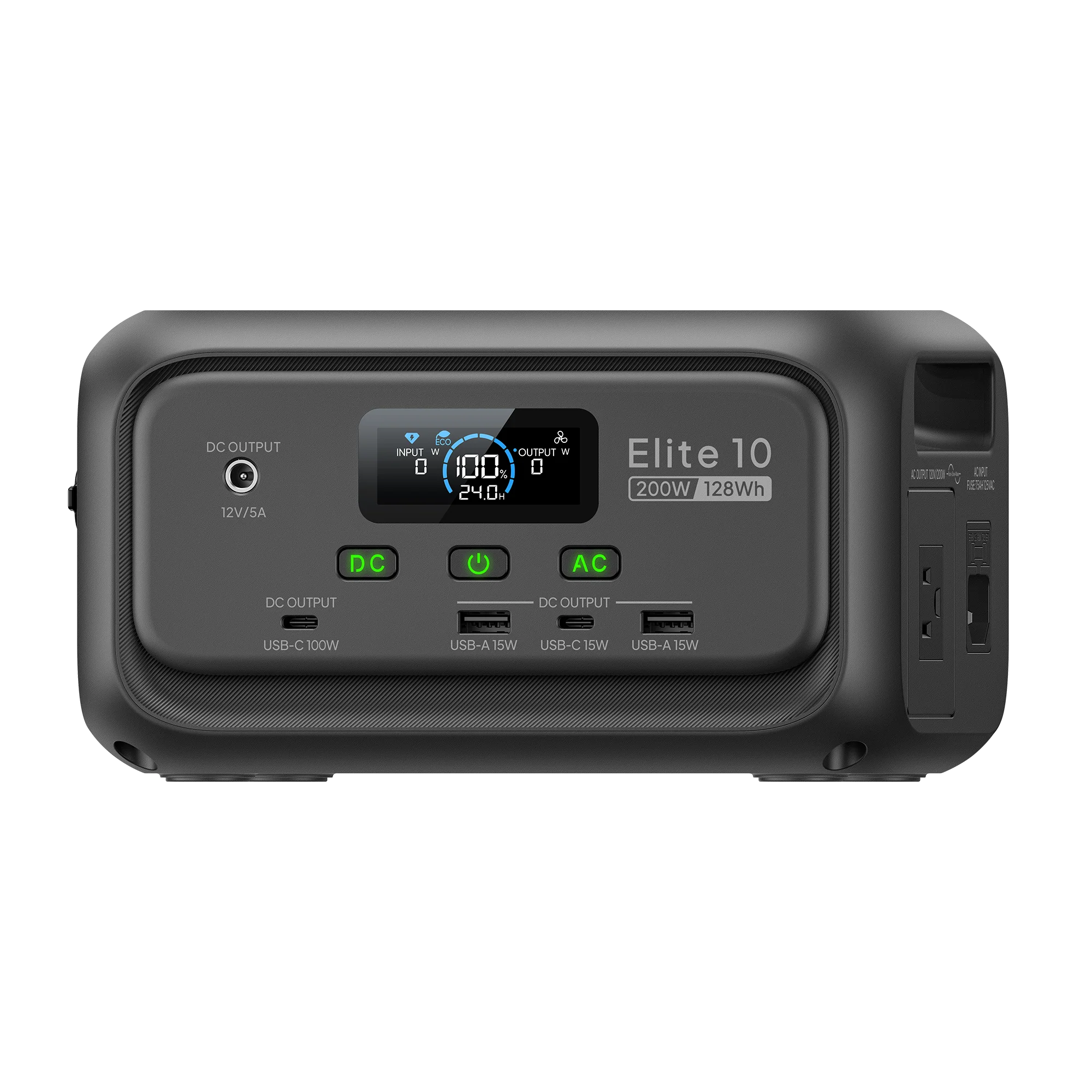
Reviewers describe the Elite 10 Mini as a palm-sized companion for drives and short trips, with the dual USB-C setup, 100W PD alongside 18W, as the feature people reach for dailyB4B1. It fits a real 200W AC outlet, two USB-A and a 12V DC port into that footprintB1, reaches a full charge in about 70 minutes, and does UPS duty with an under-10ms switchoverB2.
The useful honesty in its coverage is about ceilings. 128Wh charges a laptop once or twice, a phone ten to twelve times, or runs a 10W LED lamp about thirteen hours, and it is explicitly not for appliances, fridges or power toolsB3. That material comes from reviewers rather than long-term owners, which is what exists for a unit this newB2B3.
“A 128Wh LiFePO4 mini power station with a 200W AC outlet plus dual USB-C (100W PD and 18W), two USB-A, and a 12V DC port.”
Sources
bluettipower.com · macrumors.com · backuppowerhub.com · geardiary.com · outdoortechlab.com · irishexaminer.com · 9to5toys.com · cleantechnica.com
Sources & Research Notes
Every owner claim in this report is traceable to a published source. The bracketed references above resolve here.
Recurring owner themes
- Established home-backup platform with wheeled portability and massive expandability; the consistent knock is fan noise under heavy load. [DELTA Pro · 3 entries]
- Palm-sized LFP mini unit with a real AC outlet, fast charging, sub-10ms UPS, and dual USB-C — for gadgets, not appliances. [Elite 10 Mini · 3 entries]
- A1
“Long regarded as a gold standard for home backup — designed for high-draw appliances and full-scale battery expansion, running home essentials like a fridge, lighting, and a space heater through outages.”
backuppowerhub.com / us.ecoflow.com — EcoFlow DELTA Pro review · 2025-2026 · [positive]
- A2
“Heavy but wheeled — integrated wheels and a telescoping handle help move its considerable weight, though they work best on flat, smooth surfaces; a cart is needed for uneven ground.”
outdoorgearlab.com / bobvila.com — DELTA Pro-line review · 2025-2026 · [mixed]
- A3
“Reliable through extended outage use — served as primary backup across multiple overnight outages over months, powering essentials simultaneously; LFP battery rated for thousands of cycles and 10+ years of daily use.”
powerstationadvisor.com / robbsutton.com — DELTA Pro-line review · 2025-2026 · [positive]
- A4
“Not silent under heavy load — under 2000W-plus draws the fans emit a noticeable high-pitched whine that's distracting in a quiet room, though it runs quietly enough at lighter loads.”
outdoorgearlab.com — DELTA Pro-line noise testing · 2025-2026 · [negative]
- B1
“A 128Wh LiFePO4 mini power station with a 200W AC outlet plus dual USB-C (100W PD and 18W), two USB-A, and a 12V DC port.”
bluettipower.com / macrumors.com — Elite 10 Mini review · 2026 · [positive]
- B2
“Reaches a full charge in about 70 minutes — one of the fastest in the sub-200Wh segment — and supports UPS mode with an under-10ms switchover.”
backuppowerhub.com / geardiary.com — Elite 10 Mini review · 2026 · [positive]
- B3
“128Wh is enough to charge a laptop 1-2 times, a phone 10-12 times, or run a 10W LED lamp about 13 hours; not for appliances, fridges, or power tools.”
outdoortechlab.com / irishexaminer.com — Elite 10 Mini review · 2026 · [mixed]
- B4
“Launched at $119 (down from $199); owners highlight the dual USB-C setup as a most-used feature — a palm-sized companion for drives and short trips.”
9to5toys.com / cleantechnica.com — Elite 10 Mini review · 2026 · [positive]
Research compiled August 1, 2026.
Who Should Buy Which
Buy the DELTA Pro if you…
- →Your power goes out for longer than an afternoon and there's a fridge involved. An 8-hour outage costs 54% of one tank, and 1,600W of solar input puts 3,600Wh back in a bit over two hours of strong sun, which is what turns a one-night unit into a multi-day one.
- →You want the option to grow. The DELTA Pro accepts EcoFlow expansion batteries, so the day your load climbs past 3,600Wh you add to it rather than replace it.
- →You need to start things, not only feed them. 3,600W continuous with 7,200W of surge covers the compressor and heating-element end of the appliance list, which is where an 8-hour blackout at 1,645Wh actually lives.
Buy the Elite 10 Mini if you…
- →Your whole list is a laptop, a phone, a camera battery and a lamp. 128Wh does one to two laptop charges, ten to twelve phone fills, or about thirteen hours of a 10W LEDB3, for $119.
- →You want a desk UPS that won't wake you. 10ms switchover and a 45 dBA rating against the DELTA Pro's 20ms and 60 dBA, and it's back to full in about 70 minutesB2.
- →You travel and want an actual AC outlet in the bag. Just under four pounds, a genuine 200W socket, dual USB-C and a 12V port, small enough to be a trip companion rather than cargoB1B4.
If neither fits
Anyone in the middle should close both tabs. If you need a fridge overnight but not a whole house, or you want real AC output in something one person can carry up stairs, you're shopping the mid-size class that lives between 128Wh and 3,600Wh, and neither of these is it. Van-life readers especially: a day on the road wants 4,685Wh, which is 153% of the DELTA Pro and 4,306% of the Elite 10 Mini. Neither covers it out of the box, and only the DELTA Pro can be grown until it does.
The Bottom Line
Take the DELTA Pro if something in your life has a compressor in it. Five of six scenarios go to it and none go to the Elite, and the ones that matter aren't close: an 8-hour outage at 54% of a tank, a CPAP night at 10%, refilled in a bit over two hours of full sun. That isn't a comparison the Elite lost. It's a job it was never built to take.
And take the Elite 10 Mini if your honest list is a laptop, a phone and a lamp. Both of these stop at 100W over USB-C, so on the cable you'd use every day they're the same machine, except one costs $119 and rides in a daypack while the other costs $1,899 and needs somewhere to live. The question was never which unit is better. It's whether the thing you need to run has a plug on it. Answer that and this page is over.
Frequently Asked Questions
Answers drawn from the spec record and cited owner research.
Can the BLUETTI Elite 10 Mini run a CPAP all night?
No. A CPAP night runs about 320Wh and the Elite holds 128Wh, so it needs nearly three times its own capacity and gets you roughly a third of the way to morning. Starting the machine isn't the problem; feeding it until 6 a.m. is. The DELTA Pro covers the same night on 10% of its capacity, which works out to about ten nights per charge.
Is the EcoFlow DELTA Pro worth $1,899 if I mostly charge laptops and phones?
No. Both units cap USB-C at 100W, so a laptop charges at the same speed off either one, and the Elite 10 Mini does that job for $119 and just under four pounds. The DELTA Pro's price buys 3,600W of AC output and 7,200W of surge. If nothing you own needs that, you're buying 99 pounds of headroom you'll never reach.
Which one is the better UPS for a computer or a router?
The Elite 10 Mini catches the drop faster, 10ms against the DELTA Pro's 20ms, which is the difference between line-interactive and standby classification, and it's quieter at a rated 45 dBA versus 60. What it can't do is hold anything for long: an 8-hour outage at 1,645Wh would need about fifteen times its 128Wh. Use the Elite to bridge flickers and brownouts, and the DELTA Pro when the power is genuinely going to be out.
Can you add more capacity to the Elite 10 Mini later?
No, it's sealed at 128Wh, and that's normal for a four-pound unit. You don't expand something you throw in a bag; if you need more, you buy more unit. The DELTA Pro is the expandable one here. It takes EcoFlow expansion batteries, so its 3,600Wh is a starting point rather than a ceiling. Size the Elite for what you need today.
How much of a blackout does the DELTA Pro actually cover?
An 8-hour outage at 1,645Wh uses 54% of the DELTA Pro's 3,600Wh, so one full charge covers nearly two of them. With 1,600W of solar input it refills 3,600Wh in a bit over two hours of strong sun, which is what makes a multi-day outage survivable instead of a countdown. For reference, a weekend camping load of 2,100Wh puts it at 69% of a tank.
Brand matchup
EcoFlow vs BLUETTI: measured across every matchup →Where to buy
EcoFlow DELTA ProPick
$1,799.00
$1,799.00 · direct from EcoFlow
down from $1,899 · 5% below usual
Last checked 16 days ago. Prices move — check before you buy.
BLUETTI Elite 10 Mini
$119.00
$119.00 · direct from BLUETTI
Last checked 16 days ago. Prices move — check before you buy.
Prices may vary by retailer and are subject to change.