Head-to-head test
BLUETTI Elite 320 vs DJI Power 2000
The DJI is the nicer box to carry; the Elite is the better battery to own — 3,200Wh for $999 against 2,048Wh for $1,299, so the cheaper unit is also the bigger one, and the only real question left is whether you have to lift it.
Full profiles: BLUETTI Elite 320 → · DJI Power 2000 →

Written by Gunner GustafsonUpdated
Whole-Home Backup Tester, Station Arena Test Desk
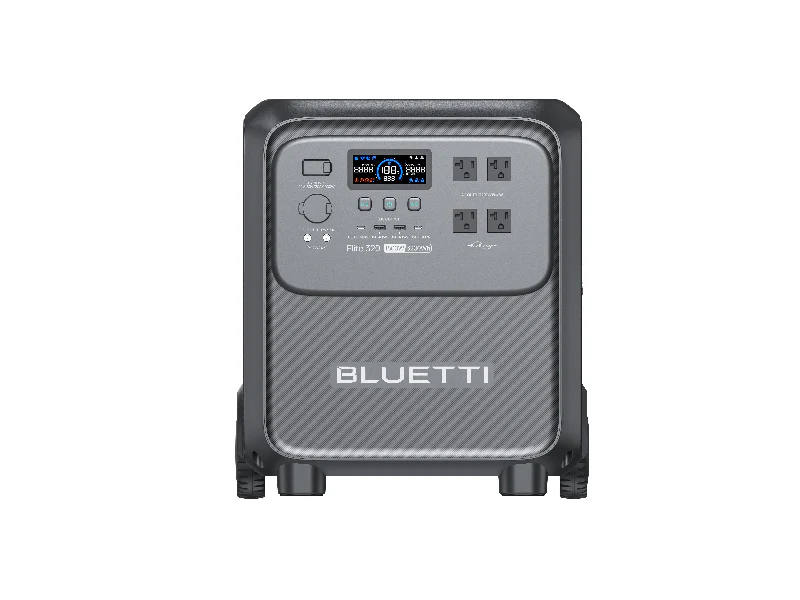
$936.25 · direct from BLUETTI
down from $1,100 · 15% below usual
Last checked 1 day ago. Prices move — check before you buy.
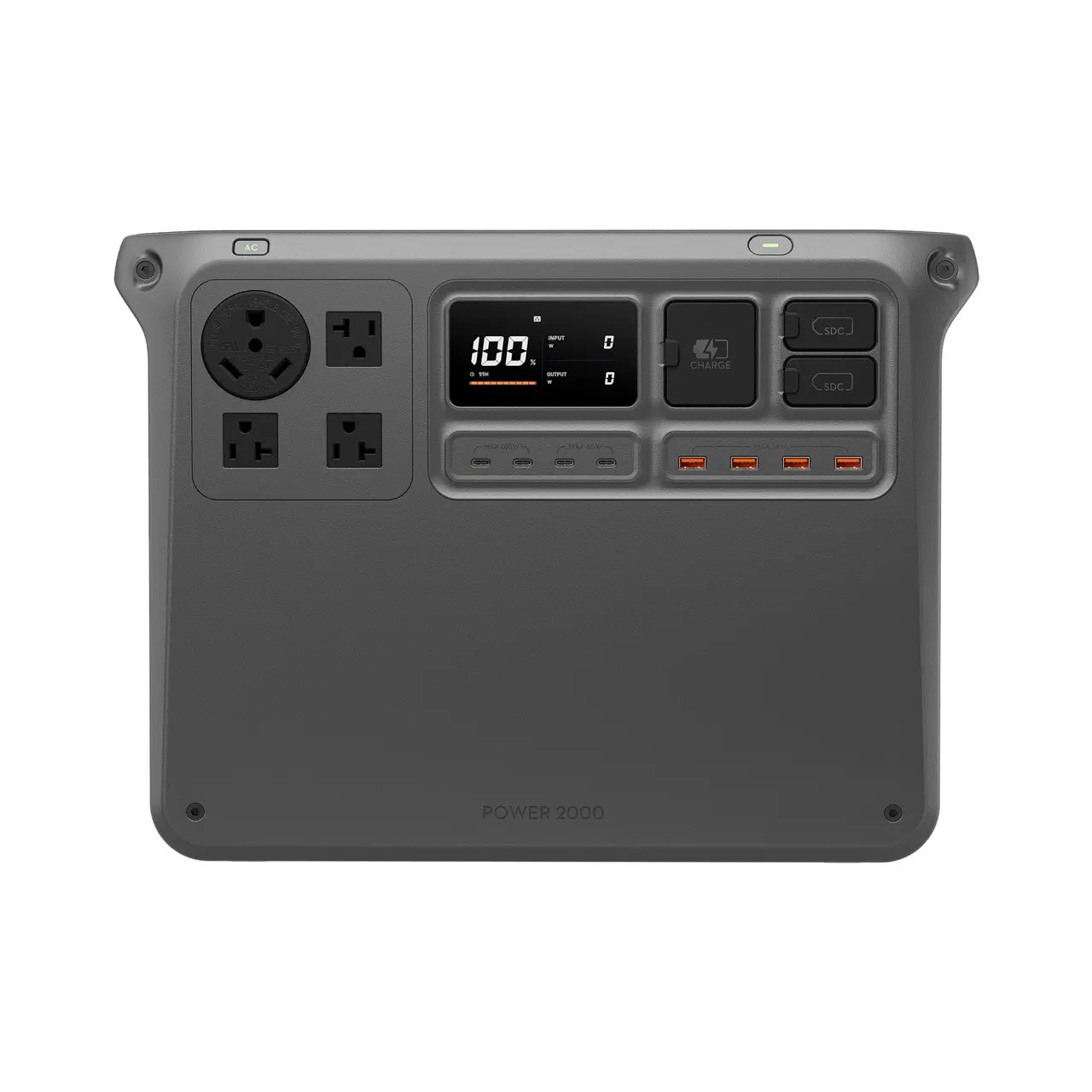
$1,299.00 · direct from DJI
Last checked 1 day ago. Prices move — check before you buy.
Spec deltas
For $300 less, the Elite 320 gives you 1,152Wh more battery. It holds 3,200Wh at $999; the DJI Power 2000 holds 2,048Wh at $1,299. Everything downstream of that follows from it — the Elite works out to $0.10 per lifetime kilowatt-hour against the DJI's $0.16, and it covers every runtime scenario a single unit can handle while the DJI comes up short on the biggest ones.
The catch is that the extra battery weighs something. The Elite is a nearly-75-pound rolling home-backup unit that lives on its wheels; the DJI is a 48.5-pound box you actually pick up and carry. The DJI also runs quieter, at about 29 dBA where the Elite doesn't publish a noise figure at all, pushes 3,000W of continuous output to the Elite's 1,800W, and takes 1,800W of solar to refill.
Take the Elite 320 if this is home backup — you get more energy for less money and never have to move it far. Take the DJI Power 2000 if you're loading it into a vehicle most weekends, sleeping near it, or starting loads north of 1,800W. One is the better value; the other is the better traveler.
What the Numbers Reveal
Each conclusion stated first — the numbers behind it on one line, the full analysis below.
Capacity
Fourteen hundred fewer watt-hours for three hundred more dollars means the DJI's premium buys you nothing you can store. Its case is a class above the Elite's, but a nicer case doesn't run your fridge an hour longer.
Elite 320: 3,200Wh at $999DJI Power 2000: 2,048Wh at $1,299Lifetime cost: $0.10/kWh (Elite) vs $0.16/kWh (DJI)
Why it mattersIf runtime per dollar is why you're shopping, the Elite ends the conversation before the other specs even load.
weight
For a unit that sits in a closet until the grid drops, 75 pounds on wheels is a non-issue and you banked 1,152Wh for the trouble. For a unit that gets lifted over a tailgate every Friday, that same weight is the whole story, and the DJI's 48.5 lb is worth trading capacity for.
Elite 320: about 75 lb, ships on wheels with a telescoping handleA2DJI Power 2000: 48.5 lb, no wheels neededThe Elite is positioned as a rolling home-backup stationA1
Why it mattersDecide where the unit lives before you compare anything else — it sorts this matchup cleaner than any spec.
continuous output
For daily off-grid cycling, the DJI's 1,800W input turns a recharge into a coffee break while the Elite's 1,000W ties up your panels till afternoon. But the Elite's bigger tank needs refilling less often, so the advantage only compounds when you're draining and refilling every day.
DJI: 3,000W continuous output and 1,800W solar inputElite: 1,800W continuous output and 1,000W solar inputOff-grid, you recharge every day the sun is up
Why it mattersSolar-first van and cabin buyers should weight the DJI's input speed and output ceiling heavily; occasional users won't notice either.
The DJI can grow past 3,200Wh with extra batteries, which is real for someone heading toward van-life loads. Short of that, the Elite's sealed ceiling is higher than the DJI's starting point, so 'expandable' is a promise you'd only cash years out. The quiet, by contrast, is something you hear the first night.
DJI runs at about 29 dBA and is expandableB2Elite's noise level is not published; it's a sealed 3,200Wh unitThe DJI's base capacity is 2,048Wh, below the Elite's 3,200Wh
Why it mattersIf the unit shares a room where you sleep or work, the DJI's silence is the tangible edge; the expansion path is for a future most buyers won't reach.
The specific dimensions that decide these two units — everything else is a tie.
Lifetime Value
Selected because: Cheaper sticker and bigger battery point the same way — the economic core of the verdict.
cost / lifetime kWh
There's rarely a row this lopsided. The Elite is cheaper to buy and cheaper to own — $0.10 per lifetime kilowatt-hour against $0.16, and $199 a warranty year against $260 — and it got there by holding more battery, not less. The DJI's $1,299 doesn't buy more stored energy than the Elite's $999; it buys a lighter, quieter, better-built box around a smaller one.
That reframes the whole matchup. You're not paying the DJI premium for capacity, because it has less. You're paying it for portability and refinement. Whether those are worth $300 and 1,152Wh is a real question — but call it what it is, and don't pretend the pricier unit is the more capable battery.
Portability & Form Factor
Selected because: The 26-lb gap between a wheeled home unit and a carryable box is the axis that sorts buyers.
weight
Seventy-five pounds is a two-person lift, or a one-person regret, which is exactly why the Elite rolls on wheels with a telescoping handleA2 and never asks to leave the ground floor. The DJI's 48.5 lb is a bent-knee grab you can do solo and forget. On flat floors the Elite's wheels erase the gap; on stairs, over a tailgate, or down a boat ramp, the 26 pounds are all you'll think about.
This is the cleanest way to sort the two. If the unit's job is to sit still and wait for an outage, weight is noise and the Elite banked capacity for it. If its job is to move — campsite, jobsite, truck bed, week after week — the DJI is the one your back votes for.
Your Life, Your Pick
Selected because: Elite clears every single-unit scenario; DJI misses the largest — shows the capacity gap in use.
Run the load baskets and the capacity gap stops being abstract. The Elite covers our weekend-camping basket and a full 8-hour blackout; the DJI's 2,048Wh falls short of the camping load and squeaks through the blackout with nothing to spare. Everything smaller — CPAP, a remote workday, a tailgate — both units clear with room, so those come down to weight and quiet, not runtime.
The one scenario both lose is Van Life Daily at 4,685Wh, which is more than either single unit holds. That's the one place the DJI's expandability could eventually matter, and the one place the Elite's sealed design genuinely can't follow. For everything short of living out of the thing, the Elite's tank is the one that finishes the night.
Growth Path
Selected because: Expansion gotcha fires against the Elite; needs the honest reframe (its sealed ceiling still tops DJI's base).
solar input
The spec sheet flags the Elite as a closed system, and that's true: 3,200Wh is the ceiling, and outgrowing it means a second unit. But read the number before you read the warning. The Elite's sealed ceiling sits above the DJI's starting capacity, so for the buyer choosing between these two today, 'expandable' describes a door the DJI would only need because it holds less to begin with.
The DJI's expansion path is a real advantage for exactly one person: the one whose loads are headed past 3,200Wh, toward van-life territory. If that's you, it's the deciding feature and you should stop reading here. If it isn't — and for most home-backup buyers it never becomes so — the Elite's fixed 3,200Wh is a ceiling you'll never touch, not a wall you'll hit.
Brand Trust
Selected because: Cross-brand: established BLUETTI value play vs 2024-entrant DJI with drone pedigree and a proprietary streak.
BLUETTI is the value incumbent with one of the broadest lineups in the category and a genuinely good app, and the Elite 320's price-to-capacity is that reputation made literal. The asterisk is support: it's the most inconsistent in the space, email-based with timezone lag, and buying direct tends to go smoother than through a third party. Budget for a good outcome, plan for a slow one.
DJI arrived in 2024 with drone-industry engineering and it shows in the build — but it's two years into power stations, with no dedicated owner community yet and an app score that reflects the whole DJI catalog rather than this box. Treat the on-device screen as the real interface. Nothing here disqualifies the DJI; it's a polished newcomer against a proven value brand, and the polish is exactly what you're paying the $300 for.
Strengths & trade-offs
BLUETTI Elite 320
Strengths
- +Costs $199 less
- +Larger battery capacity
Trade-offs
- –Significantly heavier (+26.5 lbs), making it harder to move.
- –Weaker inverter (-1,200W) limits appliance compatibility.
- –Shorter-lived battery — rated for 3,000 charge cycles vs the Power 2000's 4,000, so it wears out sooner.
DJI Power 2000
Strengths
- +Lighter by 26.5 lb
- +Higher AC output
- +Faster solar charging
- +Rated for 4,000 charge cycles — much longer battery lifespan
Trade-offs
- –No major technical downsides compared to rival.
Will It Power Your Gear?
Scenario math and per-appliance runtimes, modeled from the spec record.
Scenario verdicts
We ran the math on six real-world scenarios. Here's which unit survives your actual life.
SCN-01 · 2 nights · needs 2,100Wh
Weekend Camping
Two nights off-grid with essential comfort
Elite 320
A 2,100Wh weekend fits inside the Elite's 3,200Wh with headroom; the DJI's 2,048Wh comes up just short of the full basket. Trim a little and the DJI gets there — but out of the box, the Elite is the one that finishes the trip.
Battery budget usedlower = more headroom
LOAD Phone Charger 15W×6h · LED Lights 40W×8h · Box Fan 75W×14h · CPAP Machine 40W×16h
SCN-02 · 8 hours · needs 1,645Wh
8-Hour Blackout
Keep the essentials running through a night without power
Elite 320
The Elite covers the full 1,645Wh basket with room to spare; the DJI clears it with almost nothing left. If a blackout is your reason for buying, the Elite's larger reserve is the difference between riding out the night and rationing the last hour.
Battery budget usedlower = more headroom
LOAD Fridge 150W×8h · Router + Modem 20W×8h · LED Lights (4 bulbs) 40W×6h · Phone Charger 15W×3h
SCN-03 · 8 hours · needs 320Wh
CPAP Overnight
Sleep therapy without interruption — the #1 medical use case
Either unit
A 320Wh night uses a sliver of either tank, so both pass easily. The tiebreak is at your pillow: the DJI publishes about 29 dBA and the Elite publishes no noise figure at all, so for the machine 18 inches from your head, the known-quiet unit is the safer bet.
Battery budget usedlower = more headroom
LOAD CPAP Machine 40W×8h
SCN-04 · 8 hours · needs 910Wh
Remote Workday
Full work day off-grid without power anxiety
Elite 320
A 910Wh workday is a third of the Elite and under half the DJI — neither breaks a sweat. Pick on the desk, not the battery: the DJI's lighter case is easier to shuttle between rooms, the Elite's bigger reserve means you never think about it.
Battery budget usedlower = more headroom
LOAD Laptop 60W×8h · External Monitor 30W×8h · Router + Modem 20W×8h · Phone Charger 15W×2h
SCN-05 · 4 hours · needs 670Wh
Tailgate Party
Game day power for the crew
Elite 320
670Wh of party leaves both units most of their tank. The deciding spec is the walk from the parking lot: the DJI is 26 pounds lighter in the hand that isn't carrying the cooler.
Battery budget usedlower = more headroom
LOAD Blender 400W×0.5h · LED TV (55") 80W×4h · Bluetooth Speaker 15W×4h · Phone Charger (×3) 45W×2h
SCN-06 · 24 hours · needs 4,685Wh
Van Life Daily
A full day of mobile living — the ultimate endurance test
Neither unit
A 4,685Wh day is more than either unit holds — this is the one basket both lose. It's also the only place the DJI's expansion path matters and the Elite's sealed design can't follow. Full-time off-grid means a bigger platform than either base unit.
Battery budget usedlower = more headroom
LOAD Mini-Fridge 150W×24h · Laptop 60W×4h · Phone Charger 15W×3h · LED Lights 40W×5h · Fan 75W×8h
The Load Test
RUNTIME = (Wh × 0.85) ÷ LOAD
None of the scenarios above exactly yours? Build it. Toggle what you'd plug in; both units are tested against the combined draw.
Essentials
Comfort & Convenience
High-Draw Appliances
Test duration
8h
Continuous draw
205W
Projected runtime
For this load: Elite 320 runs 13.3h vs 8.5h.
$1,099.99 list · direct from BLUETTI
Modeled from the spec record — same math as the tables below. Methodology
Runtime by appliance
Real-world runtime estimates for common appliances, modeled at 85% inverter efficiency.¹
Essentials
The basics you need runningscale 0–181.3hComfort & Convenience
Makes off-grid life actually enjoyablescale 0–36.3hHigh-Draw Appliances
These reveal the real limitsscale 0–2.7h¹ Runtime = (capacity × 0.85) ÷ appliance watts. Within each group, all bars share one time scale (the group's longest runtime), so lengths are comparable across appliances; identical runtimes collapse into a single blue/orange bar. Actual runtime varies with battery age, temperature, and simultaneous loads — see methodology.
Conclusion
July 16, 2026
Verdict: the Elite 320
The Elite 320 holds 3,200Wh and costs $999; the DJI Power 2000 holds 2,048Wh and costs $1,299. So the Elite is $300 cheaper and 1,152Wh larger at the same time, which is why it lands at $0.10 per lifetime kilowatt-hour against the DJI's $0.16. For home backup and raw runtime, that's not an argument, it's a rout — the Elite wins every single-unit scenario either can attempt. The DJI earns its price in the hand, not the closet: 48.5 lb against nearly 75, near-silent operation at about 29 dBA, 3,000W of continuous output for bigger loads, and 1,800W of solar that refills it in a fraction of the Elite's solar day. Buy the Elite for a home that loses power. Buy the DJI if the unit rides in a truck every weekend and quiet matters more than the extra battery you're not carrying.
Today the Elite 320 is $936.25, $163.74 under its typical $1,099.99. The verdict weighs typical prices, not today's. Prices checked 1 day ago.
Editor-assigned confidence, based on cited owner research and spec analysis.
List prices as of July 16, 2026. The links below open BLUETTI's and DJI's current prices.
$936.25 · direct from BLUETTI
down from $1,100 · 15% below usual
Last checked 1 day ago. Prices move — check before you buy.
or check the Power 2000 price$1,299.00 list
Written by Gunner Gustafson, Whole-Home Backup Tester · Station Arena Test Desk · Updated July 16, 2026
Measured Data
Benchmark scores and the full spec record, side by side.
Benchmark scores
Not rated for both units (minimum threshold unmet): CPAP, Apartment Balcony, Camping.
Full specifications
ᵈ Derived: price ÷ rated capacity. See the data behind our comparisons →
Comparison ToolAdd more power stations, side by sideOpen Tool →How these numbers are produced
Numeric verification
Every figure on this page traces to our spec database or arithmetic on it — no estimated numbers.
Owner claims
Statements about owner experience are cited to published reviews — see Sources & Research Notes below.
Runtime model
Runtime = (rated capacity × 0.85 inverter efficiency) ÷ device wattage. Solar recharge estimates assume panels deliver 70% of rated output. Cold weather, battery age, and stacked loads reduce real-world results.
Power Score
Computed from 14 published spec dimensions, weighted per use-case bench. Higher is better; a unit must meet a bench's minimum threshold to be rated.
See the full weight table and data sourcing on our methodology page →Class ranking (the star rating)
Each unit's star score is a category ranking, not customer reviews — no buyer opinions feed it. We score every station on size-independent quality (value, output, portability, endurance, ports, warranty, and more), then percentile-rank it against the other units in its capacity class, so a class-leading compact unit and a class-leading whole-home unit can both earn 5★. Here, Elite 320 rates 4.0/5 (44th percentile of 26 Large-class units), and Power 2000 rates 4.3/5 (56th percentile of 26 Large-class units).
How the class ranking is computed →Test Notes & Caveats
Hidden gotchas and advantages we spotted that you won't find on the product page.
Elite 320: 75 lbs Is a Commitment
At 75 lbs, this is manageable but not fun to move. That's heavier than a large checked suitcase. How much it costs you depends on whether it rolls — wheels and a telescoping handle change the job completely at this weight, and our spec record doesn't track them, so look at the product photos before you plan on carrying it from the car.
The Elite's ceiling is sealed — but it's a high ceiling
The Elite 320 doesn't expand: 3,200Wh is what you buy and what you keep. That's the honest knock against it. The context the warning leaves out is that 3,200Wh already tops the DJI's 2,048Wh base, so between these two, the sealed unit is the larger one. Expansion only becomes the deciding factor if your loads climb past 3,200Wh — real for future van-lifers, irrelevant for most home backup.
Warranty: No Difference
Both units carry the same 5-year warranty, so coverage isn't a tiebreaker here. Both figures are maximums rather than guarantees: BLUETTI's depends on buying direct from BLUETTI or registering the unit, since reseller purchases carry a shorter term; DJI's on buying from DJI's own store, which is where the full five years is advertised.
Battery Lifespan in Real Years
The Power 2000 is rated for 4,000 cycles vs 3,000. In real life: at daily use, that's 11 vs 8.2 years. At weekend use (twice a week), it's 38 vs 29 years. One caution reading years across different sizes: a cycle is 2,048Wh on the Power 2000 and 3,200Wh on the Elite 320, so count lifetime energy — roughly 8,192 kWh against 9,600 kWh over the rated life. After hitting the cycle limit, the battery doesn't die — it drops to ~80% of original capacity, which is still very usable.
The Elite doesn't publish a noise number
The DJI lists about 30 dBA and reviewers measured roughly 29; the Elite 320 publishes no noise spec at all. For a unit that lives in your house, that silence on the spec sheet is a small unknown you're accepting — and it's the one place the pricier DJI buys you a figure you can actually check before it's running in your bedroom.
Full record above — the Test Desk pick is the Elite 320.
Check Elite 320 price →or check the Power 2000 priceOwnership Analysis
What happens after you buy — true cost of ownership, brand trust, and growth potential.
Lifetime value
Service lifeyears at one full cycle per day
Lifetime energy delivered
Cost per delivered kWh
│ warranty ends · Reaching the cycle rating means ~80% capacity remains — degraded, not dead.
Analyst note
The Elite 320 wins on both sticker price and long-term value. At $0.11/kWh over its lifetime, it's meaningfully cheaper to own. Clear value winner. One caution on the lifespan row: the Power 2000 takes longer to reach its cycle rating, but a cycle moves a different amount of energy on each unit — the Elite 320 still delivers more over its shorter horizon (9,600 vs 8,192 kWh). Years measure wear, not usefulness.
Brand trust
BLUETTI
Ecosystem
One of the broadest lineups — 15-20+ models from budget (AC2A) to flagship portable (Apex 300, 2764.8Wh). Includes specialized products: vehicle solar hubs, sodium-ion cold-weather units, and balcony storage systems.
Support
The most inconsistent support in the space. Heavily email-based with China timezone delays. Some users get smooth, efficient service; others report weeks of troubleshooting runarounds, being offered discounts on new units instead of repairs, and confusing third-party purchase claim processes. Buying direct from Bluetti's website tends to produce better support outcomes.
Community
Active and growing — Reddit r/bluetti has a dedicated community. Second-largest after EcoFlow in engagement.
App experience
Rated 4.5/5 iOS and Android — tied for best app experience in the category. V3.0 UI redesign was well-received.
Unique strength
One of the widest lineups in power stations and a genuinely strong app, so the Elite slots into an ecosystem you can grow across even though the unit itself is sealed.
Worth knowing
BLUETTI's value-per-watt-hour is the best in the category and the Elite 320 is that reputation in one product. The counterweight is support: it's the most inconsistent in the space, heavily email-based with timezone delays, and buying direct tends to produce better outcomes than third-party channels.
DJI
Ecosystem
New entrant (2024) — five power station models to date: Power 500, Power 1000 (since superseded by the V2 but still sold), Power 1000 V2, Power 1000 Mini, Power 2000. Buying a "Power 1000" listing? Check which revision it actually ships.
Support
Leveraging DJI's established global support and repair center network from the drone business. Generally positive reputation inherited from drone operations, but limited power-station-specific track record.
Community
No dedicated power station community yet. Discussions happen within r/dji (~250K members, mostly drone users). Very small power-specific presence on Facebook and forums.
App experience
Rated 3.5/5 iOS and Android (DJI Home app ratings reflect entire DJI ecosystem including drones/cameras, not power-station-specific). Users report the on-device screen is more reliable than the app.
Unique strength
Quietest-in-class operation and among the fastest solar and wall charging tested, backed by an unusually thorough safety build.
Worth knowing
Two years into power stations, DJI brings drone-grade engineering and build quality but a short category track record. There's no dedicated owner community yet, and the app score reflects the entire DJI catalog rather than this unit — the on-device screen is the interface that matters.
Analyst note
BLUETTI is the proven value brand and the Elite is the most battery per dollar here; DJI is the polished 2024 newcomer selling refinement, quiet, and portability at a premium. You're not choosing which company makes the bigger battery — the Elite is bigger and cheaper. You're choosing whether DJI's lighter, quieter, better-built box is worth $300 and 1,152Wh to you.
Growth path
Elite 320
FIXED CAPACITYFixed at 3,200Wh — a sealed, complete system rather than a starting point. There's no expansion port, so that figure is the ceiling: check it against your longest unplugged stretch before you buy.
Accepts up to 1,000W of solar. Enough for a serious multi-panel array.
Adequate ports for most setups, but heavy users may want a power strip.
Power 2000
EXPANDABLESupports DJI expansion batteries, so you can add capacity later without replacing the base unit — useful if your needs may climb past 2,048Wh.
Accepts up to 1,800W of solar. Enough for a serious multi-panel array.
Generous port selection supports complex multi-device setups.
Expansion batteries are DJI-specific. You're investing in the DJI ecosystem.
Realistic full solar rechargeat 70% of rated panel output — see methodology
Analyst note
Don't read the Power 2000's expandability as a straight win here: it starts at 2,048Wh, below the Elite 320's 3,200Wh, so a first expansion battery largely buys back capacity the Elite 320 already includes. It only pulls ahead if you'd grow past 3,200Wh — short of that, the Elite 320's larger fixed capacity is the simpler value.
What Owners Report
Patterns from published owner reports and long-term reviews — every claim cited to its source below.
BLUETTI Elite 320
Reviewers frame the Elite 320 as affordable, essential home backup: a 3,200Wh LFP battery that runs the fridge and the essentials for up to two days of household power off four AC outlets and a pair of USB-C ports at 140W and 100WA3A1. The standout in write-ups is the format — a suitcase-style rolling station with oversized shock-absorbing wheels and a retractable handle, built to move around the house rather than out of itA2. Long-term owner data is still thin; this is a CES-2026 launch, so treat the field read as directional, not seasonedA1.
“A 3,200Wh LiFePO4 battery delivering 1,800W continuous (2,700W Power Lifting, 3,600W peak), with 10ms UPS protection — a suitcase-style rolling home-backup station introduced at CES 2026.”
Sources
prnewswire.com · rv.com · notebookcheck.net · ussolarsupplier.com · finance.yahoo.co
DJI Power 2000
The DJI Power 2000's reviews cluster on two things: it's quiet and it's overbuilt. Testers measured about 29 dBA at five feet when the fan kicked in, virtually silent, and it stayed among the quietest units even under the heaviest loadsB2. The build gets an eightfold protection system — flame-retardant materials, a nano-coated BMS, a stack of temperature sensors and fuses, and reinforcement rated to take a one-ton static loadB3. Charging is a highlight too: a full wall charge in about 90 minutes and a full solar charge in roughly 75 on 1,800W of inputB1. As with the Elite, the ledger is review-based rather than multi-year — DJI is new to this categoryB4.
“Among the fastest-charging tested — a full wall charge in about 90 minutes (reviewers measured even faster, roughly an hour), and up to 1,800W of solar input for a full solar charge in about 75 minutes.”
Sources
bobvila.com · t3.com · thesolarlab.com · campingsolar.us · protoolreviews.com · greenerideal.com · dronexl.co
Sources & Research Notes
Every owner claim in this report is traceable to a published source. The bracketed references above resolve here.
Recurring owner themes
- Large 3,200Wh LFP capacity, wheeled mobility, 10ms UPS, and affordable home-backup positioning are the standout points. [Elite 320 · 3 entries]
- Standout fast charging (wall and 1800W solar), near-silent operation, and an unusually robust safety-focused build are the consistent praise. [Power 2000 · 3 entries]
- A1
“A 3,200Wh LiFePO4 battery delivering 1,800W continuous (2,700W Power Lifting, 3,600W peak), with 10ms UPS protection — a suitcase-style rolling home-backup station introduced at CES 2026.”
prnewswire.com / rv.com — Elite 320 review · 2026 · [positive]
- A2
“Weighs about 75 lbs with oversized shock-absorbing wheels and a retractable telescoping handle for easy transport around the home.”
rv.com / notebookcheck.net — Elite 320 review · 2026 · [positive]
- A3
“The big 3,200Wh LFP battery lasts over a decade and provides over 66 hours of refrigeration — up to two days of essential household power — via four AC outlets, dual USB-A, and two USB-C (140W and 100W).”
rv.com / ussolarsupplier.com — Elite 320 review · 2026 · [positive]
- B1
“Among the fastest-charging tested — a full wall charge in about 90 minutes (reviewers measured even faster, roughly an hour), and up to 1,800W of solar input for a full solar charge in about 75 minutes.”
bobvila.com / t3.com — DJI Power 2000 review · 2025-2026 · [positive]
- B2
“One of the quietest power stations tested — only about 29 dB at 5 feet when the fan kicked in, virtually silent, and it stayed among the quietest units even under the heaviest loads.”
bobvila.com / thesolarlab.com — DJI Power 2000 review · 2025-2026 · [positive]
- B3
“Built with an eightfold protection system — flame-retardant materials, a nano-coated BMS, 26 temperature sensors, 21 fuses, and structural reinforcement rated to support a one-ton static load — positioning it as one of the safest, most robust units on the market.”
campingsolar.us / protoolreviews.com — DJI Power 2000 review · 2025-2026 · [positive]
- B4
“Ran everything reviewers threw at it, handled surges consistently, and recharged incredibly fast, especially from solar; deep integration for DJI drone users is a unique advantage.”
greenerideal.com / dronexl.co — DJI Power 2000 review · 2025-2026 · [positive]
Research compiled July 16, 2026.
Who Should Buy Which
Buy the Elite 320 if you…
- →The home-backup buyer: 3,200Wh for $999 is the most runtime per dollar here, and it never has to leave the house.
- →Anyone who values capacity over portability: the Elite covers a full 8-hour blackout and a weekend of camping loads the DJI can't finish.
- →The one-location owner: on flat floors the wheels and handle make 75 lb a non-issue, and you banked the extra battery for the troubleA2.
Buy the Power 2000 if you…
- →The weekly hauler: 48.5 lb goes over a tailgate solo where the Elite needs its wheels and a ramp.
- →Light sleepers and shared rooms: about 29 dBA, and it stays quiet even working hardB2.
- →Big-load and solar-first users: 3,000W of continuous output starts appliances the Elite can't, and 1,800W of solar refills it in a fraction of the Elite's solar dayB1.
- →The buyer who knows their needs will grow past 3,200Wh: the DJI expands and the Elite doesn't.
If neither fits
If your day looks like our Van Life basket at 4,685Wh, neither single unit finishes it — that's more than either holds. You want an expandable platform with the second battery in the cart from day one, or a larger home system entirely. Buying either of these to live off-grid full-time means recharging before you've finished the day.
The Bottom Line
The Elite 320 is $300 cheaper and 1,152Wh larger than the DJI Power 2000 — the rare matchup where the lower price and the bigger battery are the same unit. That makes it the clear pick for home backup and anyone measuring runtime per dollar, and it wins every single-unit scenario either can attempt.
The DJI answers with the things you feel in the hand and the ear: 48.5 lb instead of 75, about 29 dBA of quiet, more output, and faster solar. If the unit travels most weekends or sleeps in your room, pay the premium and don't look back. Otherwise, buy the Elite — it's the better battery, and it's the cheaper one.
Frequently Asked Questions
Answers drawn from the spec record and cited owner research.
Is the BLUETTI Elite 320 or the DJI Power 2000 better for home backup?
The Elite 320, and it isn't close on the numbers. It holds 3,200Wh to the DJI's 2,048Wh, costs $300 less at $999, and covers a full 8-hour blackout basket the DJI can't quite finish. Since a home unit mostly sits still, the Elite's extra weight barely matters — you bought more runtime for less money.
Why does the cheaper Elite 320 have more capacity than the pricier DJI?
Because you're not paying the DJI's premium for battery. The extra $300 buys a lighter 48.5-lb case, near-silent operation at about 29 dBA, faster solar input, and DJI's drone-grade build — not more stored energy. If capacity per dollar is your metric, the Elite wins; if portability and quiet are, the DJI's price starts to make sense.
Which one is easier to move around?
The DJI, by 26 pounds. It's 48.5 lb and made to be carried; the Elite is nearly 75 lb and made to be rolled, shipping with wheels and a telescoping handle for exactly that reason. On flat floors the Elite's wheels close the gap, but for stairs, tailgates, or boat ramps the DJI is the one you lift without a second person.
Can the DJI Power 2000 be expanded and the Elite 320 can't?
Yes — the DJI accepts expansion batteries and the Elite is a sealed 3,200Wh unit. But the Elite's fixed ceiling is already higher than the DJI's 2,048Wh starting point, so expansion only becomes decisive if your needs climb past 3,200Wh, which is van-life territory most home buyers never reach. For a fixed capacity budget, the Elite gives you more of it up front.
Which charges faster from solar?
The DJI. It takes up to 1,800W of solar and reviewers logged a full solar charge in about 75 minutes, while the Elite's 1,000W input needs more than three hours of strong sun to refill its bigger 3,200Wh tank. If you're recharging off panels every day, the DJI's input speed is a real daily convenience; if you top up occasionally, it barely registers.
Brand matchup
BLUETTI vs DJI: measured across every matchup →Where to buy
BLUETTI Elite 320Pick
$936.25
$936.25 · direct from BLUETTI
down from $1,100 · 15% below usual
Last checked 1 day ago. Prices move — check before you buy.
DJI Power 2000
$1,299.00
$1,299.00 · direct from DJI
Last checked 1 day ago. Prices move — check before you buy.
Prices may vary by retailer and are subject to change.