Head-to-head test
BLUETTI Elite 30 V2 vs BLUETTI Elite 320
This is a sizing question wearing a comparison's clothes: the Elite 30 V2 starts every load on this page and outlasts none of them, right down to the CPAP night that needs 320Wh from a 245Wh usable pack.
Full profiles: BLUETTI Elite 30 V2 → · BLUETTI Elite 320 →

Written by Ian SchneiderUpdated
Solar & Off-Grid Tester, Station Arena Test Desk

$249.99 · direct from BLUETTI
Last checked 1 day ago. Prices move — check before you buy.
$936.25 · direct from BLUETTI
down from $1,100 · 15% below usual
Last checked 1 day ago. Prices move — check before you buy.
Spec deltas
The Elite 320 takes five of the six scenarios on this page and the Elite 30 V2 takes none, which reads like a rout until you notice what's actually happening. The 30 V2 can start every load here. It just can't finish one.
That includes the CPAP night, the smallest job on the list: 320Wh of overnight draw against 245 usable watt-hours, because the 288Wh nameplate loses about 15% to inverter losses before your equipment sees any of it. Watts decide what switches on. Watt-hours decide whether it's still on at 6 a.m., and that is the entire distance between a $239 box and an $1,100 one.
So who is genuinely cross-shopping these two? Someone who hasn't written down their load list yet. Do that first, in watt-hours, and this page answers itself in five minutes. If the total lands under the 30 V2's 245 usable watt-hours, buy the small one and keep the difference. If it's a fridge and an evening, you want the 320. If it's a full-time van, the honest answer further down is neither.
What the Numbers Reveal
Each conclusion stated first — the numbers behind it on one line, the full analysis below.
That holds even for the smallest job on the list. A CPAP asking 320Wh of a 245Wh usable pack is not a close call, and no eco mode, dimmed screen or careful bedtime recovers the missing 75 watt-hours. The 320 does the same night on roughly an eighth of its capacity and wakes up ready to do it again.
Elite 30 V2: 600W continuous, 1,500W surge, and the engine marks it able to start the peak load in all six scenariosElite 30 V2 usable energy: 245Wh (288Wh nameplate, derated 15% for inverter losses)CPAP Overnight needs 320Wh; the Elite 320 spends 12% of its 2,720Wh usable on the same night
Why it mattersIf anything on your list has to run all night, size on watt-hours and ignore the watts entirely. The 600W rating will tell you yes when the answer is no.
solar input
The cheap one is the expensive energy, and the recharge side doesn't rescue it. A 1,000W solar input refills the 320's 3,200Wh in a bit over three hours of full sun, against about an hour and a half for 288Wh at 200W. Eleven times the energy for four and a half times the price, and it takes about twice as long to fill, not eleven times.
Elite 30 V2: $239 for 288Wh, rated 3,000 cyclesElite 320: $1,100 for 3,200Wh, also rated 3,000 cyclesSolar input: 200W on the 30 V2, 1,000W on the 320
Why it mattersIf the reason you're shopping is blackouts or off-grid days, $239 isn't a saving. It's a smaller purchase that leaves the original problem exactly where it was.
continuous output
The same kettle is about a quarter of the 320's 1,800W continuous rating and would run roughly five and a half hours on its pack (2,720 divided by 476). These two aren't separated by what they'll switch on. They're separated by how soon you go looking for somewhere to plug the power station itself back in.
One reviewer ran a kettle drawing 476W on the Elite 30 V2A13Elite 30 V2: 600W continuous output, 245Wh usableElite 320: 1,800W continuous output, 2,720Wh usable
Why it mattersIf your list includes anything that makes heat, read the 30 V2's output rating as a half-hour allowance rather than a capability.
The specific dimensions that decide these two units — everything else is a tie.
Runtime: Will It Power Your Gear?
Selected because: every scenario here comes down to usable watt-hours, and only one of these two has enough of them.
continuous output
Usable energy, not nameplate, is what your night actually runs on. Both packs get derated 15% for inverter losses, which turns 288Wh into 245 and 3,200Wh into 2,720. That one haircut is why the 30 V2 misses the smallest job on this page and the 320 never notices it.
The 30 V2 isn't underpowered, and that's the part that trips buyers up. It starts the peak load in all six profiles here, including every one the engine says it can't complete. A unit that can switch your fridge on for ten minutes and a unit that can run it overnight look identical on the shelf.
Your Life, Your Pick
Selected because: the Elite 320 covers five of the six load profiles and the Elite 30 V2 covers none, which is a cleaner answer than any spec row.
Five profiles, five wins for the 320, and no partial credit for the 30 V2 anywhere. The margins are the interesting part: the 320 sits at 25% of usable for a tailgate and 77% for a camping weekend, so the only profile that really stretches it is the one that lasts three days. The 30 V2 is past 100% in every single case, which means the smallest job on the list is already too big.
The sixth profile goes to neither, and that's an honest read rather than a technicality. A 4,685Wh day is a bigger appetite than a 3,200Wh battery can feed, so the van-life buyer is shopping a category up no matter which of these two they came in looking at.
Lifetime Value
Selected because: both units carry the same 3,000-cycle rating, so the prices resolve into 864 kWh of lifetime energy against 9,600.
cost / lifetime kWh
Divide price by capacity and the small unit turns expensive. $239 over 288Wh is 83 cents per watt-hour; $1,100 over 3,200Wh is 34 cents. You aren't paying a premium for the bigger box, you're paying less than half as much for every watt-hour inside it.
The five-year warranty is identical on both, so the row it settles isn't coverage, it's stakes: $48 of hardware insured per year against $220. Same term, same brand, and only one of them ruins an afternoon if it quits in year four.
Portability & Form Factor
Selected because: 10.3 lbs against roughly 75 is the one axis the Elite 30 V2 wins outright.
weight
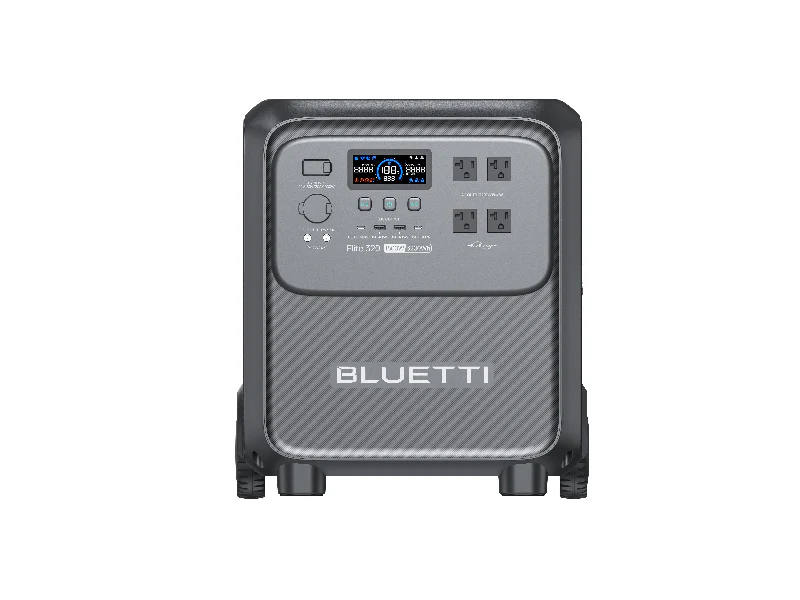
Ten pounds you carry with two fingers. Seventy-five pounds you roll, and then you find somebody else's two hands for the tailgate or the basement stairs. The 320's wheels and telescoping handleB2 solve flat ground and doorways, which is most of home backup and none of the loading.
This is the 30 V2's only structural win and it's a real one. If the unit's job is to leave the house often, 10.3 lbs against 75 changes how many trips it actually comes on. If its job is to sit in a closet until the power goes out, weight is a one-time problem and capacity is a permanent one.
What the Specs Don't Tell You
Selected because: the surge ratio, the warranty row and the missing noise figure all read differently from the way they look in the table.
The surge row rewards reading twice. The 30 V2's 1,500W ceiling on a 600W continuous rating is 2.5x of headroom, against the 320's 1.5x (2,700 over 1,800), and the small unit still loses every startup fight that matters. A compressor draws watts, not multiples.
The missing noise number on the 320 is a documentation gap, not a finding. What can be said is that the unit likely to end up beside your bed is the 10-pound one, and that's the one with both a published figure and hands-on reviewer descriptions of how the fan behavesA4A5A6.
Strengths & trade-offs
BLUETTI Elite 30 V2
Strengths
- +Costs $861 less
- +Lighter by 64.7 lb
Trade-offs
- –Weaker inverter (-1,200W) limits appliance compatibility.
BLUETTI Elite 320
Strengths
- +Larger battery capacity
- +Higher AC output
- +Faster solar charging
Trade-offs
- –Substantially more expensive (+$861) than the Elite 30 V2.
- –Significantly heavier (+64.7 lbs), making it harder to move.
Will It Power Your Gear?
Scenario math and per-appliance runtimes, modeled from the spec record.
Scenario verdicts
We ran the math on seven real-world scenarios. Here's which unit survives your actual life.
SCN-01 · 2 nights · needs 2,100Wh
Weekend Camping
Two nights off-grid with essential comfort
Elite 320
2,100Wh across a weekend is 77% of the Elite 320's usable pack, so you drive home with something left and nobody rations Saturday night. The same weekend on the Elite 30 V2 means draining and refilling it more than eight times between Friday and Sunday, which is a chore with a battery attached rather than a power supply.
Battery budget usedlower = more headroom
LOAD Phone Charger 15W×6h · LED Lights 40W×8h · Box Fan 75W×14h · CPAP Machine 40W×16h
SCN-02 · 8 hours · needs 1,645Wh
8-Hour Blackout
Keep the essentials running through a night without power
Elite 320
1,645Wh over eight hours uses 60% of the Elite 320's usable capacity, so the lights come back before the battery gives out and you spend the evening not thinking about it. The Elite 30 V2 brings 245 usable watt-hours to a 1,645Wh problem: that's a phone-charging companion during an outage, not a way through one.
Battery budget usedlower = more headroom
LOAD Fridge 150W×8h · Router + Modem 20W×8h · LED Lights (4 bulbs) 40W×6h · Phone Charger 15W×3h
SCN-03 · 8 hours · needs 320Wh
CPAP Overnight
Sleep therapy without interruption — the #1 medical use case
Elite 320
The Elite 320 finishes this night at 12% used, the kind of margin where you stop checking the screen. The Elite 30 V2 doesn't finish it at all. 320Wh of overnight draw against 245Wh of usable battery is over the line rather than near it, and there's no setting that closes a gap measured in watt-hours.
Battery budget usedlower = more headroom
LOAD CPAP Machine 40W×8h
SCN-04 · 8 hours · needs 910Wh
Remote Workday
Full work day off-grid without power anxiety
Elite 320
The Elite 30 V2 doesn't finish — 245Wh usable against the 910Wh this needs leaves it 665Wh short, about 27% of the scenario covered. The Elite 320 covers it with 1,810Wh to spare.
Battery budget usedlower = more headroom
LOAD Laptop 60W×8h · External Monitor 30W×8h · Router + Modem 20W×8h · Phone Charger 15W×2h
SCN-05 · 4 hours · needs 670Wh
Tailgate Party
Game day power for the crew
Elite 320
The Elite 30 V2 doesn't finish — 245Wh usable against the 670Wh this needs leaves it 425Wh short, about 36% of the scenario covered. The Elite 320 covers it with 2,050Wh to spare.
Battery budget usedlower = more headroom
LOAD Blender 400W×0.5h · LED TV (55") 80W×4h · Bluetooth Speaker 15W×4h · Phone Charger (×3) 45W×2h
SCN-06 · 24 hours · needs 4,685Wh
Van Life Daily
A full day of mobile living — the ultimate endurance test
Neither unit
Neither unit covers a 4,685Wh day, and it isn't a near-run thing: the Elite 320 falls about 1,965Wh short after spending all 2,720 of its usable watt-hours. Putting that much back every day would take 4.7 hours at its full 1,000W solar ceiling, on a pack too small to bank a day's worth anyway. Full-time van power is a wired-in battery bank job, and both of these are the wrong shape for it.
Battery budget usedlower = more headroom
LOAD Mini-Fridge 150W×24h · Laptop 60W×4h · Phone Charger 15W×3h · LED Lights 40W×5h · Fan 75W×8h
SCN-07 · an afternoon · needs 100Wh
Afternoon Off-Grid
Phones and a speaker at the park, beach, or campsite — the small-unit job description
Either unit
This row is here for the Elite 30 V2's class of job: phones and a speaker, 100Wh across an afternoon. Both cover it — the Elite 30 V2 finishes at 41% used, and the Elite 320 barely notices it. For this job the Elite 320's extra capacity is dead weight, not headroom; take the Elite 30 V2 at 10.3 lbs and leave the rest at home.
Battery budget usedlower = more headroom
LOAD Phone Charger (×2) 30W×2h · Bluetooth Speaker 10W×4h
The Load Test
RUNTIME = (Wh × 0.85) ÷ LOAD
None of the scenarios above exactly yours? Build it. Toggle what you'd plug in; both units are tested against the combined draw.
Essentials
Comfort & Convenience
High-Draw Appliances
Test duration
8h
Continuous draw
205W
Projected runtime
For this load: Elite 320 runs 13.3h vs 1.2h.
$1,099.99 list · direct from BLUETTI
Modeled from the spec record — same math as the tables below. Methodology
Runtime by appliance
Real-world runtime estimates for common appliances, modeled at 85% inverter efficiency.¹
Essentials
The basics you need runningscale 0–181.3hComfort & Convenience
Makes off-grid life actually enjoyablescale 0–36.3hHigh-Draw Appliances
These reveal the real limitsscale 0–2.7h¹ Runtime = (capacity × 0.85) ÷ appliance watts. Within each group, all bars share one time scale (the group's longest runtime), so lengths are comparable across appliances; identical runtimes collapse into a single blue/orange bar. Actual runtime varies with battery age, temperature, and simultaneous loads — see methodology.
Conclusion
August 9, 2026
Verdict: the Elite 320, on Power Score margin
Buy the Elite 320 if the power station is meant to replace grid power for any stretch longer than an errand. It carries five of the six load profiles here, the sixth is out of reach for both, and it does that on the same 3,000-cycle rating and the same 5-year warranty as the 30 V2, so nothing about the cheaper unit catches up later. The $861 between $239 and $1,100 buys 2,475 more usable watt-hours (2,720 against 245), which is the difference between charging your phone through an outage and cooking through one. Buy the Elite 30 V2 only if you already know your list is device-sized. At $239 and 10.3 lbs it's the right purchase for that job and a poor substitute for the 320.
Today the Elite 320 is $936.25, $163.74 under its typical $1,099.99. The verdict weighs typical prices, not today's. Prices checked 1 day ago.
Editor-assigned confidence, based on cited owner research and spec analysis.
List prices as of August 9, 2026. The links below open BLUETTI's current price.
$936.25 · direct from BLUETTI
down from $1,100 · 15% below usual
Last checked 1 day ago. Prices move — check before you buy.
or check the Elite 30 V2 price$249.99 list
Written by Ian Schneider, Solar & Off-Grid Tester · Station Arena Test Desk · Updated August 9, 2026
Measured Data
Benchmark scores and the full spec record, side by side.
Benchmark scores
Not rated for both units (minimum threshold unmet): RV Living, Home Backup, CPAP, Food Truck, Apartment Balcony, Camping.
Full specifications
ᵈ Derived: price ÷ rated capacity. See the data behind our comparisons →
Comparison ToolAdd more power stations, side by sideOpen Tool →How these numbers are produced
Numeric verification
Every figure on this page traces to our spec database or arithmetic on it — no estimated numbers.
Owner claims
Statements about owner experience are cited to published reviews — see Sources & Research Notes below.
Runtime model
Runtime = (rated capacity × 0.85 inverter efficiency) ÷ device wattage. Solar recharge estimates assume panels deliver 70% of rated output. Cold weather, battery age, and stacked loads reduce real-world results.
Power Score
Computed from 14 published spec dimensions, weighted per use-case bench. Higher is better; a unit must meet a bench's minimum threshold to be rated.
See the full weight table and data sourcing on our methodology page →Class ranking (the star rating)
Each unit's star score is a category ranking, not customer reviews — no buyer opinions feed it. We score every station on size-independent quality (value, output, portability, endurance, ports, warranty, and more), then percentile-rank it against the other units in its capacity class, so a class-leading compact unit and a class-leading whole-home unit can both earn 5★. Here, Elite 30 V2 rates 4.9/5 (95th percentile of 22 Personal-class units), and Elite 320 rates 4.0/5 (44th percentile of 26 Large-class units).
How the class ranking is computed →Test Notes & Caveats
Hidden gotchas and advantages we spotted that you won't find on the product page.
Ten Pounds You Carry, Seventy-Five You Park
Seventy-five pounds rolls fine across a kitchen floor and up a curb cut on the 320's wheels and telescoping handle. It does not go into a truck bed alone, and it does not go down basement stairs at all without a second person. The Elite 30 V2 is 10.3 lbs, which is a one-hand lift and no planning. Work out which of those two verbs describes your real use before the capacity argument gets a vote.
The Ratio Flatters the Small One
The 30 V2 gets 1,500W of surge on a 600W continuous rating, which is 2.5x of headroom. The 320 gets 2,700W on 1,800W, or 1.5x. The percentage favours the little unit and the outcome doesn't, because a motor at startup draws watts rather than multiples, and 1,500W is where the 30 V2 stops no matter how generous the ratio looks.
Same Five Years, Different Stakes
Both units carry a 5-year warranty, so this row can't break the tie. What it does show is what's being insured: $239 across five years is $48 of hardware a year, against $220 for the Elite 320. Same term, same brand, and only one of them is a bad afternoon if it fails in year four.
No Published Noise Figure for the 320
The Elite 320 has no noise rating in our data and the Elite 30 V2 does, which is a gap in the paperwork rather than evidence about the fan. Weigh it by placement instead: a 75-pound rolling unit lives in a utility room or beside the couch, while the 10-pound one is small enough to end up on a nightstand, and that's where a fan actually costs you sleep. If silence at 3 a.m. is a requirement, ask BLUETTI for the 320's figure before you buy rather than reading the absence as a verdict.
Full record above — the Test Desk pick is the Elite 320.
Check Elite 320 price →or check the Elite 30 V2 priceOwnership Analysis
What happens after you buy — true cost of ownership, brand trust, and growth potential.
Lifetime value
Service lifeyears at one full cycle per day
Lifetime energy delivered
Cost per delivered kWh
│ warranty ends · Reaching the cycle rating means ~80% capacity remains — degraded, not dead.
Analyst note
The Elite 30 V2 is cheaper to buy, but the Elite 320 is cheaper to own. At $0.11/kWh over its lifetime vs $0.28/kWh, the Elite 320's higher cycle life and capacity make each dollar go further over the years. One thing to know reading the table: both carry the same 3,000-cycle rating, so the lifetime rows are sticker price and capacity in disguise — the wear horizon is identical and decides nothing here.
Delivers each lifetime kWh for $0.17 less — check the Elite 320 price →
Growth path
Elite 30 V2
FIXED CAPACITYFixed at 288Wh, with no expansion — so size it for your needs up front rather than planning to add capacity later.
Accepts up to 200W of solar. Limited to a single portable panel.
Limited ports. You'll likely need a power strip or splitter.
Elite 320
FIXED CAPACITYFixed at 3,200Wh — a sealed, complete system rather than a starting point. There's no expansion port, so that figure is the ceiling: check it against your longest unplugged stretch before you buy.
Accepts up to 1,000W of solar. Enough for a serious multi-panel array.
Adequate ports for most setups, but heavy users may want a power strip.
Realistic full solar rechargeat 70% of rated panel output — see methodology
Analyst note
Neither expands, and that's no knock on either — each is a complete unit at a fixed size. Buy the capacity that covers your needs now (the Elite 320 gives you the larger ceiling); you can't add to either later.
What Owners Report
Patterns from published owner reports and long-term reviews — every claim cited to its source below.
BLUETTI Elite 30 V2
No owner threads exist for this unit yet. What's on record comes from review-site testing, much of it on units BLUETTI supplied, and the longest stretch anyone describes is a few months of work trips and camping with no failuresA1A9A16. Read the enthusiasm with that in mind.
The consistent finding across three separate reviewers is that it's quiet: near-silent on light loads, with the fan only announcing itself at higher wattage, and one write-up putting it under 30 dBA4A5A6. The consistent complaint is the button layout, since you arm the AC or DC rail before anything charges. One long-term reviewer called that an unnecessary step; another simply documented it as how the unit worksA7A8. Runtime under sustained heavy editing came in below expectations for one reviewer, who put it down to the 288Wh pack rather than any defectA9.
Two details worth having before you buy: the advertised charge times held up in hands-on testing rather than only on the boxA11A12, and there's no IP rating, so it lives in the tent or the truck rather than out in the rainA14.
“The smartphone app works great allowing for customizing the settings and keeping track of the unit's status.”
BLUETTI Elite 320
There is no field experience on the Elite 320 to report. Every entry in our ledger traces back to the CES 2026 launch materials or coverage built from them, including the capacity, the 10ms UPS, the wheels and telescoping handle, and the 'over 66 hours of refrigeration' figureB1B2B3B4. Nobody has published an outage they actually got through with one.
One number to hold loosely: those launch write-ups quote a 3,600W peak alongside the 2,700W lifting figure we trackB1. Until somebody measures it under load, plan your startup surges around 2,700W and treat the bigger number as a headline.
“A 3,200Wh LiFePO4 battery delivering 1,800W continuous (2,700W Power Lifting, 3,600W peak), with 10ms UPS protection — a suitcase-style rolling home-backup station introduced at CES 2026.”
Sources
prnewswire.com · rv.com · notebookcheck.net · ussolarsupplier.com · finance.yahoo.co
Sources & Research Notes
Every owner claim in this report is traceable to a published source. The bracketed references above resolve here.
Recurring owner themes
- Multiple independent reviewers, testing separately over several months, consistently describe the unit as very quiet even under load, with the fan only noticeably kicking in at higher wattages. [Elite 30 V2 · 3 entries]
- Impressions of the companion app are inconsistent between reviewers — one calls the UI rough/basic while another says it works great for monitoring and customization. [Elite 30 V2 · 2 entries]
- BLUETTI's advertised fast-charging claims (turbo to 80% in ~45 min, full charge in roughly 70 minutes to 2 hours) were verified as accurate in hands-on testing rather than just marketing numbers. [Elite 30 V2 · 2 entries]
- The three separate physical power buttons (main/DC/AC) create an extra step in normal use that at least one long-term user found unnecessary, though another reviewer described it neutrally as just how BLUETTI designs its units. [Elite 30 V2 · 2 entries]
- Reviewers who kept the unit for extended field use (months, not just an initial test) report continued satisfaction and no durability failures, despite the unit lacking a formal IP rating. [Elite 30 V2 · 2 entries]
- Large 3,200Wh LFP capacity, wheeled mobility, 10ms UPS, and affordable home-backup positioning are the standout points. [Elite 320 · 3 entries]
- A1
“My only criticism of the app is that it doesn't look overly slick and maybe a bit agricultural; it's functional but a bit rough compared to many apps.”
Digital Reviews Network — 'BLUETTI Elite 30 V2 Review: Portable Power Station with 140W USB-C & UPS for Glamping' · 2025-12 · [negative]
- A4
“It is nearly silent when charging and when powering things like iPhones and Macs. The fan inside will kick on under higher loads, but it's still not unreasonably loud. I can hear it, but it's a noise I could sleep through.”
MacRumors — 'Bluetti Elite 30 V2 Review: A Lightweight Portable Power Station for Camping and Backup Power' · 2025-12 · [positive]
- A5
“It doesn't make much noise, which is a good thing when you're relaxing or trying to sleep.”
AllOutdoor — 'AllOutdoor Review – BLUETTI Elite 30 V2 Power Station' · 2026-07 · [positive]
- A6
“The device ran quietly, under 30 dB, so it didn't interrupt the peaceful outdoors.”
TheGadgetFlow — 'Bluetti Elite 30 V2 review: more than a mini power station, coming up at CES 2026' · 2026-01 · [positive]
- A7
“The separate AC/DC button felt a bit pointless and added an extra step when quickly turning the outputs on or off.”
AllOutdoor — 'AllOutdoor Review – BLUETTI Elite 30 V2 Power Station' · 2026-07 · [negative]
- A8
“When you plug something in, you have to turn on power to the appropriate port before charging will begin. It's also a good idea to turn it off when you're done to ensure there's no power drain.”
MacRumors — 'Bluetti Elite 30 V2 Review: A Lightweight Portable Power Station for Camping and Backup Power' · 2025-12 · [mixed]
- A9
“The battery life in real-world use was a little less than I expected when doing demanding editing, but that's to be expected with its small 288Wh capacity.”
AllOutdoor — 'AllOutdoor Review – BLUETTI Elite 30 V2 Power Station' · 2026-07 · [negative]
- A10
“If the mains power goes down, it switches to battery power in less than 10 milliseconds, and that was reassuring in cabins where the electricity was a bit patchy.”
AllOutdoor — 'AllOutdoor Review – BLUETTI Elite 30 V2 Power Station' · 2026-07 · [positive]
- A11
“Turbo mode can get you up to 80% in about 45 minutes, while a full charge on standard takes 2 hours and silent takes 3. I have to say those times are pretty accurate based on my usage.”
The Gadgeteer — 'Bluetti Elite 30 V2 portable power station review - Petite portable power to keep the party going' · 2025-10 · [positive]
- A12
“Plugged into a standard outlet, the Elite 30 V2 fully recharged surprisingly quickly in about 70 minutes. That's perfect for last-minute prep before a camping trip.”
TheGadgetFlow — 'Bluetti Elite 30 V2 review: more than a mini power station, coming up at CES 2026' · 2026-01 · [positive]
- A13
“I filled the kettle and fired it up. Within a few seconds the kettle was drawing 476 watts... I've never been able to use the Joulle kettle with a 288Wh power station before.”
The Digital Story — 'The Bluetti Elite 30 V2 Portable Power Station Review' · 2025-09 · [positive]
- A14
“This station lacks an official IP rating for water or dust resistance, so it's best stored inside a tent or vehicle rather than left exposed during rainstorms.”
BackupPowerHub — 'BLUETTI Elite 30 V2 Review: Best Ultra-Portable Under $250 in 2026?' · 2026 · [mixed]
- A16
“After using the BLUETTI Elite 30 V2 Portable Power Station for months on work and camping, I've found it to be a very good and handy piece of equipment that is pretty affordable.”
AllOutdoor — 'AllOutdoor Review – BLUETTI Elite 30 V2 Power Station' · 2026-07 · [positive]
- B1
“A 3,200Wh LiFePO4 battery delivering 1,800W continuous (2,700W Power Lifting, 3,600W peak), with 10ms UPS protection — a suitcase-style rolling home-backup station introduced at CES 2026.”
prnewswire.com / rv.com — Elite 320 review · 2026 · [positive]
- B2
“Weighs about 75 lbs with oversized shock-absorbing wheels and a retractable telescoping handle for easy transport around the home.”
rv.com / notebookcheck.net — Elite 320 review · 2026 · [positive]
- B3
“The big 3,200Wh LFP battery lasts over a decade and provides over 66 hours of refrigeration — up to two days of essential household power — via four AC outlets, dual USB-A, and two USB-C (140W and 100W).”
rv.com / ussolarsupplier.com — Elite 320 review · 2026 · [positive]
- B4
“Positioned as affordable, essential home backup at a $1,199.99 MSRP.”
prnewswire.com / finance.yahoo.com — Elite 320 launch · 2026 · [positive]
Research compiled August 9, 2026.
Who Should Buy Which
Buy the Elite 30 V2 if you…
- →You want power you can carry in one hand. At 10.3 lbs the 30 V2 comes out of the trunk with two fingers and goes wherever you were already walking, and that is honestly the whole argument for it.
- →Your list is device-shaped: phones, a laptop, camera batteries, string lights. 245 usable watt-hours covers a weekend of that, and it refills from a wall outlet faster than you can pack the carA12.
- →You want a desk UPS more than a backup battery. The 10ms switchover keeps a workstation alive through the flicker that reboots everything else, and one reviewer specifically valued that in cabins with unreliable mainsA10.
Buy the Elite 320 if you…
- →You're buying for outages. An eight-hour blackout profile draws 1,645Wh, which is 60% of the 320's usable pack, so the lights come back before the battery gives out and you never had to ration anything.
- →You need 1,800W continuous to be the entry ticket rather than the ceiling. A 2,700W lifting figure starts equipment the 600W unit can only look at.
- →You'd rather buy the ceiling once. Neither model expands, so the 3,200Wh you pay for is the 3,200Wh you own for all 3,000 cycles.
If neither fits
Anyone whose day genuinely looks like the van-life profile here should close both tabs. That's 4,685Wh daily, and the Elite 320 comes up about 1,965Wh short even after spending every one of its 2,720 usable watt-hours, every single day. Refilling that much would need 4.7 hours at its full 1,000W solar ceiling on a pack that can't hold a day's worth in the first place. What you want is a wired-in house battery bank with a proper charge controller, and buying two of these instead is a more expensive version of the same shortfall. At the other end: if the honest list is a phone and a set of lights, a USB power bank does that job for a fraction of $239 and fits in a pocket.
The Bottom Line
Take the Elite 320. Same 3,000-cycle rating, same five-year warranty, same 10ms switchover as the small one, and it's the only unit of the two still running when the load is a night long instead of an hour.
The 30 V2's win is real and it's narrow: you pick it up with one hand. That's worth paying for when the unit's job is to travel, and worth nothing when its job is to sit in a closet until the power goes out. Write down your watt-hours, then buy the one that covers them, because neither of these grows later.
Frequently Asked Questions
Answers drawn from the spec record and cited owner research.
Can the BLUETTI Elite 30 V2 run a CPAP all night?
No. The overnight CPAP profile here draws 320Wh and the 30 V2 holds 245Wh usable (288Wh nameplate, less roughly 15% to inverter losses), so it runs dry before the alarm. The Elite 320 finishes the same night having used about 12% of its pack. If medical equipment is the reason you're shopping, this single row decides the page.
What's the actual difference between the Elite 30 V2 and the Elite 320?
Everything except the badge and the 10ms switchover. It's 288Wh versus 3,200Wh, 600W versus 1,800W continuous, and 10.3 lbs versus roughly 75. These are the two ends of BLUETTI's Elite range, not two interpretations of the same product.
Is the Elite 320 worth $1,100 when the Elite 30 V2 is $239?
If you're buying to replace grid power, yes. Both carry the same 3,000-cycle rating and the same 5-year warranty, so the extra $861 buys about eleven times the lifetime energy rather than a nicer version of the same thing. If you're buying to top up devices, no amount of value math makes the bigger unit the right purchase.
Can you add extra batteries to either one?
Neither expands. Both are sealed at their rated capacity, which isn't a knock on either one since each is a complete unit rather than a starter kit. It does mean you buy for your worst week up front, because there's no adding to them later.
How loud are they?
BLUETTI publishes a noise figure for the 30 V2 and not for the 320. Reviewers describe the small unit as quiet on light loads with the fan only noticeable at higher wattage. For the 320 there's no published or measured figure in our data, so treat it as unknown rather than assuming it either way.
Where to buy
BLUETTI Elite 30 V2
$249.99
$249.99 · direct from BLUETTI
Last checked 1 day ago. Prices move — check before you buy.
BLUETTI Elite 320Pick
$936.25
$936.25 · direct from BLUETTI
down from $1,100 · 15% below usual
Last checked 1 day ago. Prices move — check before you buy.
Prices may vary by retailer and are subject to change.