Head-to-head test
BLUETTI Elite 320 vs BLUETTI Elite 400
The Elite 400 costs $700 more for 640Wh and 800 continuous watts extra — real headroom, but the Elite 320 already covers every scenario a typical buyer runs, for two-thirds the price and two more AC outlets.
Full profiles: BLUETTI Elite 320 → · BLUETTI Elite 400 →

Written by Gunner GustafsonUpdated
Whole-Home Backup Tester, Station Arena Test Desk
$936.25 · direct from BLUETTI
down from $1,100 · 15% below usual
Last checked 1 day ago. Prices move — check before you buy.

$1,299.00 · direct from BLUETTI
down from $1,399 · 7% below usual
Last checked 1 day ago. Prices move — check before you buy.
Spec deltas
$700 separates these two, and $700 buys 640 more watt-hours, 800 more continuous watts, and one specific tradeoff: fewer AC outlets. The Elite 400 is BLUETTI's largest Elite-tier unit, and on paper it wins almost every spec. In practice, it wins fewer decisions than the spec sheet suggests.
Run six real-world loads through both and the story is margin, not capability, for five of them. The Elite 320 already clears camping, blackout, CPAP, remote work, and tailgate loads on its own — the Elite 400 just clears them with more to spare. The one place the gap turns real is continuous wattage: 2,600W against 1,800W, an 800W difference that decides whether certain devices run at all.
The other genuine difference is outlets, and it runs the wrong way for the pricier unit. The Elite 320 ships with four AC sockets; the Elite 400, despite costing more and weighing more, has two.
What the Numbers Reveal
Each conclusion stated first — the numbers behind it on one line, the full analysis below.
The Weekend Camping load needs 2,100Wh. The Elite 320 already covers it using 77% of its capacity — well inside its ceiling. The extra 640Wh on the Elite 400 drops that to 64%, which is more comfort, not a load the Elite 320 was failing to cover.
Elite 320 costs $999, Elite 400 costs $1,399 — $700 moreElite 320 runs $.31 per watt-hour, Elite 400 runs $.44
Why it mattersBuyers whose loads already fit inside 3,200Wh are paying $700 for margin they won't notice; only a buyer whose load actually exceeds the Elite 320's ceiling gets new capability for that money.
Everything else about the Elite 400's premium buys capacity and continuous wattage — outlet count went backward instead of forward, which is the kind of detail a spec sheet buries and a power strip exposes.
Elite 320 ships with four AC outletsA3Elite 400 ships with only two AC sockets, flagged by reviewers as a compromiseB4
Why it mattersAnyone running several devices at once rather than one big load should count outlets before watt-hours; the cheaper unit wins that count 4-to-2.
continuous output
Paired with a disclosed 30dB noise rating and a 70-minute fast charge reviewers single out as class-leadingB2, the Elite 400 reads like the unit built for someone running real continuous loads, not just topping off a phone overnight.
Elite 400 outputs 2,600W continuous against Elite 320's 1,800W — an 800W gapElite 400 discloses a 30dB noise figure; the Elite 320 publishes none
Why it mattersBuyers who keep hitting a wattage ceiling on the Elite 320 — not just running bigger scenarios, an actual continuous-draw limit — are the ones who should pay the $700.
The specific dimensions that decide these two units — everything else is a tie.
Lifetime Value
Selected because: Cost per watt-hour and cost per lifetime kWh both favor the Elite 320 by a wide, consistent margin.
cost / lifetime kWh
$0.10 per lifetime kilowatt-hour for the Elite 320, $0.15 for the Elite 400 — and the warranty math agrees: $200 a year of ownership against $340, even though both carry the same 5-year warranty. Cost per watt-hour runs $.31 against $.44; going bigger cost more per unit of energy here, not less.
Nothing about running these daily instead of on weekends changes the ranking. The Elite 320 is the better cost-per-Wh buy at every usage rate in this test.
Your Life, Your Pick
Selected because: Most scenarios show margin, not capability, differences — worth explaining directly.
Every scenario the Elite 320 can handle, it handles — the two units differ in margin, not outcome, for five of six loads tested. Weekend Camping: 77% of capacity used against 64%. 8-Hour Blackout: 60% against 50%. Both clear the load either way, so the gap is comfort, not capability.
Van Life Daily is the exception that proves the rule: at 4,685Wh a day, the Elite 400 needs 144% of its capacity and the Elite 320 needs 172% — closer, but neither gets there. If your daily draw is anywhere near that number, look past both of these.
What the Specs Don't Tell You
Selected because: UPS speed, warranty cost, and noise disclosure all fire and split between the two units.
The Elite 320's 10ms UPS switchover edges out the Elite 400's 15ms; both land in the line-interactive tier that protects electronics through the switch to battery, so the 5ms gap is real but rarely decisive. Warranty ties at five years on both, though the Elite 400 costs $140 more per warranty-year to own.
Noise disclosure is the one flag that clearly favors the Elite 400: it publishes 30dB, the Elite 320 publishes nothing. If quiet operation matters to you, that's a known quantity on one side of this page and a guess on the other.
Portability & Form Factor
Selected because: Weight and the outlet-count reversal are both genuine, decision-relevant physical differences.
weight
Both units roll — the Elite 320 on oversized wheels with a telescoping handleA2, the Elite 400 on a built-in trolleyB2. Weight tips toward the Elite 320 by about 10 lbs (74.96 against 85), though neither is a unit you carry up a flight of stairs solo.
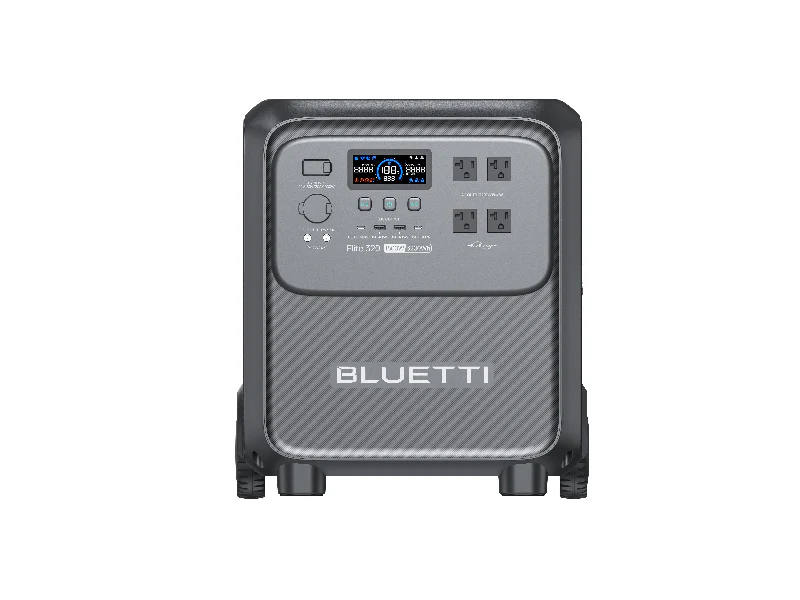
The stranger number is outlets. The Elite 400 costs $700 more and weighs 10 lbs more, and it gives you two fewer places to plug things in — four AC sockets on the Elite 320 against two on the Elite 400, a compromise reviewers flagged directlyA3B4. Running several devices at once rather than one big load, that count matters more than the extra watt-hours.
Strengths & trade-offs
BLUETTI Elite 320
Strengths
- +Costs $299 less
- +Lighter by 10 lb
Trade-offs
- –Weaker inverter (-800W) limits appliance compatibility.
BLUETTI Elite 400
Strengths
- +Larger battery capacity
- +Higher AC output
Trade-offs
- –Significantly heavier (+10 lbs), making it harder to move.
- –Very heavy unit that may be difficult for one person to lift.
Will It Power Your Gear?
Scenario math and per-appliance runtimes, modeled from the spec record.
Scenario verdicts
We ran the math on six real-world scenarios. Here's which unit survives your actual life.
SCN-01 · 2 nights · needs 2,100Wh
Weekend Camping
Two nights off-grid with essential comfort
Elite 400
The Elite 320 finishes the weekend at 77% used with 620Wh in hand — one cold night or an extra device eats into that. The Elite 400 finishes at 64% with 1,164Wh, real slack for the spontaneous stuff. If you camp in variable weather, that buffer is the difference between relaxing and watching the battery app.
Battery budget usedlower = more headroom
LOAD Phone Charger 15W×6h · LED Lights 40W×8h · Box Fan 75W×14h · CPAP Machine 40W×16h
SCN-02 · 8 hours · needs 1,645Wh
8-Hour Blackout
Keep the essentials running through a night without power
Elite 400
Both survive the night. The Elite 400 finishes at 50% used with 1,619Wh left — 98% of a second night. The Elite 320 finishes at 60% with 1,075Wh, 65% of a second night. If your outages tend to run past one evening, that difference is the whole argument between them.
Battery budget usedlower = more headroom
LOAD Fridge 150W×8h · Router + Modem 20W×8h · LED Lights (4 bulbs) 40W×6h · Phone Charger 15W×3h
SCN-03 · 8 hours · needs 320Wh
CPAP Overnight
Sleep therapy without interruption — the #1 medical use case
Either unit
A CPAP is about 40W for eight hours, so both cover the night with room to spare and capacity decides nothing. Fan noise would — but Elite 320 doesn't publish a figure, so there's nothing to hold it to. Buy on price, weight, and whether you can live with a fan you haven't heard.
Battery budget usedlower = more headroom
LOAD CPAP Machine 40W×8h
SCN-04 · 8 hours · needs 910Wh
Remote Workday
Full work day off-grid without power anxiety
Either unit
Both power your workstation all day without strain. At these utilization levels the real difference is USB-C for direct laptop charging — 140W on the Elite 320 against 100W — which beats the inverter for convenience and wastes less energy.
Battery budget usedlower = more headroom
LOAD Laptop 60W×8h · External Monitor 30W×8h · Router + Modem 20W×8h · Phone Charger 15W×2h
SCN-05 · 4 hours · needs 670Wh
Tailgate Party
Game day power for the crew
Either unit
Both handle game day easily. Since capacity isn't the deciding factor, weight is: at 75 lbs the Elite 320 is the one you'll be glad you brought. Fan noise under load is worth a listen too — it's audible in the lulls between songs.
Battery budget usedlower = more headroom
LOAD Blender 400W×0.5h · LED TV (55") 80W×4h · Bluetooth Speaker 15W×4h · Phone Charger (×3) 45W×2h
SCN-06 · 24 hours · needs 4,685Wh
Van Life Daily
A full day of mobile living — the ultimate endurance test
Neither unit
Neither unit covers this scenario's 4,685Wh: the Elite 320 comes up 1,965Wh short (about 58% covered), the Elite 400 1,421Wh (69%). Either gets you most of the way, so this is a scenario you plan around rather than one you should rule them out for.
Battery budget usedlower = more headroom
LOAD Mini-Fridge 150W×24h · Laptop 60W×4h · Phone Charger 15W×3h · LED Lights 40W×5h · Fan 75W×8h
The Load Test
RUNTIME = (Wh × 0.85) ÷ LOAD
None of the scenarios above exactly yours? Build it. Toggle what you'd plug in; both units are tested against the combined draw.
Essentials
Comfort & Convenience
High-Draw Appliances
Test duration
8h
Continuous draw
205W
Projected runtime
For this load: Elite 400 runs 15.9h vs 13.3h.
$1,399 list · direct from BLUETTI
Modeled from the spec record — same math as the tables below. Methodology
Runtime by appliance
Real-world runtime estimates for common appliances, modeled at 85% inverter efficiency.¹
Essentials
The basics you need runningscale 0–217.6hComfort & Convenience
Makes off-grid life actually enjoyablescale 0–43.5hHigh-Draw Appliances
These reveal the real limitsscale 0–3.3h¹ Runtime = (capacity × 0.85) ÷ appliance watts. Within each group, all bars share one time scale (the group's longest runtime), so lengths are comparable across appliances; identical runtimes collapse into a single blue/orange bar. Actual runtime varies with battery age, temperature, and simultaneous loads — see methodology.
Conclusion
July 14, 2026
Verdict: the BLUETTI Elite 320
Buy the Elite 320 unless you already know your loads push past 1,800W continuous. It's $700 cheaper, cheaper per lifetime kilowatt-hour, and covers camping, blackouts, CPAP, remote work, and tailgating with capacity to spare. The Elite 400's extra 800 continuous watts and disclosed 30dB noise figure are the two genuine reasons to pay the premium; its bigger battery mostly buys comfort margin on loads the Elite 320 already handles.
Today the Elite 320 is $936.25, $163.74 under its typical $1,099.99 and the Elite 400 is $1,299, $100 under its typical $1,399. The verdict weighs typical prices, not today's. Prices checked 1 day ago.
Editor-assigned confidence, based on cited owner research and spec analysis.
List prices as of July 14, 2026. The links below open BLUETTI's current price.
$936.25 · direct from BLUETTI
down from $1,100 · 15% below usual
Last checked 1 day ago. Prices move — check before you buy.
or check the Elite 400 price$1,299.00 list
Written by Gunner Gustafson, Whole-Home Backup Tester · Station Arena Test Desk · Updated July 14, 2026
Measured Data
Benchmark scores and the full spec record, side by side.
Benchmark scores
Not rated for both units (minimum threshold unmet): Tailgating.
Full specifications
ᵈ Derived: price ÷ rated capacity. See the data behind our comparisons →
Comparison ToolAdd more power stations, side by sideOpen Tool →How these numbers are produced
Numeric verification
Every figure on this page traces to our spec database or arithmetic on it — no estimated numbers.
Owner claims
Statements about owner experience are cited to published reviews — see Sources & Research Notes below.
Runtime model
Runtime = (rated capacity × 0.85 inverter efficiency) ÷ device wattage. Solar recharge estimates assume panels deliver 70% of rated output. Cold weather, battery age, and stacked loads reduce real-world results.
Power Score
Computed from 14 published spec dimensions, weighted per use-case bench. Higher is better; a unit must meet a bench's minimum threshold to be rated.
See the full weight table and data sourcing on our methodology page →Class ranking (the star rating)
Each unit's star score is a category ranking, not customer reviews — no buyer opinions feed it. We score every station on size-independent quality (value, output, portability, endurance, ports, warranty, and more), then percentile-rank it against the other units in its capacity class, so a class-leading compact unit and a class-leading whole-home unit can both earn 5★. Here, Elite 320 rates 4.0/5 (44th percentile of 26 Large-class units), and Elite 400 rates 3.8/5 (27th percentile of 16 Home Backup-class units).
How the class ranking is computed →Test Notes & Caveats
Hidden gotchas and advantages we spotted that you won't find on the product page.
Weight Reality Check
Neither unit is grab-and-go. The Elite 320 (75 lbs) is manageable solo but heavier than a large checked suitcase. The Elite 400 (85 lbs) is noticeably heavier. That's a 10 lb difference.
Elite 400: Power Lifting to 3,900W
The Elite 400 has BLUETTI's Power Lifting mode, which runs a resistive appliance rated up to 3,900W from its 2,600W inverter. It does that by delivering less power than the appliance asks for, not more than the inverter has: the heater still works, it just heats more slowly. Two things follow. BLUETTI scopes the mode to purely resistive loads — a heater, a kettle, an incandescent lamp — so it does nothing for a fridge compressor, a pump or a power tool, and this record publishes no surge figure at all, so read the mode as a resistive-load feature rather than as starting ability. And it is not a reason to size down, because running a load that big from 3,840Wh is a short session either way. Genuinely useful if a heater or a kettle is why you're buying; beside the point otherwise. The Elite 320 publishes no equivalent.
Both cross into UPS-safe territory, one just a bit faster
10ms on the Elite 320 against 15ms on the Elite 400 — both fall in the line-interactive tier that protects sensitive electronics through the switch to battery. The 5ms gap is real but unlikely to be the deciding factor for most buyers.
Warranty: No Difference
Both units carry the same 5-year warranty, so coverage isn't a tiebreaker here. Both figures are maximums rather than guarantees — they depend on buying direct from BLUETTI or registering the unit, since reseller purchases carry a shorter term. Worth saying because the per-dollar framing can suggest otherwise: the Elite 320 works out at 4.5 years of cover per $1,000 spent against the Elite 400's 3.6, but that spread is the price gap, not the terms.
The Elite 400 tells you what you're getting into
30dB is a real, disclosed number — quiet enough to sit near overnight. The Elite 320 doesn't publish a noise figure, so buyers sensitive to fan noise are choosing on incomplete information.
Full record above — the Test Desk pick is the Elite 320.
Check Elite 320 price →or check the Elite 400 priceOwnership Analysis
What happens after you buy — true cost of ownership, brand trust, and growth potential.
Lifetime value
Service lifeyears at one full cycle per day
Lifetime energy delivered
Cost per delivered kWh
│ warranty ends · Reaching the cycle rating means ~80% capacity remains — degraded, not dead.
Analyst note
Both units have similar long-term ownership costs ($0.11/kWh vs $0.12/kWh). The price difference is what you see on the sticker — neither is a hidden bargain or rip-off. One thing to know reading the table: both carry the same 3,000-cycle rating, so the lifetime rows are sticker price and capacity in disguise — the wear horizon is identical and decides nothing here.
Growth path
Elite 320
FIXED CAPACITYFixed at 3,200Wh — a sealed, complete system rather than a starting point. There's no expansion port, so that figure is the ceiling: check it against your longest unplugged stretch before you buy.
Accepts up to 1,000W of solar. Enough for a serious multi-panel array.
Adequate ports for most setups, but heavy users may want a power strip.
Elite 400
FIXED CAPACITYFixed at 3,840Wh — a sealed, complete system rather than a starting point. There's no expansion port, so that figure is the ceiling: check it against your longest unplugged stretch before you buy.
Accepts up to 1,000W of solar. Enough for a serious multi-panel array.
Adequate ports for most setups, but heavy users may want a power strip.
Realistic full solar rechargeat 70% of rated panel output — see methodology
Analyst note
Neither expands, and that's no knock on either — each is a complete unit at a fixed size. Buy the capacity that covers your needs now (the Elite 400 gives you the larger ceiling); you can't add to either later.
What Owners Report
Patterns from published owner reports and long-term reviews — every claim cited to its source below.
BLUETTI Elite 320
The Elite 320 launched positioned as affordable, essential home backup — a $1,199.99 MSRP at introduction that's since settled closer to $999A4. Reviewers keep circling back to the fundamentals: 3,200Wh of LFP behind 1,800W continuous output and 10ms UPS protection, plus four AC outlets, dual USB-A, and two USB-C portsA1A3. At around 75 lbs, the oversized wheels and telescoping handle make it easy to roll from room to roomA2.
“A 3,200Wh LiFePO4 battery delivering 1,800W continuous (2,700W Power Lifting, 3,600W peak), with 10ms UPS protection — a suitcase-style rolling home-backup station introduced at CES 2026.”
Sources
prnewswire.com · rv.com · notebookcheck.net · ussolarsupplier.com · finance.yahoo.co
BLUETTI Elite 400
The Elite 400 is BLUETTI's largest Elite-tier unit — 3,840Wh of LFP behind 2,600W continuous output, fixed at that capacity with no expansion pathB1. Reviewers call it one of the most complete units at the 3,000Wh-plus tier: a 70-minute fast charge, 15ms UPS protection, and a built-in trolley for moving its extra weightB2. That completeness comes with two flagged compromises — just two AC sockets, and a heftier roughly 86 lbs that reviewers note is still lighter than some rivalsB3B4.
“BLUETTI's largest Elite-range unit — a 3,840Wh LiFePO4 battery with 2,600W continuous output (3,900W Power Lifting), fixed at native capacity with no expansion.”
Sources
techradar.com · amazon.com · backuppowerhub.com · cleantechnica.com · notebookcheck.net · thesolarlab.com · edinburghnews.scotsman.co
Sources & Research Notes
Every owner claim in this report is traceable to a published source. The bracketed references above resolve here.
Recurring owner themes
- Large 3,200Wh LFP capacity, wheeled mobility, 10ms UPS, and affordable home-backup positioning are the standout points. [Elite 320 · 3 entries]
- Large 3,840Wh LFP capacity, fast charging, 15ms UPS, and a trolley are the praise; only two AC sockets, no expansion, and heavy weight are the caveats. [Elite 400 · 2 entries]
- A1
“A 3,200Wh LiFePO4 battery delivering 1,800W continuous (2,700W Power Lifting, 3,600W peak), with 10ms UPS protection — a suitcase-style rolling home-backup station introduced at CES 2026.”
prnewswire.com / rv.com — Elite 320 review · 2026 · [positive]
- A2
“Weighs about 75 lbs with oversized shock-absorbing wheels and a retractable telescoping handle for easy transport around the home.”
rv.com / notebookcheck.net — Elite 320 review · 2026 · [positive]
- A3
“The big 3,200Wh LFP battery lasts over a decade and provides over 66 hours of refrigeration — up to two days of essential household power — via four AC outlets, dual USB-A, and two USB-C (140W and 100W).”
rv.com / ussolarsupplier.com — Elite 320 review · 2026 · [positive]
- A4
“Positioned as affordable, essential home backup at a $1,199.99 MSRP.”
prnewswire.com / finance.yahoo.com — Elite 320 launch · 2026 · [positive]
- B1
“BLUETTI's largest Elite-range unit — a 3,840Wh LiFePO4 battery with 2,600W continuous output (3,900W Power Lifting), fixed at native capacity with no expansion.”
techradar.com / amazon.com — Elite 400 review · 2026 · [mixed]
- B2
“Combines 3,840Wh LFP capacity, 3,900W surge, 70-minute fast charging, 15ms UPS protection, and a built-in trolley system — one of the most complete units at the 3,000Wh+ tier in 2026.”
backuppowerhub.com / cleantechnica.com — Elite 400 review · 2026 · [positive]
- B3
“A hefty ~86 lbs (39 kg), though reviewers note it's lighter than some competitors, with wheels and a trolley for mobility.”
notebookcheck.net / thesolarlab.com — Elite 400 review · 2026 · [mixed]
- B4
“Powerful, but reviewers flag only two AC sockets and no battery expansion as compromises — good but not quite as good as it could have been.”
techradar.com / edinburghnews.scotsman.com — Elite 400 review · 2026 · [mixed]
Research compiled July 14, 2026.
Who Should Buy Which
Buy the Elite 320 if you…
- →Buyers whose loads already fit comfortably inside 3,200Wh — camping, blackouts, CPAP, remote work — where the Elite 320 covers the load with room to spare.
- →Anyone who wants more places to plug things in at once: four AC sockets against the Elite 400's two.
Buy the Elite 400 if you…
- →Buyers who keep hitting a continuous-wattage ceiling — running something close to or past 1,800W steady — where the extra 800W is a real capability unlock, not just comfort margin.
- →Anyone who wants a disclosed, verifiably quiet operating number: 30dB against the Elite 320's undisclosed figure.
If neither fits
Anyone running full van-life daily loads, around 4,685Wh a day, should skip both — even the bigger Elite 400 needs 144% of its capacity for that load and doesn't reach it.
The Bottom Line
The Elite 320 wins this one on value: it's $700 cheaper, covers every scenario a typical buyer actually runs, and gives you two more outlets to plug into. The Elite 400 earns its premium only when the load is the kind that pushes past 1,800W continuous — that 800W gap is the one difference here that's a real capability unlock rather than comfort margin.
Buy the Elite 320 unless you already know your loads need that extra continuous wattage.
Frequently Asked Questions
Answers drawn from the spec record and cited owner research.
Is the BLUETTI Elite 400 worth $700 more than the Elite 320?
Only if you're regularly running something close to or above 1,800W continuous — the Elite 400's extra 800W is the one difference here that's a real capability gap, not just comfort margin. For camping, blackouts, CPAP, and remote work, the Elite 320 already covers the load.
Which one has more AC outlets, the Elite 320 or the Elite 400?
The Elite 320, by two. It ships with four AC outlets against the Elite 400's two — reviewers specifically flagged the Elite 400's outlet count as a compromise given its size and price.
Which one is quieter, the Elite 320 or the Elite 400?
The Elite 400 is the only one with a disclosed noise figure — 30dB. The Elite 320 doesn't publish a number, so there's no verified answer for it either way.
Do either the Elite 320 or Elite 400 support battery expansion?
No. Both are closed systems — 3,200Wh is the Elite 320's ceiling and 3,840Wh is the Elite 400's. Whichever you buy, make sure it covers your needs for the next several years, because neither has an add-on battery.
Where to buy
BLUETTI Elite 320Pick
$936.25
$936.25 · direct from BLUETTI
down from $1,100 · 15% below usual
Last checked 1 day ago. Prices move — check before you buy.
BLUETTI Elite 400
$1,299.00
$1,299.00 · direct from BLUETTI
down from $1,399 · 7% below usual
Last checked 1 day ago. Prices move — check before you buy.
Prices may vary by retailer and are subject to change.