Head-to-head test
BLUETTI Elite 200 V2 vs DJI Power 2000
Six cents per lifetime kilowatt-hour against sixteen: these two hold the same charge, and the DJI's real gifts — refill speed, five fewer pounds, an expansion port — have to be worth $400 and a shorter rated life to win.
Full profiles: BLUETTI Elite 200 V2 → · DJI Power 2000 →

Written by Gunner GustafsonUpdated
Whole-Home Backup Tester, Station Arena Test Desk

$849.00 · direct from BLUETTI
down from $899 · 6% below usual
Last checked 1 day ago. Prices move — check before you buy.
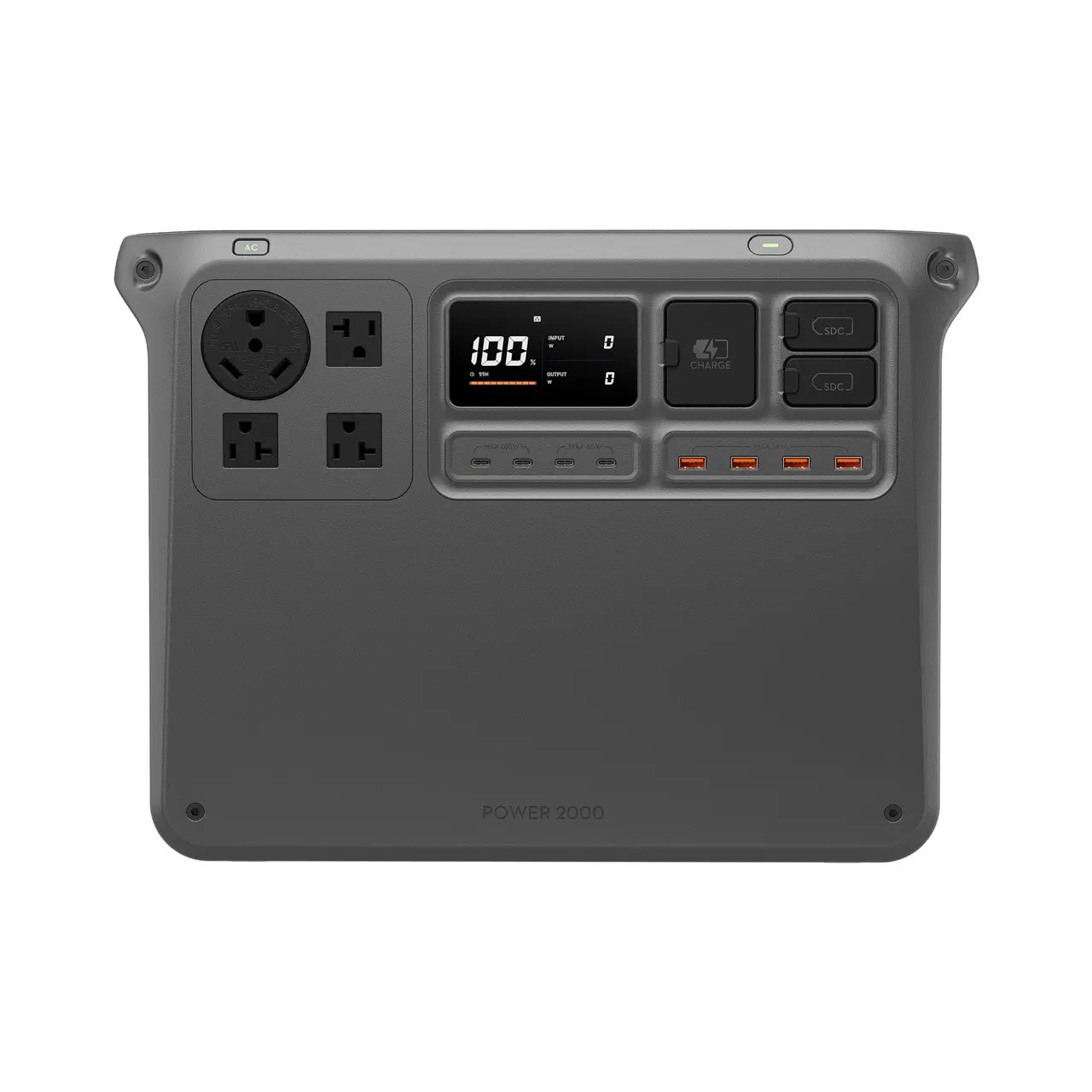
$1,299.00 · direct from DJI
Last checked 1 day ago. Prices move — check before you buy.
Spec deltas
Take the BLUETTI Elite 200 V2 and keep the $400. These two boxes store the same energy — 2,073.6Wh against the DJI's 2,048 — but the Elite costs $899 to the Power 2000's $1,299 and is rated for 6,000 charge cycles to its 4,000. You are being asked to pay more for the version that holds the same charge and retires earlier.
And yet the DJI is the nicer machine in most of the ways you can touch. It pushes 3,000W continuous to the Elite's 2,600W, drinks 1,800W of solar to the Elite's 1,000W, carries 4.9 lbs less, fast-charges laptops at 140W, and accepts expansion batteries while the Elite is sealed for life. Reviewers clocked its wall charge at around 90 minutesB1. None of that is marketing; it's just priced at $1,299.
The Elite's answer is arithmetic: the same tank, $400 less money, and half again the rated lifespan. The DJI has to win on features because it cannot win on math — and for most buyers, the math is the product.
What the Numbers Reveal
Each conclusion stated first — the numbers behind it on one line, the full analysis below.
rated cycles
Multiply capacity by cycles and the Elite is rated for 12,442 kWh of lifetime throughput to the DJI's 8,192 — which prices out to $0.06 per lifetime kilowatt-hour against $0.16. Every category the DJI wins is a convenience. This one is the purchase itself.
Elite 200 V2: $899, rated 6,000 cycles, 2,073.6WhPower 2000: $1,299, rated 4,000 cycles, 2,048Wh
Why it mattersUnless a specific DJI feature is on your must-have list, the value question is settled before you reach the scenarios.
solar input
From empty, the DJI's 1,800W input is a bit over an hour of strong sun (2,048Wh at 1,800W); the Elite's 1,000W cap makes the same refill roughly a two-hour job (2,073.6Wh at 1,000W). Reviewers confirmed the DJI's speed in practice, clocking full wall charges in around an hour and a halfB1. The catch: that 1,800W only exists once you've bought DJI's adapter — the unit doesn't take panels directly.
Power 2000: 1,800W max solar input; Elite 200 V2: 1,000WThe 8-Hour Blackout scenario drains 94% of the DJI's usable energy and 93% of the Elite'sThe DJI has no built-in solar charge controller — panels connect through a separate proprietary adapter
Why it mattersIf your outages run days and your panel array is serious, this is the one honest argument for the extra $400 — just put the adapter in the cart with it.
continuous output
In one bench test the Elite held a 3,000W surge for over two minutes, beyond its own continuous ratingA7, and testers report the DJI took surges in stride as wellB4. Both will start fridge-class loads. The DJI's extra 400W only earns its keep on sustained draws between 2,600W and 3,000W — space-heaters-plural territory.
Power 2000: 3,000W continuous output, with no surge rating listed in our spec dataElite 200 V2: 2,600W continuous, 3,900W surgeFridge and AC compressors surge to 2-3x their rated draw at startup
Why it mattersIf your biggest load is a fridge, a griddle, or a power tool, the DJI's flashiest spec-sheet win changes nothing for you.
Look at the Van Life Daily scenario — 4,685Wh, more than double either tank — and the difference turns concrete: the DJI can stack expansion batteries toward a real number, while the Elite's only move is a second checkout. The wager is that DJI's two-year-old accessory line is still around and growing when you finally need it.
Elite 200 V2: no expansion — sealed at 2,073.6WhPower 2000: accepts DJI expansion batteriesDJI's power lineup launched in 2024 and spans four models
Why it mattersBuyers with growth actually scheduled should flip to the DJI here; buyers with growth as a vibe should keep the difference.
The specific dimensions that decide these two units — everything else is a tie.
Lifetime Value
Selected because: The $400 price gap plus the 2,000-cycle gap is the verdict; lead with the ownership math.
cost / lifetime kWh
Both warranties run five years, so divide the sticker by the coverage: $160 per covered year for the Elite, $260 for the DJI. Same promise, $100 a year more. And the warranty is the short view — the cycle ratings are where the gap compounds, because the cheaper unit is also the one rated to keep working half again as long.
The honest qualifier is cadence. Cycle these only on weekends and both outlive your interest in them — 57.7 years of rated life for the Elite, 38.5 for the DJI — so light users are really just choosing on price. It's daily cyclers, the van setups and off-grid sheds and outage-every-month counties, who collect the full difference. The harder you plan to work these, the more the budget pick saves you. That sentence almost never gets to be true.
Growth Path
Selected because: Expansion is the firing gotcha and the DJI's best counterargument; handle it honestly right after the value case.
solar input
Outgrow the Elite and your upgrade path is the checkout page: it's sealed at 2,074Wh, no expansion port, full stop. The Power 2000 accepts DJI expansion batteries, which turns the same-size tank into a starting bid instead of a final answer. In a matchup this lopsided on price, this is the DJI's structural card, and it's real.
The fine print: DJI's power lineup arrived in 2024 and runs four models deep, so you're wagering tomorrow's capacity needs on a young accessory catalog — and expansion batteries stack their own cost onto the pricier base unit. If growth is real and scheduled, this section outranks the one above it and the DJI is your unit. If growth is hypothetical, you're paying today for an option you may never exercise.
Runtime: Will It Power Your Gear?
Selected because: Capacities are 1% apart — defuse the runtime table fast and redirect to refill speed, where the units genuinely differ.
continuous output
Read the runtime rows as one column: 2,073.6Wh versus 2,048 is a 1% gap, and no fridge, router, or projector will ever surface it. Capacity is not a reason to pick either box.
Refill speed is. The DJI accepts 1,800W of solar to the Elite's 1,000W — from empty, a bit over an hour of strong sun versus about two — and reviewers clocked its wall charge at around 90 minutesB1. The Elite's counterpunch happens after the fill: bench testing found 94% efficiency and a 9.5W idle draw, the best that reviewer had measured at this sizeA5A6, so more of every stored watt-hour reaches your gear. The DJI fills faster; the Elite leaks less.
Brand Trust
Selected because: Cross-brand pair: veteran with support issues vs 2024 newcomer with proprietary locks — buyers will ask.
This is a veteran with a customer-service problem against a prodigy with a two-year resume. BLUETTI runs the broadest lineup in the category, standardizes on long-life LFP across it, and ships a 4.5-star app; its support is also the most inconsistent in the space, with buying direct from BLUETTI improving your odds. DJI arrives from drones with 700-plus battery patents, a global repair network, and build quality a class above — but only four power products and no long-term track record in this category.
The tiebreaker is DJI's proprietary streak. The 1,800W solar headline requires DJI's own adapter, because there's no built-in solar charge controller, and the SDC fast-charge ports serve DJI aircraft rather than your other gear. Own a flight bag full of DJI batteries and the Power 2000 becomes a hub that earns some of its premium. Own none and you're paying for connectors you'll never use. The Elite asks for no such loyalty.
Strengths & trade-offs
BLUETTI Elite 200 V2
Strengths
- +Costs $400 less
- +Larger battery capacity
- +Rated for 6,000 charge cycles — much longer battery lifespan
Trade-offs
- –No major technical downsides compared to rival.
DJI Power 2000
Strengths
- +Lighter by 4.9 lb
- +Higher AC output
- +Faster solar charging
Trade-offs
- –Substantially more expensive (+$400) than the Elite 200 V2.
- –Shorter-lived battery — rated for 4,000 charge cycles vs the Elite 200 V2's 6,000, so it wears out sooner.
Will It Power Your Gear?
Scenario math and per-appliance runtimes, modeled from the spec record.
Scenario verdicts
We ran the math on six real-world scenarios. Here's which unit survives your actual life.
SCN-01 · 2 nights · needs 2,100Wh
Weekend Camping
Two nights off-grid with essential comfort
Neither unit
The weekend budget is 2,100Wh, and after inverter losses neither tank covers it — the trip asks for 119% of the Elite's usable energy and 121% of the DJI's. So this scenario is really about the panel you brought. The DJI accepts 1,800W of solar to the Elite's 1,000W and closes the gap faster in a good sun window; the Elite counters by running quieter at the campsite and costing less to leave out in the weather. Capacity says dead heat; sunlight breaks the tie.
Battery budget usedlower = more headroom
LOAD Phone Charger 15W×6h · LED Lights 40W×8h · Box Fan 75W×14h · CPAP Machine 40W×16h
SCN-02 · 8 hours · needs 1,645Wh
8-Hour Blackout
Keep the essentials running through a night without power
Either unit
Both survive the night, barely: 1,645Wh of fridge, lights, and phones consumes 93% of the Elite's usable energy and 94% of the DJI's. With margins that thin, temperament matters. Both hand off in 10ms, fast enough that a desktop never notices the grid left, and both run quiet in a dark house. If the outage stretches into a second day, the DJI refills from panels nearly twice as fast — provided its solar adapter is already in the drawer. Call it a tie decided by whether your blackouts end in hours or days.
Battery budget usedlower = more headroom
LOAD Fridge 150W×8h · Router + Modem 20W×8h · LED Lights (4 bulbs) 40W×6h · Phone Charger 15W×3h
SCN-03 · 8 hours · needs 320Wh
CPAP Overnight
Sleep therapy without interruption — the #1 medical use case
Elite 200 V2
A CPAP draws about 320Wh overnight — an 18% dent, so either unit delivers five nights and change per charge. The spec that matters lives on the nightstand: the Elite idles at 16dB, the DJI at 30, and both sit closer to a wristwatch than a white-noise machine. The Elite is the one you'll touch to confirm it's on. If sleep is the use case, that's the tiebreak.
Battery budget usedlower = more headroom
LOAD CPAP Machine 40W×8h
SCN-04 · 8 hours · needs 910Wh
Remote Workday
Full work day off-grid without power anxiety
Either unit
A 910Wh workday leaves either unit at about half charge when you log off, so endurance is a tie. The differences live at the margins: the DJI's 140W USB-C feeds a big laptop at full speed where the Elite tops out at 100W, and the Elite hums along more quietly beside your monitor. Pick by port or by silence.
Battery budget usedlower = more headroom
LOAD Laptop 60W×8h · External Monitor 30W×8h · Router + Modem 20W×8h · Phone Charger 15W×2h
SCN-05 · 4 hours · needs 670Wh
Tailgate Party
Game day power for the crew
Either unit
670Wh of TV, speakers, and blender is a 38% draw on either — both drive home with most of a tank. The DJI is the friendlier carry across a parking lot at 48.5 lbs to the Elite's 53.4, and that's the whole difference. On capacity this one is a coin flip, and the beverages don't care which box chilled them.
Battery budget usedlower = more headroom
LOAD Blender 400W×0.5h · LED TV (55") 80W×4h · Bluetooth Speaker 15W×4h · Phone Charger (×3) 45W×2h
SCN-06 · 24 hours · needs 4,685Wh
Van Life Daily
A full day of mobile living — the ultimate endurance test
Neither unit
A 4,685Wh day laps both units — the load runs 266% of the Elite's usable energy and 269% of the DJI's. Only the DJI even has a road toward that number, since it accepts expansion batteries and the Elite is sealed. But building a stack that size out of a two-year-old accessory line is a project, not a purchase. Full-timers should start a size class up and keep boxes like these for the weekend rig.
Battery budget usedlower = more headroom
LOAD Mini-Fridge 150W×24h · Laptop 60W×4h · Phone Charger 15W×3h · LED Lights 40W×5h · Fan 75W×8h
The Load Test
RUNTIME = (Wh × 0.85) ÷ LOAD
None of the scenarios above exactly yours? Build it. Toggle what you'd plug in; both units are tested against the combined draw.
Essentials
Comfort & Convenience
High-Draw Appliances
Test duration
8h
Continuous draw
205W
Projected runtime
Dead heat — both run this 205W load for roughly 8.6h. Pick on price, weight, or ports.
Modeled from the spec record — same math as the tables below. Methodology
Runtime by appliance
Real-world runtime estimates for common appliances, modeled at 85% inverter efficiency.¹
Essentials
The basics you need runningscale 0–117.5hComfort & Convenience
Makes off-grid life actually enjoyablescale 0–23.5hHigh-Draw Appliances
These reveal the real limitsscale 0–1.8h¹ Runtime = (capacity × 0.85) ÷ appliance watts. Within each group, all bars share one time scale (the group's longest runtime), so lengths are comparable across appliances; identical runtimes collapse into a single blue/orange bar. Actual runtime varies with battery age, temperature, and simultaneous loads — see methodology.
Conclusion
July 13, 2026
Verdict: the Elite 200 V2
Same tank, different bills. The Elite 200 V2 matches the Power 2000's capacity within 1%, costs $400 less, and is rated for half again the charge cycles — which is why its rated lifetime energy works out to six cents a kilowatt-hour against the DJI's sixteen. The Power 2000's genuine wins are real: 3,000W output, 1,800W of solar input, a 48.5-lb body, 140W USB-C, and an expansion path the sealed Elite will never have. But those are conveniences and options, and they arrive with caveats of their own — a product line born in 2024, solar only through a proprietary adapter, SDC ports that serve DJI drones and nothing else. Buy the DJI if fast refills, scheduled expansion, or a DJI flight bag is central to your plan. Otherwise this is a $899 unit beating a $1,299 unit at the one thing both were bought to do.
Today the Elite 200 V2 is $849, $50 under its typical $899. The verdict weighs typical prices, not today's. Prices checked 1 day ago.
Editor-assigned confidence, based on cited owner research and spec analysis.
List prices as of July 13, 2026. The links below open BLUETTI's and DJI's current prices.
$849.00 · direct from BLUETTI
down from $899 · 6% below usual
Last checked 1 day ago. Prices move — check before you buy.
or check the Power 2000 price$1,299.00 list
Written by Gunner Gustafson, Whole-Home Backup Tester · Station Arena Test Desk · Updated July 13, 2026
Measured Data
Benchmark scores and the full spec record, side by side.
Benchmark scores
Not rated for both units (minimum threshold unmet): Camping.
Full specifications
ᵈ Derived: price ÷ rated capacity. See the data behind our comparisons →
Comparison ToolAdd more power stations, side by sideOpen Tool →How these numbers are produced
Numeric verification
Every figure on this page traces to our spec database or arithmetic on it — no estimated numbers.
Owner claims
Statements about owner experience are cited to published reviews — see Sources & Research Notes below.
Runtime model
Runtime = (rated capacity × 0.85 inverter efficiency) ÷ device wattage. Solar recharge estimates assume panels deliver 70% of rated output. Cold weather, battery age, and stacked loads reduce real-world results.
Power Score
Computed from 14 published spec dimensions, weighted per use-case bench. Higher is better; a unit must meet a bench's minimum threshold to be rated.
See the full weight table and data sourcing on our methodology page →Class ranking (the star rating)
Each unit's star score is a category ranking, not customer reviews — no buyer opinions feed it. We score every station on size-independent quality (value, output, portability, endurance, ports, warranty, and more), then percentile-rank it against the other units in its capacity class, so a class-leading compact unit and a class-leading whole-home unit can both earn 5★. Here, Elite 200 V2 rates 4.5/5 (72nd percentile of 26 Large-class units), and Power 2000 rates 4.3/5 (56th percentile of 26 Large-class units).
How the class ranking is computed →Test Notes & Caveats
Hidden gotchas and advantages we spotted that you won't find on the product page.
The Elite's Ceiling Is Set at Checkout
There is no expansion port on the Elite 200 V2. Its 2,073.6Wh is the most it will ever hold, and the only upgrade path is a second unit. The Power 2000 accepts DJI expansion batteries, which makes its 2,048Wh a floor instead of a ceiling. Two caveats keep this card from deciding the page: DJI's power lineup launched in 2024, so the accessory catalog is still young, and add-on batteries stack cost onto the pricier base unit. If your loads are growing on a schedule, though, this is the DJI's whole case — and the Elite has no answer to it.
Elite 200 V2: Power Lifting to 3,900W
The Elite 200 V2 has BLUETTI's Power Lifting mode, which runs a resistive appliance rated up to 3,900W from its 2,600W inverter. It does that by delivering less power than the appliance asks for, not more than the inverter has: the heater still works, it just heats more slowly. Two things follow. BLUETTI scopes the mode to purely resistive loads — a heater, a kettle, an incandescent lamp — so it does nothing for a fridge compressor, a pump or a power tool, and this record publishes no surge figure at all, so read the mode as a resistive-load feature rather than as starting ability. And it is not a reason to size down, because running a load that big from 2,074Wh is a short session either way. Genuinely useful if a heater or a kettle is why you're buying; beside the point otherwise. The Power 2000 publishes no equivalent.
Five Years of Coverage, Two Different Bills
Both makers back their unit for five years, which turns the warranty into simple division: the Elite costs $160 per covered year, the DJI $260. That's $100 a year more for an identical promise. Coverage length is a genuine tie; what it protects — your purchase price — is not.
6,000 Cycles vs 4,000, in Real Years
Cycle a battery daily and its rating turns into a calendar: the Elite's 6,000 cycles is a 16.4-year run, the DJI's 4,000 is 11. Both are LFP and both outlast their warranties by years, so occasional users can skim past this card. It exists for the daily cyclers, and it says the cheaper unit is also the one rated to last half again as long — not a sentence you get to write about many product pairs.
Full record above — the Test Desk pick is the Elite 200 V2.
Check Elite 200 V2 price →or check the Power 2000 priceOwnership Analysis
What happens after you buy — true cost of ownership, brand trust, and growth potential.
Lifetime value
Service lifeyears at one full cycle per day
Lifetime energy delivered
Cost per delivered kWh
│ warranty ends · Reaching the cycle rating means ~80% capacity remains — degraded, not dead.
Analyst note
The Elite 200 V2 wins on both sticker price and long-term value. At $0.07/kWh over its lifetime, it's meaningfully cheaper to own. Clear value winner.
Brand trust
BLUETTI
Ecosystem
One of the broadest lineups — 15-20+ models from budget (AC2A) to flagship portable (Apex 300, 2764.8Wh). Includes specialized products: vehicle solar hubs, sodium-ion cold-weather units, and balcony storage systems.
Support
The most inconsistent support in the space. Heavily email-based with China timezone delays. Some users get smooth, efficient service; others report weeks of troubleshooting runarounds, being offered discounts on new units instead of repairs, and confusing third-party purchase claim processes. Buying direct from Bluetti's website tends to produce better support outcomes.
Community
Active and growing — Reddit r/bluetti has a dedicated community. Second-largest after EcoFlow in engagement.
App experience
Rated 4.5/5 iOS and Android — tied for best app experience in the category. V3.0 UI redesign was well-received.
Unique strength
Among the best capacity-to-price ratios available — several Elite and Apex units are the lowest $/Wh in the catalog. Widest product diversity including industry-firsts like sodium-ion cold-weather units and dual solar+alternator vehicle hubs. LFP across the rest of the range, though rated cycle life spans 2,500 (EB3A) to 6,000, and it varies WITHIN the Elite range rather than tracking it — the Elite 300 and Elite 200 V2 are rated 6,000 while the Elite 30 V2, Elite 10 Mini, Elite 320 and Elite 400 are rated 3,000+ and the Elite 100 V2 4,000+, so check the specific model. Dual-voltage (120V/240V) in flagships.
Worth knowing
Support is the asterisk on the value story: BLUETTI's service reputation is the most inconsistent in the category, and buying direct from BLUETTI's own site tends to produce better outcomes than third-party channels. The 4.5-star app and the broadest lineup in the business are the compensations.
DJI
Ecosystem
New entrant (2024) — five power station models to date: Power 500, Power 1000 (since superseded by the V2 but still sold), Power 1000 V2, Power 1000 Mini, Power 2000. Buying a "Power 1000" listing? Check which revision it actually ships.
Support
Leveraging DJI's established global support and repair center network from the drone business. Generally positive reputation inherited from drone operations, but limited power-station-specific track record.
Community
No dedicated power station community yet. Discussions happen within r/dji (~250K members, mostly drone users). Very small power-specific presence on Facebook and forums.
App experience
Rated 3.5/5 iOS and Android (DJI Home app ratings reflect entire DJI ecosystem including drones/cameras, not power-station-specific). Users report the on-device screen is more reliable than the app.
Unique strength
Runs quiet — 23-30dB published on most of the range (manufacturer best-case figures), at the quiet end of the category; our record carries no figure for the Power 1000 V2. Fast wall charging, quickest on the Power 1000 V2 at ~56 min — that figure is the V2's, not the whole line's. 700+ battery patents from drone R&D. SDC ports for ultra-fast DJI drone charging. Premium industrial design and build quality. LFP batteries rated for 4,000+ cycles.
Worth knowing
Two years into power stations, DJI leans proprietary: solar input requires DJI's own adapter rather than a built-in controller, and the SDC fast-charge ports speak only DJI. For drone pilots that's an ecosystem; for everyone else it's a padlock.
Analyst note
A value veteran against a premium newcomer. BLUETTI brings the category's broadest lineup, full LFP standardization, and a strong capacity-per-dollar reputation, dragged on by famously uneven customer support. DJI brings drone-grade battery engineering, a global repair network, and top-tier build quality, limited by a two-year track record and connectors that assume you're staying in the family. Pick your risk: the veteran's support roulette or the newcomer's short resume. The price gap means the veteran's gamble at least comes with change.
Growth path
Elite 200 V2
FIXED CAPACITYFixed at 2,074Wh — a sealed, complete system rather than a starting point. There's no expansion port, so that figure is the ceiling: check it against your longest unplugged stretch before you buy.
Accepts up to 1,000W of solar. Enough for a serious multi-panel array.
Adequate ports for most setups, but heavy users may want a power strip.
Power 2000
EXPANDABLESupports DJI expansion batteries, so you can add capacity later without replacing the base unit — useful if your needs may climb past 2,048Wh.
Accepts up to 1,800W of solar. Enough for a serious multi-panel array.
Generous port selection supports complex multi-device setups.
Expansion batteries are DJI-specific. You're investing in the DJI ecosystem.
Realistic full solar rechargeat 70% of rated panel output — see methodology
Analyst note
Don't read the Power 2000's expandability as a straight win here: it starts at 2,048Wh, below the Elite 200 V2's 2,074Wh, so a first expansion battery largely buys back capacity the Elite 200 V2 already includes. It only pulls ahead if you'd grow past 2,074Wh — short of that, the Elite 200 V2's larger fixed capacity is the simpler value.
What Owners Report
Patterns from published owner reports and long-term reviews — every claim cited to its source below.
BLUETTI Elite 200 V2
Reviewers keep reaching the same verdict from different directions: this is the practical oneA10. One ran it as a weekly energy bank for a van, filling it when the panels produced and living off it when they didn'tA1; another kept a camping fridge cold for days of summer heatA14 and recharged e-bikes on it repeatedly per fillA13. The bench numbers explain the stamina — 94% efficiency and a 9.5W idle draw, the best that lab had measured in this classA5A6 — and it runs whisper-quiet at 16dB under light loadA9. Pushed past its rating, it held a 3,000W surge for over two minutesA7, and its UPS carried a home lab through a real outage without a hiccupA8, with another tester clocking the handoff at 15msA12.
The knocks are small and consistent: no built-in light, which one reviewer cursed while wrangling a 50-plus-pound box by flashlightA3, and an app and accessory ecosystem that still trail Anker and EcoFlowA4. Worth flagging: this is reviewer data, not long-haul owner data. The V2 is recent enough that nobody has years on one yet.
“It bridged the solar gap when panels weren't producing, effectively acting as a weekly "energy bank" I could fill up and live off.”
Sources
thevanconversion.com · thesolarlab.com · storagereview.com · dustinabbott.net · nsmb.com
DJI Power 2000
The Power 2000's reviews are short on complaints. Testers put a full wall charge at about 90 minutes, some measuring closer to an hour, and a full solar refill at a bit over an hour on its 1,800W inputB1. It stayed near-silent under load, just under 30dB from five feet awayB2, and the build drew as much praise as the speed: flame-retardant materials, 26 temperature sensors, and a frame rated to hold a one-ton static loadB3. Everything reviewers plugged in, it ran — surges includedB4.
What the record can't offer is time. DJI has only been building power stations since 2024, so there are no second-winter reports, no cycle-count anecdotes, no support-ticket sagas, good or bad. The early record is genuinely strong; it's also only two years deep.
“Among the fastest-charging tested — a full wall charge in about 90 minutes (reviewers measured even faster, roughly an hour), and up to 1,800W of solar input for a full solar charge in about 75 minutes.”
Sources
bobvila.com · t3.com · thesolarlab.com · campingsolar.us · protoolreviews.com · greenerideal.com · dronexl.co
Sources & Research Notes
Every owner claim in this report is traceable to a published source. The bracketed references above resolve here.
Recurring owner themes
- Multiple independent reviewers report the near-instant UPS switchover works reliably for continuous device uptime during outages. [Elite 200 V2 · 2 entries]
- Reviewers who measured it independently found best-in-class efficiency and very low idle power draw for a unit of this size. [Elite 200 V2 · 2 entries]
- Owners/testers praise real-world off-grid runtime — charging e-bikes, running fridges, powering laptops/appliances for extended periods. [Elite 200 V2 · 3 entries]
- The two consistent nitpicks are the missing built-in light/flashlight and an app/ecosystem experience that lags behind Anker and EcoFlow. [Elite 200 V2 · 2 entries]
- Value proposition is repeatedly framed as 'practical rather than flashy' — strong price-to-spec ratio, though less competitive outside the US market. [Elite 200 V2 · 2 entries]
- Standout fast charging (wall and 1800W solar), near-silent operation, and an unusually robust safety-focused build are the consistent praise. [Power 2000 · 3 entries]
- A1
“It bridged the solar gap when panels weren't producing, effectively acting as a weekly "energy bank" I could fill up and live off.”
thevanconversion.com — BLUETTI Elite 200 V2 In-Depth Review: The Best Portable Power Station for Vanlife? · 2026-04 · [positive]
- A3
“For a 50+ pound unit that requires two hands to carry, it's frustrating to fumble around in the dark with a flashlight and heavy power station.”
thesolarlab.com — Bluetti Elite 200 V2 Review: A Solid Comeback? · unknown · [negative]
- A4
“It still lacks the refinement and ecosystem support that we've recently seen from EcoFlow and Anker, and the app experience could definitely be improved.”
thesolarlab.com — Bluetti Elite 200 V2 Review: A Solid Comeback? · unknown · [negative]
- A5
“Even the idle power draw was impressive, coming in at just 9.5W per hour, which is also the lowest we've seen on a unit this size.”
thesolarlab.com — Bluetti Elite 200 V2 Review: A Solid Comeback? · unknown · [positive]
- A6
“The efficiency came in at 94%, which is the highest we've ever seen in a portable power station.”
thesolarlab.com — Bluetti Elite 200 V2 Review: A Solid Comeback? · unknown · [positive]
- A7
“Even when we pushed the thing beyond its inverter's 2,600W limit, it was able to sustain a 3,000W surge for over 2 minutes.”
thesolarlab.com — Bluetti Elite 200 V2 Review: A Solid Comeback? · unknown · [positive]
- A8
“The BLUETTI Elite 200 V2 kept everything operational throughout the entire outage. It's not merely a backup solution; it provides true resilience to the home lab.”
storagereview.com — Portable Power Meets Lab-Grade Reliability: BLUETTI Elite 200 V2 Review · 2025-04 · [positive]
- A9
“Even under operation, it's whisper-quiet at just 16 dB under small loads, making it ideal for off-grid setups, RVs, or quiet workstations.”
storagereview.com — Portable Power Meets Lab-Grade Reliability: BLUETTI Elite 200 V2 Review · 2025-04 · [positive]
- A10
“The Elite 200 V2 isn't sexy…but it sure is practical! It's the most powerful portable unit I've tested.”
dustinabbott.net — Bluetti Elite 200 V2 Portable Power Station Review · 2025-03 · [positive]
- A12
“The UPS function can kick in within 15ms and take over powering duties for me as the iMac sips at an average 50-100w of power.”
nsmb.com — Bluetti Elite 200 V2 and Handsfree 2 Power Stations reviewed · unknown · [positive]
- A13
“The Elite 200 V2, with its 2,073.6Wh capacity, can charge the eebs a couple of times over before depleting its reserves.”
nsmb.com — Bluetti Elite 200 V2 and Handsfree 2 Power Stations reviewed · unknown · [positive]
- A14
“The Elite can power a 35-quart fridge in the heat of the summer for a few days.”
nsmb.com — Bluetti Elite 200 V2 and Handsfree 2 Power Stations reviewed · unknown · [positive]
- B1
“Among the fastest-charging tested — a full wall charge in about 90 minutes (reviewers measured even faster, roughly an hour), and up to 1,800W of solar input for a full solar charge in about 75 minutes.”
bobvila.com / t3.com — DJI Power 2000 review · 2025-2026 · [positive]
- B2
“One of the quietest power stations tested — only about 29 dB at 5 feet when the fan kicked in, virtually silent, and it stayed among the quietest units even under the heaviest loads.”
bobvila.com / thesolarlab.com — DJI Power 2000 review · 2025-2026 · [positive]
- B3
“Built with an eightfold protection system — flame-retardant materials, a nano-coated BMS, 26 temperature sensors, 21 fuses, and structural reinforcement rated to support a one-ton static load — positioning it as one of the safest, most robust units on the market.”
campingsolar.us / protoolreviews.com — DJI Power 2000 review · 2025-2026 · [positive]
- B4
“Ran everything reviewers threw at it, handled surges consistently, and recharged incredibly fast, especially from solar; deep integration for DJI drone users is a unique advantage.”
greenerideal.com / dronexl.co — DJI Power 2000 review · 2025-2026 · [positive]
Research compiled July 13, 2026.
What Owners Actually Report
Drawn from 108 comments on independent review channels — not from retailer reviews, which skew to the first week of ownership. Each line is our summary of one commenter's claim, linked to the original. We record what they said, including where it contradicts the spec sheet.
BLUETTI Elite 200 V2
24 claims from 18 comments · 18 from owners · 7 with figures
- Price & value
- 8 · 15% negative
- Runtime
- 3 · 0% negative
- Warranty & support
- 3 · 0% negative
- Solar input
- 3 · 6% negative
- Other
- 2 · 55% negative
What owners complain about
Displays 107W in and out while watt-meters read 58.6W in and 60.44W out.
App & firmwaremeasuredowner3 agreedsource →
PV priority mode does not hold off AC charging as set; suspects deliberately flattering data.
Otherowner3 agreedsource →
Bought it for $950 two months ago and says it now lists at $1,699 as tariffs kick in.
Price & valuemeasuredownerafter 2 monthssource →
What owners praise
Elite 200 V2 plus one 450W panel covers his 3.5kWh per day trailer needs.
Runtimemeasuredowner14 agreedsource →
At $700-750 on Black Friday it beats the Delta 3 Max at the same 2kW/2kWh class.
Price & valuemeasuredowner1 agreedsource →
Accepts the 25.6V battery over the solar input without issue.
Solar inputowner4 agreedsource →
DJI Power 2000
143 claims from 90 comments · 58 from owners · 5 with figures
- App & firmware
- 24 · 42% negative
- Other
- 21 · 36% negative
- Build quality
- 25 · 72% negative
- Durability
- 11 · 100% negative
- Warranty & support
- 8 · 34% negative
What owners complain about
With the expansion battery he only gets 2800Wh on DC.
Runtimemeasuredownersource →
DJI told him all Power 2000 units have an EMI issue with no fix; his Mac Mini coil-whined.
Build qualityowner5 agreedsource →
3600W surge is not bad but lower than some comparable units.
Inverter & surgemeasuredownersource →
What owners praise
Claims are weighted by how specific they are, whether the commenter owns the unit, and how many readers agreed. Comments that mention a product under a rival's review count for more, because the commenter had no reason to be there. This is what buyers report, not our test results — for measurements we ran ourselves, see the methodology.
Who Should Buy Which
Buy the Elite 200 V2 if you…
- →You want stored energy at the lowest cost per year of ownership: $899, 6,000 rated cycles, and a five-year warranty that works out to $160 per covered year.
- →It will sleep in your bedroom or hum behind your desk: 16dB at light load is quiet enough to check by hand, and the 10ms switchover keeps a CPAP or desktop alive when the grid blinks.
- →You want panels without a parts list — solar plugs straight into the Elite's 1,000W input, with no proprietary adapter between you and the sun.
Buy the Power 2000 if you…
- →Your recharge windows are short: 1,800W of solar input refills the DJI in roughly the time the Elite gets halfway.
- →You already fly DJI drones — the SDC fast-charge ports and shared ecosystem turn brand lock-in into an actual feature.
- →You expect to outgrow 2kWh: DJI expansion batteries raise the ceiling, while the Elite's is fixed at purchase.
- →You'll carry it weekly and charge big laptops: 48.5 lbs against 53.4, and 140W USB-C against 100W.
If neither fits
Full-time van dwellers and whole-home preppers. A van-life day runs 4,685Wh — more than double what either box delivers — and even the DJI would need multiple expansion batteries on day one to reach it. Shop a size class up, or a purpose-built dual-battery van system, and keep units this size for the weekend rig.
The Bottom Line
The Power 2000 is the better grab-and-go machine: lighter by 4.9 lbs, nearly twice the solar throughput, 140W USB-C, and the only expansion path in this matchup. If one of those is the feature your setup actually hinges on, pay the $1,299 with a clear conscience.
Everyone else is buying stored electricity, and the Elite 200 V2 sells it cheaper in every direction that compounds: less money today, a longer rated life, quieter while it works. Take the Elite — and let the leftover $400 buy the panel the DJI assumed you already had.
Frequently Asked Questions
Answers drawn from the spec record and cited owner research.
Is the DJI Power 2000 worth $400 more than the BLUETTI Elite 200 V2?
For most buyers, no. The two store essentially identical energy (2,048Wh vs 2,073.6Wh), and the DJI's premium buys speed and convenience — 1,800W solar input, a wall charge reviewers clocked around 90 minutes, 4.9 fewer pounds, 140W USB-C, and an expansion option — not more battery or more life. The Elite is rated for 2,000 more cycles and costs $400 less. Pay the premium only if fast refills, expansion, or DJI drone integration is a requirement rather than a nice-to-have.
Which is quieter, the BLUETTI Elite 200 V2 or the DJI Power 2000?
The Elite, though both are unusually quiet. Its light-load noise spec is 16dB — functionally silent — while the DJI's is 30dB, and testers measured the DJI just under that with the fan running. For a nightstand CPAP or a shared bedroom, take the Elite; in any other room, either disappears.
Can the Elite 200 V2 or the DJI Power 2000 power a weekend camping trip?
Not quite on battery alone. Our weekend profile budgets 2,100Wh, which works out to 119% of the Elite's usable energy and 121% of the DJI's — both fall just short after inverter losses. A solar panel closes the gap easily: the DJI swallows up to 1,800W of panel input (through DJI's proprietary adapter), while the Elite takes up to 1,000W plugged straight in. Or drop one appliance from the packing list and either makes it.
Does the DJI Power 2000 have a built-in solar charge controller?
No. Panels connect only through DJI's separate proprietary solar adapter, so budget for that accessory if solar is part of your plan. With it, the ceiling is a class-leading 1,800W, and reviewers recorded a full solar refill in a bit over an hour. The Elite 200 V2 needs no adapter and accepts up to 1,000W directly.
Which lasts longer, the Elite 200 V2 or the DJI Power 2000?
The Elite, by rating: 6,000 cycles to the DJI's 4,000, which at a full cycle every day is 16.4 years against 11. Both are LFP chemistry with five-year warranties, so neither is fragile — the Elite simply has more trips in the tank, and bench testing measured it wasting less per trip, at 94% efficiency.
Brand matchup
BLUETTI vs DJI: measured across every matchup →Where to buy
BLUETTI Elite 200 V2Pick
$849.00
$849.00 · direct from BLUETTI
down from $899 · 6% below usual
Last checked 1 day ago. Prices move — check before you buy.
DJI Power 2000
$1,299.00
$1,299.00 · direct from DJI
Last checked 1 day ago. Prices move — check before you buy.
Prices may vary by retailer and are subject to change.