Head-to-head test
EcoFlow DELTA 3 Max Plus vs DJI Power 2000
DJI wants $100 more for the same battery, the same inverter, and the same warranty. That premium gets earned back by exactly two buyers: serious solar users and DJI drone pilots. Everyone else is buying the EcoFlow.
Full profiles: EcoFlow DELTA 3 Max Plus → · DJI Power 2000 →
Looking for a different matchup? EcoFlow DELTA 3 Max vs DJI Power 2000

Written by Gunner GustafsonUpdated
Whole-Home Backup Tester, Station Arena Test Desk

$1,199.00 · direct from EcoFlow
Last checked 1 day ago. Prices move — check before you buy.
$1,299.00 · direct from DJI
Last checked 1 day ago. Prices move — check before you buy.
Spec deltas
Strip the badges off and you've bought the same machine twice: 2,048Wh of LFP battery, a 3,000W inverter, 4,000 rated cycles, a five-year warranty, a 10-millisecond switchover, the same 30dBA noise rating. The EcoFlow DELTA 3 Max Plus lists at $1,199. The DJI Power 2000 lists at $1,299.
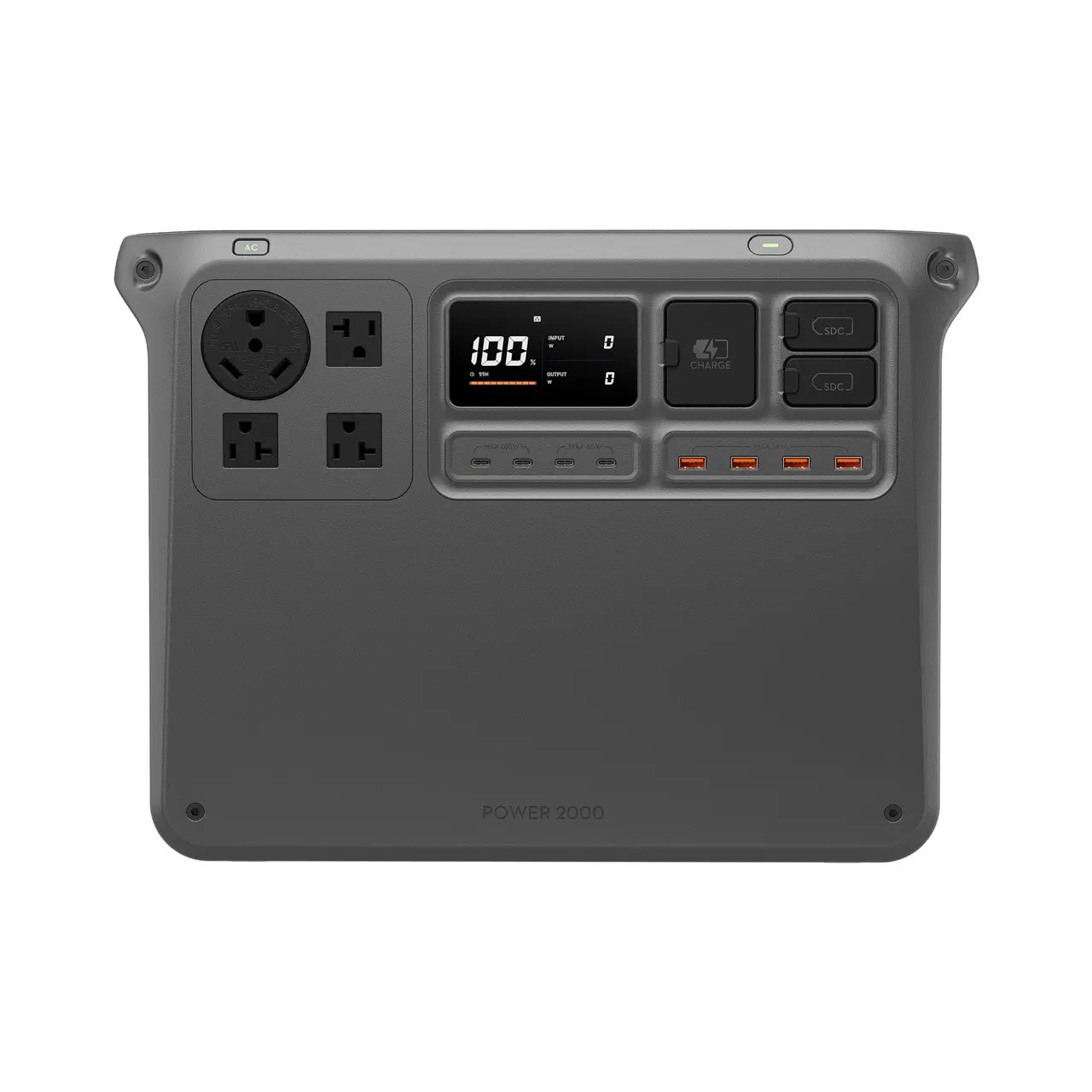
What DJI's extra $100 buys is real but narrow. The Power 2000 accepts 1,800W of solar to the EcoFlow's 1,000W, pushes 140W over USB-C to the EcoFlow's 100W, weighs 2.2 lbs less, and carries DJI's drone-bred build quality. What it doesn't buy is a single additional watt-hour, watt, cycle, or year of coverage. And two of those advantages arrive with strings attached: the solar input runs through a separate proprietary adapter because there's no built-in charge controller, and the SDC fast-charge ports only speak to DJI's own gear.
So our pick is the EcoFlow, and for the typical buyer it isn't close: identical lifetime energy at 12 cents per lifetime kilowatt-hour against 16 settles a comparison this symmetrical. The DJI isn't a bad unit at a bad price — it's an excellent unit at the wrong price for most people, with two specific buyers who should pay it anyway. Most of this page is about finding out whether you're one of them.
What the Numbers Reveal
Each conclusion stated first — the numbers behind it on one line, the full analysis below.
Typical price
With throughput locked, the door price is the only lever left, and it moves everything by the same amount: the DJI costs about a third more per lifetime kilowatt-hour and a third more per year of warranty coverage, for the same cells, the same inverter class, and the same paper.
Both units: 2,048Wh capacity, 3,000W output, 4,000 rated cycles, five-year warrantyEcoFlow $1,199 vs DJI $1,299Identical lifetime throughput: 2,048Wh × 4,000 cycles = 8,192kWh each
Why it mattersIf you're buying stored energy per dollar — and most people cross-shopping these two are — the EcoFlow wins before either box is out of the carton.
solar input
But the headline needs its asterisk: that 1,800W arrives only through a proprietary adapter you must buy, pack, and not lose, where the EcoFlow's input is plug-and-play. The speed is real — reviewers verified itB1 — and from a wall outlet the two units finish within about 20 minutes of each other anywayA3B1.
DJI solar ceiling 1,800W vs EcoFlow 1,000WReviewers clocked a full DJI solar charge in about 75 minutesB1DJI has no built-in solar charge controller — panels connect through a separate proprietary adapter
Why it mattersSerious solar users have the one honest performance case for the premium. Everyone who recharges from an outlet should skip the solar column entirely.
Fold in the proprietary SDC ports and the proprietary solar adapter, and the Power 2000's long-term story is a bet that a two-year-old product line keeps getting investment. EcoFlow's side needs no bet — the batteries exist, the panels exist, and reviewers describe the expansion experience as polished and effortlessA4.
Both spec sheets say expandableEcoFlow's Smart Extra Batteries already ship, scaling the Max Plus to five times its base capacityA4DJI entered power stations in 2024 and has no expansion battery ecosystem yet
Why it mattersIf you're buying 2kWh today because you might need 6kWh in two years, treat EcoFlow's expansion as real and DJI's as a roadmap.
The EcoFlow hands you a number to plan around: 6,000W of surge, enough to start a fridge and a sump pump on the same bad evening without doing anxiety arithmetic. The DJI very likely copes — reviewers report it handled every surge they threw at itB4 — but handled-ours is an anecdote, and EcoFlow prints a rating.
8-Hour Blackout scenario: both units pass at 94% of usable capacityEcoFlow publishes a 6,000W surge rating, double its continuous outputDJI lists no surge figure in our spec data; fridge and AC compressors briefly pull 2-3× their running draw at startup
Why it mattersEmergency-prep buyers who want compressor starts guaranteed in writing just found one more reason to keep the $100.
The specific dimensions that decide these two units — everything else is a tie.
Lifetime Value
Selected because: Identical throughput plus a $100 price gap makes cost-per-lifetime-kWh the verdict's engine.
cost / lifetime kWh
Every dollar of the DJI's higher price is pure premium: identical energy, identical rated life, identical warranty term, so nothing in the lifetime math ever gives the $100 back. You pay about a third more for every kilowatt-hour these units will ever store and for every year of coverage they carry. If the DJI were the cheaper unit this page would flip — that's how evenly matched the hardware is. It isn't, and it doesn't.
Growth Path
Selected because: The computed rec favors DJI's solar ceiling while battery expansion favors EcoFlow — both growth axes need one honest treatment.
solar input
If growth means solar, the recommendation above is right and the DJI has the stronger path: an 80% higher input ceiling is the difference between a panel array you'll outgrow and one you won't, and it's the best argument on this page for paying DJI's premium. Take it seriously if panels are the plan. Just budget for the proprietary adapter that stands between the port and your panels, because the charge controller isn't built in.
If growth means capacity, the ledger flips. Both units accept expansion batteries on paper; the difference is that EcoFlow's Smart Extra Batteries exist, ship, and stack todayA4, while DJI's expansion line is still a stub two years into the category. A port is not a growth path until something plugs into it.
Brand Trust
Selected because: Cross-brand maturity gap: EcoFlow's ecosystem and community vs DJI's 2024 entry; also where EcoFlow's recall and paywall history get named.
EcoFlow's edge is time and scale: the largest lineup in portable power, the largest owner community in the category, and an accessory bench deep enough that the thing you'll want in year three probably already exists. It comes with warts we'd rather name than bury. Support experiences are polarized, the company recalled the older DELTA Max 2000 in October 2025 for overheating, and it tested subscription paywalls for app features in early 2025 before backlash paused the plan. None of that touches this unit; all of it belongs in your file on the company.
DJI is the opposite profile: world-class hardware pedigree and a global repair network inherited from the drone business, with almost no power-station history of its own. Two years into the category its accessory shelf is thin, its community is mostly drone pilots, and its app trails EcoFlow's by a wide margin. Buying the Power 2000 means betting DJI stays serious about this category. Decent odds — but the EcoFlow buyer doesn't have to place the bet.
Your Life, Your Pick
Selected because: All six scenarios tie at identical percentages — say so explicitly so readers stop hunting for a runtime winner.
Six scenarios, six identical scores. When two units share a battery and an inverter, the runtime table turns into a mirror: both clear a blackout with the same slim margin, both loaf through a CPAP night and a remote workday, and both miss a full camping weekend and van-life duty by exactly the same distance. Capacity will never separate these two.
So read each card for its tiebreak instead — surge paper for the blackout, the USB-C port for the workday, a couple of pounds for the tailgate. Where neither unit covers the load, the honest answer is an expansion battery or a bigger class of machine, and only one of these brands can sell you the expansion battery this afternoon.
Strengths & trade-offs
EcoFlow DELTA 3 Max Plus
Strengths
- +Costs $100 less
Trade-offs
- –No major technical downsides compared to rival.
DJI Power 2000
Strengths
- +Lighter by 2.2 lb
- +Faster solar charging
Trade-offs
- –No major technical downsides compared to rival.
Will It Power Your Gear?
Scenario math and per-appliance runtimes, modeled from the spec record.
Scenario verdicts
We ran the math on six real-world scenarios. Here's which unit survives your actual life.
SCN-01 · 2 nights · needs 2,100Wh
Weekend Camping
Two nights off-grid with essential comfort
Neither unit
A full weekend's 2,100Wh overruns both boxes by the same fifth — identical capacity means identical shortfall, so neither earns the win here. Either one finishes the trip with a panel working the daytime shift, or with an expansion battery, and only one of these brands can actually sell you that battery today. Campers at this scale should let that break the tie, not capacity.
Battery budget usedlower = more headroom
LOAD Phone Charger 15W×6h · LED Lights 40W×8h · Box Fan 75W×14h · CPAP Machine 40W×16h
SCN-02 · 8 hours · needs 1,645Wh
8-Hour Blackout
Keep the essentials running through a night without power
Either unit
Both units clear the eight-hour night with the same six percent to spare — a pass, but a pass on fumes, so don't get ambitious with the space heater. Since capacity and switchover are dead even, the tiebreak is startup paper: the EcoFlow publishes a surge rating at double its continuous output for hard-starting compressors, and the DJI publishes none.
Battery budget usedlower = more headroom
LOAD Fridge 150W×8h · Router + Modem 20W×8h · LED Lights (4 bulbs) 40W×6h · Phone Charger 15W×3h
SCN-03 · 8 hours · needs 320Wh
CPAP Overnight
Sleep therapy without interruption — the #1 medical use case
Either unit
A CPAP sips well under a fifth of either battery overnight, and both carry the same 30dBA rating, so neither fan has a reason to wake you. This is the truest tie on the page. Coin flips go to the cheaper coin.
Battery budget usedlower = more headroom
LOAD CPAP Machine 40W×8h
SCN-04 · 8 hours · needs 910Wh
Remote Workday
Full work day off-grid without power anxiety
Either unit
About half a battery runs your desk for the day on either unit, so the real tiebreak is the laptop port: the DJI pushes 140W over USB-C to the EcoFlow's 100W. If your machine actually drinks 140W, this is the one scenario where the DJI earns a concrete, daily-felt point.
Battery budget usedlower = more headroom
LOAD Laptop 60W×8h · External Monitor 30W×8h · Router + Modem 20W×8h · Phone Charger 15W×2h
SCN-05 · 4 hours · needs 670Wh
Tailgate Party
Game day power for the crew
Either unit
Either box runs the TV and the slow cooker deep into the fourth quarter at just over a third of capacity. The only difference your Saturday will notice is the carry: the DJI is 2.2 lbs lighter across the parking lot. Everything else about game day is a tie.
Battery budget usedlower = more headroom
LOAD Blender 400W×0.5h · LED TV (55") 80W×4h · Bluetooth Speaker 15W×4h · Phone Charger (×3) 45W×2h
SCN-06 · 24 hours · needs 4,685Wh
Van Life Daily
A full day of mobile living — the ultimate endurance test
Neither unit
A van-life day wants more than double what either unit holds, so no winner exists here — it's a category error, not a matchup. If this is your load, you need a bigger base unit or a system built around expansion batteries from day one, and it's worth knowing EcoFlow's expansion line is shipping today while DJI's hasn't arrived yet.
Battery budget usedlower = more headroom
LOAD Mini-Fridge 150W×24h · Laptop 60W×4h · Phone Charger 15W×3h · LED Lights 40W×5h · Fan 75W×8h
The Load Test
RUNTIME = (Wh × 0.85) ÷ LOAD
None of the scenarios above exactly yours? Build it. Toggle what you'd plug in; both units are tested against the combined draw.
Essentials
Comfort & Convenience
High-Draw Appliances
Test duration
8h
Continuous draw
205W
Projected runtime
Dead heat — both run this 205W load for roughly 8.5h. Pick on price, weight, or ports.
Modeled from the spec record — same math as the tables below. Methodology
Runtime by appliance
Real-world runtime estimates for common appliances, modeled at 85% inverter efficiency.¹
Essentials
The basics you need runningscale 0–116.1hComfort & Convenience
Makes off-grid life actually enjoyablescale 0–23.2hHigh-Draw Appliances
These reveal the real limitsscale 0–1.7h¹ Runtime = (capacity × 0.85) ÷ appliance watts. Within each group, all bars share one time scale (the group's longest runtime), so lengths are comparable across appliances; identical runtimes collapse into a single blue/orange bar. Actual runtime varies with battery age, temperature, and simultaneous loads — see methodology.
Conclusion
July 13, 2026
Verdict: the DELTA 3 Max Plus
Spec for spec these are twins. Same capacity, same output, same cycle life, same warranty, same switchover, so the matchup collapses to price, and the EcoFlow wins it by $100. The gap only widens from there: EcoFlow publishes a surge rating at double its continuous output where DJI lists none, its solar input is plug-and-play where DJI's requires a proprietary adapter, and its expansion batteries are shipping product where DJI's ecosystem is still a promise. The Power 2000 earns its premium for exactly two buyers: solar users who'll actually feed its 1,800W input and DJI drone pilots who'll use its SDC fast-charge ports. Everyone else is paying extra for build quality they'll never bill against.
Editor-assigned confidence, based on cited owner research and spec analysis.
List prices as of July 13, 2026. The links below open EcoFlow's and DJI's current prices.
$1,199.00 · direct from EcoFlow
Last checked 1 day ago. Prices move — check before you buy.
or check the Power 2000 price$1,299.00 list
Written by Gunner Gustafson, Whole-Home Backup Tester · Station Arena Test Desk · Updated July 13, 2026
Measured Data
Benchmark scores and the full spec record, side by side.
Benchmark scores
Not rated for both units (minimum threshold unmet): Camping.
Full specifications
ᵈ Derived: price ÷ rated capacity. See the data behind our comparisons →
Comparison ToolAdd more power stations, side by sideOpen Tool →How these numbers are produced
Numeric verification
Every figure on this page traces to our spec database or arithmetic on it — no estimated numbers.
Owner claims
Statements about owner experience are cited to published reviews — see Sources & Research Notes below.
Runtime model
Runtime = (rated capacity × 0.85 inverter efficiency) ÷ device wattage. Solar recharge estimates assume panels deliver 70% of rated output. Cold weather, battery age, and stacked loads reduce real-world results.
Power Score
Computed from 14 published spec dimensions, weighted per use-case bench. Higher is better; a unit must meet a bench's minimum threshold to be rated.
See the full weight table and data sourcing on our methodology page →Class ranking (the star rating)
Each unit's star score is a category ranking, not customer reviews — no buyer opinions feed it. We score every station on size-independent quality (value, output, portability, endurance, ports, warranty, and more), then percentile-rank it against the other units in its capacity class, so a class-leading compact unit and a class-leading whole-home unit can both earn 5★. Here, DELTA 3 Max Plus rates 4.2/5 (52nd percentile of 26 Large-class units), and Power 2000 rates 4.3/5 (56th percentile of 26 Large-class units).
How the class ranking is computed →Test Notes & Caveats
Hidden gotchas and advantages we spotted that you won't find on the product page.
Warranty: No Difference
Both units carry the same 5-year warranty, so coverage isn't a tiebreaker here. The Power 2000's figure is a maximum rather than a guarantee — it depends on buying from DJI's own store, which is where the full five years is advertised.
Full record above — the Test Desk pick is the DELTA 3 Max Plus.
Check DELTA 3 Max Plus price →or check the Power 2000 priceOwnership Analysis
What happens after you buy — true cost of ownership, brand trust, and growth potential.
Lifetime value
Service lifeyears at one full cycle per day
Lifetime energy delivered
Cost per delivered kWh
│ warranty ends · Reaching the cycle rating means ~80% capacity remains — degraded, not dead.
Analyst note
Both units have similar long-term ownership costs ($0.15/kWh vs $0.16/kWh). The price difference is what you see on the sticker — neither is a hidden bargain or rip-off. One thing to know reading the table: both carry the same 4,000-cycle rating, so the lifetime rows are sticker price and capacity in disguise — the wear horizon is identical and decides nothing here.
Brand trust
EcoFlow
Ecosystem
The deepest catalog in portable power — a dozen-plus stations plus solar panels and smart home gear — which means the accessory you'll want in year three probably already exists.
Support
US-based phone, email, and chat, with polarized outcomes: plenty of painless prepaid-label replacements, but enough refurb-for-new stories that buying through Costco or Amazon for the stronger return window is the smart hedge.
Community
The largest owner community in the category, including a subreddit around 31K strong — which is who answers your question at 11 p.m. when support is closed.
App experience
Rated 4.6/5 iOS (~8,400 ratings) · 4.2/5 Android (~17,000 ratings)
Unique strength
X-Stream fast charging, the most active release cadence in the space, and an expansion platform that already ships. The Max Plus's growth path is an order button, not an announcement.
Worth knowing
EcoFlow recalled the older DELTA Max 2000 in October 2025 for overheating, and in early 2025 it tested putting advanced app features behind a subscription before community backlash paused the plan. Neither involves this unit; both are fair context on the company.
DJI
Ecosystem
Four power stations, all launched since 2024. The hardware pedigree is real; the catalog around it is still being written, and there's no expansion battery on the shelf yet.
Support
You inherit DJI's global support and repair network from the drone business: genuinely strong infrastructure with a short power-station track record.
Community
No dedicated power-station community yet. You'll be asking drone pilots — r/dji is 250K strong, and most of them are there to talk about flying.
App experience
Rated 3.5/5 iOS and Android (DJI Home app ratings reflect entire DJI ecosystem including drones/cameras, not power-station-specific). Users report the on-device screen is more reliable than the app.
Unique strength
Battery know-how from 700-plus drone-derived patents, near-silent operation, some of the fastest wall charging in the category, and SDC ports that fast-charge DJI flight batteries directly. If you fly DJI, that port can settle this page by itself.
Worth knowing
Solar input requires a separate proprietary adapter (there's no built-in charge controller), the SDC ports only speak DJI, and the app rates a middling 3.5 stars — the on-device screen is the more dependable interface.
Analyst note
This is a maturity gap, not a quality gap. DJI builds excellent hardware and backs it with infrastructure borrowed from a drone empire; EcoFlow has the ecosystem a power station eventually needs — expansion batteries, panels, community, parts — that a 2024 entrant hasn't had time to grow. Buy DJI for the object, EcoFlow for everything that plugs into it.
Growth path
DELTA 3 Max Plus
EXPANDABLESupports EcoFlow expansion batteries, so you can add capacity later without replacing the base unit — useful if your needs may climb past 2,048Wh.
Accepts up to 1,000W of solar. Enough for a serious multi-panel array.
Generous port selection supports complex multi-device setups.
Expansion batteries are EcoFlow-specific. You're investing in the EcoFlow ecosystem.
Power 2000
EXPANDABLESupports DJI expansion batteries, so you can add capacity later without replacing the base unit — useful if your needs may climb past 2,048Wh.
Accepts up to 1,800W of solar. Enough for a serious multi-panel array.
Generous port selection supports complex multi-device setups.
Expansion batteries are DJI-specific. You're investing in the DJI ecosystem.
Realistic full solar rechargeat 70% of rated panel output — see methodology
Analyst note
Both expand, but the Power 2000's higher solar ceiling (1,800W vs 1,000W) gives it the stronger off-grid growth path — more panels can feed a bigger bank as it grows.
What Owners Report
Patterns from published owner reports and long-term reviews — every claim cited to its source below.
EcoFlow DELTA 3 Max Plus
Review coverage of the Max Plus is solid and consistently positive, though long-term owner data is still accumulating — the unit is a recent addition to the DELTA line. Reviewers single out the output and surge bump over the standard DELTA 3 MaxA1, and charging that reached 80% in about 50 minutes and full in roughly 70A3. The quiet is the sleeper detail: even charging at full power, one tester's meter barely registered above room noise from a meter awayA2.
The expansion story draws its own praise: Smart Extra Batteries scale the unit from 2kWh to 10kWh across five charging methods, in a system reviewers describe as polished and effortlessA4.
“Bumps output to 3,000W continuous with a 6,000W surge — a significant upgrade over the DELTA 3 Max's 2,400W and 4,800W surge.”
Sources
storagereview.com · androidguys.com · t3.com · trustedreviews.com
DJI Power 2000
DJI's ledger reads like a very good first impression, which is what it is: the Power 2000 launched into a category DJI only entered in 2024, and multi-year owner data doesn't exist yet. Within that window the praise is uniform. Reviewers measured a full wall charge in about 90 minutes — some closer to an hour — and a full solar refill in about 75B1; noise around 29dB at five feet even under heavy loadB2; and a build with 26 temperature sensors, 21 fuses, and a frame rated to hold a one-ton static loadB3.
Testers ran everything they had at it, surge loads included, without a stumble, and called out the drone-charging integration as a genuine differentiator for DJI pilotsB4. Nothing in the field record argues against this unit. The record is just short.
“Among the fastest-charging tested — a full wall charge in about 90 minutes (reviewers measured even faster, roughly an hour), and up to 1,800W of solar input for a full solar charge in about 75 minutes.”
Sources
bobvila.com · t3.com · thesolarlab.com · campingsolar.us · protoolreviews.com · greenerideal.com · dronexl.co
Sources & Research Notes
Every owner claim in this report is traceable to a published source. The bracketed references above resolve here.
Recurring owner themes
- The Max Plus delivers more output and surge than the Max, plus a larger expansion ceiling, while staying quiet and fast-charging — a polished, higher-power take on the same platform. [DELTA 3 Max Plus · 3 entries]
- Standout fast charging (wall and 1800W solar), near-silent operation, and an unusually robust safety-focused build are the consistent praise. [Power 2000 · 3 entries]
- A1
“Bumps output to 3,000W continuous with a 6,000W surge — a significant upgrade over the DELTA 3 Max's 2,400W and 4,800W surge.”
storagereview.com / androidguys.com — DELTA 3 Max Plus review · 2026 · [positive]
- A2
“Stays genuinely quiet under typical loads, only spinning up its fans briefly during shutdown; even charging at full power the decibel meter barely registered above room noise at one meter.”
t3.com / trustedreviews.com — DELTA 3 Max Plus review · 2026 · [positive]
- A3
“Fast charging — reached 80% in about 50 minutes and full in around 70 minutes.”
t3.com — DELTA 3 Max Plus review · 2026 · [positive]
- A4
“Scalable — supports expandable capacity from 2kWh up to 10kWh via Smart Extra Batteries, with 5 charging methods; reviewers describe it as polished and effortless.”
storagereview.com / t3.com — DELTA 3 Max Plus review · 2026 · [positive]
- B1
“Among the fastest-charging tested — a full wall charge in about 90 minutes (reviewers measured even faster, roughly an hour), and up to 1,800W of solar input for a full solar charge in about 75 minutes.”
bobvila.com / t3.com — DJI Power 2000 review · 2025-2026 · [positive]
- B2
“One of the quietest power stations tested — only about 29 dB at 5 feet when the fan kicked in, virtually silent, and it stayed among the quietest units even under the heaviest loads.”
bobvila.com / thesolarlab.com — DJI Power 2000 review · 2025-2026 · [positive]
- B3
“Built with an eightfold protection system — flame-retardant materials, a nano-coated BMS, 26 temperature sensors, 21 fuses, and structural reinforcement rated to support a one-ton static load — positioning it as one of the safest, most robust units on the market.”
campingsolar.us / protoolreviews.com — DJI Power 2000 review · 2025-2026 · [positive]
- B4
“Ran everything reviewers threw at it, handled surges consistently, and recharged incredibly fast, especially from solar; deep integration for DJI drone users is a unique advantage.”
greenerideal.com / dronexl.co — DJI Power 2000 review · 2025-2026 · [positive]
Research compiled July 13, 2026.
Who Should Buy Which
Buy the DELTA 3 Max Plus if you…
- →You're the typical buyer here: you want the most stored energy per dollar between exactly these two, and the spec twins make that a price contest the EcoFlow wins by $100.
- →You're buying blackout insurance and want the fridge start covered by a printed surge rating, with the option to add a shipping-today expansion battery the week the grid makes you nervous.
- →You want plug-and-play solar and the biggest owner community in the category behind you, so year-three troubleshooting is a forum search instead of a support ticket.
Buy the Power 2000 if you…
- →You fly DJI drones. The SDC ports fast-charge flight batteries straight off the unit — a genuine differentiator reviewers call outB4 — and nothing EcoFlow makes does that. Deep in that ecosystem, this feature alone can settle the page.
- →You're building a serious solar rig, well past 1,000W of panels, and you'll actually use the higher ceiling. Budget for the proprietary adapter and you'll refill at a pace the EcoFlow physically can't match.
- →Your laptop drinks 140W over USB-C, or you want the lighter unit with the tank-grade build reviewers rave aboutB3, and the price gap doesn't move you.
If neither fits
If your daily draw looks like van life — thousands of watt-hours, every single day — both of these are 2kWh boxes you'd be cycling to death. Close this tab cheerfully and shop the 4kWh-and-up class, or a system designed from day one around expansion batteries.
The Bottom Line
Two identical batteries walked in and the cheaper one wins. Every spec that decides what these boxes actually do for you is shared to the digit, so the DJI's case rests on a solar ceiling most buyers won't feed, a laptop port, and a tank of an enclosure — against a $100 bill and an expansion shelf that's still empty.
If you're a DJI pilot or you're building a big solar rig, you're the exception and you already know it: buy the Power 2000 and enjoy it. Everyone else gets the same lifetime of energy from the EcoFlow at three-quarters the cost per kilowatt-hour, from the brand that can already sell you the expansion battery. Take the DELTA 3 Max Plus.
Frequently Asked Questions
Answers drawn from the spec record and cited owner research.
Is the DJI Power 2000 worth $100 more than the EcoFlow DELTA 3 Max Plus?
For most buyers, no. The two match exactly on capacity, output, cycle life, warranty, and switchover speed, so the premium buys DJI's higher solar ceiling, its 140W USB-C port, and its build quality — not more battery. Pay it if you'll genuinely use 1,800W of solar input or you charge DJI drones; otherwise the EcoFlow is the same machine for less.
Which charges faster, the DELTA 3 Max Plus or the DJI Power 2000?
From the wall it's close to a tie: reviewers measured the EcoFlow full in roughly 70 minutes and the DJI in about 90, sometimes closer to an hour. From solar the DJI pulls away — its 1,800W input refilled it in about 75 minutes in testing, where the EcoFlow's 1,000W ceiling means roughly two hours of strong sun (2,048Wh at 1,000W). One catch: the DJI needs its proprietary solar adapter to take panel input at all.
Can these run a refrigerator through a blackout?
Yes, both. Our 8-hour blackout load (fridge plus essentials, about 1,645Wh) fits inside either unit with the same slim margin, and both switch over in 10 milliseconds if you use them as standby power. The EcoFlow adds a published 6,000W surge rating — the spec that guarantees a compressor start — where the DJI lists no surge figure, though reviewers report it handled every surge they tested.
Do the DELTA 3 Max Plus and DJI Power 2000 work as UPS backup?
Both switch over in 10 milliseconds, fast enough that desktop computers, routers, and CPAPs ride through the cutover. Neither is a double-conversion UPS for lab-grade equipment, but for home-office duty they're equivalent. This spec is a dead tie.
Which is quieter, the EcoFlow DELTA 3 Max Plus or the DJI Power 2000?
On paper it's a tie at 30dBA. In reviews, both test near-silent: the DJI measured about 29dB at five feet even under heavy load, and the EcoFlow barely registered above room noise while fast-charging. If this is parking next to your bed for a CPAP, either works — an overnight CPAP uses under a fifth of either battery, so the fans barely have a job.
Brand matchup
EcoFlow vs DJI: measured across every matchup →Where to buy
EcoFlow DELTA 3 Max PlusPick
$1,199.00
$1,199.00 · direct from EcoFlow
Last checked 1 day ago. Prices move — check before you buy.
DJI Power 2000
$1,299.00
$1,299.00 · direct from DJI
Last checked 1 day ago. Prices move — check before you buy.
Prices may vary by retailer and are subject to change.