News · Home backup · Explainer
Your EV Is a Giant Battery. So Why Can’t It Run Your House?
It can, slowly. A new EV carries a huge battery and costs nothing extra to tap, but it delivers 1.9 kW, from wherever the car happens to be parked. Vehicle-to-load against a power station, a home battery and the new vehicle-to-home kits: where each one wins, and why the best answer is the car and a station together.
 By Gunner Gustafson, Whole-Home Backup TesterAdd as a preferred source on Google
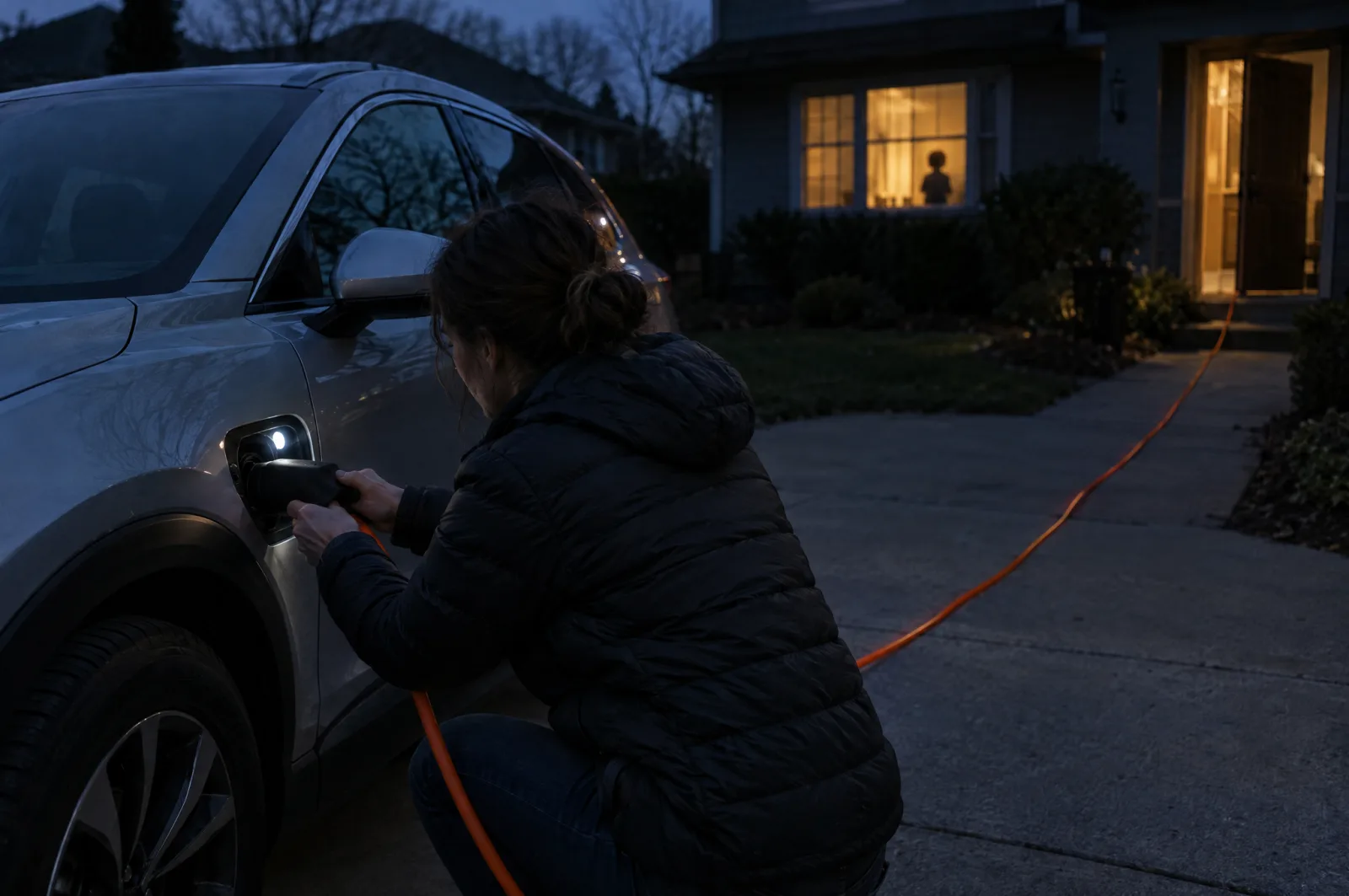
The short version · as of October 19, 2026
- A long-range IONIQ 5 holds 84 kWh, about 6.2 Powerwalls’ worth. It pours it out through a 1.9 kW outlet, about a sixth of a Powerwall’s tap. A huge tank, a narrow tap.
- Through that cord the car runs a fridge, a freezer, the Wi-Fi, lights, phones and a TV for about 16 days. It cannot start a typical sump pump, and nothing at 240 V.
- If you already own the car, that is the cheapest backup there is: an adapter and a cord. It is also hand-operated, 120 V only, and gone when the car is.
- A 4 to 6 kWh power station ($2,599 to $4,199 today) gives what the car can’t: 240 V, a motor-starting surge, a switchover in milliseconds, and it stays home. It runs the same basket for about 1 day.
- Letting the car feed the whole panel is real for the Cybertruck ($3,950 to $5,950 installed) and GM’s EVs ($6,748 for the kit until November 2, 2026, before installation). Since October 1, every new Model 3 and Model Y can do it too, through a Powerwall. Hyundai, Kia and Nissan’s cars cannot.
- They are not rivals. The car is the tank and the station is the tap: a 1.9 kW cord refills an EcoFlow TITAN 5000 about 10 times, 2.6 hours a fill.
The claim
Can an EV really power a house? Yes, slowly
The pitch writes itself.
A new Kia EV9 carries 99.8 kWh of battery.[5] A Tesla Powerwall 3 carries 13.5.[2] The Powerwall costs $13,000 to $20,000 to install.[13] The car came with its outlet for free.
So why would anyone buy a home battery?
Because a battery has two numbers, and the pitch only quotes one. The tank, in kilowatt-hours, is how long you can go. The tap, in kilowatts, is how much you can run at once.
Every EV sold in the US with vehicle-to-load, or V2L, has an enormous tank and a narrow tap. Hyundai’s and Kia’s cars deliver 120 V at under 16 amps,[6] which is 1.9 kW: one ordinary kitchen outlet. Nissan’s new LEAF gives 1,500 W through an adapter on its charge port.[8]
A Powerwall 3 delivers 11.5 kW, and starts motors drawing 185 A.[2]
Tank · kWh
Tap · kW
Cars, through their outlets
The tank · kWh it holds
The tap · kW it pours
Hyundai IONIQ 5
84 kWh1.9 kWKia EV9
99.8 kWh1.9 kWNissan LEAF
75 kWh1.5 kWTesla Model 3 / Y
60+ kWh2.4 kW11.5 kWTesla Cybertruck
90+ kWh9.6 kW11.5 kWChevrolet Silverado EV
pack size not published
10.2 kWFord F-150 Lightning
90+ kWh9.6 kWBatteries built for the house
The tank · kWh it holds
The tap · kW it pours
Tesla Powerwall 3
13.5 kWh11.5 kWEcoFlow TITAN 5000
5.0 kWh7.2 kWAnker SOLIX F3800 Plus
3.8 kWh6 kW
The exceptions are the trucks. A Cybertruck has five outlets good for 9.6 kW together, one of them 240 V.[1] A Silverado EV offers up to 11 outlets and 10.2 kW.[9]
Ford’s F-150 Lightning did 9.6 kW on its upgraded system and 2.4 kW on the base one.[10] Its production ended in December,[11] so it is now a used-truck option.
Those trucks really are a home battery on wheels. The cars are a very large camping battery.
One thing changed this month. Tesla says every Model 3 and Model Y ordered on or after October 1 can share its battery. With a Mobile Connector and an outlet adapter the charge port becomes a 120 V, 20 A outlet. With a Powerwall 3 and a Wall Connector, the car can feed the house through an outage.[1]
That puts the two best-selling EVs in America on this chart.
| Car | Battery | Through its outlets | Where | Feeds the panel? |
|---|---|---|---|---|
| Hyundai IONIQ 52027 | 84 kWhLong Range pack; the Standard Range SE carries 63 kWh | 1.9 kW | Charge-port adapter outside; a 120 V outlet under the rear seat on upper trims | No |
| Kia EV92026 | 99.8 kWhLong Range pack; the Light carries 76.1 kWh | 1.9 kW | Charge-port adapter outside; a 120 V outlet at the base of the rear seat | No |
| Nissan LEAF2026 | 75 kWhone pack on every grade | 1.5 kW | Adapter on the J1772 port; a cargo-area V2L plug on PLATINUM+ | No |
| Tesla Model 3 and Model Yordered Oct 1, 2026 or later | 60+ kWh* | 2.4 kW | Mobile Connector plus Tesla Outlet Adapter turns the charge port into one 120 V, 20 A outlet | Yes, 11.5 kW: a Powerwall 3 and a Wall Connector; no stand-alone gateway for these two |
| Tesla Cybertruck AWD and Cyberbeast | 90+ kWh* | 9.6 kW | Two 120 V 20 A outlets in the cabin; two 120 V 20 A and one 240 V 40 A in the bed | Yes, 11.5 kW: Powershare Gateway and Universal Wall Connector |
| Chevrolet Silverado EV2027 | Not published | 10.2 kW | Up to 11 outlets, 120 V and 240 V, with the accessory power bar | Yes: GM Energy PowerShift Charger and V2H Enablement Kit |
| Ford F-150 Lightningproduction ended December 2025 | 90+ kWh* | 9.6 kW2.4 kW on the base system | Ten 120 V outlets across the cab, bed and front trunk; the 9.6 kW system adds a 240 V outlet in the bed | Yes, 9.6 kW: Charge Station Pro and the Home Integration System, sold through Sunrun |
* Tesla and Ford publish days, not kilowatt-hours: “over three days” at 30 kWh a day is at least 90 kWh delivered; Tesla’s “over two days” for the Model 3 and Y, at least 60. GM publishes range, not pack size.
The tap
What does a 1.9 kW cord actually run?
Think of the outlet as a doorway 1,920 W wide.
Anything that runs under that walks through.
But motors and compressors need a shove to start: two to three times their running draw, for a moment. The doorway has to be wide enough for the shove, on top of everything else already running.
Appliance
LED bulb / lamp
Wi-Fi router + modem
CPAP with heated humidifier
Laptop
TV (LED, 50–55")
Chest or upright freezer
Refrigerator (full-size)
Home oxygen concentrator
Gas furnace (blower fan)
Sump pump, 1/3 HP
Window AC, medium (8,000–10,000 BTU)
Microwave
Space heater
Well pump, 1/2 HP240 V
Central air conditioner (3-ton)240 V
Food, phones and Wi-Fi
Fits- Running, all on
- 515 W
- Worst instant
- 1,565 W
- Energy per day
- 3.5 kWh
Everything can be on, and the fridge can start on top of it.
The same, plus the furnace fan
Tight- Running, all on
- 1,265 W
- Worst instant
- 2,315 W
- Energy per day
- 10.7 kWh
Runs, as long as the furnace is not starting while the fridge, freezer and TV are all drawing. Stagger them.
The same, plus a sump pump
No- Running, all on
- 2,065 W
- Worst instant
- 3,365 W
- Energy per day
- 12.6 kWh
The sump pump needs 2,100 W to start. That is wider than the doorway, on its own.
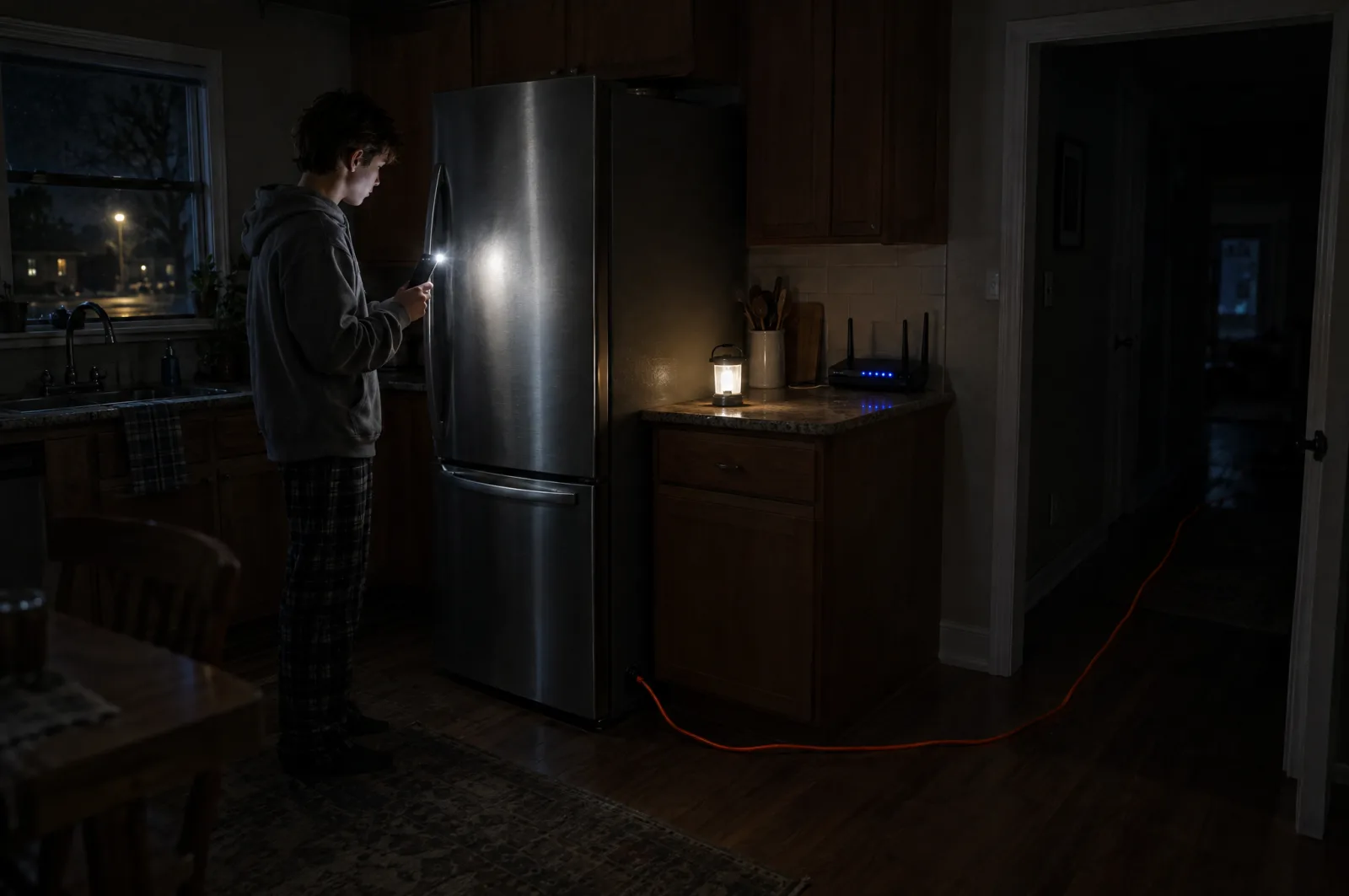
The carmakers say the same thing in their own words. Kia’s manual: “Do not use high power electrical appliances such as an air conditioner, washing machine or dryer.”[6]
And, in a line worth reading twice: “Do not use appliances that require a continuous power supply, such as medical equipment.”[6]
The car will cut the outlet when the pack reaches the discharge limit you set, when it overheats, or if someone turns the car off. For a CPAP or an oxygen concentrator, that is the argument for a battery that does nothing else. Our medical-equipment planner sizes one.
Two more lines the chart cannot show. A well pump is 240 V, so no car outlet in the first group can touch it, and nor can any 120 V transfer switch.
And every one of these outlets is outside, or in the back seat. The fridge is reached by an extension cord through a door, in whatever weather caused the outage.
The tank
How long would the car keep the lights on?
Here the car wins, by a mile.
The table runs each tank down from full on each basket. We keep 20% of the car’s pack back so it can still drive, and count 85% of every battery’s energy as reaching the appliance after the inverter.
The last column is the 30 kWh a day Tesla and Ford plan on, close to the US average of 29.6 kWh.[12]
| Tank | Delivers | Food, phones and Wi-Fi3.5 kWh/day | The same, plus the furnace fan10.7 kWh/day | The same, plus a sump pump12.6 kWh/day | Average home30 kWh/day |
|---|---|---|---|---|---|
| Hyundai IONIQ 5 | 57 kWh | 16.4 d | 5.3 d† | won’t start it | not at 1.9 kW |
| Kia EV9 | 68 kWh | 19.5 d | 6.3 d† | won’t start it | not at 1.9 kW |
| Nissan LEAF | 51 kWh | 14.6 d† | 4.8 d† | won’t start it | not at 1.5 kW |
| Tesla Model 3 / Y | 60 kWh* | 17.2 d | 5.6 d | 4.8 d† | not at 2.4 kW |
| Tesla Cybertruck | 90 kWh* | 25.8 d | 8.4 d | 7.1 d | 3 d |
| Ford F-150 Lightning | 90 kWh* | 25.8 d | 8.4 d | 7.1 d | 3 d |
| Tesla Powerwall 3 | 11.5 kWh | 3.3 d | 1.1 d | 22 h | 9 h |
| EcoFlow TITAN 5000 | 4.3 kWh | 1.2 d | 10 h | 8 h | 3 h |
| Anker SOLIX F3800 Plus | 3.3 kWh | 22 h | 7 h | 6 h | 3 h |
† The furnace fan’s start is wider than the cord with everything else on; it runs if the starts are staggered. * A maker’s “n days at 30 kWh” floor, used as is. Cars keep a 20% driving reserve.
So an IONIQ 5 runs the essentials for about 16 days, and the winter basket for about 5.5 days.
An EcoFlow TITAN 5000 runs them for about 1 day and about 10 hours. A Powerwall 3 runs an average home for about 9 hours. A Cybertruck, by Tesla’s own estimate, for over three.[1]
The car is 13 power stations deep. Nobody buys 13 power stations.
The money
What does each path cost, and what do you get for it?
There are four ways to get stored power into a house.
“Is the car cheaper” only has an answer once you say which two you are comparing. Prices below are today’s: the stations’ from the makers’ stores as our price monitor last read them, the installed systems’ from Tesla’s and GM’s own pages.
A cord from the car
You already own an EV with V2L
- Costs
- The adapter and a heavy-gauge extension cord
- Pours
- 1.5 kW to 2.4 kW at 120 V
- Runs
- Food, phones and Wi-Fi. A furnace fan is tight
- Switches over
- You, by hand, with the car parked where the cord reaches
- The catch
- Nothing at 240 V. Gone when the car is.
A power station, plugged into the panel
Any home; no car needed
- Costs
- $2,599 to $4,199 for a 4 to 6 kWh unit today, plus $300 to $600 for an electrician’s transfer switch
- Pours
- 3.8 kW to 7.2 kW, with 240 V on every unit listed below
- Runs
- All three baskets, including the sump pump and a well pump
- Switches over
- Milliseconds, on the units with a UPS mode, for whatever is plugged into them
- The catch
- A small tank: about 1 day of food, phones and Wi-Fi per charge. Solar, or the car, refills it.
The car feeds the whole panel (vehicle-to-home)
Cybertruck, Silverado EV and F-150 Lightning owners; Model 3 and Y owners with a Powerwall
- Costs
- Tesla: $3,950 to $5,950 installed. GM: $6,748 for the kit until November 2, 2026, $8,998 after, plus installation
- Pours
- 11.5 kW on a Cybertruck, enough for 240 V loads and central air
- Runs
- The house, at up to 30 kWh a day for three days, by Tesla’s and Ford’s own estimates
- Switches over
- Automatic, when the car is plugged in
- The catch
- Gone when the car is. Hyundai, Kia and Nissan’s cars can’t do it at all.
A battery on the wall
Homes that want it to just work
- Costs
- $13,000 to $20,000 installed for a 13.5 kWh Tesla Powerwall 3, with no federal credit since December 31, 2025
- Pours
- 11.5 kW, with a 185 A motor start
- Runs
- The whole house, briefly: a Powerwall’s tank is a sixth of a long-range car’s
- Switches over
- Automatic and seamless
- The catch
- About 9 hours of an average home per charge. It needs solar or the grid back to go on.
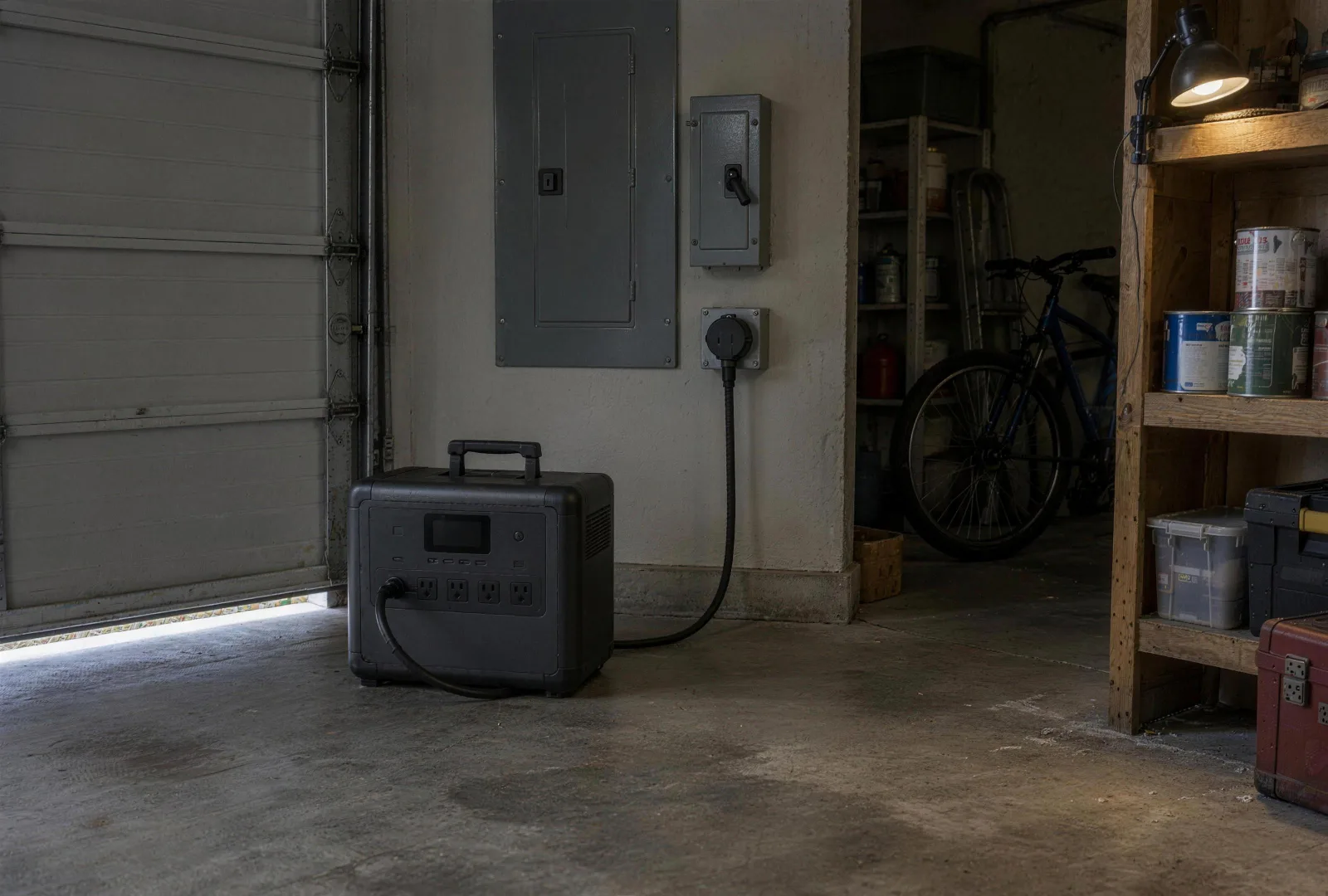
Compare like with like and the car does win twice. Against the extension-cord path it is nearly free, because the battery was paid for with the car.
And against a wall battery, letting a truck feed the panel is the cheaper whole-home system. Tesla puts Powershare Home Backup at about $1,950 of hardware and $2,000 to $4,000 of installation.[1] GM lists its charger-and-kit bundle at $8,998, $6,748 on promotion until November 2, 2026, before installation.[3] Either delivers a tank several Powerwalls deep.
Home batteries also lost their 30% federal credit for anything installed after December 31, 2025,[17] which widens that gap.
It loses the comparison people actually make, between a car they do not own and a battery they might buy. The cheapest car on the first chart starts at $29,990.[8] A power station with 240 V and a UPS mode starts around $2,599.
V2L is a very good reason to pick one EV over another. It is not a reason to buy an EV.
Whichever path, never feed the house through a dryer or range outlet.
A double-male “suicide cord” pushes power back out through the meter into the street, where a line worker may be restoring your service, and leaves live 240 V prongs in your laundry room.[16]
An electrician’s interlock kit or manual transfer switch, $300 to $600 installed in our home backup guide[15] and under $843 in a recent worked example,[14] is what makes a car or a station legal on hardwired circuits. Electrically, a V2L outlet is a small inverter generator, and the same rules apply.
Not alternatives
The car is the tank. The station is the tap. Use both
Put the two charts together and the question dissolves.
Everything the car lacks, the station has: 240 V for the well pump, a surge that starts the sump pump, a switchover measured in milliseconds for the CPAP, and a place in the house.
Everything the station lacks, the car has, which is energy.
So plug one into the other.
An EcoFlow TITAN 5000 holds 5.0 kWh.[15] A 1.9 kW cord fills it from empty in about 2.6 hours before charging losses, and an IONIQ 5 keeping its 20% reserve has enough for about 10 fills.
The station runs the house, quietly and automatically, on its 7.2 kW tap. The car tops it up during the day, and still drives to work. That is about 4 days of the winter basket, furnace fan included, from a car whose own outlet could only carry it on the edge of tripping.
It is also the version that works for a renter, a household with one car that commutes, or anyone whose panel an electrician has not touched. The station plugs into the wall between outages and recharges from the grid, and the car becomes a reserve rather than the plan. Add a panel or two and the car is not even needed for a short outage; our system builder pairs them.
The taps we track · 240 V and a UPS mode on every one
Prices from the makers’ US stores, read by our price monitor every 12 hours. Each name opens our page on the unit; the side-by-sides check them against each other.
- EcoFlow TITAN 50005.0 kWh · 7.2 kW · about 1 day of food, phones and Wi-Fi
$3,199
$638/kWh
- Anker SOLIX F3800 Plus3.8 kWh · 6 kW · about 22 hours of food, phones and Wi-Fi
$2,600
$677/kWh
- EcoFlow DELTA Pro 34.1 kWh · 4 kW · about 24 hours of food, phones and Wi-Fi
$2,799
$683/kWh
- BLUETTI Apex 300 + B300K5.5 kWh · 3.8 kW · about 1.5 days of food, phones and Wi-Fi
$2,599
$470/kWh
- Jackery Explorer 5000 Plus5.0 kWh · 7.2 kW · about 1 day of food, phones and Wi-Fi
$3,149
$625/kWh
- EcoFlow DELTA Pro Ultra6.1 kWh · 7.2 kW · about 1.5 days of food, phones and Wi-Fi
$4,199
$683/kWh
We may earn a commission if you buy through these links. It never changes what we report. How we make money. For a bigger tank, our home backup guide covers the expandable systems, and the calculator sizes one to your own list.
The decision
Which one should you buy?
- You own an EV with V2L, heat with gas, and outages are rare and short. Buy the adapter and a 12-gauge outdoor cord, and nothing else. Run the fridge, the router and a lamp. Set the discharge limit so the car can still drive.
- You have a sump pump, a well pump, a CPAP, or outages that last days. The car can’t start the pump, can’t reach 240 V, and the manual tells you not to run medical gear from it. Buy a station with a UPS mode and 240 V, have an electrician fit an inlet, and treat the car as its charger.
- You drive a Cybertruck, a Silverado EV or another of GM’s twelve V2H-capable EVs, or you are ordering a Model 3 or Y. The installed vehicle-to-home kit is the cheapest whole-home backup you can buy, by a wide margin, as long as the truck is home when the lights go out. Price the installation first; the hardware is the smaller half.
- You don’t have an EV and want backup. Nothing here argues for buying a car. A station covers an apartment or a gas-heated house; an expandable system or a wall battery covers a 240 V house. Our home backup guide and calculator start from your own appliances.
Get one email when a home-backup station’s price drops
The units above, checked twice a day. Nothing else.
By subscribing, you agree to our Privacy Policy. Unsubscribe anytime.
How we did this
Method and sources
Car figures are the makers’ own, read on October 19, 2026: battery sizes from Hyundai’s, Kia’s and Nissan’s specification pages, outlet ratings from Tesla’s Powershare page, Chevrolet’s Silverado EV page and Kia’s owner’s manual (the “under 16 amps” line, which at 120 V is 1.9 kW).
Tesla and GM do not publish pack sizes. Where a maker says “over three days at 30 kWh a day” we use 90 kWh as a floor and mark it.
Prices for installed systems are Tesla’s and GM’s pages on the same day; the power stations’ are the catalogue prices this site’s monitor last read. Appliance draws are planning figures from this site’s appliance library, which records the source of each; starting watts follow the generator makers’ two-to-three-times rule. Runtimes assume 85% of rated energy reaches the appliance and that a car keeps 20% to drive.
The photographs are generated illustrations, labelled as such in their captions and in each file’s metadata; no real product, place or person is shown.
- [2]Tesla, “Powerwall 3 specifications”, read October 19, 2026.
- [3]GM Energy, “GM Energy V2H Bundle: price, V2H-capable vehicles, promotion through November 2”, read October 19, 2026.
- [4]GM Energy, “GM Energy V2H Enablement Kit: Home Hub, inverter and dark-start battery, 200 A service”, read October 19, 2026.
- [5]Kia Media, “2026 Kia EV9 specifications: 76.1 and 99.8 kWh packs”, read October 19, 2026.
- [6]Kia, “Owner’s manual, Vehicle to Load: “Only use electrical appliances under 16 amps”; no heaters, air conditioners or medical equipment”, read October 19, 2026.
- [7]Hyundai USA, “2027 IONIQ 5: Vehicle-to-Load 120 V outlets; 63 and 84 kWh packs; trims from $35,250”, read October 19, 2026.
- [8]Nissan USA, “2026 Nissan LEAF press kit: 75 kWh, V2L 1,500 W with adapter”, read October 19, 2026.
- [9]Chevrolet, “Silverado EV: up to 11 outlets and 10.2 kW of offboard power”, read October 19, 2026.
- [10]The Drive, “The electric Ford F-150 can power your entire house for three days on a single charge”, May 19, 2021.
- [11]Electrek, “Ford reveals new F-150 Lightning EREV plans, kills off EV version”, December 15, 2025.
- [12]U.S. Energy Information Administration, “How much electricity does an American home use?”, read October 19, 2026.
- [13]PowerOutage.us, “Tesla Powerwall cost analysis”, read October 19, 2026.
- [14]ThePricer, “How much does it cost to install a manual transfer switch?”, July 2026.
- [15]Power Station Arena, “Home backup guide: the ladder from extension cords to a smart panel”, 2026.
- [16]Electrical Safety Foundation International, “Generator safety: never backfeed through an outlet”, read October 19, 2026.
- [17]Solar Energy Industries Association, “The clean energy provisions in the “One Big Beautiful Bill”: Section 25D ends December 31, 2025”, read October 19, 2026.
- [18]Lectron, “How to use the V2L feature of the Hyundai IONIQ 5 with an adapter (15 A, 120 V, NEMA 5-15)”, read October 19, 2026.