Head-to-head test
Goal Zero Sherpa 100AC vs Goal Zero Sherpa 100PD
Both Sherpas are the same 94.7Wh battery — the only real fork is whether you need an actual wall-outlet AC port, and everything else on this page follows from that one answer.
Full profiles: Goal Zero Sherpa 100AC → · Goal Zero Sherpa 100PD →

Written by Wenny ZhengUpdated
Portable Power Tester, Station Arena Test Desk
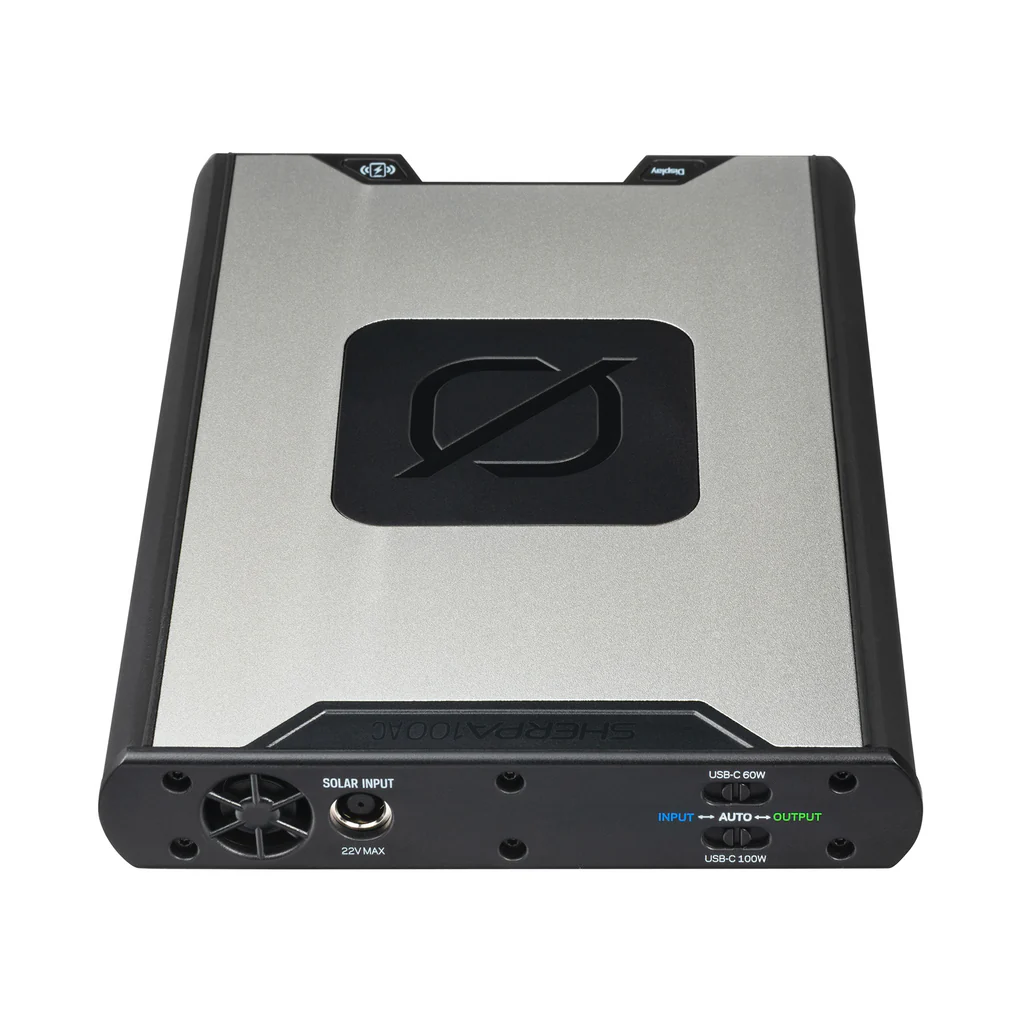
$249.95 · direct from Goal Zero
Last checked 1 day ago. Prices move — check before you buy.
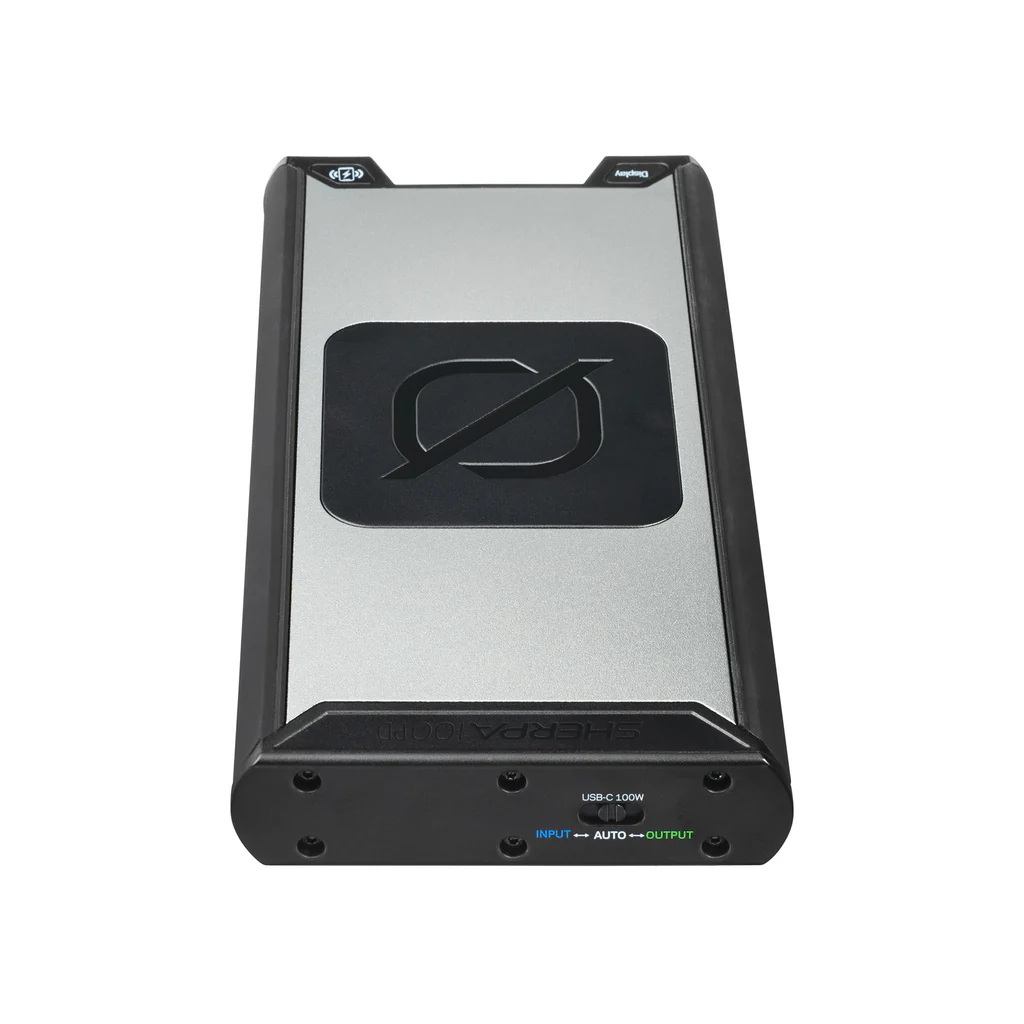
$199.95 · direct from Goal Zero
Last checked 1 day ago. Prices move — check before you buy.
Spec deltas
The Goal Zero Sherpa 100AC and 100PD share the same 94.7Wh cell, the same 500-cycle life, and the same 2-year warranty — the entire comparison comes down to one port. The 100AC packs a 100W AC inverter rated for 150W surge, so it can power anything with a standard wall plug; the 100PD drops that inverter and charges only through USB-C and USB-A, for $50 less.
That single missing part also explains the rest of the spec sheet: the 100AC weighs 2.1 lbs against the 100PD's 1.5, and it accepts up to 60W of solar versus 20W, because the extra hardware and a bigger input jack both live in the same corner of the case as the inverter.
Neither one is a blackout box or a camping power station — that's a different comparison for a different capacity class — but as a pocket-sized charger for phones, laptops, and cameras, the fork is simple: do you own a device that only takes a wall plug, or doesn't.
What the Numbers Reveal
Each conclusion stated first — the numbers behind it on one line, the full analysis below.
The 100PD is $50 cheaper and 0.6 lb lighter for skipping that inverter, which means you're paying $50 and carrying an extra half pound purely for a socket you may never plug anything into.
Sherpa 100AC is rated for a 150W surge through its AC inverter portSherpa 100PD is rated for 0W surge — it has no AC inverter port at all
Why it mattersIf every device in your bag already charges over USB-C or USB-A, the inverter is a cost with no payoff — skip it.
cost / lifetime kWh
Stretched across the 2-year warranty, that surcharge comes to $125 a year of ownership for the 100AC against $100 for the 100PD, for hardware that adds zero watt-hours.
Sherpa 100AC costs $250, working out to $5.28 per lifetime kWhSherpa 100PD costs $200, working out to $4.22 per lifetime kWh
Why it mattersAnyone who'll never touch the AC port is paying pure margin for it — there's no scenario where the 100AC wins on cost alone.
solar input
For someone recharging by panel rather than wall or car — backpacking, a remote workday off-grid — that speed gap compounds daily, and the 100PD's proprietary-panel requirement narrows which panel you're allowed to use to close it.
Sherpa 100AC accepts up to 60W of solar inputSherpa 100PD accepts up to 20W, and the ledger notes it's tied to Goal Zero's proprietary Nomad 20 panelB7
Why it mattersRegular solar rechargers should weight the 100AC's faster, more open input above its extra weight and price.
That reviewer still carried the 100PD on business trips for months as a laptop-and-phone companionB4, so the small efficiency gap is real but not one that changes what the unit is good for day to day.
Bench testing put the 100PD's real-world output at 81.52% efficiency, just under the reviewer's own 82.64% site averageB3The same reviewer found the 100PD's wireless pad tops out near 10W in practice, well under a fast wired chargeB8
Why it mattersDon't buy the 100PD expecting it to out-charge the 100AC — buy it because you don't need the inverter, full stop.
The specific dimensions that decide these two units — everything else is a tie.
Portability & Form Factor
Selected because: 0.6 lb plus AC-hardware bulk is the tactile difference between an otherwise identical pair.
weight
Half a pound doesn't sound like much until it's the last half pound of room in a bag that already has a laptop charger and a camera kit wedged into it. The 100AC weighs 2.1 lbs to the 100PD's 1.5 — the same 94.7Wh cell, but the 100AC has to package a physical inverter and prong assembly the 100PD simply doesn't carry.
That extra weight buys you the one thing USB-C can't do: power anything with a wall plug — a CPAP brick without a DC adapter, an old camera charger, a reading lamp. If your gear bag is already all USB-C, you're carrying 0.6 lb of hardware for sockets you'll never use.
Lifetime Value
Selected because: Same capacity and cycle life means the cost gap is purely the AC-inverter premium, worth quantifying.
cost / lifetime kWh
Same 94.7Wh capacity, same 500 cycles, so the entire lifetime-cost gap is really an AC-inverter tax. The 100AC comes out to $5.28 per lifetime kWh against the 100PD's $4.22, and over the 2-year warranty that's $125 a year of ownership versus $100.
There's no scenario where the 100AC pulls ahead on cost — it's $50 more upfront for a component that doesn't add a single watt-hour of capacity. Buy it for the socket, not for the economics.
PowerScore Breakdown
Selected because: The lighter, cheaper unit outranking the AC-equipped one is counterintuitive and worth explaining.
overall power score
The 100PD actually out-scores the 100AC, 793 to 693, which reads backwards until you remember the score isn't rewarding ports — it's rewarding the unit that hits the identical 94.7Wh, 500-cycle numbers for less money and less weight.
Treat the ranking as a nudge, not a verdict: it's telling you the 100AC's extra hardware is a want, not a need, for most buyers. If you're one of the people who actually needs that wall outlet, the score doesn't know that, and you should ignore it.
Your Life, Your Pick
Selected because: Both fail every big-outage scenario identically — the honest reminder these are personal-electronics banks, not backup power.
Every big-outage scenario on this page needs far more than either unit can supply, and by the same margin, because the batteries inside are identical. An 8-hour blackout alone calls for roughly 17 times either Sherpa's 94.7Wh, and a weekend of van life draws around 49 times that — these are personal-electronics banks, not the box you run a fridge or a CPAP compressor off overnight.
That's not a knock on either unit; it's the wrong test. Judge them on phones, laptops, cameras, and a weekend of USB devices, and both pass easily. Judge them on a blackout, and neither was built for that job — look at a 1,000Wh-plus station instead.
Strengths & trade-offs
Goal Zero Sherpa 100AC
Strengths
- +Faster solar charging
Trade-offs
- –Lacks smartphone app control for remote monitoring.
Goal Zero Sherpa 100PD
Strengths
- +Costs $50 less
- +Lighter by 0.6 lb
Trade-offs
- –Lacks smartphone app control for remote monitoring.
Will It Power Your Gear?
Scenario math and per-appliance runtimes, modeled from the spec record.
Scenario verdicts
We ran the math on seven real-world scenarios. Here's which unit survives your actual life.
SCN-01 · 2 nights · needs 2,100Wh
Weekend Camping
Two nights off-grid with essential comfort
Neither unit
A weekend off-grid needs about 22 times what either Sherpa carries — these are phone-and-laptop banks, not the unit you run a camp fridge on.
Battery budget usedlower = more headroom
LOAD Phone Charger 15W×6h · LED Lights 40W×8h · Box Fan 75W×14h · CPAP Machine 40W×16h
SCN-02 · 8 hours · needs 1,645Wh
8-Hour Blackout
Keep the essentials running through a night without power
Neither unit
An 8-hour blackout draws roughly 17 times the 94.7Wh either unit holds. Neither Sherpa is a blackout box, and neither is trying to be.
Battery budget usedlower = more headroom
LOAD Fridge 150W×8h · Router + Modem 20W×8h · LED Lights (4 bulbs) 40W×6h · Phone Charger 15W×3h
SCN-03 · 8 hours · needs 320Wh
CPAP Overnight
Sleep therapy without interruption — the #1 medical use case
Neither unit
A full CPAP night needs about 3.4 times the 94.7Wh on tap here — enough for a nap on the couch, not a full night's sleep.
Battery budget usedlower = more headroom
LOAD CPAP Machine 40W×8h
SCN-04 · 8 hours · needs 910Wh
Remote Workday
Full work day off-grid without power anxiety
Neither unit
A full remote workday pulls close to 10 times either unit's 94.7Wh — fine for topping off a laptop between meetings, not for running the whole day off-grid.
Battery budget usedlower = more headroom
LOAD Laptop 60W×8h · External Monitor 30W×8h · Router + Modem 20W×8h · Phone Charger 15W×2h
SCN-05 · 4 hours · needs 670Wh
Tailgate Party
Game day power for the crew
Neither unit
A tailgate crowd needs about 7 times the capacity either Sherpa holds — bring it for phones and a speaker, not the cooler-and-TV setup.
Battery budget usedlower = more headroom
LOAD Blender 400W×0.5h · LED TV (55") 80W×4h · Bluetooth Speaker 15W×4h · Phone Charger (×3) 45W×2h
SCN-06 · 24 hours · needs 4,685Wh
Van Life Daily
A full day of mobile living — the ultimate endurance test
Neither unit
Daily van life draws roughly 49 times either unit's 94.7Wh — this is the backup for your devices inside the van, not the van's power system.
Battery budget usedlower = more headroom
LOAD Mini-Fridge 150W×24h · Laptop 60W×4h · Phone Charger 15W×3h · LED Lights 40W×5h · Fan 75W×8h
SCN-07 · an afternoon · needs 100Wh
Afternoon Off-Grid
Phones and a speaker at the park, beach, or campsite — the small-unit job description
Neither unit
Neither unit covers this scenario's 100Wh: the Sherpa 100AC comes up 20Wh short (about 81% covered), the Sherpa 100PD 20Wh (81%). Either gets you most of the way, so this is a scenario you plan around rather than one you should rule them out for.
Battery budget usedlower = more headroom
LOAD Phone Charger (×2) 30W×2h · Bluetooth Speaker 10W×4h
The Load Test
RUNTIME = (Wh × 0.85) ÷ LOAD
None of the scenarios above exactly yours? Build it. Toggle what you'd plug in; both units are tested against the combined draw.
Essentials
Comfort & Convenience
High-Draw Appliances
Test duration
8h
Continuous draw
205W
Projected runtime
The Sherpa 100PD has no AC outlets for the wall-plug loads here, and the Sherpa 100AC's 100W can't hold 205W either.
Modeled from the spec record — same math as the tables below. Methodology
Runtime by appliance
Real-world runtime estimates for common appliances, modeled at 85% inverter efficiency.¹
Essentials
The basics you need runningscale 0–5.4hComfort & Convenience
Makes off-grid life actually enjoyablescale 0–1.1hHigh-Draw Appliances
These reveal the real limits¹ Runtime = (capacity × 0.85) ÷ appliance watts. Within each group, all bars share one time scale (the group's longest runtime), so lengths are comparable across appliances; identical runtimes collapse into a single blue/orange bar. Actual runtime varies with battery age, temperature, and simultaneous loads — see methodology.
Conclusion
July 15, 2026
Verdict: the Sherpa 100PD
Buy the Sherpa 100PD unless you specifically need to plug something into a wall outlet. It's the identical 94.7Wh, 500-cycle battery for $50 less and 0.6 lb lighter, it wins the power score 793 to 693, and it comes out cheaper on lifetime cost ($4.22 vs $5.28 per kWh). The 100AC earns its premium only through its AC inverter and faster 60W solar input — real advantages, but narrow ones.
Editor-assigned confidence, based on cited owner research and spec analysis.
List prices as of July 15, 2026. The links below open Goal Zero's current price.
$199.95 · direct from Goal Zero
Last checked 1 day ago. Prices move — check before you buy.
or check the Sherpa 100AC price$249.95 list
Written by Wenny Zheng, Portable Power Tester · Station Arena Test Desk · Updated July 15, 2026
Measured Data
Benchmark scores and the full spec record, side by side.
Benchmark scores
Full specifications
ᵈ Derived: price ÷ rated capacity. See the data behind our comparisons →
Comparison ToolAdd more power stations, side by sideOpen Tool →How these numbers are produced
Numeric verification
Every figure on this page traces to our spec database or arithmetic on it — no estimated numbers.
Owner claims
Statements about owner experience are cited to published reviews — see Sources & Research Notes below.
Runtime model
Runtime = (rated capacity × 0.85 inverter efficiency) ÷ device wattage. Solar recharge estimates assume panels deliver 70% of rated output. Cold weather, battery age, and stacked loads reduce real-world results.
Power Score
Computed from 14 published spec dimensions, weighted per use-case bench. Higher is better; a unit must meet a bench's minimum threshold to be rated.
See the full weight table and data sourcing on our methodology page →Class ranking (the star rating)
Each unit's star score is a category ranking, not customer reviews — no buyer opinions feed it. We score every station on size-independent quality (value, output, portability, endurance, ports, warranty, and more), then percentile-rank it against the other units in its capacity class, so a class-leading compact unit and a class-leading whole-home unit can both earn 5★. Here, Sherpa 100AC rates 3.3/5 (1st percentile of 22 Personal-class units), and Sherpa 100PD rates 3.4/5 (5th percentile of 22 Personal-class units).
How the class ranking is computed →Test Notes & Caveats
Hidden gotchas and advantages we spotted that you won't find on the product page.
Sherpa 100PD: No AC Outlets At All
The Sherpa 100PD's 100W is a DC port total — USB and 12V — not an inverter rating. Anything with a wall plug (a fridge, a TV, a coffee maker, most fans and lamps) never plugs in, at any wattage. That's the design, not a defect: it buys weight, silence, and efficiency for phone, laptop, camera, and 12V-CPAP loads. The Sherpa 100AC carries a real inverter behind 1 AC outlet, so it plays in both worlds. Decide which side of that line your gear lives on before weighing anything else on this page.
Warranty: No Difference
Both units carry the same 2-year warranty, so coverage isn't a tiebreaker here. Worth saying because the per-dollar framing can suggest otherwise: the Sherpa 100PD works out at 10 years of cover per $1,000 spent against the Sherpa 100AC's 8, but that spread is the price gap, not the terms.
Full record above — the Test Desk pick is the Sherpa 100PD.
Check Sherpa 100PD price →or check the Sherpa 100AC priceOwnership Analysis
What happens after you buy — true cost of ownership, brand trust, and growth potential.
Lifetime value
Service lifeyears at one full cycle per day
Lifetime energy delivered
Cost per delivered kWh
│ warranty ends · Reaching the cycle rating means ~80% capacity remains — degraded, not dead.
Analyst note
The Sherpa 100PD wins on both sticker price and long-term value. At $4.22/kWh over its lifetime, it's meaningfully cheaper to own. Clear value winner. One thing to know reading the table: both carry the same 500-cycle rating, so the lifetime rows are sticker price and capacity in disguise — the wear horizon is identical and decides nothing here.
Delivers each lifetime kWh for $1.06 less — check the Sherpa 100PD price →
Growth path
Sherpa 100AC
FIXED CAPACITYFixed at 95Wh, with no expansion — so size it for your needs up front rather than planning to add capacity later.
Accepts up to 60W of solar. Limited to a single portable panel.
Limited ports. You'll likely need a power strip or splitter.
Sherpa 100PD
FIXED CAPACITYFixed at 95Wh, with no expansion — so size it for your needs up front rather than planning to add capacity later.
Accepts up to 20W of solar. Limited to a single portable panel.
Limited ports. You'll likely need a power strip or splitter.
Realistic full solar rechargeat 70% of rated panel output — see methodology
Analyst note
Neither expands, and that's no knock on either — each is a complete unit at a fixed size. They hold the same 95Wh, so capacity can't break the tie: decide on price, weight, and the rest, and know that whichever you pick is the ceiling.
What Owners Report
Patterns from published owner reports and long-term reviews — every claim cited to its source below.
Goal Zero Sherpa 100AC
The 100AC's own field ledger is thinner than its sibling's — mostly launch-era reviews rather than months of ownership — but what's there is consistent. Reviewers flag its 94.7Wh capacity as sitting right under the FAA's 100Wh carry-on cutoff, making it one of the few power banks you can fly with without a second thoughtA1. At 2 lbs it disappears into a laptop bag and adds a 15W wireless pad on top of the AC and USB-C portsA2. In one hands-on test, the 100W USB-C port took a laptop from 10% to 100% in 90 minutes while spending only 45% of the Sherpa's own charge, and it recharges over USB-C without needing a separate wall brickA3. Reviewers describe it as a natural fit for digital nomads and outdoor creators juggling a camera and a laptop on the same batteryA4.
“A 94.7Wh power bank — under the 100Wh FAA flight limit, so it's airline-approved — with a 100W AC port for laptop chargers, camera cradles, or small lamps.”
Sources
campingsolar.us · matadornetwork.com · gearjunkie.com · shotkit.com · packandtrail.com · the-gadgeteer.com
Goal Zero Sherpa 100PD
The 100PD has a deeper, more mixed field record, largely from a reviewer who carried it on business trips for months and made it a replacement for the hotel-room power stripB4B5. The praise is specific: rugged, well-built metal construction that owners trust outdoorsB9B13, and one owner ran a USB fan all night while charging a phone and a watch and still had roughly half the battery left by morningB15. The complaints are just as specific — the Qi wireless pad is slow enough that one reviewer called it among the slowest they'd tested, useful mainly if the phone sits on it overnightB1, the metal trim can scratch a bare phone left case-freeB2, and bench testing put real-world efficiency at 81.52%, just under the review site's own 82.64% averageB3. Solar recharging is locked to Goal Zero's proprietary Nomad 20 panel rather than a generic inputB7, and one owner in near-freezing conditions reported their phone repeatedly flagging moisture while resting near the unitB12.
“In testing, the Sherpa 100PD pumped out 77.2Wh, giving it an efficiency of 81.52 percent; that's just below the average of 82.64 percent efficiency in our testing.”
Sources & Research Notes
Every owner claim in this report is traceable to a published source. The bracketed references above resolve here.
Recurring owner themes
- Airline-legal 94.7Wh, a real 100W AC port, wireless charging, and 2-lb travel portability are the standout points. [Sherpa 100AC · 3 entries]
- Owners and reviewers consistently praise the rugged metal build quality and durability for travel/outdoor use. [Sherpa 100PD · 3 entries]
- Wireless (Qi) charging is repeatedly noted as slow/underwhelming compared to wired charging, though still useful in a pinch. [Sherpa 100PD · 3 entries]
- Solar recharging is seen as a limitation since it requires Goal Zero's proprietary Nomad panel/USB port rather than a standard input. [Sherpa 100PD · 1 entries]
- Real-world charging reliability at lower charge levels or with laptops shows some inconsistency versus spec claims. [Sherpa 100PD · 2 entries]
- A1
“A 94.7Wh power bank — under the 100Wh FAA flight limit, so it's airline-approved — with a 100W AC port for laptop chargers, camera cradles, or small lamps.”
campingsolar.us / matadornetwork.com — Sherpa 100AC review · 2026 · [positive]
- A2
“Weighs just 2 lbs and adds best-in-class 15W wireless charging; a tiny, elegant unit that fits in a laptop bag.”
gearjunkie.com / shotkit.com — Sherpa 100AC review · 2026 · [positive]
- A3
“Its 100W USB-C port charged a laptop from 10% to 100% in 90 minutes, drawing 45% from the Sherpa's battery, and it recharges from a USB-C source with no separate wall plug.”
packandtrail.com — Sherpa 100AC review · 2026 · [positive]
- A4
“A versatile travel power pack for cameras, laptops, and phones — ideal for digital nomads and outdoor creatives.”
the-gadgeteer.com — Sherpa 100AC review · 2026 · [positive]
- B1
“That makes this one of the slowest wireless charging pads I've tested, so unless you plan on leaving your phone on the pad overnight, I'd suggest using a wired connection.”
PCWorld — Goal Zero Sherpa 100PD review: A heavy battery pack that's become my go-to for trips · 2019-12 · [negative]
- B2
“If you're like me and don't use a case for your phone, that trim is going to scratch the back of your handset over time.”
PCWorld — Goal Zero Sherpa 100PD review · 2019-12 · [negative]
- B3
“In testing, the Sherpa 100PD pumped out 77.2Wh, giving it an efficiency of 81.52 percent; that's just below the average of 82.64 percent efficiency in our testing.”
PCWorld — Goal Zero Sherpa 100PD review · 2019-12 · [mixed]
- B4
“For the past few months, the Goal Zero Sherpa 100PD has been in my backpack for every business trip I've gone on, and I don't see that changing anytime soon.”
PCWorld — Goal Zero Sherpa 100PD review · 2019-12 · [positive]
- B5
“It's not the lightest battery pack, weighing in at 1.4 pounds, and I definitely notice that it's in my bag, but it has essentially replaced the power strip I would bring with me on trips.”
PCWorld — Goal Zero Sherpa 100PD review · 2019-12 · [positive]
- B7
“The Sherpa 100PD can also be powered by solar, but it requires Goal Zero's proprietary Nomad 20 solar panel.”
GearJunkie — Goal Zero Sherpa 100AC & 100PD Review · 2022-11 · [negative]
- B8
“The fastest I ever got out of it was 10W with an iPhone 11 Pro and a Galaxy S20+, which is right around what I expected.”
Android Central — Goal Zero Sherpa 100 PD Qi review · 2023-09 · [mixed]
- B9
“Overall, the materials feel high-quality, and the construction is excellent, with no gaps or obvious production marks.”
Android Central — Goal Zero Sherpa 100 PD Qi review · 2023-09 · [positive]
- B12
“Temperatures had dipped to below freezing at night, and throughout the day and evening, my Samsung Galaxy S21+ phone kept complaining of moisture.”
REI product reviews — Goal Zero Sherpa 100PD Power Bank · unknown · [mixed]
- B13
“Externally, the Sherpa 100PD is rugged and well-built for the outdoors where dependability is a requirement for me.”
REI product reviews — Goal Zero Sherpa 100PD Power Bank · unknown · [positive]
- B15
“I have also ran a usb fan all night on a trip and charge my phone and apple watch. While doing that it only went down to 50 ish percent so I was very pleased with it.”
ReadAboutGear — Goal Zero Sherpa 100 PD Review · unknown · [positive]
Research compiled July 15, 2026.
Who Should Buy Which
Buy the Sherpa 100AC if you…
- →Anyone who needs to plug in a device with an actual wall prong — a CPAP without a DC option, an older camera charger brick, a small reading lamp — since the 100PD has no AC port at all.
- →Frequent solar rechargers: the 100AC's 60W input tops up the same 94.7Wh cell roughly three times faster than the 100PD's 20W, and it isn't locked to a proprietary panel.
Buy the Sherpa 100PD if you…
- →Anyone whose whole kit is already USB-C or USB-A — phones, laptops, camera batteries with a USB-C brick — and doesn't want to pay $50 or carry an extra 0.6 lb for a socket they'll never use.
- →Business and light travelers who want the lightest version of the same 94.7Wh capacity for a bag that already has enough weight in it.
If neither fits
Anyone planning to run a fridge, power tools, or a full night of CPAP without recharging, or to keep a campsite or home office alive through a multi-hour outage — both Sherpas top out at 94.7Wh, nowhere near what those jobs need. Look at a 1,000Wh-plus power station instead.
The Bottom Line
Two identical 94.7Wh batteries wearing different jackets: the 100AC adds a real AC wall outlet and faster 60W solar for $250, the 100PD strips both for $200 and 0.6 lb less to carry. Take the 100PD if your gear is already USB-C — it's the same battery for less money and less weight, and the power score (793 to 693) agrees.
Take the 100AC only if you own a device that needs a wall prong or you recharge from the sun often enough that 60W over 20W actually matters. Outside those two reasons, the extra $50 is buying hardware you'll carry and never plug in.
Frequently Asked Questions
Answers drawn from the spec record and cited owner research.
What's the real difference between the Goal Zero Sherpa 100AC and 100PD?
The 100AC has a 100W AC inverter with a 150W surge rating, so it can power anything with a standard wall plug; the 100PD drops that inverter entirely and charges only through USB-C and USB-A. Everything else — the 94.7Wh capacity, the 500-cycle life, the 2-year warranty — is identical. The 100AC also accepts up to 60W of solar versus the 100PD's 20W.
Are both airline-legal for carry-on?
Yes. Both sit at 94.7Wh, comfortably under the FAA's 100Wh carry-on limit for spare batteries, so either one travels in a laptop bag without a special exception.
Does the 100PD's wireless charging work as well as the 100AC's?
Both include a built-in Qi pad, but reviewers found the wireless charging slow in practice — one called it among the slowest they'd tested, topping out around 10W and best used for an overnight charge rather than a quick top-up. Treat wireless as a backup on either unit, not your primary charging method.
Can I use any solar panel to recharge the 100PD?
Not really — the 100PD's 20W solar input is tied to Goal Zero's proprietary Nomad 20 panel, while the 100AC accepts up to 60W and gives you more flexibility if you're regularly charging off-grid.
Is the extra $50 for the 100AC worth it?
Only if you'll actually use the AC outlet. Lifetime cost works out to $5.28 per kWh for the 100AC versus $4.22 for the 100PD off the identical battery, so the entire premium buys the inverter and the faster solar input, not any additional capacity.
Where to buy
Goal Zero Sherpa 100AC
$249.95
$249.95 · direct from Goal Zero
Last checked 1 day ago. Prices move — check before you buy.
Goal Zero Sherpa 100PDPick
$199.95
$199.95 · direct from Goal Zero
Last checked 1 day ago. Prices move — check before you buy.
Prices may vary by retailer and are subject to change.