Head-to-head test
EcoFlow RIVER 3 230 vs Anker SOLIX C300X
The RIVER 3 230 is the cheapest way into a genuinely good 300W power station at $199, and the C300X asks $101 more for a quarter more capacity, a stronger USB-C port, and a faster switchover, which is more unit than a phone-and-tablet buyer needs at this size.
Full profiles: EcoFlow RIVER 3 230 → · Anker SOLIX C300X →

Written by Wenny ZhengUpdated
Portable Power Tester, Station Arena Test Desk
Spec deltas
The RIVER 3 230 costs $199, the cheapest capable small station in this comparison, and the C300X costs $300. That $101 is a lot to weigh against two units that share a 300W inverter, a 600W surge, LiFePO4 chemistry, 3,000 cycles, and a five-year warranty. What the Anker adds for the money is 58 more watt-hours, a 140W USB-C port, and a switchover twice as quick.
The C300X is the better-equipped unit, and 58Wh is real: about a quarter more capacity, enough for a couple more phone top-ups or another hour of a small load. Reviewers clocked a 60W laptop running past four hours and a 50W mini fridge holding about five and a halfB9. But the RIVER 3 230 does the same category of work, and it does it for a hundred dollars less.
Where the C300X pulls clear is refinement, not capability. Its 140W USB-C port fast-charges a 16-inch laptop the RIVER 3 230's 100W won't, its 10ms switchover beats the 230's 20, and testers found it near-silent even under loadB4 against the 230's already-quiet sub-30dBA1. Genuine upgrades, all of them, but $101 of upgrade on a unit you bought to keep small and cheap.
What the Numbers Reveal
Each conclusion stated first — the numbers behind it on one line, the full analysis below.
The $101 gap here is the widest in this group, and none of it goes to reliability or lifespan; both are 3,000-cycle LiFePO4 boxes covered five years. It's paying for 58Wh and refinements, at a size where the whole appeal is spending as little as possible.
RIVER 3 230 $199 vs C300X $300, same 300W output and 3,000 cyclesRIVER 3 230 costs $0.29 per lifetime kWh vs the C300X's $0.35Same five-year warranty on both
Why it mattersIf the reason you're shopping this tier is price, the RIVER 3 230 is the answer and the C300X is a hundred dollars of nice-to-have.
Capacity
58 watt-hours buys the C300X a couple more phone charges or an extra hour of a small load, and reviewers' runtime numbers back that upB9. What it doesn't buy is a category change; if 230Wh leaves you short for your actual use, 288Wh usually does too, and you want a bigger unit, not this $101 step.
C300X holds 288Wh, RIVER 3 230 holds 230WhA 60W laptop ran past four hours on the C300XB9A single CPAP night runs about 320Wh
Why it mattersBuy the extra capacity if it comfortably covers your load; if it only barely does, size up past both instead of paying to inch the ceiling.
The 140W port matters only if you run a 16-inch laptop, since 100W already maxes a 14-inch; the 10ms switchover matters only if you back a fussy desktop, since 20ms clears most. For a phone-and-tablet owner, both upgrades are invisible, which is most of what $101 buys here.
C300X USB-C is 140W vs the RIVER 3 230's 100WC300X switchover is 10ms vs 20msA 16-inch MacBook Pro wants 140W
Why it mattersBig-laptop and desktop-UPS users get something for the premium; everyone else is paying for ports they won't push.
The specific dimensions that decide these two units — everything else is a tie.
Lifetime Value
Selected because: cheaperToOwn is p1 ($0.29 vs $0.35) and the $101 sticker gap is the widest in the batch; the axis of the page.
$199 is the number that defines this matchup. It buys 690 kilowatt-hours across 3,000 cycles at $0.29 each; the C300X, at $300, delivers 864 kilowatt-hours but at $0.35 per kilowatt-hour. The RIVER 3 230 is cheaper to buy by $101 and cheaper to own by six cents on every kilowatt-hour, with the identical five-year warranty behind it. For the lowest-cost entry into a real LiFePO4 station, this is it.
Runtime: Will It Power Your Gear?
Selected because: The 58Wh edge is the C300X's main case; runtime numbers from the ledger make it concrete and honest.
On paper the C300X's 288Wh outlasts the 230Wh RIVER 3 230 by about a quarter, and the field numbers make that concrete: a 60W laptop ran past four hours and a 50W mini fridge about five and a half on the AnkerB9. Scale those down by the 58Wh difference and the RIVER 3 230 lands maybe forty minutes behind on the same loads. That matters if you're squeezing a full workday out of one charge; it's noise if you're topping up devices between wall outlets.
PowerScore Breakdown
Selected because: 1666 vs 1581 captures the Anker's edges but the 85-point gap is far smaller than the price gap.
overall power score
PowerScore has the C300X ahead, 1666 to 1581, and the 85-point gap is far smaller than the price gap. It reflects the Anker's real edges, 58 more watt-hours, 140W USB-C, a 10ms switchover, against a 230 that gives up nothing on output, since the two share a 300W inverter. The score says the C300X is the more capable small unit. It doesn't say it's $101 more capable.
Brand Trust
Selected because: Cross-brand: EcoFlow's catalog and community vs Anker's household trust and cooling SOLIX support.
EcoFlow is the category's biggest catalog and its busiest innovator, with a community large enough to answer most questions before support has to, balanced against uneven service and a 2025 recall on a bigger model. Anker trades on a decade of consumer-electronics goodwill and InfiniPower cells that last, but its SOLIX support seems to be cooling toward scripted replies, and it has quietly removed features in firmware. On a budget unit you'll rarely call anyone about, both are safe, and EcoFlow's crowd is the handier resource.
Strengths & trade-offs
EcoFlow RIVER 3 230
Strengths
- +Lighter by 1.2 lb
- +Faster solar charging
Trade-offs
- –No major technical downsides compared to rival.
Anker SOLIX C300X
Strengths
- +Larger battery capacity
Trade-offs
- –No major technical downsides compared to rival.
Will It Power Your Gear?
Scenario math and per-appliance runtimes, modeled from the spec record.
Scenario verdicts
We ran the math on seven real-world scenarios. Here's which unit survives your actual life.
SCN-01 · 2 nights · needs 2,100Wh
Weekend Camping
Two nights off-grid with essential comfort
Neither unit
Neither unit covers this scenario's 2,100Wh: the RIVER 3 230 comes up 1,905Wh short (about 9% covered), the SOLIX C300X 1,855Wh (12%). This is well outside what either unit is for; the right answer here is a larger station, not a choice between these two.
Battery budget usedlower = more headroom
LOAD Phone Charger 15W×6h · LED Lights 40W×8h · Box Fan 75W×14h · CPAP Machine 40W×16h
SCN-02 · 8 hours · needs 1,645Wh
8-Hour Blackout
Keep the essentials running through a night without power
Neither unit
Neither of these carries a house through an 8-hour blackout; the load is several times what a 230Wh or 288Wh battery holds. What they're actually for in an outage is keeping phones, a router, and a CPAP alive, and there both do the job, with the C300X's extra 58Wh buying a little more margin before you recharge. If real blackout coverage is the goal, this tier is the wrong shelf, and the $101 between them doesn't change that.
Battery budget usedlower = more headroom
LOAD Fridge 150W×8h · Router + Modem 20W×8h · LED Lights (4 bulbs) 40W×6h · Phone Charger 15W×3h
SCN-03 · 8 hours · needs 320Wh
CPAP Overnight
Sleep therapy without interruption — the #1 medical use case
Neither unit
Neither unit covers this scenario's 320Wh: the RIVER 3 230 comes up 125Wh short (about 61% covered), the SOLIX C300X 75Wh (76%). Either gets you most of the way, so this is a scenario you plan around rather than one you should rule them out for.
Battery budget usedlower = more headroom
LOAD CPAP Machine 40W×8h
SCN-04 · 8 hours · needs 910Wh
Remote Workday
Full work day off-grid without power anxiety
Neither unit
Neither unit covers this scenario's 910Wh: the RIVER 3 230 comes up 715Wh short (about 22% covered), the SOLIX C300X 665Wh (27%). This is well outside what either unit is for; the right answer here is a larger station, not a choice between these two.
Battery budget usedlower = more headroom
LOAD Laptop 60W×8h · External Monitor 30W×8h · Router + Modem 20W×8h · Phone Charger 15W×2h
SCN-05 · 4 hours · needs 670Wh
Tailgate Party
Game day power for the crew
Neither unit
Neither unit can hold the 400W peak this scenario needs — the RIVER 3 230 on its 300W continuous rating, the SOLIX C300X on its 300W, so capacity never gets a say. This is the wrong size of unit for the job rather than a close call.
Battery budget usedlower = more headroom
LOAD Blender 400W×0.5h · LED TV (55") 80W×4h · Bluetooth Speaker 15W×4h · Phone Charger (×3) 45W×2h
SCN-06 · 24 hours · needs 4,685Wh
Van Life Daily
A full day of mobile living — the ultimate endurance test
Neither unit
A full day of van-life draw dwarfs both units, so on their own neither runs a rig; these are the devices-and-lights layer of a van setup, not its house battery. Between them, the C300X's 58Wh and 140W USB-C make it the slightly better daily driver for laptops and cameras, and the RIVER 3 230 makes it the cheaper one. For a van's core power you want a much larger system either way.
Battery budget usedlower = more headroom
LOAD Mini-Fridge 150W×24h · Laptop 60W×4h · Phone Charger 15W×3h · LED Lights 40W×5h · Fan 75W×8h
SCN-07 · an afternoon · needs 100Wh
Afternoon Off-Grid
Phones and a speaker at the park, beach, or campsite — the small-unit job description
Either unit
This is the job small stations are actually for, and both do it: the RIVER 3 230 finishes at 51% used, the SOLIX C300X at 41%. At this size the decider is what rides in the bag, not the leftover watt-hours: the SOLIX C300X weighs 9 lbs, and at 7.8 lbs the RIVER 3 230 is the easier carry, but it is no longer sold, so the SOLIX C300X is the one to plan around.
Battery budget usedlower = more headroom
LOAD Phone Charger (×2) 30W×2h · Bluetooth Speaker 10W×4h
The Load Test
RUNTIME = (Wh × 0.85) ÷ LOAD
None of the scenarios above exactly yours? Build it. Toggle what you'd plug in; both units are tested against the combined draw.
Essentials
Comfort & Convenience
High-Draw Appliances
Test duration
8h
Continuous draw
205W
Projected runtime
For this load: SOLIX C300X runs 1.2h vs 1h.
$299.99 list · direct from Anker
Planning for more than this? Describe your whole setup and get it sized →
Modeled from the spec record — same math as the tables below. Methodology
Runtime by appliance
Real-world runtime estimates for common appliances, modeled at 85% inverter efficiency.¹
Essentials
The basics you need runningscale 0–16.3hComfort & Convenience
Makes off-grid life actually enjoyablescale 0–3.3hHigh-Draw Appliances
These reveal the real limits¹ Runtime = (capacity × 0.85) ÷ appliance watts. Within each group, all bars share one time scale (the group's longest runtime), so lengths are comparable across appliances; identical runtimes collapse into a single blue/orange bar. Actual runtime varies with battery age, temperature, and simultaneous loads — see methodology.
Conclusion
July 18, 2026
Verdict withdrawn: the RIVER 3 230 is no longer sold
We picked the RIVER 3 230, but it's been discontinued (EcoFlow now points buyers to the RIVER 3 PLUS). The SOLIX C300X is still on sale, but that alone doesn't make it our pick. The comparison below is still accurate if you own either one.
Editor-assigned confidence, based on cited owner research and spec analysis.
Written by Wenny Zheng, Portable Power Tester · Station Arena Test Desk · Updated July 18, 2026
Black Friday · 38 days out
Price to beat:SOLIX C300X $300
We have never seen it discounted, so any real cut would be a first.
Measured Data
Benchmark scores and the full spec record, side by side.
Benchmark scores
Full specifications
ᵈ Derived: price ÷ rated capacity. See the data behind our comparisons →
Comparison ToolAdd more power stations, side by sideOpen Tool →How these numbers are produced
Numeric verification
Every figure on this page traces to our spec database or arithmetic on it — no estimated numbers.
Owner claims
Statements about owner experience are cited to published reviews — see Sources & Research Notes below.
Runtime model
Runtime = (rated capacity × 0.85 inverter efficiency) ÷ device wattage. Solar recharge estimates assume panels deliver 70% of rated output. Cold weather, battery age, and stacked loads reduce real-world results.
Power Score
Computed from 14 published spec dimensions, weighted per use-case bench. Higher is better; a unit must meet a bench's minimum threshold to be rated.
See the full weight table and data sourcing on our methodology page →Class ranking (the star rating)
Each unit's star score is a category ranking, not customer reviews — no buyer opinions feed it. We score every station on size-independent quality (value, output, portability, endurance, ports, warranty, and more), then percentile-rank it against the other units in its capacity class, so a class-leading compact unit and a class-leading whole-home unit can both earn 5★. Here, RIVER 3 230 rates 4.3/5 (61st percentile of 24 Personal-class units), and SOLIX C300X rates 4.6/5 (74th percentile of 24 Personal-class units).
How the class ranking is computed →Test Notes & Caveats
Hidden gotchas and advantages we spotted that you won't find on the product page.
UPS Switchover: ≤10ms vs ≤20ms
Both list a UPS mode, at different rated speeds. The SOLIX C300X is rated ≤10ms — quick enough on paper that desktop PCs and routers should ride through, treating that as the rating it is. The RIVER 3 230 is rated ≤20ms — fine on paper for routers and most electronics; the fussiest PC power supplies sit right at this line. If a computer with unsaved work is the thing being protected, the stated class is worth the attention; nothing here is a lab result.
Same five years, different track record behind it
Both units carry a five-year warranty, so on paper the coverage is a tie. The quiet difference is what sits behind it: the RIVER 3 line has months of field reports, while the C300X is a 2026 SKU whose long-term reliability is still being written. That's not a strike against the Anker, just a reason the identical warranty is doing slightly more work on the newer unit. Buy either with the coverage; only one has years of owners proving it rarely gets used.
Ownership Analysis
What happens after you buy — true cost of ownership, brand trust, and growth potential.
Lifetime value
Service lifeyears at one full cycle per day
Lifetime energy delivered
Cost per delivered kWh
│ warranty ends · Reaching the cycle rating means ~80% capacity remains — degraded, not dead.
Analyst note
The RIVER 3 230 is no longer sold, so there is no price to work its cost per kWh from, and this comparison doesn't quote one. On what you can actually buy today, the SOLIX C300X works out at $0.35/kWh over its rated life. If you already own the RIVER 3 230, the hardware comparison still holds: over its rated life the RIVER 3 230 delivers about 690 kWh and the SOLIX C300X about 864 kWh. One thing to know reading the table: both carry the same 3,000-cycle rating, so the lifetime rows are sticker price and capacity in disguise — the wear horizon is identical and decides nothing here.
Brand trust
EcoFlow
Ecosystem
The largest range and the fastest release cadence in portable power, with an owner community big enough to troubleshoot most issues before a ticket is needed.
Support
US-based but inconsistent: smooth prepaid-label swaps for many, drawn-out waits or refurbished replacements for an unlucky minority. Retail channels like Costco add a return backstop.
Community
Largest community in the space — Reddit r/Ecoflow_community (~31K members), multiple Facebook groups, and an official community forum
App experience
Rated 4.6/5 iOS (~8,400 ratings) · 4.2/5 Android (~17,000 ratings)
Unique strength
Fastest-charging technology (X-Stream), deepest product ecosystem, and most active innovation cadence. At the top of the range sit two whole-home paths: the TITAN line, one 5 kWh unit that grows to 30 kWh, and the DELTA Pro Ultra platform, which stacks batteries and inverters further — flagship paths, not line-wide features.
Worth knowing
The class's fastest charging and deepest accessory bench, with a 2025 recall on a larger model and no paid service after the warranty ends.
Anker
Ecosystem
A compact SOLIX lineup that borrows enormous trust from Anker's charger business; narrower than EcoFlow, but a name buyers already know.
Support
Built a reputation on effortless replacements, though recent SOLIX contact skews toward AI scripts and awkward logistics on heavy units. The brand equity remains.
Community
Moderate — active Reddit (r/Anker, r/AnkerSOLIXCommunity) and growing. Benefits from Anker's massive consumer electronics brand awareness.
App experience
Rated 4.5/5 iOS (~1,100 ratings) · 4.3/5 Android
Unique strength
Parent brand trust from Anker's consumer electronics dominance. InfiniPower technology for long cycle life. Strong $/Wh value in the mid-size and larger units — the S2000, F2600 and C1000 are among the better buys per watt-hour in the catalog.
Worth knowing
Long-life InfiniPower cells and some of the strongest value per watt-hour going, with the caveat that firmware has dropped features without warning.
Analyst note
EcoFlow is the deep-catalog specialist with the crowd to match; Anker is the trusted generalist with keener pricing and a support desk past its best. At $199 versus $300 you'll seldom lean on either, so let the hardware and the hundred-dollar gap decide, not the logo.
Growth path
RIVER 3 230
FIXED CAPACITYFixed at 230Wh, with no expansion — so size it for your needs up front rather than planning to add capacity later.
Accepts up to 110W of solar. Limited to a single portable panel.
Limited ports. You'll likely need a power strip or splitter.
SOLIX C300X
FIXED CAPACITYFixed at 288Wh, with no expansion — so size it for your needs up front rather than planning to add capacity later.
Accepts up to 100W of solar. Limited to a single portable panel.
Adequate ports for most setups, but heavy users may want a power strip.
Realistic full solar rechargeat 70% of rated panel output — see methodology
Analyst note
Growth only counts if you can still buy in, and the RIVER 3 230 is no longer sold (EcoFlow points owners to the RIVER 3 PLUS). That leaves the SOLIX C300X: it is sealed at 288Wh, so buy the size that covers you now. The RIVER 3 230's fixed 230Wh still matters if you already own one, but it isn't a reason to pick it over the SOLIX C300X.
What Owners Report
Patterns from published owner reports and long-term reviews — every claim cited to its source below.
EcoFlow RIVER 3 230
The RIVER 3 230 rides the RIVER 3 line's reputation: sub-30dB running that reviewers rate as whisper-quiet, one of the platform's signature upgrades over the RIVER 2A1. The line also brings IP54 splash resistance, a faster UPS, a 2x runtime mode, and a compact buildA2, and the standing recommendation is that for camping, van life, or home UPS backup where quiet and durability matter, a RIVER 3 is the pick in this classA3. The 230 is the smallest, lightest, cheapest way into that, with field data at the exact-variant level still thin.
“The RIVER 3 operates under 30 dB — EcoFlow calls it 'whisper quiet,' quieter than a library — one of the most significant upgrades over the louder RIVER 2.”
Sources
backuppowerhub.com · ecoflow.com · rv.com
Anker SOLIX C300X
The C300X's field story is what it actually runs. Reviewers logged a 60W laptop going past four hours, a 50W mini fridge holding about five and a half hours continuous, and north of twenty phone charges from a full batteryB9. Efficiency came in honest: around 50 minutes at a steady 300W draw against its rating, roughly the loss you'd expect from any inverterB5. The catches are minor and specific: the unit deliberately powers off under very low draws like a smartwatch or headphones, which surprises owners the first timeB3, some hit an app pairing dropoutB1, and one reported a battery that wouldn't charge past 25%B2. As a 2026 SKU, the record is expert testing plus a handful of early owner notes, not years of accumulated use.
“The unit was confirmed to shut itself off when charging very low-draw devices like headphones or a smartwatch — an intended power-saving cutoff rather than a defect, but one that catches owners off guard.”
Sources
teqclub.com · thesolarlab.com · backuppowerhub.com
Sources & Research Notes
Every owner claim in this report is traceable to a published source. The bracketed references above resolve here.
Recurring owner themes
- The RIVER 3 line's upgrades — sub-30 dB noise, IP54 waterproofing, faster UPS, more compact build — make it the recommended pick over the RIVER 2 for most uses. [RIVER 3 230 · 3 entries]
- Independent hands-on reviewers found the C300X near-silent at its rated 300W load, though one test noted the fan becoming noticeably audible under a heavier transient/overload draw. [SOLIX C300X · 2 entries]
- AC charging and UPS switchover both performed at or better than spec in hands-on testing — fast wall recharge and an imperceptible transfer that kept a computer, router, and CPAP running through a pulled plug. [SOLIX C300X · 2 entries]
- The most concrete owner-reported defects both sit in the app/charging pipeline: a Bluetooth pairing dropout that blocks monitoring, and a specific report of the battery refusing to charge past 25%. [SOLIX C300X · 2 entries]
- A1
“The RIVER 3 operates under 30 dB — EcoFlow calls it 'whisper quiet,' quieter than a library — one of the most significant upgrades over the louder RIVER 2.”
backuppowerhub.com / ecoflow.com — RIVER 3 review · 2026 · [positive]
- A2
“Over the RIVER 2, the RIVER 3 adds IP54 waterproofing, a faster UPS switchover, a 2x runtime mode, quieter operation, and a more compact form factor.”
backuppowerhub.com — RIVER 2 vs RIVER 3 · 2026 · [positive]
- A3
“Recommended as the better buy for most in 2026 — for camping, van life, or home UPS backup, where durability and noise matter, the data consistently favors the RIVER 3.”
backuppowerhub.com / rv.com — RIVER 3 review · 2026 · [positive]
- B1
“Users reported trouble connecting the C300X to the Anker app, which blocked monitoring power usage and changing settings; re-pairing by "forgetting" the device in Bluetooth settings and reconnecting through the app usually fixed it.”
teqclub.com — "Solving Common Anker C300X Problems" · unknown · [negative]
- B2
“My Anker solix c300x Portable Power Station will not accept charge more than 25%.”
teqclub.com — "Solving Common Anker C300X Problems" (quoted owner comment) · unknown · [negative]
- B3
“The unit was confirmed to shut itself off when charging very low-draw devices like headphones or a smartwatch — an intended power-saving cutoff rather than a defect, but one that catches owners off guard.”
teqclub.com — "Solving Common Anker C300X Problems" · unknown · [mixed]
- B4
“This unit is impressively quiet. Even with the internal fans running when we pushed it to its limits, the C300X makes virtually no noise.”
thesolarlab.com — "Anker C300X Power Station Review" · 2026 · [positive]
- B5
“Rated for about 57 minutes at a 300W load, the C300X actually delivered around 50 minutes in testing — 87% efficiency. The advertised 1-hour full AC charge came in at 1 hour 8 minutes.”
thesolarlab.com — "Anker C300X Power Station Review" · 2026 · [mixed]
- B9
“A 60W laptop ran 4 hours 15 minutes before hitting 20% battery; a 50W mini fridge ran 5 hours 30 minutes continuous; the unit was good for about 22 full phone charges or 9 drone-battery cycles per depletion.”
backuppowerhub.com — "Anker SOLIX C300X Review" · 2026 · [positive]
- B10
“The app's most useful function was over-the-air firmware updates and historical usage data — the reviewer used the history to notice a portable fan was drawing twice the wattage expected.”
backuppowerhub.com — "Anker SOLIX C300X Review" · 2026 · [positive]
Research compiled July 18, 2026.
Who Should Buy Which
Buy the RIVER 3 230 if you…
- →The lowest-budget buyer: $199 for a real 300W LiFePO4 station, $101 under the Anker.
- →Phone, tablet, and laptop top-ups: 100W USB-C covers everything but a 16-inch laptop, and 230Wh is plenty between outlets.
- →Weight-minded packers: a hair under eight pounds, lighter than the C300X.
- →Quiet-room users watching cost: sub-30dB for the least money hereA1.
Buy the SOLIX C300X if you…
- →Buyers who want more headroom in the class: 288Wh to 230, about a quarter more, with runtime numbers to matchB9.
- →Big-laptop owners: 140W USB-C the RIVER 3 230's 100W can't match.
- →The quietest-bedside seeker: near-silent even under loadB4, plus the faster 10ms transfer.
- →App users who track consumption: the history view is a genuinely useful toolB10.
If neither fits
If your real target is an overnight CPAP with the humidifier on, a weekend of camping, or an 8-hour blackout, both come up short; a 320Wh night alone outruns even the 288Wh Anker. When 230Wh or 288Wh isn't enough, the fix is a 500Wh-and-up unit, not the $101 step between these two.
The Bottom Line
The RIVER 3 230 wins on the widest value gap in this batch: $199 to $300, cheaper to own, same 300W output and five-year warranty, doing the same everyday charging. The C300X is the more capable box, 58Wh larger with a stronger USB-C port and a quieter build, and if you'll use that headroom it's a fair upgrade. But this is the tier where the whole idea is spending the least for a unit that lasts, and the 230 does exactly that.
Take the RIVER 3 230 and keep the hundred dollars, unless the extra 58Wh or 140W charging genuinely fits your load, in which case the C300X is the better-equipped pickB9.
Frequently Asked Questions
Answers drawn from the spec record and cited owner research.
Is the EcoFlow RIVER 3 230 or the Anker SOLIX C300X the better buy?
For most buyers, the RIVER 3 230. It's $199 to the Anker's $300 and cheaper to own at $0.29 per lifetime kilowatt-hour against $0.35, on the same 300W output, 3,000 cycles, and five-year warranty. The C300X is the bigger, better-equipped unit, but $101 is a steep premium at a size where staying cheap is the point.
How much more can the C300X actually run?
About a quarter more, from its 288Wh against the 230's 230Wh. In testing that looked like a 60W laptop past four hours and a 50W mini fridge around five and a half. Useful if you're stretching one charge across a workday; close to irrelevant if you're topping up devices near wall power.
Is the $101 difference worth it?
Only if you'll use what it buys: the extra 58Wh, the 140W USB-C for a big laptop, or the quieter, faster-switching build. If you're charging phones, a tablet, and a 14-inch laptop, the RIVER 3 230 does the same job and saves you a hundred dollars.
Will either run a CPAP overnight?
Not a full humidifier-on night. A typical CPAP night is about 320Wh, more than even the 288Wh C300X holds, and the 230Wh RIVER 3 230 is further short. For heated-humidifier use, look at a 500Wh-and-up unit; both here are fine for a partial night or humidifier off.
Which is quieter, and does it matter at this price?
The C300X is marginally quieter, near-silent under load in testing versus the RIVER 3 230's sub-30dB, but both are quiet enough for a bedroom. At this tier the noise difference is a tiebreaker, not a reason to spend $101 more; if silence is critical, the Anker earns a slight nod.
Where to buy

EcoFlow RIVER 3 230
Left EcoFlow's store
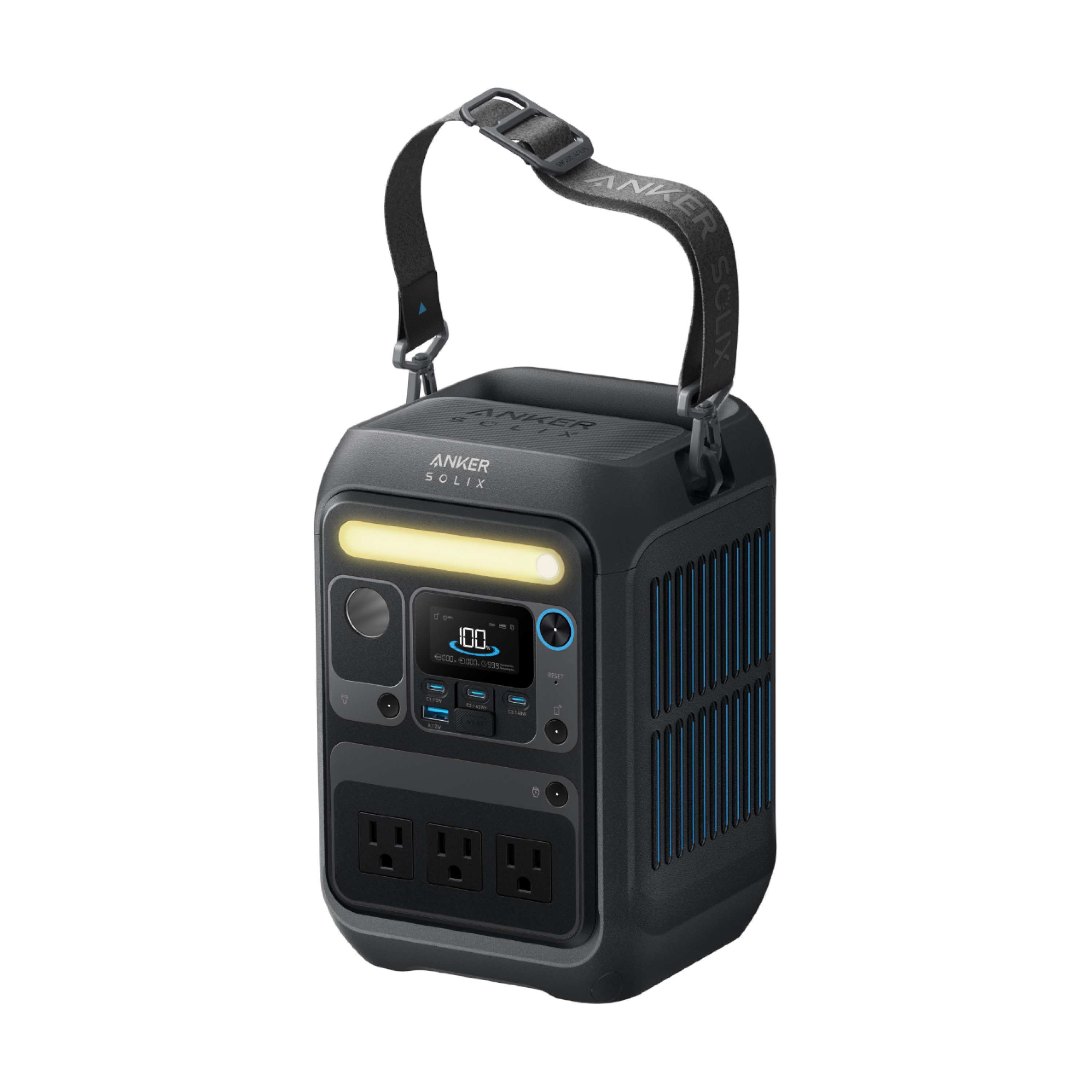
Anker SOLIX C300X
$299.99
$299.99 · direct from Anker
Last checked 16 days ago. Prices move — check before you buy.
Prices may vary by retailer and are subject to change.