Head-to-head test
Anker SOLIX C300 DC vs Anker SOLIX C300X
These are the same 288Wh battery in two shells, so the only question that decides it is whether anything you plug in ends in a wall plug: the C300X's $100 premium is buying an AC inverter, not more power.
Full profiles: Anker SOLIX C300 DC → · Anker SOLIX C300X →
Looking for a different matchup? Anker SOLIX C300 vs SOLIX C300X

Written by Wenny ZhengUpdated
Portable Power Tester, Station Arena Test Desk
Spec deltas
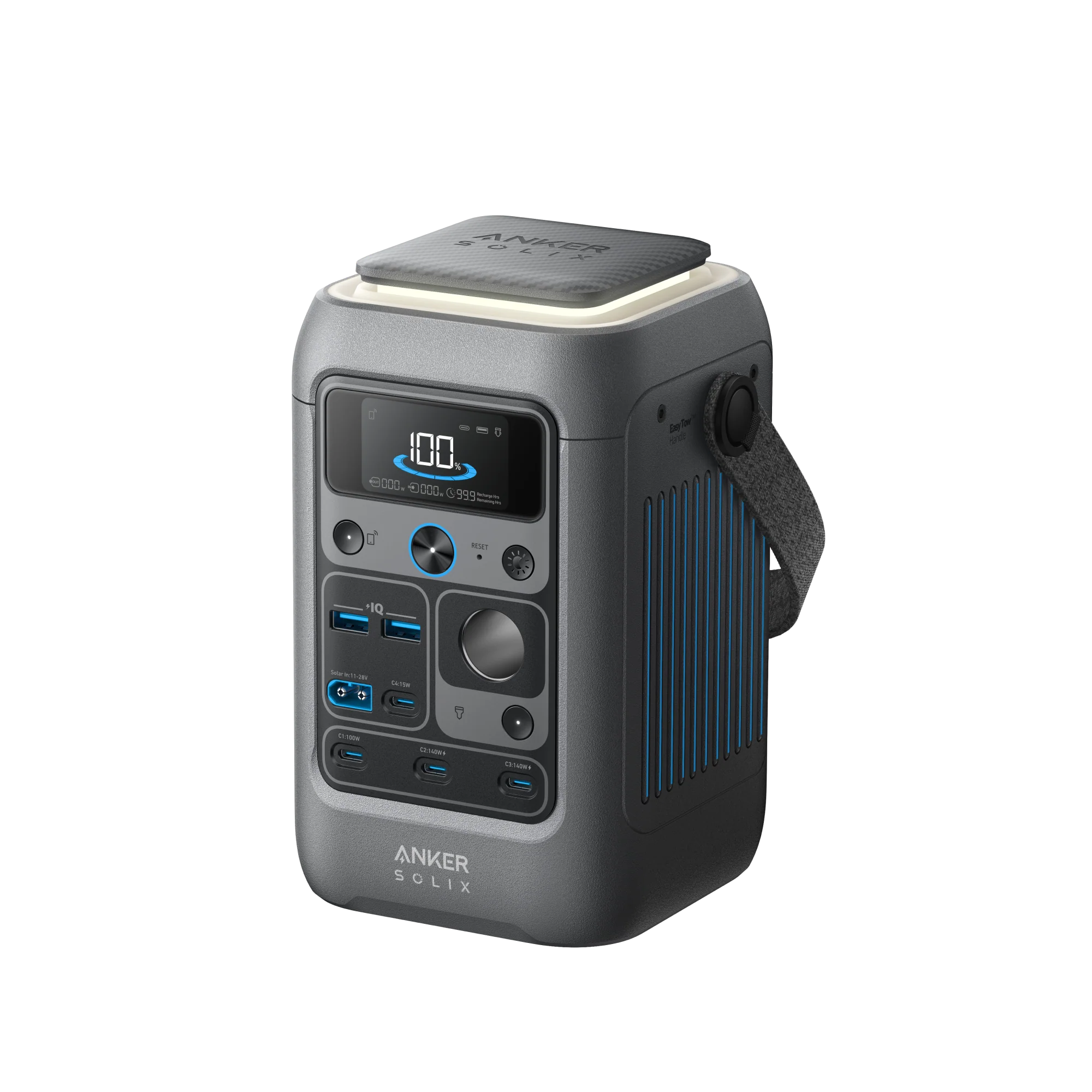
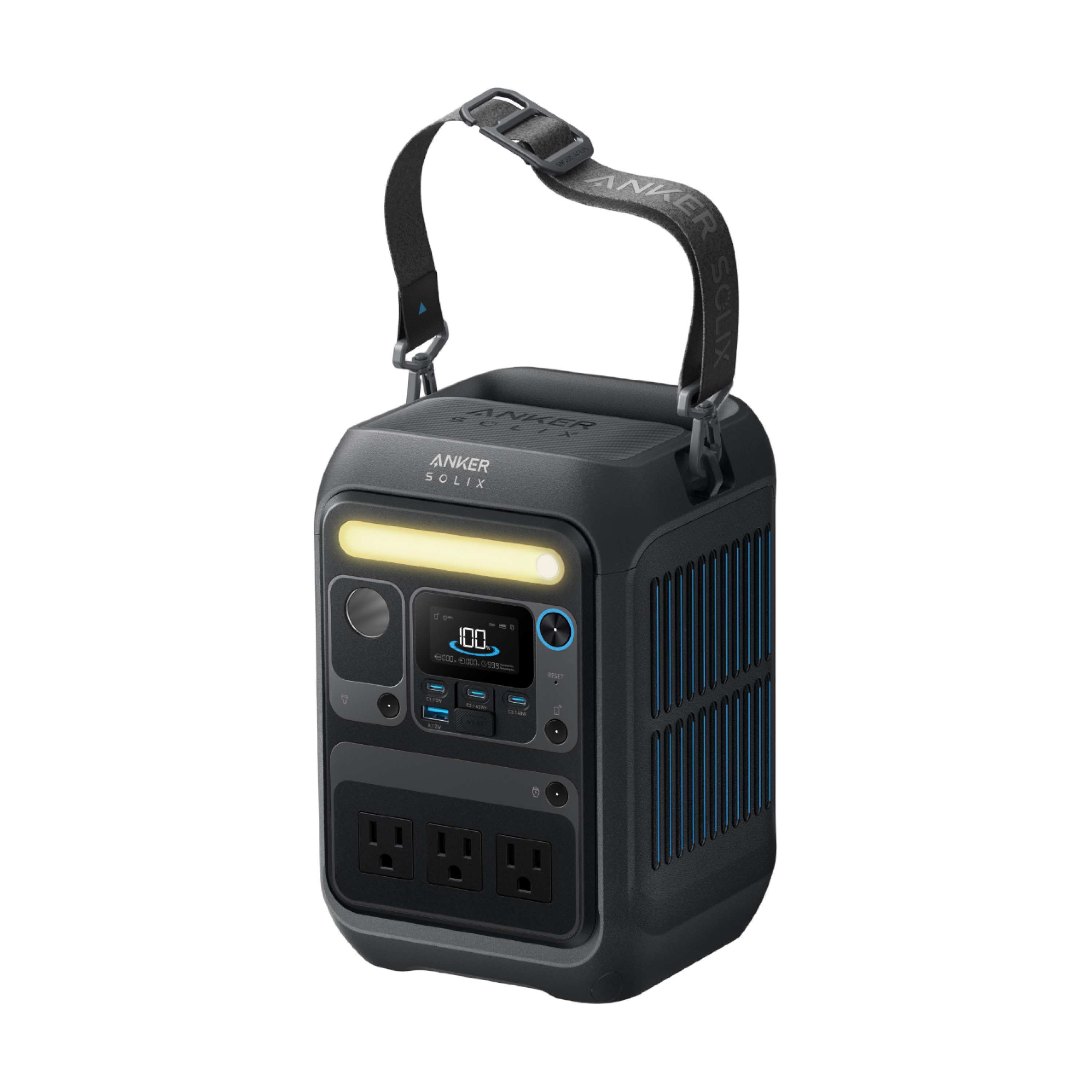
Same battery, different body. The C300 DC and the C300X hold an identical 288Wh, push the same 300W, and are rated for the same 3,000 cycles. The one thing that separates them is the one thing a power station is most defined by: the C300X has a real AC inverter and three wall outlets, and the C300 DC has none. So the $100 between them isn't buying watt-hours. It's buying the ability to plug in a wall device at all.
For most people cross-shopping these two, pay the $100. The C300X runs anything with a plug, rides a grid blip on a sub-10ms UPS, and carries five years of coverage to the DC unit's three, while still doing every USB and 12V job the cheaper unit does. The C300 DC can never gain an outlet.
But if your entire kit charges over USB-C or 12V, a phone, a laptop, camera batteries, a headlamp, a 12V cooler, then the C300 DC is the smarter buy, not the compromise. It's $100 less and nearly three pounds lighter for the same battery, and the extra money would be paying for an inverter you'd never switch on. This whole page comes down to one question: does anything you own end in a wall plug?
What the Numbers Reveal
Each conclusion stated first — the numbers behind it on one line, the full analysis below.
Because the batteries are identical, the $100 gap buys exactly one capability: the inverter, plus the UPS and warranty that ride along with it. You are not paying for more energy or a longer life, since those are the same on both. You are paying for the outlet.
C300 DC: no AC outlets, its 300W is a DC total across USB and 12V, no inverterC300X: a real inverter behind 3 AC outlets, 600W surge over 300W continuousboth hold the identical 288Wh and the same 3,000-cycle rating
Why it mattersAnswer one question before you weigh anything else here, does any device you plan to power end in a wall plug, and that alone picks your unit.
cost / lifetime kWh
Flip the lens to warranty and the expensive unit becomes the cheaper one: five years spreads the C300X's price to $60 a covered year against the DC unit's $67. The premium isn't waste, it just isn't capacity. It's capability and coverage.
both store the same 864 kWh over a 3,000-cycle lifeC300 DC $200 works out to $0.23 per lifetime kWhC300X $300 works out to $0.35 per lifetime kWhC300X warranty is 5 years vs 3, which is $60 vs $67 per covered year
Why it mattersIf you value AC, the UPS, and the longer warranty, the $100 is well spent; if you only need the cells, it's pure overpay.
But the same 245Wh usable that bridges the flicker can't carry the night: a CPAP's 320Wh leaves the unit about 75Wh short. The UPS is a keep-alive for the half-second the grid drops, not a battery that runs the load until morning.
C300X lists a UPS switchover of 10ms or less; the C300 DC lists no UPS at alla reviewer pulled the wall plug on a running computer, router, modem and CPAP with no flickerB7245Wh usable against a roughly 320Wh CPAP night, which leaves it about 75Wh short
Why it mattersBuy the C300X to keep a desk alive through blips; don't buy either as a whole-night CPAP or fridge backup.
The specific dimensions that decide these two units — everything else is a tie.
What the Specs Don't Tell You
Selected because: The C300X's inverter, sub-10ms UPS and 5-year warranty against the C300 DC's DC-only, no-UPS, 3-year build. This is where the two actually part ways.
This is the section that decides it. The C300X carries a real inverter behind three AC outlets with 600W of surge; the C300 DC has no outlets and no inverter, so its 300W is a DC total across USB and 12V. Anything with a wall plug runs on one and not the other, and that gap can't be closed with a cable or a firmware update.
The same $100 step adds two things you feel later: a UPS that hands your gear to battery in 10ms or less when the grid drops, and five years of warranty against three. Be honest about the UPS's ceiling, though. On 245Wh usable it's a keep-alive for a router or modem through a blip, not a battery that runs a CPAP through the night. It buys you the half-second, not the eight hours.
Lifetime Value
Selected because: Identical 288Wh and 864 lifetime kWh on both, so the $100 gap ($0.23 vs $0.35 per lifetime kWh) is buying features, not energy.
cost / lifetime kWh
Both units store the same 864 kWh over their 3,000-cycle life, which makes the cost-per-kWh gap easy to read: it isn't an energy or quality difference, it's the price of the inverter. You pay $0.23 a lifetime kWh on the C300 DC and $0.35 on the C300X for the very same electrons, because one of them can do more with them.
Warranty flips the story. Spread each price over its coverage and the pricier box is the cheaper one to keep: $60 a covered year on the C300X's five years, $67 on the C300 DC's three. So which one is expensive depends entirely on the lens. Per kWh stored, the DC unit wins; per year insured, the C300X does. Neither lens is about capacity, because on capacity they're the same unit.
Portability & Form Factor
Selected because: 6.2 lbs for the C300 DC against 9 for the C300X, nearly three pounds, and the whole reason the lighter DC unit exists.
weight
The whole reason the C300 DC exists is on the scale: 6.2 lbs against the C300X's 9. Neither is heavy, and 9 lbs is a comfortable one-handed carry, so if this lives on a shelf and backs up a desk the difference never registers. In a backpack you haul all day, 2.8 lbs is real weight, and it's almost exactly the inverter the DC unit chose to leave out.
Your Life, Your Pick
Selected because: Both are 288Wh, so they clear device and short off-grid jobs and fall short of every household load, the profile that tells you what size you're really buying.
Run both against real household loads and they lose together: a weekend campsite, an eight-hour blackout, a van-life day all want far more than 288Wh, and both fall short by a wide margin. That's the honest shape of a 288Wh unit, it's device-scale, not house-scale. Where they both pass is the small stuff, an afternoon off-grid finishes at 41% used on either one.
The scenarios do expose one real split, and it isn't about capacity. In every job that involves a wall plug, the C300 DC is out before watt-hours even enter the conversation, because it can't plug the thing in. The C300X can at least start the load, even where it can't sustain it long. So read these as a size check first: if your real need is a fridge overnight, buy neither and go up a class.
Strengths & trade-offs
Anker SOLIX C300 DC
Strengths
- +Costs $100 less
- +Lighter by 2.8 lb
Trade-offs
- –No major technical downsides compared to rival.
Anker SOLIX C300X
Strengths
- +Longer warranty
Trade-offs
- –Substantially more expensive (+$100) than the SOLIX C300 DC.
Will It Power Your Gear?
Scenario math and per-appliance runtimes, modeled from the spec record.
Scenario verdicts
We ran the math on seven real-world scenarios. Here's which unit survives your actual life.
SCN-01 · 2 nights · needs 2,100Wh
Weekend Camping
Two nights off-grid with essential comfort
Neither unit
The SOLIX C300 DC has no AC outlets, so the led lights and box fan in this scenario never plug in — it's a DC station for USB and 12V gear, and no wattage figure changes that, so capacity never gets a say. This is the wrong kind of unit for the job rather than a close call. The SOLIX C300X doesn't have the energy either — 245Wh usable against 2,100Wh, 1,855Wh short — so neither route works.
Battery budget usedlower = more headroom
LOAD Phone Charger 15W×6h · LED Lights 40W×8h · Box Fan 75W×14h · CPAP Machine 40W×16h
SCN-02 · 8 hours · needs 1,645Wh
8-Hour Blackout
Keep the essentials running through a night without power
Neither unit
A fridge, a router, and a modem for eight hours wants 1,645Wh, and both units carry 288. The C300X can at least plug them in and the C300 DC can't plug them in at all, but even the C300X drains long before morning. Neither is a blackout battery. Buy one of these to keep phones and a laptop alive and a light on; buy a 1 to 2kWh unit if you want the fridge to survive the night.
Battery budget usedlower = more headroom
LOAD Fridge 150W×8h · Router + Modem 20W×8h · LED Lights (4 bulbs) 40W×6h · Phone Charger 15W×3h
SCN-03 · 8 hours · needs 320Wh
CPAP Overnight
Sleep therapy without interruption — the #1 medical use case
Neither unit
A humidifier-off CPAP pulls about 40W, and on 245Wh usable that's roughly six hours, not a full eight, so neither unit covers the 320Wh night. Both will bridge a blackout rather than replace the nightstand outlet. If CPAP is the whole reason you're buying, the C300X earns its keep by holding the line the instant the grid drops; the C300 DC has no UPS, so its gear rides an outage only as far as you wake up to notice.
Battery budget usedlower = more headroom
LOAD CPAP Machine 40W×8h
SCN-04 · 8 hours · needs 910Wh
Remote Workday
Full work day off-grid without power anxiety
Neither unit
The SOLIX C300 DC has no AC outlets, so the external monitor and router + modem in this scenario never plug in — it's a DC station for USB and 12V gear, and no wattage figure changes that, so capacity never gets a say. This is the wrong kind of unit for the job rather than a close call. The SOLIX C300X doesn't have the energy either — 245Wh usable against 910Wh, 665Wh short — so neither route works.
Battery budget usedlower = more headroom
LOAD Laptop 60W×8h · External Monitor 30W×8h · Router + Modem 20W×8h · Phone Charger 15W×2h
SCN-05 · 4 hours · needs 670Wh
Tailgate Party
Game day power for the crew
Neither unit
The SOLIX C300 DC has no AC outlets, so the blender and led tv in this scenario never plug in — it's a DC station for USB and 12V gear, and no wattage figure changes that, and the SOLIX C300X can start the 400W peak but not hold it — 600W of surge gets it going, then the 300W continuous rating takes over, so capacity never gets a say. This is the wrong kind of unit for the job rather than a close call.
Battery budget usedlower = more headroom
LOAD Blender 400W×0.5h · LED TV (55") 80W×4h · Bluetooth Speaker 15W×4h · Phone Charger (×3) 45W×2h
SCN-06 · 24 hours · needs 4,685Wh
Van Life Daily
A full day of mobile living — the ultimate endurance test
Neither unit
The SOLIX C300 DC has no AC outlets, so the mini-fridge, led lights and the rest in this scenario never plug in — it's a DC station for USB and 12V gear, and no wattage figure changes that, so capacity never gets a say. This is the wrong kind of unit for the job rather than a close call. The SOLIX C300X doesn't have the energy either — 245Wh usable against 4,685Wh, 4,440Wh short — so neither route works.
Battery budget usedlower = more headroom
LOAD Mini-Fridge 150W×24h · Laptop 60W×4h · Phone Charger 15W×3h · LED Lights 40W×5h · Fan 75W×8h
SCN-07 · an afternoon · needs 100Wh
Afternoon Off-Grid
Phones and a speaker at the park, beach, or campsite — the small-unit job description
Either unit
This is the job small stations are actually for, and both do it: the SOLIX C300 DC finishes at 41% used, the SOLIX C300X at 41%. At this size the decider is what rides in the bag, then price, not the leftover watt-hours: the SOLIX C300X weighs 9 lbs, and at 6.2 lbs the SOLIX C300 DC is the one you'll be glad you brought.
Battery budget usedlower = more headroom
LOAD Phone Charger (×2) 30W×2h · Bluetooth Speaker 10W×4h
The Load Test
RUNTIME = (Wh × 0.85) ÷ LOAD
None of the scenarios above exactly yours? Build it. Toggle what you'd plug in; both units are tested against the combined draw.
Essentials
Comfort & Convenience
High-Draw Appliances
Test duration
8h
Continuous draw
205W
Projected runtime
Only the SOLIX C300X can run this load — the SOLIX C300 DC has no AC outlets for the wall-plug gear in it.
$299.99 list · direct from Anker
Planning for more than this? Describe your whole setup and get it sized →
Modeled from the spec record — same math as the tables below. Methodology
Runtime by appliance
Real-world runtime estimates for common appliances, modeled at 85% inverter efficiency.¹
Essentials
The basics you need runningscale 0–16.3hComfort & Convenience
Makes off-grid life actually enjoyablescale 0–3.3hHigh-Draw Appliances
These reveal the real limits¹ Runtime = (capacity × 0.85) ÷ appliance watts. Within each group, all bars share one time scale (the group's longest runtime), so lengths are comparable across appliances; identical runtimes collapse into a single blue/orange bar. Actual runtime varies with battery age, temperature, and simultaneous loads — see methodology.
Conclusion
August 30, 2026
Verdict: the Anker SOLIX C300X
Buy the C300X unless you already know your whole kit charges over USB-C or 12V. For $100 more it adds a real inverter and three AC outlets, a UPS that hands your gear to battery in 10ms or less when the grid drops, and five years of warranty against three, all on the identical 288Wh battery, and it still does every DC job the cheaper unit does. The C300 DC's case is real but narrow: it's nearly three pounds lighter and $100 cheaper, which wins for the pure device-charger counting every ounce in a bag. But an inverter is the one thing you can't add to the DC unit later, so when in doubt, spend the $100.
Editor-assigned confidence, based on cited owner research and spec analysis.
List prices as of August 30, 2026. The links below open Anker's current price.
$299.99 · direct from Anker
Last checked 16 days ago. Prices move — check before you buy.
Written by Wenny Zheng, Portable Power Tester · Station Arena Test Desk · Updated August 30, 2026
Black Friday · 38 days out
Price to beat:SOLIX C300X $300
We have never seen it discounted, so any real cut would be a first.
Measured Data
Benchmark scores and the full spec record, side by side.
Benchmark scores
Not rated for both units (minimum threshold unmet): UPS, CPAP, Tailgating.
Full specifications
ᵈ Derived: price ÷ rated capacity. See the data behind our comparisons →
Comparison ToolAdd more power stations, side by sideOpen Tool →How these numbers are produced
Numeric verification
Every figure on this page traces to our spec database or arithmetic on it — no estimated numbers.
Owner claims
Statements about owner experience are cited to published reviews — see Sources & Research Notes below.
Runtime model
Runtime = (rated capacity × 0.85 inverter efficiency) ÷ device wattage. Solar recharge estimates assume panels deliver 70% of rated output. Cold weather, battery age, and stacked loads reduce real-world results.
Power Score
Computed from 14 published spec dimensions, weighted per use-case bench. Higher is better; a unit must meet a bench's minimum threshold to be rated.
See the full weight table and data sourcing on our methodology page →Class ranking (the star rating)
Each unit's star score is a category ranking, not customer reviews — no buyer opinions feed it. We score every station on size-independent quality (value, output, portability, endurance, ports, warranty, and more), then percentile-rank it against the other units in its capacity class, so a class-leading compact unit and a class-leading whole-home unit can both earn 5★. Here, SOLIX C300 DC rates 4.4/5 (65th percentile of 24 Personal-class units), and SOLIX C300X rates 4.6/5 (74th percentile of 24 Personal-class units).
How the class ranking is computed →Test Notes & Caveats
Hidden gotchas and advantages we spotted that you won't find on the product page.
SOLIX C300 DC: No AC Outlets At All
The SOLIX C300 DC's 300W is a DC port total — USB and 12V — not an inverter rating. Anything with a wall plug (a fridge, a TV, a coffee maker, most fans and lamps) never plugs in, at any wattage. That's the design, not a defect: it buys weight, silence, and efficiency for phone, laptop, camera, and 12V-CPAP loads. The SOLIX C300X carries a real inverter behind 3 AC outlets, so it plays in both worlds. Decide which side of that line your gear lives on before weighing anything else on this page.
Only the SOLIX C300X Lists a UPS Mode
The SOLIX C300X can sit between the wall and your gear and hand it to battery when the grid drops — rated ≤10ms — quick enough on paper that desktop PCs and routers should ride through, treating that as the rating it is. Worth it for a router or a modem — not a CPAP: at 245Wh usable it can bridge the flicker but cannot run the night. The SOLIX C300 DC's spec sheet lists no UPS mode, so anything plugged into it rides an outage only as far as your reaction time.
Warranty: 5 Years vs 3
The SOLIX C300X is covered for 5 years against the SOLIX C300 DC's 3 years. An underrated factor if you're keeping this unit for years.
SOLIX C300 DC: Noise Level Not Disclosed
The SOLIX C300X publishes its noise level (25dB); the SOLIX C300 DC doesn't publish one. That isn't evidence the SOLIX C300 DC is louder — it means there's no figure to hold it to, and no way to compare the two on this without hearing them. If you're buying for a bedroom, a CPAP, or an apartment, treat the SOLIX C300X's 25dB as the only published number on the table — a spec-sheet figure, not a measurement — and look for hands-on reports of the SOLIX C300 DC before deciding.
Full record above — the Test Desk pick is the SOLIX C300X.
Check SOLIX C300X price →or check the SOLIX C300 DC priceOwnership Analysis
What happens after you buy — true cost of ownership, brand trust, and growth potential.
Lifetime value
Service lifeyears at one full cycle per day
Lifetime energy delivered
Cost per delivered kWh
│ warranty ends · Reaching the cycle rating means ~80% capacity remains — degraded, not dead.
Analyst note
The SOLIX C300 DC wins on both sticker price and long-term value. At $0.23/kWh over its lifetime, it's meaningfully cheaper to own. Clear value winner. One thing to know reading the table: both carry the same 3,000-cycle rating, so the lifetime rows are sticker price and capacity in disguise — the wear horizon is identical and decides nothing here.
Growth path
SOLIX C300 DC
FIXED CAPACITYFixed at 288Wh, with no expansion — so size it for your needs up front rather than planning to add capacity later.
Accepts up to 100W of solar. Limited to a single portable panel.
Adequate ports for most setups, but heavy users may want a power strip.
SOLIX C300X
FIXED CAPACITYFixed at 288Wh, with no expansion — so size it for your needs up front rather than planning to add capacity later.
Accepts up to 100W of solar. Limited to a single portable panel.
Adequate ports for most setups, but heavy users may want a power strip.
Realistic full solar rechargeat 70% of rated panel output — see methodology
Analyst note
Neither expands, and that's no knock on either — each is a complete unit at a fixed size. They hold the same 288Wh, so capacity can't break the tie: decide on price, weight, and the rest, and know that whichever you pick is the ceiling.
What Owners Report
Patterns from published owner reports and long-term reviews — every claim cited to its source below.
Anker SOLIX C300 DC
Field data on the C300 DC is still thin, and most of what exists is reviews rather than long-term owners. Reviewers highlight the light 6.2-lb body and the fast two-way USB-C that refills the unit to 80% in about an hourA1A2. The owners who have weighed in like the portability, and that a single charge tops a phone and laptop several times or runs a fan for hoursA3. The consistent read across all of it is the same: this is a device charger, best for travelers keeping gear topped up rather than running anything with a plugA4.
“A 288Wh unit that ditches the heavy AC inverter to focus on DC power, keeping it very light at about 6.2 lbs.”
Sources
the-gadgeteer.com · forbes.com · androidpolice.com · batteryessence.com · bestbuy.com · campingsolar.us
Anker SOLIX C300X
The C300X has more hands-on coverage, and it's mostly good. Independent reviewers found it near-silent at its rated 300W, with the fan only becoming audible when pushed under a heavier overload drawB4B11. Both the UPS and AC charging met or beat spec: a reviewer yanked the wall plug on a running computer, router, modem and CPAP with no flicker, and wall charging hit 80% in about 49 minutesB7B8.
The blemishes cluster in one place, the app and charging pipeline: a Bluetooth pairing dropout that blocks monitoring until you re-pair, and one owner whose unit refused to charge past 25%B1B2. One quirk worth knowing is a power-saving cutoff that shuts the unit off under very low draws like a smartwatch or headphones, which catches people off guardB3. The build itself drew praise, with the handle showing no wear after dozens of trunk loadsB12.
“The unit was confirmed to shut itself off when charging very low-draw devices like headphones or a smartwatch — an intended power-saving cutoff rather than a defect, but one that catches owners off guard.”
Sources
teqclub.com · thesolarlab.com · backuppowerhub.com
Sources & Research Notes
Every owner claim in this report is traceable to a published source. The bracketed references above resolve here.
Recurring owner themes
- Light DC-only design (no AC inverter), fast USB-C charging, and good port selection for device charging are the highlights. [SOLIX C300 DC · 3 entries]
- Independent hands-on reviewers found the C300X near-silent at its rated 300W load, though one test noted the fan becoming noticeably audible under a heavier transient/overload draw. [SOLIX C300X · 2 entries]
- AC charging and UPS switchover both performed at or better than spec in hands-on testing — fast wall recharge and an imperceptible transfer that kept a computer, router, and CPAP running through a pulled plug. [SOLIX C300X · 2 entries]
- The most concrete owner-reported defects both sit in the app/charging pipeline: a Bluetooth pairing dropout that blocks monitoring, and a specific report of the battery refusing to charge past 25%. [SOLIX C300X · 2 entries]
- A1
“A 288Wh unit that ditches the heavy AC inverter to focus on DC power, keeping it very light at about 6.2 lbs.”
the-gadgeteer.com / forbes.com — SOLIX C300 DC review · 2026 · [positive]
- A2
“Offers 2 USB-A and 4 USB-C ports plus a 12V car socket; two-way USB-C with PD 3.1 recharges the unit to 80% in about 1 hour.”
androidpolice.com / batteryessence.com — SOLIX C300 DC review · 2026 · [positive]
- A3
“Owners praise its portability and capacity — enough to charge a phone and laptop several times, run a fan for hours, or power a small light setup.”
bestbuy.com owner reviews — SOLIX C300 DC / C300X · 2026 · [positive]
- A4
“A DC-focused design with app integration and solar support — best for modern travelers charging devices, not running AC appliances.”
androidpolice.com / campingsolar.us — SOLIX C300 DC review · 2026 · [mixed]
- B1
“Users reported trouble connecting the C300X to the Anker app, which blocked monitoring power usage and changing settings; re-pairing by "forgetting" the device in Bluetooth settings and reconnecting through the app usually fixed it.”
teqclub.com — "Solving Common Anker C300X Problems" · unknown · [negative]
- B2
“My Anker solix c300x Portable Power Station will not accept charge more than 25%.”
teqclub.com — "Solving Common Anker C300X Problems" (quoted owner comment) · unknown · [negative]
- B3
“The unit was confirmed to shut itself off when charging very low-draw devices like headphones or a smartwatch — an intended power-saving cutoff rather than a defect, but one that catches owners off guard.”
teqclub.com — "Solving Common Anker C300X Problems" · unknown · [mixed]
- B4
“This unit is impressively quiet. Even with the internal fans running when we pushed it to its limits, the C300X makes virtually no noise.”
thesolarlab.com — "Anker C300X Power Station Review" · 2026 · [positive]
- B7
“Pulling the AC plug mid-use while a computer, router, modem, and CPAP machine were running, the computer stayed on without interruption — no screen flicker, no system hiccup.”
backuppowerhub.com — "Anker SOLIX C300X Review" · 2026 · [positive]
- B8
“AC charging to 80% took 49 minutes in testing, matching the advertised claim; full charge landed at 65 minutes. A 100W solar panel took 3 hours 15 minutes, and 12V car charging took about 6.5 hours.”
backuppowerhub.com — "Anker SOLIX C300X Review" · 2026 · [positive]
- B11
“Under a 500W circular saw load, the fan ramped up noticeably — a contrast to how quiet the unit stays at its rated 300W.”
backuppowerhub.com — "Anker SOLIX C300X Review" · 2026 · [mixed]
- B12
“The C300X feels premium in a way many budget power stations don't; the carry handle showed no wear or flex after dozens of trunk loads.”
backuppowerhub.com — "Anker SOLIX C300X Review" · 2026 · [positive]
Research compiled August 30, 2026.
Who Should Buy Which
Buy the SOLIX C300 DC if you…
- →The minimalist whose entire kit charges over USB-C or 12V: phone, laptop, camera batteries, a headlamp, a 12V cooler.
- →The backpacker or air traveler counting every pound, where 6.2 lbs versus 9 is a real difference in a bag you carry all day.
- →Anyone who knows, for certain, they'll never reach for a wall plug, and would rather pocket the $100 than carry an inverter they won't use.
Buy the SOLIX C300X if you…
- →Anyone who wants to plug in a wall device, a lamp, a TV, a CPAP with its stock AC brick, a small blender at a tailgate, and doesn't want to discover mid-trip that the cheaper unit can't.
- →The desk worker who wants a router and modem to ride through a grid flicker on the UPS.
- →The buyer keeping this unit for years who values five years of coverage over three.
If neither fits
If you want to run a full-size fridge overnight or ride out a real blackout, 288Wh is too small for both, a bad outage wants a 1 to 2kWh unit. And if you need to power AC tools or a microwave, 300W continuous won't start most of them, so look a class up to a 500 to 1,000W station.
The Bottom Line
Strip everything else away and one fact remains: these are the same 288Wh battery, and only one of them can run a wall plug. That's the whole comparison. Pay the $100 for the C300X and you get an inverter, a UPS, and two more years of warranty on top of every DC trick the cheaper unit already does, and the inverter is the one piece you can't bolt on later.
Skip it only if you already know your answer. If your bag is nothing but USB-C cables and a 12V cooler, the C300 DC is lighter, cheaper, and does your exact job without charging you for silicon you'll never fire up. Everyone else: buy the outlet you might need, not the one you're sure you won't.
Frequently Asked Questions
Answers drawn from the spec record and cited owner research.
Can the Anker SOLIX C300 DC run AC appliances?
No. It's a DC-only unit: its 300W rating is a total across USB and 12V ports, and it has no AC outlets or inverter. Anything with a wall plug won't run on it at any wattage. If you need to plug in a lamp, a TV, or an appliance, you need the C300X.
Is the C300X worth $100 more than the C300 DC?
If you'll ever plug in a wall device, yes, because that's the one thing the DC unit can't do and you can't add it later. The $100 also buys a sub-10ms UPS and five years of warranty against three. If your gear is all USB-C and 12V, though, the extra money is buying an inverter you won't use.
What's the difference between the C300 DC and the C300X?
They share the same 288Wh battery, 300W output, and 3,000-cycle rating. The C300X adds a real AC inverter with three outlets and 600W of surge, a UPS mode, a published 25dB quiet-mode figure, and five years of warranty. The C300 DC drops all of that to save $100 and nearly three pounds.
Can either one run a CPAP all night?
Not a full night. Both hold about 245Wh usable, and a humidifier-off CPAP pulls near 40W, so you get roughly six hours against a typical eight-hour, 320Wh night. Both will bridge a blackout; neither replaces the nightstand outlet for nightly use. The C300X at least holds the line the instant the grid drops thanks to its UPS.
Which is quieter for a bedroom?
Only the C300X publishes a number, as low as 25dB, and that's a quiet-mode floor rather than a measured level. Independent testing found it near-silent even with the fans running at its rated load. The C300 DC publishes no noise spec, so there's no figure to hold it to, buying for a bedroom, favor the unit with the published number and check hands-on reports.
Where to buy
Anker SOLIX C300 DC
Sold on Amazon · today’s price is on the listing
Anker SOLIX C300XPick
$299.99
$299.99 · direct from Anker
Last checked 16 days ago. Prices move — check before you buy.
Prices may vary by retailer and are subject to change.