Head-to-head test
EcoFlow RIVER 3 230 vs Anker SOLIX C300
The extra $141 isn't a markup — it's 58 more Wh, a UPS switchover twice as fast, and a second full-speed USB-C port, all at the same cost per watt-hour; the RIVER 3 only wins if that $141 or 1.3 lb is the real constraint.
Full profiles: EcoFlow RIVER 3 230 → · Anker SOLIX C300 →

Written by Wenny ZhengUpdated
Portable Power Tester, Station Arena Test Desk

$189.00 · direct from EcoFlow
Last checked 56 days ago. Prices move — check before you buy.
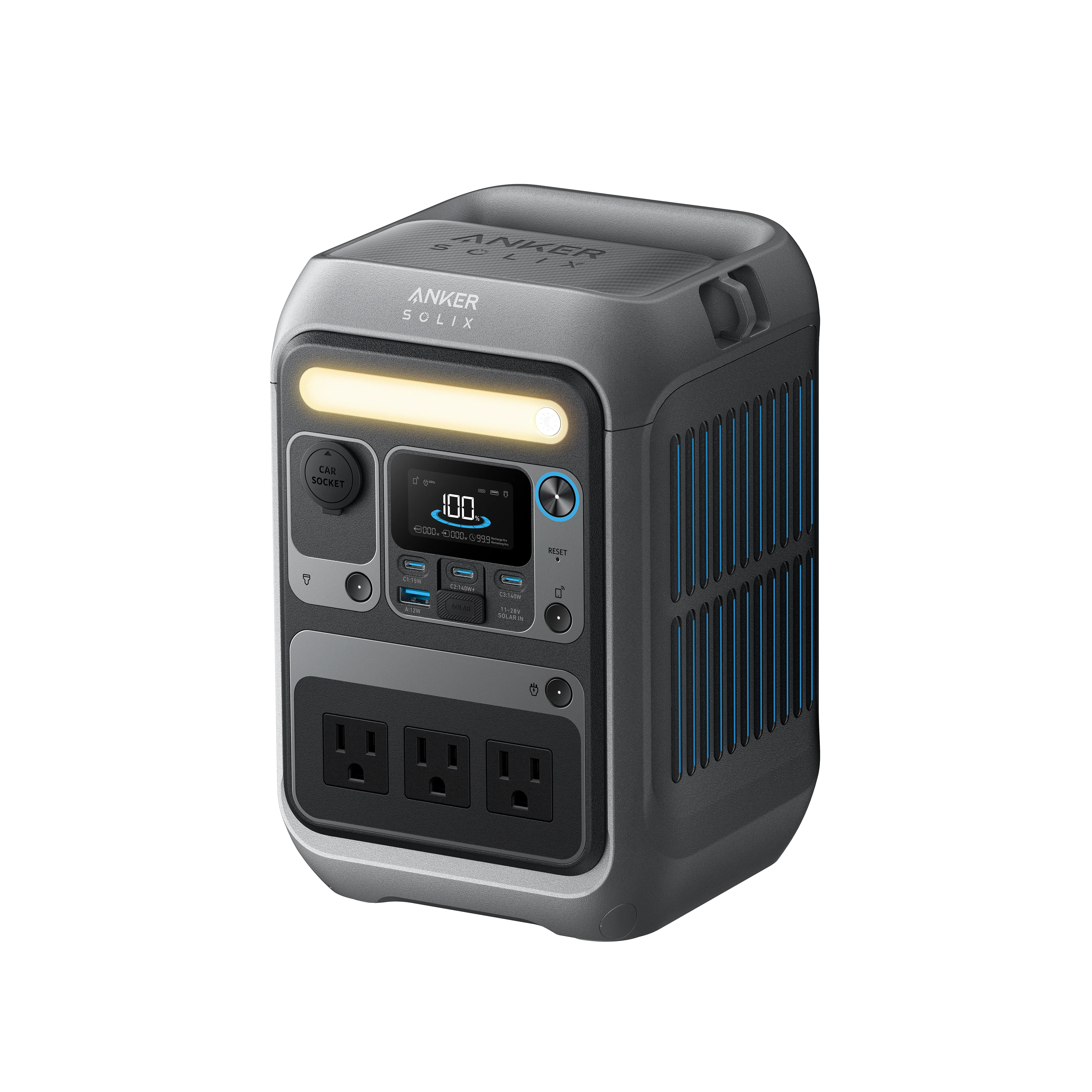
$329.99 · direct from Anker
Last checked 1 day ago. Prices move — check before you buy.
Spec deltas
The Anker SOLIX C300 costs $141 more than the EcoFlow RIVER 3 230, and by the time you've amortized both across their identical 3,000-cycle lifespan, that gap nearly disappears: $0.28 versus $0.29 per lifetime kilowatt-hour. What the $141 actually buys isn't cushion — it's 58 additional watt-hours, a UPS that switches over twice as fast, and dual 140W USB-C ports where the RIVER 3 has a single 100W port.
The RIVER 3 hits back where it counts for a different buyer. It's 1.3 lb lighter (7.8 lb versus 9.1 lb), $141 cheaper to buy today, and its 110W solar input edges out the C300's 100W. If this thing lives in a daypack and gets topped off by a panel on the trail, the lighter, cheaper unit is the sensible call.
Between the two, the C300 is the better default: quieter, faster to switch over, and functionally the same price per watt-hour over its life. Take the RIVER 3 only if weight or the sticker price is the actual constraint.
What the Numbers Reveal
Each conclusion stated first — the numbers behind it on one line, the full analysis below.
The $141 price gap isn't just paying for 58 more Wh; it's paying for a genuinely different charging topology, two devices at full speed instead of one.
RIVER 3 230 has a single 100W USB-C portSOLIX C300 has dual 140W USB-C ports
Why it mattersAnyone who travels with a laptop and a phone and fast-charges both at once should pay the $141; single-device chargers have no reason to.
The two are nearly identical on lifetime cost per kWh ($0.28 vs $0.29), so switchover speed — not price — is the real reason to pick one over the other for UPS duty.
RIVER 3 230 switches over in 20msSOLIX C300 switches over in 10ms
Why it mattersAnyone using this as a mini-UPS for a router, NAS, or desktop should default to the C300; anyone using it purely to top off phones outdoors won't notice the 10ms.
weight
The RIVER 3's 110W solar input also edges out the C300's 100W, so the RIVER 3 is the better grab-and-go unit and the C300 is the better bedside or desk unit.
RIVER 3 230 is rated at 30 dB, EcoFlow's own 'whisper quiet' ratingA1SOLIX C300 is rated at 25 dBRIVER 3 230 weighs 7.8 lb versus the C300's 9.1 lb
Why it mattersIf the unit lives on a nightstand or a desk, take the C300; if it lives in a backpack, take the RIVER 3.
Capacity
Spread across the shared 5-year warranty, that's about $141 a year owned for the RIVER 3 against $48 for the C300 — the $141 gap doesn't vanish, it just spreads differently across the same ownership horizon.
RIVER 3 230 costs $189 for 230Wh ($.87/Wh sticker)SOLIX C300 costs $330 for 288Wh ($.83/Wh sticker)
Why it mattersStop treating the $141 as a premium tax and treat it as 58Wh more capacity for functionally the same cost per watt-hour — decide on capacity need, not price anxiety.
The specific dimensions that decide these two units — everything else is a tie.
PowerScore Breakdown
Selected because: Identical AC output spec (300W/600W both) makes the composite score gap the cleanest single thing to explain.
overall power score
Both units push the same 300W continuous, 600W surge out of the wall — the identical AC spec most buyers check first. The gap between them (1581 vs 1772) comes entirely from what's behind that number: 58 more Wh of capacity, ports that can actually deliver on two devices at once, and a switchover fast enough to protect sensitive electronics.
If the appliance being plugged in only cares about the AC socket, the score gap is close to irrelevant — a coffee maker doesn't know which unit it's plugged into. The gap shows up in the edge cases: fast-charging two devices, riding through a power blip, or how the battery ages over 3,000 cycles.
Lifetime Value
Selected because: Near-identical cost-per-kWh reveals what the $141 gap actually buys.
cost / lifetime kWh
Run the math over each unit's full 3,000-cycle life and the price gap effectively disappears: $0.29 per lifetime kilowatt-hour for the RIVER 3, $0.28 for the C300. Paying $141 more for a unit that costs the same per watt-hour over its life isn't a premium — it's just more unit for slightly more money.
Spread across the shared 5-year warranty, that's roughly $141 a year owned for the RIVER 3 against $48 for the C300 — the cheaper unit today stays the cheaper unit to own, even though it isn't the cheaper unit per watt-hour.
Portability & Form Factor
Selected because: The 1.3 lb weight gap and the solar input difference matter for backpack versus desk use.
weight
7.8 lb rides in a daypack or a laptop bag without announcing itself; 9.1 lb still fits the same bag, but it's the difference between forgetting you're carrying it and feeling it by the third mile. The RIVER 3's 110W solar input also edges out the C300's 100W, so if a panel is doing the recharging, the lighter unit gets there marginally faster too.
None of that matters if the unit lives on a desk or a nightstand instead of a pack — in that world, weight is irrelevant and the C300's quieter fan (25 dB vs 30 dB) is the spec that actually gets noticed.
What the Specs Don't Tell You
Selected because: UPS switchover speed is the one gotcha with a real physical consequence at this size.
The UPS speed gap is the one gotcha here with a real physical consequence: 10ms keeps the C300's switchover fast and clean; 20ms on the RIVER 3 is still fast by consumer standards, but it's double the gap. For a router or NAS riding through brief outages, that difference is the whole point of buying a UPS-capable unit.
The warranty gotcha is closer to a wash — both units carry 5 years, and the cost-per-year math (roughly $141 vs $48) just mirrors the sticker price. Nobody's coverage runs out first; the price gap is the whole story there.
Brand Trust
Selected because: Cross-brand pair (EcoFlow vs Anker) with meaningfully different support and community profiles.
EcoFlow and Anker solve the trust question differently. EcoFlow has the deeper ecosystem and by far the larger community to lean on if something goes wrong, but support outcomes are genuinely mixed — some owners get a prepaid-label replacement, others wait weeks or receive a refurbished unit.
Anker still carries the halo of its consumer-electronics reputation, but recent SOLIX-specific support reports lean more on AI-driven responses and slower resolution than that reputation would suggest. Neither brand's support is a reason to prefer one unit over the other here — decide on the hardware, not the logo.
Strengths & trade-offs
EcoFlow RIVER 3 230
Strengths
- +Costs $141 less
- +Lighter by 1.3 lb
- +Faster solar charging
Trade-offs
- –No major technical downsides compared to rival.
Anker SOLIX C300
Strengths
- +Larger battery capacity
Trade-offs
- –Substantially more expensive (+$141) than the RIVER 3 230.
Will It Power Your Gear?
Scenario math and per-appliance runtimes, modeled from the spec record.
Scenario verdicts
We ran the math on seven real-world scenarios. Here's which unit survives your actual life.
SCN-01 · 2 nights · needs 2,100Wh
Weekend Camping
Two nights off-grid with essential comfort
Neither unit
Neither unit covers this scenario's 2,100Wh: the RIVER 3 230 comes up 1,905Wh short (about 9% covered), the SOLIX C300 1,855Wh (12%). This is well outside what either unit is for; the right answer here is a larger station, not a choice between these two.
Battery budget usedlower = more headroom
LOAD Phone Charger 15W×6h · LED Lights 40W×8h · Box Fan 75W×14h · CPAP Machine 40W×16h
SCN-02 · 8 hours · needs 1,645Wh
8-Hour Blackout
Keep the essentials running through a night without power
Neither unit
Neither unit covers this scenario's 1,645Wh: the RIVER 3 230 comes up 1,450Wh short (about 12% covered), the SOLIX C300 1,400Wh (15%). This is well outside what either unit is for; the right answer here is a larger station, not a choice between these two.
Battery budget usedlower = more headroom
LOAD Fridge 150W×8h · Router + Modem 20W×8h · LED Lights (4 bulbs) 40W×6h · Phone Charger 15W×3h
SCN-03 · 8 hours · needs 320Wh
CPAP Overnight
Sleep therapy without interruption — the #1 medical use case
Neither unit
Neither unit covers this scenario's 320Wh: the RIVER 3 230 comes up 125Wh short (about 61% covered), the SOLIX C300 75Wh (76%). Either gets you most of the way, so this is a scenario you plan around rather than one you should rule them out for.
Battery budget usedlower = more headroom
LOAD CPAP Machine 40W×8h
SCN-04 · 8 hours · needs 910Wh
Remote Workday
Full work day off-grid without power anxiety
Neither unit
Neither unit covers this scenario's 910Wh: the RIVER 3 230 comes up 715Wh short (about 22% covered), the SOLIX C300 665Wh (27%). This is well outside what either unit is for; the right answer here is a larger station, not a choice between these two.
Battery budget usedlower = more headroom
LOAD Laptop 60W×8h · External Monitor 30W×8h · Router + Modem 20W×8h · Phone Charger 15W×2h
SCN-05 · 4 hours · needs 670Wh
Tailgate Party
Game day power for the crew
Neither unit
Neither unit can hold the 400W peak this scenario needs — the RIVER 3 230 on its 300W continuous rating, the SOLIX C300 on its 300W, so capacity never gets a say. This is the wrong size of unit for the job rather than a close call.
Battery budget usedlower = more headroom
LOAD Blender 400W×0.5h · LED TV (55") 80W×4h · Bluetooth Speaker 15W×4h · Phone Charger (×3) 45W×2h
SCN-06 · 24 hours · needs 4,685Wh
Van Life Daily
A full day of mobile living — the ultimate endurance test
Neither unit
Neither unit covers this scenario's 4,685Wh: the RIVER 3 230 comes up 4,490Wh short (about 4% covered), the SOLIX C300 4,440Wh (5%). This is well outside what either unit is for; the right answer here is a larger station, not a choice between these two.
Battery budget usedlower = more headroom
LOAD Mini-Fridge 150W×24h · Laptop 60W×4h · Phone Charger 15W×3h · LED Lights 40W×5h · Fan 75W×8h
SCN-07 · an afternoon · needs 100Wh
Afternoon Off-Grid
Phones and a speaker at the park, beach, or campsite — the small-unit job description
Either unit
This is the job small stations are actually for, and both do it: the RIVER 3 230 finishes at 51% used, the SOLIX C300 at 41%. At this size the decider is what rides in the bag — 7.8 lbs for the RIVER 3 230 against 9.1 for the SOLIX C300 — and price, not the leftover watt-hours.
Battery budget usedlower = more headroom
LOAD Phone Charger (×2) 30W×2h · Bluetooth Speaker 10W×4h
The Load Test
RUNTIME = (Wh × 0.85) ÷ LOAD
None of the scenarios above exactly yours? Build it. Toggle what you'd plug in; both units are tested against the combined draw.
Essentials
Comfort & Convenience
High-Draw Appliances
Test duration
8h
Continuous draw
205W
Projected runtime
For this load: SOLIX C300 runs 1.2h vs 1h.
$329.99 list · direct from Anker
Modeled from the spec record — same math as the tables below. Methodology
Runtime by appliance
Real-world runtime estimates for common appliances, modeled at 85% inverter efficiency.¹
Essentials
The basics you need runningscale 0–16.3hComfort & Convenience
Makes off-grid life actually enjoyablescale 0–3.3hHigh-Draw Appliances
These reveal the real limits¹ Runtime = (capacity × 0.85) ÷ appliance watts. Within each group, all bars share one time scale (the group's longest runtime), so lengths are comparable across appliances; identical runtimes collapse into a single blue/orange bar. Actual runtime varies with battery age, temperature, and simultaneous loads — see methodology.
Conclusion
July 15, 2026
Verdict: the Anker SOLIX C300
Take the SOLIX C300. The $141 premium is fully offset once you amortize it across the unit's life — $0.28 per lifetime kWh against the RIVER 3's $0.29 — so you're not paying more, you're buying 58 extra Wh, a UPS switchover twice as fast, and a second full-speed USB-C port. The RIVER 3 only wins if you specifically need the lighter, cheaper unit for a pack that's already full or a budget that's already spent.
Editor-assigned confidence, based on cited owner research and spec analysis.
List prices as of July 15, 2026. The links below open EcoFlow's and Anker's current prices.
$329.99 · direct from Anker
Last checked 1 day ago. Prices move — check before you buy.
or check the RIVER 3 230 price$189.00 list
Written by Wenny Zheng, Portable Power Tester · Station Arena Test Desk · Updated July 15, 2026
Measured Data
Benchmark scores and the full spec record, side by side.
Benchmark scores
Full specifications
ᵈ Derived: price ÷ rated capacity. See the data behind our comparisons →
Comparison ToolAdd more power stations, side by sideOpen Tool →How these numbers are produced
Numeric verification
Every figure on this page traces to our spec database or arithmetic on it — no estimated numbers.
Owner claims
Statements about owner experience are cited to published reviews — see Sources & Research Notes below.
Runtime model
Runtime = (rated capacity × 0.85 inverter efficiency) ÷ device wattage. Solar recharge estimates assume panels deliver 70% of rated output. Cold weather, battery age, and stacked loads reduce real-world results.
Power Score
Computed from 14 published spec dimensions, weighted per use-case bench. Higher is better; a unit must meet a bench's minimum threshold to be rated.
See the full weight table and data sourcing on our methodology page →Class ranking (the star rating)
Each unit's star score is a category ranking, not customer reviews — no buyer opinions feed it. We score every station on size-independent quality (value, output, portability, endurance, ports, warranty, and more), then percentile-rank it against the other units in its capacity class, so a class-leading compact unit and a class-leading whole-home unit can both earn 5★. Here, RIVER 3 230 rates 4.3/5 (57th percentile of 22 Personal-class units), and SOLIX C300 rates 4.2/5 (52nd percentile of 22 Personal-class units).
How the class ranking is computed →Test Notes & Caveats
Hidden gotchas and advantages we spotted that you won't find on the product page.
A switchover that's actually twice as fast
10ms versus 20ms sounds like a rounding error until a router or a desktop sits behind it — halving the gap is the difference between electronics that don't notice the outage and ones that might blip or reboot. For phone-and-flashlight duty, neither speed matters.
Same coverage, split differently
Both units carry a 5-year warranty. Spread over that window, the RIVER 3 works out to about $141 a year owned and the C300 to about $48 — the cheaper sticker price is still the cheaper unit to own, warranty included. Nobody outgrows five years' coverage on either.
Full record above — the Test Desk pick is the SOLIX C300.
Check SOLIX C300 price →or check the RIVER 3 230 priceOwnership Analysis
What happens after you buy — true cost of ownership, brand trust, and growth potential.
Lifetime value
Service lifeyears at one full cycle per day
Lifetime energy delivered
Cost per delivered kWh
│ warranty ends · Reaching the cycle rating means ~80% capacity remains — degraded, not dead.
Analyst note
The RIVER 3 230 wins on both sticker price and long-term value. At $0.27/kWh over its lifetime, it's meaningfully cheaper to own. Clear value winner. One thing to know reading the table: both carry the same 3,000-cycle rating, so the lifetime rows are sticker price and capacity in disguise — the wear horizon is identical and decides nothing here.
Brand trust
EcoFlow
Ecosystem
EcoFlow fields the broadest lineup in the category, from the RIVER 3 up through the DELTA Pro Ultra X — if this ever needs a bigger sibling, EcoFlow has one.
Support
US-based phone and chat support, though outcomes are mixed — some owners get a prepaid-label replacement with no fuss, others wait weeks or get a refurb. Buying through Costco or Amazon tends to produce the better outcome.
Community
The largest owner community in the category by a wide margin — useful when troubleshooting at 11pm.
App experience
Rated 4.6/5 iOS (~8,400 ratings) · 4.2/5 Android (~17,000 ratings)
Unique strength
Fastest charging tech in the category and the most active release cadence.
Worth knowing
A DELTA Max 2000 recall for overheating risk in late 2025 is worth knowing about, even though it doesn't touch this specific unit.
Anker
Ecosystem
Anker's SOLIX line is smaller and more focused — 7-8 models running from this compact C-series up to the F-series flagships.
Support
Anker's consumer-electronics reputation for effortless replacements is still real, but recent SOLIX support reports lean more on AI agents and slower resolution than the brand's history would suggest.
Community
A smaller but active community, riding on Anker's much larger name recognition outside portable power.
App experience
Rated 4.5/5 iOS (~1,100 ratings) · 4.3/5 Android
Unique strength
InfiniPower cell tech built for a long cycle life, and some of the best dollars-per-watt-hour pricing in the category on the Gen 2 lineup.
Worth knowing
Firmware updates have quietly removed features on some units before — worth checking release notes before updating.
Analyst note
Neither brand's support is the reason to pick one unit over the other here — EcoFlow's is inconsistent, Anker's is trending down from a stronger baseline. Decide on the unit's specs, not the logo.
Growth path
RIVER 3 230
FIXED CAPACITYFixed at 230Wh, with no expansion — so size it for your needs up front rather than planning to add capacity later.
Accepts up to 110W of solar. Limited to a single portable panel.
Limited ports. You'll likely need a power strip or splitter.
SOLIX C300
FIXED CAPACITYFixed at 288Wh, with no expansion — so size it for your needs up front rather than planning to add capacity later.
Accepts up to 100W of solar. Limited to a single portable panel.
Adequate ports for most setups, but heavy users may want a power strip.
Realistic full solar rechargeat 70% of rated panel output — see methodology
Analyst note
Neither expands, and that's no knock on either — each is a complete unit at a fixed size. Buy the capacity that covers your needs now (the SOLIX C300 gives you the larger ceiling); you can't add to either later.
What Owners Report
Patterns from published owner reports and long-term reviews — every claim cited to its source below.
EcoFlow RIVER 3 230
EcoFlow's RIVER 3 line picked up real upgrades over the RIVER 2 — IP54 waterproofing, a faster UPS switchover, a 2x runtime mode, quieter running, and a smaller footprintA2. That quieter running is rated under 30 dB, which EcoFlow itself calls whisper quietA1. Reviewers covering the line for 2026 landed on the RIVER 3 as the better buy for most people doing camping, van life, or home UPS backup, largely on that noise and durability upgradeA3.
“The RIVER 3 operates under 30 dB — EcoFlow calls it 'whisper quiet,' quieter than a library — one of the most significant upgrades over the louder RIVER 2.”
Sources
backuppowerhub.com · ecoflow.com · rv.com
Anker SOLIX C300
The C300 packs 288Wh and 300W output (600W with SurgePad) behind dual 140W USB-C ports built for fast device chargingB1. Reviewers call it impressively light and compact for its capacity — Anker's own claim is 30% smaller than competing stations in its classB2. Its 10ms UPS switchover comes up repeatedly as genuinely unusual at this size and priceB3, and reviewers frame it as built for buyers who want reliability and smart features in a compact packageB4.
“288Wh capacity with 300W output (600W with SurgePad) and dual 140W USB-C ports for fast device charging.”
Sources
ankersolix.com · trustedreviews.com · im.com.au · solarwaypoint.com · backuppowerhub.com · powerstationlab.com
Sources & Research Notes
Every owner claim in this report is traceable to a published source. The bracketed references above resolve here.
Recurring owner themes
- The RIVER 3 line's upgrades — sub-30 dB noise, IP54 waterproofing, faster UPS, more compact build — make it the recommended pick over the RIVER 2 for most uses. [RIVER 3 230 · 3 entries]
- Compact, light design; dual 140W USB-C fast charging; and a standout 10ms UPS rare at this size are the highlights. [SOLIX C300 · 3 entries]
- A1
“The RIVER 3 operates under 30 dB — EcoFlow calls it 'whisper quiet,' quieter than a library — one of the most significant upgrades over the louder RIVER 2.”
backuppowerhub.com / ecoflow.com — RIVER 3 review · 2026 · [positive]
- A2
“Over the RIVER 2, the RIVER 3 adds IP54 waterproofing, a faster UPS switchover, a 2x runtime mode, quieter operation, and a more compact form factor.”
backuppowerhub.com — RIVER 2 vs RIVER 3 · 2026 · [positive]
- A3
“Recommended as the better buy for most in 2026 — for camping, van life, or home UPS backup, where durability and noise matter, the data consistently favors the RIVER 3.”
backuppowerhub.com / rv.com — RIVER 3 review · 2026 · [positive]
- B1
“288Wh capacity with 300W output (600W with SurgePad) and dual 140W USB-C ports for fast device charging.”
ankersolix.com / trustedreviews.com — SOLIX C300 review · 2026 · [positive]
- B2
“Anker claims the C300 is 30% smaller than competing power stations; reviewers call it impressively light and compact for the capacity, aimed at keeping phones and gadgets charged on hikes and camping trips.”
im.com.au / solarwaypoint.com — SOLIX C300 review · 2026 · [positive]
- B3
“Its 10ms UPS switchover is legitimately unique in this size and price class.”
backuppowerhub.com / powerstationlab.com — SOLIX C300 review · 2026 · [positive]
- B4
“Targets users who value reliability, smart features, and compact design.”
backuppowerhub.com — SOLIX C300 review · 2026 · [positive]
Research compiled July 15, 2026.
Who Should Buy Which
Buy the RIVER 3 230 if you…
- →Backpackers and day-hikers who want the lightest possible unit (7.8 lb) and don't mind a single USB-C port.
- →Budget buyers who want the lower $189 sticker price and don't need dual-device fast charging.
Buy the SOLIX C300 if you…
- →Anyone running this as a bedside or desk mini-UPS for a router or NAS, where the 10ms switchover and 25 dB noise floor matter.
- →Travelers who fast-charge a laptop and a phone at the same time and want both at full 140W.
If neither fits
Anyone planning a weekend of camping, an 8-hour blackout, or even a full remote workday should skip both — the lightest of those loads tested here, Tailgate Party at 670Wh, already uses up nearly all of either unit's usable capacity. Look at something in the 1,000Wh-plus class instead.
The Bottom Line
The SOLIX C300 is the better default. Not because it's a dramatically stronger performer — both units are still 230-288Wh electronics chargers, not blackout units — but because the $141 gap costs nothing on a per-watt-hour basis, and it buys a UPS fast enough to protect real electronics, a second full-speed USB-C port, and a quieter fan.
Take the RIVER 3 230 only if the extra 1.3 lb or the extra $141 is the actual constraint — a backpack that's already full, or a budget that's already spent. Otherwise, spend the $141.
Frequently Asked Questions
Answers drawn from the spec record and cited owner research.
Can the EcoFlow RIVER 3 230 or Anker SOLIX C300 handle a power outage?
No. Both are 230-288Wh units, and even an 8-hour blackout load runs many times what either can store. They're built for topping off phones, laptops, and small electronics, not running a fridge through an outage. Consider a 1,000Wh-plus unit for real backup duty.
Is the Anker SOLIX C300 worth $141 more than the EcoFlow RIVER 3 230?
On lifetime cost per kWh they're nearly identical, $0.28 versus $0.29, so the $141 doesn't function as a premium. It buys 58Wh more capacity, dual 140W USB-C ports instead of one 100W port, and a 10ms UPS switchover instead of 20ms. If none of those matter to you, keep the $141.
Which is lighter, the RIVER 3 230 or the SOLIX C300?
The RIVER 3 at 7.8 lb versus the C300 at 9.1 lb, a 1.3 lb gap. That's meaningful in a backpack carried for miles; it's irrelevant sitting on a desk or nightstand.
Do either of these expand to more capacity later?
No, both are closed systems — what you buy is what you own, with no add-on battery packs. If you expect to outgrow the capacity, choose the higher one now (the C300's 288Wh) or look at a line built around expansion batteries.
Which has the quieter fan, the RIVER 3 or the C300?
The C300, rated at 25 dB against the RIVER 3's 30 dB, which EcoFlow calls 'whisper quiet' in its own right. Both are quiet units; the 5 dB gap is the kind of difference you notice with the unit two feet from your head, not across a room.
Where to buy
EcoFlow RIVER 3 230
$189.00
$189.00 · direct from EcoFlow
Last checked 56 days ago. Prices move — check before you buy.
Anker SOLIX C300Pick
$329.99
$329.99 · direct from Anker
Last checked 1 day ago. Prices move — check before you buy.
Prices may vary by retailer and are subject to change.