Head-to-head test
EcoFlow DELTA Pro 3 vs EcoFlow RIVER 3 230
The RIVER 3 230 can't finish one night on a CPAP, so this was never a head-to-head. It's a sizing question, and the only thing that decides it is whether your whole load list fits inside 196 usable watt-hours.
Full profiles: EcoFlow DELTA Pro 3 → · EcoFlow RIVER 3 230 →

Written by Gunner GustafsonUpdated
Whole-Home Backup Tester, Station Arena Test Desk
$2,799.00 · direct from EcoFlow
Last checked 1 day ago. Prices move — check before you buy.

$189.00 · direct from EcoFlow
Last checked 56 days ago. Prices move — check before you buy.
Spec deltas
The RIVER 3 230 goes zero for six on the loads this page models, and the smallest of those loads is one person's CPAP running overnight. It comes up 125Wh short of that 320Wh night. The DELTA Pro 3 covers the same night having used about a tenth of what it holds.
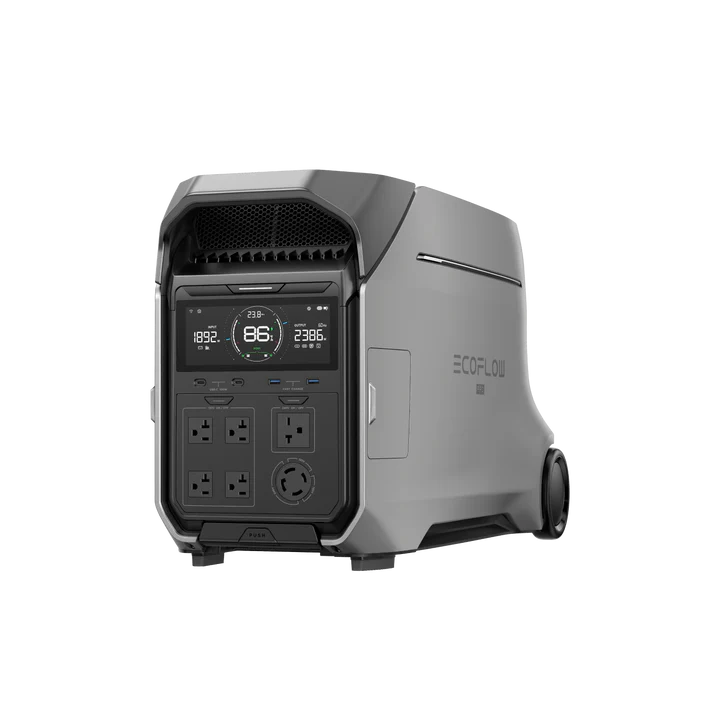
Nobody is genuinely torn between these two. One is a 7.8-lb box that costs $189 and holds 230Wh; the other weighs 112.4 lbs, costs $2,799, and holds 4,096Wh. That is roughly thirteen times the price for roughly eighteen times the energy, from the same brand, at opposite ends of the same catalogue. What actually sends people here is the sizing question underneath: which end of that range does my life sit on.
So the DELTA Pro 3 wins, and on its own that means very little, because it wins by being eighteen times the battery. The useful version is narrower. If your list includes an overnight CPAP, an eight-hour outage, or a full remote workday, the 230 is out before the comparison starts. If your list is a phone, a laptop and a light, both boxes charge that laptop at the same 100W over USB-C, and only one of them fits in a backpack.
What the Numbers Reveal
Each conclusion stated first — the numbers behind it on one line, the full analysis below.
That reframes the whole comparison. The 230 isn't a small version of what the DELTA Pro 3 does; it's a different category of object. Every scenario here assumes something drawing for a night or a working day, and the 230 is built for topping up devices between wall outlets. Once any item on your list runs for hours, the price gap stops being a trade-off and becomes irrelevant, because only one of these two is still a candidate.
RIVER 3 230 usable energy is 196Wh (230Wh nameplate, after the flat 85% derate applied to both units)The lightest scenario modeled here, CPAP Overnight, asks for 320WhIts shortfalls across the six scenarios run from 125Wh on that CPAP night to 4,490Wh on Van Life Daily
Why it mattersIf you came here hoping the RIVER 3 230 was the affordable way to cover outages, it isn't the affordable version. It's a different product, and you should size against your worst realistic night instead.
rated cycles
But that denominator is a ceiling you have to climb to, and almost nobody does. Cycle the DELTA Pro 3 twice a week and you reach its rated end of life in 38.5 years, which is not a purchase horizon, it's an inheritance. The per-kWh figure isn't a discount you receive at checkout; it's a rate that only applies to someone with a weekly reason to drain the thing. RVers, job sites, and households that lose power often enough to have a routine collect it. Buyers with two outages a year never do.
DELTA Pro 3: $2,799 across 4,096Wh x 4,000 cycles = 16,384 kWh of rated lifetime outputRIVER 3 230: $189 across 230Wh x 3,000 cycles = 690 kWh of rated lifetime outputReaching 4,000 cycles takes 11 years at daily use and 38.5 years at twice-a-week use
Why it mattersIf you can't name a weekly reason to cycle it, ignore the cost-per-kWh column entirely. It is not describing your purchase.
weight
So the $2,610 between them buys exactly one thing: the other 3,286Wh of usable capacity, and the ability to run something for hours instead of topping it up. It does not buy a faster laptop charge. It also costs you portability in a way that's easy to underrate at the checkout page. The RIVER 3 230 goes in a bag; the DELTA Pro 3 gets a spot on a floor and stays there.
Both units top out at 100W USB-C7.8 lbs versus 112.4 lbs, which is about fourteen times the weightThe usable capacity gap is 3,286Wh (3,482Wh against 196Wh)
Why it mattersLaptop-and-phone buyers already have everything they came for in the 230. Only commit the difference if you can point at the load that needs those extra watt-hours.
The specific dimensions that decide these two units — everything else is a tie.
Your Life, Your Pick
Selected because: Six modeled loads, and the RIVER 3 230 clears none of them. It misses the smallest, a 320Wh CPAP night, by 125Wh. This is where the decision actually gets made.
Zero for six, and the margins say it isn't close. The RIVER 3 230 misses the CPAP night by 125Wh and the eight-hour blackout by 1,450Wh, the second of which is more than seven times its usable capacity. Every figure in this section runs against a flat 85% derate applied identically to both units, so 230Wh becomes 196Wh and 4,096Wh becomes 3,482Wh. These are not nameplate comparisons, which is the only reason they're worth reading.
The honest result is Van Life Daily, where both units lose. It asks for 4,685Wh a day and the DELTA Pro 3 is 1,203Wh short of it. That matters more than it looks: it means the range on this page doesn't stretch far enough at the top either, and a reader who assumed the big EcoFlow was automatically the safe over-buy has just been told otherwise.
Portability & Form Factor
Selected because: 7.8 lbs against 112.4 lbs is the RIVER 3 230's entire case, and for the right buyer it's enough on its own.
weight
7.8 lbs is a bag. 112.4 lbs is a decision about which room you're giving up, about fourteen times the weight and firmly in two-person territory with the path planned before you start. Nothing in the capacity column matters if the unit never leaves the garage because loading it into the car is its own project. That is the RIVER 3 230's entire argument, and against the right buyer it wins on that one line.
Both units run a 100W USB-C port, which is the quiet fact sitting under this whole comparison. For a laptop and a phone the two boxes are interchangeable. The DELTA Pro 3 earns its weight on things that draw for hours, never on the things you plug in and forget about.
Lifetime Value
Selected because: The expensive box delivers the cheaper kilowatt-hour. Whether that's a reason to buy it depends on something the table can't show you, so we check it here.
cost / lifetime kWh
The arithmetic behind the cheaper kilowatt-hour is simple and slightly deceptive. 4,096Wh times 4,000 cycles is 16,384 kWh of rated lifetime output, and spreading $2,799 across that is very little per unit of energy. The RIVER 3 230's 230Wh across 3,000 cycles comes to 690 kWh, and $189 across that is more. Both figures are ceilings, and a ceiling is only a price if you reach it.
Reaching them takes time nobody actually plans for. At twice-a-week use the DELTA Pro 3's cycle rating runs 38.5 years and the RIVER 3 230's runs 28.8. Read the per-kWh column as a description of a buyer rather than a discount: it's telling you the DELTA Pro 3 pays off for someone who drains it on a schedule. If you're buying for the two bad nights a year, you're buying cheap energy and then not buying the energy.
What the Specs Don't Tell You
Selected because: Six cards fire on this pair. The two worth your time are the 112.4-lb placement problem and a surge comparison that looks like a point for the RIVER 3 230 and isn't.
rated cycles
The weight card is the one to read twice, because it's the cost of our own pick. 112.4 lbs isn't a heavy box, it's a placement decision you make once and live with. By comparison the RIVER 3 230's fixed 230Wh barely registers as a warning. A sealed 230Wh unit isn't limited; that's the product, at 7.8 lbs, for $189.
The surge card reads like a point for the RIVER 3 230 and isn't. Its 600W surge over a 300W continuous rating is a 2x ratio against the DELTA Pro 3's 1.5x, but a ratio only describes an inverter's relationship with itself. A compressor pulls watts at startup, not multiples of somebody else's rating, and 6,000W swallows spikes that 600W will refuse.
Strengths & trade-offs
EcoFlow DELTA Pro 3
Strengths
- +Larger battery capacity
- +Higher AC output
- +Faster solar charging
- +Rated for 4,000 charge cycles — much longer battery lifespan
Trade-offs
- –Substantially more expensive (+$2,610) than the RIVER 3 230.
- –Significantly heavier (+104.6 lbs), making it harder to move.
- –Very heavy unit that may be difficult for one person to lift.
EcoFlow RIVER 3 230
Strengths
- +Costs $2,610 less
- +Lighter by 104.6 lb
Trade-offs
- –Weaker inverter (-3,700W) limits appliance compatibility.
- –Sealed capacity — the DELTA Pro 3 can add batteries to grow past 230Wh; this one can't.
- –Shorter-lived battery — rated for 3,000 charge cycles vs the DELTA Pro 3's 4,000, so it wears out sooner.
Will It Power Your Gear?
Scenario math and per-appliance runtimes, modeled from the spec record.
Scenario verdicts
We ran the math on seven real-world scenarios. Here's which unit survives your actual life.
SCN-01 · 2 nights · needs 2,100Wh
Weekend Camping
Two nights off-grid with essential comfort
Neither unit
A weekend's 2,100Wh is the heaviest load the DELTA Pro 3 clears here, and it still finishes at 60% used, with 1,382Wh sitting unspent. The RIVER 3 230 ends 1,905Wh short of the weekend, from a battery that holds 230Wh in total. This isn't a unit you stretch across two nights. It's one you top a phone off with.
Battery budget usedlower = more headroom
LOAD Phone Charger 15W×6h · LED Lights 40W×8h · Box Fan 75W×14h · CPAP Machine 40W×16h
SCN-02 · 8 hours · needs 1,645Wh
8-Hour Blackout
Keep the essentials running through a night without power
DELTA Pro 3
Eight hours of outage costs 1,645Wh, and the DELTA Pro 3 hands it over having used 47% of itself, which means a second bad night the same week is still covered. The RIVER 3 230 finishes 1,450Wh short. It isn't outage equipment. It's the thing that keeps your phone alive while you go find the outage equipment.
Battery budget usedlower = more headroom
LOAD Fridge 150W×8h · Router + Modem 20W×8h · LED Lights (4 bulbs) 40W×6h · Phone Charger 15W×3h
SCN-03 · 8 hours · needs 320Wh
CPAP Overnight
Sleep therapy without interruption — the #1 medical use case
DELTA Pro 3
This is the closest the RIVER 3 230 comes to a pass, and it still doesn't reach morning. A 320Wh night against its usable capacity leaves it 125Wh short, which in practice means the machine quits somewhere in the small hours. The tiebreak people expect here is fan noise eighteen inches from your head, and it doesn't apply: both units are rated 30 dBA, so this comes down to capacity and nothing else. The DELTA Pro 3 finishes the night at 9% used.
Battery budget usedlower = more headroom
LOAD CPAP Machine 40W×8h
SCN-04 · 8 hours · needs 910Wh
Remote Workday
Full work day off-grid without power anxiety
DELTA Pro 3
A full workday away from an outlet is 910Wh, which the DELTA Pro 3 absorbs at 26% of capacity. Against 3,482Wh usable that's close to four of these days back to back before you go hunting for a wall socket. The RIVER 3 230 ends a single day 715Wh short. If the plan is a laptop all day off-grid, the 230 is a lunch break, not a workday.
Battery budget usedlower = more headroom
LOAD Laptop 60W×8h · External Monitor 30W×8h · Router + Modem 20W×8h · Phone Charger 15W×2h
SCN-05 · 4 hours · needs 670Wh
Tailgate Party
Game day power for the crew
Neither unit
The RIVER 3 230 fails this one twice. Its 300W continuous rating sits under the 400W the scenario draws, and note that's a continuous-rating comparison rather than a surge one, since the 600W surge headroom exists for the instant a motor spins up and not for a sustained pull. Even if the output cleared it, the energy doesn't: 670Wh asked, and it comes up 475Wh short. The DELTA Pro 3 runs the same party at 19% of capacity.
Battery budget usedlower = more headroom
LOAD Blender 400W×0.5h · LED TV (55") 80W×4h · Bluetooth Speaker 15W×4h · Phone Charger (×3) 45W×2h
SCN-06 · 24 hours · needs 4,685Wh
Van Life Daily
A full day of mobile living — the ultimate endurance test
Neither unit
Both units lose this one, and neither loses narrowly. Full-time van life asks for 4,685Wh a day; the DELTA Pro 3 gets about three-quarters of the way there and stops 1,203Wh short, while the RIVER 3 230 covers roughly four percent of it. This is the scenario that shows the range on this page running out at the top as well as the bottom. If you're living in the vehicle, you're shopping for a larger station or a wired-in bank, not choosing between these two.
Battery budget usedlower = more headroom
LOAD Mini-Fridge 150W×24h · Laptop 60W×4h · Phone Charger 15W×3h · LED Lights 40W×5h · Fan 75W×8h
SCN-07 · an afternoon · needs 100Wh
Afternoon Off-Grid
Phones and a speaker at the park, beach, or campsite — the small-unit job description
Either unit
This row is here for the RIVER 3 230's class of job: phones and a speaker, 100Wh across an afternoon. Both cover it — the RIVER 3 230 finishes at 51% used, and the DELTA Pro 3 barely notices it. For this job the DELTA Pro 3's extra capacity is dead weight, not headroom; take the RIVER 3 230 at 7.8 lbs and leave the rest at home.
Battery budget usedlower = more headroom
LOAD Phone Charger (×2) 30W×2h · Bluetooth Speaker 10W×4h
The Load Test
RUNTIME = (Wh × 0.85) ÷ LOAD
None of the scenarios above exactly yours? Build it. Toggle what you'd plug in; both units are tested against the combined draw.
Essentials
Comfort & Convenience
High-Draw Appliances
Test duration
8h
Continuous draw
205W
Projected runtime
For this load: DELTA Pro 3 runs 17h vs 1h.
$2,799 list · direct from EcoFlow
Modeled from the spec record — same math as the tables below. Methodology
Runtime by appliance
Real-world runtime estimates for common appliances, modeled at 85% inverter efficiency.¹
Essentials
The basics you need runningscale 0–232.1hComfort & Convenience
Makes off-grid life actually enjoyablescale 0–46.4hHigh-Draw Appliances
These reveal the real limitsscale 0–3.5h¹ Runtime = (capacity × 0.85) ÷ appliance watts. Within each group, all bars share one time scale (the group's longest runtime), so lengths are comparable across appliances; identical runtimes collapse into a single blue/orange bar. Actual runtime varies with battery age, temperature, and simultaneous loads — see methodology.
Conclusion
August 9, 2026
Verdict: the DELTA Pro 3, on Power Score margin
Take the DELTA Pro 3 if you can name a load that runs for hours. It covers five of the six scenarios modeled here outright, finishing a 320Wh CPAP night with 3,162Wh still unspent, and it delivers cheaper energy over its life: $0.15 per lifetime kWh against the RIVER 3 230's $0.27. The catch is that the discount only arrives if you collect it. Those 4,000 cycles are 11 years of daily use, and if your real pattern is two or three outages a year you have paid $2,799 for energy you will never draw. The RIVER 3 230 is the right buy for a genuinely small list, and it is a good one at 7.8 lbs, but be clear about what it is: it doesn't finish a single scenario on this page, including the easiest, which it misses by 125Wh.
Editor-assigned confidence, based on cited owner research and spec analysis.
List prices as of August 9, 2026. The links below open EcoFlow's current price.
$2,799.00 · direct from EcoFlow
Last checked 1 day ago. Prices move — check before you buy.
or check the RIVER 3 230 price$189.00 list
Written by Gunner Gustafson, Whole-Home Backup Tester · Station Arena Test Desk · Updated August 9, 2026
Measured Data
Benchmark scores and the full spec record, side by side.
Benchmark scores
Not rated for both units (minimum threshold unmet): UPS, RV Living, Home Backup, CPAP, Solar Generator, Tailgating, Food Truck, Apartment Balcony, Camping.
Full specifications
ᵈ Derived: price ÷ rated capacity. See the data behind our comparisons →
Comparison ToolAdd more power stations, side by sideOpen Tool →How these numbers are produced
Numeric verification
Every figure on this page traces to our spec database or arithmetic on it — no estimated numbers.
Owner claims
Statements about owner experience are cited to published reviews — see Sources & Research Notes below.
Runtime model
Runtime = (rated capacity × 0.85 inverter efficiency) ÷ device wattage. Solar recharge estimates assume panels deliver 70% of rated output. Cold weather, battery age, and stacked loads reduce real-world results.
Power Score
Computed from 14 published spec dimensions, weighted per use-case bench. Higher is better; a unit must meet a bench's minimum threshold to be rated.
See the full weight table and data sourcing on our methodology page →Class ranking (the star rating)
Each unit's star score is a category ranking, not customer reviews — no buyer opinions feed it. We score every station on size-independent quality (value, output, portability, endurance, ports, warranty, and more), then percentile-rank it against the other units in its capacity class, so a class-leading compact unit and a class-leading whole-home unit can both earn 5★. Here, DELTA Pro 3 rates 4.0/5 (40th percentile of 16 Home Backup-class units), and RIVER 3 230 rates 4.3/5 (57th percentile of 22 Personal-class units).
How the class ranking is computed →Test Notes & Caveats
Hidden gotchas and advantages we spotted that you won't find on the product page.
112.4 lbs Is a Placement Decision, Not a Lift
You'll move the DELTA Pro 3 twice: out of the box, and into the spot where it lives. At 112.4 lbs that's a two-person job with the route cleared in advance, and stairs are a real problem rather than an inconvenience. Decide the spot before it arrives, near where the cords need to run, on a patch of floor you don't mind surrendering. The RIVER 3 230 solves this by weighing 7.8 lbs and giving you nothing to decide.
The RIVER 3 230's Ceiling Is the Point
Sealed at 230Wh with no expansion, and that isn't a flaw so much as a description. It's what a 7.8-lb, $189 battery is. The DELTA Pro 3 does take EcoFlow expansion batteries, but nobody choosing the 230 is one accessory away from needing them; that growth path belongs to someone already committed to the 4,096Wh end of the range. Size the RIVER 3 230 against what you'll genuinely plug into it, and if the answer is more than it holds, the fix isn't an add-on. It's a different unit.
Surge Power: Ratio and Ceiling Disagree
The RIVER 3 230 holds the higher surge-to-continuous ratio (2× vs 1.5×), but the DELTA Pro 3 holds the higher absolute surge ceiling — 6,000W against 600W. These measure different things. The ratio says how much headroom an inverter keeps above its own rating; the ceiling says how big a startup spike it can actually swallow. A motor draws a number of watts at switch-on, not a multiple of someone else's rating, so on raw starting ability the DELTA Pro 3 is the stronger unit here — while the RIVER 3 230 is the one running further below its own limit at steady state.
10ms vs 20ms: Real, and Not What Decides This
The DELTA Pro 3 cuts to battery in 10ms and the RIVER 3 230 in 20ms. Both are quick, and a blanket assurance that your equipment is therefore protected isn't ours to give, because hold-up time varies by power supply and the only honest check is looking up the spec on the specific gear you care about and comparing it to these two numbers. What we can say is that this isn't the axis separating these units. A 10ms difference settles nothing that the capacity gap on this page hasn't already settled.
Warranty: No Difference
Both units carry the same 5-year warranty, so coverage isn't a tiebreaker here. Worth saying because the per-dollar framing can suggest otherwise: the RIVER 3 230 works out at 26.5 years of cover per $1,000 spent against the DELTA Pro 3's 1.8, but that spread is the price gap, not the terms.
Battery Lifespan in Real Years
The DELTA Pro 3 is rated for 4,000 cycles vs 3,000. In real life: at daily use, that's 11 vs 8.2 years. At weekend use (twice a week), it's 38 vs 29 years. One caution reading years across different sizes: a cycle is 4,096Wh on the DELTA Pro 3 and 230Wh on the RIVER 3 230, so count lifetime energy — roughly 16,384 kWh against 690 kWh over the rated life. After hitting the cycle limit, the battery doesn't die — it drops to ~80% of original capacity, which is still very usable.
Full record above — the Test Desk pick is the DELTA Pro 3.
Check DELTA Pro 3 price →or check the RIVER 3 230 priceOwnership Analysis
What happens after you buy — true cost of ownership, brand trust, and growth potential.
Lifetime value
Service lifeyears at one full cycle per day
Lifetime energy delivered
Cost per delivered kWh
│ warranty ends · Reaching the cycle rating means ~80% capacity remains — degraded, not dead.
Analyst note
The RIVER 3 230 is cheaper to buy, but the DELTA Pro 3 is cheaper to own. At $0.17/kWh over its lifetime vs $0.27/kWh, the DELTA Pro 3's higher cycle life and capacity make each dollar go further over the years.
Delivers each lifetime kWh for $0.10 less — check the DELTA Pro 3 price →
Growth path
DELTA Pro 3
EXPANDABLESupports EcoFlow expansion batteries, so you can add capacity later without replacing the base unit — useful if your needs may climb past 4,096Wh.
Accepts up to 2,000W of solar. Enough for a serious multi-panel array.
Generous port selection supports complex multi-device setups.
Expansion batteries are EcoFlow-specific. You're investing in the EcoFlow ecosystem.
RIVER 3 230
FIXED CAPACITYFixed at 230Wh, with no expansion — so size it for your needs up front rather than planning to add capacity later.
Accepts up to 110W of solar. Limited to a single portable panel.
Limited ports. You'll likely need a power strip or splitter.
Realistic full solar rechargeat 70% of rated panel output — see methodology
Analyst note
The RIVER 3 230 is sealed at 230Wh, which is fine if that covers you. The DELTA Pro 3 starts at 4,096Wh and can grow beyond it with EcoFlow expansion batteries — real headroom the RIVER 3 230 doesn't have if your needs climb toward partial-home backup.
What Owners Report
Patterns from published owner reports and long-term reviews — every claim cited to its source below.
EcoFlow DELTA Pro 3
Field coverage on the DELTA Pro 3 is review-desk material rather than long-term ownership. Four entries, all from review sites and retailer listingsA1A2A3A4, and what they mostly do is corroborate the spec sheet: 4,096Wh of LFP with 4,000W continuous and a 6,000W ceilingA1, a 4,000-cycle rating to 80% capacityA2, and a reputation as a serious whole-home backup unitA4. Useful confirmation, but not the same thing as knowing how it behaves in year three.
Take the charging claims as directional. The entry praising its multi-source recharge also puts solar input at 2,600WA3, where our spec sheet says 2,000W, and we've written this page to 2,000W. Same entry set puts the weight at about 113.5 lbsA4 against the 112.4 lbs we list. Neither gap changes a decision, but together they tell you this coverage is aggregated from marketing and review copy rather than measured, so treat any single number in it as a starting point.
“4,096Wh LFP battery with 4,000W continuous AC output (6,000W with X-Boost) and dual-voltage 120V/240V, expandable to 48kWh.”
Sources
ecoflow.com · amazon.com · homedepot.com · thepowerpick.com · outboundpower.com · techradar.com · thesolarlab.com
EcoFlow RIVER 3 230
Nearly everything written about the RIVER 3 is written against the RIVER 2, not against anything on this page. The line gets credit for running under 30 dBB1, for adding IP54 sealing and a faster UPS switchoverB2, and it's recommended over its predecessor for camping, van life and home UPS dutyB3. Read those with the comparison in mind. Faster UPS means faster than a RIVER 2; here it's the slower of the two, 20ms against 10ms. Quieter doesn't separate them either, since both units are rated 30 dBA on our sheet.
The van life recommendationB3 is the one to set aside completely. It's a within-line verdict about which RIVER to buy, and the Van Life Daily load modeled here asks for 4,685Wh, leaving the RIVER 3 230 4,490Wh short. Coverage of this specific 230Wh variant is also thin, since most of what exists describes the standard RIVER 3 rather than the smaller oneB1B2B3, so variant-level claims are directional at best.
“The RIVER 3 operates under 30 dB — EcoFlow calls it 'whisper quiet,' quieter than a library — one of the most significant upgrades over the louder RIVER 2.”
Sources
backuppowerhub.com · ecoflow.com · rv.com
Sources & Research Notes
Every owner claim in this report is traceable to a published source. The bracketed references above resolve here.
Recurring owner themes
- Huge 4,096Wh LFP capacity, 4,000W dual-voltage output, very fast charging, and big expandability are the standout praise; it's heavy at ~113 lbs. [DELTA Pro 3 · 2 entries]
- The RIVER 3 line's upgrades — sub-30 dB noise, IP54 waterproofing, faster UPS, more compact build — make it the recommended pick over the RIVER 2 for most uses. [RIVER 3 230 · 3 entries]
- A1
“4,096Wh LFP battery with 4,000W continuous AC output (6,000W with X-Boost) and dual-voltage 120V/240V, expandable to 48kWh.”
ecoflow.com / amazon.com — DELTA Pro 3 · 2026 · [positive]
- A2
“LiFePO4 rated for 4,000+ cycles to 80% (10+ years), with an IP65 battery rating.”
homedepot.com / thepowerpick.com — DELTA Pro 3 review · 2026 · [positive]
- A3
“Multi-charge technology reaches 0-80% in about 50 minutes using up to 7,000W input, with a full charge in roughly 90 minutes; up to 2,600W solar.”
outboundpower.com / techradar.com — DELTA Pro 3 review · 2026 · [positive]
- A4
“Weighs about 113.5 lbs; reviewers call it a gold-standard whole-home backup unit for 2026.”
techradar.com / thesolarlab.com — DELTA Pro 3 review · 2026 · [positive]
- B1
“The RIVER 3 operates under 30 dB — EcoFlow calls it 'whisper quiet,' quieter than a library — one of the most significant upgrades over the louder RIVER 2.”
backuppowerhub.com / ecoflow.com — RIVER 3 review · 2026 · [positive]
- B2
“Over the RIVER 2, the RIVER 3 adds IP54 waterproofing, a faster UPS switchover, a 2x runtime mode, quieter operation, and a more compact form factor.”
backuppowerhub.com — RIVER 2 vs RIVER 3 · 2026 · [positive]
- B3
“Recommended as the better buy for most in 2026 — for camping, van life, or home UPS backup, where durability and noise matter, the data consistently favors the RIVER 3.”
backuppowerhub.com / rv.com — RIVER 3 review · 2026 · [positive]
Research compiled August 9, 2026.
Who Should Buy Which
Buy the DELTA Pro 3 if you…
- →You lose power for most of a day more than once a year and want the outage to be boring. 3,482Wh usable covers the eight-hour blackout modeled here with 1,837Wh unspent, so a long one doesn't turn into rationing arithmetic at hour six.
- →Something on your list draws hard and keeps drawing: an RV, a workshop, a job site, a home office that has to stay up. 4,000W continuous with a 6,000W ceiling starts and holds things a 300W inverter won't attempt.
- →You want one purchase to outlast the decision. 4,000 cycles is 11 years at daily use, it takes EcoFlow expansion batteries if the list grows, and 2,000W of solar input means you can put energy back between outage days where the RIVER 3 230 tops out at 110W.
Buy the RIVER 3 230 if you…
- →Your list is a phone, a laptop, camera batteries and a light. Both boxes charge that laptop at 100W over USB-C, and only one of them weighs 7.8 lbs.
- →You want power that travels. A bike trip, a beach afternoon, the passenger footwell instead of the garage floor. The best station is the one you actually bring, and at 7.8 lbs this is the one you'll bring.
- →You already own something big and want a small second unit for the trips where hauling 112.4 lbs is more effort than the trip is worth.
If neither fits
If your day looks like the Van Life Daily load on this page, 4,685Wh, close the tab. The DELTA Pro 3 gets about three-quarters of the way through it and the RIVER 3 230 covers about four percent, so you want a larger station or a properly wired house bank, not a choice between these two. And if you landed here because the DELTA Pro 3's cost per kilowatt-hour looks like a bargain but you can only name two or three outages a year, buy neither as a value play. Buy the smallest unit that covers your worst realistic night, which is very likely something in the middle of this catalogue rather than either end of it.
The Bottom Line
Take the DELTA Pro 3 if you can name the load. It clears five of the six scenarios on this page and never by a hair, and over enough cycles it's genuinely the cheaper energy of the two. That last part is the trap worth repeating once: the discount only exists if you drain the thing on a schedule, and the buyer who purchases for two bad nights a year never collects it.
The RIVER 3 230 isn't the loser here so much as the wrong entrant. Zero for six, and 125Wh short of the easiest load on the board. Buy it because it weighs 7.8 lbs and charges your laptop at the same 100W the big box does, not because it's the budget route to backup power. There is no budget route to 4,096Wh. There's just a smaller job, and if that's the job you have, the 230 does it and you keep the $2,610.
Frequently Asked Questions
Answers drawn from the spec record and cited owner research.
Is the DELTA Pro 3 worth the extra $2,610?
Only if you can name a load that runs for hours. The gap between $189 and $2,799 buys 3,286Wh more usable capacity and the inverter to use it, and nothing else you'd notice day to day. Both units charge a laptop at the same 100W over USB-C. If your honest list is devices rather than appliances, the extra money buys capacity you'll never reach into.
Can the RIVER 3 230 run a CPAP overnight?
Not the 320Wh night this page models. It holds 196Wh usable, which leaves it 125Wh short, so the machine stops before morning. If your specific machine draws less than that over a full night, check the label on it, because the answer changes with humidifier use and pressure settings. The DELTA Pro 3 finishes the same night with about nine-tenths of its capacity untouched.
Which one is quieter?
Neither. Both are rated 30 dBA on our spec sheet, so noise is not a tiebreak between them. This is worth stating plainly because RIVER 3 coverage leans hard on how quiet the line is, calling it whisper quiet and quieter than a library. That's a comparison against the RIVER 2 it replaced, not against the DELTA Pro 3.
Does the DELTA Pro 3's faster UPS switchover actually matter?
Not between these two. 10ms against 20ms is a real difference on paper, but if you're protecting a specific piece of equipment, look up its documented hold-up time and compare it to those two numbers rather than trusting a general assurance that everything is safe. On this page the switchover gap is a footnote to a capacity gap that has already decided the matchup.
Should I buy the RIVER 3 230 for power outages?
For a real outage, no. The eight-hour blackout modeled here needs 1,645Wh and the RIVER 3 230 finishes 1,450Wh short of it, so it's a top-up battery rather than backup equipment. It will keep small devices alive while you sort out something bigger. If outages are the reason you're shopping, size against your worst realistic night first and let price follow that number.
Where to buy
EcoFlow DELTA Pro 3Pick
$2,799.00
$2,799.00 · direct from EcoFlow
Last checked 1 day ago. Prices move — check before you buy.
EcoFlow RIVER 3 230
$189.00
$189.00 · direct from EcoFlow
Last checked 56 days ago. Prices move — check before you buy.
Prices may vary by retailer and are subject to change.