Head-to-head test
EcoFlow DELTA 3 Ultra vs BLUETTI Elite 300
Both boxes hold the same energy, so the only question left is whether you'll ever pull more than 2,400W at once; if you won't, the Ultra's extra $200 buys you 14.1 lb of chassis and a ceiling you never touch.
Full profiles: EcoFlow DELTA 3 Ultra → · BLUETTI Elite 300 →

Written by Gunner GustafsonUpdated
Whole-Home Backup Tester, Station Arena Test Desk

$1,399.00 · direct from EcoFlow
Last checked 1 day ago. Prices move — check before you buy.
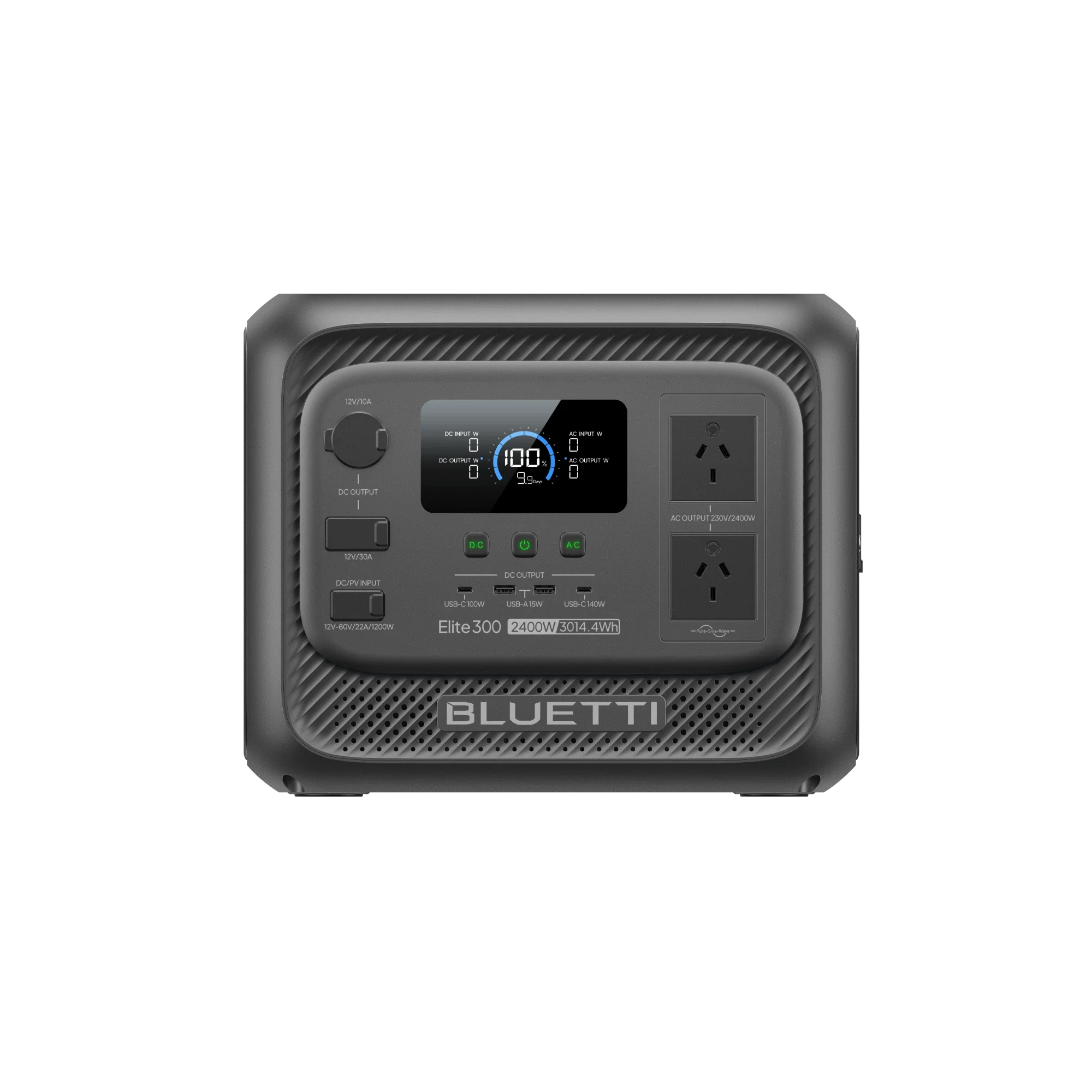
$1,099.00 · direct from BLUETTI
down from $1,199 · 8% below usual
Last checked 1 day ago. Prices move — check before you buy.
Spec deltas
The DELTA 3 Ultra and the Elite 300 hold the same energy: 3,072Wh against 3,014.4Wh, a difference of 57.6Wh that no one has ever felt in use. One costs $1,399 and the other costs $1,199. That $200 isn't buying you battery.
It's buying inverter. The Ultra runs 3,600W continuous with 7,200W of surge behind it; the Elite 300 runs 2,400W with 4,800W. That's the one axis where the EcoFlow is plainly the better machine, and if anything on your load list needs that headroom, stop reading and buy it. Everything else on the sheet points the other way. The Elite 300 weighs 58 lb to the Ultra's 72.1, drinks 1,200W of solar to its 800W, and is rated for 6,000 cycles against 4,000.
Build quality doesn't settle this one and neither does the badge on the front. What settles it is whether you'll ever ask for everything at once. Most people buying a 3kWh box for campsites, blackouts and a desk away from the office won't, and for them the cheaper unit is also the lighter one, the quicker one to refill, and the one rated to outlast the other. The rest of this page is the arithmetic.
What the Numbers Reveal
Each conclusion stated first — the numbers behind it on one line, the full analysis below.
continuous output
Permission has a shipping weight. It arrives inside 14.1 more pounds of chassis, and you carry those on every trip whether you ever open the tap or not. Across all six scenarios we model, both units cleared every startup peak, so the buyer whose heaviest hour is a coffee maker and a fridge is hauling headroom up the basement stairs for the pleasure of owning it.
DELTA 3 Ultra: 3,072Wh, 3,600W continuous, 7,200W surge, $1,399Elite 300: 3,014.4Wh, 2,400W continuous, 4,800W surge, $1,199Weight: 72.1 lb vs 58 lb
Why it mattersAdd up the heaviest thing you'd ever run alongside everything else. Above that line only the Ultra qualifies and the price stops mattering. Below it, you're shopping for the same battery in a smaller box.
solar input
One outage evening eats roughly two-thirds of either pack, so a blackout that runs past a single night becomes a refill job you do daily, and the panel ceiling decides whether you're full by early afternoon or still climbing at dusk. Output is the Ultra's advantage, and an inverter has never put a single watt-hour back into anything.
Elite 300 accepts 1,200W of solar into 3,014.4WhDELTA 3 Ultra accepts 800W of solar into 3,072Wh8-Hour Blackout draws 1,645Wh — 63% of the Ultra's usable energy, 64% of the Elite 300's
Why it mattersIf you're buying for the outage that outlasts one night, the input ceiling beats the output ceiling. One of them works while the sun is up; the other only works while the power is going out.
cost / lifetime kWh
The answer is the van and the off-grid cabin, and that day runs to nearly double what either box holds after losses. Whoever would collect on 6,000 cycles was never choosing between these two in the first place. Everyone else charges on weekends and after storms, where both ratings run past the point where anybody still owns the thing.
Elite 300: 6,000 cycles, 18,086 kWh over its rated life, $0.07 per lifetime kWhDELTA 3 Ultra: 4,000 cycles, 12,288 kWh over its rated life, $0.11 per lifetime kWhVan Life Daily needs 4,685Wh — 179% of the Ultra's usable energy and 183% of the Elite 300's
Why it mattersDon't let cycle life pick this one. It pays out decades after you've moved on, while the price gap, the pounds and the extra sun pay out on the first trip.
EcoFlow rates the Ultra at 30 dBA. BLUETTI doesn't publish a figure for the Elite 300 at all. Coverage of the Ultra hardware describes fans that stay unobtrusive even with the inverter pushed hardA1A2, which is press testing rather than a year of 3 a.m.s, but a directional number still beats a blank field.
DELTA 3 Ultra is rated 30 dBA; BLUETTI publishes no noise figure for the Elite 300CPAP Overnight draws 320Wh — 12% of either packBoth units switch over in 10ms
Why it mattersIf this box is going to spend outages two feet from your head, that's the one place the Ultra's premium buys something you can check before you commit instead of after.
The specific dimensions that decide these two units — everything else is a tie.
Lifetime Value
Selected because: The Elite 300 is cheaper the day you buy it and cheaper for every kilowatt-hour it delivers afterward, at $0.07 against $0.11.
cost / lifetime kWh
The Elite 300 is the cheaper unit twice over. It's less at checkout, and across its rated life it moves 18,086 kWh against the Ultra's 12,288, which lands at $0.07 per lifetime kilowatt-hour against $0.11. Warranties are level at five years apiece, so the coverage costs $240 a year against $260. Every column in this section points the same way, which happens less often than you'd think.
One caution before you bank any of that: lifetime math only pays if you cycle the pack, and weekend owners never will. On weekend duty the ratings stretch to 57.7 years for the Elite 300 and 38.5 for the Ultra, and numbers like that stop being product specs and start being trivia. The money you save at the register is the part of this section you can actually spend.
Portability & Form Factor
Selected because: One of these you pick up and carry. The other you plan a route for.
weight
The Elite 300 is the one that fits. It's certified the smallest 3kWh power station by volume as of January 2026B2, and reviewers put it only about 2 kg above the Elite 200 V2B3, so it packs like the class below it. In a trunk that already contains a cooler, a tent and two camp chairs, the cubic inches argue louder than the pounds do.
Score this section by how the unit is going to live. If it sits beside the breaker panel and never moves, skip it entirely and spend the money on inverter instead. If it rides in a car most weekends, the smaller, lighter box wins on the first trip and then wins again every trip after that.
Your Life, Your Pick
Selected because: Five scenarios, five dead heats, and a sixth that beats both units outright.
Five of the six scenarios come out as ties, and the margins show why. Weekend camping takes 80% of the Ultra's usable energy and 82% of the Elite 300's, and nothing in the set separates the two by more than two points. Usable means 85% of rated after inverter losses, which is 2,611Wh for the Ultra and 2,562Wh for the Elite 300. When the percentages track that closely, this table has stopped being a comparison; spend the attention on price instead.
Van Life Daily is the exception, and the engine calls it for neither, correctly. A full van day is 4,685Wh, nearly double what either box holds after losses, so both are empty while the day is still going. Neither unit takes an add-on battery, so there's no buying one now and growing into the job later. That need belongs to a modular system, and no amount of choosing carefully between these two will change it.
What the Specs Don't Tell You
Selected because: Three flags fire here, and the one that should change a mind is the noise figure BLUETTI never published.
rated cycles
Two of the three cards here are context. The third is a blank space: BLUETTI never published a decibel rating for the Elite 300, and EcoFlow published one for the Ultra. A missing number isn't proof of a loud machine. It does mean you're the one who runs the test.
That blank lands on exactly one person, and it's whoever plans to sleep in the same room as this thing during an outage. Hands-on testing of the Ultra hardware reports fans that never turned distracting even at full inverter loadA1A2, which is reviewers on a deadline rather than owners with a year of nights behind them, but it's more than the Elite 300 has on the record. If the Elite 300 is headed for a bedroom, buy it somewhere you can send it back.
PowerScore Breakdown
Selected because: The Ultra takes the composite score, 5,072 to 4,904, and where those points come from decides whether it should move you.
overall power score
The Ultra's 168-point lead is the inverter, almost all of it. Output is the one column where it's meaningfully ahead, and any composite has to weight output heavily, because for a certain buyer output is the entire purchase.
What a score can't weigh is your particular week. It doesn't know the stairs you carry the thing up, the hours of sun your roof gets, or whether anything you own has ever asked for more than the Elite 300 can hand it. If nothing does, those points describe a capability you paid for and will never call on, and the number you should be reading is the price.
Strengths & trade-offs
EcoFlow DELTA 3 Ultra
Strengths
- +Larger battery capacity
- +Higher AC output
Trade-offs
- –Significantly heavier (+14.1 lbs), making it harder to move.
- –Shorter-lived battery — rated for 4,000 charge cycles vs the Elite 300's 6,000, so it wears out sooner.
BLUETTI Elite 300
Strengths
- +Costs $200 less
- +Lighter by 14.1 lb
- +Faster solar charging
- +Rated for 6,000 charge cycles — much longer battery lifespan
Trade-offs
- –Weaker inverter (-1,200W) limits appliance compatibility.
Will It Power Your Gear?
Scenario math and per-appliance runtimes, modeled from the spec record.
Scenario verdicts
We ran the math on six real-world scenarios. Here's which unit survives your actual life.
SCN-01 · 2 nights · needs 2,100Wh
Weekend Camping
Two nights off-grid with essential comfort
Either unit
Both handle two nights comfortably. The Elite 300 uses 82% and the DELTA 3 Ultra uses 80%. With this little difference, pick based on weight and portability instead. The lighter unit wins for car camping.
Battery budget usedlower = more headroom
LOAD Phone Charger 15W×6h · LED Lights 40W×8h · Box Fan 75W×14h · CPAP Machine 40W×16h
SCN-02 · 8 hours · needs 1,645Wh
8-Hour Blackout
Keep the essentials running through a night without power
Either unit
Both units walk this one. An evening costs 1,645Wh, which is 63% of the DELTA 3 Ultra's usable energy and 64% of the Elite 300's, so either gets you to morning with room to spare. Day two is where they separate. The Elite 300 accepts 1,200W of solar against the Ultra's 800W, and once an outage outlasts a night, refill speed is the only spec still working for you.
Battery budget usedlower = more headroom
LOAD Fridge 150W×8h · Router + Modem 20W×8h · LED Lights (4 bulbs) 40W×6h · Phone Charger 15W×3h
SCN-03 · 8 hours · needs 320Wh
CPAP Overnight
Sleep therapy without interruption — the #1 medical use case
Either unit
A CPAP night draws 320Wh, which is 12% of either pack, and both units cut over in 10ms if the grid drops. Call it a dead heat and break it on sound: EcoFlow publishes a decibel rating for the DELTA 3 Ultra, and BLUETTI publishes none for the Elite 300. When the box is two feet from your pillow, the number you can look up is worth the price gap.
Battery budget usedlower = more headroom
LOAD CPAP Machine 40W×8h
SCN-04 · 8 hours · needs 910Wh
Remote Workday
Full work day off-grid without power anxiety
Either unit
Both power your workstation all day without strain, and their USB-C output is a wash — pick on weight, ports, or price.
Battery budget usedlower = more headroom
LOAD Laptop 60W×8h · External Monitor 30W×8h · Router + Modem 20W×8h · Phone Charger 15W×2h
SCN-05 · 4 hours · needs 670Wh
Tailgate Party
Game day power for the crew
Either unit
Both handle game day easily. Since capacity isn't the deciding factor, weight is: at 58 lbs the Elite 300 is the one you'll be glad you brought. Fan noise under load is worth a listen too — it's audible in the lulls between songs.
Battery budget usedlower = more headroom
LOAD Blender 400W×0.5h · LED TV (55") 80W×4h · Bluetooth Speaker 15W×4h · Phone Charger (×3) 45W×2h
SCN-06 · 24 hours · needs 4,685Wh
Van Life Daily
A full day of mobile living — the ultimate endurance test
Neither unit
Neither unit covers a van's day. The load is 4,685Wh, which is 179% of the DELTA 3 Ultra's usable energy and 183% of the Elite 300's, so both are empty with the day still running. Neither one takes an add-on battery, so this isn't a gap you close later with an accessory. Full-time van power is a modular system or a second charging source, not the larger of these two.
Battery budget usedlower = more headroom
LOAD Mini-Fridge 150W×24h · Laptop 60W×4h · Phone Charger 15W×3h · LED Lights 40W×5h · Fan 75W×8h
The Load Test
RUNTIME = (Wh × 0.85) ÷ LOAD
None of the scenarios above exactly yours? Build it. Toggle what you'd plug in; both units are tested against the combined draw.
Essentials
Comfort & Convenience
High-Draw Appliances
Test duration
8h
Continuous draw
205W
Projected runtime
Dead heat — both run this 205W load for roughly 12.7h. Pick on price, weight, or ports.
Modeled from the spec record — same math as the tables below. Methodology
Runtime by appliance
Real-world runtime estimates for common appliances, modeled at 85% inverter efficiency.¹
Essentials
The basics you need runningscale 0–174.1hComfort & Convenience
Makes off-grid life actually enjoyablescale 0–34.8hHigh-Draw Appliances
These reveal the real limitsscale 0–2.6h¹ Runtime = (capacity × 0.85) ÷ appliance watts. Within each group, all bars share one time scale (the group's longest runtime), so lengths are comparable across appliances; identical runtimes collapse into a single blue/orange bar. Actual runtime varies with battery age, temperature, and simultaneous loads — see methodology.
Conclusion
August 2, 2026
Verdict: the BLUETTI Elite 300
Take the Elite 300 unless something you own pulls more than 2,400W at the same time as everything else. The two packs are 57.6Wh apart, which is nothing, and from there the cheaper unit wins every spec you actually touch: $1,199 against $1,399, 58 lb against 72.1, 1,200W of solar input against 800W, 6,000 cycles against 4,000. What the DELTA 3 Ultra owns is the inverter, 3,600W continuous with 7,200W of surge behind it against 2,400W and 4,800W, and that's decisive for anyone who runs heavy loads together. It's also a ceiling most people buying a 3kWh box for camping, backup and remote work never reach. Two things keep this short of a lock. BLUETTI publishes no noise figure for the Elite 300 while EcoFlow rates the Ultra at 30 dBA, and BLUETTI's support is the more erratic of the two, which is a good reason to buy direct and register it the day it lands.
Today the Elite 300 is $1,099, $100 under its typical $1,199. The verdict weighs typical prices, not today's. Prices checked 1 day ago.
Editor-assigned confidence, based on cited owner research and spec analysis.
List prices as of August 2, 2026. The links below open EcoFlow's and BLUETTI's current prices.
$1,099.00 · direct from BLUETTI
down from $1,199 · 8% below usual
Last checked 1 day ago. Prices move — check before you buy.
or check the DELTA 3 Ultra price$1,399.00 list
Written by Gunner Gustafson, Whole-Home Backup Tester · Station Arena Test Desk · Updated August 2, 2026
Measured Data
Benchmark scores and the full spec record, side by side.
Benchmark scores
Not rated for both units (minimum threshold unmet): Apartment Balcony.
Full specifications
ᵈ Derived: price ÷ rated capacity. See the data behind our comparisons →
Comparison ToolAdd more power stations, side by sideOpen Tool →How these numbers are produced
Numeric verification
Every figure on this page traces to our spec database or arithmetic on it — no estimated numbers.
Owner claims
Statements about owner experience are cited to published reviews — see Sources & Research Notes below.
Runtime model
Runtime = (rated capacity × 0.85 inverter efficiency) ÷ device wattage. Solar recharge estimates assume panels deliver 70% of rated output. Cold weather, battery age, and stacked loads reduce real-world results.
Power Score
Computed from 14 published spec dimensions, weighted per use-case bench. Higher is better; a unit must meet a bench's minimum threshold to be rated.
See the full weight table and data sourcing on our methodology page →Class ranking (the star rating)
Each unit's star score is a category ranking, not customer reviews — no buyer opinions feed it. We score every station on size-independent quality (value, output, portability, endurance, ports, warranty, and more), then percentile-rank it against the other units in its capacity class, so a class-leading compact unit and a class-leading whole-home unit can both earn 5★. Here, DELTA 3 Ultra rates 4.7/5 (80th percentile of 26 Large-class units), and Elite 300 rates 4.6/5 (76th percentile of 26 Large-class units).
How the class ranking is computed →Test Notes & Caveats
Hidden gotchas and advantages we spotted that you won't find on the product page.
72.1 lb Is a Bent-Knees Lift
The Ultra weighs 72.1 lb and the Elite 300 weighs 58. Neither is a one-hand carry, but 58 lb is a lift you just do, and 72.1 lb is a lift you think about first. If the unit lives beside your breaker panel and never moves, this card is noise and you should buy the bigger inverter without a second thought. If it rides in a car most weekends, that 14.1 lb is the whole argument, and it never gets lighter.
Warranty: No Difference
Both units carry the same 5-year warranty, so coverage isn't a tiebreaker here. The Elite 300's figure is a maximum rather than a guarantee — it depends on buying direct from BLUETTI or registering the unit, since reseller purchases carry a shorter term.
6,000 Cycles Against 4,000, and Who Ever Collects
The Elite 300 is rated for 6,000 cycles and the DELTA 3 Ultra for 4,000, which is the Elite 300's headline advantage on paper. It's also the advantage you're least likely to collect. Cycle ratings pay out for the person who drains and refills the pack every single day, and that person needs more capacity than either of these holds. If you charge on weekends and after storms, neither pack will ever be cycled to death; both get replaced for entirely different reasons. Weigh this one last.
The Elite 300's Noise Level Is a Blank Space
BLUETTI doesn't publish a decibel rating for the Elite 300. EcoFlow rates the DELTA 3 Ultra at 30 dBA. That's the clearest strike against the unit we're recommending, and it's worth saying out loud rather than burying: a missing number isn't proof of a loud machine, but it does mean you're the one who finds out. It bites in exactly one room, the one where capacity is irrelevant and fan behaviour is everything. If you're buying the Elite 300 for bedroom duty, run it under load while you can still send it back.
Full record above — the Test Desk pick is the Elite 300.
Check Elite 300 price →or check the DELTA 3 Ultra priceOwnership Analysis
What happens after you buy — true cost of ownership, brand trust, and growth potential.
Lifetime value
Service lifeyears at one full cycle per day
Lifetime energy delivered
Cost per delivered kWh
│ warranty ends · Reaching the cycle rating means ~80% capacity remains — degraded, not dead.
Analyst note
The Elite 300 wins on both sticker price and long-term value. At $0.07/kWh over its lifetime, it's meaningfully cheaper to own. Clear value winner.
Brand trust
EcoFlow
Ecosystem
Largest in portable power — 12-15 models across DELTA Pro, DELTA 3, and RIVER 3 series, plus solar panels and smart home panels
Support
US-based phone, email and chat (1-800-368-8604), with a track record that splits hard. Some claims come back as a prepaid label and a replacement, no argument. Others turn into long waits, or a refurbished unit against a new-unit claim. Buying through Costco or Amazon gives you a return path that doesn't depend on which side you land on.
Community
Largest community in the space — Reddit r/Ecoflow_community (~31K members), multiple Facebook groups, and an official community forum
App experience
Rated 4.6/5 iOS (~8,400 ratings) · 4.2/5 Android (~17,000 ratings)
Unique strength
Fastest-charging technology (X-Stream), deepest product ecosystem, and most active innovation cadence. At the very top of the range, the DELTA Pro Ultra platform stacks batteries and inverters into whole-home backup — a flagship path, not a line-wide feature.
Worth knowing
EcoFlow recalled the DELTA Max 2000 in October 2025 over an overheating and fire risk tied to 6 incidents, and floated subscription paywalls on advanced app features in early 2025 before community pushback shelved the plan. Neither touches this unit. Both tell you something about how the company moves. There's also no out-of-warranty parts or service, so past year five the plan is replacement rather than repair.
BLUETTI
Ecosystem
One of the broadest lineups — 15-20+ models from budget (AC2A) to flagship portable (Apex 300, 2764.8Wh). Includes specialized products: vehicle solar hubs, sodium-ion cold-weather units, and balcony storage systems.
Support
The weakest link in this recommendation, and you should hear it here rather than later. BLUETTI's support runs on email and China hours, and the experience is inconsistent: some claims close efficiently, others become weeks of troubleshooting, and a repair request occasionally comes back as a discount on a new unit. Buying direct from BLUETTI rather than through a third party tends to produce better outcomes, and it costs nothing to do.
Community
Active and growing — Reddit r/bluetti has a dedicated community. Second-largest after EcoFlow in engagement.
App experience
Rated 4.5/5 iOS and Android — tied for best app experience in the category. V3.0 UI redesign was well-received.
Unique strength
Capacity per dollar is BLUETTI's whole identity and the Elite 300 is a clean example of it: $0.40 per Wh against the DELTA 3 Ultra's $0.42, with the longer cell rating of the two. The wider catalog is the most varied in the category, down to sodium-ion cold-weather units and dual solar-plus-alternator vehicle hubs.
Worth knowing
Customer support inconsistency is the #1 risk factor. Older/discontinued units may become unrepairable — no spare parts policy for some models. Some reports of erratic communication from support agents.
Analyst note
EcoFlow is the easier company to need something from. BLUETTI is the better unit at this price. That trade is the real cost of the money you save, and if it makes you uneasy, buy the Elite 300 direct from BLUETTI and register it the day it arrives. That's the version of this purchase with the fewest surprises in it.
Growth path
DELTA 3 Ultra
FIXED CAPACITYFixed at 3,072Wh — a sealed, complete system rather than a starting point. There's no expansion port, so that figure is the ceiling: check it against your longest unplugged stretch before you buy.
Accepts up to 800W of solar. Suitable for a 1-2 panel setup.
Generous port selection supports complex multi-device setups.
Elite 300
FIXED CAPACITYFixed at 3,014Wh — a sealed, complete system rather than a starting point. There's no expansion port, so that figure is the ceiling: check it against your longest unplugged stretch before you buy.
Accepts up to 1,200W of solar. Enough for a serious multi-panel array.
Adequate ports for most setups, but heavy users may want a power strip.
Realistic full solar rechargeat 70% of rated panel output — see methodology
Analyst note
Neither expands, and that's no knock on either — each is a complete unit at a fixed size. Buy the capacity that covers your needs now (the DELTA 3 Ultra gives you the larger ceiling); you can't add to either later.
What Owners Report
Patterns from published owner reports and long-term reviews — every claim cited to its source below.
EcoFlow DELTA 3 Ultra
Everything on the record for this one comes from review units rather than long-term owners, so read it as directionalA1A2A5. It's consistent, at least. Fans that stay unobtrusive even with the inverter pushed hardA1A2. Switchover testers describe as instant, with no dips and no shutdowns when the wall power gets yankedA5A6, which is what that 10ms figure is supposed to feel like in a room. One tester ran a full eight-hour workday on a laptop, a desktop workstation and monitors and finished with 40% leftA8: roughly 60% of the pack for a day our own model puts at 35%, and a fair warning that a workstation is not a laptop. Another logged a little over 4.5 hours pulling 300W to 600W from a single AC outputA7.
The complaints are small and specific, which is its own kind of endorsement. The display washes out in direct sun and wants a hand cupped over itA11. Under overload the unit drops its 30A port first, worth knowing if that happens to be the circuit you cared aboutA3. Build quality runs the other way entirely: the casing, the AC cable, and the rear port doors that slide into their own protective slots all draw praiseA9A15.
“Even when you're pushing it hard, the DELTA 3 Ultra Plus runs much quieter than older EcoFlow models, like the DELTA 2 Max.”
Sources
thesolarlab.com · postperspective.com · appleinsider.com · digitaltrends.com · popsci.com
BLUETTI Elite 300
The Elite 300's field record is short, because the unit is new. What exists is 2026 review coverage and early owner reports spanning home backup, RV and off-grid use, and it runs positive across all threeB4. The claim that keeps coming back is the cell tier: 6,000-plus cycles to 80%, the same LFP BLUETTI ships in the Elite 100 V2, Elite 200 V2 and Apex 300B1, which is a lineup-wide bet rather than a promise about one model. Nobody has filed a year-three report on this one, because year three hasn't happened.
“3,014Wh of premium LiFePO4 rated for 6,000+ cycles to 80% — over 16 years of daily use — the same cell tier used in the Elite 100 V2, Elite 200 V2, and Apex 300.”
Sources
backuppowerhub.com · trustedreviews.com · rv.com · thetechnologyman.com · exspenditure.com · reviewed.com · camerajabber.com
Sources & Research Notes
Every owner claim in this report is traceable to a published source. The bracketed references above resolve here.
Recurring owner themes
- Reviewers consistently praise the quiet fan operation of the Ultra-tier unit compared to older EcoFlow models, though this is described in professional test conditions rather than long-term ownership. [DELTA 3 Ultra · 2 entries]
- UPS/switchover performance is repeatedly called seamless with no observed dips or shutdowns during power interruption tests. [DELTA 3 Ultra · 3 entries]
- The unit's substantial 74 lb weight is flagged across multiple reviews as a portability drawback, mitigated somewhat by wheels and handle design. [DELTA 3 Ultra · 2 entries]
- Build quality/durability (casing, cable, port covers) is repeatedly highlighted as premium and well-engineered. [DELTA 3 Ultra · 2 entries]
- 6,000-cycle LFP longevity, a class-leading compact size for 3kWh, and strong real-world performance are the standout praise. [Elite 300 · 3 entries]
- A1
“Even when you're pushing it hard, the DELTA 3 Ultra Plus runs much quieter than older EcoFlow models, like the DELTA 2 Max.”
thesolarlab.com — EcoFlow DELTA 3 Ultra Plus Review: The Ultimate DELTA? · 2025-09/10 (approx) · [positive]
- A2
“Even when you're pushing the inverter to its maximum output, the fans never become annoying or distracting.”
thesolarlab.com — EcoFlow DELTA 3 Ultra Plus Review: The Ultimate DELTA? · 2025-09/10 (approx) · [positive]
- A3
“One weird thing we noticed was the fact that the unit always seems to shut down the 30A port first when you overload the unit.”
thesolarlab.com — EcoFlow DELTA 3 Ultra Plus Review: The Ultimate DELTA? · 2025-09/10 (approx) · [mixed]
- A5
“Over my career I have become accustomed to APC batteries immediately switching on when there is a power hit or power shut-off, and the EcoFlow Delta 3 Ultra Plus works in the exact same way.”
postperspective.com — Review: EcoFlow Delta 3 Ultra Plus Portable Power Station · 2026-04 · [positive]
- A6
“I didn't experience any shut-offs or dips when I unplugged the EcoFlow from the wall.”
postperspective.com — Review: EcoFlow Delta 3 Ultra Plus Portable Power Station · 2026-04 · [positive]
- A7
“Using Maxon's Cinebench 2026 GPU benchmark, I was pulling between 300W and 600W on one of the AC outputs... the EcoFlow Delta 3 Ultra Plus would last a little over 4.5 hours.”
postperspective.com — Review: EcoFlow Delta 3 Ultra Plus Portable Power Station · 2026-04 · [positive]
- A8
“I was able to work remotely for an eight-hour day with 40% power left, which included running my laptop, desktop workstation and monitors.”
postperspective.com — Review: EcoFlow Delta 3 Ultra Plus Portable Power Station · 2026-04 · [positive]
- A9
“It does not feel cheap or fragile. Everything from the outer shell case to the plastic buttons and the AC cable feels substantial and durable enough to withstand day-to-day wear and tear.”
appleinsider.com — EcoFlow Delta 3 Ultra Plus review: Premium, but solid power · 2025-11-16 · [positive]
- A11
“But, while facing the sun, I had to employ the classic "cup hands cover" maneuver to get a clear look at the screen status.”
appleinsider.com — EcoFlow Delta 3 Ultra Plus review: Premium, but solid power · 2025-11-16 · [negative]
- A15
“I really love how the rear panel doors for the input ports slide into protective slots when in use.”
popsci.com — EcoFlow DELTA 3 portable power station series first impressions · 2025-09-29 · [positive]
- B1
“3,014Wh of premium LiFePO4 rated for 6,000+ cycles to 80% — over 16 years of daily use — the same cell tier used in the Elite 100 V2, Elite 200 V2, and Apex 300.”
backuppowerhub.com / trustedreviews.com — Elite 300 review · 2026 · [positive]
- B2
“Certified as the world's smallest 3kWh portable power station by volume (as of January 2026), fitting a chassis closer to a standard 2kWh unit, at just under 58 lbs.”
backuppowerhub.com / rv.com — Elite 300 review · 2026 · [positive]
- B3
“Only about 2 kg heavier than the Elite 200 V2 and not dramatically larger, so it's still manageable to move around for a 3kWh unit.”
thetechnologyman.com / exspenditure.com — Elite 300 review · 2026 · [positive]
- B4
“Multiple 2026 owner reviews report strong real-world performance across home backup, RV, and off-grid use.”
reviewed.com / camerajabber.com — Elite 300 owner reviews · 2026 · [positive]
Research compiled August 2, 2026.
Who Should Buy Which
Buy the DELTA 3 Ultra if you…
- →The workshop, the jobsite, the kitchen with everything running at once. If two heavy loads have to work together, the Ultra's inverter is the only one here that clears it, and no amount of stored capacity substitutes for inverter size.
- →Anyone who'll be sleeping in the same room as it. EcoFlow publishes a decibel rating and BLUETTI doesn't, and two feet from your pillow at 3 a.m. that's the only spec still on duty.
- →Anyone who wants a bigger net behind the purchase: 12-15 models across the DELTA and RIVER lines plus panels, and roughly 31K members on Reddit, which is where you get an answer late on a Sunday night.
Buy the Elite 300 if you…
- →Almost everyone else standing between these two. Same energy inside, less money at the register, less weight in your hands, and not one scenario in our set that the Ultra covers and this one doesn't.
- →The blackout that outlasts a night. The Elite 300 takes on half again more solar per hour, which decides whether day two starts full or starts behind.
- →Anyone who loads it into a car alone. This is the one you can still lift at the end of a long weekend, when the trunk is full and you've stopped being careful.
- →Laptop-heavy setups. 140W out of USB-C against 100W means the machine you actually work on charges at full speed and one brick stays home.
If neither fits
Skip both if you're powering a van or a full off-grid day. That load is 4,685Wh and neither box comes close, so you'd be running on fumes with hours of daylight left, and since neither one takes an add-on battery there's no growing into it later. Buy into a modular system built to chain packs, or plan on a second charging source from the start. At the other end of the room, if what you really need to cover is a CPAP and a couple of phones, that's 320Wh, and you'd be buying a 3kWh box to use a corner of it. A 1kWh-class unit does that job and leaves most of the money in your pocket.
The Bottom Line
Buy the Elite 300. What the DELTA 3 Ultra does better is run everything at once, and most people buying a 3kWh box for campsites and blackouts never ask it to, while what the Elite 300 does better shows up on the first trip: $200 still in your pocket, a lighter lift into the trunk, and a fuller pack by early afternoon on a clear day. Inside, the two are the same battery. You're choosing a chassis and an input ceiling, not a capacity.
Flip it in two cases. If anything on your load list needs more than the Elite 300's inverter can hand it, only the Ultra qualifies and the price stops being the subject. And if this box is going to spend outages in your bedroom, a decibel rating you can look up beats a blank space where BLUETTI's should be. Everyone else: take the cheaper one and put the difference toward a panel.
Frequently Asked Questions
Answers drawn from the spec record and cited owner research.
Is the EcoFlow DELTA 3 Ultra worth $200 more than the BLUETTI Elite 300?
Only if you need the output. The two store the same energy, so the extra $200 buys 3,600W of continuous output instead of 2,400W and 7,200W of surge instead of 4,800W. It also costs you 14.1 lb (72.1 against 58) and drops your solar input ceiling from 1,200W to 800W. If nothing you own asks for that headroom, you're paying more to carry more.
Which charges faster from solar, the DELTA 3 Ultra or the Elite 300?
The Elite 300, and not by a little. It takes 1,200W of solar against the Ultra's 800W, so at rated input 3,014.4Wh ÷ 1,200W is about two and a half hours from empty while 3,072Wh ÷ 800W is about four. No real array hits its rated figure, but that derating hits both units in the same proportion, so on a weak day the gap gets wider rather than narrower.
What can the DELTA 3 Ultra run that the Elite 300 can't?
Anything pulling more than 2,400W continuously, plus any startup surge between 4,800W and 7,200W. Both units share the same 2x surge-to-continuous ratio, so the Ultra isn't cleverer about swallowing a compressor kick, it's just scaled larger. In all six scenarios we model both units cleared every peak, so this only decides anything if your load list is heavier than camping, backup and remote work.
Which one is quieter to sleep next to?
The Ultra, as far as anyone can prove. It's the only one of the two with a published figure, 30 dBA, and BLUETTI doesn't disclose a noise level for the Elite 300 at all. Coverage of the Ultra hardware describes fans that stay unobtrusive under heavy load, though that's press testing rather than long-term ownership. If bedroom noise is what decides your purchase, buy the published spec or buy the Elite 300 somewhere you can return it after a night under load.
Can either the DELTA 3 Ultra or the Elite 300 run a van or off-grid setup full time?
No, and it isn't close. Our van-life model is 4,685Wh a day, which is 179% of the Ultra's usable energy and 183% of the Elite 300's after inverter losses, so you'd be empty before the day was. Neither unit accepts an expansion battery, so there's no buying one now and adding capacity later. Full-time off-grid means a modular system that chains packs, or a unit this size paired with a dedicated charging source.
Brand matchup
EcoFlow vs BLUETTI: measured across every matchup →Where to buy
EcoFlow DELTA 3 Ultra
$1,399.00
$1,399.00 · direct from EcoFlow
Last checked 1 day ago. Prices move — check before you buy.
BLUETTI Elite 300Pick
$1,099.00
$1,099.00 · direct from BLUETTI
down from $1,199 · 8% below usual
Last checked 1 day ago. Prices move — check before you buy.
Prices may vary by retailer and are subject to change.