Head-to-head test
EcoFlow DELTA 3 Plus vs Anker SOLIX C800
Pay double and you're not just buying capacity — you're buying a 3,600W surge ceiling that can actually start a fridge, solar input more than twice as fast, and a battery slot that keeps growing instead of stopping cold at 768Wh.
Full profiles: EcoFlow DELTA 3 Plus → · Anker SOLIX C800 →

Written by Ian SchneiderUpdated
Solar & Off-Grid Tester, Station Arena Test Desk

$719.00 · direct from EcoFlow
Last checked 1 day ago. Prices move — check before you buy.
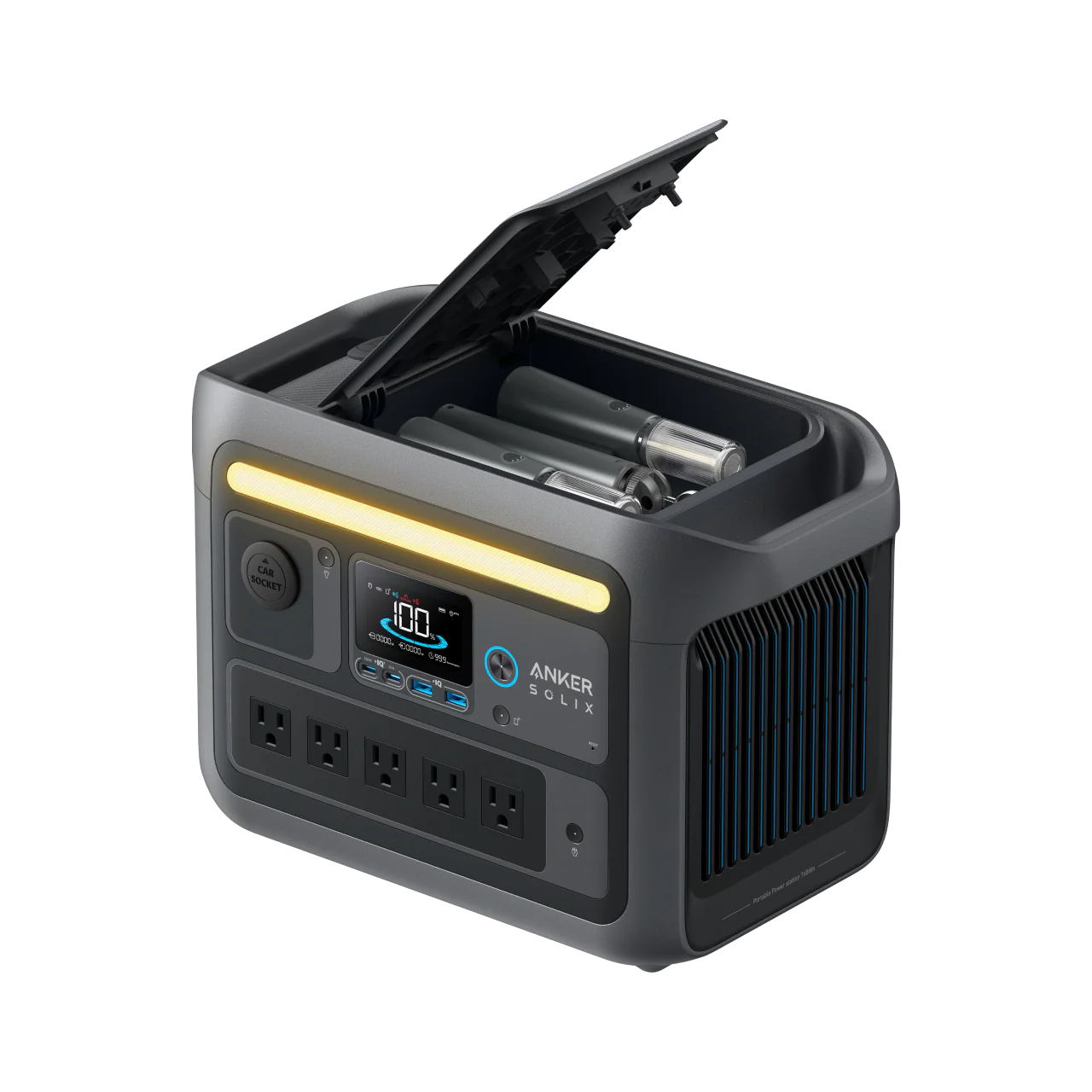
No longer sold
Anker has replaced the C800 line with the C800X — at $449.99 it currently ships with a 100W solar panel included, so the newer unit costs less than the C800 did.
SOLIX C800X · $449.99Spec deltas
$719 against $349 — the DELTA 3 Plus costs almost exactly double the SOLIX C800, and unlike a lot of price gaps in this category, the spec sheet actually backs it up: 1,024Wh against 768Wh, 1,800W continuous output against 1,200W, and a 3,600W surge ceiling against 1,600W.
The number that matters more than any of those is solar input. The DELTA 3 Plus accepts up to 1,000W, the SOLIX C800 caps at 300W — so despite holding less energy to begin with, the SOLIX C800 takes roughly two and a half times as long to refill from the sun. That gap is the real argument for paying more, if you're ever actually off-grid.
Neither unit is sized for a real camping weekend or a multi-appliance blackout — both fail those jobs by a wide margin. This is a decision about margin and growth room on the jobs they can actually do, not about which one is the emergency generator.
What the Numbers Reveal
Each conclusion stated first — the numbers behind it on one line, the full analysis below.
solar input
An outage doesn't wait for a sunny afternoon to end. On a partly-cloudy day where panels rarely hit their rated wattage, that gap in refill speed compounds into the difference between fully charged by lunch and still topping off at dusk.
DELTA 3 Plus accepts up to 1,000W of solar input against a 1,024Wh capacitySOLIX C800 accepts up to 300W of solar input against a 768Wh capacity
Why it mattersAnyone planning to lean on solar during a multi-day outage should weight this over the sticker price — the SOLIX C800's slower refill is the real cost of the cheaper unit.
continuous output
A fridge or AC compressor's startup surge can sit above the SOLIX C800's entire 1,600W inverter ceiling before the compressor even settles into its running draw. The DELTA 3 Plus's 3,600W ceiling has room to spare for the same load.
DELTA 3 Plus surges to 3,600W against an 1,800W continuous rating — 2x headroomSOLIX C800 surges to 1,600W against a 1,200W continuous rating — 1.33x headroom
Why it mattersAnyone whose backup-power plan includes actually starting a fridge or window AC should read the SOLIX C800's surge rating as a real limitation, not a footnote.
Meanwhile the SOLIX C800, rated a worse 45dB on paper, gets reported as silent under loads up to 500W with only a mild hum at its ceilingB7. For CPAP or overnight use, the printed dB numbers point the wrong direction entirely.
DELTA 3 Plus is rated 30dB, quieter on paper than the SOLIX C800's 45dB specOwners report the DELTA 3 Plus's fans activate even under low loads and cycle on and off erratically, undercutting its near-silent marketingA1A2
Why it mattersBuyers picking a unit for quiet overnight duty should weight the ledger over the spec sheet here — it's the SOLIX C800 owners are calling quiet, not the DELTA 3 Plus.
Capacity
What justifies it is the expansion port. The $350 premium isn't really paying for 256 extra watt-hours today — it's paying for a battery slot that can keep growing, against a SOLIX C800 that's done growing the day you unbox it.
DELTA 3 Plus supports EcoFlow expansion batteries, growing capacity beyond its 1,024Wh baseSOLIX C800 is a closed system — 768Wh is the permanent ceiling
Why it mattersOnly pay the premium if you'll actually use the expansion path. If 768Wh is genuinely your permanent ceiling, the SOLIX C800 is the better buy at half the price.
The specific dimensions that decide these two units — everything else is a tie.
Lifetime Value
Selected because: The engine's own cheaperToOwn call goes to the SOLIX C800 — has to be surfaced plainly before the capability argument.
cost / lifetime kWh
Run the ownership math and the SOLIX C800 is, technically, the cheaper unit to own: $0.15 per lifetime kWh against the DELTA 3 Plus's $0.17, and $70 per warranty-year against $140. Both figures move almost in lockstep with the sticker price, since both units carry the same 5-year warranty term.
That math doesn't account for the expansion port, which is the DELTA 3 Plus's actual value proposition. If you never expand it, you're paying more per watt-hour for a unit that's also more expensive to own outright — the honest case for the DELTA 3 Plus rests on capability and growth room, not on it being the smarter financial bet.
Your Life, Your Pick
Selected because: Tailgate Party is the one scenario the SOLIX C800 flatly can't finish; CPAP Overnight is where both have room to spare.
Weekend Camping, the 8-Hour Blackout, and Van Life Daily defeat both units — this isn't the product class for a two-night trip, a multi-appliance outage, or daily van life power, and the gap between the two doesn't change that verdict.
Where they actually diverge: CPAP Overnight (37% of usable capacity for the DELTA 3 Plus, 49% for the SOLIX C800 — both handle it, DELTA 3 Plus with more to spare) and Tailgate Party, where the DELTA 3 Plus finishes at 77% and the SOLIX C800 tips over the edge at 103% — the only scenario here where the cheaper unit genuinely can't finish the job.
Growth Path
Selected because: The DELTA 3 Plus's expansion port is the real reason to pay double — the honest core of this matchup.
solar input
This is where the DELTA 3 Plus's real argument lives. It accepts EcoFlow expansion batteries and keeps growing past 1,024Wh; the SOLIX C800 stops at 768Wh for the life of the unit, no matter what you're willing to spend later.
That only matters if your needs are actually going to grow — more gear, longer trips, a slow expansion into partial home backup. If you're confident 768Wh covers you permanently, the growth path is a feature you're paying for and never using.
What the Specs Don't Tell You
Selected because: Surge headroom and the noise-spec contradiction are concrete, spec-true tiebreakers.
rated cycles
The surge numbers are the real story: 3,600W against 1,600W, or 2x continuous rating against 1.33x. That's the difference between an inverter that can start a fridge compressor and one that's already near its ceiling before the compressor settles in — and it shows up again in switchover speed, 10ms line-interactive for the DELTA 3 Plus against 20ms standby-class for the SOLIX C800.
Noise runs backward from the spec sheet. The DELTA 3 Plus is rated quieter on paper, 30dB against 45dB, but owners report erratic fan cycling even at low loadsA1A2 — while SOLIX C800 owners report near-silence under everyday loads despite the worse number printed on the boxB7. Don't shop this one by dB rating alone.
Brand Trust
Selected because: Cross-brand pair — EcoFlow's deeper ecosystem against Anker's broader consumer trust.
EcoFlow runs the deeper ecosystem here — a dozen-plus models plus solar panels and smart home panels, the fastest charging tech in the category, and the largest community by a wide margin. That scale cuts both ways: a 2025 recall on a different model and a since-abandoned subscription-paywall test are real marks against them, and support experiences are polarized between hassle-free replacements and long waits.
Anker brings the trust of a much bigger consumer-electronics brand and a 5-year warranty that reviewers call genuinely better than most direct rivalsB6, but SOLIX-specific support is trending down from that historic strength, and its expansion ecosystem is smaller than EcoFlow's by design — the SOLIX line isn't built to grow the way the DELTA line is.
Strengths & trade-offs
EcoFlow DELTA 3 Plus
Strengths
- +Larger battery capacity
- +Higher AC output
- +Faster solar charging
- +Rated for 4,000 charge cycles — much longer battery lifespan
Trade-offs
- –No major technical downsides compared to rival.
Anker SOLIX C800
Strengths
- +Costs $120 less
- +Lighter by 3.2 lb
Trade-offs
- –Weaker inverter (-600W) limits appliance compatibility.
- –Sealed capacity — the DELTA 3 Plus can add batteries to grow past 768Wh; this one can't.
- –Shorter-lived battery — rated for 3,000 charge cycles vs the DELTA 3 Plus's 4,000, so it wears out sooner.
Will It Power Your Gear?
Scenario math and per-appliance runtimes, modeled from the spec record.
Scenario verdicts
We ran the math on six real-world scenarios. Here's which unit survives your actual life.
SCN-01 · 2 nights · needs 2,100Wh
Weekend Camping
Two nights off-grid with essential comfort
Neither unit
Neither unit covers this scenario's 2,100Wh: the DELTA 3 Plus comes up 1,230Wh short (about 41% covered), the SOLIX C800 1,447Wh (31%). Treat this as partial cover — enough for the essentials in it, not the whole list.
Battery budget usedlower = more headroom
LOAD Phone Charger 15W×6h · LED Lights 40W×8h · Box Fan 75W×14h · CPAP Machine 40W×16h
SCN-02 · 8 hours · needs 1,645Wh
8-Hour Blackout
Keep the essentials running through a night without power
Neither unit
Neither unit covers this scenario's 1,645Wh: the DELTA 3 Plus comes up 775Wh short (about 53% covered), the SOLIX C800 992Wh (40%). Treat this as partial cover — enough for the essentials in it, not the whole list.
Battery budget usedlower = more headroom
LOAD Fridge 150W×8h · Router + Modem 20W×8h · LED Lights (4 bulbs) 40W×6h · Phone Charger 15W×3h
SCN-03 · 8 hours · needs 320Wh
CPAP Overnight
Sleep therapy without interruption — the #1 medical use case
DELTA 3 Plus
Both handle it comfortably — the DELTA 3 Plus uses 37% of its usable capacity, the SOLIX C800 49%. Neither number is close to a real constraint here; if this is your only use case, buy on price and quiet operation, not capacity.
Battery budget usedlower = more headroom
LOAD CPAP Machine 40W×8h
SCN-04 · 8 hours · needs 910Wh
Remote Workday
Full work day off-grid without power anxiety
Neither unit
Neither unit clears this one, but the DELTA 3 Plus comes far closer at 105% of usable capacity against the SOLIX C800's 139%. If your actual workday looks like this, size up from both rather than stretching either.
Battery budget usedlower = more headroom
LOAD Laptop 60W×8h · External Monitor 30W×8h · Router + Modem 20W×8h · Phone Charger 15W×2h
SCN-05 · 4 hours · needs 670Wh
Tailgate Party
Game day power for the crew
DELTA 3 Plus
The DELTA 3 Plus finishes at 77% of usable capacity with real room left. The SOLIX C800 tips over the edge at 103% — the one scenario here where the cheaper unit genuinely can't finish the job.
Battery budget usedlower = more headroom
LOAD Blender 400W×0.5h · LED TV (55") 80W×4h · Bluetooth Speaker 15W×4h · Phone Charger (×3) 45W×2h
SCN-06 · 24 hours · needs 4,685Wh
Van Life Daily
A full day of mobile living — the ultimate endurance test
Neither unit
Not close for either — 538% and 718% of usable capacity respectively. Van life daily power is a different, much bigger class of unit; neither of these was built for it.
Battery budget usedlower = more headroom
LOAD Mini-Fridge 150W×24h · Laptop 60W×4h · Phone Charger 15W×3h · LED Lights 40W×5h · Fan 75W×8h
The Load Test
RUNTIME = (Wh × 0.85) ÷ LOAD
None of the scenarios above exactly yours? Build it. Toggle what you'd plug in; both units are tested against the combined draw.
Essentials
Comfort & Convenience
High-Draw Appliances
Test duration
8h
Continuous draw
205W
Projected runtime
For this load: DELTA 3 Plus runs 4.2h vs 3.2h.
$719 list · direct from EcoFlow
Modeled from the spec record — same math as the tables below. Methodology
Runtime by appliance
Real-world runtime estimates for common appliances, modeled at 85% inverter efficiency.¹
Essentials
The basics you need runningscale 0–58hComfort & Convenience
Makes off-grid life actually enjoyablescale 0–11.6hHigh-Draw Appliances
These reveal the real limitsscale 0–0.9h¹ Runtime = (capacity × 0.85) ÷ appliance watts. Within each group, all bars share one time scale (the group's longest runtime), so lengths are comparable across appliances; identical runtimes collapse into a single blue/orange bar. Actual runtime varies with battery age, temperature, and simultaneous loads — see methodology.
Conclusion
July 14, 2026
Verdict: the DELTA 3 Plus, on Power Score margin
The DELTA 3 Plus wins on capability, not on economics — the engine's own numbers put the SOLIX C800 as the technically cheaper unit to own, $0.15 against $0.17 per lifetime kWh. What the DELTA 3 Plus buys instead is margin: a 3,600W surge ceiling with enough headroom to actually start a fridge compressor, solar input that refills it in a fraction of the time, and an expansion port that keeps 1,024Wh from being a permanent ceiling. If your heaviest job is a CPAP overnight or a light tailgate afternoon, the SOLIX C800 already covers it for $350 less. If you need real backup-power margin or expect your needs to grow, the DELTA 3 Plus is worth the premium.
Editor-assigned confidence, based on cited owner research and spec analysis.
List prices as of July 14, 2026. The links below open EcoFlow's and Anker's current prices.
$719.00 · direct from EcoFlow
Last checked 1 day ago. Prices move — check before you buy.
or check the SOLIX C800 price$599.00 list
Written by Ian Schneider, Solar & Off-Grid Tester · Station Arena Test Desk · Updated July 14, 2026
Measured Data
Benchmark scores and the full spec record, side by side.
Benchmark scores
Not rated for both units (minimum threshold unmet): RV Living, Home Backup, Food Truck.
Full specifications
ᵈ Derived: price ÷ rated capacity. See the data behind our comparisons →
Comparison ToolAdd more power stations, side by sideOpen Tool →How these numbers are produced
Numeric verification
Every figure on this page traces to our spec database or arithmetic on it — no estimated numbers.
Owner claims
Statements about owner experience are cited to published reviews — see Sources & Research Notes below.
Runtime model
Runtime = (rated capacity × 0.85 inverter efficiency) ÷ device wattage. Solar recharge estimates assume panels deliver 70% of rated output. Cold weather, battery age, and stacked loads reduce real-world results.
Power Score
Computed from 14 published spec dimensions, weighted per use-case bench. Higher is better; a unit must meet a bench's minimum threshold to be rated.
See the full weight table and data sourcing on our methodology page →Class ranking (the star rating)
Each unit's star score is a category ranking, not customer reviews — no buyer opinions feed it. We score every station on size-independent quality (value, output, portability, endurance, ports, warranty, and more), then percentile-rank it against the other units in its capacity class, so a class-leading compact unit and a class-leading whole-home unit can both earn 5★. Here, DELTA 3 Plus rates 4.2/5 (54th percentile of 27 Everyday-class units), and SOLIX C800 rates 4.1/5 (47th percentile of 20 Compact-class units).
How the class ranking is computed →Test Notes & Caveats
Hidden gotchas and advantages we spotted that you won't find on the product page.
The Spec Sheet Has This Backward
The DELTA 3 Plus is rated 30dB, the SOLIX C800 45dB — on paper, the DELTA 3 Plus is the quiet one. Owner reports say the opposite: DELTA 3 Plus fans activate even at low loads and cycle erratically, while SOLIX C800 owners report near-silence under everyday loads. Shop this by the field reports, not the printed number.
What $350 More Actually Buys
Day one, the DELTA 3 Plus's extra capacity is real but modest — 256 more watt-hours than the SOLIX C800. The real value of the premium is the expansion port: a slot that keeps growing against a SOLIX C800 that's done growing the moment you unbox it. If you won't use it, you're paying more for a battery that's only slightly bigger.
One of These Can Start a Fridge
A fridge or AC compressor can demand 2-3x its running draw just to start. The DELTA 3 Plus's 3,600W surge is 2x its 1,800W continuous rating — enough to clear that range. The SOLIX C800's 1,600W surge is only 1.33x its 1,200W rating, below what many compressor startups ask for.
UPS Switchover: ≤10ms vs ≤20ms
Both list a UPS mode, at different rated speeds. The DELTA 3 Plus is rated ≤10ms — quick enough on paper that desktop PCs and routers should ride through, treating that as the rating it is. The SOLIX C800 is rated ≤20ms — fine on paper for routers and most electronics; the fussiest PC power supplies sit right at this line. If a computer with unsaved work is the thing being protected, the stated class is worth the attention; nothing here is a lab result.
Warranty: No Difference
Both units carry the same 5-year warranty, so coverage isn't a tiebreaker here.
Battery Lifespan in Real Years
The DELTA 3 Plus is rated for 4,000 cycles vs 3,000. In real life: at daily use, that's 11 vs 8.2 years. At weekend use (twice a week), it's 38 vs 29 years. One caution reading years across different sizes: a cycle is 1,024Wh on the DELTA 3 Plus and 768Wh on the SOLIX C800, so count lifetime energy — roughly 4,096 kWh against 2,304 kWh over the rated life. After hitting the cycle limit, the battery doesn't die — it drops to ~80% of original capacity, which is still very usable.
Full record above — the Test Desk pick is the DELTA 3 Plus.
Check DELTA 3 Plus price →or check the SOLIX C800 priceOwnership Analysis
What happens after you buy — true cost of ownership, brand trust, and growth potential.
Lifetime value
Service lifeyears at one full cycle per day
Lifetime energy delivered
Cost per delivered kWh
│ warranty ends · Reaching the cycle rating means ~80% capacity remains — degraded, not dead.
Analyst note
The SOLIX C800 is cheaper to buy, but the DELTA 3 Plus is cheaper to own. At $0.18/kWh over its lifetime vs $0.26/kWh, the DELTA 3 Plus's higher cycle life and capacity make each dollar go further over the years.
Brand trust
EcoFlow
Ecosystem
Largest in portable power — 12-15 models across DELTA Pro, DELTA 3, and RIVER 3 series, plus solar panels and smart home panels
Support
US-based phone/email/chat support (1-800-368-8604). Experiences are polarized — many report hassle-free prepaid-label replacements, but others report long waits and refurbished units sent for new claims. Pro tip: buying from Costco or Amazon gives you a stronger return safety net.
Community
Largest community in the space — Reddit r/Ecoflow_community (~31K members), multiple Facebook groups, and an official community forum
App experience
Rated 4.6/5 iOS (~8,400 ratings) · 4.2/5 Android (~17,000 ratings)
Unique strength
Fastest charging tech in the category and the deepest expansion ecosystem — the only one of these two brands built around units that keep growing.
Worth knowing
A 2025 recall on a different model line and an abandoned subscription-paywall test for app features are real marks worth knowing about, even though they don't touch this specific unit.
Anker
Ecosystem
7-8 SOLIX portable power stations across C-series (compact) and F-series (flagship), plus the X1 home energy system
Support
US-based support. Historically known for incredible no-hassle replacements, but recent reports describe AI-driven support agents giving generic responses and complex return logistics for heavy units (hazmat shipping). The Anker brand reputation is still strong, but SOLIX-specific support quality is trending down.
Community
Moderate — active Reddit (r/Anker, r/AnkerSOLIXCommunity) and growing. Benefits from Anker's massive consumer electronics brand awareness.
App experience
Rated 4.5/5 iOS (~1,100 ratings) · 4.3/5 Android
Unique strength
The trust of a much larger consumer-electronics brand, plus a 5-year warranty on the SOLIX line that reviewers call genuinely longer than most direct rivals.
Worth knowing
SOLIX-specific support is trending down from Anker's historically excellent standard, and the SOLIX ecosystem isn't built to expand the way EcoFlow's is.
Analyst note
EcoFlow's brand bet is depth and growth — more models, more expansion paths, faster iteration, with the rough edges that come from moving fast. Anker's bet is trust carried over from decades in consumer electronics, applied to a smaller, more contained SOLIX lineup that isn't trying to be everything at once.
Growth path
DELTA 3 Plus
EXPANDABLESupports EcoFlow expansion batteries, so you can add capacity later without replacing the base unit — useful if your needs may climb past 1,024Wh.
Accepts up to 1,000W of solar. Enough for a serious multi-panel array.
Generous port selection supports complex multi-device setups.
Expansion batteries are EcoFlow-specific. You're investing in the EcoFlow ecosystem.
SOLIX C800
FIXED CAPACITYFixed at 768Wh, with no expansion — so size it for your needs up front rather than planning to add capacity later.
Accepts up to 300W of solar. Limited to a single portable panel.
Adequate ports for most setups, but heavy users may want a power strip.
Realistic full solar rechargeat 70% of rated panel output — see methodology
Analyst note
The SOLIX C800 is sealed at 768Wh, which is fine if that covers you. The DELTA 3 Plus starts at 1,024Wh and can grow beyond it with EcoFlow expansion batteries — though at this size expansion means longer runtimes on the same loads, not a path to home backup. More hours, not more house.
What Owners Report
Patterns from published owner reports and long-term reviews — every claim cited to its source below.
EcoFlow DELTA 3 Plus
Reviewer coverage on the DELTA 3 Plus is consistent on both ends: fast, well-executed charging and a genuinely fast sub-10ms UPS switchover that holds up under testingA3. The flaw is the fans — they activate even under low loads and cycle on and off erratically, undercutting the near-silent marketing the unit ships withA1A2.
That erratic cycling isn't just annoying — reviewers flag it as a real risk of the unit running hotter than it should under sustained heavy drawA2. The read from reviewers is cautiously optimistic: EcoFlow has patched fan behavior on other units after launch before, and this looks fixable in firmware rather than baked into the hardwareA4.
“Otherwise well-designed, with very fast recharge times and a seamless sub-10ms UPS switchover for uninterrupted power.”
Sources
thesolarlab.com
Anker SOLIX C800
Where the DELTA 3 Plus's fans are the flaw, the SOLIX C800's are the surprise: reviewers report zero fan noise under loads up to 500W, with only a mild hum at its ceilingB7 — a better real-world showing than its 45dB spec would suggest, and the more relevant comparison in a matchup that's partly about which unit is actually quiet.
The rest of the ledger is a value story: a 42-minute run on a 1,000W coffee makerB3, a full charge in 58 minutes off a 600W adapterB9, and a 5-year warranty reviewers call 3 years longer than typical rivalsB6. The tradeoff is its 300W solar ceiling, called middling next to similarly-sized unitsB5, and 23.8 lbs that reviewers flag as too heavy to carry far on footB12.
“We dropped it from a tailgate (30 inches) onto gravel—only minor scuffing, no damage.”
Sources
backuppowerhub.com · portablepowergeek.co.uk · batteryskills.com · batteryessence.com · toolsandtoys.net · bikmantech.com
Sources & Research Notes
Every owner claim in this report is traceable to a published source. The bracketed references above resolve here.
Recurring owner themes
- The DELTA 3 Plus's headline weakness is fan behavior — fans run even at low load and cycle erratically, undercutting its quiet-UPS marketing. [DELTA 3 Plus · 3 entries]
- Build quality/chassis is repeatedly called solid and drop-resistant, but reviewers flag the lack of an IP weather rating as a real-world caveat for outdoor use. [SOLIX C800 · 3 entries]
- The 58-minute AC fast-recharge is the single most-mentioned standout feature, praised as faster than rivals like the Jackery 700. [SOLIX C800 · 2 entries]
- Reviewers note the unit can briefly exceed its 1200W rating for heavy appliances, but caution it can't sustain full-size continuous loads like a full-size fridge. [SOLIX C800 · 2 entries]
- Long 5-year warranty and strong retailer star ratings are cited as reassurance/value signals. [SOLIX C800 · 2 entries]
- Weight (~23-24 lbs) is repeatedly flagged as a downside relative to lighter rivals despite the compact footprint. [SOLIX C800 · 2 entries]
- A1
“Marketed as near-silent, but real-world fan performance is a significant flaw: the fans activate even under low loads and cycle on and off erratically, which limits its effectiveness as a quiet UPS.”
T3 — EcoFlow DELTA 3 Plus review: Lightning-fast charging with a noisy flaw; thesolarlab.com — DELTA 3 Plus Review · 2026 · [negative]
- A2
“Part of why it stays quiet is that the internal fans aren't always doing their job properly — the erratic cycling raises the risk of the unit overheating when running heavy loads.”
thesolarlab.com — EcoFlow DELTA 3 Plus Review: Amazing, but One Big Quirk? · 2026 · [negative]
- A3
“Otherwise well-designed, with very fast recharge times and a seamless sub-10ms UPS switchover for uninterrupted power.”
T3 / thesolarlab.com — DELTA 3 Plus reviews · 2026 · [positive]
- A4
“Reviewers note EcoFlow should be able to resolve the fan behavior with a software update, as it has done for other power stations after release.”
thesolarlab.com — DELTA 3 Plus Review · 2026 (dated claim — may be partially addressed by firmware) · [mixed]
- B3
“A 1,000W coffee maker ran 42 minutes straight.”
backuppowerhub.com — Anker SOLIX C800 Review: Best Budget Power Station? · 2025-12 · [positive]
- B5
“Only allows a middling amount of solar charge at 300W max solar panels, when compared to its equivalently-sized models.”
portablepowergeek.co.uk — Anker Solix C800 Review · 2024-11 · [mixed]
- B6
“It's backed by a warranty of 5 years – which, by the way, is fully 3 years more than its direct rivals.”
portablepowergeek.co.uk — Anker Solix C800 Review · 2024-11 · [positive]
- B7
“Zero fan noise under 500W loads, unlike louder competitors (e.g., Bluetti EB55). Only a mild hum at max load.”
batteryskills.com — Anker SOLIX C800 Portable Power Station Review · 2025-10 · [positive]
- B9
“Achieved a full charge in 58 minutes using a 600W AC adapter (matching Anker's claim), while competitors like the Jackery 700 take 2+ hours.”
batteryskills.com — Anker SOLIX C800 Portable Power Station Review · 2025-10 · [positive]
- B12
“At 23.15 lbs (10.5 kg), this is too heavy for carrying far on foot. For hiking, a smaller, lighter power bank under 5 lbs is a better fit.”
batteryessence.com — Anker SOLIX C800 Portable Power Station 768Wh Review · 2026-03 · [negative]
Research compiled July 14, 2026.
Who Should Buy Which
Buy the DELTA 3 Plus if you…
- →You want real margin to start a fridge or window AC off-grid — the DELTA 3 Plus's 3,600W surge clears that bar; the SOLIX C800's 1,600W ceiling doesn't.
- →Your power needs might grow over the next few years, and you'd rather add a battery than buy a whole second unit.
Buy the SOLIX C800 if you…
- →Your heaviest real job is a CPAP overnight or a light tailgate afternoon — 768Wh already covers both with capacity to spare, and $350 stays in your pocket.
- →You want quiet overnight operation and trust the field reports over the spec sheet: owners call the SOLIX C800 near-silent under everyday loads despite its worse dB ratingB7, while the quieter-on-paper DELTA 3 Plus draws real fan complaintsA1.
This is you — check the SOLIX C800 price
If neither fits
If your actual need is a two-night camping trip (about 2,100Wh) or an 8-hour multi-appliance blackout (about 1,645Wh), both of these fall short. Look at a larger-capacity unit, or the DELTA 3 Plus's own expansion batteries, instead of choosing between these two.
The Bottom Line
The SOLIX C800 is the technically cheaper unit to own, and for a CPAP overnight or a light tailgate afternoon, it does the job for $350 less. But the DELTA 3 Plus is the one built for margin: a 3,600W surge ceiling that can actually start a fridge, solar input that refills it in a fraction of the time, and an expansion port that keeps 1,024Wh from being the end of the story.
Buy the SOLIX C800 if your needs are already known and modest. Buy the DELTA 3 Plus if you need real headroom or expect to need more later — that's what the extra $350 actually pays for.
Frequently Asked Questions
Answers drawn from the spec record and cited owner research.
What's the real difference between the DELTA 3 Plus and SOLIX C800 besides the $350?
Capacity, output, and growth room. The DELTA 3 Plus holds 1,024Wh to the SOLIX C800's 768Wh, outputs 1,800W continuous against 1,200W, and surges to 3,600W against 1,600W. It also accepts EcoFlow expansion batteries; the SOLIX C800 is a closed 768Wh system for life.
Can either of these actually start a fridge?
The DELTA 3 Plus is more likely to. Its 3,600W surge gives 2x headroom over its 1,800W continuous rating, matching the low end of the 2-3x startup surge a fridge compressor typically demands. The SOLIX C800's 1,600W surge is only 1.33x its 1,200W rating — below what many compressor loads ask for on startup.
Which one recharges faster from solar?
The DELTA 3 Plus by a wide margin. It accepts up to 1,000W of solar against the SOLIX C800's 300W, so despite holding less energy, the SOLIX C800 takes roughly two and a half times as long to refill from empty in the same sun.
Is the DELTA 3 Plus's fan actually a problem?
Reviewers say yes, in its current form. Fans activate even at low loads and cycle erratically, undercutting the unit's near-silent marketing and raising overheating risk under sustained heavy draw. It's flagged as likely fixable in a future firmware update, based on EcoFlow's history with other models, but it's not fixed yet.
Does the SOLIX C800 expand later if I outgrow it?
No. It's a closed system — 768Wh is the permanent ceiling, and there's no expansion battery or port to add to it. If there's a real chance you'll need more later, the DELTA 3 Plus's expansion path or a larger unit is the safer buy now.
Where to buy
EcoFlow DELTA 3 PlusPick
$719.00
$719.00 · direct from EcoFlow
Last checked 1 day ago. Prices move — check before you buy.
Anker SOLIX C800
$599.00
$599.00 · direct from Anker
Last checked 1 day ago. Prices move — check before you buy.
Prices may vary by retailer and are subject to change.