Head-to-head test
Anker SOLIX C800 vs Anker SOLIX C800X
Anker SOLIX C800 vs Anker SOLIX C800X: the same 768Wh pack, the same 1,200W inverter and 1,600W surge ceiling, the same 3,000-cycle rating. Anker retired the C800, so the C800X is the one you can buy, and the only thing it gives up is a published fan-noise figure, which matters only if it sleeps beside you.
Full profiles: Anker SOLIX C800 → · Anker SOLIX C800X →

Written by Ian SchneiderUpdated
Solar & Off-Grid Tester, Station Arena Test Desk
Spec deltas
Anker retired the SOLIX C800 in early August, so there's no price on it here and no buy button. Take the C800X. That's not a close call, and it's also not much of a loss, because the two units share a 768Wh pack, a 1,200W inverter with a 1,600W ceiling, a 3,000-cycle rating, a 5-year warranty, 300W of solar input, a 100W USB-C port and five AC outlets.
The one number that didn't survive the handover is fan noise. Anker publishes 45dB for the C800 and publishes nothing for the C800X, which is a strange way round for a replacement to arrive. It isn't evidence the newer unit is louder. It means there's no figure to hold it to, and on a 768Wh station the buyer most likely to care is the one running a CPAP off it.
Everything else here is identical or close enough to ignore. The C800X is 24 lb against 23.8, which is nothing you'll feel lifting it over a tailgate. Neither expands. Both deliver about 653Wh of that 768Wh once you apply the flat 85% derate this site uses on every unit, and that ceiling, rather than the difference between them, is what should decide whether either one is the right size for you.
What the Numbers Reveal
Each conclusion stated first — the numbers behind it on one line, the full analysis below.
So both units behave identically, and they behave in a way the ratings hide. Coffee makers, kettles, toasters and heaters are easy. A fridge started while anything substantial is already running is the load that trips them. The C800X carries the same 1,200W, the same 1,600W and the same 400W of slack, so the one real limit on the older unit is the one thing Anker's replacement didn't change.
Both units rate 1,200W continuous and 1,600W peak, so the surge budget is 400W above the running loadA full-size refrigerator draws 700-800W just to startA11A reviewer ran a 1,000W coffee maker for 42 minutes straightA3 and held a 1,500W space heater for 25 minutes before it throttledA8Usable capacity is about 653Wh on both units after the flat 85% derate
Why it mattersIf you're buying either of these for something with a motor in it, look up its startup draw rather than its running watts, and don't count on the newer unit having more room. It doesn't.
That inverts how an upgrade is supposed to work. Anyone shopping the C800X for a CPAP, an apartment or a shared room has a published number for the unit they can't buy and a shrug for the one they can, and the single measured-sounding figure out there belongs to a site with a commission riding on the answerB16. The C800's quiet-under-load reportA7 is the nearest proxy available, and a proxy is not the same box.
Anker publishes a fan-noise figure for the C800 and none for the C800XA CPAP night is about 320Wh against roughly 653Wh usable, leaving about 333Wh spare on either unitThe only dB number circulating for the C800X is an affiliate site's unverified claim of below 30dB at a 290W loadB16, and no owner anywhere has published oneB0A reviewer described the C800 as making no fan noise under 500W, with only a mild hum at full loadA7
Why it mattersBedside buyers should order the C800X from somewhere with a return window and treat the first night as the test. Everyone else can ignore this line entirely.
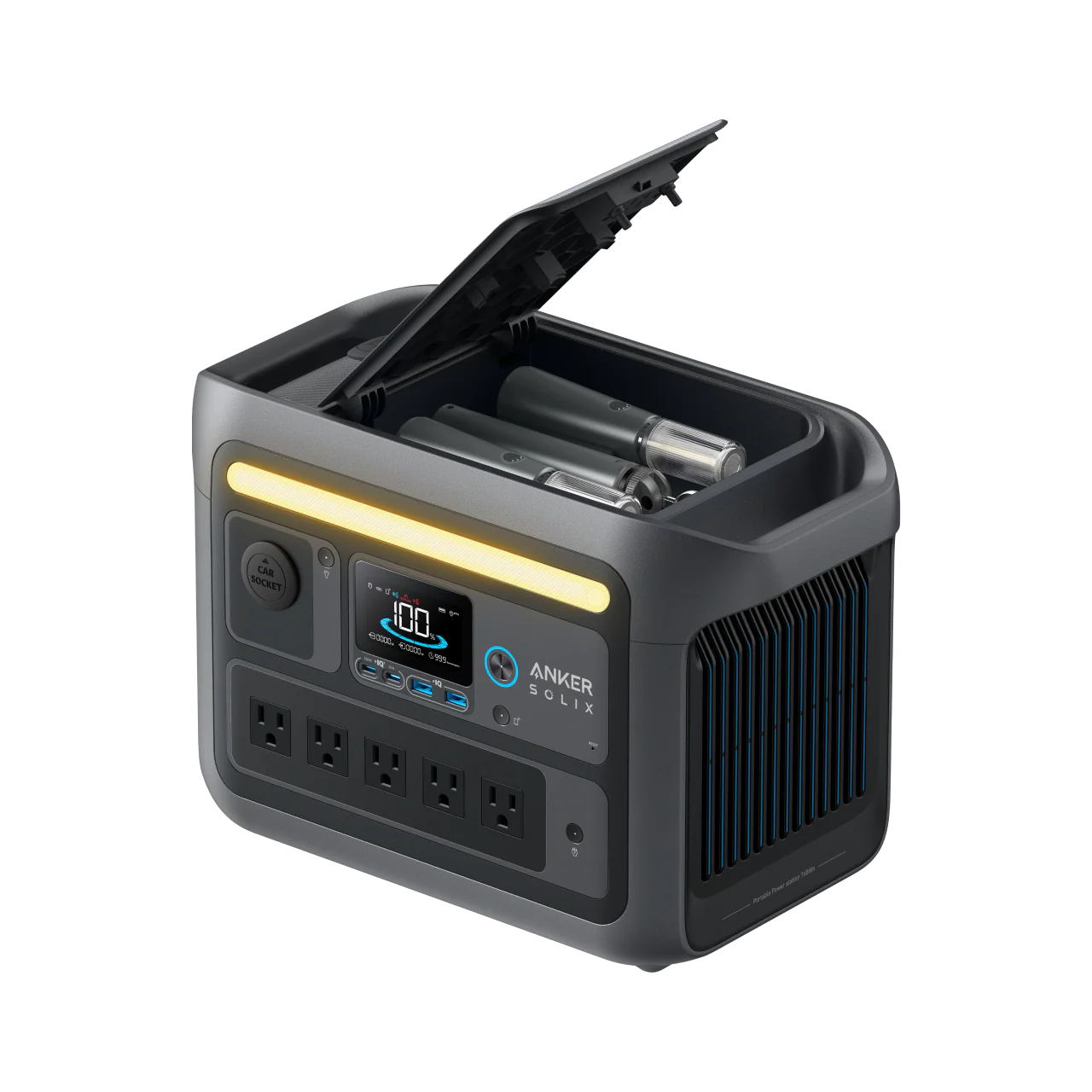
It's the only column on this page where the older unit comes out ahead, and it's a preference rather than a capability. If you already own headlamps and lanterns, a built-in pole is occupying space you had a use forB11. If you don't, it's a light you'll never forget to pack. Either way it's too small to chase discontinued stock over, and far too small to replace a working C800 for.
The C800's top compartment is an empty storage areaA13Owners who went looking report the C800X and the C800 Plus carry a telescoping light pole in that compartment while the base C800 doesn't, and say Anker never spells the lineup out anywhere they can findB1B2One owner deliberately chose the version without lights to keep the top space for his own lights, chargers and cablesB11
Why it mattersIf you own a C800, there is nothing here to upgrade for. If you are buying the X, expect the lid to be occupied and plan to keep your cables somewhere else.
The specific dimensions that decide these two units — everything else is a tie.
What the Specs Don't Tell You
Selected because: The only difference the spec sheets show between these two units lives in these cards: the C800 publishes a fan-noise figure, the C800X publishes none, and both carry the same five years.
Two of these three cards are the same missing number seen from opposite ends. Anker printed a fan figure for the unit it stopped selling and printed none for the unit it replaced it with, so this page ends up holding the older box to a standard the newer one was never asked to meet. That's a documentation gap rather than a performance gap, and the honest reading is that nobody knows.
The warranty card is where the two genuinely tie, and it's worth more than a tie usually is. Five years against a pack rated for 3,000 cycles means that if you cycle this thing every single day, about 8.2 years of rated cell life outlasts the cover by roughly three. The five years is there for the inverter, the ports and the fan, which is the part of a power station that actually fails.
Runtime: Will It Power Your Gear?
Selected because: Capacity is identical at 768Wh, so the question that's left is what the shared 1,200W inverter and 1,600W ceiling will actually start.
653Wh is the number to plan with, not 768. The scenario table applies a flat 85% derate to every unit it scores, and nobody runs a pack to zero anyway. That is a laptop-and-lights evening, a full night of CPAP with room over, or one appliance at a time.
The ceiling that will actually surprise you is the surge one. 1,600W peak on a 1,200W inverter is 400W of slack, and a full-size fridge wants 700-800W of that the instant its compressor kicksA11. Resistive loads don't behave that way and both units shrug them off: one reviewer held 1,500W for 25 minutes before it throttledA8. So the rule isn't "anything under 1,200W is fine." It's "anything with a motor, check the startup number first."
Your Life, Your Pick
Selected because: Five of the six load profiles come back short on both units, which is the real sizing answer for a 768Wh station.
Five of the six profiles come back as neither, and that isn't a failure of the comparison. It's the answer. A 768Wh pack covers 40% of the eight-hour blackout list and 14% of a van-life day, and no choice between two identical batteries moves either figure. If your real list looks like those rows, close this page and shop for a pack that covers those numbers on one charge.
The two rows worth reading closely are the near misses. Tailgate Party asks for 670Wh and both units deliver 653, so you lose the end of the evening rather than the middle of it, and the 400W peak it wants is comfortably inside what either inverter starts. Remote Workday lands 257Wh short of 910, which 300W of panel closes in under an hour of good sun. Those are planning problems. The blackout and van-life rows are shopping problems.
Growth Path
Selected because: Neither unit expands, so the 768Wh you buy is the 768Wh you keep, on both units.
768Wh is the ceiling on both, and since neither expands, this section can't break the tie. What's worth knowing is the workaround that gets tried anyway: owners feed an external LiFePO4 pack into the solar input and call the unit expandedB12. More experienced owners itemise the bill: you're charging the internal pack from the external one through the MPPT, so you pay conversion losses and extra cycles on the very cells you were trying to spare, and while you're doing it the only charge input is occupiedB13.
That's a real workaround and it's also a warning. If you can already picture yourself needing more than 653Wh of usable energy, buy a bigger station instead of a 768Wh one with a battery hanging off its charge port. Size it up front. Whichever of these you end up with is what you own.
Strengths & trade-offs
Anker SOLIX C800
Strengths
- +Lighter by 0.2 lb
Trade-offs
- –No major technical downsides compared to rival.
Anker SOLIX C800X
Strengths
- Solid all-rounder with standard specs.
Trade-offs
- –No major technical downsides compared to rival.
Will It Power Your Gear?
Scenario math and per-appliance runtimes, modeled from the spec record.
Scenario verdicts
We ran the math on six real-world scenarios. Here's which unit survives your actual life.
SCN-01 · 2 nights · needs 2,100Wh
Weekend Camping
Two nights off-grid with essential comfort
Neither unit
Neither unit covers this scenario's 2,100Wh: the SOLIX C800 comes up 1,447Wh short (about 31% covered), the SOLIX C800X 1,447Wh (31%). Treat this as partial cover — enough for the essentials in it, not the whole list.
Battery budget usedlower = more headroom
LOAD Phone Charger 15W×6h · LED Lights 40W×8h · Box Fan 75W×14h · CPAP Machine 40W×16h
SCN-02 · 8 hours · needs 1,645Wh
8-Hour Blackout
Keep the essentials running through a night without power
Neither unit
Both units cover about 40% of this eight-hour list and finish 992Wh short of all of it. Nothing on the list is beyond the hardware, since the peak draw is only 150W, so this isn't a question of whether they can, it's a question of how long. Read it as a unit that carries the essentials through an evening outage and hands you a triage decision after that.
Battery budget usedlower = more headroom
LOAD Fridge 150W×8h · Router + Modem 20W×8h · LED Lights (4 bulbs) 40W×6h · Phone Charger 15W×3h
SCN-03 · 8 hours · needs 320Wh
CPAP Overnight
Sleep therapy without interruption — the #1 medical use case
Either unit
A CPAP pulls about 40W, so eight hours is 320Wh out of roughly 653Wh usable. You'd wake with more than half the pack untouched, on either unit. Capacity decides nothing here and weight decides nothing either at two tenths of a pound apart. What's left is the fan, and only one of these two has a published figure for it, which is the one you can't buy. If you're the person awake at 3 a.m. listening for it, that's the whole decision.
Battery budget usedlower = more headroom
LOAD CPAP Machine 40W×8h
SCN-04 · 8 hours · needs 910Wh
Remote Workday
Full work day off-grid without power anxiety
Neither unit
Neither unit covers this scenario's 910Wh: the SOLIX C800 comes up 257Wh short (about 72% covered), the SOLIX C800X 257Wh (72%). Either gets you most of the way, so this is a scenario you plan around rather than one you should rule them out for.
Battery budget usedlower = more headroom
LOAD Laptop 60W×8h · External Monitor 30W×8h · Router + Modem 20W×8h · Phone Charger 15W×2h
SCN-05 · 4 hours · needs 670Wh
Tailgate Party
Game day power for the crew
Neither unit
Seventeen watt-hours. That's the entire gap between the 670Wh this evening wants and the 653Wh either unit actually delivers, which means you lose the end of the night rather than the middle of it. The 400W peak on the list is comfortably inside what either inverter starts, so nothing trips; the pack just runs dry. Drop one appliance, or accept that the music stops before everyone does.
Battery budget usedlower = more headroom
LOAD Blender 400W×0.5h · LED TV (55") 80W×4h · Bluetooth Speaker 15W×4h · Phone Charger (×3) 45W×2h
SCN-06 · 24 hours · needs 4,685Wh
Van Life Daily
A full day of mobile living — the ultimate endurance test
Neither unit
4,685Wh a day against 653Wh of usable pack. You'd need seven of these lined up on the floor, which is how you know this is the wrong question rather than a close one. Choosing between two identical 768Wh boxes doesn't move this row an inch. Full-time van power starts at a much larger station, or at a system you can actually add batteries to, and neither of these expands.
Battery budget usedlower = more headroom
LOAD Mini-Fridge 150W×24h · Laptop 60W×4h · Phone Charger 15W×3h · LED Lights 40W×5h · Fan 75W×8h
The Load Test
RUNTIME = (Wh × 0.85) ÷ LOAD
None of the scenarios above exactly yours? Build it. Toggle what you'd plug in; both units are tested against the combined draw.
Essentials
Comfort & Convenience
High-Draw Appliances
Test duration
8h
Continuous draw
205W
Projected runtime
Dead heat — both run this 205W load for roughly 3.2h. Pick on price, weight, or ports.
Planning for more than this? Describe your whole setup and get it sized →
Modeled from the spec record — same math as the tables below. Methodology
Runtime by appliance
Real-world runtime estimates for common appliances, modeled at 85% inverter efficiency.¹
Essentials
The basics you need runningscale 0–43.5hComfort & Convenience
Makes off-grid life actually enjoyablescale 0–8.7hHigh-Draw Appliances
These reveal the real limitsscale 0–0.7h¹ Runtime = (capacity × 0.85) ÷ appliance watts. Within each group, all bars share one time scale (the group's longest runtime), so lengths are comparable across appliances; identical runtimes collapse into a single blue/orange bar. Actual runtime varies with battery age, temperature, and simultaneous loads — see methodology.
Conclusion
September 19, 2026
Verdict: the SOLIX C800X
Buy the C800X. It's the only one of the two Anker still sells, and it matches the C800 line for line: 768Wh, 1,200W continuous, 1,600W peak, 3,000 cycles, five years of cover, 300W of solar input, five AC outlets, a 100W USB-C port, switchover specified at no worse than 20ms. The single thing you give up is the C800's published fan-noise figure, because Anker printed no equivalent for the X. If this is going on a nightstand, buy it somewhere with a return window and judge the fan yourself on night one. Confidence is high on the choice and deliberately not on the noise: the only dB number in circulation for the C800X comes from one affiliate site's unverified testB16, and no owner has published oneB0.
Editor-assigned confidence, based on cited owner research and spec analysis.
List prices as of September 19, 2026. The links below open Anker's current price.
$449.99 · direct from Anker
Last checked 16 days ago. Prices move — check before you buy.
Written by Ian Schneider, Solar & Off-Grid Tester · Station Arena Test Desk · Updated September 19, 2026
Black Friday · 38 days out
Price to beat:SOLIX C800X $450
We have never seen it discounted, so any real cut would be a first.
Measured Data
Benchmark scores and the full spec record, side by side.
Benchmark scores
Full specifications
ᵈ Derived: price ÷ rated capacity. See the data behind our comparisons →
Comparison ToolAdd more power stations, side by sideOpen Tool →How these numbers are produced
Numeric verification
Every figure on this page traces to our spec database or arithmetic on it — no estimated numbers.
Owner claims
Statements about owner experience are cited to published reviews — see Sources & Research Notes below.
Runtime model
Runtime = (rated capacity × 0.85 inverter efficiency) ÷ device wattage. Solar recharge estimates assume panels deliver 70% of rated output. Cold weather, battery age, and stacked loads reduce real-world results.
Power Score
Computed from 14 published spec dimensions, weighted per use-case bench. Higher is better; a unit must meet a bench's minimum threshold to be rated.
See the full weight table and data sourcing on our methodology page →Class ranking (the star rating)
Each unit's star score is a category ranking, not customer reviews — no buyer opinions feed it. We score every station on size-independent quality (value, output, portability, endurance, ports, warranty, and more), then percentile-rank it against the other units in its capacity class, so a class-leading compact unit and a class-leading whole-home unit can both earn 5★. Here, SOLIX C800 rates 4.1/5 (47th percentile of 20 Compact-class units), and SOLIX C800X rates 4.3/5 (58th percentile of 20 Compact-class units).
How the class ranking is computed →Test Notes & Caveats
Hidden gotchas and advantages we spotted that you won't find on the product page.
SOLIX C800: 45dB Published
45dB is about as loud as a running refrigerator. It is Anker's own rating rather than a reading on a shared bench — makers differ on whether they quote a best case or a figure under load, so treat it as a starting point rather than what you would hear at a bedside. For most people, fan noise around 45dB and up is where sleep starts to suffer.
Warranty: Five Years Each, No Tiebreak
Both units carry the same 5-year term, so coverage decides nothing here. What's worth knowing is how that term sits against the pack: 3,000 cycles works out at about 8.2 years at one cycle a day, so cycle it hard and the cells are rated to outlast the cover by roughly three years. That tells you what the five years is really for. It's the inverter, the ports, the fan and the BMS, not the battery's slow fade. Register the unit and keep the receipt, because a warranty you can't date is a warranty you can't claim.
SOLIX C800X: No Published Noise Figure
Anker printed a fan-noise number for the C800 and printed none for the C800X, which leaves the retired unit as the only one on this page you can hold to a figure. That isn't evidence the newer unit is louder. It means there's nothing to check, and no way to compare the two here short of hearing them. If this is going on a nightstand, into an apartment, or next to a CPAP, that absence is the one thing on the page a spec sheet can't settle for you, so buy it somewhere with a return window and let the first night be the test.
Full record above — the Test Desk pick is the SOLIX C800X.
Check SOLIX C800X price →Ownership Analysis
What happens after you buy — true cost of ownership, brand trust, and growth potential.
Lifetime value
Service lifeyears at one full cycle per day
Lifetime energy delivered
Cost per delivered kWh
│ warranty ends · Reaching the cycle rating means ~80% capacity remains — degraded, not dead.
Analyst note
The SOLIX C800 is no longer sold, so there is no price to work its cost per kWh from, and this comparison doesn't quote one. On what you can actually buy today, the SOLIX C800X works out at $0.20/kWh over its rated life. If you already own the SOLIX C800, the hardware comparison still holds: each delivers about 2,304 kWh over its rated life. One thing to know reading the table: both carry the same 3,000-cycle rating, so the lifetime rows are sticker price and capacity in disguise — the wear horizon is identical and decides nothing here.
Growth path
SOLIX C800
FIXED CAPACITYFixed at 768Wh, with no expansion — so size it for your needs up front rather than planning to add capacity later.
Accepts up to 300W of solar. Limited to a single portable panel.
Adequate ports for most setups, but heavy users may want a power strip.
SOLIX C800X
FIXED CAPACITYFixed at 768Wh, with no expansion — so size it for your needs up front rather than planning to add capacity later.
Accepts up to 300W of solar. Limited to a single portable panel.
Adequate ports for most setups, but heavy users may want a power strip.
Realistic full solar rechargeat 70% of rated panel output — see methodology
Analyst note
Growth only counts if you can still buy in, and the SOLIX C800 is no longer sold, replaced by the SOLIX C800X beside it. That leaves the SOLIX C800X: it is sealed at 768Wh, so buy the size that covers you now. The SOLIX C800's fixed 768Wh still matters if you already own one, but it isn't a reason to pick it over the SOLIX C800X.
What Owners Report
Patterns from published owner reports and long-term reviews — every claim cited to its source below.
Anker SOLIX C800
Field data on the plain C800 is thin in a specific way: there are no owner forum threads at all, so everything here comes from independent hands-on review blogs rather than crowd-sourced consensus, and several of those blogs contradict each other on basics like price and warranty length, so read what follows as tester experience on a short leashA0.
What's there is mostly warm about the box itself. One reviewer dropped it 30 inches from a tailgate onto gravel and found only scuffingA1, and the chassis gets called rugged and impact-resistant more than onceA14. Nobody found an IP rating, so it wants a cover when it rainsA2. It ran a 1,000W coffee maker for 42 minutes straightA3 and held a 1,500W space heater for 25 minutes before throttlingA8, while the same sources are clear it won't carry a full-size fridge plus other essentials for longA11. On noise, one reviewer reported nothing audible under 500W and only a mild hum at full tiltA7. Retail sentiment is strong, at 4.7 stars across 692 Amazon reviewsA10. The recurring complaint is weight, flagged against lighter rivals in the same size classA4A12.
One caution that belongs to the family rather than to either unit: a commenter on the latest firmware described their C800's temperature reading falling from a 66F room to below freezing and shutting the AC inverter offB7. Our researcher couldn't confirm the model and found the same behaviour reported on a sibling SOLIX unit, so treat it as a BMS sensor quirk worth knowing about rather than a verdict on either boxB0.
“We dropped it from a tailgate (30 inches) onto gravel—only minor scuffing, no damage.”
Sources
backuppowerhub.com · portablepowergeek.co.uk · batteryskills.com · batteryessence.com · toolsandtoys.net · bikmantech.com
Anker SOLIX C800X
The C800X's field record is thinner still, and nearly all of it is comment threads under one YouTube channel's two videos on the unitB0. Reddit produced nothing. Several of the most useful comments couldn't be pinned to the exact model, so they're worth reading as character rather than measurementB6B14.
The loudest theme isn't performance, it's confusion. Owners can't tell the C800, C800X and C800 Plus apart and say Anker doesn't spell the lineup out anywhere they can findB1B2, and one buyer described the listings as very hard to locate, with different panel bundles priced differentlyB4. The people who kept theirs are content: one runs PCs and a router off it and reports no interruption when the power dropsB6, another has had one about a year and runs a heater on low and a toasterB14. The hardware faults on record both come from 2024 stock, including reverse polarity on an early AC outlet that killed an owner's window air conditionerB9. Neither has resurfaced in later reports, which is about all you can say about a two-year-old complaint.
Support splits hard. One owner describes order mistakes Anker wouldn't correct and advises against buying unless you can afford to roll the diceB8. Another sent in a dead USB-C port on an Anker-provided label and had the unit back, repaired, in three daysB10. And every measured-sounding figure in circulation for this unit, the sub-30dB fan, the 24 to 30 hour fridge run, the 8% loss at 28F, traces back to a single affiliate site claiming a 45-day test that nobody has verifiedB16B17B18. The highest-traffic video review contains no measurements at all, and its own viewers said soB15.
“I am confused the Anker C800x isn't supposed to have the lights in the top compartment? Those are supposed to be in the Anker solix C800 plus.”
Sources
battenhomesecurity.com
Sources & Research Notes
Every owner claim in this report is traceable to a published source. The bracketed references above resolve here.
Recurring owner themes
- Build quality/chassis is repeatedly called solid and drop-resistant, but reviewers flag the lack of an IP weather rating as a real-world caveat for outdoor use. [SOLIX C800 · 3 entries]
- The 58-minute AC fast-recharge is the single most-mentioned standout feature, praised as faster than rivals like the Jackery 700. [SOLIX C800 · 2 entries]
- Reviewers note the unit can briefly exceed its 1200W rating for heavy appliances, but caution it can't sustain full-size continuous loads like a full-size fridge. [SOLIX C800 · 2 entries]
- Long 5-year warranty and strong retailer star ratings are cited as reassurance/value signals. [SOLIX C800 · 2 entries]
- Weight (~23-24 lbs) is repeatedly flagged as a downside relative to lighter rivals despite the compact footprint. [SOLIX C800 · 2 entries]
- Buyers cannot tell the C800X apart from the C800 and C800 Plus; the top-compartment light pole is the only difference anyone can name, and owners say Anker's own materials never spell the lineup out. [SOLIX C800X · 4 entries]
- Anker's after-sales handling is polarised: one owner describes an order/RMA that Anker would not correct, another a no-quibble USB-C warranty repair returned within three days. [SOLIX C800X · 2 entries]
- Owners work around the absence of an expansion battery by feeding an external LiFePO4 pack into the 11-60V XT-60 solar input; experienced users counter that it costs MPPT conversion losses and occupies the only charge input. [SOLIX C800X · 2 entries]
- The hardware faults on record are all from 2024 units - a false low-temperature reading that shut the inverter off despite current firmware, and a reported reverse-polarity AC outlet on early stock - so they may not describe current production. [SOLIX C800X · 2 entries]
- Owners who kept the unit report it doing exactly the job they bought it for - UPS for a router and PCs, a heater on low, a toaster - with no reliability complaint after roughly a year. [SOLIX C800X · 2 entries]
- Every measured figure in circulation for this unit traces back to one affiliate site's unverified test; the highest-traffic C800X video review contains no measurements at all and viewers called it out. [SOLIX C800X · 4 entries]
- A1
“We dropped it from a tailgate (30 inches) onto gravel—only minor scuffing, no damage.”
backuppowerhub.com — Anker SOLIX C800 Review: Best Budget Power Station? · 2025-12 · [positive]
- A2
“However, the C800 lacks IP weather rating. Keep it covered when camping.”
backuppowerhub.com — Anker SOLIX C800 Review: Best Budget Power Station? · 2025-12 · [negative]
- A3
“A 1,000W coffee maker ran 42 minutes straight.”
backuppowerhub.com — Anker SOLIX C800 Review: Best Budget Power Station? · 2025-12 · [positive]
- A4
“The Solix C800 is nearly 3kg heavier than the River 2 Pro, and 2.5kg heavier than the Grecel T1000.”
portablepowergeek.co.uk — Anker Solix C800 Review · 2024-11 · [negative]
- A7
“Zero fan noise under 500W loads, unlike louder competitors (e.g., Bluetti EB55). Only a mild hum at max load.”
batteryskills.com — Anker SOLIX C800 Portable Power Station Review · 2025-10 · [positive]
- A8
“Powered a 1500W space heater (surpassing its 1200W rating) for 25 minutes before throttling—unexpectedly robust for its size.”
batteryskills.com — Anker SOLIX C800 Portable Power Station Review · 2025-10 · [positive]
- A9
“Achieved a full charge in 58 minutes using a 600W AC adapter (matching Anker's claim), while competitors like the Jackery 700 take 2+ hours.”
batteryskills.com — Anker SOLIX C800 Portable Power Station Review · 2025-10 · [positive]
- A10
“Holds a 4.7-star rating from 692 Amazon reviews and ranks #81 in Outdoor Generators.”
batteryessence.com — Anker SOLIX C800 Portable Power Station 768Wh Review (retailer review summary) · 2026-03 · [positive]
- A11
“The 1200W output won't run a full-size refrigerator (700-800W startup) plus other essentials for long.”
batteryessence.com — Anker SOLIX C800 Portable Power Station 768Wh Review · 2026-03 · [negative]
- A12
“At 23.15 lbs (10.5 kg), this is too heavy for carrying far on foot. For hiking, a smaller, lighter power bank under 5 lbs is a better fit.”
batteryessence.com — Anker SOLIX C800 Portable Power Station 768Wh Review · 2026-03 · [negative]
- A13
“The top of the C800 is simply an empty storage area for keeping your smaller gear safe and organized.”
toolsandtoys.net — Anker SOLIX 'C800' and 'C800 Plus' Portable Power Stations · 2024 (CES 2024 launch coverage) · [neutral]
- A14
“Both models feature a rugged, durable chassis made from high-quality, impact-resistant materials, ready to withstand the rigors of outdoor use.”
bikmantech.com — Anker SOLIX C800 vs C800 Plus - Ultimate Camping Power Comparison · 2025-06 · [positive]
- A15
“The 58-minute fast charge means you can drain it all evening and have it ready by morning. No more planning days ahead for recharging.”
backuppowerhub.com — Anker SOLIX C800 Review: Best Budget Power Station? · 2025-12 · [positive]
- B1
“I am confused the Anker C800x isn't supposed to have the lights in the top compartment? Those are supposed to be in the Anker solix C800 plus.”
youtube The Solar Lab — comment on "Anker C800X - Finally, a REAL Power Station for $499?" · 2025-11 · [mixed]
- B2
“I have same question re: the 800, 800X and 800 Plus. So far, only thing I know fir sure is that the X & + versions have flashlights & telescoping rod in top compartment, while the 800 does not... Anker doesn't spell it out anywhere I can find.”
youtube The Solar Lab — comment reply on "Anker C800X - Finally, a REAL Power Station for $499?" · 2024-10 · [negative]
- B4
“I just bought the c800x with the 200 watt panels..was very hard to locate on the Anker website..cost was $629…could of bought the unit with the 100 watt panels..for $429...very strange way to locate the c800 units.”
youtube The Solar Lab — comment on "What Power Station Do You Actually Need? - Anker SOLIX Edition" · 2026-07 · [mixed]
- B5
“The C800X is showing as "Final Sale" on the Canadian site, so it sounds like it may be phased out soon.”
youtube The Solar Lab — comment on "What Power Station Do You Actually Need? - Anker SOLIX Edition" · 2026-07 · [mixed]
- B6
“Yes I've actually purchased both this and the CX1000, and I have no interruption of service on the PCs or router when unplugged or power outage.”
youtube The Solar Lab — reply to a question about using it as a home-office UPS, on "Anker C800X - Finally, a REAL Power Station for $499?" · 2026-08 · [positive]
- B7
“I have the latest firmware on the C800, the temp drops suddenly from room temp (19C 66 F) to 4C 39 F and sometimes below freezing 0 C 32 F shutting off the AC inverter....this is when its inside my living room the entire time.”
youtube The Solar Lab — comment on "Anker C800X - Finally, a REAL Power Station for $499?" · 2024-12 · [negative]
- B8
“A pretty good product, but pray you never need customer support. They made several mistakes with my order... It was their complete lack of willingness to try and correct them. Unless you can roll the dice for $500, I would avoid it.”
youtube The Solar Lab — comment on "Anker C800X - Finally, a REAL Power Station for $499?" · 2024-09 · [negative]
- B9
“The first units they sent out were defective, ( reverse polarity ) on the 110 ac outlet! Ruined my window ac !”
youtube The Solar Lab — comment reply on "Anker C800X - Finally, a REAL Power Station for $499?" · 2024-09 · [negative]
- B10
“I had to do a warranty claim on mine due to the usb c stopped working. So far it's been easy, sent then a video about the issue. sent it in via FedEx label provided by Anker. After 3 days, they just emailed me it's been repaired.”
youtube The Solar Lab — comment reply on "Anker C800X - Finally, a REAL Power Station for $499?" · 2024-11 · [mixed]
- B11
“I already have flashlights and lanterns that take 18650 and 21700 lithium batteries, so I opted for the C800 without the lights for $429. I would rather have the extra storage space on top for my own lights, chargers and cables.”
youtube The Solar Lab — comment on "Anker C800X - Finally, a REAL Power Station for $499?" · 2024-07 · [mixed]
- B12
“Can't expand? Get a 5k to 15k rack mount battery. A cable to attach it to the solar input, done. Expanded... The rack mount battery is 52.1 volts and the solar input on the Anker can handle 60.”
youtube The Solar Lab — comment on "Anker C800X - Finally, a REAL Power Station for $499?" · 2024-08 · [positive]
- B13
“Yes its expandable××there losses going into the solar charge controller and then extra wear on the batteries as you're charging the internal batteries first then discharging them. Plus you're limited to the capacity of the mppt and you can no longer use it to charge the unit.”
youtube The Solar Lab — reply rebutting the XT-60 expansion workaround, on "Anker C800X - Finally, a REAL Power Station for $499?" · 2025-07 · [mixed]
- B14
“mine has 4 outlets to use for small things...I can run a portable heater (on low) or fan. Also, small appliances (toaster). It also has USB ports for charging things... I've had it about a year and I love it.”
youtube The Solar Lab — comment reply on "Anker C800X - Finally, a REAL Power Station for $499?" · 2025-11 · [positive]
- B15
“You are called 'The Solar Lab' but this video didn't have any tests or performance info? Maybe you should be called the 'Unsponsored Unboxers'.”
youtube The Solar Lab — top comment on "Anker C800X - Finally, a REAL Power Station for $499?" (129k views, the highest-traffic C800X review) · 2024-03 · [negative]
- B16
“Fan noise stayed below 30dB, allowing comfortable indoor use. Multi-device testing at a 290W combined load showed stable long-duration performance.”
battenhomesecurity.com — "Anker SOLIX C800X Review: Serious Emergency Power Station", byline Fabian Raemy; affiliate site claiming a 45-day in-house test (test claim unverified) · 2025-12 · [positive]
- B17
“95°F testing caused no throttling, while 28°F cold testing reduced capacity by only 8%.”
battenhomesecurity.com — "Anker SOLIX C800X Review: Serious Emergency Power Station", byline Fabian Raemy; affiliate site claiming a 45-day in-house test (test claim unverified) · 2025-12 · [positive]
- B18
“Simulated 48-hour winter outage... refrigerator runtime of 24-30 hours. SurgePad supported brief surges, including a 1400W air conditioner startup.”
battenhomesecurity.com — "Anker SOLIX C800X Review: Serious Emergency Power Station", byline Fabian Raemy; affiliate site claiming a 45-day in-house test (test claim unverified) · 2025-12 · [positive]
Research compiled September 19, 2026.
Who Should Buy Which
Buy the SOLIX C800 if you…
- →Nobody, new. Anker retired the C800 on August 5, 2026, and this page shows no price and no buy button for it, which is the correct amount of enthusiasm for a unit you can't order.
- →If you already own one, keep it. The C800X is the same 768Wh pack, the same 1,200W inverter and the same 3,000-cycle rating, so there's no upgrade here to spend money on, only a replacement to buy the day this one finally dies.
- →If you trip over retailer stock and you carry your own lights, the empty top compartmentA13 is the single thing the older unit has that the newer one apparently doesn'tB11. That's a preference about where you keep your cables, not a reason to go hunting.
Buy the SOLIX C800X if you…
- →The person who wants one box, permanently sized, and never wants to think about it again: 768Wh with 653Wh of it usable, five AC outlets, a 100W USB-C port, and 2,304 kWh of rated throughput that works out near twenty cents a kilowatt-hour across the pack's life at $450.
- →The home-office UPS buyer. Switchover is specified at no worse than 20ms, five AC outlets cover a desktop, a monitor, a router and a lamp, and one owner reports exactly that setup riding out outages with no interruptionB6.
- →The CPAP user who buys somewhere with a return window. A 40W machine for eight hours is 320Wh against 653Wh usable, so you'll wake with half the pack untouched. Listen to the fan on night one, because there's no published figure you could have checked firstB0.
- →The one-appliance camper: coffee in the morning, lights and a fan at night, phones and a laptop in between, and 300W of panel on the car roof to claw a couple of hundred watt-hours back over lunch.
If neither fits
Anyone whose real list looks like the blackout or van-life rows. 1,645Wh over eight hours leaves either unit 992Wh short, and a 4,685Wh van day leaves them 4,032Wh short. Neither gap closes with a different 768Wh box, so that calls for a much larger station or a genuinely expandable system. Same answer if you need a full-size fridge started while other things are already running: 400W of slack above the 1,200W rating isn't enough for a 700-800W startup kick, and neither unit has more of it.
The Bottom Line
Buy the C800X. It's the only one of these two Anker still sells, and the handover cost you a line of documentation rather than any capability: same 768Wh pack, same 1,200W inverter, same 1,600W ceiling, same 3,000 cycles, same five years. The fan figure is the only thing that didn't come across, so if this is going on a nightstand, buy it where you can send it back and let the first night decide.
Then set the retirement question down and look at what you're actually buying. 653Wh of usable energy is one appliance at a time, and the 400W of slack above that 1,200W rating is what a fridge compressor swallows in a single kick. Size it for the evening you really have, because neither of these will ever be bigger than the day you bought it.
Frequently Asked Questions
Answers drawn from the spec record and cited owner research.
Is the Anker SOLIX C800 discontinued?
Yes. Anker retired it on August 5, 2026, and names the SOLIX C800X as its replacement, which is why this page shows no price and no buy button on the C800 side. If you still see one listed somewhere, that's retailer stock rather than a current model.
What's actually different between the SOLIX C800 and the C800X?
On the spec sheet, close to nothing. Both are 768Wh, 1,200W continuous, 1,600W peak, 3,000 cycles, five-year warranty, 300W solar input, 100W USB-C, five AC outlets, switchover no worse than 20ms, and neither expands. Two differences are real: Anker publishes a fan-noise figure for the C800 and none for the C800X, and owners report the X carries a telescoping light pole in the top compartment where the base C800 has an empty cubby. Weight is 24 lb against 23.8, which you won't notice.
Does the SOLIX C800X really charge fully in 58 minutes?
Treat the minute figure as unconfirmed. The review reporting 58 minutes names a 600W AC input, and 600W for 58 minutes moves about 580Wh into a pack that holds 768, so the arithmetic doesn't close. Our own research flagged the same problem in the version of the claim repeated for the C800X. Fast AC charging is genuinely what reviewers single out about this family; the specific number isn't one to plan an outage around.
Will the SOLIX C800X run a refrigerator?
A mini fridge, comfortably. A full-size one is where it gets tight: startup draw is 700-800W and the inverter only has 400W of headroom above its 1,200W rating, so that kick has to fit alongside whatever else is plugged in. Then there's the pack, at 653Wh usable. The 24-to-30-hour fridge runtime you'll see quoted comes from one unverified affiliate test, and our research notes that 30 hours implies about a 26W average draw, which is optimistic.
Is the SOLIX C800X going to be discontinued too?
Nothing on our record says so. The C800X carries no retirement and it's the unit Anker points C800 buyers at. One owner did report seeing it marked Final Sale on Anker's Canadian site in July 2026, which is one person reading one country's storefront rather than a retirement. It's still a fair reason to check stock and the panel bundle on the listing you're actually buying from before you commit.
Where to buy
Anker SOLIX C800
No longer sold

Anker SOLIX C800XPick
$449.99
$449.99 · direct from Anker
Last checked 16 days ago. Prices move — check before you buy.
Prices may vary by retailer and are subject to change.