Head-to-head test
EcoFlow DELTA 2 Max vs EcoFlow DELTA 3 Max
EcoFlow DELTA 2 Max vs EcoFlow DELTA 3 Max: the same 2,048Wh, 2,400W output, 4,800W surge and 50.7 lbs on both, but the DELTA 3 Max is rated for 4,000 cycles against 3,000 and switches over in 10ms rather than under 20ms. Buy the DELTA 3 Max unless you find the DELTA 2 Max deeply discounted.
Full profiles: EcoFlow DELTA 2 Max → · EcoFlow DELTA 3 Max →

Written by Gunner GustafsonUpdated
Whole-Home Backup Tester, Station Arena Test Desk
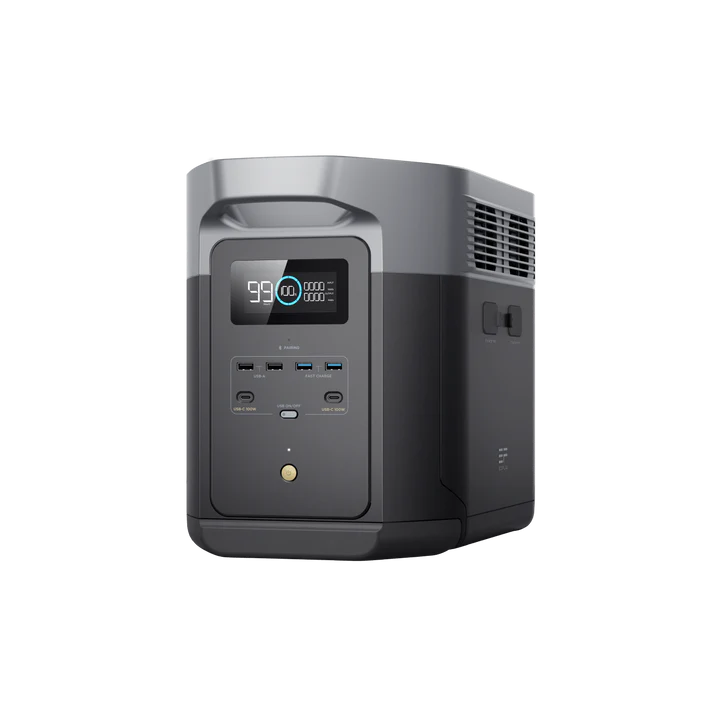
$1,049.00 · direct from EcoFlow
Last checked 2 hours ago. Prices move — check before you buy.

$899.00 · direct from EcoFlow
Last checked 2 hours ago. Prices move — check before you buy.
Spec deltas
This is one of the most lopsided matchups in the lineup, and it's the same brand a generation apart. The EcoFlow DELTA 2 Max lists at $1,599; the newer DELTA 3 Max is $899 — half the price.
And the newer, cheaper unit isn't cutting corners to get there. Capacity (2,048Wh), output (2,400W), surge (4,800W), weight (50.7 lbs), solar input (1,000W), and expandability are all identical. Where they differ, the DELTA 3 Max wins: more cycles (4,000 vs 3,000), a faster 10ms UPS, and quieter fans.
The result is a rout on value. The DELTA 3 Max's cost-to-own is $0.10 per lifetime kWh to the DELTA 2 Max's $0.26 — over 2.5 times cheaper. The only thing that could revive the DELTA 2 Max is a steep discount well below the DELTA 3 Max's price.
What the Numbers Reveal
Each conclusion stated first — the numbers behind it on one line, the full analysis below.
rated cycles
Paying $1,599 for the DELTA 2 Max means paying double for the older platform that the $899 DELTA 3 Max matches on every core spec and beats on cycle life.
the DELTA 3 Max costs $899 vs the DELTA 2 Max's $1,599capacity (2,048Wh), output (2,400W), surge (4,800W), and weight (50.7 lbs) are identicalthe DELTA 3 Max is rated 4,000 cycles vs the DELTA 2 Max's 3,000
Why it mattersAt list prices there is no case for the DELTA 2 Max.
With the same battery capacity but a lower price and more cycles, the DELTA 3 Max delivers energy at $0.10 per kWh against the DELTA 2 Max's $0.26 — over 2.5x cheaper to own.
the DELTA 2 Max costs $0.26 per lifetime kWh vs the DELTA 3 Max's $0.10both hold the same 2,048Whthe DELTA 3 Max is rated for more cycles
Why it mattersThe newer unit isn't just cheaper upfront; it's dramatically cheaper over its whole life.
Beyond price, the DELTA 3 Max is whisper-quiet where the DELTA 2 Max's fans get loud under loadA1B1, and it switches over faster as a UPS.
the DELTA 3 Max is whisper-quiet, essentially silent under moderate loadB1the DELTA 2 Max's fans get loud under heavy loads or chargingA1the DELTA 3 Max switches over in 10ms vs the DELTA 2 Max's under 20ms
Why it mattersThe DELTA 3 Max is the better daily-use machine too, not merely the cheaper one.
The specific dimensions that decide these two units — everything else is a tie.
What the Specs Don't Tell You
Selected because: The half-price-with-matched-specs inversion is the whole story.
rated cycles
The number that ends the debate: the DELTA 3 Max is $899 to the DELTA 2 Max's $1,599 — exactly half. And it's not the cheaper unit giving something up. Capacity, output, surge, weight, and solar input all match to the number.
Where they part, the newer unit leads: 4,000 cycles to 3,000, a faster UPS, and quieter fans. So the older DELTA 2 Max costs twice as much for slightly less. Unless it turns up heavily discounted, the price tag and the spec sheet both point to the DELTA 3 Max.
Lifetime Value
Selected because: The 2.6x cost-to-own gap is decisive.
cost / lifetime kWh
Because both hold the same 2,048Wh, cost-to-own comes down to price and cycles — and the DELTA 3 Max wins both. It lands at $0.10 per lifetime kWh against the DELTA 2 Max's $0.26, more than 2.5 times cheaper for the same stored, cycled energy.
That's about as clear as a value comparison gets: identical battery, a lower price, more cycles. There's no durability or capacity advantage on the DELTA 2 Max's side to offset it, so the newer unit is the better economic choice by a wide margin.
Brand Trust
Selected because: Fan noise and the DELTA 2 Max's genuine durability both deserve mention.
To be fair to the DELTA 2 Max, it's a genuinely solid machine. Reviewers report fast AC charging and no structural degradation after six months of real use, on LFP cells rated for 3,000+ cyclesA2A3. It earned its reputation as a versatile, dependable unitA4.
But its recurring complaint is exactly what the newer generation fixed: fan noise. The DELTA 2 Max's fans get loud under heavy loads or chargingA1, while the DELTA 3 Max is described as whisper-quiet, essentially silent under moderate loadB1, with capacity holding steady across months of testingB3. Same trust, newer and quieter execution.
Growth Path
Selected because: Both expand — worth confirming parity so it isn't mistaken for a DELTA 2 Max edge.
solar input
Both units are expandable, so neither has an edge on room to grow — worth stating plainly, since expandability is sometimes a reason to hold onto an older flagship. It isn't here.
The DELTA 3 Max adds capacity just as the DELTA 2 Max does, on the same 2,048Wh base. So if a larger bank is your goal, the newer, cheaper, quieter unit gets you there for half the entry price.
Strengths & trade-offs
EcoFlow DELTA 2 Max
Strengths
- +Faster solar charging
Trade-offs
- –Shorter-lived battery — rated for 3,000 charge cycles vs the DELTA 3 Max's 4,000, so it wears out sooner.
EcoFlow DELTA 3 Max
Strengths
- +Costs $150 less
- +Rated for 4,000 charge cycles — much longer battery lifespan
Trade-offs
- –No major technical downsides compared to rival.
Will It Power Your Gear?
Scenario math and per-appliance runtimes, modeled from the spec record.
Scenario verdicts
We ran the math on six real-world scenarios. Here's which unit survives your actual life.
SCN-01 · 2 nights · needs 2,100Wh
Weekend Camping
Two nights off-grid with essential comfort
Neither unit
A full weekend of camp loads outruns a single 2kWh charge for both, and since they share capacity and 1,000W solar, they recharge at the same rate too. Nothing separates them in this scenario except price and quieter fans — both of which favor the DELTA 3 Max.
Battery budget usedlower = more headroom
LOAD Phone Charger 15W×6h · LED Lights 40W×8h · Box Fan 75W×14h · CPAP Machine 40W×16h
SCN-02 · 8 hours · needs 1,645Wh
8-Hour Blackout
Keep the essentials running through a night without power
Either unit
Both units carry a fridge-plus-lights-and-devices blackout across eight hours on a single charge — identical 2,048Wh and 2,400W output mean they perform exactly the same here. The DELTA 3 Max's faster 10ms UPS is the only edge, keeping sensitive gear from blinking at the moment the grid drops.
Battery budget usedlower = more headroom
LOAD Fridge 150W×8h · Router + Modem 20W×8h · LED Lights (4 bulbs) 40W×6h · Phone Charger 15W×3h
SCN-03 · 8 hours · needs 320Wh
CPAP Overnight
Sleep therapy without interruption — the #1 medical use case
Either unit
A CPAP is about 40W for eight hours, so both cover the night many times over and the capacity margin is a formality. Both happen to list 30dB — the same published figure twice, not a measured tie — so there is nothing in the noise column to separate them either. Buy whichever is cheaper or easier to carry.
Battery budget usedlower = more headroom
LOAD CPAP Machine 40W×8h
SCN-04 · 8 hours · needs 910Wh
Remote Workday
Full work day off-grid without power anxiety
Either unit
A laptop-monitor-router workday near 910Wh uses well under half of either identical 2,048Wh battery. Runtime is the same; the DELTA 3 Max simply does it quieter and for half the money.
Battery budget usedlower = more headroom
LOAD Laptop 60W×8h · External Monitor 30W×8h · Router + Modem 20W×8h · Phone Charger 15W×2h
SCN-05 · 4 hours · needs 670Wh
Tailgate Party
Game day power for the crew
Either unit
Both handle game day easily. Since capacity isn't the deciding factor, weight is: at 50.7 lbs the DELTA 2 Max is the one you'll be glad you brought. Fan noise under load is worth a listen too — it's audible in the lulls between songs.
Battery budget usedlower = more headroom
LOAD Blender 400W×0.5h · LED TV (55") 80W×4h · Bluetooth Speaker 15W×4h · Phone Charger (×3) 45W×2h
SCN-06 · 24 hours · needs 4,685Wh
Van Life Daily
A full day of mobile living — the ultimate endurance test
Neither unit
Neither unit covers this scenario's 4,685Wh: the DELTA 2 Max comes up 2,944Wh short (about 37% covered), the DELTA 3 Max 2,944Wh (37%). Treat this as partial cover — enough for the essentials in it, not the whole list.
Battery budget usedlower = more headroom
LOAD Mini-Fridge 150W×24h · Laptop 60W×4h · Phone Charger 15W×3h · LED Lights 40W×5h · Fan 75W×8h
The Load Test
RUNTIME = (Wh × 0.85) ÷ LOAD
None of the scenarios above exactly yours? Build it. Toggle what you'd plug in; both units are tested against the combined draw.
Essentials
Comfort & Convenience
High-Draw Appliances
Test duration
8h
Continuous draw
205W
Projected runtime
Dead heat — both run this 205W load for roughly 8.5h. Pick on price, weight, or ports.
Modeled from the spec record — same math as the tables below. Methodology
Runtime by appliance
Real-world runtime estimates for common appliances, modeled at 85% inverter efficiency.¹
Essentials
The basics you need runningscale 0–116.1hComfort & Convenience
Makes off-grid life actually enjoyablescale 0–23.2hHigh-Draw Appliances
These reveal the real limitsscale 0–1.7h¹ Runtime = (capacity × 0.85) ÷ appliance watts. Within each group, all bars share one time scale (the group's longest runtime), so lengths are comparable across appliances; identical runtimes collapse into a single blue/orange bar. Actual runtime varies with battery age, temperature, and simultaneous loads — see methodology.
Conclusion
July 12, 2026
Verdict: the DELTA 3 Max
The EcoFlow DELTA 3 Max is the obvious winner at $899 against the DELTA 2 Max's $1,599 — half the price for identical capacity (2,048Wh), output (2,400W), surge (4,800W), weight (50.7 lbs), and solar (1,000W), while adding more cycles (4,000 vs 3,000), a faster UPS (10ms vs under 20ms), and notably quieter operation. Its cost-to-own is $0.10 per lifetime kWh against the DELTA 2 Max's $0.26 — over 2.5x cheaper. At list prices there is no reason to choose the DELTA 2 Max; consider it only if found deeply discounted below the DELTA 3 Max.
Editor-assigned confidence, based on cited owner research and spec analysis.
List prices as of July 12, 2026. The links below open EcoFlow's current price.
$899.00 · direct from EcoFlow
Last checked 2 hours ago. Prices move — check before you buy.
or check the DELTA 2 Max price$1,049.00 list
Written by Gunner Gustafson, Whole-Home Backup Tester · Station Arena Test Desk · Updated July 12, 2026
Measured Data
Benchmark scores and the full spec record, side by side.
Benchmark scores
Full specifications
ᵈ Derived: price ÷ rated capacity. See the data behind our comparisons →
Comparison ToolAdd more power stations, side by sideOpen Tool →How these numbers are produced
Numeric verification
Every figure on this page traces to our spec database or arithmetic on it — no estimated numbers.
Owner claims
Statements about owner experience are cited to published reviews — see Sources & Research Notes below.
Runtime model
Runtime = (rated capacity × 0.85 inverter efficiency) ÷ device wattage. Solar recharge estimates assume panels deliver 70% of rated output. Cold weather, battery age, and stacked loads reduce real-world results.
Power Score
Computed from 14 published spec dimensions, weighted per use-case bench. Higher is better; a unit must meet a bench's minimum threshold to be rated.
See the full weight table and data sourcing on our methodology page →Class ranking (the star rating)
Each unit's star score is a category ranking, not customer reviews — no buyer opinions feed it. We score every station on size-independent quality (value, output, portability, endurance, ports, warranty, and more), then percentile-rank it against the other units in its capacity class, so a class-leading compact unit and a class-leading whole-home unit can both earn 5★. Here, DELTA 2 Max rates 3.8/5 (28th percentile of 26 Large-class units), and DELTA 3 Max rates 4.2/5 (52nd percentile of 26 Large-class units).
How the class ranking is computed →Test Notes & Caveats
Hidden gotchas and advantages we spotted that you won't find on the product page.
UPS Switchover: ≤10ms vs ≤20ms
The DELTA 3 Max switches over in about 10ms as a line-interactive UPS; the DELTA 2 Max is slower at sub-20ms standby. Both hold most electronics through an outage, but the newer unit's faster handoff is the safer bet for a desktop or gear that's fussy about even a brief blink.
Warranty: No Difference
Both units carry the same 5-year warranty, so coverage isn't a tiebreaker here.
Battery Lifespan in Real Years
The DELTA 3 Max is rated for 4,000 cycles to the DELTA 2 Max's 3,000 — more usable life from the same 2,048Wh battery. Paired with its lower price, that's what drives its cost-to-own to well under half the older unit's.
Full record above — the Test Desk pick is the DELTA 3 Max.
Check DELTA 3 Max price →or check the DELTA 2 Max priceOwnership Analysis
What happens after you buy — true cost of ownership, brand trust, and growth potential.
Lifetime value
Service lifeyears at one full cycle per day
Lifetime energy delivered
Cost per delivered kWh
│ warranty ends · Reaching the cycle rating means ~80% capacity remains — degraded, not dead.
Analyst note
The DELTA 3 Max wins on both sticker price and long-term value. At $0.11/kWh over its lifetime, it's meaningfully cheaper to own. Clear value winner.
Growth path
DELTA 2 Max
EXPANDABLESupports EcoFlow expansion batteries, so you can add capacity later without replacing the base unit — useful if your needs may climb past 2,048Wh.
Accepts up to 1,000W of solar. Enough for a serious multi-panel array.
Generous port selection supports complex multi-device setups.
Expansion batteries are EcoFlow-specific. You're investing in the EcoFlow ecosystem.
DELTA 3 Max
EXPANDABLESupports EcoFlow expansion batteries, so you can add capacity later without replacing the base unit — useful if your needs may climb past 2,048Wh.
Accepts up to 500W of solar. Suitable for a 1-2 panel setup.
Generous port selection supports complex multi-device setups.
Expansion batteries are EcoFlow-specific. You're investing in the EcoFlow ecosystem.
Realistic full solar rechargeat 70% of rated panel output — see methodology
Analyst note
Both expand, but the DELTA 2 Max's higher solar ceiling (1,000W vs 500W) gives it the stronger off-grid growth path — more panels can feed a bigger bank as it grows.
What Owners Report
Patterns from published owner reports and long-term reviews — every claim cited to its source below.
EcoFlow DELTA 2 Max
The DELTA 2 Max is a solid, versatile LFP unit. Reviewers cite fast AC charging — 0 to 80% in about 50 minutes — and no structural degradation after six months of use, on cells rated for 3,000+ cyclesA2A3.
Its recurring weakness is noise: the fans get loud under heavy loads or chargingA1. Reviewers still call it worth buying, but with caveatsA4 — caveats the newer DELTA 3 Max largely resolves at half the price.
“Fast AC wall charging — 0 to 80% in about 50 minutes and a full charge in roughly 80 minutes.”
Sources
powerstationadvisor.com · pcworld.com · thesolarlab.com · protoolsadvisor.com · trailandkale.com
EcoFlow DELTA 3 Max
The DELTA 3 Max tests well and quietly. Reviewers describe it as whisper-quiet, essentially silent under moderate loadB1, and highlight EcoFlow's app as one of the main reasons people pick itB2.
Durability checks out too — capacity stayed consistent between one-month and three-month testingB3 — and it earns strong overall marks across nearly every measureB4. A quiet, dependable, well-rounded 2kWh unit at half the DELTA 2 Max's price.
“Whisper-quiet under moderate load — essentially silent at conversational distance; the app adds a low-power quiet mode and a custom charge-speed limit if fan noise bothers you. Fans rise under heavy load but stay quieter than most competitors in the 2kWh class.”
Sources
backuppowerhub.com · thesolarlab.com · androidguys.com
Sources & Research Notes
Every owner claim in this report is traceable to a published source. The bracketed references above resolve here.
Recurring owner themes
- Solid LFP durability, fast charging, and ecosystem/expandability are the praise; loud fans under heavy load or charging are the recurring complaint. [DELTA 2 Max · 3 entries]
- Reviewers consistently praise practical quietness (with app-based quiet/charge-limit modes) and the EcoFlow app/ecosystem as differentiators. [DELTA 3 Max · 2 entries]
- A1
“Fan noise is a significant issue — cooling fans can get loud, around 52 dB during heavy loads or charging; a Quiet Charging mode reduces noise but extends charge time, and giving it 6 inches of clearance helps airflow.”
powerstationadvisor.com / pcworld.com — DELTA 2 Max review · 2025-2026 · [negative]
- A2
“Fast AC wall charging — 0 to 80% in about 50 minutes and a full charge in roughly 80 minutes.”
thesolarlab.com / protoolsadvisor.com — DELTA 2 Max review · 2025-2026 · [positive]
- A3
“LiFePO4 chemistry rated for 3,000+ cycles to 80% with superior thermal stability; after 6 months of real use there was no structural degradation and it felt as solid as day one.”
powerstationadvisor.com / trailandkale.com — DELTA 2 Max review · 2025-2026 · [positive]
- A4
“Reviewers say it's still worth buying but with caveats — a versatile unit with expandability and ecosystem compatibility.”
thesolarlab.com / powerstationadvisor.com — DELTA 2 Max review · 2025-2026 · [mixed]
- B1
“Whisper-quiet under moderate load — essentially silent at conversational distance; the app adds a low-power quiet mode and a custom charge-speed limit if fan noise bothers you. Fans rise under heavy load but stay quieter than most competitors in the 2kWh class.”
backuppowerhub.com — EcoFlow DELTA 3 Max Review; thesolarlab.com — DELTA 3 Max Review · 2026 · [positive]
- B2
“The EcoFlow app is one of the main reasons people migrate to the ecosystem: deep control including a custom charge-speed limit and quiet mode, well beyond the on-device interface.”
androidguys.com / thesolarlab.com — EcoFlow DELTA 3 Max line · 2026 · [positive]
- B3
“Capacity stayed consistent between 1-month and 3-month tests (within measurement error). The unit survived truck-bed transport, storage in a ~105°F garage, and operation near freezing (~34°F) without issue.”
backuppowerhub.com — EcoFlow DELTA 3 Max Review (hands-on) · 2026 · [positive]
- B4
“Rated 8.5/10 overall — strong across nearly every metric in the 2kWh class, with fast recharge and LFP longevity called one of the best value propositions in the segment.”
backuppowerhub.com — EcoFlow DELTA 3 Max Review · 2026 · [positive]
Research compiled July 12, 2026.
Who Should Buy Which
Buy the DELTA 2 Max if you…
Buy the DELTA 3 Max if you…
If neither fits
Both are expandable 2kWh units. For whole-home or multi-day off-grid power, expand the DELTA 3 Max or step up to a larger stacked system rather than either as a standalone — but between these two, the DELTA 3 Max is the only sensible starting point at list.
The Bottom Line
The EcoFlow DELTA 3 Max is the easy call: half the DELTA 2 Max's price for the same 2,048Wh, output, and surge, plus more cycles, a faster UPS, and quieter fans — at over 2.5x lower cost-to-own. For essentially every buyer, it's the right choice.
The older DELTA 2 Max is a genuinely durable, versatile unitA3, but at its $1,599 list it makes no sense against the $899 DELTA 3 Max. Consider it only if you find it heavily discounted below the newer model — otherwise the DELTA 3 Max wins on price, longevity, and quiet.
Frequently Asked Questions
Answers drawn from the spec record and cited owner research.
EcoFlow DELTA 2 Max vs DELTA 3 Max — which should I buy?
The DELTA 3 Max, decisively. At $899 it's half the DELTA 2 Max's $1,599 price, with identical capacity (2,048Wh), output (2,400W), and surge (4,800W), plus more cycles (4,000 vs 3,000), a faster 10ms UPS, and quieter fans. The only reason to consider the DELTA 2 Max is if it's deeply discounted below the DELTA 3 Max.
Why is the DELTA 2 Max so much more expensive?
It's the older generation at a high list price. At $1,599 it costs double the newer DELTA 3 Max, which matches its capacity, output, and surge for $899 — and beats it on cycles and UPS speed. In practice the DELTA 2 Max often sells for less on the street, but at listed prices the DELTA 3 Max dominates.
Which is cheaper to own?
The DELTA 3 Max, by more than 2.5x — $0.10 per lifetime kWh versus the DELTA 2 Max's $0.26. Both use the same 2,048Wh battery, so the newer unit's lower price and higher cycle rating make it far cheaper over its life, not just upfront.
Which is quieter?
The DELTA 3 Max. It's described as whisper-quiet, essentially silent under moderate load, while the DELTA 2 Max's recurring complaint is fan noise that gets loud under heavy loads or charging. The newer generation directly addressed the older unit's biggest gripe.
Where to buy
EcoFlow DELTA 2 Max
$1,049.00
$1,049.00 · direct from EcoFlow
Last checked 2 hours ago. Prices move — check before you buy.
EcoFlow DELTA 3 MaxPick
$899.00
$899.00 · direct from EcoFlow
Last checked 2 hours ago. Prices move — check before you buy.
Prices may vary by retailer and are subject to change.