Head-to-head test
EcoFlow DELTA 2 vs EcoFlow DELTA 2 Max
Same 3,000-cycle battery, same 5-year warranty, same expansion port — the Max exactly doubles the DELTA 2's capacity (1,024Wh to 2,048Wh) and very nearly doubles its weight and its price too. The warranty is the one number that doesn't move, which means the extra $550 has to earn its keep entirely in watt-hours, and it does the moment your heaviest single day needs more than the DELTA 2 can actually deliver.
Full profiles: EcoFlow DELTA 2 → · EcoFlow DELTA 2 Max →

Written by Ian SchneiderUpdated
Solar & Off-Grid Tester, Station Arena Test Desk
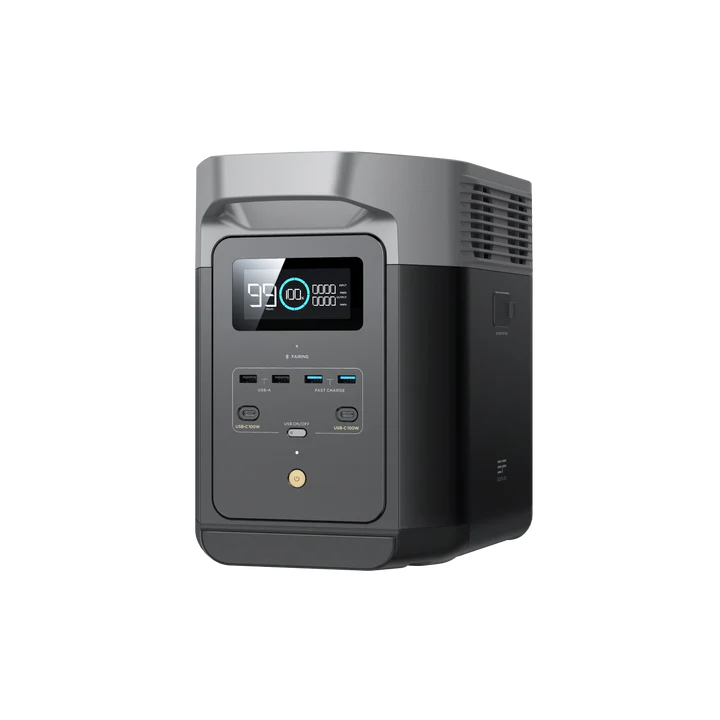
$499.00 · direct from EcoFlow
Last checked 58 days ago. Prices move — check before you buy.
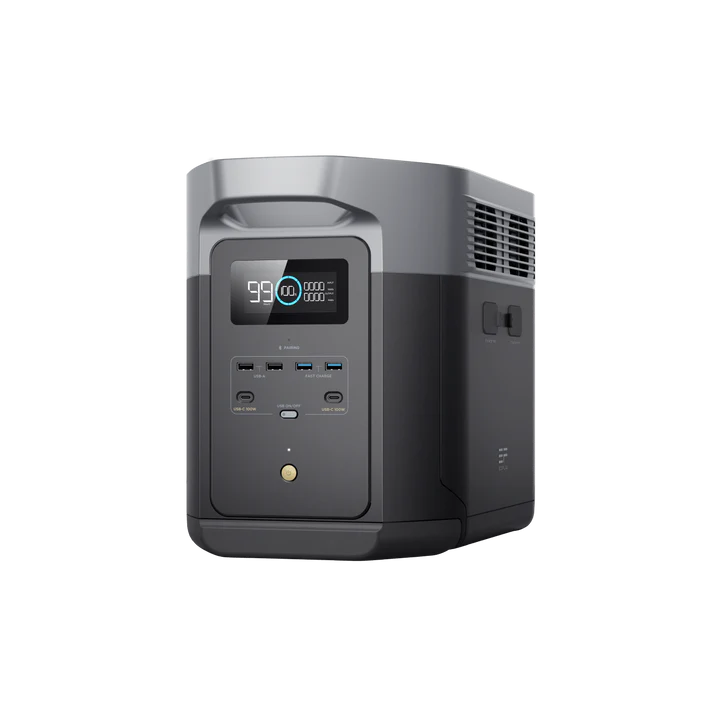
$1,049.00 · direct from EcoFlow
Last checked 1 day ago. Prices move — check before you buy.
Spec deltas
The DELTA 2 Max isn't a new design, it's the DELTA 2 with 1,024Wh more capacity bolted on, and a price tag that's nearly 2x as high to match ($1,049 against $499). Same 3,000-cycle LiFePO4 chemistry underneath, same 5-year warranty on top. The only real question this page answers is whether that extra battery is worth nearly double the money for your specific week, not anyone's average one.
Run six real household scenarios against both and the Max wins four outright, not narrowly. The base DELTA 2 doesn't lose these on preference. It comes up short finishing a full remote workday, needing 105% of its usable capacity for a 910Wh day, and further short on an 8-hour blackout at 189%. It runs out. The Max doesn't.
But winning four of six isn't the same as being worth it for everyone. Two of the six scenarios overpower both units regardless of price, and of the other four, two are so lightly loaded that the win is academic. The real question isn't which unit is better in the abstract. It's whether your heaviest actual day looks more like a CPAP overnight or a full workday, and this page is built to answer exactly that.
What the Numbers Reveal
Each conclusion stated first — the numbers behind it on one line, the full analysis below.
Capacity
At $499 the DELTA 2 buys a unit that goes dark before the last call of the day. The $1,049 Max isn't paying for indulgent headroom here: 831Wh of its usable capacity is still unused at day's end, but the other 910Wh is the difference between finishing work and not.
DELTA 2: 1,024Wh capacity, about 870Wh usable after typical inverter lossesRemote Workday scenario needs 910Wh over the dayDELTA 2 Max: 2,048Wh capacity, about 1,741Wh usable, 831Wh clear of that same 910Wh day
Why it mattersIf the Max is running your workday rather than your campsite, the price gap stops being the deciding factor. Only one of these two units actually finishes the day.
Typical price
Those two 'cheaper to own' answers aren't a contradiction. They're pricing different bets. The lifetime-kWh number only pays off if the battery actually sees years of regular, heavy cycling. The warranty-year number is the honest price of betting that it won't.
DELTA 2: $499, 3,000 cycles at 1,024Wh capacity works out to 3,072 lifetime kWh delivered, $0.16 per lifetime kWhDELTA 2 Max: $1,049, 3,000 cycles at 2,048Wh capacity works out to 6,144 lifetime kWh delivered, $0.15 per lifetime kWhBoth carry an identical 5-year warranty: $100 a year of coverage on the DELTA 2 versus $190 a year on the Max
Why it mattersA buyer who'll cycle this thing for a decade should read the kWh number and buy the Max. A buyer who uses it a dozen nights a year should read the warranty number and buy the cheaper unit. The extra capacity was never going to get exercised enough to earn back the $550.
continuous output
A fridge or window AC that looks compatible on continuous wattage alone can still refuse to start on the DELTA 2, because the brief startup spike can run 2-3x the running draw, a test the Max's 2.0x ratio is built to pass and the DELTA 2's 1.5x ratio sits right at the edge of.
DELTA 2: 1,800W continuous, 2,700W surge, a 1.5x surge-to-continuous ratioDELTA 2 Max: 2,400W continuous, 4,800W surge, a 2.0x surge-to-continuous ratioFridge and AC compressors commonly surge 2-3x their rated draw at startup
Why it mattersAnyone planning to start a compressor-based appliance off either unit should check the surge ratio, not the continuous wattage on the spec sheet. That check favors the Max.
The specific dimensions that decide these two units — everything else is a tie.
Lifetime Value
Selected because: Central to the page's core question: which unit is actually cheaper to own, and by which cost metric.
cost / lifetime kWh
Run the numbers over each unit's full life and the Max is technically the cheaper one to own: $0.15 per lifetime kWh against the DELTA 2's $0.16, because both are rated for the same 3,000 cycles and the Max just holds twice the energy per cycle (6,144 lifetime kWh delivered against 3,072). The extra $550 up front is spread across twice the total energy, which is why the bigger unit edges out the smaller one on a pure cost-per-kWh basis despite costing nearly double.
That number assumes you'll actually put those cycles on the battery. Judge the same two units by cost per warranty year instead: both back an identical 5-year warranty, but the DELTA 2 costs roughly half as much per year of that same promise ($100 versus $190). If your actual usage is light, a handful of trips a year rather than a daily cycle, you'll retire the unit long before the lifetime-kWh math ever kicks in, and the warranty-year number is the one that matters.
Your Life, Your Pick
Selected because: Six real loads separate the cases where the extra capacity is wasted from the ones where it's required.
Only one scenario here is genuinely a wash. CPAP Overnight needs just 320Wh, and the DELTA 2 finishes the night having used 37% of its capacity; the Max's 18% is a better number on paper, but neither reading changes what you should do, which is buy on price. Tailgate Party is a half-step up: both units finish a 670Wh day, but the DELTA 2 is using 77% of what it has to do it, against the Max's 38%. Still a pass for the smaller unit, just a tighter one.
Past that, the margin stops being cosmetic. An 8-hour blackout needs 1,645Wh: the DELTA 2 needs 189% of its usable capacity to cover it, which means it doesn't, while the Max finishes at 94%, tight but real. A full remote workday (910Wh) is the same story in miniature. The DELTA 2 comes up about 40Wh short and never finishes the day, while the Max still has 831Wh unused at quitting time. And at the top end, a full weekend of camping (2,100Wh) or a day of van life (4,685Wh), even the Max's extra capacity runs out, needing 121% and 269% of its usable capacity respectively. Past a certain daily draw, the answer to 'which one' stops being either of these.
What the Specs Don't Tell You
Selected because: Only three fire for this pair; each is substantive enough to carry real weight on its own.
Three things separate these units beyond size, and only one favors the DELTA 2. Its spec'd noise level (50dB) is the one high enough to flag on this page; the Max's spec'd 30dB looks like a clean win by comparison. Published dB numbers are typically measured at idle or light load rather than under the draw of fast charging or a running fridge, so treat the spec gap as a starting point, not the whole story. The field-experience section below fills in what the number alone won't.
The other two both favor the Max, by a real margin. Its inverter carries a 2.0x surge-to-continuous ratio against the DELTA 2's 1.5x, which matters the moment you plug in a fridge or a window AC. Those compressors spike 2-3x their rated draw on startup, and the DELTA 2's thinner surge margin is the more likely one to trip. And though both units carry an identical 5-year warranty, the DELTA 2 delivers it for about half the cost per year ($100 versus $190), the one place in this whole comparison where paying less buys you something better, not just something smaller.
Growth Path
Selected because: Same expansion port on both, but the solar ceiling is the real long-term differentiator.
solar input
Both units expand the same way: add EcoFlow's expansion batteries and grow past the base capacity without replacing the unit itself. Where they diverge is how fast you can refill whatever you've built. The Max accepts up to 1,000W of solar, the DELTA 2 up to 500W, exactly half. If the plan is ever to lean on this system off-grid rather than off a wall outlet, the solar ceiling, not the expansion port both units already have, is the number that decides how sustainable that plan is.
Strengths & trade-offs
EcoFlow DELTA 2
Strengths
- +Costs $550 less
- +Lighter by 23.7 lb
Trade-offs
- –Weaker inverter (-600W) limits appliance compatibility.
EcoFlow DELTA 2 Max
Strengths
- +Larger battery capacity
- +Higher AC output
- +Faster solar charging
Trade-offs
- –Substantially more expensive (+$550) than the DELTA 2.
- –Significantly heavier (+23.7 lbs), making it harder to move.
Will It Power Your Gear?
Scenario math and per-appliance runtimes, modeled from the spec record.
Scenario verdicts
We ran the math on six real-world scenarios. Here's which unit survives your actual life.
SCN-01 · 2 nights · needs 2,100Wh
Weekend Camping
Two nights off-grid with essential comfort
Neither unit
Both fall short here, but not by the same margin. The Max needs 121% of its own usable capacity for a full camping weekend; the DELTA 2 needs 241%. Neither number is a rounding error, but the gap between them shows which one is closer to being enough.
Battery budget usedlower = more headroom
LOAD Phone Charger 15W×6h · LED Lights 40W×8h · Box Fan 75W×14h · CPAP Machine 40W×16h
SCN-02 · 8 hours · needs 1,645Wh
8-Hour Blackout
Keep the essentials running through a night without power
DELTA 2 Max
The Max finishes this one at 94% of its usable capacity, tight, but it finishes. The DELTA 2 needs 189%, which means it runs dry with hours of the outage still to go. An outage doesn't pause so you can recharge; this is the scenario where the extra capacity is not optional.
Battery budget usedlower = more headroom
LOAD Fridge 150W×8h · Router + Modem 20W×8h · LED Lights (4 bulbs) 40W×6h · Phone Charger 15W×3h
SCN-03 · 8 hours · needs 320Wh
CPAP Overnight
Sleep therapy without interruption — the #1 medical use case
DELTA 2 Max
Both units are dramatically overqualified for a CPAP load. The DELTA 2 finishes the night having used 37% of its capacity, the Max just 18%. Neither number should be the deciding factor here. Buy on price for this use case, not on remaining battery.
Battery budget usedlower = more headroom
LOAD CPAP Machine 40W×8h
SCN-04 · 8 hours · needs 910Wh
Remote Workday
Full work day off-grid without power anxiety
DELTA 2 Max
The DELTA 2 comes up short on a full workday, needing 105% of its usable capacity to get through it. It doesn't finish. The Max needs 52%, comfortably inside its limit. For daily desk use, this is the scenario that actually separates these two units, not a marginal edge.
Battery budget usedlower = more headroom
LOAD Laptop 60W×8h · External Monitor 30W×8h · Router + Modem 20W×8h · Phone Charger 15W×2h
SCN-05 · 4 hours · needs 670Wh
Tailgate Party
Game day power for the crew
DELTA 2 Max
Both finish game day, but the DELTA 2 is working harder to do it: 77% of its usable capacity against the Max's 38%. Neither unit is stressed by a tailgate's actual load, so weight is the more useful tiebreaker here. The DELTA 2 is 23.7 lbs lighter, which matters more in a parking lot than the unused capacity does.
Battery budget usedlower = more headroom
LOAD Blender 400W×0.5h · LED TV (55") 80W×4h · Bluetooth Speaker 15W×4h · Phone Charger (×3) 45W×2h
SCN-06 · 24 hours · needs 4,685Wh
Van Life Daily
A full day of mobile living — the ultimate endurance test
Neither unit
Full-time van life is where both units run out of road. The DELTA 2 needs 538% of its usable capacity for a single day's draw, the Max needs 269%. Both are well past what a portable station in this class can sustain daily. This is a fixed-solar-and-house-battery problem, not a which-EcoFlow problem.
Battery budget usedlower = more headroom
LOAD Mini-Fridge 150W×24h · Laptop 60W×4h · Phone Charger 15W×3h · LED Lights 40W×5h · Fan 75W×8h
The Load Test
RUNTIME = (Wh × 0.85) ÷ LOAD
None of the scenarios above exactly yours? Build it. Toggle what you'd plug in; both units are tested against the combined draw.
Essentials
Comfort & Convenience
High-Draw Appliances
Test duration
8h
Continuous draw
205W
Projected runtime
For this load: DELTA 2 Max runs 8.5h vs 4.2h.
$1,049 list · direct from EcoFlow
Modeled from the spec record — same math as the tables below. Methodology
Runtime by appliance
Real-world runtime estimates for common appliances, modeled at 85% inverter efficiency.¹
Essentials
The basics you need runningscale 0–116.1hComfort & Convenience
Makes off-grid life actually enjoyablescale 0–23.2hHigh-Draw Appliances
These reveal the real limitsscale 0–1.7h¹ Runtime = (capacity × 0.85) ÷ appliance watts. Within each group, all bars share one time scale (the group's longest runtime), so lengths are comparable across appliances; identical runtimes collapse into a single blue/orange bar. Actual runtime varies with battery age, temperature, and simultaneous loads — see methodology.
Conclusion
July 28, 2026
Verdict: the DELTA 2 Max, on Power Score margin
Take the DELTA 2 Max if your typical draw is a full remote workday or a multi-day outage. The base DELTA 2 can't finish either one: it needs 105% of its usable capacity for a 910Wh workday and 189% for a 1,645Wh, 8-hour blackout, while the Max clears both with real capacity left over. The Max is also the cheaper unit per lifetime kWh delivered: $0.15 against the DELTA 2's $0.16, the result of holding exactly twice the capacity across the same 3,000-cycle life. The counter-argument is real: per year of warranty coverage, the DELTA 2 is unambiguously the better deal ($100 versus $190 for the identical 5-year term), and for genuinely light loads like a CPAP night or a tailgate, that's what should decide it.
Editor-assigned confidence, based on cited owner research and spec analysis.
List prices as of July 28, 2026. The links below open EcoFlow's current price.
$1,049.00 · direct from EcoFlow
Last checked 1 day ago. Prices move — check before you buy.
or check the DELTA 2 price$499.00 list
Written by Ian Schneider, Solar & Off-Grid Tester · Station Arena Test Desk · Updated July 28, 2026
Measured Data
Benchmark scores and the full spec record, side by side.
Benchmark scores
Not rated for both units (minimum threshold unmet): Camping.
Full specifications
ᵈ Derived: price ÷ rated capacity. See the data behind our comparisons →
Comparison ToolAdd more power stations, side by sideOpen Tool →How these numbers are produced
Numeric verification
Every figure on this page traces to our spec database or arithmetic on it — no estimated numbers.
Owner claims
Statements about owner experience are cited to published reviews — see Sources & Research Notes below.
Runtime model
Runtime = (rated capacity × 0.85 inverter efficiency) ÷ device wattage. Solar recharge estimates assume panels deliver 70% of rated output. Cold weather, battery age, and stacked loads reduce real-world results.
Power Score
Computed from 14 published spec dimensions, weighted per use-case bench. Higher is better; a unit must meet a bench's minimum threshold to be rated.
See the full weight table and data sourcing on our methodology page →Class ranking (the star rating)
Each unit's star score is a category ranking, not customer reviews — no buyer opinions feed it. We score every station on size-independent quality (value, output, portability, endurance, ports, warranty, and more), then percentile-rank it against the other units in its capacity class, so a class-leading compact unit and a class-leading whole-home unit can both earn 5★. Here, DELTA 2 rates 4.1/5 (46th percentile of 27 Everyday-class units), and DELTA 2 Max rates 3.8/5 (28th percentile of 26 Large-class units).
How the class ranking is computed →Test Notes & Caveats
Hidden gotchas and advantages we spotted that you won't find on the product page.
Noise Spec Gap: 50dB vs 30dB Isn't the Full Story
The DELTA 2 is spec'd at 50dB; the Max at 30dB. That gap looks decisive on a spec sheet, but manufacturer dB ratings are typically measured at idle or light load, not during fast charging or a heavy inverter draw, which is when the fans on either unit actually spin up. Read the spec digits as a floor, not a promise of a quiet room under real load.
Surge Ratio: 2.0x vs 1.5x, and It's Not Just a Number
The Max's inverter handles a 2.0x surge-to-continuous ratio (4,800W surge over 2,400W continuous); the DELTA 2 manages 1.5x (2,700W over 1,800W). Fridge and AC compressors commonly spike 2-3x their running draw at startup, so the Max's ratio clears that bar with room, while the DELTA 2's sits right at the edge of it. Continuous wattage alone won't tell you which unit actually starts your fridge.
Same 5-Year Warranty, Half the Price Per Year
Both units carry an identical 5-year warranty. Priced against that term, the DELTA 2 costs about $100 a year of coverage; the Max costs about $190. Same promise, nearly double the cost of getting it: the one comparison on this page where the cheaper unit is also the better deal outright.
Full record above — the Test Desk pick is the DELTA 2 Max.
Check DELTA 2 Max price →or check the DELTA 2 priceOwnership Analysis
What happens after you buy — true cost of ownership, brand trust, and growth potential.
Lifetime value
Service lifeyears at one full cycle per day
Lifetime energy delivered
Cost per delivered kWh
│ warranty ends · Reaching the cycle rating means ~80% capacity remains — degraded, not dead.
Analyst note
Both units have similar long-term ownership costs ($0.16/kWh vs $0.17/kWh). The price difference is what you see on the sticker — neither is a hidden bargain or rip-off. One thing to know reading the table: both carry the same 3,000-cycle rating, so the lifetime rows are sticker price and capacity in disguise — the wear horizon is identical and decides nothing here.
Growth path
DELTA 2
EXPANDABLESupports EcoFlow expansion batteries, so you can add capacity later without replacing the base unit — useful if your needs may climb past 1,024Wh.
Accepts up to 500W of solar. Suitable for a 1-2 panel setup.
Generous port selection supports complex multi-device setups.
Expansion batteries are EcoFlow-specific. You're investing in the EcoFlow ecosystem.
DELTA 2 Max
EXPANDABLESupports EcoFlow expansion batteries, so you can add capacity later without replacing the base unit — useful if your needs may climb past 2,048Wh.
Accepts up to 1,000W of solar. Enough for a serious multi-panel array.
Generous port selection supports complex multi-device setups.
Expansion batteries are EcoFlow-specific. You're investing in the EcoFlow ecosystem.
Realistic full solar rechargeat 70% of rated panel output — see methodology
Analyst note
Both expand, but the DELTA 2 Max's higher solar ceiling (1,000W vs 500W) gives it the stronger off-grid growth path — more panels can feed a bigger bank as it grows.
What Owners Report
Patterns from published owner reports and long-term reviews — every claim cited to its source below.
EcoFlow DELTA 2
Reviewers consistently flag one thing about the DELTA 2: fan noise. Multiple independent write-ups report the fans engage well before max output and run continuously under sustained draw, whether that's fast AC charging or a heavier continuous load, loud enough that running medical equipment in the same room means either living with the noise or routing a cable elsewhereA1A2. EcoFlow has reportedly said a firmware fix for the fan behavior is planned, though as of these reviews it hadn't shippedA4.
Outside of that, the field record is strong. Reviewers who ran the unit through outages, camping trips, and day-to-day home-office use over an extended stretch single out fast charging, dependable LiFePO4 chemistry, and the expansion option as what holds upA3.
“When charging at 1200W the fans sound like a gaming laptop, though you can lower the charging speed in the app to silence it.”
Sources
portablepowerlab.com
EcoFlow DELTA 2 Max
The Max draws the same core complaint as its smaller sibling: loud cooling fans under heavy load or fast charging, pronounced enough that EcoFlow builds in a Quiet Charging mode specifically to tame it, at the cost of a longer charge timeB1. Worth weighing against its quieter 30dB spec rating: that number describes idle behavior, not the load these reviews are actually describing.
The praise is just as consistent. Reviewers single out fast AC charging and describe extended real-world use turning up no structural degradation, the unit still feeling as solid as day oneB2B3. The overall take is a qualified thumbs-up: a versatile, expandable unit worth buying, fan noise asideB4.
“Fast AC wall charging — 0 to 80% in about 50 minutes and a full charge in roughly 80 minutes.”
Sources
powerstationadvisor.com · pcworld.com · thesolarlab.com · protoolsadvisor.com · trailandkale.com
Sources & Research Notes
Every owner claim in this report is traceable to a published source. The bracketed references above resolve here.
Recurring owner themes
- Fan noise under moderate-to-high load is the dominant, repeatedly-cited complaint; the fan spins up above ~120W. [DELTA 2 · 3 entries]
- Solid LFP durability, fast charging, and ecosystem/expandability are the praise; loud fans under heavy load or charging are the recurring complaint. [DELTA 2 Max · 3 entries]
- A1
“Fans trigger at anything above 120 watts; at maximum load (1,500–1,800W) they run continuously at ~48–55 dB. Powering medical equipment above 120W in a bedroom means listening to the fans or running an extension cable out of the room.”
portablepowerlab.com — EcoFlow Delta 2 Review: 6 Months of Real Use; PCWorld — EcoFlow Delta 2 review · 2026 · [negative]
- A2
“When charging at 1200W the fans sound like a gaming laptop, though you can lower the charging speed in the app to silence it.”
PCWorld — EcoFlow Delta 2 power station review · 2026 · [mixed]
- A3
“After 18 months of real-world testing through multiple power outages, camping trips, and daily home-office use, the unit earned recognition for fast charging, reliable LiFePO4 battery chemistry, and expandability.”
portablepowerlab.com — EcoFlow Delta 2 Review: 6 Months of Real Use · 2026 · [positive]
- A4
“EcoFlow officials indicated they plan to address the fan noise in an upcoming firmware update, as they have for other models after release.”
portablepowerlab.com — EcoFlow Delta 2 Review · 2026 (dated claim — may be partially addressed) · [mixed]
- B1
“Fan noise is a significant issue — cooling fans can get loud, around 52 dB during heavy loads or charging; a Quiet Charging mode reduces noise but extends charge time, and giving it 6 inches of clearance helps airflow.”
powerstationadvisor.com / pcworld.com — DELTA 2 Max review · 2025-2026 · [negative]
- B2
“Fast AC wall charging — 0 to 80% in about 50 minutes and a full charge in roughly 80 minutes.”
thesolarlab.com / protoolsadvisor.com — DELTA 2 Max review · 2025-2026 · [positive]
- B3
“LiFePO4 chemistry rated for 3,000+ cycles to 80% with superior thermal stability; after 6 months of real use there was no structural degradation and it felt as solid as day one.”
powerstationadvisor.com / trailandkale.com — DELTA 2 Max review · 2025-2026 · [positive]
- B4
“Reviewers say it's still worth buying but with caveats — a versatile unit with expandability and ecosystem compatibility.”
thesolarlab.com / powerstationadvisor.com — DELTA 2 Max review · 2025-2026 · [mixed]
Research compiled July 28, 2026.
What Owners Actually Report
Drawn from 210 comments on independent review channels — not from retailer reviews, which skew to the first week of ownership. Each line is our summary of one commenter's claim, linked to the original. We record what they said, including where it contradicts the spec sheet.
EcoFlow DELTA 2
224 claims from 155 comments · 178 from owners · 60 with figures
- Runtime
- 32 · 13% negative
- Price & value
- 38 · 4% negative
- Charging
- 17 · 23% negative
- Durability
- 22 · 67% negative
- Warranty & support
- 22 · 59% negative
What owners complain about
Ignores solar unless he unplugs it from the wall, so he switched to the AC180.
Solar inputowner63 agreedsource →
His Delta 2 went bad three months after purchase and EcoFlow agreed it was defective.
Durabilityownerafter 3 months236 agreedsource →
Past 30 days the five-year warranty only gets a refurbished unit covered for 30 days.
Warranty & supportowner236 agreedsource →
What owners praise
DELTA 2 plus extra battery and 600W solar cost ~$1200 and paid for itself in under 2 years in California.
Price & valuemeasuredowner736 agreedsource →
Batteries still hold 98%+ capacity, ahead of the 80%-at-10-years warranty curve.
Durabilitymeasuredowner736 agreedsource →
Gets 180-190W into it from a 100Ah LiFePO4 via XT60i cable, no converter needed.
Chargingmeasuredowner106 agreedsource →
EcoFlow DELTA 2 Max
74 claims from 55 comments · 60 from owners · 20 with figures
- Runtime
- 13 · 0% negative
- Solar input
- 10 · 20% negative
- Price & value
- 11 · 45% negative
- Expandability
- 8 · 15% negative
- Noise
- 5 · 58% negative
What owners complain about
Its own MPPT is limited to a mere 60 VOC from solar panels.
Solar inputmeasuredowner19 agreedsource →
Delta 2 Max is promised at 30 dB but measured 42 dB in his hands.
Noisemeasuredowner5 agreedsource →
Got a 5kWh rival for less than he paid for a DELTA 2 Max with extra battery.
Price & valueowner17 agreedsource →
What owners praise
Feeding his lead-acid UPS from it stretches desktop runtime from 8 minutes to 4 hours.
Runtimemeasuredowner8 agreedsource →
Bought the Delta 2 Max for $899 on Black Friday; the Delta 2 was $399.
Price & valuemeasuredowner21 agreedsource →
Takes 500-1000W from a DIY 48V bank over XT60i, far cheaper than the official spare battery.
Expandabilitymeasuredowner19 agreedsource →
Claims are weighted by how specific they are, whether the commenter owns the unit, and how many readers agreed. Comments that mention a product under a rival's review count for more, because the commenter had no reason to be there. This is what buyers report, not our test results — for measurements we ran ourselves, see the methodology.
Who Should Buy Which
Buy the DELTA 2 if you…
- →Buy the DELTA 2 if your loads are on the lighter side of this test: a CPAP overnight (it finishes using 37% of its capacity) or a tailgate (77%, tighter, but still a clean pass). Paying nearly 2x for the Max's extra headroom on those nights doesn't buy you anything you'll use.
- →It's also the better buy per warranty dollar. Both carry an identical 5-year warranty, but the DELTA 2 costs roughly half as much per year of that same coverage ($100 versus $190). If you care what the warranty actually costs relative to the unit, that math favors the smaller battery outright.
Buy the DELTA 2 Max if you…
- →Buy the Max if you're using this for anything that runs a full day: remote work, an extended outage, a home base you actually depend on. The DELTA 2 can't finish a full remote workday, needing 105% of its usable capacity for a 910Wh day, or an 8-hour blackout at 189%. The Max clears both, using just 52% and 94% respectively.
- →It's also the pick for growing off-grid later. Both units accept the same expansion batteries, but the Max's 1,000W solar ceiling, double the DELTA 2's 500W, refills whatever you've built faster. Its inverter's 2.0x surge-to-continuous ratio, against the DELTA 2's 1.5x, also makes it the safer bet for starting a fridge or window AC compressor.
If neither fits
Skip both if your daily draw looks like the Weekend Camping or Van Life Daily tests here: 2,100Wh and 4,685Wh respectively. Even the Max only reaches 121% and 269% of its own usable capacity against those loads, which isn't a marginal miss, it's the wrong capacity class. Look at multi-kWh home battery systems or a dedicated van electrical setup instead of a second portable station.
The Bottom Line
The DELTA 2 Max wins this comparison, but not simply because bigger is better. It wins because the base DELTA 2 provably runs out of power in two of the six scenarios tested here, a full remote workday and an 8-hour blackout, while the Max clears both with capacity to spare. If your use case looks like either of those, the extra $550 buys a unit that actually finishes the job, not just a bigger version of one that already does.
If your heaviest day looks like a CPAP overnight or a tailgate instead, none of that matters. The DELTA 2 finishes those comfortably, and the Max's entire capacity advantage becomes money spent on a battery you'll never fully draw down. Buy for your heaviest actual day, not the biggest number on the shelf.
Frequently Asked Questions
Answers drawn from the spec record and cited owner research.
Is the EcoFlow DELTA 2 Max just a bigger DELTA 2, or is it actually a different unit?
Functionally, it's the same platform scaled up: identical 3,000-cycle LiFePO4 chemistry, identical 5-year warranty, identical expansion port. The Max simply doubles the DELTA 2's capacity (2,048Wh vs 1,024Wh) and very nearly doubles its price ($1,049 vs $499) and its weight (50.7 lbs vs 27 lbs).
Is the DELTA 2 Max worth the extra $550 over the DELTA 2?
Only if your actual use exceeds what the DELTA 2 can finish. In this test the base unit fails a full remote workday (needing 105% of its usable capacity) and an 8-hour blackout (189%), where the Max clears both comfortably. For lighter loads, a CPAP overnight or a tailgate, the DELTA 2 finishes with capacity to spare, and the extra $550 buys headroom you won't use.
Which one is cheaper to own long-term?
Two different answers, depending which cost you track. Per lifetime kWh delivered, the Max is marginally cheaper to own ($0.15 vs $0.16), because it holds twice the energy over the same 3,000-cycle life. Per year of warranty coverage, the DELTA 2 is clearly cheaper ($100 vs $190 for the identical 5-year term). Buyers who'll actually cycle the battery for years should weight the first number; occasional users should weight the second.
Is the DELTA 2 Max quieter than the DELTA 2?
Not by the spec sheet: the Max is rated at 30dB against the DELTA 2's 50dB, a real gap on paper. But manufacturer dB ratings are usually measured at idle or light load, and reviewers of both units report the fans getting genuinely loud under heavy draw or fast charging. Treat the spec gap as a starting point, not a guarantee the bigger unit is quieter in real use.
Can either of these actually start a fridge or window AC unit?
Both handle continuous fridge or AC draw fine: 1,800W and 2,400W of continuous output is plenty for either appliance. Startup is the real test. Those compressors can spike to 2-3x their running draw for a second when the compressor kicks on, and that's where the Max's 2.0x surge-to-continuous ratio (4,800W surge over 2,400W continuous) has more headroom than the DELTA 2's 1.5x (2,700W over 1,800W).
Where to buy
EcoFlow DELTA 2
$499.00
$499.00 · direct from EcoFlow
Last checked 58 days ago. Prices move — check before you buy.
EcoFlow DELTA 2 MaxPick
$1,049.00
$1,049.00 · direct from EcoFlow
Last checked 1 day ago. Prices move — check before you buy.
Prices may vary by retailer and are subject to change.