Head-to-head test
EcoFlow DELTA 2 Max vs EcoFlow DELTA 3 Max Plus
EcoFlow DELTA 2 Max vs EcoFlow DELTA 3 Max Plus: the same 2,048Wh and the same 50.7 lbs; the Max Plus runs 3,000W to the DELTA 2 Max's 2,400W, surges 6,000W to 4,800W, switches in 10ms to 20ms, and is rated 4,000 cycles to 3,000, so unless the lower sticker today decides it, buy the DELTA 3 Max Plus.
Full profiles: EcoFlow DELTA 2 Max → · EcoFlow DELTA 3 Max Plus →

Written by Gunner GustafsonUpdated
Whole-Home Backup Tester, Station Arena Test Desk
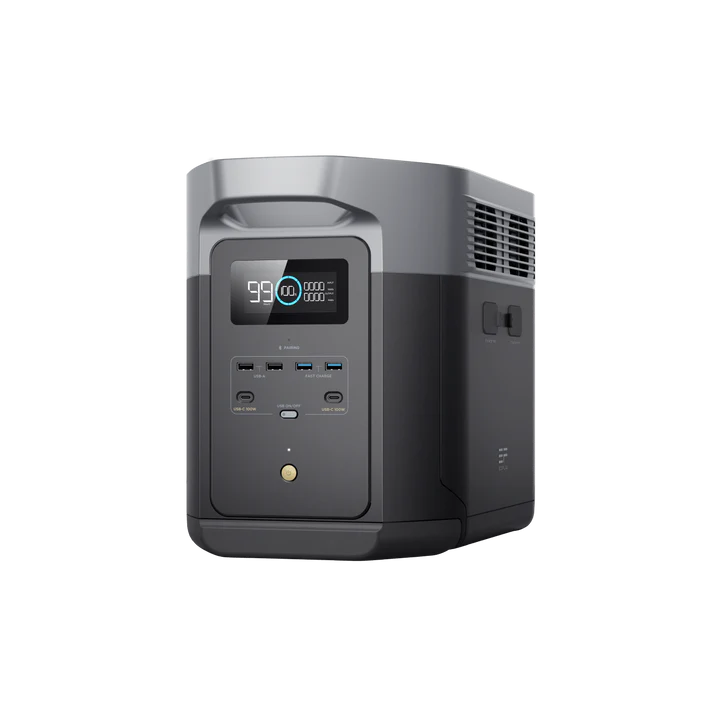
$1,049.00 · direct from EcoFlow
Last checked 1 day ago. Prices move — check before you buy.

$1,199.00 · direct from EcoFlow
Last checked 1 day ago. Prices move — check before you buy.
Spec deltas
The DELTA 2 Max is $1,049 right now — $150 less than the DELTA 3 Max Plus's $1,199, and the first time this matchup has priced the older unit as the bargain.
That $150 doesn't buy back any of the ground the newer unit already had. The Max Plus still runs 3,000W continuous to the DELTA 2 Max's 2,400W, holds a 6,000W surge to 4,800W, and switches to battery in 10ms to the DELTA 2 Max's 20ms — the same gaps as before, just at a different price.
The cheaper unit isn't the cheaper one to own, either. Cost-to-own works out to $0.13 per lifetime kWh for the Max Plus against $0.15 for the DELTA 2 Max, because its extra 1,000 charge cycles spread that $150 premium over a lot more energy delivered. Owners still report the DELTA 2 Max's fans climbing toward 52dB under heavy loadA1, while the Max Plus stays close to silent even charging at full powerB2 — the newer unit's premium buys quiet, too.
What the Numbers Reveal
Each conclusion stated first — the numbers behind it on one line, the full analysis below.
rated cycles
Spread the Max Plus's extra $150 over its extra cycles and the math flips: 8,192 lifetime kWh instead of 6,144 brings its cost down to $0.13 per kWh, two cents less than the DELTA 2 Max's $0.15. The 'budget' unit is the one that actually costs more per unit of energy it will ever deliver.
the DELTA 2 Max is $1,049 and the DELTA 3 Max Plus is $1,199, a $150 gapthe DELTA 2 Max costs $0.15 per lifetime kWh against the Max Plus's $0.13the Max Plus is rated for 4,000 cycles against the DELTA 2 Max's 3,000, totaling 8,192 lifetime kWh against 6,144
Why it mattersAnyone comparing sticker prices alone picks the DELTA 2 Max; anyone planning to keep the unit for years should run the $150-over-2,048-extra-kWh math instead and buy the Max Plus.
continuous output
600W more continuous output, 1,200W more surge headroomB1, a switchover twice as fast, and — per owner reports — a genuinely quieter fan profileA1B2: none of it is a marginal edge. The Max Plus isn't winning on one tiebreaker; it's winning on all of them.
the Max Plus runs 3,000W continuous with a 6,000W surge against the DELTA 2 Max's 2,400W and 4,800WB1the Max Plus switches to battery in 10ms against the DELTA 2 Max's 20msowners report the DELTA 2 Max's fans climb toward 52dB under heavy loadA1, while the Max Plus stays near-silent even at full chargeB2
Why it mattersIf $150 is a real constraint tonight, that's a legitimate reason to buy the DELTA 2 Max — but know you're trading away power headroom, switchover speed, and quiet, not just saving cash.
The Max Plus's extra output and surge never show up as extra runway in any of these scenarios, because none of them draws anywhere near either unit's power ceiling. The decision this page has to make isn't about capability in use — it's entirely about the $150 at checkout against the two-cent-per-kWh gap over the unit's life.
both units cover an 8-hour blackout at 94% of its 1,645Wh drawboth cover a CPAP night at just 18% of capacityneither covers a two-night camping trip (121% of the 2,100Wh needed) or a full van-life day (269% of the 4,685Wh needed)
Why it mattersDon't pick between these two based on which one gets you through a specific night — on that question, they're the same unit. Pick based on how you value cash now versus cost per kWh later.
The specific dimensions that decide these two units — everything else is a tie.
Lifetime Value
Selected because: The price flip and the cost-per-kWh paradox is the whole story this rewrite has to tell.
cost / lifetime kWh
The DELTA 3 Max Plus now costs $150 more than the DELTA 2 Max at checkout — $1,199 against $1,049, a full reversal of the gap this page used to describe. But cost-to-own doesn't reverse with it. The Max Plus's extra 1,000 charge cycles (4,000 against 3,000) spread its price over 8,192 lifetime kWh instead of the DELTA 2 Max's 6,144, and it still comes out ahead on cost per kWh: $0.13 against $0.15.
Stretched across the five-year warranty both units share, that's $220 a year to own the Max Plus against $190 for the DELTA 2 Max — thirty dollars a year more for the unit that will have put out a third more total energy by the time either warranty runs out. The DELTA 2 Max is the cheaper purchase. It isn't the cheaper unit to own.
What the Specs Don't Tell You
Selected because: The two gotchas that fire (UPS switchover, cycle life) both explain why the pricier unit is still the better long-term buy.
rated cycles
The two gotchas that actually fire here both tell the same story as the price math above: more money buys more unit. The Max Plus's 10ms switchover beats the DELTA 2 Max's 20ms — twice as fast onto battery power, the kind of margin that matters if something sensitive is plugged in behind it.
Its 4,000-cycle rating over the DELTA 2 Max's 3,000 is the same gap driving the cost-to-own numbers above: a third more full charges before the battery meaningfully fades. There's no gotcha here where the DELTA 2 Max comes out ahead — it just costs $150 less to accept the gap.
Your Life, Your Pick
Selected because: All six scenarios return a tie or a shared miss, showing the decision isn't about capability — reinforces that price and cost-to-own are what's left to decide on.
Run the two through six real use cases and they perform identically in every one: the same 94% of an 8-hour blackout's draw, the same 18% for a CPAP night, the same shortfall on a two-night camping trip or a full van-life day. That's what sharing a 2,048Wh battery guarantees — the Max Plus's extra output and surge don't add runway here, because none of these loads gets anywhere near either unit's ceiling.
Which means the scenario columns won't break this tie. The decision comes down to the $150 at checkout against the two-cent-per-kWh gap in the section above, not to which one gets you through the night.
Strengths & trade-offs
EcoFlow DELTA 2 Max
Strengths
- +Costs $150 less
Trade-offs
- –Weaker inverter (-600W) limits appliance compatibility.
- –Shorter-lived battery — rated for 3,000 charge cycles vs the DELTA 3 Max Plus's 4,000, so it wears out sooner.
EcoFlow DELTA 3 Max Plus
Strengths
- +Higher AC output
- +Rated for 4,000 charge cycles — much longer battery lifespan
Trade-offs
- –No major technical downsides compared to rival.
Will It Power Your Gear?
Scenario math and per-appliance runtimes, modeled from the spec record.
Scenario verdicts
We ran the math on six real-world scenarios. Here's which unit survives your actual life.
SCN-01 · 2 nights · needs 2,100Wh
Weekend Camping
Two nights off-grid with essential comfort
Neither unit
Neither covers a full two-night camping trip on one charge — both fall short of the 2,100Wh needed, so you're topping up from the same 1,000W solar input either way. With capacity a tie, the decision reverts to the checkout price: the DELTA 2 Max is $150 cheaper ($1,049 vs $1,199), and camp gear rarely needs the Max Plus's extra surge headroom (6,000W vs 4,800W) outdoors.
Battery budget usedlower = more headroom
LOAD Phone Charger 15W×6h · LED Lights 40W×8h · Box Fan 75W×14h · CPAP Machine 40W×16h
SCN-02 · 8 hours · needs 1,645Wh
8-Hour Blackout
Keep the essentials running through a night without power
Either unit
Both units cover a typical 8-hour outage at the same 94% of that 1,645Wh draw off the same 2,048Wh battery — capacity is a wash. The Max Plus's faster 10ms switchover (against the DELTA 2 Max's 20ms) is the real tiebreak if something sensitive is plugged in behind it; if not, the DELTA 2 Max covers the same outage for $150 less ($1,049 vs $1,199).
Battery budget usedlower = more headroom
LOAD Fridge 150W×8h · Router + Modem 20W×8h · LED Lights (4 bulbs) 40W×6h · Phone Charger 15W×3h
SCN-03 · 8 hours · needs 320Wh
CPAP Overnight
Sleep therapy without interruption — the #1 medical use case
Either unit
A CPAP barely dents either battery — both handle it at just 18% of capacity, with hours to spare, and both list the same nominal 30dB noise rating. With capacity and rated noise tied, this scenario comes down to the $150 at checkout ($1,049 vs $1,199): the DELTA 2 Max covers the same overnight draw for less, while the Max Plus is the one to reach for if the numbers in the sections above are what you're weighing instead.
Battery budget usedlower = more headroom
LOAD CPAP Machine 40W×8h
SCN-04 · 8 hours · needs 910Wh
Remote Workday
Full work day off-grid without power anxiety
Either unit
Both power your workstation all day without strain. At these utilization levels the real difference is USB-C for direct laptop charging — 140W on the DELTA 3 Max Plus against 100W — which beats the inverter for convenience and wastes less energy.
Battery budget usedlower = more headroom
LOAD Laptop 60W×8h · External Monitor 30W×8h · Router + Modem 20W×8h · Phone Charger 15W×2h
SCN-05 · 4 hours · needs 670Wh
Tailgate Party
Game day power for the crew
Either unit
Both handle game day easily. Since capacity isn't the deciding factor, weight is: at 50.7 lbs the DELTA 2 Max is the one you'll be glad you brought. Fan noise under load is worth a listen too — it's audible in the lulls between songs.
Battery budget usedlower = more headroom
LOAD Blender 400W×0.5h · LED TV (55") 80W×4h · Bluetooth Speaker 15W×4h · Phone Charger (×3) 45W×2h
SCN-06 · 24 hours · needs 4,685Wh
Van Life Daily
A full day of mobile living — the ultimate endurance test
Neither unit
Neither unit covers this scenario's 4,685Wh: the DELTA 2 Max comes up 2,944Wh short (about 37% covered), the DELTA 3 Max Plus 2,944Wh (37%). Treat this as partial cover — enough for the essentials in it, not the whole list.
Battery budget usedlower = more headroom
LOAD Mini-Fridge 150W×24h · Laptop 60W×4h · Phone Charger 15W×3h · LED Lights 40W×5h · Fan 75W×8h
The Load Test
RUNTIME = (Wh × 0.85) ÷ LOAD
None of the scenarios above exactly yours? Build it. Toggle what you'd plug in; both units are tested against the combined draw.
Essentials
Comfort & Convenience
High-Draw Appliances
Test duration
8h
Continuous draw
205W
Projected runtime
Dead heat — both run this 205W load for roughly 8.5h. Pick on price, weight, or ports.
Modeled from the spec record — same math as the tables below. Methodology
Runtime by appliance
Real-world runtime estimates for common appliances, modeled at 85% inverter efficiency.¹
Essentials
The basics you need runningscale 0–116.1hComfort & Convenience
Makes off-grid life actually enjoyablescale 0–23.2hHigh-Draw Appliances
These reveal the real limitsscale 0–1.7h¹ Runtime = (capacity × 0.85) ÷ appliance watts. Within each group, all bars share one time scale (the group's longest runtime), so lengths are comparable across appliances; identical runtimes collapse into a single blue/orange bar. Actual runtime varies with battery age, temperature, and simultaneous loads — see methodology.
Conclusion
July 26, 2026
Verdict: the EcoFlow DELTA 3 Max Plus
The DELTA 3 Max Plus costs $150 more than the DELTA 2 Max right now ($1,199 vs $1,049) — the first time this pair has priced the newer unit above the older one. The specs didn't move, though: the Max Plus still runs 3,000W continuous against the DELTA 2 Max's 2,400W, holds a 6,000W surge against 4,800W, switches to battery in 10ms against 20ms, and is rated for 4,000 cycles against 3,000. Those extra cycles spread its price over 8,192 lifetime kWh instead of 6,144, and the math still favors it: $0.13 per lifetime kWh against $0.15. If $150 today is the real constraint, the DELTA 2 Max is a defensible budget pick with no gotcha working against it beyond a documented fan-noise complaintA1. If you can stretch the extra $150, the Max Plus wins on every measure that's supposed to be the cheaper unit's home turf, including cost per kWh.
Editor-assigned confidence, based on cited owner research and spec analysis.
List prices as of July 26, 2026. The links below open EcoFlow's current price.
$1,199.00 · direct from EcoFlow
Last checked 1 day ago. Prices move — check before you buy.
or check the DELTA 2 Max price$1,049.00 list
Written by Gunner Gustafson, Whole-Home Backup Tester · Station Arena Test Desk · Updated July 26, 2026
Measured Data
Benchmark scores and the full spec record, side by side.
Benchmark scores
Full specifications
ᵈ Derived: price ÷ rated capacity. See the data behind our comparisons →
Comparison ToolAdd more power stations, side by sideOpen Tool →How these numbers are produced
Numeric verification
Every figure on this page traces to our spec database or arithmetic on it — no estimated numbers.
Owner claims
Statements about owner experience are cited to published reviews — see Sources & Research Notes below.
Runtime model
Runtime = (rated capacity × 0.85 inverter efficiency) ÷ device wattage. Solar recharge estimates assume panels deliver 70% of rated output. Cold weather, battery age, and stacked loads reduce real-world results.
Power Score
Computed from 14 published spec dimensions, weighted per use-case bench. Higher is better; a unit must meet a bench's minimum threshold to be rated.
See the full weight table and data sourcing on our methodology page →Class ranking (the star rating)
Each unit's star score is a category ranking, not customer reviews — no buyer opinions feed it. We score every station on size-independent quality (value, output, portability, endurance, ports, warranty, and more), then percentile-rank it against the other units in its capacity class, so a class-leading compact unit and a class-leading whole-home unit can both earn 5★. Here, DELTA 2 Max rates 3.8/5 (28th percentile of 26 Large-class units), and DELTA 3 Max Plus rates 4.2/5 (52nd percentile of 26 Large-class units).
How the class ranking is computed →Test Notes & Caveats
Hidden gotchas and advantages we spotted that you won't find on the product page.
UPS Switchover: 10ms vs 20ms
The DELTA 3 Max Plus switches to battery in 10ms; the DELTA 2 Max takes 20ms — twice as long. Both are fast enough for most electronics, but a switchover-sensitive desktop or NAS sits safer behind the Max Plus's faster cutover.
Warranty: No Difference
Both units carry the same 5-year warranty, so coverage isn't a tiebreaker here.
Cycle Life: 4,000 vs 3,000 Charges
4,000 cycles against 3,000 — the DELTA 3 Max Plus is rated for a third more full charges before its capacity meaningfully fades. That extra cycle life is also why it's the cheaper unit to own per kWh, even though it costs $150 more today.
Full record above — the Test Desk pick is the DELTA 3 Max Plus.
Check DELTA 3 Max Plus price →or check the DELTA 2 Max priceOwnership Analysis
What happens after you buy — true cost of ownership, brand trust, and growth potential.
Lifetime value
Service lifeyears at one full cycle per day
Lifetime energy delivered
Cost per delivered kWh
│ warranty ends · Reaching the cycle rating means ~80% capacity remains — degraded, not dead.
Analyst note
The DELTA 2 Max is cheaper to buy, but the DELTA 3 Max Plus is cheaper to own. At $0.15/kWh over its lifetime vs $0.17/kWh, the DELTA 3 Max Plus's higher cycle life and capacity make each dollar go further over the years.
Growth path
DELTA 2 Max
EXPANDABLESupports EcoFlow expansion batteries, so you can add capacity later without replacing the base unit — useful if your needs may climb past 2,048Wh.
Accepts up to 1,000W of solar. Enough for a serious multi-panel array.
Generous port selection supports complex multi-device setups.
Expansion batteries are EcoFlow-specific. You're investing in the EcoFlow ecosystem.
DELTA 3 Max Plus
EXPANDABLESupports EcoFlow expansion batteries, so you can add capacity later without replacing the base unit — useful if your needs may climb past 2,048Wh.
Accepts up to 1,000W of solar. Enough for a serious multi-panel array.
Generous port selection supports complex multi-device setups.
Expansion batteries are EcoFlow-specific. You're investing in the EcoFlow ecosystem.
Realistic full solar rechargeat 70% of rated panel output — see methodology
Analyst note
Both expand, so neither locks you out of growth — decide on capacity, price, and the rest, not the expansion checkbox.
What Owners Report
Patterns from published owner reports and long-term reviews — every claim cited to its source below.
EcoFlow DELTA 2 Max
The DELTA 2 Max earns real trust as a durable, older-generation unit: LFP cells rated for 3,000-plus cycles that showed no structural degradation after six months of real useA3, plus fast AC charging — 80% in about 50 minutesA2. Reviewers still call it worth buying, but with caveatsA4.
The loudest caveat is literal. Its fans climb to around 52dB under heavy load or charging, a recurring complaint that a Quiet Charging mode only partly tamesA1.
“Fast AC wall charging — 0 to 80% in about 50 minutes and a full charge in roughly 80 minutes.”
Sources
powerstationadvisor.com · pcworld.com · thesolarlab.com · protoolsadvisor.com · trailandkale.com
EcoFlow DELTA 3 Max Plus
Reviewers frame the DELTA 3 Max Plus as a polished, higher-power take on the platform: 3,000W output with a 6,000W surge, a real step up over the standard DELTA 3 MaxB1, staying genuinely quiet even at full chargeB2, and fast-charging to 80% in about 50 minutesB3.
It's also described as scaling from 2kWh up to 10kWh via Smart Extra BatteriesB4. It's a recent release, so long-term owner data is thinner than the DELTA 2 Max's, but early sentiment is consistently positive.
“Bumps output to 3,000W continuous with a 6,000W surge — a significant upgrade over the DELTA 3 Max's 2,400W and 4,800W surge.”
Sources
storagereview.com · androidguys.com · t3.com · trustedreviews.com
Sources & Research Notes
Every owner claim in this report is traceable to a published source. The bracketed references above resolve here.
Recurring owner themes
- Solid LFP durability, fast charging, and ecosystem/expandability are the praise; loud fans under heavy load or charging are the recurring complaint. [DELTA 2 Max · 3 entries]
- The Max Plus delivers more output and surge than the Max, plus a larger expansion ceiling, while staying quiet and fast-charging — a polished, higher-power take on the same platform. [DELTA 3 Max Plus · 3 entries]
- A1
“Fan noise is a significant issue — cooling fans can get loud, around 52 dB during heavy loads or charging; a Quiet Charging mode reduces noise but extends charge time, and giving it 6 inches of clearance helps airflow.”
powerstationadvisor.com / pcworld.com — DELTA 2 Max review · 2025-2026 · [negative]
- A2
“Fast AC wall charging — 0 to 80% in about 50 minutes and a full charge in roughly 80 minutes.”
thesolarlab.com / protoolsadvisor.com — DELTA 2 Max review · 2025-2026 · [positive]
- A3
“LiFePO4 chemistry rated for 3,000+ cycles to 80% with superior thermal stability; after 6 months of real use there was no structural degradation and it felt as solid as day one.”
powerstationadvisor.com / trailandkale.com — DELTA 2 Max review · 2025-2026 · [positive]
- A4
“Reviewers say it's still worth buying but with caveats — a versatile unit with expandability and ecosystem compatibility.”
thesolarlab.com / powerstationadvisor.com — DELTA 2 Max review · 2025-2026 · [mixed]
- B1
“Bumps output to 3,000W continuous with a 6,000W surge — a significant upgrade over the DELTA 3 Max's 2,400W and 4,800W surge.”
storagereview.com / androidguys.com — DELTA 3 Max Plus review · 2026 · [positive]
- B2
“Stays genuinely quiet under typical loads, only spinning up its fans briefly during shutdown; even charging at full power the decibel meter barely registered above room noise at one meter.”
t3.com / trustedreviews.com — DELTA 3 Max Plus review · 2026 · [positive]
- B3
“Fast charging — reached 80% in about 50 minutes and full in around 70 minutes.”
t3.com — DELTA 3 Max Plus review · 2026 · [positive]
- B4
“Scalable — supports expandable capacity from 2kWh up to 10kWh via Smart Extra Batteries, with 5 charging methods; reviewers describe it as polished and effortless.”
storagereview.com / t3.com — DELTA 3 Max Plus review · 2026 · [positive]
Research compiled July 26, 2026.
Who Should Buy Which
Buy the DELTA 2 Max if you…
- →You need the $150 back today more than you need the extra headroom — the DELTA 2 Max is a real unit, not a compromise, it's just a generation behind.
- →You'll mostly run it outdoors or for light emergency duty, where the Max Plus's extra surge and quieter fansA1B2 matter less than at a desk or bedside.
- →You already own DELTA 2-series batteries or accessories worth reusing.
Buy the DELTA 3 Max Plus if you…
- →You want the better cost-to-own — $0.13 per lifetime kWh against the DELTA 2 Max's $0.15, despite the higher sticker price.
- →You'll stress the inverter — 3,000W continuous and a 6,000W surge give real headroom the DELTA 2 Max's 2,400W/4,800W doesn't.
- →It runs near your desk or your bed — it stays near-silent where the DELTA 2 Max's fans climb toward 52dB under loadA1B2.
If neither fits
Both are 2,048Wh units, and neither covers a full two-night camping trip (121% of the 2,100Wh you'd need) or a full van-life day (269% of the 4,685Wh you'd need) on one charge. Need more than that, either one expands with EcoFlow's Smart Extra Batteries; need less, a 1kWh-class unit saves money and weight you won't use.
The Bottom Line
If you can stretch the extra $150, buy the EcoFlow DELTA 3 Max Plus. It runs more power (3,000W vs 2,400W), holds more surge (6,000W vs 4,800W), switches to battery twice as fast (10ms vs 20ms), and — because its extra 1,000 cycles spread that higher price over more lifetime energy — it's still the cheaper unit to own at $0.13 per kWh against the DELTA 2 Max's $0.15.
The DELTA 2 Max isn't a bad buy at $1,049; it's just the budget version of the same platform, fan noiseA1 included. Buy it if the $150 today matters more than the cents per kWh later. Buy the Max Plus if it doesn't.
Frequently Asked Questions
Answers drawn from the spec record and cited owner research.
EcoFlow DELTA 2 Max vs DELTA 3 Max Plus — which should I buy?
If $150 matters right now, the DELTA 2 Max ($1,049) is a defensible pick with no real gotcha against it beyond its documented fan noise. If you can stretch to the DELTA 3 Max Plus ($1,199), it wins on power (3,000W vs 2,400W), surge (6,000W vs 4,800W), switchover speed (10ms vs 20ms), and even cost per kWh over its life ($0.13 vs $0.15) — it's the rare case where the pricier unit is also the better long-term value.
Is the DELTA 2 Max actually cheaper than the DELTA 3 Max Plus now?
Yes — $1,049 against $1,199, a $150 gap. That's a reversal from when this page last checked prices, when the DELTA 2 Max was the pricier unit. The specs behind the price didn't change, though: the Max Plus is still ahead on output, surge, cycle life, and switchover speed.
Which one is quieter?
The DELTA 3 Max Plus, by a real margin according to owner and reviewer reports. Both list a nominal 30dB rating, but the DELTA 2 Max's fans are a recurring complaint, climbing to around 52dB under heavy load or charging, while the Max Plus was measured barely above room noise even charging at full power.
Which is cheaper to own over time?
The DELTA 3 Max Plus, even though it costs $150 more upfront. Its 4,000-cycle rating against the DELTA 2 Max's 3,000 means it delivers 8,192 lifetime kWh instead of 6,144, which works out to $0.13 per kWh against $0.15 — a lower cost per unit of energy despite the higher sticker price.
Where to buy
EcoFlow DELTA 2 Max
$1,049.00
$1,049.00 · direct from EcoFlow
Last checked 1 day ago. Prices move — check before you buy.
EcoFlow DELTA 3 Max PlusPick
$1,199.00
$1,199.00 · direct from EcoFlow
Last checked 1 day ago. Prices move — check before you buy.
Prices may vary by retailer and are subject to change.