Head-to-head test
DJI Power 2000 vs Goal Zero Yeti 1000 (6th Gen)
Nearly the same money buys either 988Wh or 2,048Wh, so the Yeti 1000 is the right box only if 13.2 lbs and a 12V socket outrank half the battery.
Full profiles: DJI Power 2000 → · Goal Zero Yeti 1000 (6th Gen) →

Written by Ian SchneiderUpdated
Solar & Off-Grid Tester, Station Arena Test Desk
Spec deltas
Twice the battery for $99 more. The Power 2000 stores 2,048Wh against the Yeti 1000 (6th Gen)'s 988Wh, runs 3,000W continuous against 2,000W, and accepts 1,800W of solar against 900W, and the two prices are close enough that the usual size-versus-budget tradeoff never really shows up.
Both records read 4,000 cycles, which works out to roughly eleven years of daily cycling for either one. Identical rated life, double the energy per cycle: 8,192 lifetime kWh from the DJI against 3,952 from the Yeti. You are not buying durability from one of these and convenience from the other. You are buying how much work fits inside the same eleven years.
What the Yeti buys back is a lift you don't have to plan and a 12V car socket the DJI doesn't have. 35.3 lbs against 48.5 is the difference between carrying a power station and moving one, and a CPAP night runs it down to 38% of its usable capacity with nothing else asked of it. Name your load. If you can, and it fits, the small box is a defensible buy. If you can't, buy the headroom.
What the Numbers Reveal
Each conclusion stated first — the numbers behind it on one line, the full analysis below.
Capacity
So the ownership-cost gap here is not a durability story at all, it's arithmetic on capacity. Sixteen cents per lifetime kilowatt-hour for the DJI against thirty for the Yeti. Saving $99 today costs you 4,240 kWh of delivered energy (8,192 minus 3,952) across the same eleven years, and no feature on the Yeti's sheet pays that back.
Power 2000: 2,048Wh, rated 4,000 cyclesYeti 1000 (6th Gen): 988Wh, rated 4,000 cyclesThe two typical prices sit $99 apart
Why it mattersAnyone keeping the unit past the first camping season is buying kilowatt-hours rather than a box, and on this pair the cheaper price is the more expensive purchase.
solar input
That matters most in the case these get bought for, because an outage doesn't schedule itself and a unit you refill inside one good solar window is a different tool from one you nurse across two. The catch sits on the DJI side, and it's worth saying out loud: there's no built-in solar charge controller, so that 1,800W arrives only through a separate proprietary adapter. Reviewers put a full solar charge at roughly 75 minutesA1, so the ceiling is real. It just isn't included.
Power 2000: 1,800W maximum solar input into 2,048WhYeti 1000 (6th Gen): 900W maximum solar input into 988WhDJI has no built-in solar charge controller and requires a separate proprietary adapter for solar input
Why it mattersIf panels are the plan, add the DJI adapter to the number you're comparing before you decide the two prices are close.
continuous output
For anything that runs rather than starts, a microwave through a long evening, a heater, a counter with three things plugged into it, continuous is the rating that governs, and the DJI takes that by 1,000W. Peak only decides the instant a compressor kicks over, since compressors pull two to three times their running draw for that moment. The Yeti's headline peak buys a fraction of a second. The DJI's continuous buys the whole afternoon.
Power 2000: 3,000W continuous, no published peak figure on our recordYeti 1000 (6th Gen): 2,000W continuous with a published 3,600W peakThe heaviest instantaneous demand across our six scenarios is 400W, at the tailgate
Why it mattersShop the continuous number unless the one load you care about is a startup surge, in which case note that the Yeti is the only one of the two with a published figure you can check against.
The outage isn't close at all. 1,645Wh against 840Wh usable leaves the Yeti 805Wh short, a little over half the night. The DJI covers the same night with 96Wh in hand, which is a pass rather than a cushion, and worth knowing about our own pick: it finishes that outage with nothing left for the morning after.
Yeti 1000 (6th Gen): 988Wh nameplate, 840Wh after the flat 15% allowance applied to every unit hereRemote Workday needs 910Wh8-Hour Blackout needs 1,645Wh
Why it mattersIf a blackout is the reason you're shopping, neither of these is generous. Only one of them finishes.
The specific dimensions that decide these two units — everything else is a tie.
Runtime: Will It Power Your Gear?
Selected because: Capacity is the axis of this matchup: 2,048Wh against 988Wh, or 1,741Wh against 840Wh once the flat 15% allowance comes off both.
continuous output
Half the battery is the fact that survives every other comparison on this page. 2,048Wh against 988Wh becomes 1,741Wh against 840Wh once the flat 15% allowance comes off both, and that derate is our own standard applied to every unit on the site, not a measurement of either box. From there the arithmetic is blunt: any load the Yeti finishes, the DJI finishes with more than twice the reserve.
Where it bites is the middle of the range. Under about 840Wh of demand both units do the job and the extra capacity is weight you're carrying for nothing. Between 840Wh and 1,741Wh, only one of them does the job at all. A fridge, some lights, a router and a laptop through an evening lands squarely in that band, which is why this stops being an abstract spec gap about four hours into the first outage.
Lifetime Value
Selected because: Both records read 4,000 cycles, so the entire ownership-cost gap is capacity: 8,192 lifetime kWh against 3,952.
cost / lifetime kWh
Four thousand cycles each is the one spec where these two records agree exactly, and it quietly settles the money question. Neither unit is the durable one. Both should still be cycling in about eleven years of daily use, so you aren't buying lifespan here, you're buying how much work fits inside the same eleven years.
Double the delivered energy for a price gap of $99 isn't a close call, and the per-kilowatt-hour figures beside this paragraph say so without help. There is exactly one honest way to make the Yeti's math work, and it's to admit you'll never draw the DJI's extra half: buy the small box on purpose, for a load you can name, and energy you never use costs nothing per kWh. Buy it by accident and you've paid nearly the same money for half a unit.
Your Life, Your Pick
Selected because: The Yeti ties the CPAP night and covers the tailgate, then misses a workday by 70Wh and an eight-hour outage by 805Wh.
Six scenarios and the Yeti wins none of them outright. It ties the CPAP night, where both units have so much room left that capacity stops being the question. It covers the tailgate too, at 80% of its usable capacity against the DJI's 38%, though the row still goes to the DJI on reserve, and the number you'd actually feel on game day is the 13.2 lbs you didn't carry. Everything heavier than that, it loses.
The near-miss is the instructive one. A remote workday needs 910Wh, the Yeti's 988Wh nameplate clears it, and the flat 15% allowance is what drops it to 840Wh and 70Wh short. Read that as a warning rather than a verdict: a unit whose rated capacity matches your day's load has no margin for a cold morning, a second laptop, or the coffee you didn't plan on. The eight-hour outage needs no interpretation. 1,645Wh against 840Wh usable is 805Wh short, and the DJI ends that same night holding 96Wh.
Portability & Form Factor
Selected because: The Yeti's real case: 35.3 lbs against 48.5, plus a 12V car socket the Power 2000's record doesn't carry.
weight
35.3 lbs is a packed suitcase. 48.5 lbs is a two-hands, bent-knees lift, and 13.2 lbs is exactly the distance between those two sentences. If the unit lives in a closet and comes out twice a year, that gap is a rounding error you'll never think about. If it goes trunk to campsite to trunk every weekend, it's the one spec on this page you feel in your back rather than read on a chart.
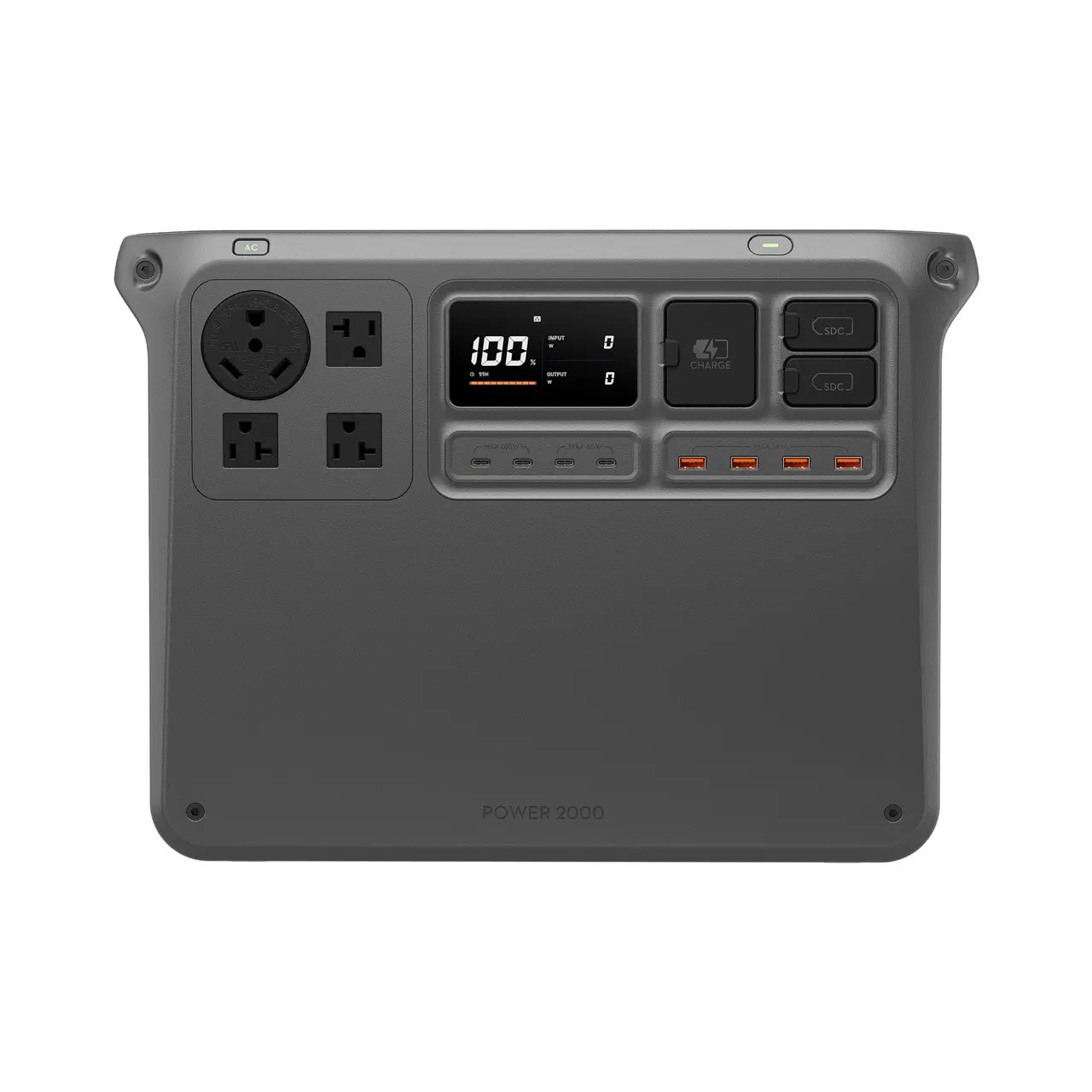
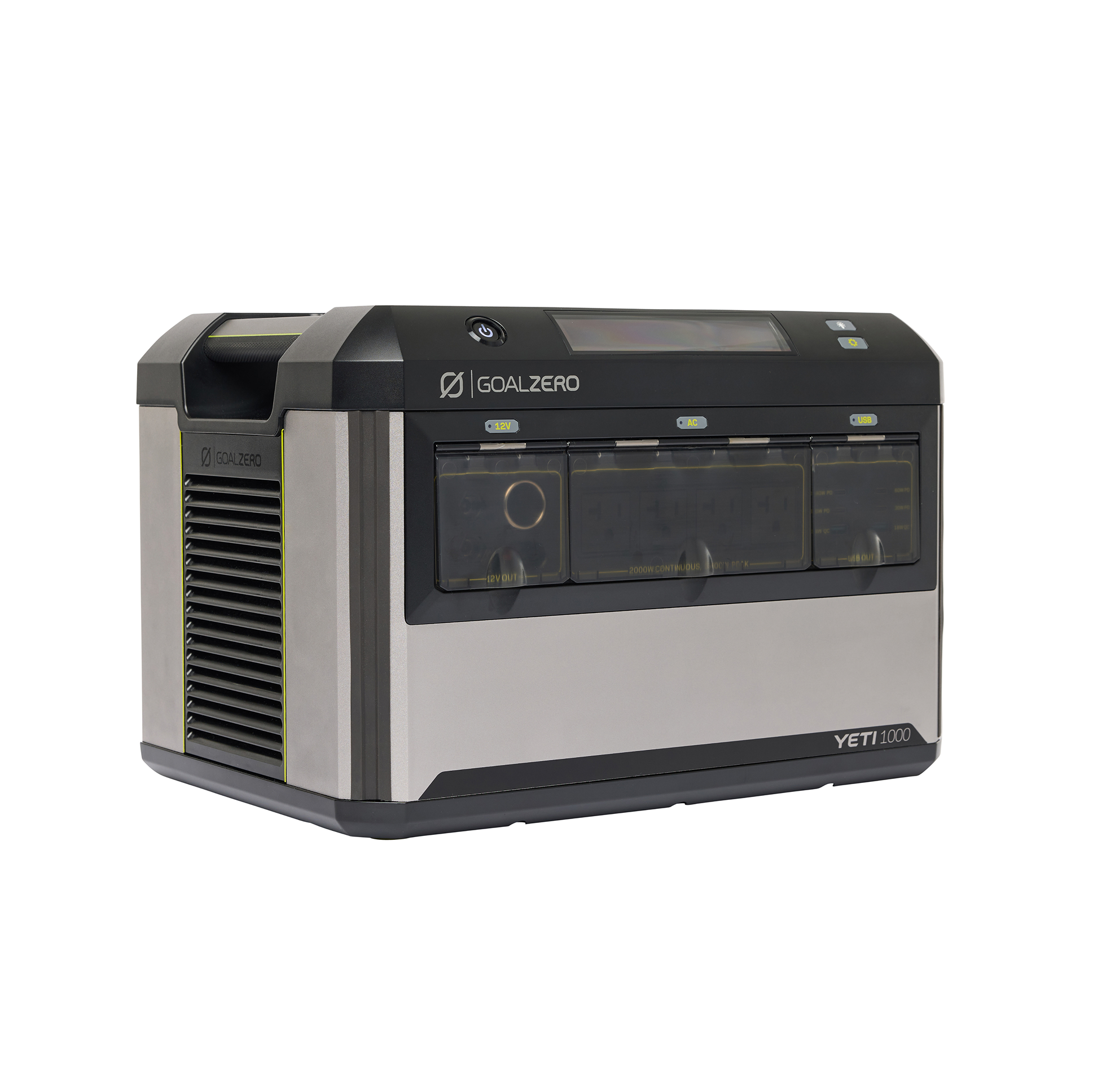
The quieter portability win is the 12V car socket: the Yeti has one, the Power 2000's record carries none. That's the socket a 12V fridge, a tire inflator and most overlanding gear plug straight into, and going through an AC outlet instead means running the inverter to make household power your fridge immediately converts back to DC. The DJI answers with four USB-A ports against two, and the USB-C story is identical on both, four ports and the same 140W ceiling. One real hole on the DJI, a handful of small conveniences on the Yeti.
Brand Trust
Selected because: DJI has been building power stations only since 2024, and this Yeti SKU has no independent field data at all yet.
Neither brand hands you the comfortable answer. DJI has been making power stations since 2024, five models so far, and the battery pedigree behind them is genuine but it comes from drones rather than from a decade of people riding out blackouts on these boxes. Goal Zero has the heritage, having more or less created this category in the US, and it's also the one whose support reputation has slid from its premium standard, with the official community forums now shut down.
The sharper asymmetry is evidence rather than history. The Power 2000 has a real body of independent review coverage behind it, consistent on fast charging, near-silence and an unusually safety-forward buildA1A2A3. For the Yeti 1000 (6th Gen) we found nothing: no hands-on reviews, no forum threads, no owner reports specific to this SKU, and every Yeti 1000 review that did surface turned out to be a different sibling and was excluded rather than misattributedB0. That isn't a mark against the unit. It does mean that if you buy one, you're the field data.
Strengths & trade-offs
DJI Power 2000
Strengths
- +Larger battery capacity
- +Higher AC output
- +Faster solar charging
Trade-offs
- –Significantly heavier (+13.2 lbs), making it harder to move.
Goal Zero Yeti 1000 (6th Gen)
Strengths
- +Costs $99 less
- +Lighter by 13.2 lb
Trade-offs
- –Weaker inverter (-1,000W) limits appliance compatibility.
- –Sealed capacity — the Power 2000 can add batteries to grow past 988Wh; this one can't.
Will It Power Your Gear?
Scenario math and per-appliance runtimes, modeled from the spec record.
Scenario verdicts
We ran the math on six real-world scenarios. Here's which unit survives your actual life.
SCN-01 · 2 nights · needs 2,100Wh
Weekend Camping
Two nights off-grid with essential comfort
Neither unit
A weekend's 2,100Wh is more than either box holds, so this one comes down to how much of the list you get. The Power 2000 covers about 83% of it before it's empty; the Yeti about 40%. Both refill from panels in roughly an hour at their rated input (2,048Wh at 1,800W, 988Wh at 900W), which is what turns a shortfall into a schedule rather than a dead Sunday. Plan the essentials, and plan on sun.
Battery budget usedlower = more headroom
LOAD Phone Charger 15W×6h · LED Lights 40W×8h · Box Fan 75W×14h · CPAP Machine 40W×16h
SCN-02 · 8 hours · needs 1,645Wh
8-Hour Blackout
Keep the essentials running through a night without power
Power 2000
The Power 2000 finishes this night with 96Wh left, which is a pass and not a cushion: one unplanned device and it's a coin flip. The Yeti doesn't get there at all, with 840Wh usable against the 1,645Wh the night needs, leaving it 805Wh short at a little over half the outage. If blackouts are why you're shopping, note that the winner here only just wins.
Battery budget usedlower = more headroom
LOAD Fridge 150W×8h · Router + Modem 20W×8h · LED Lights (4 bulbs) 40W×6h · Phone Charger 15W×3h
SCN-03 · 8 hours · needs 320Wh
CPAP Overnight
Sleep therapy without interruption — the #1 medical use case
Either unit
Eight hours of CPAP is 320Wh, and both units have so much left over that capacity is the wrong thing to shop on: 18% used against 38%. What should decide it is the fan eighteen inches from your head, and there the sheets are lopsided, with DJI publishing 30dB as a best-case figure and Goal Zero publishing nothing for this unit. Failing that, it's 35.3 lbs against 48.5 and which price you prefer.
Battery budget usedlower = more headroom
LOAD CPAP Machine 40W×8h
SCN-04 · 8 hours · needs 910Wh
Remote Workday
Full work day off-grid without power anxiety
Power 2000
This is the closest the Yeti comes to a win, and it still loses. Its 988Wh nameplate clears the 910Wh this day needs; the flat 15% allowance applied to every unit here is what drops it to 840Wh and 70Wh short. The Power 2000 ends the same day with 831Wh untouched, which is the difference between a unit sized for your Tuesday and one sized for your Tuesday plus whatever else happens.
Battery budget usedlower = more headroom
LOAD Laptop 60W×8h · External Monitor 30W×8h · Router + Modem 20W×8h · Phone Charger 15W×2h
SCN-05 · 4 hours · needs 670Wh
Tailgate Party
Game day power for the crew
Power 2000
Both handle game day; the Power 2000 keeps more in reserve (38% used vs 80%). Tailgating is a light load, though, so the number you'll feel is weight: 35.3 lbs for the Yeti 1000 (6th Gen) against 48.5 lbs for the Power 2000, from the trunk to the setup spot.
Battery budget usedlower = more headroom
LOAD Blender 400W×0.5h · LED TV (55") 80W×4h · Bluetooth Speaker 15W×4h · Phone Charger (×3) 45W×2h
SCN-06 · 24 hours · needs 4,685Wh
Van Life Daily
A full day of mobile living — the ultimate endurance test
Neither unit
Neither unit covers this scenario's 4,685Wh: the Power 2000 comes up 2,944Wh short (about 37% covered), the Yeti 1000 (6th Gen) 3,845Wh (18%). This is well outside what either unit is for; the right answer here is a larger station, not a choice between these two.
Battery budget usedlower = more headroom
LOAD Mini-Fridge 150W×24h · Laptop 60W×4h · Phone Charger 15W×3h · LED Lights 40W×5h · Fan 75W×8h
The Load Test
RUNTIME = (Wh × 0.85) ÷ LOAD
None of the scenarios above exactly yours? Build it. Toggle what you'd plug in; both units are tested against the combined draw.
Essentials
Comfort & Convenience
High-Draw Appliances
Test duration
8h
Continuous draw
205W
Projected runtime
For this load: Power 2000 runs 8.5h vs 4.1h.
$1,299 list · direct from DJI
Planning for more than this? Describe your whole setup and get it sized →
Modeled from the spec record — same math as the tables below. Methodology
Runtime by appliance
Real-world runtime estimates for common appliances, modeled at 85% inverter efficiency.¹
Essentials
The basics you need runningscale 0–116.1hComfort & Convenience
Makes off-grid life actually enjoyablescale 0–23.2hHigh-Draw Appliances
These reveal the real limitsscale 0–1.7h¹ Runtime = (capacity × 0.85) ÷ appliance watts. Within each group, all bars share one time scale (the group's longest runtime), so lengths are comparable across appliances; identical runtimes collapse into a single blue/orange bar. Actual runtime varies with battery age, temperature, and simultaneous loads — see methodology.
Conclusion
September 19, 2026
Verdict: the Power 2000, on Power Score margin
Buy the Power 2000. The two prices sit $99 apart, and for that the DJI holds 2,048Wh against 988Wh, runs 3,000W continuous against 2,000W, and accepts 1,800W of solar against 900W. Both records read 4,000 cycles, so nothing about lifespan claws that back: the DJI simply moves a bit over twice the energy through the same rated life. Warranty doesn't separate them either, though the terms aren't the same shape, since Goal Zero's five years stand as written while DJI's five are an up-to figure that depends on buying from DJI's own store. The Yeti's case is real and narrow: 35.3 lbs against 48.5, a 12V car socket the DJI's record doesn't carry, and a published 3,600W peak where the DJI publishes no peak figure at all. If you can name your whole load and it's small, that case holds. If you can't, the smaller box runs out first, and it runs out in the two situations people actually buy these for: an eight-hour outage and a full working day away from a wall.
Editor-assigned confidence, based on cited owner research and spec analysis.
List prices as of September 19, 2026. The links below open DJI's and Goal Zero's current prices.
$1,299.00 · direct from DJI
Last checked 16 days ago. Prices move — check before you buy.
or check the Yeti 1000 (6th Gen) price$1,199.95 list
Written by Ian Schneider, Solar & Off-Grid Tester · Station Arena Test Desk · Updated September 19, 2026
Black Friday · 38 days out
Prices to beat:Power 2000 $1,299Yeti 1000 (6th Gen) $1,200
We have never seen either discounted, so any real cut would be a first.
Measured Data
Benchmark scores and the full spec record, side by side.
Benchmark scores
Not rated for both units (minimum threshold unmet): RV Living, Home Backup, Food Truck.
Full specifications
ᵈ Derived: price ÷ rated capacity. See the data behind our comparisons →
Comparison ToolAdd more power stations, side by sideOpen Tool →How these numbers are produced
Numeric verification
Every figure on this page traces to our spec database or arithmetic on it — no estimated numbers.
Owner claims
Statements about owner experience are cited to published reviews — see Sources & Research Notes below.
Runtime model
Runtime = (rated capacity × 0.85 inverter efficiency) ÷ device wattage. Solar recharge estimates assume panels deliver 70% of rated output. Cold weather, battery age, and stacked loads reduce real-world results.
Power Score
Computed from 14 published spec dimensions, weighted per use-case bench. Higher is better; a unit must meet a bench's minimum threshold to be rated.
See the full weight table and data sourcing on our methodology page →Class ranking (the star rating)
Each unit's star score is a category ranking, not customer reviews — no buyer opinions feed it. We score every station on size-independent quality (value, output, portability, endurance, ports, warranty, and more), then percentile-rank it against the other units in its capacity class, so a class-leading compact unit and a class-leading whole-home unit can both earn 5★. Here, Power 2000 rates 4.3/5 (60th percentile of 26 Large-class units), and Yeti 1000 (6th Gen) rates 4.6/5 (74th percentile of 20 Compact-class units).
How the class ranking is computed →Test Notes & Caveats
Hidden gotchas and advantages we spotted that you won't find on the product page.
Where each one tops out
The Yeti 1000 (6th Gen) is sealed at 988Wh, and sealed is fine as long as you picked the number on purpose. The Power 2000 starts at 2,048Wh and takes DJI expansion batteries after that, which makes expansion the second thing it has over the Yeti rather than the first: the base alone is already more than double. Two honest catches on our own pick, though. Those expansion batteries are DJI's own, so the growth path locks you to one vendor's parts. And a sealed box that was big enough to begin with never needed a growth path at all.
No worse than 10ms against no worse than 15ms
Both units list a UPS mode, the Power 2000 rated no worse than 10ms and the Yeti 1000 (6th Gen) no worse than 15ms. Read both as published ceilings, because that is what they are. Neither is a lab result, and the distance between a rating and a measurement is wider than the 5ms between these two. Routers, NAS boxes and most electronics ride through either class. A desktop with unsaved work and a fussy power supply is the one case where the tighter rating earns attention, and even there you are trusting a spec sheet rather than a test.
Warranty: No Difference
Both units carry the same 5-year warranty, so coverage isn't a tiebreaker here. The Power 2000's figure is a maximum rather than a guarantee — it depends on buying from DJI's own store, which is where the full five years is advertised.
One number on the table, one blank
The Power 2000's record carries 30dB; the Yeti 1000 (6th Gen)'s carries nothing. That gap is about disclosure, not about which unit is louder, and it helps to know how the published figure works: makers generally quote a best case, often a capped quiet mode, so the real unit is louder than its number once it's working. A 30dB spec and a blank are not two numbers you can subtract. If this is going in a bedroom or beside a CPAP, the DJI at least gives you something to hold the maker to.
Full record above — the Test Desk pick is the Power 2000.
Check Power 2000 price →or check the Yeti 1000 (6th Gen) priceOwnership Analysis
What happens after you buy — true cost of ownership, brand trust, and growth potential.
Lifetime value
Service lifeyears at one full cycle per day
Lifetime energy delivered
Cost per delivered kWh
│ warranty ends · Reaching the cycle rating means ~80% capacity remains — degraded, not dead.
Analyst note
The Yeti 1000 (6th Gen) is cheaper to buy, but the Power 2000 is cheaper to own. At $0.16/kWh over its lifetime vs $0.30/kWh, the Power 2000's higher cycle life and capacity make each dollar go further over the years. One thing to know reading the table: both carry the same 4,000-cycle rating, so the lifetime rows are sticker price and capacity in disguise — the wear horizon is identical and decides nothing here.
Delivers each lifetime kWh for $0.14 less — check the Power 2000 price →
Brand trust
DJI
Ecosystem
New entrant (2024) — five power station models to date: Power 500, Power 1000 (since superseded by the V2 but still sold), Power 1000 V2, Power 1000 Mini, Power 2000. Buying a "Power 1000" listing? Check which revision it actually ships.
Support
Leveraging DJI's established global support and repair center network from the drone business. Generally positive reputation inherited from drone operations, but limited power-station-specific track record.
Community
No dedicated power station community yet. Discussions happen within r/dji (~250K members, mostly drone users). Very small power-specific presence on Facebook and forums.
App experience
Rated 3.5/5 iOS and Android (DJI Home app ratings reflect entire DJI ecosystem including drones/cameras, not power-station-specific). Users report the on-device screen is more reliable than the app.
Unique strength
Quiet and fast, and both traits come out of the drone business. The Power 2000's record carries 30dB, at the quiet end of the category, with the usual caveat that makers publish a best case rather than a measurement. Its cells are LFP rated for 4,000-plus cycles, and the battery R&D behind them is why a 2024 entrant arrived at numbers like these instead of growing into them.
Worth knowing
Two things to price in before you compare stickers. There is no built-in solar charge controller, so solar input runs through a separate proprietary adapter rather than the unit itself, and the SDC fast-charging ports are DJI's own, so that advantage mostly lands if you already own DJI gear. Beyond that, DJI has been building power stations only since 2024 across five models: deep hardware pedigree, short power-station track record. Expansion exists on the Power 2000 but not across the whole line, and the original Power 1000 still shares shelf space with its V2, so check which revision a listing actually ships.
Goal Zero
Ecosystem
Focused rather than broad. The current range is the 6th-generation Yeti and the Yeti Pro series, with Sherpa power banks below 100Wh, Alta coolers, Nomad and Ranger panels and vehicle integration kits arranged around them; the X-generation units are the outgoing ones. You buy into Goal Zero for the accessories that clip onto the station, not for breadth of station choice.
Support
US-based company (Salt Lake City, owned by NRG Energy). Historically considered premium support, but 2025-2026 reports describe long wait times, unresponsive email communication, and tickets going unaddressed for weeks. The "premium support justifies premium pricing" argument is weakening.
Community
Small but loyal — strong following in overlanding and preparedness communities. Official community forums were recently shuttered, frustrating long-time users.
App experience
Rated 4.4/5 iOS (~1,200 ratings) but recent reviews skew negative — recurring connectivity issues, crashes, and stability problems.
Unique strength
Pioneer of the portable power market — strongest brand heritage. US-based company with ruggedized, weather-resistant designs (IP ratings vary by model). Integrated "Yeti-Ready" ecosystem with coolers, lights, and vehicle kits.
Worth knowing
Goal Zero is US-based, out of Salt Lake City and owned by NRG Energy, and it sits at the premium end on price per watt-hour, which on this pair it does not escape. The premium-support argument that used to justify that position has weakened, and the official community forums have been shut down, leaving a small but genuinely loyal overlanding and preparedness following scattered elsewhere. The phone app is well rated overall, with connectivity and stability its known weak points.
Analyst note
A heritage brand against a hardware brand. Goal Zero more or less created the US portable power market and still builds the most integrated kit around its stations. DJI arrived in 2024 with drone-grade battery engineering and immediately undercut the category on price per watt-hour. Neither position is comfortable for a buyer: one has the long track record and the softening support story, the other has deep hardware credibility and barely two years of power-station history. On this pair, brand is the tiebreaker you reach for after the specs have decided, and the specs are not close.
Growth path
Power 2000
EXPANDABLESupports DJI expansion batteries, so you can add capacity later without replacing the base unit — useful if your needs may climb past 2,048Wh.
Accepts up to 1,800W of solar. Enough for a serious multi-panel array.
Generous port selection supports complex multi-device setups.
Expansion batteries are DJI-specific. You're investing in the DJI ecosystem.
Yeti 1000 (6th Gen)
FIXED CAPACITYFixed at 988Wh, with no expansion — so size it for your needs up front rather than planning to add capacity later.
Accepts up to 900W of solar. Suitable for a 1-2 panel setup.
Generous port selection supports complex multi-device setups.
Realistic full solar rechargeat 70% of rated panel output — see methodology
Analyst note
The Yeti 1000 (6th Gen) is sealed at 988Wh, which is fine if that covers you. The Power 2000 starts at 2,048Wh and can grow beyond it with DJI expansion batteries — real headroom the Yeti 1000 (6th Gen) doesn't have if your needs climb toward partial-home backup.
What Owners Report
Patterns from published owner reports and long-term reviews — every claim cited to its source below.
DJI Power 2000
The consistent praise is speed and quiet. Reviewers put a full wall charge at about 90 minutes, with some measuring closer to an hour, and a full solar charge at roughly 75 minutes at the 1,800W ceilingA1. On noise, one review measured about 29dB at five feet when the fan engaged and found the unit stayed among the quietest tested even under the heaviest loadsA2. Two independent strands, both pointing the same directionA1A2.
The build draws its own attention: flame-retardant materials, a nano-coated BMS, 26 temperature sensors, 21 fuses and structural reinforcement rated to hold a one-ton static loadA3. Reviewers also report it absorbed everything thrown at it, handled surges consistently and refilled fast from the sun, with real integration upside for people who already own DJI dronesA4. The honest limit on all of it: this is review-desk coverage rather than multi-year ownership, because the product is recent and long-term owner data is thinA0.
“Among the fastest-charging tested — a full wall charge in about 90 minutes (reviewers measured even faster, roughly an hour), and up to 1,800W of solar input for a full solar charge in about 75 minutes.”
Sources
bobvila.com · t3.com · thesolarlab.com · campingsolar.us · protoolreviews.com · greenerideal.com · dronexl.co
Goal Zero Yeti 1000 (6th Gen)
There is no field experience to report on this unit. Roughly 25 targeted searches across indexed press, YouTube, DIY solar forums and van-life and overlanding communities turned up nothing specific to this SKU, and every Yeti 1000 review, video and forum thread that did surface was confirmed to be a different sibling and deliberately excluded rather than misattributed to this oneB0. The sibling 6th-gen Yeti 1500 has genuine hands-on coverage; none of it mentions or tests the 1000B0. Treat everything on this page about the Yeti as spec-sheet material until reviews exist.
Sources & Research Notes
Every owner claim in this report is traceable to a published source. The bracketed references above resolve here.
Recurring owner themes
- Standout fast charging (wall and 1800W solar), near-silent operation, and an unusually robust safety-focused build are the consistent praise. [Power 2000 · 3 entries]
- A1
“Among the fastest-charging tested — a full wall charge in about 90 minutes (reviewers measured even faster, roughly an hour), and up to 1,800W of solar input for a full solar charge in about 75 minutes.”
bobvila.com / t3.com — DJI Power 2000 review · 2025-2026 · [positive]
- A2
“One of the quietest power stations tested — only about 29 dB at 5 feet when the fan kicked in, virtually silent, and it stayed among the quietest units even under the heaviest loads.”
bobvila.com / thesolarlab.com — DJI Power 2000 review · 2025-2026 · [positive]
- A3
“Built with an eightfold protection system — flame-retardant materials, a nano-coated BMS, 26 temperature sensors, 21 fuses, and structural reinforcement rated to support a one-ton static load — positioning it as one of the safest, most robust units on the market.”
campingsolar.us / protoolreviews.com — DJI Power 2000 review · 2025-2026 · [positive]
- A4
“Ran everything reviewers threw at it, handled surges consistently, and recharged incredibly fast, especially from solar; deep integration for DJI drone users is a unique advantage.”
greenerideal.com / dronexl.co — DJI Power 2000 review · 2025-2026 · [positive]
Research compiled September 19, 2026.
Who Should Buy Which
Buy the Power 2000 if you…
- →You're buying for the next outage. Our eight-hour blackout profile draws 1,645Wh, which is the line these two split on, and the DJI is the one that crosses it.
- →You work a full day away from a wall. 910Wh of laptop, monitor, phone and lights is an ordinary Tuesday, and the DJI finishes it with 831Wh still in the pack.
- →You already own DJI gear. The SDC fast-charging ports are proprietary, which is a drawback in the abstract and a genuine convenience if the things in your bag are DJI'sA4.
- →You want the ceiling left open. 2,048Wh is the floor here, and DJI expansion batteries raise it without replacing the base unit, which matters if your needs are drifting toward partial-home backup.
Buy the Yeti 1000 (6th Gen) if you…
- →You can name your entire load and it lands under about 840Wh. A CPAP, two phones, a light and a fan is 320Wh of that, 38% of what the Yeti actually holds.
- →The unit moves more than it works. 35.3 lbs into a trunk, over a tailgate, down to a dock: at 13.2 lbs less than the DJI, this is the one you'll still be willing to carry in year three.
- →Your gear runs on 12V. The Yeti has the car socket, the DJI's record carries none, and adapting around that through the inverter wastes the energy you were trying to conserve.
If neither fits
If your day looks like our van-life profile, 4,685Wh of fridge, laptops, lights and cooking, close this page. The DJI covers 37% of it and the Yeti 18%, and the answer is a larger station or a wired-in house bank rather than the better of these two. The same goes for anyone shopping to run a 240V appliance or plug into a 30A RV pedestal: both records read zero on both counts, and no adapter conjures an outlet that isn't there. And if the whole job is a phone, a laptop and a string of lights, buy something a fraction of this size and keep the difference.
The Bottom Line
Take the Power 2000. The two records agree on 4,000 cycles and part company on nearly everything else that decides a purchase: 2,048Wh against 988Wh, 3,000W continuous against 2,000W, 1,800W of solar against 900W, for prices $99 apart. The same eleven years of rated cycling pushes a bit over twice the energy through the DJI, and the eight-hour outage that splits these two is the exact night people buy them for.
The Yeti's case doesn't vanish, it narrows to one person: the buyer who can name their whole load, keeps it under 840Wh, carries the unit far more often than they drain it, and wants that 12V socket. That person is real, and 13.2 lbs matters to them on every single trip. Everyone else is being asked to pay nearly the same money for half a battery, and nothing on the Yeti's spec sheet closes a gap that size. Buy the DJI, budget for the solar adapter, and go set it up.
Frequently Asked Questions
Answers drawn from the spec record and cited owner research.
Is the DJI Power 2000 worth the extra money over the Yeti 1000 (6th Gen)?
Yes, for almost any use that involves actually running the unit down. The two prices sit $99 apart, and that buys 2,048Wh instead of 988Wh, 3,000W of continuous output instead of 2,000W, and 1,800W of solar input instead of 900W. Both are rated for 4,000 cycles, so you get a bit over twice the delivered energy out of the same rated lifespan. The Yeti is the better buy only if 35.3 lbs against 48.5, or a 12V car socket, outranks capacity for you.
Will the Yeti 1000 (6th Gen) get my fridge through an 8-hour blackout?
Not the way we model one. Our eight-hour blackout profile draws 1,645Wh, and the Yeti has 840Wh usable once the flat 15% allowance comes off its 988Wh nameplate, leaving it 805Wh short, a bit over half the night. The Power 2000 covers the same eight hours and ends with 96Wh, which is a pass with nothing behind it. If you want an outage covered with real margin, both of these are smaller than the job.
Which one is quieter, and which is better for a CPAP?
Both cover a CPAP night without strain. The profile draws 320Wh against 1,741Wh and 840Wh of usable capacity, so 18% and 38% respectively, and capacity decides nothing. Noise should decide it, and only the DJI gives you a figure to hold it to: its record carries 30dB, published as a manufacturer best case rather than a measurement, and one review measured about 29dB at five feet with the fan running. Goal Zero publishes no noise figure for this unit, which isn't evidence it's louder. It means you'd be buying a fan you have not heard.
Does the DJI Power 2000 really take 1,800W of solar?
At the rated ceiling, yes, and 2,048Wh divided by 1,800W is a bit over an hour of strong sun from empty; reviewers measured a full solar charge at roughly 75 minutes. The catch is that DJI builds no solar charge controller into the unit, so solar input runs through a separate proprietary adapter. Price that adapter in before you treat the two units as similarly priced, because the headline 1,800W is not something the box does on its own.
Can either one run a 240V appliance or an RV 30A hookup?
Neither can. Both records read zero 240V outlets and zero 30A RV receptacles, so a well pump, an electric dryer or an RV shore-power cord is out of scope whichever you buy. The Power 2000's 3,000W continuous rating covers a lot of 120V load, but it can't deliver a voltage it has no outlet for. If the 30A pedestal is the whole point, look at a hardwired or split-phase system instead.
Brand matchup
DJI vs Goal Zero: measured across every matchup →Where to buy
DJI Power 2000Pick
$1,299.00
$1,299.00 · direct from DJI
Last checked 16 days ago. Prices move — check before you buy.
Goal Zero Yeti 1000 (6th Gen)
$1,199.95
$1,199.95 · direct from Goal Zero
Last checked 16 days ago. Prices move — check before you buy.
Prices may vary by retailer and are subject to change.