Head-to-head test
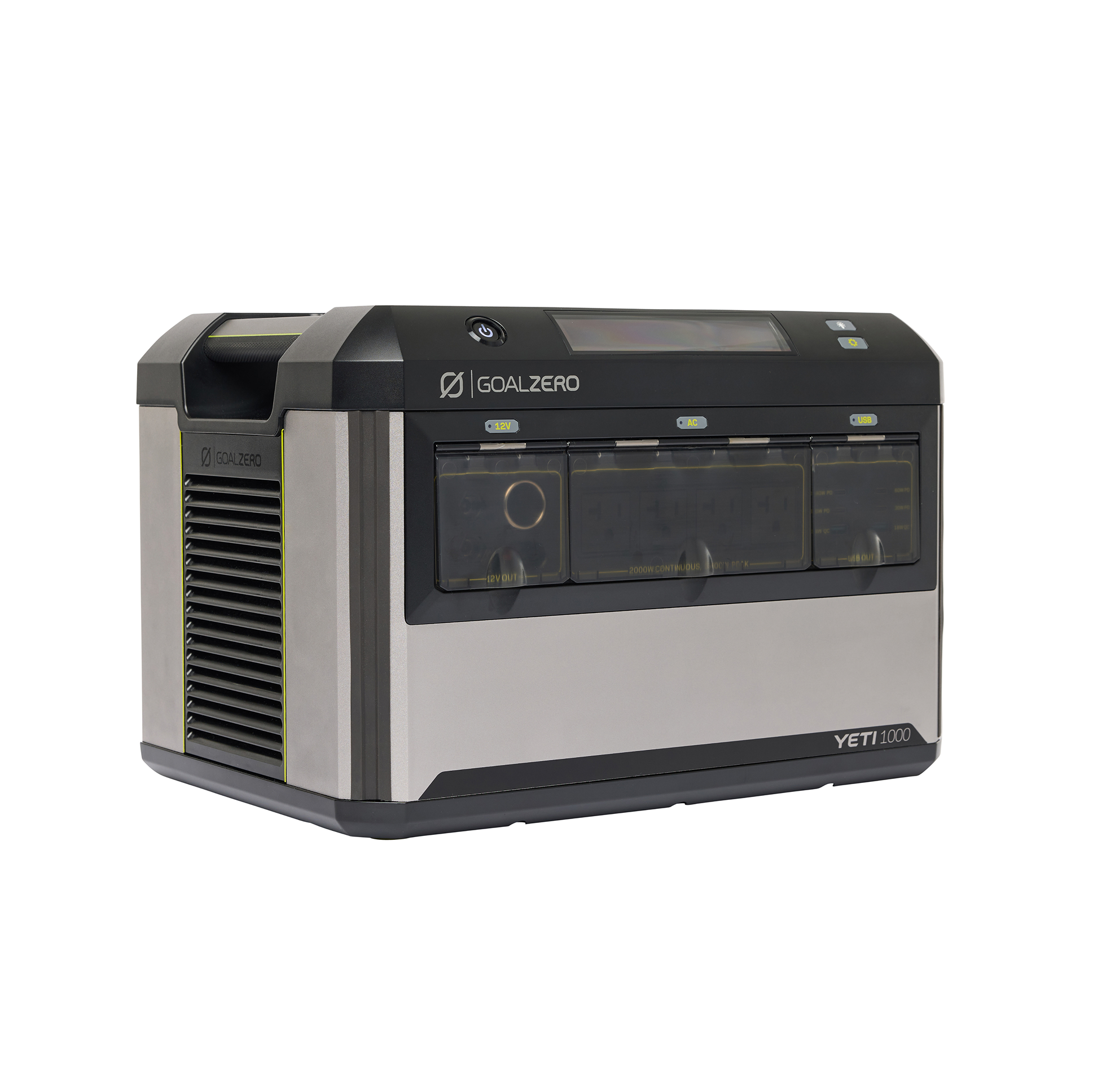
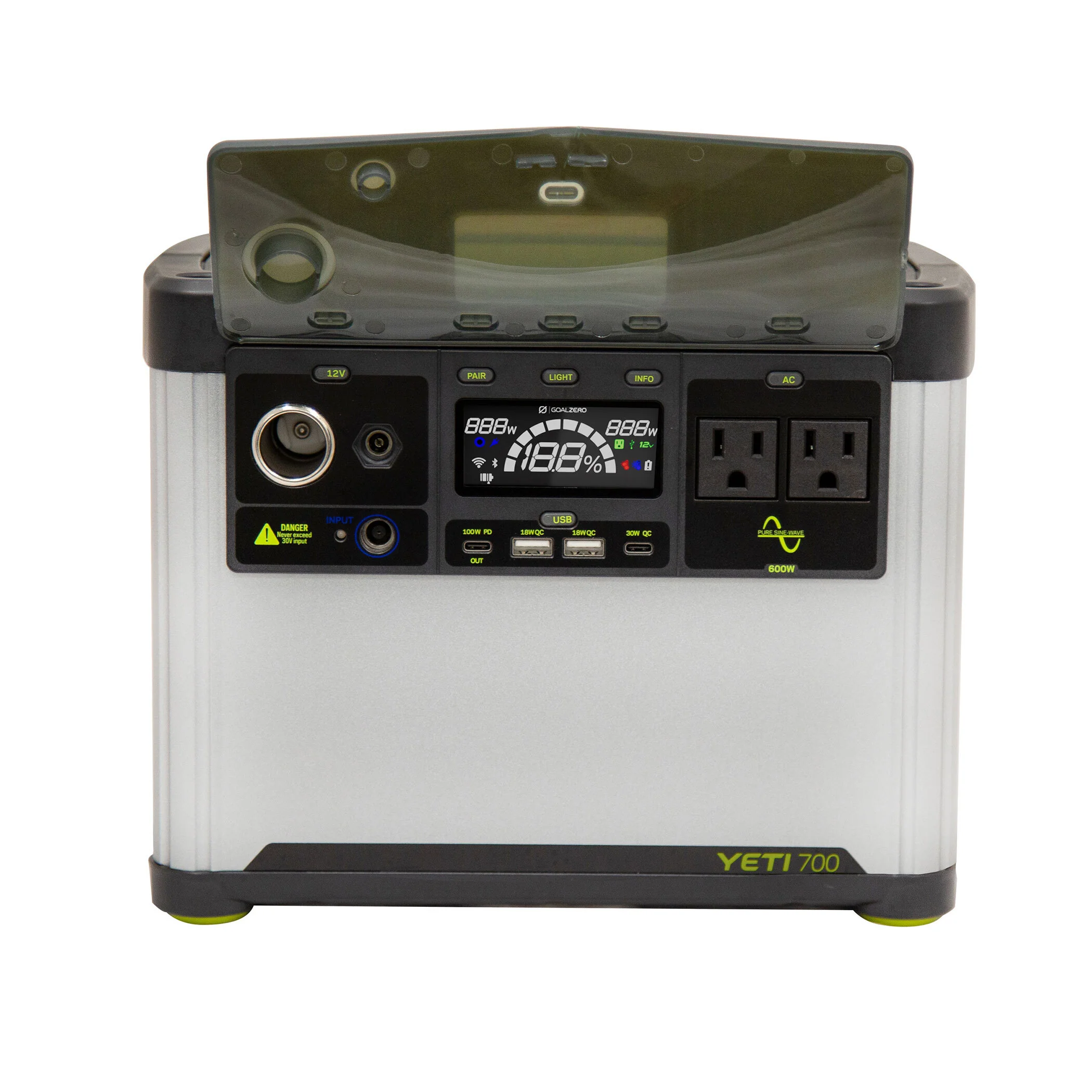
Goal Zero Yeti 1000 (6th Gen) vs Goal Zero Yeti 700
Same brand, same LFP cells, same 4,000-cycle life, but 2,000 watts of output against 600 means the Yeti 1000 runs appliances while the Yeti 700 charges devices, and that split decides everything else on this page.
Full profiles: Goal Zero Yeti 1000 (6th Gen) → · Goal Zero Yeti 700 →

Written by Ian SchneiderUpdated
Solar & Off-Grid Tester, Station Arena Test Desk
Spec deltas
Same brand, same LiFePO4 cells, same 4,000-cycle rating, same 5-year warranty. Then these two Goal Zeros part ways on one spec that reorganizes everything else: the Yeti 1000 6th Gen puts out 2,000 watts, the Yeti 700 just 600. That's not two sizes of one product. It's the difference between a unit that runs appliances and a unit that charges devices.
Everything else lines up behind that split. The 1000 holds 46% more energy (988Wh vs 677Wh), pulls 4.5x the solar input (900W vs 200W), and costs $500 more at $1,200 against $700. The 700 answers with a weight you carry one-handed (20 pounds vs 35) and a slightly lower lifetime cost per kWh. Neither expands, so whichever you pick is the ceiling for good.
So the decision is really one question. If your load list ever includes something with a heating element or a real motor, say a microwave, a coffee maker, or power tools, get the 1000; the 700's 600-watt wall won't start any of them, and you can't upgrade the inverter later. If it's phones, laptops, a CPAP, and camp lights, the 700 does all of it for $500 less and you'll never touch the headroom you didn't buy. Everything below is detail underneath that one line.
What the Numbers Reveal
Each conclusion stated first — the numbers behind it on one line, the full analysis below.
continuous output
Because the two share cells, chemistry, and cycle life, the spec table makes them look like a small and a large version of one product. The 3.3x output gap (2,000W vs 600W) says otherwise: one is a device charger that happens to run a small fridge, the other a genuine appliance unit.
Yeti 1000 6th Gen output: 2,000W continuous, 3,600W surgeYeti 700 output: 600W continuous, 1,000W surgeBoth share Goal Zero brand, LiFePO4 chemistry, and a 4,000-cycle rating
Why it mattersIf a single appliance with a warm plug is anywhere on your list, the 700 is out before capacity, price, or weight even enter the conversation.
solar input
The 1000 takes 4.5x the solar input (900W vs 200W) while holding only 1.46x the capacity, so it tops up inside a single good solar window while the 700 trickles all afternoon to refill less. In a multi-day outage, recharge speed is the survival spec, not capacity.
Yeti 1000 solar input 900W, capacity 988WhYeti 700 solar input 200W, capacity 677Wh
Why it mattersAnyone leaning on panels to ride out an outage or live off-grid should pay up for the 1000's input; it's the number that decides whether you're charged by lunch or still waiting at dusk.
cost / lifetime kWh
That gap is just the $500 price difference spread across less stored energy. The 700 is the cheaper dollar per kWh only if you'd have used its smaller capacity fully anyway; oversize yourself with the 1000 and leave part of its 988Wh unused each cycle, and you've paid the higher rate for energy you didn't need.
Both rated 4,000 cycles, 5-year warranty, about 11 years of daily useYeti 700 lifetime cost $0.26/kWh, Yeti 1000 $0.30/kWhPrice $700 vs $1,200
Why it mattersDon't read the 700's 4-cent edge as the smarter battery. It's the smaller one, priced to match, and the efficiency answer is really a sizing answer.
The specific dimensions that decide these two units — everything else is a tie.
Runtime: Will It Power Your Gear?
Selected because: The gap that actually decides this pair is output: 2,000W on the 1000 against 600W on the 700, which sets what each can physically run.
continuous output
Capacity tells you how long a unit lasts; output tells you whether your appliance turns on at all, and that's where these two separate. The 700's 600W continuous (1,000W on surge) covers a laptop brick, a CPAP, a TV, a small camp fridge. Aim it at a microwave or a hair dryer and nothing happens, because those live above the line. The 1000's 2,000W clears essentially anything you'd plug into a household outlet.
That's why the 46% capacity gap (988Wh vs 677Wh) is the less interesting number here. Two units with the same cells and cycle life read like one product in two sizes, but a 3.3x output difference means they aren't: one charges devices and dabbles in small appliances, the other runs the appliances outright. And since you can't upgrade the inverter later, the 600W ceiling is permanent, so size for it before you buy.
Your Life, Your Pick
Selected because: Our six load tests show neither unit is a whole-house battery; the only clean winner is the tailgate, and even that is close.
Run both through six real loads and the honest headline is humbling: neither covers a weekend of camping (2,100Wh), a full 8-hour blackout (1,645Wh), or a van-life day (4,685Wh). These are batteries for keeping the essentials on, not for running a house. Where they actually diverge is the middle of the range.
The tailgate (670Wh) is the lone clean win, with the 1000 finishing on 170Wh in reserve while the 700 lands 95Wh short, and a CPAP night (320Wh) is a tie both handle with ease. The takeaway: if your scenario sits at the demanding end, the real choice isn't between these two, it's between them and something bigger. Where they genuinely compete is the 300-to-700Wh, one-appliance band, and there the 1000's extra capacity buys the margin the 700 doesn't have.
Lifetime Value
Selected because: The 700 is the cheaper unit to own per lifetime kWh (26 cents against 30), but only because it stores less of the very same battery.
cost / lifetime kWh
The 700 wins the efficiency line, barely: 26 cents per lifetime kWh to the 1000's 30. Before banking that, look at why. Both packs are rated 4,000 cycles, both carry the 5-year warranty, and both should still be cycling in about 11 years of daily use. Longevity is a dead heat, so the gap isn't one lasting longer than the other.
It's the $500 price difference spread across less stored energy, which flips the takeaway. The 700 is the tighter dollar only if you'd have used its smaller capacity fully anyway. Buy the 1000 and routinely leave part of its 988Wh untouched and you've paid the higher rate for energy you didn't need; use all of it and the 46% more capacity is doing real work. The 4-cent edge is a sizing verdict in an efficiency costume.
Portability & Form Factor
Selected because: The 700 is the one you actually carry: 20 pounds against the 1000's 35, and denser with energy per pound.
weight
Fifteen pounds is the line between a grab-and-go and a plan-your-lift. The 700 at 20 pounds rides on one shoulder from the trunk to the campsite; the 1000 at 35 is a two-hand carry you set down once and leave put. For a unit that moves every day, room to room in an outage or site to site on a trip, that weight is something you feel every single time.
And the 700 is the more portable design, not merely the smaller one: it carries about 33Wh per pound to the 1000's 28 (677Wh over 20.3 pounds versus 988Wh over 35.3). The bigger unit is heavier per unit of energy it stores, so if portability is the actual point rather than capacity, the 700 isn't the compromise pick, it's the correct one.
Strengths & trade-offs
Goal Zero Yeti 1000 (6th Gen)
Strengths
- +Larger battery capacity
- +Higher AC output
- +Faster solar charging
Trade-offs
- –Substantially more expensive (+$500) than the Yeti 700.
- –Significantly heavier (+15 lbs), making it harder to move.
Goal Zero Yeti 700
Strengths
- +Costs $500 less
- +Lighter by 15 lb
Trade-offs
- –Weaker inverter (-1,400W) limits appliance compatibility.
Will It Power Your Gear?
Scenario math and per-appliance runtimes, modeled from the spec record.
Scenario verdicts
We ran the math on six real-world scenarios. Here's which unit survives your actual life.
SCN-01 · 2 nights · needs 2,100Wh
Weekend Camping
Two nights off-grid with essential comfort
Neither unit
Neither unit covers this scenario's 2,100Wh: the Yeti 1000 (6th Gen) comes up 1,260Wh short (about 40% covered), the Yeti 700 1,525Wh (27%). Treat this as partial cover — enough for the essentials in it, not the whole list.
Battery budget usedlower = more headroom
LOAD Phone Charger 15W×6h · LED Lights 40W×8h · Box Fan 75W×14h · CPAP Machine 40W×16h
SCN-02 · 8 hours · needs 1,645Wh
8-Hour Blackout
Keep the essentials running through a night without power
Neither unit
Neither unit rides out a full eight hours here; 1,645Wh is simply more than either holds. The 1000 covers about half before it's out (805Wh short), the 700 about a third (1,070Wh short). In practice both are 'keep the fridge, the phones, and the router alive' units rather than 'run the house' ones. The 1000 just lets you keep more of that list on at the same time.
Battery budget usedlower = more headroom
LOAD Fridge 150W×8h · Router + Modem 20W×8h · LED Lights (4 bulbs) 40W×6h · Phone Charger 15W×3h
SCN-03 · 8 hours · needs 320Wh
CPAP Overnight
Sleep therapy without interruption — the #1 medical use case
Either unit
This one's a tie, and capacity isn't why. A CPAP pulls about 40W, so a full night runs roughly 320Wh, and both clear it with plenty in reserve (the 1000 leaves about 520Wh, the 700 about 255Wh). Neither Goal Zero publishes a fan-noise figure, so the thing that actually matters 18 inches from your pillow is unmeasured on both. Decide on price, weight, and which one you'd rather hear at 2 a.m.
Battery budget usedlower = more headroom
LOAD CPAP Machine 40W×8h
SCN-04 · 8 hours · needs 910Wh
Remote Workday
Full work day off-grid without power anxiety
Neither unit
Neither unit covers this scenario's 910Wh: the Yeti 1000 (6th Gen) comes up 70Wh short (about 93% covered) (its nameplate 988Wh actually clears this — the flat 15% conversion allowance is what tips it under), the Yeti 700 335Wh (63%). Either gets you most of the way, so this is a scenario you plan around rather than one you should rule them out for.
Battery budget usedlower = more headroom
LOAD Laptop 60W×8h · External Monitor 30W×8h · Router + Modem 20W×8h · Phone Charger 15W×2h
SCN-05 · 4 hours · needs 670Wh
Tailgate Party
Game day power for the crew
Yeti 1000 (6th Gen)
The one scenario with a clean winner, and it's closer than the result looks. The spread needs 670Wh; the 1000 finishes with 170Wh to spare, the 700 lands 95Wh short. On its nameplate the 700's 677Wh would cover it, and the miss is entirely the flat 15% conversion allowance we hold every unit to, not a defect. Call it a party the bigger battery finishes comfortably and the smaller one very nearly does.
Battery budget usedlower = more headroom
LOAD Blender 400W×0.5h · LED TV (55") 80W×4h · Bluetooth Speaker 15W×4h · Phone Charger (×3) 45W×2h
SCN-06 · 24 hours · needs 4,685Wh
Van Life Daily
A full day of mobile living — the ultimate endurance test
Neither unit
Neither unit covers this scenario's 4,685Wh: the Yeti 1000 (6th Gen) comes up 3,845Wh short (about 18% covered), the Yeti 700 4,110Wh (12%). This is well outside what either unit is for; the right answer here is a larger station, not a choice between these two.
Battery budget usedlower = more headroom
LOAD Mini-Fridge 150W×24h · Laptop 60W×4h · Phone Charger 15W×3h · LED Lights 40W×5h · Fan 75W×8h
The Load Test
RUNTIME = (Wh × 0.85) ÷ LOAD
None of the scenarios above exactly yours? Build it. Toggle what you'd plug in; both units are tested against the combined draw.
Essentials
Comfort & Convenience
High-Draw Appliances
Test duration
8h
Continuous draw
205W
Projected runtime
For this load: Yeti 1000 (6th Gen) runs 4.1h vs 2.8h.
$1,199.95 list · direct from Goal Zero
Planning for more than this? Describe your whole setup and get it sized →
Modeled from the spec record — same math as the tables below. Methodology
Runtime by appliance
Real-world runtime estimates for common appliances, modeled at 85% inverter efficiency.¹
Essentials
The basics you need runningscale 0–56hComfort & Convenience
Makes off-grid life actually enjoyablescale 0–11.2hHigh-Draw Appliances
These reveal the real limitsscale 0–0.8h¹ Runtime = (capacity × 0.85) ÷ appliance watts. Within each group, all bars share one time scale (the group's longest runtime), so lengths are comparable across appliances; identical runtimes collapse into a single blue/orange bar. Actual runtime varies with battery age, temperature, and simultaneous loads — see methodology.
Conclusion
August 30, 2026
Verdict: the Yeti 1000 (6th Gen), on Power Score margin
Take the Yeti 1000 6th Gen if there's any chance your loads cross 600 watts, whether that's a microwave, a coffee maker, power tools, or a larger fridge, because its 2,000W inverter starts them and the 700's 600W won't. It also pulls 4.5x the solar input (900W vs 200W) and holds 46% more energy, which matters for off-grid use and multi-day outages. This is a moderate call, not a rout: if you only charge phones, laptops, a CPAP, and camp lights, the 700 covers every bit of it, weighs 15 pounds less, costs $500 less, and is actually the cheaper unit to own per kWh over its life. The verdict is really a question. Do you run appliances, or charge devices?
Editor-assigned confidence, based on cited owner research and spec analysis.
List prices as of August 30, 2026. The links below open Goal Zero's current price.
$1,199.95 · direct from Goal Zero
Last checked 16 days ago. Prices move — check before you buy.
Written by Ian Schneider, Solar & Off-Grid Tester · Station Arena Test Desk · Updated August 30, 2026
Black Friday · 38 days out
Price to beat:Yeti 1000 (6th Gen) $1,200
We have never seen it discounted, so any real cut would be a first.
Measured Data
Benchmark scores and the full spec record, side by side.
Benchmark scores
Full specifications
ᵈ Derived: price ÷ rated capacity. See the data behind our comparisons →
Comparison ToolAdd more power stations, side by sideOpen Tool →How these numbers are produced
Numeric verification
Every figure on this page traces to our spec database or arithmetic on it — no estimated numbers.
Owner claims
Statements about owner experience are cited to published reviews — see Sources & Research Notes below.
Runtime model
Runtime = (rated capacity × 0.85 inverter efficiency) ÷ device wattage. Solar recharge estimates assume panels deliver 70% of rated output. Cold weather, battery age, and stacked loads reduce real-world results.
Power Score
Computed from 14 published spec dimensions, weighted per use-case bench. Higher is better; a unit must meet a bench's minimum threshold to be rated.
See the full weight table and data sourcing on our methodology page →Class ranking (the star rating)
Each unit's star score is a category ranking, not customer reviews — no buyer opinions feed it. We score every station on size-independent quality (value, output, portability, endurance, ports, warranty, and more), then percentile-rank it against the other units in its capacity class, so a class-leading compact unit and a class-leading whole-home unit can both earn 5★. Here, Yeti 1000 (6th Gen) rates 4.6/5 (74th percentile of 20 Compact-class units), and Yeti 700 rates 3.6/5 (16th percentile of 20 Compact-class units).
How the class ranking is computed →Test Notes & Caveats
Hidden gotchas and advantages we spotted that you won't find on the product page.
A rated class, not a stopwatch
Both double as a UPS, the 1000 rated no worse than 15ms and the 700 no worse than 20ms. Those are ceilings the units promise to stay under, not measured switch times, and both sit well inside what a router, NAS, or desktop shrugs off. The only load that might feel the 5ms on paper is a fussy PC power supply with unsaved work, and even there it's a spec-sheet edge, not a tested one. Fair to note, wrong to let it decide the purchase.
Warranty: No Difference
Both units carry the same 5-year warranty, so coverage isn't a tiebreaker here. Worth saying because the per-dollar framing can suggest otherwise: the Yeti 700 works out at 7.1 years of cover per $1,000 spent against the Yeti 1000 (6th Gen)'s 4.2, but that spread is the price gap, not the terms.
Full record above — the Test Desk pick is the Yeti 1000 (6th Gen).
Check Yeti 1000 (6th Gen) price →or check the Yeti 700 priceOwnership Analysis
What happens after you buy — true cost of ownership, brand trust, and growth potential.
Lifetime value
Service lifeyears at one full cycle per day
Lifetime energy delivered
Cost per delivered kWh
│ warranty ends · Reaching the cycle rating means ~80% capacity remains — degraded, not dead.
Analyst note
Both units have similar long-term ownership costs ($0.30/kWh vs $0.26/kWh). The price difference is what you see on the sticker — neither is a hidden bargain or rip-off. One thing to know reading the table: both carry the same 4,000-cycle rating, so the lifetime rows are sticker price and capacity in disguise — the wear horizon is identical and decides nothing here.
Growth path
Yeti 1000 (6th Gen)
FIXED CAPACITYFixed at 988Wh, with no expansion — so size it for your needs up front rather than planning to add capacity later.
Accepts up to 900W of solar. Suitable for a 1-2 panel setup.
Generous port selection supports complex multi-device setups.
Yeti 700
FIXED CAPACITYFixed at 677Wh, with no expansion — so size it for your needs up front rather than planning to add capacity later.
Accepts up to 200W of solar. Limited to a single portable panel.
Adequate ports for most setups, but heavy users may want a power strip.
Realistic full solar rechargeat 70% of rated panel output — see methodology
Analyst note
Neither expands, and that's no knock on either — each is a complete unit at a fixed size. Buy the capacity that covers your needs now (the Yeti 1000 (6th Gen) gives you the larger ceiling); you can't add to either later.
What Owners Report
Patterns from published owner reports and long-term reviews — every claim cited to its source below.
Goal Zero Yeti 1000 (6th Gen)
There's no field data on the Yeti 1000 6th Gen yet. No independent hands-on reviews, forum threads, or long-term owner reports for this exact SKU (988Wh LFP, 2,000W, 4,000-cycle) surfaced in our research; Goal Zero's own page lists it sold out with a single review hidden behind a script widgetA0. So read everything on this page about the 1000 as spec-sheet, not lived experience. The numbers are the manufacturer's, and nobody has yet reported back on how its fan behaves at 2 a.m. or how the 900W solar input holds up over a hard winter.
Goal Zero Yeti 700
Coverage on the 700 is thin and leans on published specs and early review-site writeups rather than a deep bench of long-term owners. What exists is consistent: reviewers frame it as a light, simple, portability-first unit, good for quick camping trips and keeping devices topped up, explicitly not the one you buy for power or capacityB3. Its LFP pack is rated for 4,000+ cycles, which pencils out to a decade-plus of daily use, and it carries an IPX4 splash rating for the campsiteB1B2. No reliability red flags have surfaced, but this is a newish 6th-gen unit, so treat the ruggedness and longevity as well-sourced spec rather than years of proof.
“A 6th-generation 677Wh compact power station on upgraded LiFePO4 chemistry rated for 4,000+ cycles — daily use for over 10 years.”
Sources
goalzero.com · amazon.com · campingsolar.us · outdoorgearlab.com
Sources & Research Notes
Every owner claim in this report is traceable to a published source. The bracketed references above resolve here.
Recurring owner themes
- Modern LFP (4,000+ cycles), IPX4 ruggedness, and light, simple portability are the highlights; modest power and capacity. [Yeti 700 · 3 entries]
- B1
“A 6th-generation 677Wh compact power station on upgraded LiFePO4 chemistry rated for 4,000+ cycles — daily use for over 10 years.”
goalzero.com / amazon.com — Yeti 700 · 2026 · [positive]
- B2
“Carries an IPX4 water-resistance rating and can handle extreme temperatures — a rugged, outdoor-ready design.”
goalzero.com / campingsolar.us — Yeti 700 review · 2026 · [positive]
- B3
“Ideal for quick camping trips and device charging — not the most powerful or capable, but lightweight and simple, appealing to portability-focused users.”
outdoorgearlab.com — Yeti 700 review · 2026 · [mixed]
Research compiled August 30, 2026.
Who Should Buy Which
Buy the Yeti 1000 (6th Gen) if you…
- →Buy the 1000 if any appliance is on your list, like a camp coffee maker, a microwave in the van, or a circular saw on a job site. Its 2,000W inverter starts them; the 700's 600W can't.
- →Buy it if you lean on solar for outages or off-grid stretches. The 900W input tops it up in a fraction of the time the 700's 200W can manage, which is the difference between charged by lunch and waiting for tomorrow.
- →Buy it if you're honestly unsure whether your loads cross 600 watts. The 1000 can't be excluded by a load the way the 700 can, so it's the safer bet when you can't predict what you'll plug in.
Buy the Yeti 700 if you…
- →Buy the 700 if you charge devices rather than run appliances: phones, laptops, a CPAP, camp lights, a small fridge. It covers all of that and you'll never reach the 600W ceiling.
- →Buy it if you carry the unit constantly. At 20 pounds it's a one-handed grab from car to campsite, and it saves you $500 and 15 pounds over the 1000.
- →Buy it if your trips are short and simple and you want the lighter, cheaper tool that does exactly enough.
If neither fits
Skip both if your real need is whole-house or multi-day. The scenarios make it plain: a van-life day wants 4,685Wh and a full 8-hour blackout 1,645Wh, and neither unit finishes either, so both are partial-coverage, essentials-only batteries. If you're powering a fridge plus heat plus cooking for days, look at a 2,000Wh-plus station or an expandable platform instead of choosing between these two.
The Bottom Line
So it comes down to the inverter. The Yeti 1000's 2,000 watts run the microwave, the coffee maker, and the power tools; the 700's 600 run the laptop and the lights and then hit a wall. Same brand, same LFP cells, same 4,000 cycles and 5-year warranty, and none of that is the decision. The output is.
Get the 1000 if there's an appliance anywhere in your future, or if you're counting on solar to carry you through an outage, since its 900W input tops up in a fraction of the time. Get the 700 if you're charging devices and hauling the unit yourself, and pocket the $500 and 15 pounds with a clear conscience. Just be honest about which buyer you are before checkout, because neither Yeti lets you change your mind later.
Frequently Asked Questions
Answers drawn from the spec record and cited owner research.
Can the Yeti 700 run a microwave or a space heater?
No. The 700 tops out at 600W continuous and 1,000W on surge, and microwaves, kettles, hair dryers, and space heaters all draw more than that, so they won't start. The Yeti 1000 6th Gen, with 2,000W continuous and 3,600W surge, runs them without trouble. If appliances are on your list, that single fact settles the choice.
Is the Yeti 1000 6th Gen worth $500 more than the Yeti 700?
Only if you'll use what the extra buys. Both units share the brand, LFP chemistry, 4,000-cycle rating, and 5-year warranty, so the premium goes toward 46% more capacity (988Wh vs 677Wh), a 3.3x bigger inverter (2,000W vs 600W), and 4.5x the solar input (900W vs 200W). Use those and it's money well spent; leave them idle and the 700 is the tighter dollar at 26 cents per lifetime kWh against 30.
Which is better for running a CPAP overnight?
Both handle it easily, so this isn't the deciding use. A CPAP pulls roughly 40W, or about 320Wh across a night, and each unit clears that with capacity to spare. Neither publishes a fan-noise figure, so choose on price, weight, and which one you'd rather have humming on the nightstand.
How fast does each recharge from solar?
On paper, the 1000 refills in just over an hour of strong sun at its 900W input (988Wh), while the 700 takes about three and a half hours at 200W (677Wh); real conditions are slower for both. The 1000's much higher solar ceiling is one of the strongest reasons to pick it for off-grid or multi-day outage use.
Can you expand either Yeti with extra batteries?
No. Both are sealed at their rated size, 988Wh for the 1000 and 677Wh for the 700, with no add-on battery support. That's not a flaw; each is a complete unit. It just means you should buy the capacity you need now, because the size you choose is permanent.
Where to buy
Goal Zero Yeti 1000 (6th Gen)Pick
$1,199.95
$1,199.95 · direct from Goal Zero
Last checked 16 days ago. Prices move — check before you buy.
Goal Zero Yeti 700
Sold on Amazon · today’s price is on the listing
Prices may vary by retailer and are subject to change.