Head-to-head test
EcoFlow DELTA 3 vs Goal Zero Yeti 1000 (6th Gen)
Two 4,000-cycle packs within 36Wh of each other and one of them costs nearly double, so the only question that survives is whether you refill from panels, because the Yeti's 900W solar input is the single thing on this page money can't add to the DELTA 3 later.
Full profiles: EcoFlow DELTA 3 → · Goal Zero Yeti 1000 (6th Gen) →

Written by Ian SchneiderUpdated
Solar & Off-Grid Tester, Station Arena Test Desk
Spec deltas
The DELTA 3 holds 1,024Wh and the Yeti 1000 (6th Gen) holds 988Wh. Both are rated for 4,000 cycles, both surge to 3,600W, both carry five years of warranty, and the Yeti asks $571 more for the smaller pack, nearly double the DELTA 3's $629. That puts the burden of proof entirely on Goal Zero.
Goal Zero does have answers, and they deserve naming before the price does its work. The Yeti takes 900W of solar against the DELTA 3's 500W, runs 2,000W continuous against 1,800W, and puts 140W of USB-C across four ports where the DELTA 3 puts 100W across two. If your day is a laptop and a panel, those are the three specs that will actually touch you.
They don't touch most people, and the rest of the sheet runs the other way: 8.3 lb lighter, six AC outlets against four, a tighter rated UPS ceiling, a published noise figure where the Yeti has none, and room for expansion batteries the sealed Yeti can't take. The honest caveat sits on both sides. Published testing of the standard DELTA 3 is preliminary, because most hands-on work covers its Plus, Max and Ultra siblingsA0, and for this exact Yeti SKU our research turned up no hands-on coverage at allB0. Buy the DELTA 3.
What the Numbers Reveal
Each conclusion stated first — the numbers behind it on one line, the full analysis below.
cost / lifetime kWh
Fifteen cents a lifetime kilowatt-hour against thirty. Double the cost for energy within 4% of the same, over the same 4,000 cycles, under the same five-year term. Cycle either pack every weekend and 4,000 cycles is 38.5 years, which means the battery is not the component that fails first on either unit. Longevity can't be the argument for the premium.
DELTA 3: 1,024Wh x 4,000 cycles = 4,096kWh of lifetime throughputYeti 1000 (6th Gen): 988Wh x 4,000 cycles = 3,952kWhCost per lifetime kilowatt-hour: $0.15 for the DELTA 3, $0.30 for the YetiBoth units carry a 5-year warranty
Why it mattersIf you were paying up for a battery that lasts, stop here. The cheaper one lasts exactly as long.
solar input
500W is a port ceiling, not a panel budget. Buying more panels doesn't raise it, so the DELTA 3's refill stays at roughly twice the Yeti's no matter what you spend afterwards. That's the one advantage here that money can't undo later. No roof delivers rated input, so treat the ratio as the honest part and the hours as optimistic.
The 8-hour blackout profile draws 1,645Wh; the DELTA 3 falls 775Wh short and the Yeti 805Wh short, against 870Wh and 840Wh of usable energy after the flat 85% derateSolar input: 900W on the Yeti, 500W on the DELTA 3Capacity: 1,024Wh on the DELTA 3, 988Wh on the Yeti
Why it mattersIf your plan is three days grid-down with panels on the lawn, the premium is buying something real. If you'll be refilling from a wall socket, it's buying nothing.
weight
27 lb is a one-hand carry from the car. 35.3 lb is the one you set down to open the door. Do that twice a weekend for three years and those 8.3 lb are the spec you remember, particularly since the lighter box is also the one with two more sockets to plug into.
Tailgate profile: 670Wh needed at a 400W peak; both pass, leaving about 200Wh usable on the DELTA 3 and 170Wh on the YetiWeight: 27 lb for the DELTA 3, 35.3 lb for the YetiAC outlets: six on the DELTA 3, four on the Yeti
Why it mattersEvent and campsite buyers: the Yeti's headroom is real and irrelevant at these loads, so buy the one you'd rather carry.
The specific dimensions that decide these two units — everything else is a tie.
Lifetime Value
Selected because: Both packs carry the same 4,000-cycle rating, so the price gap lands entirely on what each kilowatt-hour ends up costing you.
cost / lifetime kWh
Cycle life usually settles these pages. Here it settles nothing, because both packs are rated for 4,000 cycles and both terms run five years, so the premium doesn't buy a longer life or a longer safety net. What it buys is the same energy at twice the price per kilowatt-hour over the life of the box.
Another way to feel the gap: $571 is not far off the price of a whole second DELTA 3 at $629. Whatever the Yeti does better, it has to be worth roughly the entire cheaper unit, and the three things it does better are a solar input, 200W of inverter headroom and a faster USB-C port.
Your Life, Your Pick
Selected because: Four of the six profiles come back as neither unit covering the load, so what matters is how each one falls short and how fast it refills.
At roughly 1,000Wh you're buying an evening, not a weekend, and the profiles say so bluntly. Weekend camping wants 2,100Wh and the DELTA 3 covers 41% of it. Van life wants 4,685Wh and neither unit reaches a fifth. Where they do land they land together: a CPAP night spends a bit over a third of either one's derated usable energy, and a tailgate leaves both with reserve.
Only two rows are worth arguing over. The blackout, where neither finishes and refill speed decides how you live with the shortfall. And the remote workday, where the DELTA 3 misses a 910Wh day by 40Wh and the Yeti by 70Wh, which is a rounding error you fix by unplugging one thing rather than by buying a bigger battery.
What the Specs Don't Tell You
Selected because: These four cards hold most of the real difference: expansion, the two rated UPS ceilings, identical warranties, and one unit publishing a noise figure the other doesn't.
Three of these four cards tilt the same way and the fourth is a genuine dead heat. The Yeti is sealed where the DELTA 3 can grow, the DELTA 3 holds the tighter rated UPS ceiling, and only the DELTA 3 publishes a noise figure, which is a disclosure difference rather than proof about volume. The warranty card is a true tie, five years each.
The card that doesn't fire is the one that matters most against our pick. Nothing here flags the DELTA 3's solar input ceiling, and that is the single spec where the Yeti is plainly better and the DELTA 3 can never be upgraded past. If you read one thing on this page against the DELTA 3, read that.
Brand Trust
Selected because: The Yeti's premium is nominally a brand premium, so this is the column where it has to be earned.
Goal Zero's case here is heritage, and it's real: a Salt Lake City company, NRG-owned, that more or less invented this category and still builds ruggedized gear that talks to its own coolers, lights and vehicle kits. The premium price traditionally rode on premium support. That's the part that has slipped from the standard Goal Zero itself set, and the official community forums are now closed, which matters on the night you need an answer quickly.
EcoFlow's column isn't clean either, and the catch deserves naming before you spend: it offers no parts or service out of warranty, and its support record is polarized rather than uniformly good. What it has is scale, 12 to 15 models across the DELTA and RIVER lines, the expansion batteries this comparison turns on, and a subreddit around 31,000 strong that answers questions at midnight. At nearly double the price, Goal Zero needed to win this column outright, and it doesn't.
Strengths & trade-offs
EcoFlow DELTA 3
Strengths
- +Costs $571 less
- +Lighter by 8.3 lb
- +Larger battery capacity
Trade-offs
- –No major technical downsides compared to rival.
Goal Zero Yeti 1000 (6th Gen)
Strengths
- +Higher AC output
- +Faster solar charging
Trade-offs
- –Substantially more expensive (+$571) than the DELTA 3.
- –Sealed capacity — the DELTA 3 can add batteries to grow past 988Wh; this one can't.
Will It Power Your Gear?
Scenario math and per-appliance runtimes, modeled from the spec record.
Scenario verdicts
We ran the math on six real-world scenarios. Here's which unit survives your actual life.
SCN-01 · 2 nights · needs 2,100Wh
Weekend Camping
Two nights off-grid with essential comfort
Neither unit
Neither unit covers this scenario's 2,100Wh: the DELTA 3 comes up 1,230Wh short (about 41% covered), the Yeti 1000 (6th Gen) 1,260Wh (40%). Treat this as partial cover — enough for the essentials in it, not the whole list.
Battery budget usedlower = more headroom
LOAD Phone Charger 15W×6h · LED Lights 40W×8h · Box Fan 75W×14h · CPAP Machine 40W×16h
SCN-02 · 8 hours · needs 1,645Wh
8-Hour Blackout
Keep the essentials running through a night without power
Neither unit
Neither unit finishes this night. It draws 1,645Wh, the DELTA 3 falls 775Wh short and the Yeti 805Wh short, so both get you roughly halfway and then you start rationing. Which means the spec that decides this row isn't capacity at all. It's how fast tomorrow puts the energy back, and this is the one row where the Yeti's much larger solar input earns its money: the unit that refills in half the sun-hours is the unit you'd rather have on day three.
Battery budget usedlower = more headroom
LOAD Fridge 150W×8h · Router + Modem 20W×8h · LED Lights (4 bulbs) 40W×6h · Phone Charger 15W×3h
SCN-03 · 8 hours · needs 320Wh
CPAP Overnight
Sleep therapy without interruption — the #1 medical use case
Either unit
A CPAP pulls about 40W for eight hours, so 320Wh covers the night on both units with roughly two thirds of their derated usable energy still untouched by morning. Capacity is settled before you get into bed. What isn't settled is the fan eighteen inches from your head at 2 a.m.: the DELTA 3 publishes a 30dB spec-sheet figure and the Yeti 1000 (6th Gen) publishes nothing at all. That isn't evidence the Yeti is louder. It's evidence that nobody has told you either way, which is its own kind of answer when you're the one trying to sleep.
Battery budget usedlower = more headroom
LOAD CPAP Machine 40W×8h
SCN-04 · 8 hours · needs 910Wh
Remote Workday
Full work day off-grid without power anxiety
Neither unit
Nobody finishes the 910Wh workday. The DELTA 3 comes within 40Wh of it and the Yeti stops 70Wh out, and at that margin you aren't shopping for a bigger battery, you're unplugging one thing in the late afternoon or accepting a shorter evening. The Yeti's counter is its ports: 140W across four USB-C jacks against 100W across two is a real difference at a desk with two laptops on it. It still runs out 30Wh sooner.
Battery budget usedlower = more headroom
LOAD Laptop 60W×8h · External Monitor 30W×8h · Router + Modem 20W×8h · Phone Charger 15W×2h
SCN-05 · 4 hours · needs 670Wh
Tailgate Party
Game day power for the crew
Either unit
Both cruise through game day, and a 400W peak doesn't trouble ratings of 1,800W and 2,000W. With 670Wh needed the DELTA 3 finishes with about 200Wh of usable energy left and the Yeti about 170Wh, so capacity settles nothing here either. What settles it is the walk from the car, and the DELTA 3 is the one you carry in one hand.
Battery budget usedlower = more headroom
LOAD Blender 400W×0.5h · LED TV (55") 80W×4h · Bluetooth Speaker 15W×4h · Phone Charger (×3) 45W×2h
SCN-06 · 24 hours · needs 4,685Wh
Van Life Daily
A full day of mobile living — the ultimate endurance test
Neither unit
Neither unit covers this scenario's 4,685Wh: the DELTA 3 comes up 3,815Wh short (about 19% covered), the Yeti 1000 (6th Gen) 3,845Wh (18%). This is well outside what either unit is for; the right answer here is a larger station, not a choice between these two.
Battery budget usedlower = more headroom
LOAD Mini-Fridge 150W×24h · Laptop 60W×4h · Phone Charger 15W×3h · LED Lights 40W×5h · Fan 75W×8h
The Load Test
RUNTIME = (Wh × 0.85) ÷ LOAD
None of the scenarios above exactly yours? Build it. Toggle what you'd plug in; both units are tested against the combined draw.
Essentials
Comfort & Convenience
High-Draw Appliances
Test duration
8h
Continuous draw
205W
Projected runtime
Dead heat — both run this 205W load for roughly 4.2h. Pick on price, weight, or ports.
Planning for more than this? Describe your whole setup and get it sized →
Modeled from the spec record — same math as the tables below. Methodology
Runtime by appliance
Real-world runtime estimates for common appliances, modeled at 85% inverter efficiency.¹
Essentials
The basics you need runningscale 0–58hComfort & Convenience
Makes off-grid life actually enjoyablescale 0–11.6hHigh-Draw Appliances
These reveal the real limitsscale 0–0.9h¹ Runtime = (capacity × 0.85) ÷ appliance watts. Within each group, all bars share one time scale (the group's longest runtime), so lengths are comparable across appliances; identical runtimes collapse into a single blue/orange bar. Actual runtime varies with battery age, temperature, and simultaneous loads — see methodology.
Conclusion
September 19, 2026
Verdict: the DELTA 3
Buy the DELTA 3. It holds more energy than the Yeti's sealed ceiling (1,024Wh against 988Wh), carries the same 4,000-cycle rating and the same five-year warranty, weighs 8.3 lb less, gives you six AC outlets instead of four, holds the tighter rated UPS ceiling, and asks $571 less. Over the life of the pack its energy costs $0.15 per kilowatt-hour against the Yeti's $0.30, and nothing in the Yeti's own numbers earns that back. Goal Zero wins three specs outright: 900W of solar input against 500W, 2,000W of continuous output against 1,800W, and 140W of USB-C across four ports against 100W across two. The first of those is the only one that should ever change your answer, because it's the one the DELTA 3 can't be upgraded past. Confidence sits at eight rather than nine because field evidence is thin on both sides: published testing of the standard DELTA 3 is preliminaryA0, and for this exact Yeti SKU there is none at allB0, so both units are being judged largely on paper.
Editor-assigned confidence, based on cited owner research and spec analysis.
List prices as of September 19, 2026. The links below open EcoFlow's and Goal Zero's current prices.
$629.00 · direct from EcoFlow
Last checked 16 days ago. Prices move — check before you buy.
or check the Yeti 1000 (6th Gen) price$1,199.95 list
Written by Ian Schneider, Solar & Off-Grid Tester · Station Arena Test Desk · Updated September 19, 2026
Black Friday · 38 days out
Prices to beat:DELTA 3 $519Yeti 1000 (6th Gen) $1,200
The lowest we have recorded for each. We have never seen the Yeti 1000 (6th Gen) discounted, so any real cut on it would be a first.
Measured Data
Benchmark scores and the full spec record, side by side.
Benchmark scores
Not rated for both units (minimum threshold unmet): RV Living, Home Backup, Food Truck.
Full specifications
ᵈ Derived: price ÷ rated capacity. See the data behind our comparisons →
Comparison ToolAdd more power stations, side by sideOpen Tool →How these numbers are produced
Numeric verification
Every figure on this page traces to our spec database or arithmetic on it — no estimated numbers.
Owner claims
Statements about owner experience are cited to published reviews — see Sources & Research Notes below.
Runtime model
Runtime = (rated capacity × 0.85 inverter efficiency) ÷ device wattage. Solar recharge estimates assume panels deliver 70% of rated output. Cold weather, battery age, and stacked loads reduce real-world results.
Power Score
Computed from 14 published spec dimensions, weighted per use-case bench. Higher is better; a unit must meet a bench's minimum threshold to be rated.
See the full weight table and data sourcing on our methodology page →Class ranking (the star rating)
Each unit's star score is a category ranking, not customer reviews — no buyer opinions feed it. We score every station on size-independent quality (value, output, portability, endurance, ports, warranty, and more), then percentile-rank it against the other units in its capacity class, so a class-leading compact unit and a class-leading whole-home unit can both earn 5★. Here, DELTA 3 rates 4.5/5 (73rd percentile of 27 Everyday-class units), and Yeti 1000 (6th Gen) rates 4.6/5 (74th percentile of 20 Compact-class units).
How the class ranking is computed →Test Notes & Caveats
Hidden gotchas and advantages we spotted that you won't find on the product page.
Expansion: the Yeti's Ceiling Is the Number on the Box
The Yeti 1000 (6th Gen) is sealed at 988Wh, and the DELTA 3's base pack already holds 1,024Wh, more than the Yeti's maximum before anything is bolted on. EcoFlow expansion batteries go on top of that. Keep the ambition honest: at this size expansion buys longer runtimes on the same loads, not a home-backup system. The point isn't that the DELTA 3 becomes a house battery. It's that the Yeti's capacity is fixed on the day you buy it and the DELTA 3's isn't.
UPS: Two Published Ceilings, No Worse Than 10ms and 15ms
Both units have a UPS mode, and both figures are rated ceilings rather than stopwatch results: the DELTA 3 is specified at no worse than 10ms, the Yeti 1000 (6th Gen) at no worse than 15ms. Five milliseconds of paper is a thin thing to buy on, and for a router, a modem or a TV neither rating is in question. It only gets interesting at the fussiest desktop power supplies, which sit about where the Yeti's ceiling is. If the thing being protected is a PC with unsaved work, the tighter specification is the safer bet, with the caveat that neither of these has been timed here.
Warranty: No Difference
Both units carry the same 5-year warranty, so coverage isn't a tiebreaker here. Worth saying because the per-dollar framing can suggest otherwise: the DELTA 3 works out at 7.9 years of cover per $1,000 spent against the Yeti 1000 (6th Gen)'s 4.2, but that spread is the price gap, not the terms.
Yeti 1000 (6th Gen): Noise Level Not Disclosed
The DELTA 3 publishes its noise level (30dB); the Yeti 1000 (6th Gen) doesn't publish one. That isn't evidence the Yeti 1000 (6th Gen) is louder — it means there's no figure to hold it to, and no way to compare the two on this without hearing them. If you're buying for a bedroom, a CPAP, or an apartment, treat the DELTA 3's 30dB as the only published number on the table — a spec-sheet figure, not a measurement — and look for hands-on reports of the Yeti 1000 (6th Gen) before deciding.
Full record above — the Test Desk pick is the DELTA 3.
Check DELTA 3 price →or check the Yeti 1000 (6th Gen) priceOwnership Analysis
What happens after you buy — true cost of ownership, brand trust, and growth potential.
Lifetime value
Service lifeyears at one full cycle per day
Lifetime energy delivered
Cost per delivered kWh
│ warranty ends · Reaching the cycle rating means ~80% capacity remains — degraded, not dead.
Analyst note
The DELTA 3 wins on both sticker price and long-term value. At $0.15/kWh over its lifetime, it's meaningfully cheaper to own. Clear value winner. One thing to know reading the table: both carry the same 4,000-cycle rating, so the lifetime rows are sticker price and capacity in disguise — the wear horizon is identical and decides nothing here.
Delivers each lifetime kWh for $0.15 less — check the DELTA 3 price →
Brand trust
EcoFlow
Ecosystem
Largest in portable power — 12-15 models across DELTA Pro, DELTA 3, and RIVER 3 series, plus solar panels and smart home panels
Support
US-based phone/email/chat support (1-800-368-8604). Experiences are polarized — many report hassle-free prepaid-label replacements, but others report long waits and refurbished units sent for new claims. Pro tip: buying from Costco or Amazon gives you a stronger return safety net.
Community
Largest community in the space — Reddit r/Ecoflow_community (~31K members), multiple Facebook groups, and an official community forum
App experience
Rated 4.6/5 iOS (~8,400 ratings) · 4.2/5 Android (~17,000 ratings)
Unique strength
Fastest-charging technology (X-Stream), deepest product ecosystem, and most active innovation cadence. At the top of the range sit two whole-home paths: the TITAN line, one 5 kWh unit that grows to 30 kWh, and the DELTA Pro Ultra platform, which stacks batteries and inverters further — flagship paths, not line-wide features.
Worth knowing
Tested subscription paywalls for advanced app features in early 2025 before community backlash paused the plan. No parts or service offered out of warranty.
Goal Zero
Ecosystem
Focused rather than sprawling. The current line is the 6th-gen Yeti and Yeti Pro stations, with Sherpa power banks below the 100Wh mark, Nomad and Ranger solar panels, Alta coolers, and vehicle integration kits built to work with them. It's a catalogue built around the station rather than a catalogue of stations.
Support
US-based company (Salt Lake City, owned by NRG Energy). Historically considered premium support, but 2025-2026 reports describe long wait times, unresponsive email communication, and tickets going unaddressed for weeks. The "premium support justifies premium pricing" argument is weakening.
Community
Small but loyal — strong following in overlanding and preparedness communities. Official community forums were recently shuttered, frustrating long-time users.
App experience
Rated 4.4/5 iOS (~1,200 ratings) but recent reviews skew negative — recurring connectivity issues, crashes, and stability problems.
Unique strength
Pioneer of the portable power market — strongest brand heritage. US-based company with ruggedized, weather-resistant designs (IP ratings vary by model). Integrated "Yeti-Ready" ecosystem with coolers, lights, and vehicle kits.
Worth knowing
Typically the priciest brand per watt-hour — though individual pairings vary, and on some pages the Yeti is the cheaper energy. Support quality has declined from its "premium" standard. Perceived as competitively stagnant vs. faster-innovating Chinese competitors. Reliability reports on newer models are concerning.
Analyst note
EcoFlow and Goal Zero are close competitors. Both have established support channels and growing ecosystems. Compare their specific warranty terms and community size for your peace of mind.
Growth path
DELTA 3
EXPANDABLESupports EcoFlow expansion batteries, so you can add capacity later without replacing the base unit — useful if your needs may climb past 1,024Wh.
Accepts up to 500W of solar. Suitable for a 1-2 panel setup.
Generous port selection supports complex multi-device setups.
Expansion batteries are EcoFlow-specific. You're investing in the EcoFlow ecosystem.
Yeti 1000 (6th Gen)
FIXED CAPACITYFixed at 988Wh, with no expansion — so size it for your needs up front rather than planning to add capacity later.
Accepts up to 900W of solar. Suitable for a 1-2 panel setup.
Generous port selection supports complex multi-device setups.
Realistic full solar rechargeat 70% of rated panel output — see methodology
Analyst note
The Yeti 1000 (6th Gen) is sealed at 988Wh, which is fine if that covers you. The DELTA 3 starts at 1,024Wh and can grow beyond it with EcoFlow expansion batteries — though at this size expansion means longer runtimes on the same loads, not a path to home backup. More hours, not more house.
What Owners Report
Patterns from published owner reports and long-term reviews — every claim cited to its source below.
EcoFlow DELTA 3
The fans are the finding worth having. Under 200W the DELTA 3's fans often don't spin at all, and between 500W and 800W they're barely audible from three feet awayA1. For a box that might live in a bedroom, that's the single most useful thing anyone has published about it.
It's also close to the only thing. Hands-on work on the standard DELTA 3 is thin because most of it covers the Plus, Max and Ultra variants, which differ in capacity and fan behavior, so treat sentiment here as preliminaryA0. The one UPS account we have, with routers not resetting and a fridge not skipping a compressor cycle through a cut, was observed on a sibling that shares the same rated ceiling of no worse than 10ms, which makes it character rather than proof for this SKUA2A0.
“At low loads (under 200W) the fans often stay completely off, making the Delta 3 effectively silent; under moderate load (500–800W) the fans are barely audible from three feet away.”
Sources
portablepowernerd.com · thesolarlab.com · outputreport.com
Goal Zero Yeti 1000 (6th Gen)
There is no field experience to report, and that's a finding rather than an omission. Our research ran about 25 targeted searches across press, YouTube, DIY solar forums and van-life communities and found no hands-on review, forum thread or owner report specific to this SKUB0. Every Yeti 1000 write-up that surfaced turned out to be about the Core, the 1000X or the original Lithium, and was excluded rather than misattributedB0. Even the sibling Yeti 1500 6th Gen's coverage doesn't touch this modelB0.
None of that is a strike against the unit. It's a new SKU, and silence is the correct reading of a short shelf life, not a warning. It does mean everything said about the Yeti here comes off a spec sheet, which is worth knowing when the spec sheet is asking for nearly double the moneyB0.
Sources & Research Notes
Every owner claim in this report is traceable to a published source. The bracketed references above resolve here.
- A1
“At low loads (under 200W) the fans often stay completely off, making the Delta 3 effectively silent; under moderate load (500–800W) the fans are barely audible from three feet away.”
portablepowernerd.com — EcoFlow Delta 3 Tested: 2026 Hands-On Review; thesolarlab.com · 2026 · [positive]
- A2
“UPS switchover works as advertised — a power cut results in a ~10ms handoff, fast enough that routers don't reset, fridges don't skip a compressor cycle, and CPAP machines don't interrupt therapy.”
outputreport.com / thesolarlab.com — DELTA 3 line UPS testing (observed on DELTA 3 Plus, which shares the 10ms UPS spec) · 2026 · [positive]
Research compiled September 19, 2026.
Who Should Buy Which
Buy the DELTA 3 if you…
- →You refill from a wall socket or a car and you want the evening covered for the least money: 1,024Wh, 1,800W, six outlets, 27 lb.
- →The unit sleeps in the bedroom. It's the only one of the two with a published noise figure, and the only one with any field reporting on how its fans behave at low loadA1.
- →You suspect 1,024Wh won't be enough in a year. Expansion batteries give the DELTA 3 somewhere to go, and at this size that means longer runtimes on the same loads rather than a home-backup system.
- →You carry it more than you use it, between the tailgate, the campsite and the trunk. It's the one you'd rather be holding at the top of the basement stairs.
Buy the Yeti 1000 (6th Gen) if you…
- →Panels are your only refill and you cycle the pack daily. The Yeti comes back in about half the sun-hours, and it's the one spec the DELTA 3 can't be upgraded into.
- →You have a load sitting between 1,800W and 2,000W continuous, the narrow band the Yeti runs and the DELTA 3 refuses.
- →Your desk has two USB-C laptops on it, where 140W across four ports beats 100W across two.
If neither fits
If your list looks like the weekend camping profile at 2,100Wh or the van-life one at 4,685Wh, close this tab. The DELTA 3 covers 41% of the camping load and neither unit reaches a fifth of van life, so this is a 2,000Wh-and-up purchase. Buying two of these instead of one larger station leaves you with two things to carry and two things to charge.
The Bottom Line
Fifteen cents a lifetime kilowatt-hour against thirty, for two packs rated to the same 4,000 cycles and covered by the same five years. The Yeti 1000 (6th Gen) is a competent box that does three things better, 900W of solar input, 200W more continuous output and 140W of USB-C, and it asks nearly double for the privilege while weighing more and topping out below where the DELTA 3 starts.
Buy the DELTA 3. The one honest exception is the buyer who refills from the sun every day, because 500W is a hard ceiling and the Yeti's answer to it is the only thing on this page you can't buy your way to later. If that isn't you, the cheaper unit is also the lighter one, the higher-capacity one, and the only one anybody has actually plugged in and listened toA1.
Frequently Asked Questions
Answers drawn from the spec record and cited owner research.
Is the Goal Zero Yeti 1000 (6th Gen) worth nearly double the EcoFlow DELTA 3?
Only if you refill from solar, where its panel input is roughly double the DELTA 3's and cuts the recharge from empty to about half the hours. On every other axis the cheaper unit matches or beats it: 1,024Wh against 988Wh, 27 lb against 35.3 lb, six AC outlets against four, the same 4,000 cycles and the same five-year warranty. Pay the premium for the charging rate or don't pay it at all.
Which one is quieter for a CPAP?
The DELTA 3 is the only one with a number: 30dB, published as a spec-sheet figure rather than a measurement under load. It also carries the only field report on the subject, which has the fans staying off entirely below 200W. Goal Zero publishes no noise figure for the Yeti 1000 (6th Gen) and no hands-on account of it exists yet, which is an absence of information rather than evidence that it's loud.
Can the Yeti 1000 (6th Gen) be expanded?
No. It's sealed at 988Wh and that's the ceiling. The DELTA 3 starts at 1,024Wh, already more than the Yeti's maximum, and takes EcoFlow expansion batteries on top of that. At this size expansion buys longer runtimes on the same loads rather than a path to home backup, so treat it as insurance against your own estimate.
Will either one run my fridge through an 8-hour outage?
Partly. Our blackout profile draws 1,645Wh and peaks at 150W, and while both units start and sustain that peak, the DELTA 3 covers about 53% of the energy and the Yeti about 51%. Plan on the essentials for most of the night plus a daytime refill, not the full list. If the grid might be down for days, refill rate is the spec to buy on.
Which charges faster from solar?
The Yeti, by roughly double. Its 900W input can take on 988Wh in about an hour of rated, full-strength sun, while the DELTA 3's 500W needs about two hours for 1,024Wh. Real panels on a real roof never hit rated input, so read those hours as a ratio rather than a schedule.
Where to buy

EcoFlow DELTA 3Pick
$629.00
$629.00 · direct from EcoFlow
Last checked 16 days ago. Prices move — check before you buy.
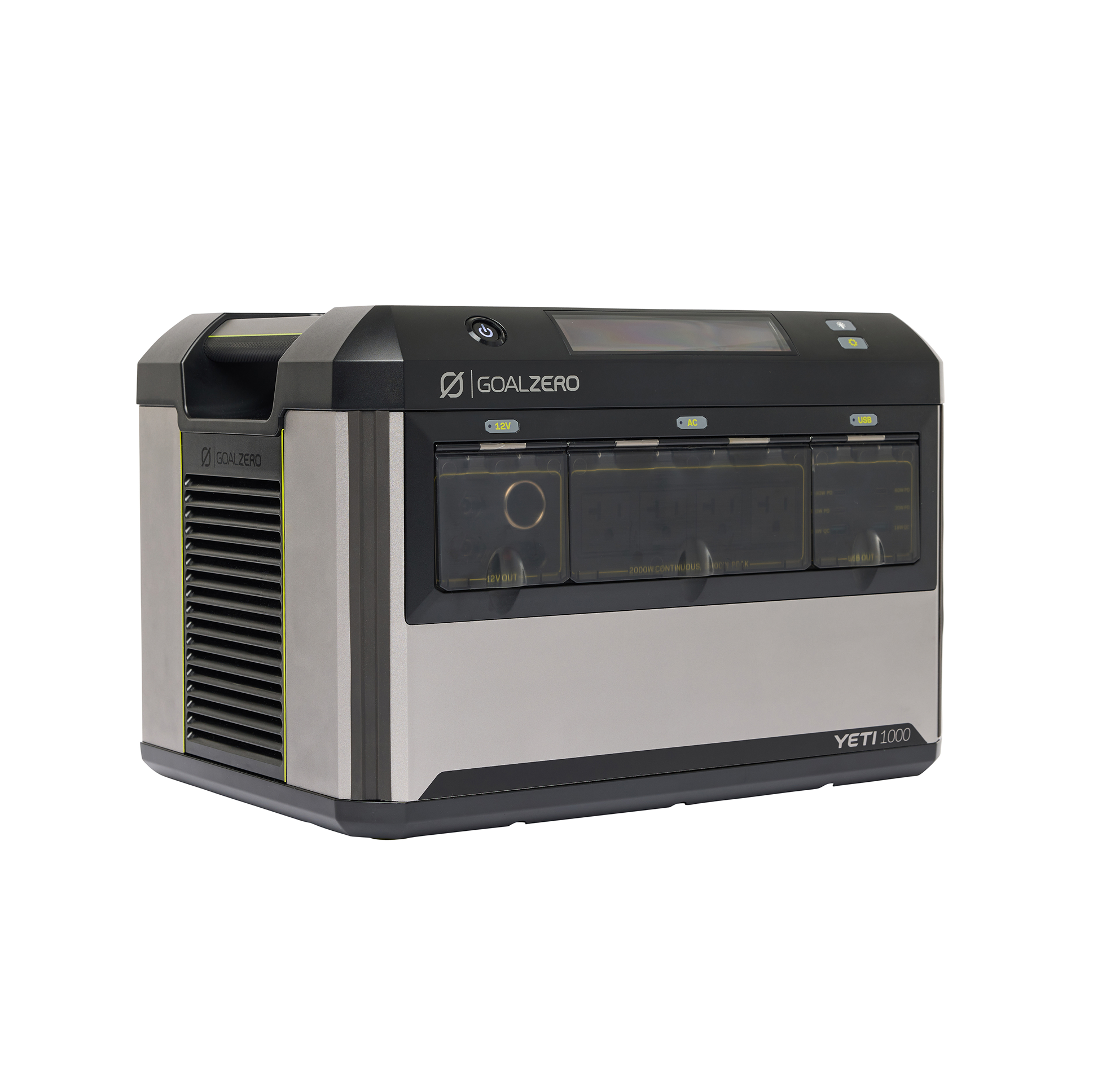
Goal Zero Yeti 1000 (6th Gen)
$1,199.95
$1,199.95 · direct from Goal Zero
Last checked 16 days ago. Prices move — check before you buy.
Prices may vary by retailer and are subject to change.