News · Home backup · Explainer
The TITAN’s Panel Has Ten Slots. Only Two Take 240 V.
One up to 30 A, one up to 20 A. Central air and a well pump usually fit; an induction range or an EV charger won’t. And EcoFlow’s manual rules out any circuit on an AFCI or GFCI breaker. Pick your circuits and see which TITAN, and which slots, they need. Then how much roof fills the Plus, and what payback looks like with the solar’s share taken out.
 By Gunner Gustafson, Whole-Home Backup TesterAdd as a preferred source on Google
The short version · as of October 23, 2026
- Your circuits pick the model. Anything on 240 V (central air, a well pump, a heat pump, an induction range) rules out the Classic. More than 7,200 W at once works only on the Plus, and only while solar or the grid is helping.
- The panel decides as much as the battery. Its ten slots include just two for 240 V, at 30 A and 20 A, so an induction range or an EV charger won’t fit. And EcoFlow’s manual says no circuit on an AFCI or GFCI breaker can go on it. If your breakers have TEST buttons, count them before you reserve.
- Twenty panels of 400 W fill the Plus’s 8,000 W solar input on paper. In good sun they make about 5,800 W. An existing rooftop array connects a different way, and it shuts off in a blackout.
- EcoFlow’s three-year payback includes what the solar panels save. One pack on its own, on San Diego’s time-of-use rates and the app’s default 50% backup reserve, pays back in about 15 years with surplus solar. Drop the reserve to zero and it’s about 7.5 years, with nothing held back for the outage.
Three TITANs · one 5 kWh battery each
Same battery. Different voltage, outlet and solar.
EcoFlow’s “from” prices for the unit alone; the Smart Home Panel 10 is a separate purchase. Reservations close November 2; sales open November 3. Each grows to six packs.
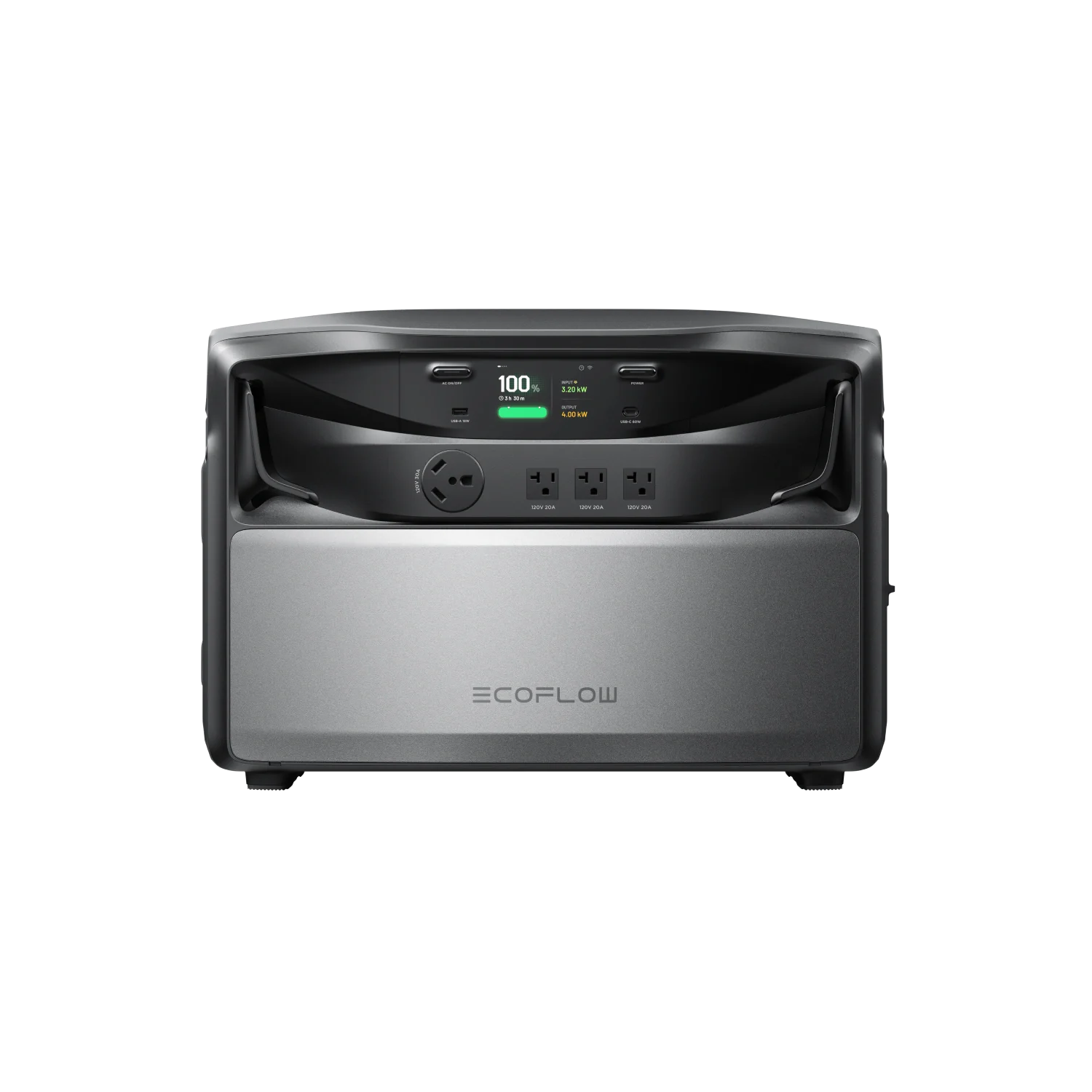 120 V only
4 kW · 3.2 kW solar · 102.5 lb
For a house whose list is all 120 V: fridge, furnace, lights, Wi-Fi.
from $2,499
Check if it’s on sale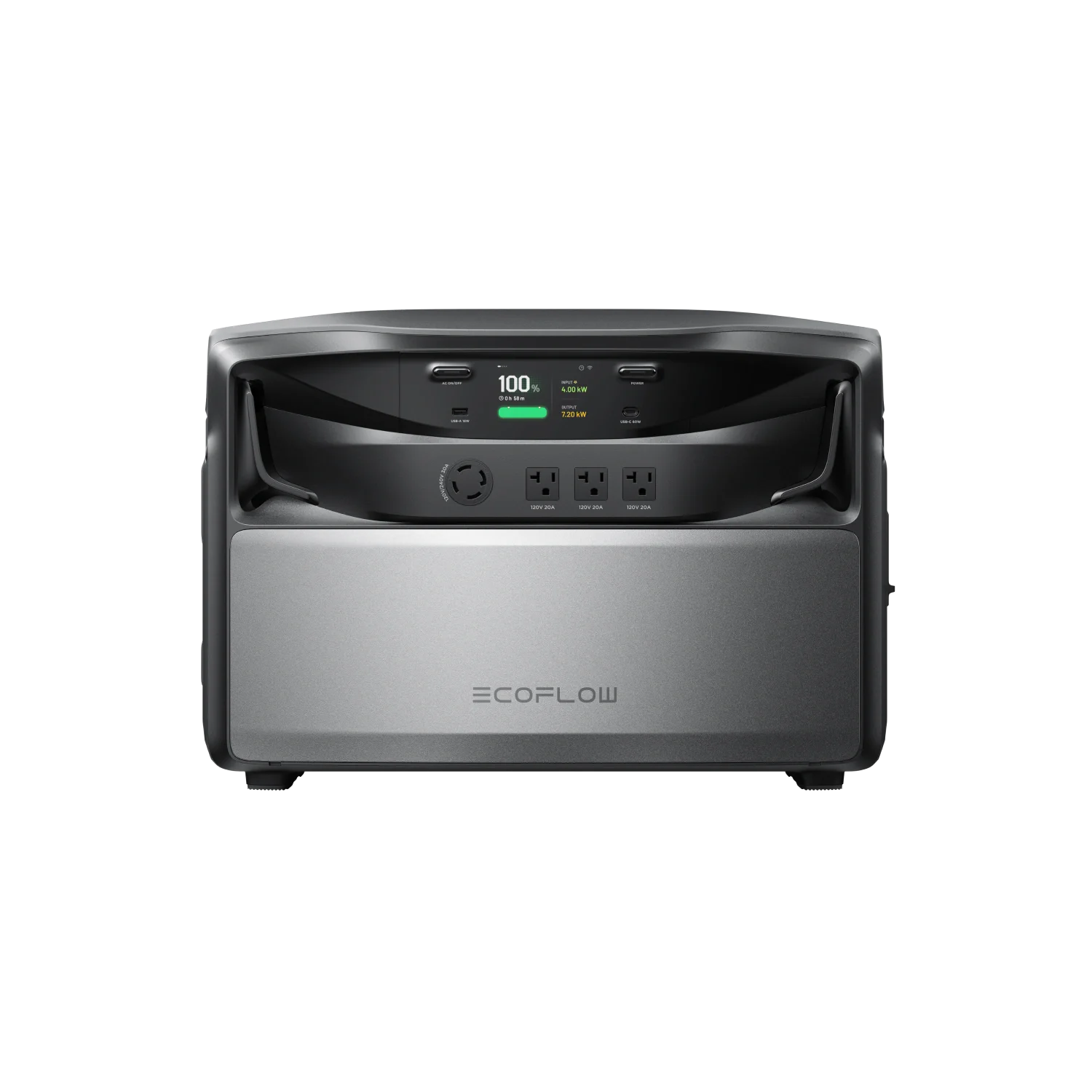 120/240 V
7.2 kW · 4 kW solar · 119 lb
Adds 240 V for central air, a well pump or a heat pump.
from $3,199
Check if it’s on sale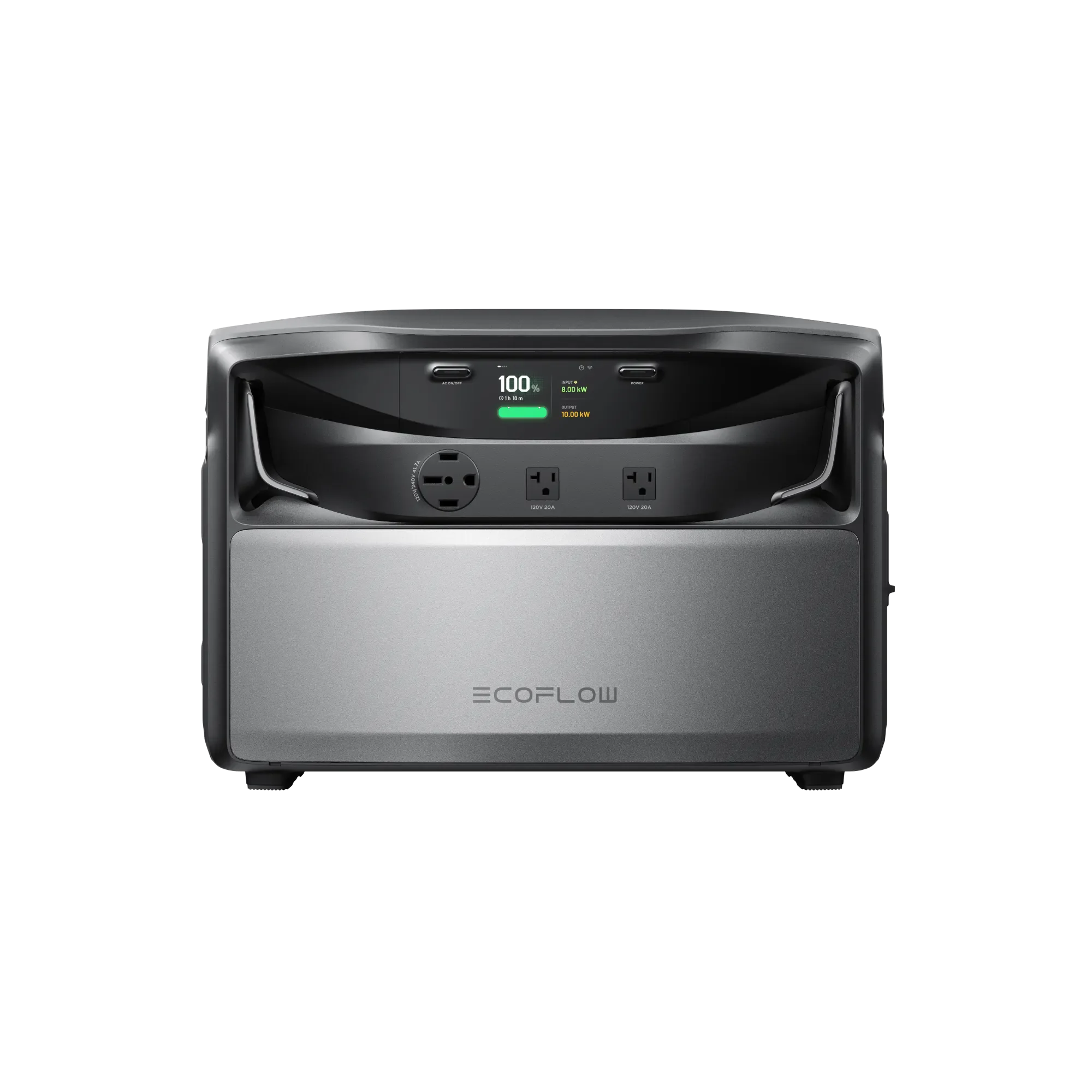 120/240 V
7.2 kW (10 with solar) · 8 kW solar · 121.3 lb
The TITAN plus twice the solar, and more output while the sun helps.
from $3,699
Check if it’s on sale
We may earn a commission if you buy through these links. It never changes what we report. How we make money.
Owners asked when EcoFlow posted the line-up[12] · jump to the answer
- My panel is full of AFCI and GFCI breakers. Does the Smart Home Panel 10 work with them?
- How much rooftop solar does the TITAN Plus need to reach its full 8 kW?
- What does the payback look like with rooftop solar?
- Will a heat pump and an induction cooktop both go on it?
- Is a DELTA Pro Ultra the better buy?
- Which circuits would you put on it first?
The panel
Which TITAN do your circuits need?
Every battery I’ve wired into my house has gone through a transfer switch, and the switch teaches you something quickly. You don’t back up a house. You back up a short list of circuits.
The Smart Home Panel 10 makes that list ten slots long, with 50 A across all of them.[3] So start there. Tap the circuits you’d want on in an outage and they land on the slots that fit them, the way they would on the real panel. The verdict underneath reads the same numbers as the rest of this page.
While you’re at it, go and look at your own breaker panel. If a breaker has a small TEST button, flag it in the planner. That matters more than it sounds, and I’ll get to why below.
Start from a house like yours
Or tap your own circuits
Watts and breaker sizes are planning figures for a typical home; your nameplates and your panel win. The slots are the ones EcoFlow’s manual lists for each version of the panel. A circuit can drop to a smaller slot if its load allows, never move up to a bigger one.
Smart Home Panel 10 (240V) · your directory
8/10 used
Breaker sizes are typical; check yours. Tap a breaker if its circuit has a TEST button in your main panel. We pre-marked the circuits recent code usually puts on one.
Your circuits want
The TITAN from $3,199
- The central air (3-ton) and the well pump need 240 V, which rules out the Classic.
- 5,700 W at once fits the TITAN’s 7,200 W from the battery alone.
EcoFlow says the TITAN and Plus start a compatible 3-ton central air with about 1,000 W of other loads running, no soft starter. It hasn’t published a surge figure, and an older single-stage unit can need far more to start. The condenser’s nameplate lists it as LRA.
- At once
- 5.7 kW
- of 7.2 kW
- One pack
- 4.1 h
- at this mix’s average
- A full day
- 6 packs
- 24.7 kWh a day
4 of your circuits sit on a TEST-button breaker. EcoFlow’s manual says the panel can’t take them as wired. Your options.
One pack holds 5,018 Wh; we count 85% of it reaching the outlet. “At once” adds every circuit running together and only the biggest kitchen-style burst. “From” prices are EcoFlow’s; sales open November 3.
The slots
What fits on the Smart Home Panel 10?
Ten slots, and they aren’t ten of the same.
EcoFlow’s manual lists the breakers.[6] The 240 V panel sold for the TITAN and the Plus has one 30 A and one 20 A two-pole, two 20 A and four 15 A single-pole. A two-pole breaker fills two positions, so the panel holds at most two circuits at 240 V and six at 120 V. The Classic’s 120 V panel has one 30 A, one 20 A and eight 15 A single-pole: ten circuits, none of them 240 V.
The manual also says each breaker in your main panel has to match its partner in the Smart Home Panel 10. So a circuit can only land on a slot its wiring can carry. A 3-ton central air or heat pump usually sits on a 30 A breaker and takes the big slot. A well pump on 20 A takes the other. That’s both. Central air plus a heat pump, or central air plus an electric water heater, only works if one of them runs on 20 A.
Anything on a 40 or 50 A breaker is out: an electric or induction range, and most Level 2 EV chargers. That answers the owner who wanted a heat pump and an induction cooktop on it.[12] The heat pump fits. A range on a 40 A circuit doesn’t. The 120 V side is tight too: the 240 V panel takes six circuits, and only two of them at 20 A. Kitchen and laundry circuits are often 20 A, so they compete for those two.
The breakers
Does the Smart Home Panel 10 work with AFCI and GFCI breakers?
No. EcoFlow’s manual says so in capital letters.
First, what these are. An AFCI breaker watches for the sparking of a damaged wire. A GFCI breaker watches for current leaking somewhere it shouldn’t, like through a person. Plenty now do both. You can spot them by the TEST button on the front. The 1999 electrical code started with bedrooms, the 2008 code spread AFCI to most living spaces, and kitchens, laundry rooms, garages and basements picked up GFCI rules along the way. In a house wired in the last fifteen years, a good part of the panel looks like that.
The product pages don’t mention it. The panel’s user manual, posted on October 20, does. Its safety rules say: “DO NOT connect the panel to main panel circuits protected by GFCI or AFCI breakers.”[6] The breakers that feed the TITAN from your main panel have to be plain ones too, and the TITAN’s own manual says the same of that feed: a double-pole breaker of 20, 30 or 50 A, not GFCI or AFCI.[4] The owner on EcoFlow’s subreddit who read the label on the back had it right.[12]
One more line from the same safety page matters for a bedroom circuit. The manual says not to put life-support or other medical equipment on a circuit the panel can switch remotely.[6] A CPAP on a backed-up bedroom circuit is exactly that. It belongs on an outlet the TITAN feeds directly, or on a battery of its own.
EcoFlow’s first home panel had the same rule but sold a box to put those breakers in downstream. This one offers nothing like it. Its newer, bigger panel went the other way.
| EcoFlow panel | Pairs with | AFCI/GFCI breakers | What EcoFlow says |
|---|---|---|---|
| Smart Home Panel (2022) | DELTA Pro | Moved downstream | Breakers feeding the panel must be non-AFCI/GFCI; protection moves downstream into a separate AFCI/GFCI box or onto outlets.[7] |
| Smart Home Panel 2 | DELTA Pro Ultra, DELTA Pro 3 | Inside the panel | Branch breakers up to 60 A move into the panel, AFCI/GFCI supported (Eaton BR, Square D HOM, Siemens Q and GE families, pigtail only; plug-on neutral not supported yet).[8] |
| Smart Home Panel 10 | TITAN | Not allowed | Its user manual: “DO NOT connect the panel to main panel circuits protected by GFCI or AFCI breakers.” It offers no downstream box or other route.[6] |
It’s the rule I’d expect. The Smart Home Panel 10 ships pre-wired, like the Reliance transfer switch on my wall. A panel like that takes a circuit off its breaker in the main panel and feeds it through its own. An AFCI or GFCI breaker can only protect what flows through it. Once the battery is feeding the circuit, nothing is flowing through the old breaker. Reliance says as much in its manual: the protection is lost whenever the switch is on generator, and the fix is to fit the right breakers in the switch itself.[9]
What I’d do before reserving.
- 1Count the TEST buttons on the circuits you’d back up. The planner above keeps count. If the answer is zero, which is common for a furnace, a well pump, central air and a water heater, the rule doesn’t touch you.
- 2If it isn’t zero, those circuits can’t go on the panel as they’re wired. Ask the installer who comes for EcoFlow’s free assessment which of yours qualify, and get it in writing.
- 3Know that any workaround is an electrician’s call under your local code, and EcoFlow’s manual doesn’t offer one. Protection moved to the first outlet on the circuit is the one people ask about. Otherwise those circuits stay off the list, and in a house wired to recent code that can mean the kitchen, the bedrooms and the laundry.
- 4Or pick a panel that documents it. The Smart Home Panel 2, sold for the DELTA Pro Ultra and the DELTA Pro 3, takes AFCI and GFCI breakers inside it. One catch for newer houses: it takes the pigtail kind only, and plug-on-neutral breakers aren’t supported yet.[8]
Solar
How much rooftop solar does the TITAN Plus need for 8 kW?
Twenty ordinary panels. Even then, 8 kW is a ceiling you’ll touch on the best days only.
The Plus has two solar inputs, each rated 4,000 W, 40 to 450 V and 16 A.[2] The voltage ceiling sets the string. Panel voltage climbs on a cold morning, so I size for a −10 °C dawn (14 °F). With EcoFlow’s own 400 W rigid panel, ten in a row reach 416 V in that cold.[13] One more would reach 458 V, over the limit. So it’s ten per input, two inputs, twenty panels.
That’s 8,000 W on the labels, about 420 square feet of roof and 960 lb of glass and aluminum before the racking. It’s roughly the floor of a two-car garage, tipped up onto your roof.
Panels deliver about 72% of their rating on a good sunny day, once heat, sun angle, wiring and dust take their share. Twenty of these then make around 5,800 W. A cold, clear spring noon gets closer to the label. You can’t wire a second string alongside to make up the difference, because two strings would push the short-circuit current past the 20 A the label allows. Bigger panels help a little: ten of Anker’s 440 W rigid panels per input make 8,800 W on paper and about 6,300 W in good sun.
| Model | Solar input | 400 W panels that fit | On the labels | Good sun |
|---|---|---|---|---|
| TITAN Classic | 3,200 W · 30–250 V | 6 | 2,400 W | ≈ 1,700 W |
| TITAN | 4,000 W · 40–450 V | 10 | 4,000 W | ≈ 2,900 W |
| TITAN Plus | 8,000 W · 40–450 V | 20 (10 + 10) | 8,000 W | ≈ 5,800 W |
The Classic’s 250 V ceiling stops it at six of these panels, short of its 3,200 W limit. Strings checked at −10 °C with the solar engine behind our panel checker.
If you already have panels on the roof, they don’t go into this input at all. An existing grid-tied array connects through the Smart Home Panel 10 and a current sensor, which EcoFlow calls AC coupling. On a normal day it stores your surplus. In a blackout, though, that array shuts itself off, as every grid-tied system must, and EcoFlow’s own FAQ says it can’t charge the TITAN then.[2] Charging during an outage means panels wired to the TITAN’s own input.
The money
What’s the payback on a TITAN with rooftop solar?
Longer than three years, unless the battery takes credit for the panels.
EcoFlow’s pages promise up to $2,900 a year and a three-year payback for the TITAN, and $3,100 for the Plus. The footnote is upfront about where those come from: a 15 kWh system (three packs) with 4 kW of solar for the TITAN or 8 kW for the Plus, in a San Diego house using 16.5 kWh a day on SDG&E’s TOU-DR2 rate.[1][2]
So I priced that house’s bill. On TOU-DR2’s January 2026 rates, with 30% of its power used in the 4 to 9 pm peak, it comes to about $3,420 a year.[10] $290 of that is a fixed daily charge no battery can touch. EcoFlow’s $2,900 is most of what’s left, and the Plus’s $3,100 is 99% of the energy part. Doubling the solar adds $200 a year. That’s what a bill looks like when it runs out.
It’s a fair figure for solar and storage together. Most of it is the panels’ work. And that system isn’t one TITAN: three packs means a TITAN plus two $2,999 extra batteries,[5] about $12,998 at EcoFlow’s “$7,000 range” for the first unit with panel and installation, before the solar.[3]
The battery’s own job is moving the panels’ energy into the evening, so I priced that job on its own: one pack, cycled once a day. There’s a catch the manual spells out. While the grid is up, the panel only lets the battery discharge down to its Backup Reserve, 50% by default, so half the pack sits waiting for an outage.[6] You can set the reserve lower in the app. The table reads both ways.
| One pack, one cycle a day | Reserve at 50% (default) | Reserve at 0% | ||
|---|---|---|---|---|
| Saved a year | Pays back $7,000 | Saved a year | Pays back $7,000 | |
| Flat-rate utility, no solar | $0 | never | $0 | never |
| Time-of-use rates, no solar | $87 | about 80 years | $174 | about 40 years |
| Time-of-use rates, rooftop solar, net billing | $464 | about 15 years | $928 | about 7.5 years |
Our assumptions SDG&E TOU-DR2, non-CARE, effective January 1, 2026: summer peak 70¢ and off-peak 43¢ a kWh, winter 62¢ and 48¢. At the default reserve, 2.1 kWh out of a pack each day for 2.5 kWh in (85% round trip); at zero reserve, 4.3 kWh out. The house uses at least that much between 4 and 9 pm. With solar, the pack fills from surplus that would otherwise have earned 5¢ a kWh exported under California’s net billing, every day of the year. Those are the best cases for the battery. The flat-rate row is zero because there’s no cheaper hour to shift from.
Nothing else shortens it. The 30% federal credit for home batteries ended for anything installed after 2025,[11] and EcoFlow’s warranty runs five years,[1] so even the solar case pays back after the warranty does.
So here’s where I land. Buy a TITAN for the outage. If you’re on time-of-use rates with a roof that exports, the savings are a real bonus, about $500 a year per pack in San Diego at the default reserve and up to $900 if you let it cycle fully. That second figure costs you the outage cover you bought it for. On a flat rate there aren’t any savings.
The other EcoFlow
Should you buy a DELTA Pro Ultra instead?
Only if your breakers make the choice for you.
One owner suggested spending a little more on a DELTA Pro Ultra.[12] EcoFlow’s store has it at $4,199 today for 6,144 Wh, against a TITAN from $3,199 for 5,018 Wh. That’s $683 a kilowatt-hour against $638. Both deliver 7,200 W. The DPU weighs 181.8 lb to the TITAN’s 119, and takes 5,600 W of solar to the Plus’s 8,000. Both home panels are sold separately.
Where the DPU pulls ahead is its panel. The Smart Home Panel 2 holds 12 circuits, takes breakers up to 60 A, and accepts AFCI and GFCI breakers inside it.[8] So a range or a car charger fits, and so does a kitchen on dual-function breakers. If your list has either, that’s worth paying for. If none of it does, the TITAN does the same job for less, with more solar on the Plus. Our side-by-side checks both prices twice a day: TITAN vs DELTA Pro Ultra, and the DELTA Pro Ultra’s own page.
Straight answers
EcoFlow TITAN questions
- Does the EcoFlow Smart Home Panel 10 work with AFCI or GFCI breakers?
- No. Its user manual says not to connect the panel to main panel circuits protected by GFCI or AFCI breakers, and it offers no downstream box. EcoFlow’s Smart Home Panel 2, sold with the DELTA Pro Ultra and DELTA Pro 3, does take those breakers inside it.
- How many solar panels does the TITAN Plus need for 8 kW?
- Twenty panels of 400 W, in two strings of ten, reach 8,000 W on the labels and need about 420 square feet of roof. In good sun they make about 5,800 W. The voltage limit (450 V per input) stops a string at ten of these panels on a cold morning.
- Can my existing rooftop solar charge a TITAN during a blackout?
- No. An existing grid-tied array connects through the Smart Home Panel 10 (AC coupling) and shuts down when the grid does. EcoFlow says outage charging needs panels wired to the TITAN’s own solar input.
- What is the payback period for an EcoFlow TITAN?
- EcoFlow quotes three years for a 15 kWh system with solar in San Diego, and that figure includes the panels’ savings. By our arithmetic, one pack at EcoFlow’s $7,000 installed range, cycling above the app’s default 50% backup reserve, saves about $464 a year with surplus solar on SDG&E time-of-use rates (about 15 years) and about $87 without solar (about 80 years). With the reserve at zero the solar case is about 7.5 years. On a flat rate it saves nothing.
- Do I need the Smart Home Panel 10?
- No. The panel is sold separately. On its own, a TITAN runs whatever is plugged into it and switches to battery in 10 ms when the grid drops. The panel adds automatic switching of up to ten circuits in under 20 ms, the app’s circuit priorities, and the grid and solar modes.
- Can I put a CPAP or other medical equipment on a Smart Home Panel 10 circuit?
- EcoFlow’s manual says not to connect life-support or other medical equipment to circuits the panel can switch remotely. Plug it into the TITAN directly, or give it a battery of its own.
- Which TITAN can run central air?
- The TITAN or the Plus. Central air needs 240 V, which the Classic doesn’t have. EcoFlow says both start a compatible 3-ton unit with about 1,000 W of other loads, no soft starter. It hasn’t published a surge figure, so check the LRA on your condenser’s nameplate. With a fridge alongside, our planning figures put the running load at 4,150 W.
- Which TITAN for a heat pump and an induction range?
- The base TITAN or the Plus has the power, but the panel won’t take a range on a 40 A or 50 A circuit: its biggest 240 V slot is 30 A. A typical 3-ton heat pump fits that slot. Pick the Plus for more headroom while the sun is up, or for its 8,000 W of solar.
- How long will a TITAN run an aquarium?
- About 57 hours on one pack, for a tank whose heater, filter and air pump draw 150 W at full tilt and about 75 W on average. Every TITAN can do it, the Classic included.
- How many circuits does the Smart Home Panel 10 back up?
- Ten positions. The 240 V version has one 30 A and one 20 A two-pole, two 20 A and four 15 A single-pole breakers, so at most two circuits at 240 V and six at 120 V. The Classic’s 120 V version takes ten 120 V circuits. Both share 50 A and switch in under 20 ms, or about 5 seconds with EPS mode off. The panel is sold separately.
What we’re asking EcoFlow
What would change this page
- Whether AFCI or GFCI protection at the first outlet is an approved way to put those circuits on the panel.
- Whether an installer can fit breakers other than the ones the manual lists, say a 40 A two-pole for a range.
- The TITAN’s surge rating.
- Prices for the panel, the extra 5 kWh battery and EcoFlow’s installation, due November 3.
Get one email when TITAN prices land on November 3
And when EcoFlow answers the questions above. Nothing else.
By subscribing, you agree to our Privacy Policy. Unsubscribe anytime.
More on the line-up: our launch story on what each step up buys, and the TITAN tracker with every spec graded.
How we did this
Method and sources
Model figures are EcoFlow’s, from its US store’s Tech Specs and comparison table read on October 23, 2026. Circuit wattages are planning figures for a typical unit from our appliance library, the same table behind our calculator; your nameplate wins. String sizes come from the solar engine behind our panel pages, checked at −10 °C. Rates are SDG&E’s published TOU-DR2 table, and the payback is shown at the app’s default backup reserve and at zero. Every assumption is printed beside the figure it produces. Where EcoFlow hasn’t published something, we say so instead of guessing.
- [1]EcoFlow US store, “TITAN 5000: Tech Specs (TITAN, 5 kWh battery, Smart Home Panel 10), FAQ, and footnote 3, “Savings & Payback””, read October 23, 2026.
- [2]EcoFlow US store, “TITAN 5000 Plus: Tech Specs, the FAQ on rooftop solar during an outage, and footnote 3, “Savings & Payback””, read October 23, 2026.
- [3]EcoFlow (PR Newswire), “EcoFlow Debuts TITAN Series: 50 A across 10 circuits, pre-assembled breakers, the “$7,000 range with panel and installation””, October 13, 2026.
- [4]EcoFlow, “TITAN 5000 User Manual, “Connect to Smart Home Panel 10”: circuit breaker specification, “Double-pole non-GFCI/AFCI branch circuit breaker (20A 30A or 50A; 50A recommended)””, read October 31, 2026.
- [5]EcoFlow US store, “TITAN 5000 Series bundle page, listing the TITAN 5kWh Extra Battery at $2,999”, read October 31, 2026.
- [6]EcoFlow, “Smart Home Panel 10 (120V/240V) User Manual: “Safety Best Practices & Rules”, Installation Overview, EPS Mode and Technical Specification (branch circuit breakers by model)”, listed October 20, 2026; read October 23, 2026.
- [7]EcoFlow, “Smart Home Panel Installation Manual V2.1 (US): upstream breakers non-GFCI/AFCI, protection downstream, the EcoFlow AFCI/GFCI Box”, January 2024.
- [8]EcoFlow, “Smart Home Panel 2 Installation Guide V2.1: “AFCI/GFCI supported, relocated from the main panel”, and the circuit-breaker compatibility table”, December 10, 2024.
- [9]Reliance Controls, “Transfer switch installation and operating instructions: the caution on AFCI and GFCI breakers”, read October 23, 2026.
- [10]San Diego Gas & Electric, “Schedule TOU-DR2, Residential Time of Use Service: total rates table, effective January 1, 2026”, January 1, 2026.
- [11]Internal Revenue Service, “Residential Clean Energy Credit: “not available for any property placed in service after December 31, 2025””, read October 23, 2026.
- [12]r/Ecoflow_community (Reddit), ““Which EcoFlow TITAN is right for your home?”: EcoFlow’s post and owners’ replies on AFCI/GFCI breakers, circuits, rooftop solar and payback”, read October 23, 2026.
- [13]Power Station Arena, “Solar panel table: EcoFlow 400 W rigid panel (Voc 37.1 V, Vmp 31 V, Imp 12.9 A, −0.35 %/°C), from EcoFlow’s spec sheet”, read October 23, 2026.