Head-to-head test
EcoFlow DELTA Pro Ultra X vs BLUETTI Elite 300
This isn't a price gap, it's a class gap: $7,999 buys a system an electrician commissions in place, and $1,199 buys 58 lbs you carry to wherever the power went out.
Full profiles: EcoFlow DELTA Pro Ultra X → · BLUETTI Elite 300 →

Written by Gunner GustafsonUpdated
Whole-Home Backup Tester, Station Arena Test Desk

$7,999.00 · direct from EcoFlow
Last checked 1 day ago. Prices move — check before you buy.
$1,099.00 · direct from BLUETTI
down from $1,199 · 8% below usual
Last checked 1 day ago. Prices move — check before you buy.
Spec deltas
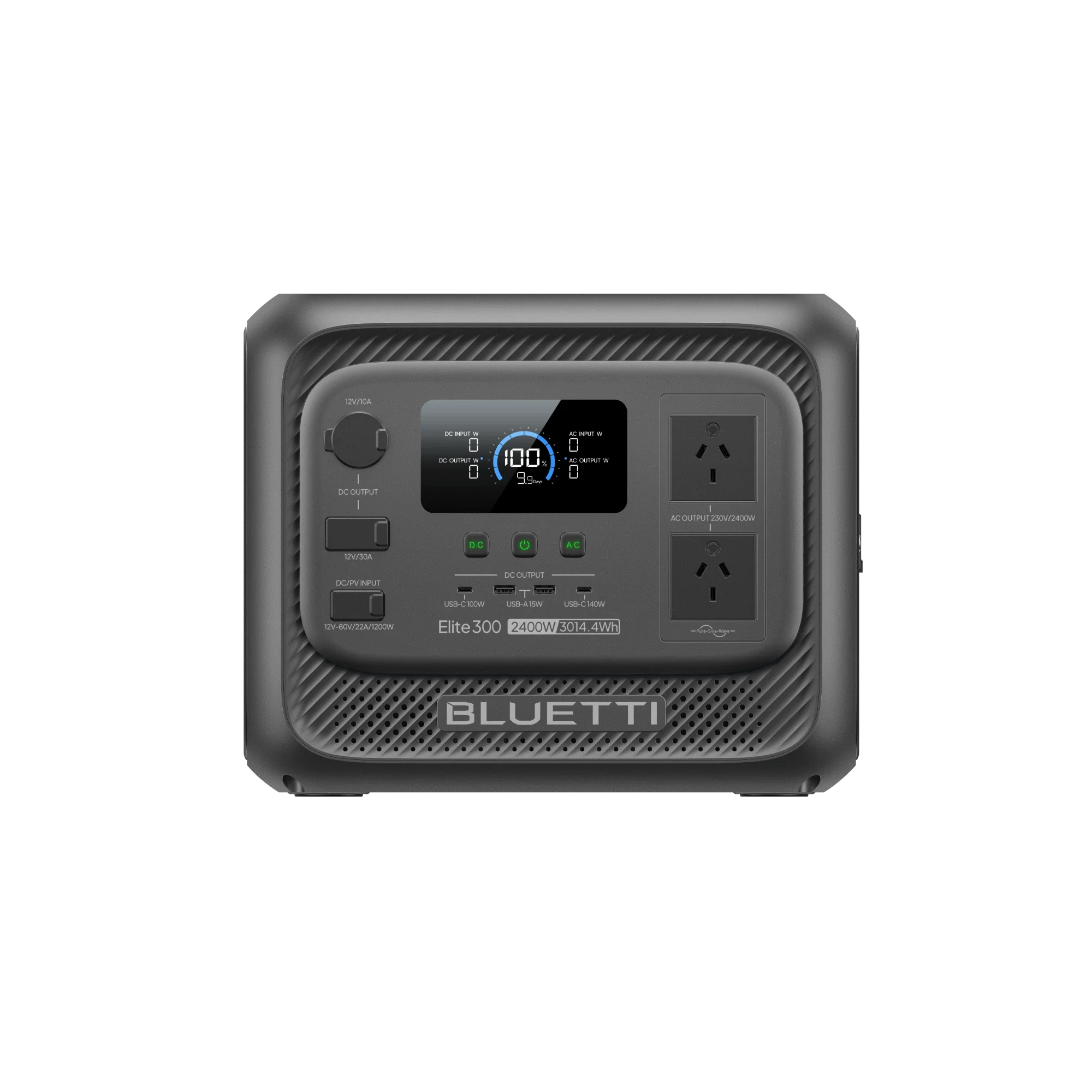
The DELTA Pro Ultra X costs $7,999 and weighs 298.7 lbs. The Elite 300 costs $1,199 and weighs 58 lbs. Those aren't two points on one scale. One is an electrical installation with a schedule and a technician attachedA4; the other is a box that fits in a trunk.
Nearly seven times the price buys about four times the energy, 12,288Wh against 3,014Wh, so the money isn't going into cells. It's going into a single 12,000W inverter rated for 120/240V serviceA1 and the panel integration that makes that number mean something. Without a panel to integrate with, you're paying for the half of the product you can't use.
The cheaper unit is also the longer-lived one. 6,000 rated cycles against 3,500 puts the Elite 300's energy at $0.07 per lifetime kWh against $0.19. Take the Elite 300 unless there's an electrician on your calendar.
What the Numbers Reveal
Each conclusion stated first — the numbers behind it on one line, the full analysis below.
continuous output
What the $3,203 buys is that the energy sits behind one 12,000W inverter instead of four 2,400W ones. Four boxes are four islands: nothing over 2,400W starts, nothing feeds a breaker panel, and you're walking extension cords between units at 2 a.m. The DELTA Pro Ultra X's price is an inverter-and-integration price wearing a battery's label.
DELTA Pro Ultra X: $7,999 for 12,288WhElite 300: $1,199 for 3,014WhDELTA Pro Ultra X continuous output: 12,000WElite 300 continuous output: 2,400W
Why it mattersIf your problem is total stored energy, buy boxes and save three thousand dollars. If your problem is one large simultaneous load or whole-house circuits, only the DELTA Pro Ultra X solves it and the price stops looking strange.
weight
58 lbs is the other kind of number. It's a bent-knees carry that one determined adult makes and reviewers describe as still manageable for a 3kWh unitB2B3, which means the Elite 300 can be in the garage on Tuesday and the bedroom on Wednesday. The DELTA Pro Ultra X gets sited once, and moving it later means undoing an installation, not clearing a doorway.
DELTA Pro Ultra X: 298.7 lbsBase storage is 6,144Wh x 2A2Quick-connect install described as roughly a week to readyA4Elite 300: 58 lbs
Why it mattersAnyone whose use case involves the unit changing rooms, houses, or vehicles has already chosen the Elite 300, whatever the capacity column says.
cost / lifetime kWh
Run the money through the cells and the DELTA Pro Ultra X's stored energy costs roughly three times as much per kilowatt-hour delivered over its rated life. Nothing about the premium is buying cheaper electricity or a longer-lived battery. It's buying simultaneity: 12,000W at once instead of 2,400W at once.
Elite 300: 6,000 cyclesDELTA Pro Ultra X: 3,500 cyclesLifetime energy: 18,086 kWh vs 43,008 kWhCost per lifetime kWh: $0.07 vs $0.19
Why it mattersIf you're justifying the DELTA Pro Ultra X to yourself on 'it'll last forever', the cycle rating says the opposite. Justify it on what it can run at one time, or don't buy it.
solar input
Except that 10,000W is an array specification, not a panel specification. You don't reach it with folding panels leaned against a picnic table; you reach it with a permanent mount and a separate installA3. The Elite 300's 1,200W sits inside what portable panels actually deliver, so its slower number is the one more buyers will ever see.
DELTA Pro Ultra X solar input: 10,000WElite 300 solar input: 1,200WCapacities: 12,288Wh and 3,014Wh
Why it mattersIf your panels fold up and go in the back seat, the DELTA Pro Ultra X's 10,000W ceiling is a number you'll never touch and shouldn't pay toward.
The specific dimensions that decide these two units — everything else is a tie.
Portability & Form Factor
Selected because: 298.7 lbs against 58 lbs isn't a spread on one scale, it's the line between a system you commission and a box you move, and it decides this page.
weight
Weight here isn't a comfort spec, it's a category boundary. The Elite 300 at 58 lbs is a thing a person relocates: garage to driveway, closet to bedside, house to RV. The DELTA Pro Ultra X at 298.7 lbs is a thing a person sites. You decide the spot once, with floor loading, service access, and a cable route in mind, and after that it's furniture with a breaker behind it.
That's also why the compactness reviewers keep noting about the Elite 300 matters more than it sounds. It's been certified as the smallest 3kWh portable by volume, in a chassis closer to a 2kWh unitB2, and it's only about 2kg above the Elite 200 V2B3. Volume is what decides whether a unit lives in a cabinet or in the middle of the floor, and floor is where good intentions about portability go to die.
Runtime: Will It Power Your Gear?
Selected because: 12,288Wh against 3,014Wh, or 10,445Wh against 2,562Wh once you derate to 85%, is the one place the price gap earns something back.
continuous output
Derate both to the 85% you can actually pull and the gap is 10,445Wh against 2,562Wh. That's four times the energy for nearly seven times the money, which is a bad trade on its own and a fine one if the extra energy is the specific thing standing between you and a hotel room. A three-day outage in February is that thing. A weekend with a fridge and some lights is not.
The honest way to read the capacity column is as a threshold question rather than a scoring one. Work out your worst realistic unplugged stretch in watt-hours, then check it against 2,562Wh. Under it, the Elite 300 is the whole answer and the rest of this page is entertainment. Over it, you're not choosing between these two, you're choosing between an installation and going without.
Lifetime Value
Selected because: Over rated cycle life the Elite 300's energy costs $0.07 per kWh against the DELTA Pro Ultra X's $0.19, so the cheaper unit is also the cheaper unit to own.
cost / lifetime kWh
Cycle ratings invert the usual expectation here. The $1,199 unit carries 6,000 cycles and the $7,999 unit carries 3,500, so the cheap one reaches its 80% capacity mark at 16.4 years of daily cycling while the expensive one gets there at 9.6. Both warranties run 5 years, meaning the paperwork treats them identically and only the cells disagree.
On the sticker, $7,999 over 12,288Wh is $0.65 a watt-hour and $1,199 over 3,014Wh is $0.40. Divide by lifetime energy instead of nameplate energy and the spread widens rather than closes: the Elite 300 delivers at $0.07 per kWh against $0.19. There's no feature on the DELTA Pro Ultra X's sheet that closes a three-to-one gap in the cost of the energy itself, and it doesn't need to close it. It just needs to be honest about what it's charging for, which is running your house, not storing electricity cheaply.
Your Life, Your Pick
Selected because: Five of the six scenarios score to the DELTA Pro Ultra X, but two of them assume a 298.7 lb installed system rides to a campsite, so read those two as capacity results only.
Read the sweep with one correction in hand: our scenario engine has no class for installed systems. Weekend Camping and Tailgate Party score a 298.7 lb wired appliance exactly as though it drove itself to the site, so the DELTA Pro Ultra X's wins there are energy results and nothing more. The scenarios that genuinely apply to it are the stationary ones, plus Van Life, where power gets installed into the vehicle rather than carried to it.
One more caveat on the pass and fail marks: they test whether each unit's continuous rating covers the load, not whether the inverter survives the startup spike. Surge is a separate row, and on that row the Elite 300 has 4,800W against 45,000W. A scenario can pass on energy and still trip on the first compressor start, so check the surge section before treating a green mark as permission.
What the Specs Don't Tell You
Selected because: The rows that settle this aren't in the spec table: placement weight, an undisclosed noise figure, surge headroom, and an expansion ceiling nobody agrees on.
rated cycles
Two of these flags are about what nobody published rather than what either unit does. The Elite 300 has no dB figure at all, and the DELTA Pro Ultra X's 30dB arrives without a load condition attached, so between them there's one number and no comparison. Treat both as unknowns if you're buying for a bedroom, and buy from somewhere with a return window.
The expansion flag deserves the same skepticism, in the other direction. The DELTA Pro Ultra X is expandable and the Elite 300 is sealed at 3,014Wh, which is straightforwardly true and straightforwardly an advantage given the rival's ceiling. What isn't available is a number for that ceiling: the published maximums for this platform contradict each other across the manufacturer's own materials and the coverage built on them, and none of them appear in our spec record. Expandable, yes. Expandable to what, no comment.
Strengths & trade-offs
EcoFlow DELTA Pro Ultra X
Strengths
- +Larger battery capacity
- +Higher AC output
- +Faster solar charging
Trade-offs
- –Substantially more expensive (+$6,800) than the Elite 300.
- –Significantly heavier (+240.7 lbs), making it harder to move.
- –Very heavy unit that may be difficult for one person to lift.
- –Shorter-lived battery — rated for 3,500 charge cycles vs the Elite 300's 6,000, so it wears out sooner.
BLUETTI Elite 300
Strengths
- +Costs $6,800 less
- +Lighter by 240.7 lb
- +Rated for 6,000 charge cycles — much longer battery lifespan
Trade-offs
- –Weaker inverter (-9,600W) limits appliance compatibility.
- –Sealed capacity — the DELTA Pro Ultra X can add batteries to grow past 3,014.4Wh; this one can't.
Will It Power Your Gear?
Scenario math and per-appliance runtimes, modeled from the spec record.
Scenario verdicts
We ran the math on six real-world scenarios. Here's which unit survives your actual life.
SCN-01 · 2 nights · needs 2,100Wh
Weekend Camping
Two nights off-grid with essential comfort
Elite 300
Scored on energy alone the DELTA Pro Ultra X takes it, finishing the 2,100Wh weekend at 20% used with 8,345Wh spare against the Elite 300's 82% and 462Wh. Both pass, and 462Wh is a real buffer rather than a squeak. What the scoring can't see is that this scenario assumes the unit travels, and our scenario engine has no class for installed systems, so a 298.7 lb wired appliance gets graded as though it rode along. Take the energy result at face value and answer the transport question separately.
Battery budget usedlower = more headroom
LOAD Phone Charger 15W×6h · LED Lights 40W×8h · Box Fan 75W×14h · CPAP Machine 40W×16h
SCN-02 · 8 hours · needs 1,645Wh
8-Hour Blackout
Keep the essentials running through a night without power
DELTA Pro Ultra X
Both carry the night: 1,645Wh is 16% of the DELTA Pro Ultra X's usable bank and 64% of the Elite 300's, leaving 8,800Wh and 917Wh respectively. The first eight hours aren't where these two separate. Day two and day three are, and there the difference is 12,000W of continuous output against 2,400W, and a 10,000W solar input against 1,200W. Whether that matters depends on whether your outages are an inconvenience or a genuine problem.
Battery budget usedlower = more headroom
LOAD Fridge 150W×8h · Router + Modem 20W×8h · LED Lights (4 bulbs) 40W×6h · Phone Charger 15W×3h
SCN-03 · 8 hours · needs 320Wh
CPAP Overnight
Sleep therapy without interruption — the #1 medical use case
Either unit
320Wh over the night is 3% of one usable bank and 12% of the other, so capacity settles precisely nothing here. The tiebreak everyone wants is noise, and it isn't available: the DELTA Pro Ultra X lists 30dB with no load condition attached and the Elite 300 lists nothing at all, which is one number and zero comparisons. Break it on what is knowable instead. $1,199 against $7,999, 58 lbs against 298.7, and one of the two can sit on the far side of a bedroom door because you put it there yourself.
Battery budget usedlower = more headroom
LOAD CPAP Machine 40W×8h
SCN-04 · 8 hours · needs 910Wh
Remote Workday
Full work day off-grid without power anxiety
DELTA Pro Ultra X
910Wh of laptop, monitor, and router is 9% of the DELTA Pro Ultra X's usable bank against 36% of the Elite 300's, and both finish the day without drama. At this load capacity isn't the interesting spec. The USB-C ports are: 140W on the Elite 300 against 100W on the DELTA Pro Ultra X, so the cheaper unit is the one that pushes more watts down a single cable to a hungry laptop.
Battery budget usedlower = more headroom
LOAD Laptop 60W×8h · External Monitor 30W×8h · Router + Modem 20W×8h · Phone Charger 15W×2h
SCN-05 · 4 hours · needs 670Wh
Tailgate Party
Game day power for the crew
Elite 300
670Wh of game day is 6% of the DELTA Pro Ultra X's usable bank and 26% of the Elite 300's, and both pass with room left. The scoring here measures energy and nothing else, which is worth saying out loud, because the actual tailgate variables are 58 lbs versus 298.7 and the fact that one of these is commissioned in place. On watt-hours the DELTA Pro Ultra X wins. On getting to the parking lot, the scenario doesn't have an opinion.
Battery budget usedlower = more headroom
LOAD Blender 400W×0.5h · LED TV (55") 80W×4h · Bluetooth Speaker 15W×4h · Phone Charger (×3) 45W×2h
SCN-06 · 24 hours · needs 4,685Wh
Van Life Daily
A full day of mobile living — the ultimate endurance test
DELTA Pro Ultra X
At 4,685Wh a day the Elite 300 simply runs out. It has 2,562Wh usable, leaving it 2,123Wh short, and with no expansion port there's no version of careful use that closes that. The DELTA Pro Ultra X covers the day at 45% used with 5,760Wh still in the bank. Van power gets installed rather than carried, so this is the one mobile scenario where an install-class system is a real answer, provided the build can take 298.7 lbs and the wiring that comes with it.
Battery budget usedlower = more headroom
LOAD Mini-Fridge 150W×24h · Laptop 60W×4h · Phone Charger 15W×3h · LED Lights 40W×5h · Fan 75W×8h
The Load Test
RUNTIME = (Wh × 0.85) ÷ LOAD
None of the scenarios above exactly yours? Build it. Toggle what you'd plug in; both units are tested against the combined draw.
Essentials
Comfort & Convenience
High-Draw Appliances
Test duration
8h
Continuous draw
205W
Projected runtime
For this load: DELTA Pro Ultra X runs 51h vs 12.5h.
$7,999 list · direct from EcoFlow
Modeled from the spec record — same math as the tables below. Methodology
Runtime by appliance
Real-world runtime estimates for common appliances, modeled at 85% inverter efficiency.¹
Essentials
The basics you need runningscale 0–696.3hComfort & Convenience
Makes off-grid life actually enjoyablescale 0–139.3hHigh-Draw Appliances
These reveal the real limitsscale 0–10.4h¹ Runtime = (capacity × 0.85) ÷ appliance watts. Within each group, all bars share one time scale (the group's longest runtime), so lengths are comparable across appliances; identical runtimes collapse into a single blue/orange bar. Actual runtime varies with battery age, temperature, and simultaneous loads — see methodology.
Conclusion
August 9, 2026
Verdict: the BLUETTI Elite 300
Buy the Elite 300 unless you are doing a whole-home electrical install, in which case the Elite 300 was never actually a candidate. These two share a spec table and nothing else. The DELTA Pro Ultra X's $7,999 is not battery money: four Elite 300s cost $4,796 and hold 12,058Wh against its 12,288Wh, so the premium is buying one 12,000W inverter and the panel integration that makes 12,000W worth havingA1. If you have a service panel, a permit, and a reason to run 240V circuits at once, that is a genuine product and the price is defensible. If you want power you can put in a vehicle or move to the room that needs it, the Elite 300 does that for $1,199, weighs 58 lbs instead of 298.7, and is rated for 6,000 cycles against 3,500, which works out to $0.07 per lifetime kWh against $0.19. The expensive unit is not the durable one here.
Today the Elite 300 is $1,099, $100 under its typical $1,199. The verdict weighs typical prices, not today's. Prices checked 1 day ago.
Editor-assigned confidence, based on cited owner research and spec analysis.
List prices as of August 9, 2026. The links below open EcoFlow's and BLUETTI's current prices.
$1,099.00 · direct from BLUETTI
down from $1,199 · 8% below usual
Last checked 1 day ago. Prices move — check before you buy.
or check the DELTA Pro Ultra X price$7,999.00 list
Written by Gunner Gustafson, Whole-Home Backup Tester · Station Arena Test Desk · Updated August 9, 2026
Measured Data
Benchmark scores and the full spec record, side by side.
Benchmark scores
Not rated for both units (minimum threshold unmet): UPS, RV Living, Solar Generator, Tailgating, Apartment Balcony.
Full specifications
ᵈ Derived: price ÷ rated capacity. See the data behind our comparisons →
Comparison ToolAdd more power stations, side by sideOpen Tool →How these numbers are produced
Numeric verification
Every figure on this page traces to our spec database or arithmetic on it — no estimated numbers.
Owner claims
Statements about owner experience are cited to published reviews — see Sources & Research Notes below.
Runtime model
Runtime = (rated capacity × 0.85 inverter efficiency) ÷ device wattage. Solar recharge estimates assume panels deliver 70% of rated output. Cold weather, battery age, and stacked loads reduce real-world results.
Power Score
Computed from 14 published spec dimensions, weighted per use-case bench. Higher is better; a unit must meet a bench's minimum threshold to be rated.
See the full weight table and data sourcing on our methodology page →Class ranking (the star rating)
Each unit's star score is a category ranking, not customer reviews — no buyer opinions feed it. We score every station on size-independent quality (value, output, portability, endurance, ports, warranty, and more), then percentile-rank it against the other units in its capacity class, so a class-leading compact unit and a class-leading whole-home unit can both earn 5★. Here, DELTA Pro Ultra X rates 4.3/5 (61st percentile of 29 Whole-Home / Off-Grid-class units), and Elite 300 rates 4.6/5 (76th percentile of 26 Large-class units).
How the class ranking is computed →Test Notes & Caveats
Hidden gotchas and advantages we spotted that you won't find on the product page.
298.7 lbs Is a Placement Decision, Not a Lift
Our spec line carries one number for the entire DELTA Pro Ultra X system and doesn't break out the pieces, which is the tell: this isn't an object with a handle, it's a stack that gets assembled where it lands. Think water heater. Pick a spot with floor support, service clearance, and a route to the panel, and expect the install to be scheduled rather than knocked out on a Saturday. The Elite 300's 58 lbs is the other kind of number, the kind you renegotiate whenever you feel like it.
Expandable, But We Won't Quote You a Ceiling
The DELTA Pro Ultra X takes expansion batteries and the Elite 300 doesn't, and with a 4x capacity gap already on the table that's a genuine advantage rather than a technicality. What we won't do is print a maximum. The published ceilings for this platform disagree with each other across the manufacturer's own materials and the coverage built on them, and none of them appear in our spec record, so any figure here would be a coin flip with a unit attached. Buy the base capacity you need today. Price the expansion when you actually reach for it.
Surge Headroom Only Pays Off If You Own the Motor
3.8x against 2x, and 45,000W against 4,800W. The direction is real, but surge headroom is insurance against one specific event: a compressor or pump slamming the inverter for a fraction of a second. If your heaviest loads are a fridge and some laptops, check the nameplate and the Elite 300's 4,800W most likely covers it, and the rest of that ceiling is a spec you'll never redeem. If you're starting a well pump, a shop compressor, or central air, this row is the entire comparison.
Warranty: No Difference
Both units carry the same 5-year warranty, so coverage isn't a tiebreaker here. The Elite 300's figure is a maximum rather than a guarantee — it depends on buying direct from BLUETTI or registering the unit, since reseller purchases carry a shorter term. Worth saying because the per-dollar framing can suggest otherwise: the Elite 300 works out at 4.2 years of cover per $1,000 spent against the DELTA Pro Ultra X's 0.6, but that spread is the price gap, not the terms.
Battery Lifespan in Real Years
The Elite 300 is rated for 6,000 cycles vs 3,500. In real life: at daily use, that's 16.4 vs 9.6 years. At weekend use (twice a week), it's 58 vs 34 years. One caution reading years across different sizes: a cycle is 3,014Wh on the Elite 300 and 12,288Wh on the DELTA Pro Ultra X, so count lifetime energy — roughly 18,086 kWh against 43,008 kWh over the rated life. After hitting the cycle limit, the battery doesn't die — it drops to ~80% of original capacity, which is still very usable.
One Published Number, Zero Comparisons
The DELTA Pro Ultra X lists 30dB and the Elite 300 lists nothing. That's a disclosure gap, not evidence of a loud fan, and it cuts both ways: a single dB figure with no load condition attached tells you very little about how a 12,000W inverter sounds while it's actually working. If quiet is a requirement rather than a preference, neither figure substitutes for standing next to the thing. Buy where you can return it.
Full record above — the Test Desk pick is the Elite 300.
Check Elite 300 price →or check the DELTA Pro Ultra X priceOwnership Analysis
What happens after you buy — true cost of ownership, brand trust, and growth potential.
Lifetime value
Service lifeyears at one full cycle per day
Lifetime energy delivered
Cost per delivered kWh
│ warranty ends · Reaching the cycle rating means ~80% capacity remains — degraded, not dead.
Analyst note
The Elite 300 wins on both sticker price and long-term value. At $0.07/kWh over its lifetime, it's meaningfully cheaper to own. Clear value winner. One caution on the lifespan row: the Elite 300 takes longer to reach its cycle rating, but a cycle moves a different amount of energy on each unit — the DELTA Pro Ultra X still delivers more over its shorter horizon (43,008 vs 18,086 kWh). Years measure wear, not usefulness.
Delivers each lifetime kWh for $0.12 less — check the Elite 300 price →
Brand trust
EcoFlow
Ecosystem
Largest in portable power — 12-15 models across DELTA Pro, DELTA 3, and RIVER 3 series, plus solar panels and smart home panels
Support
US-based phone/email/chat support (1-800-368-8604). Experiences are polarized — many report hassle-free prepaid-label replacements, but others report long waits and refurbished units sent for new claims. Pro tip: buying from Costco or Amazon gives you a stronger return safety net.
Community
Largest community in the space — Reddit r/Ecoflow_community (~31K members), multiple Facebook groups, and an official community forum
App experience
Rated 4.6/5 iOS (~8,400 ratings) · 4.2/5 Android (~17,000 ratings)
Unique strength
The deepest ecosystem in portable power and the fastest charging technology in it, with the Ultra X sitting at the top as a modular platform rather than a single box. EcoFlow's own materials quote more than one maximum expansion figure for that platform, so we don't print one.
Worth knowing
Support outcomes are polarized: prepaid-label replacements and quick turnarounds for some, long waits and refurbished units against new claims for others. On a $7,999 system bonded to your house, that variance is a larger exposure than it is on a portable, and there's no out-of-warranty parts or service program behind it. The Oct 2025 DELTA Max 2000 recall is worth knowing about as a company fact, not as a mark against this SKU.
BLUETTI
Ecosystem
One of the broadest lineups — 15-20+ models from budget (AC2A) to flagship portable (Apex 300, 2764.8Wh). Includes specialized products: vehicle solar hubs, sodium-ion cold-weather units, and balcony storage systems.
Support
The most inconsistent support in the space. Heavily email-based with China timezone delays. Some users get smooth, efficient service; others report weeks of troubleshooting runarounds, being offered discounts on new units instead of repairs, and confusing third-party purchase claim processes. Buying direct from Bluetti's website tends to produce better support outcomes.
Community
Active and growing, second only to EcoFlow in engagement, with a dedicated Reddit community. The app is the quiet win: 4.5/5 on both iOS and Android, tied for the best in the category.
App experience
Rated 4.5/5 iOS and Android — tied for best app experience in the category. V3.0 UI redesign was well-received.
Unique strength
Among the best capacity-to-price ratios in the category, and the Elite 300 is a clean example of it at $1,199 for 3,014Wh. Its cells are rated 6,000 cycles, the top of BLUETTI's LFP range rather than the middle, which is worth checking model by model because the lineup-wide cycle claim covers a wide band.
Worth knowing
Support inconsistency is the brand's main risk. It's email-heavy with timezone delays, and outcomes swing from efficient to weeks of runaround, with discounts on new units sometimes offered in place of repairs. Buying direct rather than through a marketplace tends to produce better claim outcomes, and older discontinued models can become unrepairable.
Analyst note
Neither brand's support record is a reason to buy, so the useful question is how much support exposure each purchase carries. A $1,199 portable that fails is a return. A $7,999 system wired into your electrical panel is a service call, and service is the soft spot for both companies. If you're going install-class, the channel you buy through matters more than the logo on the case.
Growth path
DELTA Pro Ultra X
EXPANDABLESupports EcoFlow expansion batteries, so you can add capacity later without replacing the base unit — useful if your needs may climb past 12,288Wh.
Accepts up to 10,000W of solar. Enough for a serious multi-panel array.
Adequate ports for most setups, but heavy users may want a power strip.
Expansion batteries are EcoFlow-specific. You're investing in the EcoFlow ecosystem.
Elite 300
FIXED CAPACITYFixed at 3,014Wh — a sealed, complete system rather than a starting point. There's no expansion port, so that figure is the ceiling: check it against your longest unplugged stretch before you buy.
Accepts up to 1,200W of solar. Enough for a serious multi-panel array.
Adequate ports for most setups, but heavy users may want a power strip.
Realistic full solar rechargeat 70% of rated panel output — see methodology
Analyst note
The Elite 300 is sealed at 3,014Wh, which is fine if that covers you. The DELTA Pro Ultra X starts at 12,288Wh and can grow beyond it with EcoFlow expansion batteries — real headroom the Elite 300 doesn't have if your needs climb toward partial-home backup.
What Owners Report
Patterns from published owner reports and long-term reviews — every claim cited to its source below.
EcoFlow DELTA Pro Ultra X
There is no owner field data for the DELTA Pro Ultra X in our ledger, and that's the most useful thing we can tell you about it. What exists is manufacturer material and launch-window coverage built on it: the 12kW 120/240V output claimA1, the 12.288kWh LFP baseA2, EV-grade cells with 24/7 BMS oversight and 10kW solar chargingA3, and a CES 2026 Innovation Award at a $7,999 base priceA4.
One entry is worth weighing rather than dismissing. The quick-connect design is credited with cutting installation time and cost substantially, with readiness quoted at roughly a weekA4. That's a vendor claim about a schedule, and schedules meet permits, panel availability, and an electrician's calendar. Budget for it going long, and get the quote before the unit.
“Base config delivers 12kW continuous at 120/240V — enough to power every circuit including a 5-ton AC — scaling to 12-36kW with surge handling to 45kW via Adaptive Start.”
Sources
ecoflow.com · outboundpower.com · bobvila.com · thesolarlab.com
BLUETTI Elite 300
Field material on the Elite 300 is thin but it exists and it's consistent. Multiple 2026 owner reviews report solid real-world performance across home backup, RV, and off-grid useB4, and the detail reviewers keep returning to is size: certified smallest 3kWh portable by volume as of January 2026, in a chassis nearer a standard 2kWh unitB2, and only about 2kg heavier than the Elite 200 V2 while remaining manageable to moveB3. Those are ownership facts rather than spec-sheet facts, and they're the ones you notice weekly.
The cell claim also survives checking. Reviewers put it at 6,000+ cycles to 80%, the same tier used in the Elite 100 V2, Elite 200 V2, and Apex 300B1, which matches the 6,000 figure on our own spec line rather than exceeding it. Nothing in the ledger addresses fan noise at low load, which is exactly the gap a CPAP buyer needs filled, so that one stays open.
“3,014Wh of premium LiFePO4 rated for 6,000+ cycles to 80% — over 16 years of daily use — the same cell tier used in the Elite 100 V2, Elite 200 V2, and Apex 300.”
Sources
backuppowerhub.com · trustedreviews.com · rv.com · thetechnologyman.com · exspenditure.com · reviewed.com · camerajabber.com
Sources & Research Notes
Every owner claim in this report is traceable to a published source. The bracketed references above resolve here.
Recurring owner themes
- Whole-home 12kW output, massive scalability (to 184kWh), EV-grade LFP, 10kW solar, and fast install are the standout features. [DELTA Pro Ultra X · 3 entries]
- 6,000-cycle LFP longevity, a class-leading compact size for 3kWh, and strong real-world performance are the standout praise. [Elite 300 · 3 entries]
- A1
“Base config delivers 12kW continuous at 120/240V — enough to power every circuit including a 5-ton AC — scaling to 12-36kW with surge handling to 45kW via Adaptive Start.”
ecoflow.com / outboundpower.com — DELTA Pro Ultra X review · 2026 · [positive]
- A2
“Base 12.288kWh of LFP storage (6,144Wh x 2), expandable to 61.44kWh with one inverter and up to 184.32kWh with three inverters and thirty batteries.”
ecoflow.com / outboundpower.com — DELTA Pro Ultra X · 2026 · [positive]
- A3
“EV-grade full-tab LFP cells with a multi-layer safety architecture and 24/7 BMS oversight; solar charging up to 10kW.”
ecoflow.com / bobvila.com — DELTA Pro Ultra X review · 2026 · [positive]
- A4
“A quick-connect design cuts installation time and cost by up to 80%, ready in about 7 days; a CES 2026 Innovation Award Honoree at a $7,999 base price.”
ecoflow.com / thesolarlab.com — DELTA Pro Ultra X review · 2026 · [positive]
- B1
“3,014Wh of premium LiFePO4 rated for 6,000+ cycles to 80% — over 16 years of daily use — the same cell tier used in the Elite 100 V2, Elite 200 V2, and Apex 300.”
backuppowerhub.com / trustedreviews.com — Elite 300 review · 2026 · [positive]
- B2
“Certified as the world's smallest 3kWh portable power station by volume (as of January 2026), fitting a chassis closer to a standard 2kWh unit, at just under 58 lbs.”
backuppowerhub.com / rv.com — Elite 300 review · 2026 · [positive]
- B3
“Only about 2 kg heavier than the Elite 200 V2 and not dramatically larger, so it's still manageable to move around for a 3kWh unit.”
thetechnologyman.com / exspenditure.com — Elite 300 review · 2026 · [positive]
- B4
“Multiple 2026 owner reviews report strong real-world performance across home backup, RV, and off-grid use.”
reviewed.com / camerajabber.com — Elite 300 owner reviews · 2026 · [positive]
Research compiled August 9, 2026.
What Owners Actually Report
Drawn from 24 comments on independent review channels — not from retailer reviews, which skew to the first week of ownership. Each line is our summary of one commenter's claim, linked to the original. We record what they said, including where it contradicts the spec sheet.
EcoFlow DELTA Pro Ultra X
11 claims from 7 comments · 2 from owners · 0 with figures
- Shipping
- 1 · 100% negative
- Build quality
- 2 · 82% negative
- Price & value
- 3 · 100% negative
- Solar input
- 2 · 48% negative
- Expandability
- 2 · 0% negative
What owners complain about
Ordered a DPUX at launch and was shipped a plain DPU battery instead; returned it.
Shippingowner9 agreedsource →
Refuses to use the included DC isolator rotary switch over arc-fault fire risk; uses own breakers.
Build qualityowner1 agreedsource →
Believes EcoFlow relabeled the DPU battery as DPUX and raised the price.
Price & value9 agreedsource →
What owners praise
Says it is the exception among portables that is not solar-input limited, at a much higher price.
Solar input6 agreedsource →
An excellent whole-home backup alternative to a traditional generator.
Other4 agreedsource →
Adding batteries or a second inverter is plug-and-stack versus bus bars, fuses and conduit.
Expandability5 agreedsource →
BLUETTI Elite 300
25 claims from 17 comments · 10 from owners · 2 with figures
- Other
- 8 · 24% negative
- Price & value
- 5 · 14% negative
- Expandability
- 3 · 100% negative
- Solar input
- 5 · 84% negative
- UPS switchover
- 1 · 0% negative
What owners complain about
No ability to add an expansion battery, so he must go DIY to reach 8kWh for his camper.
Expandabilityowner12 agreedsource →
Says the F3000 is more capable than the Elite 300.
Other7 agreedsource →
Still dislikes the 60V panel voltage limit on the Elite 300.
Solar input1 agreedsource →
What owners praise
Bought the Elite 300 under $1,000 as a good balance for a city dweller without a big solar setup.
Price & valuemeasuredowner4 agreedsource →
Calls it hands down the best overall camping power station thanks to its small footprint.
Otherownersource →
His own testing shows the Bluetti does not throttle AC output in pass-through mode.
UPS switchoverownersource →
Claims are weighted by how specific they are, whether the commenter owns the unit, and how many readers agreed. Comments that mention a product under a rival's review count for more, because the commenter had no reason to be there. This is what buyers report, not our test results — for measurements we ran ourselves, see the methodology.
Who Should Buy Which
Buy the DELTA Pro Ultra X if you…
- →You're backing up a whole house, not a room: 240V circuits, a well pump, central air, and a panel an electrician is already scheduled to touchA1.
- →You want one system rather than several, because 12,000W continuous through a single inverter is a thing four separate 2,400W boxes cannot fake.
- →You're building rooftop-scale solar anyway, and a 10,000W input ceiling is a number your array can actually reach.
- →You expect your storage needs to climb and want a platform with an expansion path, accepting that the base 12,288Wh is the only capacity figure anyone can hold the product to today.
Buy the Elite 300 if you…
- →You want the power to go where the problem is: the fridge during an outage, the job site on Saturday, the campground on Friday, at 58 lbs and $1,199.
- →Your worst realistic stretch off-grid fits inside 2,562Wh of usable energy, which covers a CPAP night eight times over and an eight-hour blackout with 917Wh spare.
- →You cycle a battery often and want the cells to outlive the habit: 6,000 rated cycles works out to 16.4 years of daily use at $0.07 per lifetime kWh.
- →You want a fast USB-C laptop charge without a wall brick. The cheaper unit is the one with the 140W port; the DELTA Pro Ultra X tops out at 100W.
If neither fits
If you need more than 3,014Wh but you're not calling an electrician, both of these are wrong for you. An expandable mid-size unit with add-on batteries lands between them and lets you buy capacity in increments instead of jumping from a $1,199 box to a $7,999 installation. And if the actual goal is whole-home backup on a budget, price a transfer switch with a conventional standby generator before a modular battery platform. Fuel is ugly and it's also cheap per kilowatt-hour.
The Bottom Line
Take the Elite 300. Four of them would still cost less than one DELTA Pro Ultra X and hold within a rounding error of the same energy, which tells you the $7,999 isn't buying battery. It's buying one inverter large enough to run a house at once, plus the installation that makes that worth having. That's a real product for a real buyer, and that buyer isn't cross-shopping a $1,199 portable.
For a blackout, a job site, a campsite, or an RV, the cheaper unit is also the longer-lived one and the only one you can pick up. Its one genuine weakness is that 3,014Wh is the ceiling and the upgrade path is a second unit, so if you already know your needs are heading toward whole-home, stop comparing these two and go get a quote. Everyone else: buy the 58 lb box and keep the $6,800.
Frequently Asked Questions
Answers drawn from the spec record and cited owner research.
Is the EcoFlow DELTA Pro Ultra X portable?
No. At 298.7 lbs it's an installed appliance, and our spec line carries a single figure for the whole system rather than a weight per piece, which is your first clue that there's no handle on it. Treat it as a placement decision: floor support, service clearance, cable route, and someone to wire it. The Elite 300's 58 lbs is the portable half of this comparison.
Could I just buy four BLUETTI Elite 300s instead of one DELTA Pro Ultra X?
On stored energy, almost exactly. Four of them run $4,796 and hold 12,058Wh, landing within 230Wh of the DELTA Pro Ultra X's 12,288Wh for $3,203 less. What four boxes can't do is act as one system: each caps at 2,400W continuous, so a single load bigger than that runs on the DELTA Pro Ultra X and on none of them, and nothing about four portables feeds a breaker panel.
Which one is cheaper to own over the long run?
The Elite 300, by roughly three to one. Rated for 6,000 cycles against 3,500, it delivers 18,086 kWh over its life for $1,199, which is $0.07 per lifetime kWh against the DELTA Pro Ultra X's $0.19. Both carry the same 5-year warranty, so the difference is in the cells, not the coverage.
Will the BLUETTI Elite 300 start a fridge or a pump?
It offers 2,400W continuous and 4,800W surge, a 2x ratio, while motors briefly pull two to three times their rated draw at startup. Read the nameplate on your specific appliance and multiply, because we don't publish a wattage for your fridge and won't invent one. Large motors are where the DELTA Pro Ultra X's 45,000W ceiling and 3.8x ratio stop being decoration.
How far can the DELTA Pro Ultra X expand?
It's expandable, and we're deliberately not giving you a maximum. The published ceilings for this platform contradict each other across the manufacturer's own materials and the review coverage built on them, and none of them appear in the spec record we hold, so any single figure we printed would be a guess with a decimal point on it. Size the base 12,288Wh for what you need now and price expansion when you actually reach for it.
Brand matchup
EcoFlow vs BLUETTI: measured across every matchup →Where to buy
EcoFlow DELTA Pro Ultra X
$7,999.00
$7,999.00 · direct from EcoFlow
Last checked 1 day ago. Prices move — check before you buy.
BLUETTI Elite 300Pick
$1,099.00
$1,099.00 · direct from BLUETTI
down from $1,199 · 8% below usual
Last checked 1 day ago. Prices move — check before you buy.
Prices may vary by retailer and are subject to change.