Head-to-head test
EcoFlow DELTA Pro Ultra vs EcoFlow DELTA Pro Ultra X
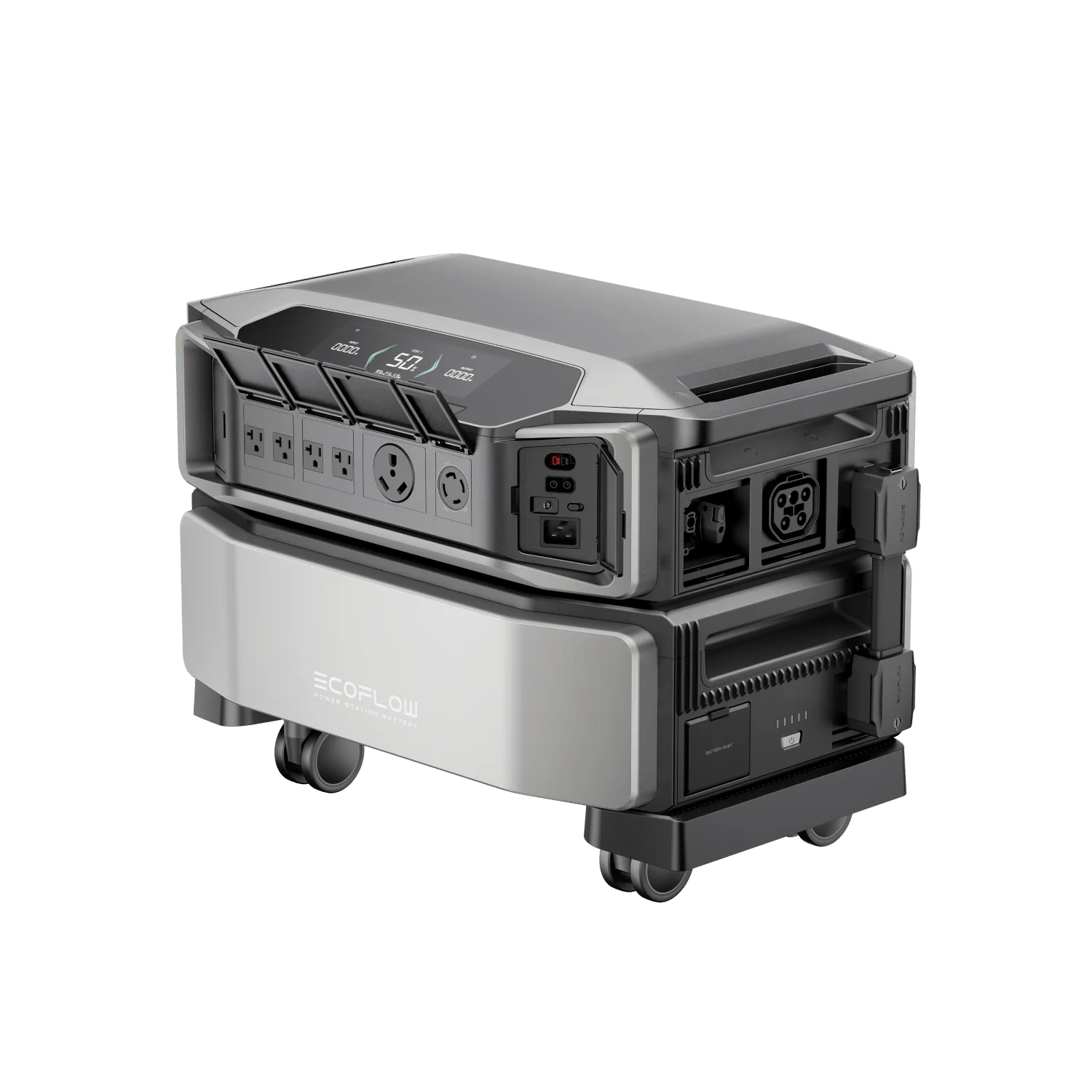
EcoFlow DELTA Pro Ultra vs EcoFlow DELTA Pro Ultra X: the same 3500-cycle cells at two scales; the Pro Ultra pushes 7,200 continuous watts and holds 6,144Wh against the X's 12,000 and 12,288Wh, but carries a 10-year warranty against 5. Buy the Pro Ultra unless your house truly needs 12,000 continuous watts.
Full profiles: EcoFlow DELTA Pro Ultra → · EcoFlow DELTA Pro Ultra X →

Written by Gunner GustafsonUpdated
Whole-Home Backup Tester, Station Arena Test Desk
$4,199.00 · direct from EcoFlow
Last checked 1 day ago. Prices move — check before you buy.

$7,999.00 · direct from EcoFlow
Last checked 1 day ago. Prices move — check before you buy.
Spec deltas
The DELTA Pro Ultra and the DELTA Pro Ultra X are the same EcoFlow platform at two different scales, and neither is something you carry — the lighter of the two already weighs 181.8 lbs. This is a whole-home purchase, not a portable-station upgrade, so the real question is which base size your house needs today.
The Pro Ultra starts at $3,999 for 6,144Wh and a 10-year warranty. The Pro Ultra X starts at $7,999 for exactly double the capacity, 12,000 continuous watts instead of 7,200, and a warranty EcoFlow cuts to 5 years. Run the math on cost per year of coverage rather than cost per watt-hour, and the gap gets harder to ignore.
Most of the scenarios below don't even separate them — a CPAP, a remote workday, a tailgate spread all draw a sliver of either battery's capacity. The split only reopens at the very top of the range, which is exactly where most buyers were never actually shopping.
What the Numbers Reveal
Each conclusion stated first — the numbers behind it on one line, the full analysis below.
Yet both work out to the same $0.19 per lifetime kilowatt-hour once you run the full 3,500-cycle life — EcoFlow prices the energy identically on both units and prices the coverage window completely differently. That gap in cost-per-warranty-year, not cost-per-watt-hour, is why the Pro Ultra comes out cheaper to own.
Pro Ultra: $3,999 with a 10-year warrantyPro Ultra X: $7,999 with a 5-year warranty
Why it mattersAnyone comparing these on sticker price alone is missing that the X's warranty-adjusted cost runs 4x higher every year EcoFlow is actually on the hook for it.
continuous output
That's the real signature of the surge-power gotcha: it's not just a bigger number, it's an inverter built to swallow a compressor or well-pump spike without tripping — headroom closer to what a large portable station offers than what the Pro Ultra's own surge rating provides.
Pro Ultra: 7,200W continuous, 10,800W surgePro Ultra X: 12,000W continuous, 45,000W surge
Why it mattersIf the load includes a well pump, a large AC compressor, or anything else with a hard startup spike, the X's headroom is the difference between starting every time and tripping a breaker — most household loads never ask either unit to prove it.
weight
Neither unit is portable in the sense the rest of EcoFlow's lineup is; both are placed once and left. But 298.7 lbs is far enough past 181.8 lbs that where each one lives — how it gets down a hallway or through a doorway — deserves as much planning as which one you buy.
Pro Ultra weighs 181.8 lbsPro Ultra X weighs 298.7 lbs
Why it mattersMeasure the doorway and the path to the install spot before ordering the X specifically; the Pro Ultra is still heavy, but two people can reposition it. The X, once it's in place, is staying there.
The split only reopens at the top of the range. Van Life Daily is the one load that actually stresses the smaller unit — 90% of the Pro Ultra's capacity gone, versus 45% of the X's — which is the only scenario here where capacity itself, not price or warranty, should decide.
CPAP Overnight, Remote Workday, and Tailgate Party all resolve as 'both' — neither unit is stressedVan Life Daily needs 4,685Wh: 90% of the Pro Ultra's capacity versus 45% of the X's
Why it mattersIf your real-world draw tops out anywhere below full-time van living, don't let the scenario comparison talk you into the X — it isn't earning its keep there.
The specific dimensions that decide these two units — everything else is a tie.
Lifetime Value
Selected because: cheaperToOwn=p1 needs explaining since cost-per-lifetime-kWh actually ties at $0.19 — the real story is cost-per-warranty-year.
cost / lifetime kWh
Both units cost the same $0.19 per lifetime kilowatt-hour once you run them through their full 3,500-cycle life — EcoFlow isn't charging a premium for the X's energy, watt-hour for watt-hour. The premium shows up somewhere else: warranty length. Spread the Pro Ultra's $3,999 over its 10-year warranty and coverage runs about $400 a year; spread the X's $7,999 over 5 years and it's about $1,600 a year — four times the annual cost for the years EcoFlow is actually standing behind the unit.
That's the honest version of cheaper to own: the Pro Ultra isn't the better deal because it's cheaper energy, it's the better deal because you're paying for half as many years of risk transferred to EcoFlow. If the X fails in year 6, that's on you; if the Pro Ultra fails in year 6, it's still under warranty.
What the Specs Don't Tell You
Selected because: all four firing gotchas (weight, surgeRatio, ups, warranty) are the real differentiators at this tier, not the headline specs.
Weight, surge headroom, switchover speed, and warranty length are where these two actually diverge — everything else scales together. The X's 298.7 lbs (116.9 lbs over the Pro Ultra's 181.8) moves it from a two-person lift into hand-truck-or-professional-install territory, and its 45,000W surge — 3.75x its 12,000W continuous rating, against the Pro Ultra's 1.5x — is built for motor starts the smaller unit was never engineered to absorb.
The other two cut the other way. The Pro Ultra switches over in 0ms, a true online UPS with no gap for sensitive electronics; the X's under-10ms switchover is fast but not zero. And the Pro Ultra's 10-year warranty runs twice as long as the X's 5 — the one place the smaller, cheaper unit is unambiguously the safer bet.
Your Life, Your Pick
Selected because: 3 of 6 scenarios resolve as both — worth stating plainly that size stops discriminating below the top of the range.
Three of the six load profiles tested here don't produce a winner at all: CPAP Overnight, Remote Workday, and Tailgate Party all resolve as both, because either battery clears them with room to spare. That's not a gap in the testing, it's the honest result of comparing two units this large against everyday loads — capacity stopped being the constraint a while ago.
The split reopens only at the top. Weekend Camping and an 8-hour blackout both lean toward the X on comfort margin, and Van Life Daily is the one scenario that actually stresses a unit, pulling 90% of the Pro Ultra's capacity against 45% of the X's. Below that ceiling, buy on price and warranty. At that ceiling, buy on capacity.
Growth Path
Selected because: same-platform step-up — frame the X as where you land if you outgrow the Pro Ultra, not a mandatory starting point.
solar input
Both platforms scale — the Pro Ultra already supports EcoFlow's own expansion batteries, adding capacity later without swapping the base unit, so which one can grow isn't really the question. The question the spec sheet answers is which continuous-power ceiling you need starting today: 7,200W on the Pro Ultra's base unit, 12,000W on the X's, a gap more batteries alone don't close.
Solar is the one place the X's growth path is genuinely stronger on its own terms — a 10,000W ceiling against the Pro Ultra's 5,600W, so a bigger panel array can actually feed it. Buy the Pro Ultra if you want room to grow later; buy the X if the day-one household load already needs what only its base inverter delivers.
Strengths & trade-offs
EcoFlow DELTA Pro Ultra
Strengths
- +Costs $3,800 less
- +Lighter by 116.9 lb
- +Longer warranty
Trade-offs
- –Weaker inverter (-4,800W) limits appliance compatibility.
- –Very heavy unit that may be difficult for one person to lift.
EcoFlow DELTA Pro Ultra X
Strengths
- +Larger battery capacity
- +Higher AC output
- +Faster solar charging
Trade-offs
- –Substantially more expensive (+$3,800) than the DELTA Pro Ultra.
- –Significantly heavier (+116.9 lbs), making it harder to move.
- –Very heavy unit that may be difficult for one person to lift.
Will It Power Your Gear?
Scenario math and per-appliance runtimes, modeled from the spec record.
Scenario verdicts
We ran the math on six real-world scenarios. Here's which unit survives your actual life.
SCN-01 · 2 nights · needs 2,100Wh
Weekend Camping
Two nights off-grid with essential comfort
Neither unit
Weekend Camping needs 2,100Wh — 40% of the Pro Ultra, 20% of the Pro Ultra X. The Pro Ultra covers it comfortably; the X's extra headroom is the more comfortable margin for a longer weekend or an unplanned extra day.
Battery budget usedlower = more headroom
LOAD Phone Charger 15W×6h · LED Lights 40W×8h · Box Fan 75W×14h · CPAP Machine 40W×16h
SCN-02 · 8 hours · needs 1,645Wh
8-Hour Blackout
Keep the essentials running through a night without power
DELTA Pro Ultra X
An 8-hour blackout draws 1,645Wh — 31% of the Pro Ultra, 16% of the Pro Ultra X. Either rides it out with room to spare; the X barely notices it happened.
Battery budget usedlower = more headroom
LOAD Fridge 150W×8h · Router + Modem 20W×8h · LED Lights (4 bulbs) 40W×6h · Phone Charger 15W×3h
SCN-03 · 8 hours · needs 320Wh
CPAP Overnight
Sleep therapy without interruption — the #1 medical use case
Either unit
CPAP overnight needs just 320Wh — 6% of the Pro Ultra, 3% of the X. At this size, both are massive overkill for a single night; this scenario doesn't separate them at all.
Battery budget usedlower = more headroom
LOAD CPAP Machine 40W×8h
SCN-04 · 8 hours · needs 910Wh
Remote Workday
Full work day off-grid without power anxiety
Either unit
A remote workday's 910Wh is 17% of the Pro Ultra and 9% of the X. Neither will come close to running dry — decide on price and warranty here, not capacity.
Battery budget usedlower = more headroom
LOAD Laptop 60W×8h · External Monitor 30W×8h · Router + Modem 20W×8h · Phone Charger 15W×2h
SCN-05 · 4 hours · needs 670Wh
Tailgate Party
Game day power for the crew
Neither unit
A tailgate spread draws 670Wh — 13% of the Pro Ultra, 6% of the X. Both shrug this off; capacity simply isn't the variable that matters at tailgate scale.
Battery budget usedlower = more headroom
LOAD Blender 400W×0.5h · LED TV (55") 80W×4h · Bluetooth Speaker 15W×4h · Phone Charger (×3) 45W×2h
SCN-06 · 24 hours · needs 4,685Wh
Van Life Daily
A full day of mobile living — the ultimate endurance test
DELTA Pro Ultra X
Van Life Daily's 4,685Wh is the one load that actually stresses these units — 90% of the Pro Ultra's capacity versus 45% of the X's. The Pro Ultra technically covers it, but with almost nothing left over; the X does it with real margin to spare.
Battery budget usedlower = more headroom
LOAD Mini-Fridge 150W×24h · Laptop 60W×4h · Phone Charger 15W×3h · LED Lights 40W×5h · Fan 75W×8h
The Load Test
RUNTIME = (Wh × 0.85) ÷ LOAD
None of the scenarios above exactly yours? Build it. Toggle what you'd plug in; both units are tested against the combined draw.
Essentials
Comfort & Convenience
High-Draw Appliances
Test duration
8h
Continuous draw
205W
Projected runtime
For this load: DELTA Pro Ultra X runs 51h vs 25.5h.
$7,999 list · direct from EcoFlow
Modeled from the spec record — same math as the tables below. Methodology
Runtime by appliance
Real-world runtime estimates for common appliances, modeled at 85% inverter efficiency.¹
Essentials
The basics you need runningscale 0–696.3hComfort & Convenience
Makes off-grid life actually enjoyablescale 0–139.3hHigh-Draw Appliances
These reveal the real limitsscale 0–10.4h¹ Runtime = (capacity × 0.85) ÷ appliance watts. Within each group, all bars share one time scale (the group's longest runtime), so lengths are comparable across appliances; identical runtimes collapse into a single blue/orange bar. Actual runtime varies with battery age, temperature, and simultaneous loads — see methodology.
Conclusion
July 28, 2026
Verdict: the EcoFlow DELTA Pro Ultra
Buy the Pro Ultra. At $3,999 against the X's $7,999, it comes with twice the warranty (10 years versus 5) and handles all six of the load scenarios tested here, including the heaviest one with real if tight margin. The X earns its price when a household genuinely needs 12,000 continuous watts or the deeper surge cushion for hard motor starts — otherwise the extra $4,000 is buying headroom you'll rarely touch.
Editor-assigned confidence, based on cited owner research and spec analysis.
List prices as of July 28, 2026. The links below open EcoFlow's current price.
$4,199.00 · direct from EcoFlow
Last checked 1 day ago. Prices move — check before you buy.
or check the DELTA Pro Ultra X price$7,999.00 list
Written by Gunner Gustafson, Whole-Home Backup Tester · Station Arena Test Desk · Updated July 28, 2026
Measured Data
Benchmark scores and the full spec record, side by side.
Benchmark scores
Full specifications
ᵈ Derived: price ÷ rated capacity. See the data behind our comparisons →
Comparison ToolAdd more power stations, side by sideOpen Tool →How these numbers are produced
Numeric verification
Every figure on this page traces to our spec database or arithmetic on it — no estimated numbers.
Owner claims
Statements about owner experience are cited to published reviews — see Sources & Research Notes below.
Runtime model
Runtime = (rated capacity × 0.85 inverter efficiency) ÷ device wattage. Solar recharge estimates assume panels deliver 70% of rated output. Cold weather, battery age, and stacked loads reduce real-world results.
Power Score
Computed from 14 published spec dimensions, weighted per use-case bench. Higher is better; a unit must meet a bench's minimum threshold to be rated.
See the full weight table and data sourcing on our methodology page →Class ranking (the star rating)
Each unit's star score is a category ranking, not customer reviews — no buyer opinions feed it. We score every station on size-independent quality (value, output, portability, endurance, ports, warranty, and more), then percentile-rank it against the other units in its capacity class, so a class-leading compact unit and a class-leading whole-home unit can both earn 5★. Here, DELTA Pro Ultra rates 4.9/5 (93rd percentile of 16 Home Backup-class units), and DELTA Pro Ultra X rates 4.3/5 (61st percentile of 29 Whole-Home / Off-Grid-class units).
How the class ranking is computed →Test Notes & Caveats
Hidden gotchas and advantages we spotted that you won't find on the product page.
Weight Reality Check
The Pro Ultra X's 298.7 lbs is 116.9 lbs heavier than the Pro Ultra's 181.8 lbs. Both are stationary, place-once systems, but the X moves the weight class from a two-person carry to hand-truck-or-professional-install territory.
Surge Power: Inverter Quality Indicator
The Pro Ultra's 10,800W surge is 1.5x its 7,200W continuous rating. The Pro Ultra X's 45,000W surge is 3.75x its 12,000W continuous rating — a much deeper cushion for hard motor starts like well pumps or large AC compressors.
UPS Switchover: 0ms-rated vs ≤10ms
The Pro Ultra switches over in 0ms, a true online UPS with no gap. The Pro Ultra X switches in under 10ms — fast enough that most electronics won't notice, but not the zero-gap protection the Pro Ultra offers the most sensitive gear.
Warranty: 10 Years vs 5
The Pro Ultra carries a 10-year warranty against the Pro Ultra X's 5 years. Spread each price over its own warranty term and the Pro Ultra runs about $400 a year of coverage versus roughly $1,600 a year for the X, even though both work out to the same $0.19 per lifetime kWh over a full 3,500-cycle life.
Full record above — the Test Desk pick is the DELTA Pro Ultra.
Check DELTA Pro Ultra price →or check the DELTA Pro Ultra X priceOwnership Analysis
What happens after you buy — true cost of ownership, brand trust, and growth potential.
Lifetime value
Service lifeyears at one full cycle per day
Lifetime energy delivered
Cost per delivered kWh
│ warranty ends · Reaching the cycle rating means ~80% capacity remains — degraded, not dead.
Analyst note
The DELTA Pro Ultra is cheaper to buy, but the DELTA Pro Ultra X is cheaper to own. At $0.19/kWh over its lifetime vs $0.2/kWh, the DELTA Pro Ultra X's higher cycle life and capacity make each dollar go further over the years. One thing to know reading the table: both carry the same 3,500-cycle rating, so the lifetime rows are sticker price and capacity in disguise — the wear horizon is identical and decides nothing here.
Growth path
DELTA Pro Ultra
EXPANDABLESupports EcoFlow expansion batteries, so you can add capacity later without replacing the base unit — useful if your needs may climb past 6,144Wh.
Accepts up to 5,600W of solar. Enough for a serious multi-panel array.
Adequate ports for most setups, but heavy users may want a power strip.
Expansion batteries are EcoFlow-specific. You're investing in the EcoFlow ecosystem.
DELTA Pro Ultra X
EXPANDABLESupports EcoFlow expansion batteries, so you can add capacity later without replacing the base unit — useful if your needs may climb past 12,288Wh.
Accepts up to 10,000W of solar. Enough for a serious multi-panel array.
Adequate ports for most setups, but heavy users may want a power strip.
Expansion batteries are EcoFlow-specific. You're investing in the EcoFlow ecosystem.
Realistic full solar rechargeat 70% of rated panel output — see methodology
Analyst note
Both expand, but the DELTA Pro Ultra X's higher solar ceiling (10,000W vs 5,600W) gives it the stronger off-grid growth path — more panels can feed a bigger bank as it grows.
What Owners Report
Patterns from published owner reports and long-term reviews — every claim cited to its source below.
EcoFlow DELTA Pro Ultra
Owner reviews on Home Depot describe the Pro Ultra as a powerful, easy-to-use whole-home backup with a quick setup, strong solar input, and solid app monitoring — reviewers specifically note the 7,200W inverter running a 3-ton central ACA4.
Field reports also point to fast recharging and a true online UPS that keeps sensitive electronics protected around the clock, with quiet operation under everyday loadsA3.
“6,144Wh per battery with 7,200W continuous output (10.8kW surge), expandable to 90kWh across a system for a household — over 30 days of essential backup.”
Sources
ecoflow.com · homedepot.com · autoboosting.com · ecogadgethub.com
EcoFlow DELTA Pro Ultra X
Coverage on the Pro Ultra X leans more toward early reviewer writeups than years of lived-in ownership reports — it's a newer, higher-end system. What's there is consistently positive: reviewers highlight EV-grade full-tab LFP cells with 24/7 battery-management oversightB3, and a quick-connect install process they credit with cutting setup time well below a typical multi-battery DIY buildB4.
Reviewers also confirm the 12kW base output covers a 5-ton central AC alongside the rest of a home's circuits, with surge handling into the tens of kilowatts for hard motor startsB1. There isn't yet the multi-year track record the smaller Pro Ultra has, so treat the safety and reliability claims as manufacturer-and-reviewer sourced rather than field-proven over time.
“Base config delivers 12kW continuous at 120/240V — enough to power every circuit including a 5-ton AC — scaling to 12-36kW with surge handling to 45kW via Adaptive Start.”
Sources
ecoflow.com · outboundpower.com · bobvila.com · thesolarlab.com
Sources & Research Notes
Every owner claim in this report is traceable to a published source. The bracketed references above resolve here.
Recurring owner themes
- Whole-home scale (to 90kWh), 7,200W output, online UPS, silent operation under load, and industry-fast charging are the standout features. [DELTA Pro Ultra · 2 entries]
- Whole-home 12kW output, massive scalability (to 184kWh), EV-grade LFP, 10kW solar, and fast install are the standout features. [DELTA Pro Ultra X · 3 entries]
- A3
“Industry-fast 8,800W charging tops up two batteries in about 2 hours; an online UPS protects sensitive electronics round the clock, and it runs at 0 dB (silent) for draws under 2,000W.”
ecoflow.com / ecogadgethub.com — DELTA Pro Ultra review · 2026 · [positive]
- A4
“Owners call it a powerful, easy-to-use whole-home backup with quick setup, strong solar input, and good app monitoring; its 7,200W inverter can power a 3-ton central AC.”
homedepot.com owner reviews — DELTA Pro Ultra · 2026 · [positive]
- B1
“Base config delivers 12kW continuous at 120/240V — enough to power every circuit including a 5-ton AC — scaling to 12-36kW with surge handling to 45kW via Adaptive Start.”
ecoflow.com / outboundpower.com — DELTA Pro Ultra X review · 2026 · [positive]
- B3
“EV-grade full-tab LFP cells with a multi-layer safety architecture and 24/7 BMS oversight; solar charging up to 10kW.”
ecoflow.com / bobvila.com — DELTA Pro Ultra X review · 2026 · [positive]
- B4
“A quick-connect design cuts installation time and cost by up to 80%, ready in about 7 days; a CES 2026 Innovation Award Honoree at a $7,999 base price.”
ecoflow.com / thesolarlab.com — DELTA Pro Ultra X review · 2026 · [positive]
Research compiled July 28, 2026.
What Owners Actually Report
Drawn from 95 comments on independent review channels — not from retailer reviews, which skew to the first week of ownership. Each line is our summary of one commenter's claim, linked to the original. We record what they said, including where it contradicts the spec sheet.
EcoFlow DELTA Pro Ultra
144 claims from 88 comments · 100 from owners · 35 with figures
- Price & value
- 22 · 18% negative
- Runtime
- 16 · 0% negative
- Expandability
- 17 · 16% negative
- Charging
- 11 · 4% negative
- Other
- 18 · 19% negative
What owners complain about
A second battery bought separately adds $1900, roughly doubling the cost.
Expandabilitymeasuredowner5 agreedsource →
After firmware updates max solar charging dropped from 7kW to 3.5kW.
App & firmwaremeasuredowner5 agreedsource →
Still charges at 7kW from a generator, so the cap looks solar-specific.
Solar inputmeasuredowner5 agreedsource →
What owners praise
Charges at 6000W from a gas generator, hitting 100% in a little over 3 hours with some sun.
Chargingmeasuredowner36 agreedsource →
Costco deal gave him the DPU with two batteries, 12kWh, for $4,500.
Price & valuemeasuredowner53 agreedsource →
Delivered with batteries manufactured less than 90 days earlier.
Shippingmeasuredowner53 agreedsource →
EcoFlow DELTA Pro Ultra X
11 claims from 7 comments · 2 from owners · 0 with figures
- Shipping
- 1 · 100% negative
- Build quality
- 2 · 82% negative
- Price & value
- 3 · 100% negative
- Solar input
- 2 · 48% negative
- Expandability
- 2 · 0% negative
What owners complain about
Ordered a DPUX at launch and was shipped a plain DPU battery instead; returned it.
Shippingowner9 agreedsource →
Refuses to use the included DC isolator rotary switch over arc-fault fire risk; uses own breakers.
Build qualityowner1 agreedsource →
Believes EcoFlow relabeled the DPU battery as DPUX and raised the price.
Price & value9 agreedsource →
What owners praise
Says it is the exception among portables that is not solar-input limited, at a much higher price.
Solar input6 agreedsource →
An excellent whole-home backup alternative to a traditional generator.
Other4 agreedsource →
Adding batteries or a second inverter is plug-and-stack versus bus bars, fuses and conduit.
Expandability5 agreedsource →
Claims are weighted by how specific they are, whether the commenter owns the unit, and how many readers agreed. Comments that mention a product under a rival's review count for more, because the commenter had no reason to be there. This is what buyers report, not our test results — for measurements we ran ourselves, see the methodology.
Who Should Buy Which
Buy the DELTA Pro Ultra if you…
- →You're outfitting a home for backup power and don't yet know if you'll ever need more than 6,144Wh — the Pro Ultra covers a full weekend, an 8-hour blackout, a CPAP, a remote workday, and a tailgate spread without breaking a sweat, and its own expansion batteries are there if you outgrow it later.
- →You want the longer warranty and the lower entry price, and you're fine with a true online, zero-gap UPS instead of the X's sub-10ms switchover — for most home electronics, the difference between the two is theoretical.
Buy the DELTA Pro Ultra X if you…
- →Your house has a genuine 12,000W continuous load — a 5-ton AC running alongside the rest of the panel, a well pump, a shop full of power tools — and you need the surge headroom to start it all reliably, not just more energy in reserve.
- →You're building toward a true whole-home standby system from day one and would rather start at 12,288Wh with a 10,000W solar ceiling than grow into it in stages — the shorter 5-year warranty and doubled price are the cost of skipping the smaller build entirely.
If neither fits
If your real-world draw is a CPAP, a laptop-and-router workday, or a weekend of camping, neither of these whole-home systems is the right purchase — you'd be paying for capacity and continuous wattage you'll use a sliver of. A portable power station a fraction of the price and weight covers those loads just as completely.
The Bottom Line
The Pro Ultra and the Pro Ultra X are the same platform sized for two different jobs: $3,999 and 6,144Wh against $7,999 and 12,288Wh, with the real fork being 7,200 continuous watts against 12,000. Buy the Pro Ultra if your home's actual peak draw fits comfortably under that first number — it covers every load tested here, comes with twice the warranty, and its own expansion batteries are there if you're wrong about needing more later.
Buy the X only when the math changes because your house genuinely needs 12,000 continuous watts or the deeper surge cushion on day one, not because bigger numbers feel safer. At this scale, more capacity you don't use is just $4,000 you didn't need to spend.
Frequently Asked Questions
Answers drawn from the spec record and cited owner research.
What's the actual difference between the EcoFlow DELTA Pro Ultra and the DELTA Pro Ultra X?
The X roughly doubles the Pro Ultra's specs across the board: 12,288Wh of capacity against 6,144Wh, 12,000W of continuous output against 7,200W, and a 45,000W surge rating against 10,800W. It also costs about double, $7,999 against $3,999, and carries half the warranty — 5 years instead of 10.
Is the DELTA Pro Ultra X worth the extra money?
Only if your home needs the extra continuous power. Both units cost the same $0.19 per lifetime kilowatt-hour, and the Pro Ultra alone clears every everyday load tested for this comparison, including an 8-hour blackout and a full weekend of camping. The X earns its price when the load is a genuine 12,000W whole-home draw or a hard motor start that needs the deeper surge cushion.
Can the smaller Pro Ultra be expanded instead of buying the X?
Yes — the Pro Ultra supports EcoFlow's own expansion batteries, so you can add capacity later without replacing the base unit. What expansion doesn't change is the base inverter's continuous output, 7,200W on the Pro Ultra versus 12,000W on the X, so expanding the Pro Ultra grows its storage, not its power ceiling.
Why does the more expensive Pro Ultra X have a shorter warranty?
EcoFlow backs the Pro Ultra for 10 years and the Pro Ultra X for 5. Spread each price over its warranty term and the Pro Ultra runs about $400 a year of coverage against roughly $1,600 a year for the X — a real cost difference even though both are priced identically per lifetime kilowatt-hour.
Which one should I buy for van life or full-time off-grid living?
The Pro Ultra X. A realistic van-life daily draw of 4,685Wh eats 90% of the Pro Ultra's capacity, leaving almost no buffer, against 45% of the X's — the one scenario in this comparison where the bigger unit's extra capacity is doing real, necessary work instead of sitting unused.
Related comparisons
Where to buy
EcoFlow DELTA Pro UltraPick
$4,199.00
$4,199.00 · direct from EcoFlow
Last checked 1 day ago. Prices move — check before you buy.
EcoFlow DELTA Pro Ultra X
$7,999.00
$7,999.00 · direct from EcoFlow
Last checked 1 day ago. Prices move — check before you buy.
Prices may vary by retailer and are subject to change.