Head-to-head test
EcoFlow DELTA Pro Ultra vs BLUETTI AC500 + 2×B300K
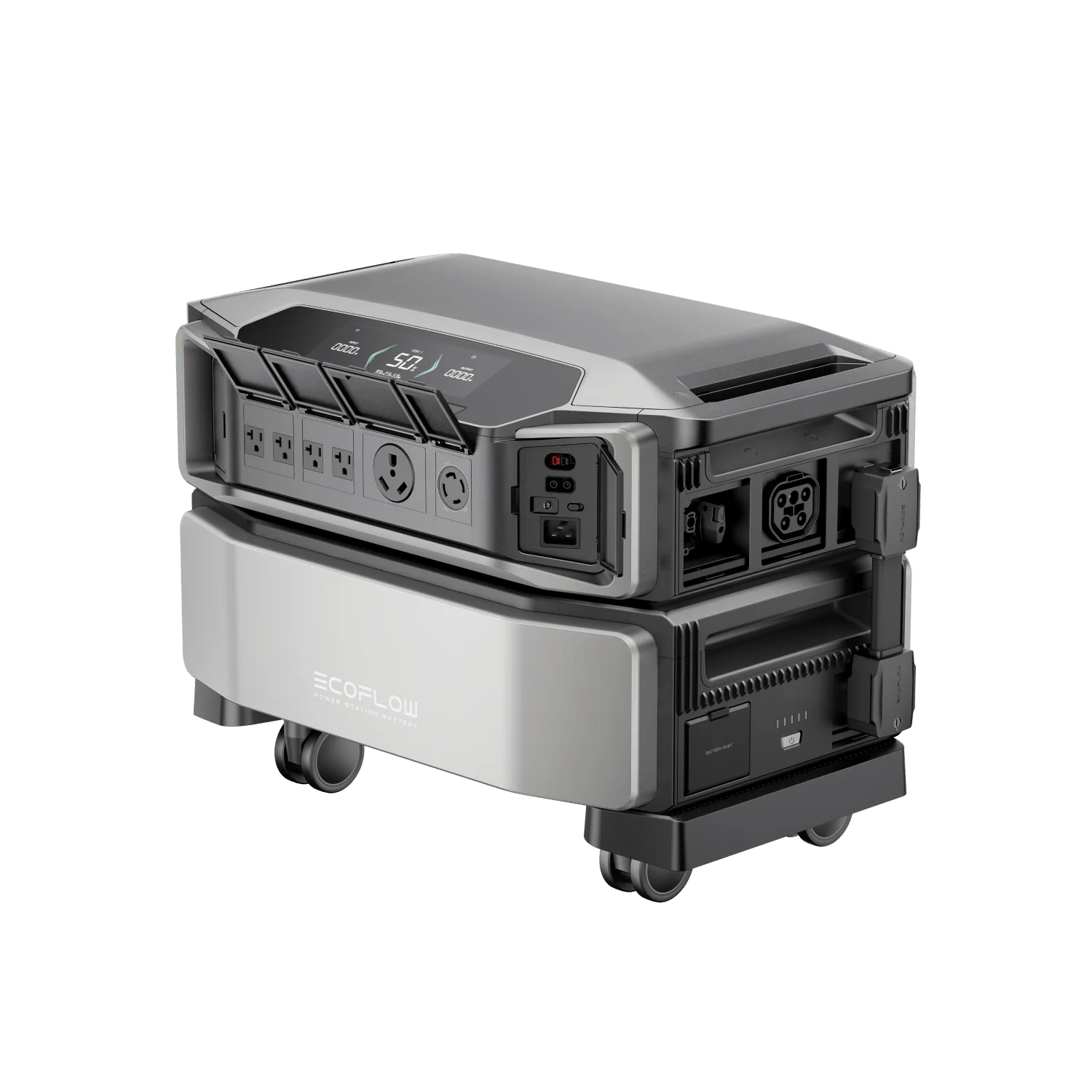
The DELTA Pro Ultra takes nearly twice the solar (5,600W vs 3,000), backs itself with a 10-year warranty, and switches over with zero interruption where the AC500 blinks at 20ms — for $800 more. The AC500 + 2×B300K is the value answer: $800 cheaper up front and cheaper to own, if you don't need what the EcoFlow's ceiling buys.
Full profiles: EcoFlow DELTA Pro Ultra → · BLUETTI AC500 + 2×B300K →

Written by Gunner GustafsonUpdated
Whole-Home Backup Tester, Station Arena Test Desk
Spec deltas
The DELTA Pro Ultra takes 5,600W of solar to the AC500 stack's 3,000 — nearly double — and that single number is the clearest reason to pay its $800 premium. Recharge speed is a survival spec, not a convenience one, and in a multi-day outage the unit that refills from the sun in a morning beats the one that needs most of the day.
It backs that up across the board. The DPU holds 6,144Wh against 5,530, runs 7,200W against 5,000, switches over with zero interruption as a true online UPS where the AC500 takes a standby-class 20ms, and runs effectively silent under load while the AC500 publishes no noise figure at all. It also carries a 10-year warranty against the AC500 stack's none. Our composite scores it 1,971 points ahead, and that gap is earned.
Now the honest part, because it's the whole reason this isn't a blowout: the AC500 is the cheaper unit to own. It's $800 less at the register and costs $0.17 per lifetime kWh against the DPU's $0.19, and its 10,000W surge nearly matches the DPU's 10,800. So the DPU isn't the value pick — it's the capability pick. Whether it's the right pick comes down to whether you'll actually use the solar intake, the online UPS, and the warranty you're paying extra for.
What the Numbers Reveal
Each conclusion stated first — the numbers behind it on one line, the full analysis below.
solar input
With 2,600W more solar intake, the DPU turns a full day of AC500 recharging into a morning, and its fast AC charging tops two batteries in about two hoursA3. In a multi-day blackout you're recharging constantly, so the faster pipe isn't a luxury — it's whether the bank is full again before the next evening.
DPU accepts 5,600W of solar; the AC500 takes 3,000WDPU's fast charging tops up two batteries in about two hoursA3A multi-day outage means recharging every day the sun is up
Why it mattersAnyone planning for real off-grid or multi-day outage use should weigh the DPU's intake above almost anything else on the page.
A true 0ms online UPS never lets the power dip, which matters for a desktop mid-save or sensitive medical gear, where the AC500's 20ms standby switch can register as a blink. Pair that with a 10-year warranty against a stack that lists none on a platform with dead-on-arrival reportsB7, and the DPU is the one you buy when downtime is expensive.
DPU switches over at 0ms as a true online UPS; the AC500 takes standby-class 20msDPU carries a 10-year warranty; the AC500 stack lists noneThe AC500 platform has some dead-on-arrival reportsB7
Why it mattersHome offices, servers, and medical equipment should take the DPU for the no-blink switch and the decade of coverage.
The DPU costs $800 more up front and a bit more per lifetime kWh, so it's not the value play by any reading. The AC500 delivers a nearly matching surge and the core of the same job for less money over the unit's whole life. Its case is simple: if you don't need the solar intake, the online UPS, or the warranty, you're paying $800 for headroom you won't touch.
AC500 stack is $3,299 vs the DPU at $4,099 — $800 lessAC500 costs $0.17 per lifetime kWh vs the DPU's $0.19AC500's 10,000W surge nearly matches the DPU's 10,800W
Why it mattersValue-first buyers who won't use the DPU's ceiling should keep the $800 and take the AC500.
The specific dimensions that decide these two units — everything else is a tie.
PowerScore Breakdown
Selected because: The DPU's 1,971-point lead across output, solar, and UPS is the spine of the verdict.
overall power score
The DPU leads our composite 8,583 to 6,612, and the lead is broad rather than lopsided in any one place. It holds 614Wh more, runs 2,200W more continuous output, takes 2,600W more solar, and switches over faster — no single knockout, just a unit that's ahead almost everywhere at once.
The AC500 keeps pace in exactly one spot worth naming: surge. Its 10,000W near-matches the DPU's 10,800, so for the instant-startup demand of a big motor, the two are close. Everywhere the measurement runs longer than a surge — sustained output, solar refill, switchover — the DPU pulls ahead. This is what paying $800 more buys: not one dramatic advantage, but a broad one.
Growth Path
Selected because: 5,600W vs 3,000W solar intake is the DPU's single most decisive advantage.
solar input
Solar intake is where the DPU's premium earns itself back. It accepts 5,600W of panels to the AC500's 3,000 — nearly double the pipe — so a bank that would take the AC500 most of a sunny day to refill comes back to the DPU in a morning. For a stationary home unit that's convenient; for an off-grid or multi-day-outage setup it's close to decisive, because the whole game off-grid is putting energy back faster than you pull it out.
Both units expand with add-on batteries, so this isn't only about today's capacity — it's about feeding a growing bank. As you add storage, the DPU's higher solar ceiling keeps up with the larger pack where the AC500's 3,000W input starts to bottleneck. If your plan is to grow the system and run it off panels, the DPU is built for that trajectory and the AC500 is working against a smaller pipe.
Lifetime Value
Selected because: The honest counter — the AC500 is $800 cheaper and cheaper to own.
This is the AC500's section, and it's a real one. It's $800 cheaper to buy — $3,299 against $4,099 — and it's also cheaper to own, at $0.17 per lifetime kWh against the DPU's $0.19. On pure money, over the whole life of the unit, the BLUETTI wins.
That's the honest frame for the entire comparison: you are not choosing the cheaper unit when you choose the DPU, you're choosing the more capable one and paying for it twice, up front and slightly over time. The DPU justifies that with solar intake, an online UPS, silence, and a 10-year warranty. If those don't map to how you'll actually use the thing, the AC500 is the smarter allocation of $800 — buy it and don't look back.
What the Specs Don't Tell You
Selected because: True 0ms online UPS, the surge comparison, and the AC500's undisclosed noise live here.
The UPS difference is the one that separates the two for sensitive gear. The DPU is a true online UPS with a 0ms switchover — the power never actually drops — while the AC500 is standby-class at 20ms, fast enough for most electronics but a real blink for a desktop mid-save or equipment that won't tolerate a gap. If you're protecting anything that can't hiccup, that's a hardware-level distinction, not a preference.
Noise splits the same way, by disclosure. The DPU is rated at 30 dB and runs effectively silent under moderate load; the AC500 stack publishes no figure, and the field reports that exist describe an audible fan under load and bright indicator lights. Neither is a dealbreaker, but the DPU tells you it'll be quiet and the AC500 leaves you to find out — an easy edge to the unit that put a number on it.
Brand Trust
Selected because: EcoFlow's ecosystem and warranty vs BLUETTI's value/app and support risk.
EcoFlow brings the deepest ecosystem and the strongest safety net. It's the largest community in the space, its fast-charging tech leads the category, and the 10-year warranty on the DPU is real reassurance on a four-figure purchase. The honest asterisk: an October 2025 recall of a different model, the DELTA Max 2000, over overheating risk is worth knowing as brand context, and EcoFlow doesn't offer parts or service once a unit is out of warranty.
BLUETTI's pitch is value and software — the best capacity-to-price in the category and an app among the best you'll use. Its weak point is support: inconsistent, email-based, and the brand's own biggest risk factor, with buying direct the safer route. Set side by side, EcoFlow is the lower-anxiety ownership experience and the longer warranty; BLUETTI is the better price and the better app, with a support desk you'd rather not have to call.
Strengths & trade-offs
EcoFlow DELTA Pro Ultra
Strengths
- +Lighter by 14.3 lb
- +Larger battery capacity
- +Higher AC output
- +Longer warranty
- +Faster solar charging
Trade-offs
- –Very heavy unit that may be difficult for one person to lift.
BLUETTI AC500 + 2×B300K
Strengths
- +Costs $251 less
Trade-offs
- –Significantly heavier (+14.3 lbs), making it harder to move.
- –Weaker inverter (-2,200W) limits appliance compatibility.
- –Very heavy unit that may be difficult for one person to lift.
Will It Power Your Gear?
Scenario math and per-appliance runtimes, modeled from the spec record.
Scenario verdicts
We ran the math on six real-world scenarios. Here's which unit survives your actual life.
SCN-01 · 2 nights · needs 2,100Wh
Weekend Camping
Two nights off-grid with essential comfort
Neither unit
Scoring these two at a campsite is a category error: neither travels — the DELTA Pro Ultra is 181.8 lbs and the AC500 + 2×B300K 196.1 lbs, and at those weights they roll off a truck bed if they go anywhere at all. The 2,100Wh here is trivial for either — it's the going that doesn't happen. If you need power away from the building, you're shopping the wrong class.
Battery budget usedlower = more headroom
LOAD Phone Charger 15W×6h · LED Lights 40W×8h · Box Fan 75W×14h · CPAP Machine 40W×16h
SCN-02 · 8 hours · needs 1,645Wh
8-Hour Blackout
Keep the essentials running through a night without power
Either unit
An eight-hour outage pulls about 1,645Wh, a small fraction of either pack, so both ride it out easily on capacity alone. The real separation in an outage is refill and switchover: the DPU catches the cut with no blink and refills from solar in a morning, while the AC500 covers the energy just as well but switches over at 20ms and takes longer to top back up.
Battery budget usedlower = more headroom
LOAD Fridge 150W×8h · Router + Modem 20W×8h · LED Lights (4 bulbs) 40W×6h · Phone Charger 15W×3h
SCN-03 · 8 hours · needs 320Wh
CPAP Overnight
Sleep therapy without interruption — the #1 medical use case
Either unit
A CPAP is about 40W for eight hours, so both of these cover the night several times over — capacity isn't the question here. What would separate them is fan noise, but AC500 + 2×B300K doesn't publish a figure, so there's nothing to hold it to. Buy on price, weight, and whether you can live with a fan you haven't heard.
Battery budget usedlower = more headroom
LOAD CPAP Machine 40W×8h
SCN-04 · 8 hours · needs 910Wh
Remote Workday
Full work day off-grid without power anxiety
Either unit
Both power your workstation all day without strain, and their USB-C output is a wash — pick on weight, ports, or price.
Battery budget usedlower = more headroom
LOAD Laptop 60W×8h · External Monitor 30W×8h · Router + Modem 20W×8h · Phone Charger 15W×2h
SCN-05 · 4 hours · needs 670Wh
Tailgate Party
Game day power for the crew
Neither unit
Scoring these two at a tailgate is a category error: neither travels — the DELTA Pro Ultra is 181.8 lbs and the AC500 + 2×B300K 196.1 lbs, and at those weights they roll off a truck bed if they go anywhere at all. The 670Wh here is trivial for either — it's the going that doesn't happen. If you need power away from the building, you're shopping the wrong class.
Battery budget usedlower = more headroom
LOAD Blender 400W×0.5h · LED TV (55") 80W×4h · Bluetooth Speaker 15W×4h · Phone Charger (×3) 45W×2h
SCN-06 · 24 hours · needs 4,685Wh
Van Life Daily
A full day of mobile living — the ultimate endurance test
DELTA Pro Ultra
A full off-grid day draws about 4,685Wh, and both units clear it — but with different margins. The DPU covers it at about 90% of usable capacity with real headroom to spare; the AC500's 5,530Wh gets there right at the edge, closer to the limit. Either finishes the day, but the DPU does it without watching the percentage, and its faster solar refill means it's also readier for the next one.
Battery budget usedlower = more headroom
LOAD Mini-Fridge 150W×24h · Laptop 60W×4h · Phone Charger 15W×3h · LED Lights 40W×5h · Fan 75W×8h
The Load Test
RUNTIME = (Wh × 0.85) ÷ LOAD
None of the scenarios above exactly yours? Build it. Toggle what you'd plug in; both units are tested against the combined draw.
Essentials
Comfort & Convenience
High-Draw Appliances
Test duration
8h
Continuous draw
205W
Projected runtime
For this load: DELTA Pro Ultra runs 25.5h vs 22.9h.
$4,199 list · direct from EcoFlow
Planning for more than this? Describe your whole setup and get it sized →
Modeled from the spec record — same math as the tables below. Methodology
Runtime by appliance
Real-world runtime estimates for common appliances, modeled at 85% inverter efficiency.¹
Essentials
The basics you need runningscale 0–348.2hComfort & Convenience
Makes off-grid life actually enjoyablescale 0–69.6hHigh-Draw Appliances
These reveal the real limitsscale 0–5.2h¹ Runtime = (capacity × 0.85) ÷ appliance watts. Within each group, all bars share one time scale (the group's longest runtime), so lengths are comparable across appliances; identical runtimes collapse into a single blue/orange bar. Actual runtime varies with battery age, temperature, and simultaneous loads — see methodology.
Conclusion
July 18, 2026
Verdict: the DELTA Pro Ultra
The DELTA Pro Ultra is the stronger machine on nearly every axis that isn't price. It holds 6,144Wh to the AC500 stack's 5,530, runs 7,200W against 5,000, takes 5,600W of solar against 3,000, switches over as a true online UPS at 0ms against the AC500's standby-class 20, runs effectively silent under load, and carries a 10-year warranty where the AC500 stack lists none — a 1,971-point composite lead (8,583 to 6,612). Here's the honest counterweight: the AC500 is the cheaper unit to own. It's $800 less up front ($3,299 vs $4,099) and lands at $0.17 per lifetime kWh against the DPU's $0.19, and its surge nearly matches (10,000W to 10,800). So this is capability against value. If you want the fastest solar refill, a true no-blink UPS, and a decade of warranty, the DPU is worth its premium. If you don't need those, the AC500 does the core job for $800 less.
Today the AC500 + 2×B300K is $3,299, $649 under its typical $3,948. The verdict weighs typical prices, not today's. Prices checked 16 days ago.
Editor-assigned confidence, based on cited owner research and spec analysis.
List prices as of July 18, 2026. The links below open EcoFlow's and BLUETTI's current prices.
$4,199.00 · direct from EcoFlow
Last checked 16 days ago. Prices move — check before you buy.
or check the AC500 + 2×B300K price$3,299.00 list
Written by Gunner Gustafson, Whole-Home Backup Tester · Station Arena Test Desk · Updated July 18, 2026
Black Friday · 38 days out
Prices to beat:DELTA Pro Ultra $3,999AC500 + 2×B300K $3,299
The lowest we have recorded for each. A Black Friday price above it is a sale that unit has already had.
Measured Data
Benchmark scores and the full spec record, side by side.
Benchmark scores
Full specifications
ᵈ Derived: price ÷ rated capacity. See the data behind our comparisons →
Comparison ToolAdd more power stations, side by sideOpen Tool →How these numbers are produced
Numeric verification
Every figure on this page traces to our spec database or arithmetic on it — no estimated numbers.
Owner claims
Statements about owner experience are cited to published reviews — see Sources & Research Notes below.
Runtime model
Runtime = (rated capacity × 0.85 inverter efficiency) ÷ device wattage. Solar recharge estimates assume panels deliver 70% of rated output. Cold weather, battery age, and stacked loads reduce real-world results.
Power Score
Computed from 14 published spec dimensions, weighted per use-case bench. Higher is better; a unit must meet a bench's minimum threshold to be rated.
See the full weight table and data sourcing on our methodology page →Class ranking (the star rating)
Each unit's star score is a category ranking, not customer reviews — no buyer opinions feed it. We score every station on size-independent quality (value, output, portability, endurance, ports, warranty, and more), then percentile-rank it against the other units in its capacity class, so a class-leading compact unit and a class-leading whole-home unit can both earn 5★. Here, DELTA Pro Ultra rates 4.9/5 (95th percentile of 20 Home Backup-class units), and AC500 + 2×B300K rates 4.1/5 (47th percentile of 20 Home Backup-class units).
How the class ranking is computed →Test Notes & Caveats
Hidden gotchas and advantages we spotted that you won't find on the product page.
Both Are Fixtures — the AC500 Is the Heavier One
For once the premium unit is also the lighter one: the DPU is about 182 lb to the AC500 stack's 196. Neither is portable — both roll on wheels and both are two-person moves — so treat the 14-lb gap as trivia. Whichever you buy, plan for it to live where you install it rather than travel with you.
AC500 + 2×B300K: Power Lifting to 6,000W
The AC500 + 2×B300K has BLUETTI's Power Lifting mode, which runs a resistive appliance rated up to 6,000W from its 5,000W inverter. It does that by delivering less power than the appliance asks for, not more than the inverter has: the heater still works, it just heats more slowly. Two things follow. BLUETTI scopes the mode to purely resistive loads — a heater, a kettle, an incandescent lamp — so it does nothing for a fridge compressor, a pump or a power tool; for motor loads the figure to read is the AC500 + 2×B300K's separate 10,000W surge peak, not this one. And it is not a reason to size down, because running a load that big from 5,530Wh is a short session either way. Genuinely useful if a heater or a kettle is why you're buying; beside the point otherwise. The DELTA Pro Ultra publishes no equivalent.
Surge Power: Ratio and Ceiling Disagree
The AC500 + 2×B300K holds the higher surge-to-continuous ratio (2× vs 1.5×), but the DELTA Pro Ultra holds the higher absolute surge ceiling — 10,800W against 10,000W. These measure different things. The ratio says how much headroom an inverter keeps above its own rating; the ceiling says how big a startup spike it can actually swallow. A motor draws a number of watts at switch-on, not a multiple of someone else's rating, so on raw starting ability the DELTA Pro Ultra is the stronger unit here — while the AC500 + 2×B300K is the one running further below its own limit at steady state.
0ms True Online vs 20ms Standby
The DPU is a true online UPS: it runs your load through the battery continuously, so an outage causes zero interruption. The AC500 is standby-class, cutting over in about 20ms — quick enough that a fridge or a lamp never notices, but a genuine gap for a desktop mid-save or equipment that won't tolerate a blink. For sensitive electronics this is a hardware distinction, not a tuning preference, and it favors the DPU outright.
Warranty: 10 Years vs 4
The DELTA Pro Ultra is covered for 10 years against the AC500 + 2×B300K's 4 years. An underrated factor if you're keeping this unit for years.
Silent Under Load vs Unspecified
The DPU publishes a 30 dB rating and runs effectively silent under moderate draw. The AC500 stack publishes no figure at all, and the field reports that exist describe an audible fan under load and bright always-on indicator lights. In a garage it's moot. In a living space or anywhere you sleep, one unit has told you it'll be quiet and the other is asking you to take the chance.
Full record above — the Test Desk pick is the DELTA Pro Ultra.
Check DELTA Pro Ultra price →or check the AC500 + 2×B300K priceOwnership Analysis
What happens after you buy — true cost of ownership, brand trust, and growth potential.
Lifetime value
Service lifeyears at one full cycle per day
Lifetime energy delivered
Cost per delivered kWh
│ warranty ends · Reaching the cycle rating means ~80% capacity remains — degraded, not dead.
Analyst note
Both units cost the same to own over their rated lives — $0.20/kWh each. Lifetime cost can't separate them, so decide on the sticker price and everything else. One thing to know reading the table: both carry the same 3,500-cycle rating, so the lifetime rows are sticker price and capacity in disguise — the wear horizon is identical and decides nothing here.
Brand trust
EcoFlow
Ecosystem
Largest in portable power — 12-15 models across DELTA Pro, DELTA 3, and RIVER 3 series, plus solar panels and smart home panels
Support
US-based phone/email/chat support (1-800-368-8604). Experiences are polarized — many report hassle-free prepaid-label replacements, but others report long waits and refurbished units sent for new claims. Pro tip: buying from Costco or Amazon gives you a stronger return safety net.
Community
Largest community in the space — Reddit r/Ecoflow_community (~31K members), multiple Facebook groups, and an official community forum
App experience
Rated 4.6/5 iOS (~8,400 ratings) · 4.2/5 Android (~17,000 ratings)
Unique strength
EcoFlow runs the deepest ecosystem in portable power and the fastest charging in the category, backed by the largest owner community and, on the DPU, a 10-year warranty that's real reassurance on a purchase this size.
Worth knowing
Two honest notes: an October 2025 recall of a different model, the DELTA Max 2000, over overheating risk is worth knowing as brand context, and EcoFlow offers no parts or service once a unit is out of warranty.
BLUETTI
Ecosystem
One of the broadest lineups — 15-20+ models from budget (AC2A) to flagship portable (Apex 300, 2764.8Wh). Includes specialized products: vehicle solar hubs, sodium-ion cold-weather units, and balcony storage systems.
Support
The most inconsistent support in the space. Heavily email-based with China timezone delays. Some users get smooth, efficient service; others report weeks of troubleshooting runarounds, being offered discounts on new units instead of repairs, and confusing third-party purchase claim processes. Buying direct from Bluetti's website tends to produce better support outcomes.
Community
Active and growing — Reddit r/bluetti has a dedicated community. Second-largest after EcoFlow in engagement.
App experience
Rated 4.5/5 iOS and Android — tied for best app experience in the category. V3.0 UI redesign was well-received.
Unique strength
BLUETTI's edge is value and software — the best capacity-to-price in the market and an app that's among the best in the category, across one of the widest lineups available.
Worth knowing
Support is the brand's biggest risk: inconsistent and heavily email-based, with buying direct the more reliable path, and some older units becoming hard to repair.
Analyst note
EcoFlow is the lower-anxiety ownership experience here — a deeper ecosystem, faster charging, and a decade of warranty behind the DPU. BLUETTI answers with a lower price and a better app, but a support desk you'd rather not lean on. If peace of mind and refill speed lead your list, that's EcoFlow; if price and daily software do, that's BLUETTI.
Growth path
DELTA Pro Ultra
EXPANDABLESupports EcoFlow expansion batteries, so you can add capacity later without replacing the base unit — useful if your needs may climb past 6,144Wh.
Accepts up to 5,600W of solar. Enough for a serious multi-panel array.
Adequate ports for most setups, but heavy users may want a power strip.
Expansion batteries are EcoFlow-specific. You're investing in the EcoFlow ecosystem.
AC500 + 2×B300K
EXPANDABLESupports BLUETTI expansion batteries, so you can add capacity later without replacing the base unit — useful if your needs may climb past 5,530Wh.
Accepts up to 3,000W of solar. Enough for a serious multi-panel array.
Adequate ports for most setups, but heavy users may want a power strip.
Expansion batteries are BLUETTI-specific. You're investing in the BLUETTI ecosystem.
Realistic full solar rechargeat 70% of rated panel output — see methodology
Analyst note
Both expand, but the DELTA Pro Ultra's higher solar ceiling (5,600W vs 3,000W) gives it the stronger off-grid growth path — more panels can feed a bigger bank as it grows.
What Owners Report
Patterns from published owner reports and long-term reviews — every claim cited to its source below.
EcoFlow DELTA Pro Ultra
The DELTA Pro Ultra reads, in the field, like a whole-home appliance rather than a big power station. It scales to household coverage — 6,144Wh per battery, expandable across a system toward 90kWh and well over a month of essential backupA1 — and owners describe an easy, quick setup that genuinely runs a home, including a 7,200W inverter that starts a 3-ton central ACA4. Its standout tricks are speed and quiet: fast charging tops two batteries in about two hours, an online UPS guards sensitive electronics around the clock, and it runs effectively silent under about 2,000W of drawA3.
The evidence base is manufacturer- and retailer-sourced with strong owner ratings, and lighter on independent long-term gripes, so treat it as flattering but not adversarial. LFP cells rated past 3,500 cycles point to a decade-plus of serviceA2. Nothing in the record raises a red flag; there's just less battle-tested owner criticism here than a years-old unit would have accumulated.
“6,144Wh per battery with 7,200W continuous output (10.8kW surge), expandable to 90kWh across a system for a household — over 30 days of essential backup.”
Sources
ecoflow.com · homedepot.com · autoboosting.com · ecogadgethub.com
BLUETTI AC500 + 2×B300K
Where the DPU leans on polish, the AC500 leans on the basics done plainly. One owner called it near-flawless from day one with an easy setupB12, and the app is described as decent, laying out the essentials cleanlyB9 — though it stops short of the DPU's depth, showing battery percentage but no time-to-empty and no voltageB2. The fan is intermittent rather than constant, but clearly audible when it spins up under loadB10. It's a capable unit that monitors itself more simply than its pricier rival.
Two cautions belong on the record. The AC500 platform has some quality-control history — a test outfit had units where the battery powered on but the inverter stayed deadB7, and a named owner's install stalled because BLUETTI forgot to ship the battery-link cableB6 — so buy from a seller with a clean return path. And the usual caveat applies: no long-term review of the exact two-battery stack exists, so these notes describe the AC500 with a single B300K, the same platform wired one-to-two.
“So far pretty darn happy, and it's much quieter than the small Pecron E1500LFP I have.”
Sources
firewoodhoardersclub.com · thesolarlab.com · freshlycharged.com · diysolarforum.com
Sources & Research Notes
Every owner claim in this report is traceable to a published source. The bracketed references above resolve here.
Recurring owner themes
- Whole-home scale (to 90kWh), 7,200W output, online UPS, silent operation under load, and industry-fast charging are the standout features. [DELTA Pro Ultra · 2 entries]
- Multiple sources report AC500 units arriving with hardware faults — a dead inverter or a missing battery-link cable — that required contacting Bluetti support. [AC500 + 2×B300K · 2 entries]
- Fan noise is intermittent but noticeable during charging/heavy load across sources, though one owner found it quieter than a competing unit. [AC500 + 2×B300K · 2 entries]
- The app covers the basics but owners want more detail (time-remaining, battery voltage), and the unit lacks a hard-reset option to recover from glitches. [AC500 + 2×B300K · 2 entries]
- A1
“6,144Wh per battery with 7,200W continuous output (10.8kW surge), expandable to 90kWh across a system for a household — over 30 days of essential backup.”
ecoflow.com / homedepot.com — DELTA Pro Ultra · 2026 · [positive]
- A2
“LFP chemistry rated for over 3,500 cycles to 80% (10+ years of use).”
ecoflow.com / autoboosting.com — DELTA Pro Ultra review · 2026 · [positive]
- A3
“Industry-fast 8,800W charging tops up two batteries in about 2 hours; an online UPS protects sensitive electronics round the clock, and it runs at 0 dB (silent) for draws under 2,000W.”
ecoflow.com / ecogadgethub.com — DELTA Pro Ultra review · 2026 · [positive]
- A4
“Owners call it a powerful, easy-to-use whole-home backup with quick setup, strong solar input, and good app monitoring; its 7,200W inverter can power a 3-ton central AC.”
homedepot.com owner reviews — DELTA Pro Ultra · 2026 · [positive]
- B2
“One other odd thing — it doesn't have a time-of-charge-remaining readout like my EF or Pecron units, just battery percentage. They don't even display battery voltage.”
firewoodhoardersclub.com — jtakeman, AC500 w/B300K install and review thread · 2025-02 · [negative]
- B6
“Got a hold of Bluetti support — seems they forgot to ship the cable connecting the main unit to the battery.”
firewoodhoardersclub.com — jtakeman, AC500 w/B300K install and review thread · 2025-02 · [negative]
- B7
“Both the AC300 and AC500 we tested had issues where the battery would turn on but not the inverter itself — dead on arrival, essentially.”
thesolarlab.com — Bluetti AC500 Review: Pros, Cons & the Ugly Truth · unknown · [negative]
- B9
“The accompanying app is decent, plainly presenting all of the basic information.”
thesolarlab.com — Bluetti AC500 Review: Pros, Cons & the Ugly Truth · unknown · [positive]
- B10
“The fan can get loud, though it's only intermittent and doesn't run constantly.”
freshlycharged.com — Powering A Room with Solar: Bluetti AC500 & B300K Review · unknown · [mixed]
- B12
“Performed near flawlessly from day one, with easy-to-understand setup and a nice app for monitoring.”
diysolarforum.com — "Bluetti ac 500" owner thread · unknown · [positive]
Research compiled July 18, 2026.
Who Should Buy Which
Buy the DELTA Pro Ultra if you…
- →You run off-grid or plan for multi-day outages — 5,600W of solar refills the bank in a morning, not a whole day.
- →You're protecting sensitive gear — a true 0ms online UPS never blinks, and a 10-year warranty covers the decade.
- →You want whole-home scale and quiet — 6,144Wh, 7,200W to start a 3-ton ACA4, and effectively silent operation under load.
Buy the AC500 + 2×B300K if you…
- →You want the capability floor for less — $800 cheaper, cheaper to own at $0.17 per lifetime kWh, with a nearly matching 10,000W surge.
- →Your solar plans are modest — 3,000W of intake is plenty if you're not chasing a same-morning refill.
- →You value the better app and the price, and can accept a standby-class UPS and BLUETTI's buy-direct support path.
If neither fits
If you need true whole-home 240V split-phase coverage for days on end, both belong in a bigger multi-battery build — start there rather than at a single stack. And if you wanted something portable, look elsewhere entirely: these are 182-to-196-lb wheeled fixtures, not units anyone carries.
The Bottom Line
The DELTA Pro Ultra wins on capability, and it's not close on the spec sheet: nearly double the solar intake, a true no-blink online UPS, near-silent operation, a 10-year warranty, and a 1,971-point composite lead. For off-grid use, sensitive gear, or anyone who wants the fastest refill and the longest coverage, it earns its $800 premium.
But give the AC500 + 2×B300K its due, because this is where honesty matters: it's the cheaper unit to buy and to own, $800 less up front at $0.17 per lifetime kWh, with a surge that nearly matches. The DPU is the better machine; the AC500 is the better value. Pick the DPU if you'll use its ceiling, and the AC500 if you won't — and don't feel talked into paying for headroom you'll never reach.
Frequently Asked Questions
Answers drawn from the spec record and cited owner research.
EcoFlow DELTA Pro Ultra or BLUETTI AC500 + 2×B300K — which is better?
The DELTA Pro Ultra is the stronger unit, and it wins if you'll use what it offers: nearly double the solar intake (5,600W vs 3,000), a true 0ms online UPS, near-silent operation, and a 10-year warranty. The AC500 stack is the value pick — $800 cheaper and cheaper to own at $0.17 per lifetime kWh. Buy the DPU for capability, the AC500 to save money on the core job.
Is the DELTA Pro Ultra worth $800 more?
It is if you need its ceiling. The $800 buys 2,600W more solar intake, a no-blink online UPS, effectively silent operation, and a decade of warranty against the AC500 stack's none. If your use is modest solar and everyday backup, those advantages may go unused, and the AC500 does the core job — including a nearly matching 10,000W surge — for less.
Which is cheaper to own long-term?
The AC500 + 2×B300K. It's $800 less up front and lands at $0.17 per lifetime kWh against the DPU's $0.19, so it's the cheaper unit both to buy and to keep. The DPU costs more on both counts — you're paying for capability and warranty, not value.
How much faster does the DELTA Pro Ultra recharge from solar?
Almost twice as fast. It accepts 5,600W of solar to the AC500's 3,000, so a bank that takes the AC500 most of a sunny day to refill comes back to the DPU in a morning, and its fast AC charging tops two batteries in about two hours. For multi-day outages or off-grid living, that refill speed is one of the most important specs on the page.
Does the UPS difference actually matter?
For sensitive electronics, yes. The DPU is a true online UPS with a 0ms switchover, so the power never drops; the AC500 is standby-class at 20ms, which is fine for most devices but can read as a blink to a desktop mid-save or medical equipment. If you're backing up gear that can't tolerate any gap, the DPU's design is the safer one.
Brand matchup
EcoFlow vs BLUETTI: measured across every matchup →Where to buy
EcoFlow DELTA Pro UltraPick
$4,199.00
$4,199.00 · direct from EcoFlow
Last checked 16 days ago. Prices move — check before you buy.

BLUETTI AC500 + 2×B300K
$3,299.00
$3,299.00 · direct from BLUETTI
down from $3,948 · 16% below usual
Last checked 16 days ago. Prices move — check before you buy.
Prices may vary by retailer and are subject to change.