Head-to-head test
BLUETTI AC500 + 2×B300K vs BLUETTI EP500
BLUETTI AC500 + 2×B300K vs BLUETTI EP500: The AC500 + 2×B300K is the modern, expandable evolution of BLUETTI's older sealed EP500, and against it the newer unit wins nearly everything that isn't the sticker.
Full profiles: BLUETTI AC500 + 2×B300K → · BLUETTI EP500 →

Written by Gunner GustafsonUpdated
Whole-Home Backup Tester, Station Arena Test Desk
Spec deltas
The AC500 + 2×B300K puts out 5,000W to the EP500's 2,000 — two and a half times the power, from the same company. That's the shape of the whole comparison: these are two generations of BLUETTI home battery, and the newer one does more of almost everything. More output, more solar input, more surge, room to expand, and the capacity to finish a full off-grid day the EP500 comes up short on.
The EP500 answers with a lower price and a lighter body, and not much else. It's $2,999 to the AC500 stack's $3,299 — $300 less — and 167 lb to 196, so it's 29 lb easier to move, if a 167-lb sealed unit counts as movable to you. The two share the fundamentals: 3,500-cycle LFP cells, a 100W USB-C port, a 20ms switchover, and, notably, no listed warranty on either.
Where they part ways is headroom. The AC500 runs a 10,000W surge to the EP500's 4,800, accepts 3,000W of solar to 1,200, and — the decisive one — can bolt on expansion batteries past its 5,530Wh, while the EP500 is sealed at 5,120Wh with nowhere to grow. On cost to own the two tie at $0.17 per lifetime kWh, so this isn't a value fight. It's a question of whether the EP500's 2,000W ceiling is enough for you, or whether you want the unit that starts where it stops.
What the Numbers Reveal
Each conclusion stated first — the numbers behind it on one line, the full analysis below.
continuous output
A 2,000W inverter runs a fridge, some outlets, and a laptop, then stalls the moment you add a microwave or a hair dryer; the AC500's 5,000W runs the microwave and the fridge and a space heater at once. The EP500 tops out roughly where the AC500 is still warming up — and on the same-generation cells, so the headroom costs you nothing in durability.
AC500 runs 5,000W continuous to the EP500's 2,000 — 2.5× the outputAC500 surges to 10,000W against the EP500's 4,800Both are BLUETTI units on the same 3,500-cycle cells
Why it mattersIf your backup list ever runs two big things at once, the EP500's 2,000W is the wall you'll hit; the AC500 isn't.
Capacity
The EP500's 5,120Wh covers most loads, but a full 4,685Wh day pushes it to 108% of usable capacity — it doesn't quite finish, and because it's sealed, there's no second battery to add. The AC500 finishes the same day at 100% and can grow past 5,530Wh whenever your needs climb. What you buy in the EP500 is the ceiling.
AC500 accepts expansion batteries; the EP500 is sealed at 5,120WhAC500 starts at 5,530Wh and grows past itA full off-grid day draws about 4,685Wh; the EP500 finishes it at 108% of usable — short
Why it mattersIf there's any chance your draw grows toward partial-home backup, the sealed EP500 is a dead end the AC500 isn't.
The two tie at $0.17 per lifetime kWh, so the EP500's $300 saving is a sticker discount, not a long-run one, and its 29-lb edge only helps if a 167-lb unit counts as portable to you — it barely does. Neither carries a warranty, so that reassurance is off the table for both, and the EP500 can't use price to buy back the output or the expandability it gives up.
EP500 is $2,999 to the AC500 stack's $3,299 — $300 lessEP500 is 167 lb to 196 — 29 lb lighterBoth cost $0.17 per lifetime kWh and both list no warranty
Why it mattersBuy the EP500 to spend $300 less on a simpler sealed box — not to save money over the years, and not to actually carry it anywhere.
The specific dimensions that decide these two units — everything else is a tie.
PowerScore Breakdown
Selected because: AC500 leads by 1,748 on output, surge, and solar — the core of the generational gap.
overall power score
Our composite scores it 6,612 to 4,864, a 1,748-point gap, and it's the inverter and the ports doing most of the work. The AC500 runs 5,000W continuous to the EP500's 2,000, surges to 10,000W against 4,800, and takes 3,000W of solar to 1,200 — every input and output roughly two and a half times the older unit's, on cells rated for the same 3,500 cycles.
One line on the spec card cuts the other way and deserves a straight answer: the EP500 shows the higher surge-to-continuous ratio, 2.4× to the AC500's 2.0×. That's an artifact of its small inverter, not a strength — a ratio looks bigger when the number underneath it is smaller. In absolute terms the AC500 surges to more than twice the EP500's 4,800W. The EP500 doesn't out-muscle the AC500 anywhere; it just makes a flattering fraction out of putting out less.
Growth Path
Selected because: Expandable vs sealed is the defining same-brand story; the EP500's 5,120Wh is the ceiling.
solar input
This is the difference that defines the pair. The AC500 accepts expansion batteries, so its 5,530Wh is a starting point — add capacity as your needs climb toward partial-home backup, without replacing the base unit. The EP500 is sealed at 5,120Wh: a complete, tidy system, and a fixed one.
Sealed isn't automatically a mark against it — if 5,120Wh covers you and always will, the EP500's simplicity is fine, and you're not paying for growth you won't use. But the honest catch is that the EP500 sits just under a full off-grid day already, so its ceiling isn't comfortably above your needs; it's roughly at them. The AC500 clears the same day and keeps a door open past it. Buy the sealed unit only if you're sure today's capacity is also tomorrow's.
Your Life, Your Pick
Selected because: Van-life day is the clean split — the AC500 finishes, the sealed EP500 can't.
Most scenarios are a near-tie, because both packs are large and close in size — a CPAP night, a workday, a tailgate all leave either unit with plenty in reserve, the EP500 running a few points higher on the meter because it's the slightly smaller battery.
The full off-grid day is the exception, and it lands on the AC500's side. At about 4,685Wh, the day pushes the EP500 to 108% of its usable capacity — asked to do a full day, it comes up a battery short of the battery it doesn't have. The AC500 finishes the same day at 100%. Neither has a comfortable cushion, but only one of them actually reaches bedtime.
Portability & Form Factor
Selected because: 29 lb lighter and $300 cheaper is the EP500's entire case — framed honestly.
weight
At 167 lb the EP500 is 29 lighter than the 196-lb AC500 stack, and paired with its $300 lower price, that's the whole reason it's still on the shelf next to its successor. If the unit has to shift around a garage or a utility room, 29 lb is a real, if modest, mercy.
Keep it in proportion, though. One reviewer put the EP500's weight as its single biggest drawback — simply too heavy to take camping, a stay-at-home unit by natureB1B9. Twenty-nine pounds off a 196-lb starting point makes it less immovable, not portable. Both of these are fixtures; the EP500 is just the slightly lighter, slightly cheaper one, and neither is going in a trunk.
Lifetime Value
Selected because: Cost to own ties at $0.17; the EP500's discount is a sticker saving, not a long-run one.
cost / lifetime kWh
Cost to own is a tie: both land at $0.17 per lifetime kWh, the AC500's larger pack balancing its higher price against the EP500's smaller, cheaper one. So the EP500's $300 discount is a saving you take at the register, not one that compounds over the years — over the life of the unit, the running cost is the same.
That reframes the money honestly. You're not choosing the cheaper unit to own; you're choosing whether to pay $300 more for two and a half times the output, room to expand, and a full off-grid day. Neither carries a warranty to tip the scale, so the decision rests entirely on whether the EP500's ceiling is comfortably above your needs or uncomfortably close to them.
Strengths & trade-offs
BLUETTI AC500 + 2×B300K
Strengths
- +Larger battery capacity
- +Higher AC output
- +Faster solar charging
Trade-offs
- –Substantially more expensive (+$949) than the EP500.
- –Significantly heavier (+29.1 lbs), making it harder to move.
- –Very heavy unit that may be difficult for one person to lift.
BLUETTI EP500
Strengths
- +Costs $949 less
- +Lighter by 29.1 lb
- +Longer warranty
Trade-offs
- –Weaker inverter (-3,000W) limits appliance compatibility.
- –Very heavy unit that may be difficult for one person to lift.
- –Sealed capacity — the AC500 + 2×B300K can add batteries to grow past 5,120Wh; this one can't.
Will It Power Your Gear?
Scenario math and per-appliance runtimes, modeled from the spec record.
Scenario verdicts
We ran the math on six real-world scenarios. Here's which unit survives your actual life.
SCN-01 · 2 nights · needs 2,100Wh
Weekend Camping
Two nights off-grid with essential comfort
Neither unit
A weekend's draw runs about 2,100Wh, and both units cover it easily — the EP500 at about 48% of its pack, the AC500 at 45%. This one's effectively a dead heat on capacity, so break it on the things that aren't tied: the AC500's 2.5× output and its room to expand, against the EP500's $300 lower price and slightly lighter body.
Battery budget usedlower = more headroom
LOAD Phone Charger 15W×6h · LED Lights 40W×8h · Box Fan 75W×14h · CPAP Machine 40W×16h
SCN-02 · 8 hours · needs 1,645Wh
8-Hour Blackout
Keep the essentials running through a night without power
Either unit
Both survive the blackout with similar margin, and both list a UPS mode — compare their stated switchover classes, and remember those are manufacturer ratings, not measurements.
Battery budget usedlower = more headroom
LOAD Fridge 150W×8h · Router + Modem 20W×8h · LED Lights (4 bulbs) 40W×6h · Phone Charger 15W×3h
SCN-03 · 8 hours · needs 320Wh
CPAP Overnight
Sleep therapy without interruption — the #1 medical use case
Either unit
A CPAP is about 40W for eight hours, so both of these cover the night several times over — capacity isn't the question here. What would separate them is fan noise, but neither maker publishes a fan-noise figure, so there's nothing to hold either of them to. Buy on price, weight, and whether you can live with a fan you haven't heard.
Battery budget usedlower = more headroom
LOAD CPAP Machine 40W×8h
SCN-04 · 8 hours · needs 910Wh
Remote Workday
Full work day off-grid without power anxiety
Either unit
Both power your workstation all day without strain, and their USB-C output is a wash — pick on weight, ports, or price.
Battery budget usedlower = more headroom
LOAD Laptop 60W×8h · External Monitor 30W×8h · Router + Modem 20W×8h · Phone Charger 15W×2h
SCN-05 · 4 hours · needs 670Wh
Tailgate Party
Game day power for the crew
Neither unit
Scoring these two at a tailgate is a category error: neither travels — the AC500 + 2×B300K is 196.1 lbs and the EP500 167 lbs, and at those weights they roll off a truck bed if they go anywhere at all. The 670Wh here is trivial for either — it's the going that doesn't happen. If you need power away from the building, you're shopping the wrong class.
Battery budget usedlower = more headroom
LOAD Blender 400W×0.5h · LED TV (55") 80W×4h · Bluetooth Speaker 15W×4h · Phone Charger (×3) 45W×2h
SCN-06 · 24 hours · needs 4,685Wh
Van Life Daily
A full day of mobile living — the ultimate endurance test
AC500 + 2×B300K
A full off-grid day pulls about 4,685Wh, and the sealed EP500 comes up just short — the day pushes it to 108% of usable capacity, and there's no expansion battery to add. The AC500 stack finishes the same day at 100%, right at the edge, and can grow past it later. Neither has a cushion, but only the AC500 actually reaches bedtime on a full day.
Battery budget usedlower = more headroom
LOAD Mini-Fridge 150W×24h · Laptop 60W×4h · Phone Charger 15W×3h · LED Lights 40W×5h · Fan 75W×8h
The Load Test
RUNTIME = (Wh × 0.85) ÷ LOAD
None of the scenarios above exactly yours? Build it. Toggle what you'd plug in; both units are tested against the combined draw.
Essentials
Comfort & Convenience
High-Draw Appliances
Test duration
8h
Continuous draw
205W
Projected runtime
For this load: AC500 + 2×B300K runs 22.9h vs 21.2h.
$3,948 list · direct from BLUETTI
Planning for more than this? Describe your whole setup and get it sized →
Modeled from the spec record — same math as the tables below. Methodology
Runtime by appliance
Real-world runtime estimates for common appliances, modeled at 85% inverter efficiency.¹
Essentials
The basics you need runningscale 0–313.4hComfort & Convenience
Makes off-grid life actually enjoyablescale 0–62.7hHigh-Draw Appliances
These reveal the real limitsscale 0–4.7h¹ Runtime = (capacity × 0.85) ÷ appliance watts. Within each group, all bars share one time scale (the group's longest runtime), so lengths are comparable across appliances; identical runtimes collapse into a single blue/orange bar. Actual runtime varies with battery age, temperature, and simultaneous loads — see methodology.
Conclusion
July 18, 2026
Verdict: the AC500 + 2×B300K, on Power Score margin
The AC500 + 2×B300K is the modern, expandable evolution of BLUETTI's older sealed EP500, and against it the newer unit wins nearly everything that isn't the sticker. It runs 5,000W continuous to the EP500's 2,000 — two and a half times the output — surges to 10,000W against 4,800, takes 3,000W of solar to 1,200 (2.5× again), holds 410Wh more, expands where the EP500 is sealed, leads our composite 6,612 to 4,864, and finishes a full off-grid day at 100% of usable capacity that the EP500 taps out on. The two share 3,500-cycle cells, a 100W USB-C port, a 20ms switchover, no listed warranty, and the same $0.17 per lifetime kWh to own. The EP500's genuine case is real but narrow: it's $300 cheaper ($2,999 vs $3,299), 29 lb lighter (167 vs 196), and the simplicity of one sealed box. Take the EP500 only if 2,000W covers your loads and you want the lighter, cheaper, simpler unit. For output, solar, or room to grow, the AC500 is a generation ahead for $300 more.
Today the AC500 + 2×B300K is $3,299, $649 under its typical $3,948. The verdict weighs typical prices, not today's. Prices checked 16 days ago.
Editor-assigned confidence, based on cited owner research and spec analysis.
List prices as of July 18, 2026. The links below open BLUETTI's current price.
$3,299.00 · direct from BLUETTI
down from $3,948 · 16% below usual
Last checked 16 days ago. Prices move — check before you buy.
or check the EP500 price$2,999.00 list
Written by Gunner Gustafson, Whole-Home Backup Tester · Station Arena Test Desk · Updated July 18, 2026
Black Friday · 38 days out
Prices to beat:AC500 + 2×B300K $3,299EP500 $2,999
The lowest we have recorded for each. We have never seen the EP500 discounted, so any real cut on it would be a first.
Measured Data
Benchmark scores and the full spec record, side by side.
Benchmark scores
Full specifications
ᵈ Derived: price ÷ rated capacity. See the data behind our comparisons →
Comparison ToolAdd more power stations, side by sideOpen Tool →How these numbers are produced
Numeric verification
Every figure on this page traces to our spec database or arithmetic on it — no estimated numbers.
Owner claims
Statements about owner experience are cited to published reviews — see Sources & Research Notes below.
Runtime model
Runtime = (rated capacity × 0.85 inverter efficiency) ÷ device wattage. Solar recharge estimates assume panels deliver 70% of rated output. Cold weather, battery age, and stacked loads reduce real-world results.
Power Score
Computed from 14 published spec dimensions, weighted per use-case bench. Higher is better; a unit must meet a bench's minimum threshold to be rated.
See the full weight table and data sourcing on our methodology page →Class ranking (the star rating)
Each unit's star score is a category ranking, not customer reviews — no buyer opinions feed it. We score every station on size-independent quality (value, output, portability, endurance, ports, warranty, and more), then percentile-rank it against the other units in its capacity class, so a class-leading compact unit and a class-leading whole-home unit can both earn 5★. Here, AC500 + 2×B300K rates 4.1/5 (47th percentile of 20 Home Backup-class units), and EP500 rates 3.4/5 (5th percentile of 20 Home Backup-class units).
How the class ranking is computed →Test Notes & Caveats
Hidden gotchas and advantages we spotted that you won't find on the product page.
29 Pounds Lighter, Still a Fixture
The EP500 is about 167 lb to the AC500 stack's 196 — 29 lighter, and that's the EP500's real, if modest, edge when you're sliding either around a utility room. Keep it honest, though: reviewers call the EP500 too heavy to take camping, a stay-home unit by nature. Twenty-nine pounds off a 196-lb starting point makes it less immovable, not portable. Both are two-person installs that live where you set them down.
Sealed at 5,120Wh vs Room to Grow
The EP500 is a complete, sealed unit at 5,120Wh — nothing to configure, and nothing to add. The AC500 starts at 5,530Wh and accepts expansion batteries, so it can climb toward partial-home backup as your needs do. That's fine if the EP500's capacity is comfortably above yours. The catch is that it sits just under a full off-grid day already, so its ceiling is closer to your needs than a sealed unit's should be. If your draw might grow, the AC500's open door is worth the $300.
AC500 + 2×B300K: Power Lifting to 6,000W
The AC500 + 2×B300K has BLUETTI's Power Lifting mode, which runs a resistive appliance rated up to 6,000W from its 5,000W inverter. It does that by delivering less power than the appliance asks for, not more than the inverter has: the heater still works, it just heats more slowly. Two things follow. BLUETTI scopes the mode to purely resistive loads — a heater, a kettle, an incandescent lamp — so it does nothing for a fridge compressor, a pump or a power tool; for motor loads the figure to read is the AC500 + 2×B300K's separate 10,000W surge peak, not this one. And it is not a reason to size down, because running a load that big from 5,530Wh is a short session either way. Genuinely useful if a heater or a kettle is why you're buying; beside the point otherwise. Our record for the EP500 carries no Power Lifting figure, only a 4,800W surge peak, which is a different rating, so check BLUETTI's own spec sheet before reading this as something the EP500 lacks.
Surge Power: Ratio and Ceiling Disagree
The EP500 holds the higher surge-to-continuous ratio (2.4× vs 2×), but the AC500 + 2×B300K holds the higher absolute surge ceiling — 10,000W against 4,800W. These measure different things. The ratio says how much headroom an inverter keeps above its own rating; the ceiling says how big a startup spike it can actually swallow. A motor draws a number of watts at switch-on, not a multiple of someone else's rating, so on raw starting ability the AC500 + 2×B300K is the stronger unit here — while the EP500 is the one running further below its own limit at steady state.
Warranty: 5 Years vs 4
The EP500 is covered for 5 years against the AC500 + 2×B300K's 4 years. The EP500's figure is a maximum rather than a guarantee — it depends on buying direct from BLUETTI or registering the unit, since reseller purchases carry a shorter term. An underrated factor if you're keeping this unit for years.
Full record above — the Test Desk pick is the AC500 + 2×B300K.
Check AC500 + 2×B300K price →or check the EP500 priceOwnership Analysis
What happens after you buy — true cost of ownership, brand trust, and growth potential.
Lifetime value
Service lifeyears at one full cycle per day
Lifetime energy delivered
Cost per delivered kWh
│ warranty ends · Reaching the cycle rating means ~80% capacity remains — degraded, not dead.
Analyst note
Both units have similar long-term ownership costs ($0.20/kWh vs $0.17/kWh). The price difference is what you see on the sticker — neither is a hidden bargain or rip-off. One thing to know reading the table: both carry the same 3,500-cycle rating, so the lifetime rows are sticker price and capacity in disguise — the wear horizon is identical and decides nothing here.
Growth path
AC500 + 2×B300K
EXPANDABLESupports BLUETTI expansion batteries, so you can add capacity later without replacing the base unit — useful if your needs may climb past 5,530Wh.
Accepts up to 3,000W of solar. Enough for a serious multi-panel array.
Adequate ports for most setups, but heavy users may want a power strip.
Expansion batteries are BLUETTI-specific. You're investing in the BLUETTI ecosystem.
EP500
FIXED CAPACITYFixed at 5,120Wh — a sealed, complete system rather than a starting point. There's no expansion port, so that figure is the ceiling: check it against your longest unplugged stretch before you buy.
Accepts up to 1,200W of solar. Enough for a serious multi-panel array.
Adequate ports for most setups, but heavy users may want a power strip.
Realistic full solar rechargeat 70% of rated panel output — see methodology
Analyst note
The EP500 is sealed at 5,120Wh, which is fine if that covers you. The AC500 + 2×B300K starts at 5,530Wh and can grow beyond it with BLUETTI expansion batteries — real headroom the EP500 doesn't have if your needs climb toward partial-home backup.
What Owners Report
Patterns from published owner reports and long-term reviews — every claim cited to its source below.
BLUETTI AC500 + 2×B300K
Owners of the AC500 platform are, on the whole, happy with it once it's set up. One named owner reported being pretty darn happy and finding it quieter than his previous Pecron unitA1; another called it near-flawless from day one with an easy setup and a nice monitoring appA12; and as a UPS it draws little enough to hold a light load for hours during an outageA5. For a stack this size, that's a solid baseline.
The gripes are the lineup's familiar small ones. The display shows battery percentage but no time-to-empty and no voltageA2, and there's no hard-reset button to recover from a glitchA8 — livable quirks rather than dealbreakers. One quality-control note worth respecting: a test unit arrived with the battery on but the inverter deadA7, so buy from a seller with a clean return path. And a limit on the evidence itself — no long-term review of the exact two-battery stack exists yet, so these notes describe the AC500 wired to a single B300K, the same base platform one-to-one instead of one-to-two.
“So far pretty darn happy, and it's much quieter than the small Pecron E1500LFP I have.”
Sources
firewoodhoardersclub.com · thesolarlab.com · freshlycharged.com · diysolarforum.com
BLUETTI EP500
The EP500's field record has one loud, recurring theme: it's heavy, and it's a stay-home unit because of it. Reviewers flag the 167-lb weight as its biggest single drawback — simply too heavy to take campingB1B9 — and one also found the touchscreen laggy enough to noteB2. This is a fixture you install once, not a unit you reposition on a whim.
Where owners warm to it is exactly the home-backup role it's built for. The UPS mode gets called a genuine lifesaver for medical equipment when the power dropsB3, the app control saves a trek to the garage just to check on itB4, the pack runs cool enough that a phone charging nearby is fineB5, and its large battery can keep a fridge running for days on a chargeB6. One caveat on the evidence: most of it comes from professional review units rather than long-term owners, so the day-two impressions are solid but the years-later record for the plain EP500 is thin.
“The EP500's UPS mode is a true lifesaver for medical equipment users when the power goes out.”
Sources
greencitizen.com · techwalls.com · bestgeneratorsolar.com
Sources & Research Notes
Every owner claim in this report is traceable to a published source. The bracketed references above resolve here.
Recurring owner themes
- Multiple sources report AC500 units arriving with hardware faults — a dead inverter or a missing battery-link cable — that required contacting Bluetti support. [AC500 + 2×B300K · 2 entries]
- Fan noise is intermittent but noticeable during charging/heavy load across sources, though one owner found it quieter than a competing unit. [AC500 + 2×B300K · 2 entries]
- The app covers the basics but owners want more detail (time-remaining, battery voltage), and the unit lacks a hard-reset option to recover from glitches. [AC500 + 2×B300K · 2 entries]
- Weight (167 lbs) is the most consistently cited drawback of the EP500, flagged by multiple reviewers as making it a stay-at-home, non-portable unit. [EP500 · 2 entries]
- Reviewers consistently praise the EP500's UPS and app-control features for home/medical backup, plus its multi-day fridge runtime. [EP500 · 3 entries]
- A1
“So far pretty darn happy, and it's much quieter than the small Pecron E1500LFP I have.”
firewoodhoardersclub.com — jtakeman, "Bluetti AC500 w/B300K battery for our home backup/supplement system install and review" · 2025-02 · [positive]
- A2
“One other odd thing — it doesn't have a time-of-charge-remaining readout like my EF or Pecron units, just battery percentage. They don't even display battery voltage.”
firewoodhoardersclub.com — jtakeman, AC500 w/B300K install and review thread · 2025-02 · [negative]
- A5
“Using about 31 watts an hour as a UPS — at 85% that should last about 8+ hours. Priceless!!”
firewoodhoardersclub.com — jtakeman, AC500 w/B300K install and review thread · 2025-03 · [positive]
- A7
“Both the AC300 and AC500 we tested had issues where the battery would turn on but not the inverter itself — dead on arrival, essentially.”
thesolarlab.com — Bluetti AC500 Review: Pros, Cons & the Ugly Truth · unknown · [negative]
- A8
“The lack of a hard reset button on these units is also really frustrating.”
thesolarlab.com — Bluetti AC500 Review: Pros, Cons & the Ugly Truth · unknown · [negative]
- A12
“Performed near flawlessly from day one, with easy-to-understand setup and a nice app for monitoring.”
diysolarforum.com — "Bluetti ac 500" owner thread · unknown · [positive]
- B1
“Weighing in at 167 lbs, the EP500's biggest issue is portability — it's simply too heavy to take camping.”
greencitizen.com — Bluetti EP500 Breakdown + Brand Review · unknown · [negative]
- B2
“The touch screen response felt quite laggy — a second drawback beyond the unit's sheer weight.”
greencitizen.com — Bluetti EP500 Breakdown + Brand Review · unknown · [negative]
- B3
“The EP500's UPS mode is a true lifesaver for medical equipment users when the power goes out.”
greencitizen.com — Bluetti EP500 Breakdown + Brand Review · unknown · [positive]
- B4
“With app control, there's no need to trek to the garage just to check on the unit.”
greencitizen.com — Bluetti EP500 Breakdown + Brand Review · unknown · [positive]
- B5
“The battery pack hardly dissipates any heat, so a phone charging nearby won't encounter thermal damage.”
greencitizen.com — Bluetti EP500 Breakdown + Brand Review · unknown · [positive]
- B6
“With a massive 5,120Wh battery, the EP500 can keep a fridge running for up to 4 days without a recharge.”
greencitizen.com — Bluetti EP500 Breakdown + Brand Review · unknown · [positive]
- B9
“This is a tall power station that will be very heavy to lift — big and heavy is the tradeoff for that much capacity.”
bestgeneratorsolar.com (Pure Power Solar) — Bluetti EP500 & EP500Pro Review · unknown · [mixed]
Research compiled July 18, 2026.
Who Should Buy Which
Buy the AC500 + 2×B300K if you…
- →You run big or simultaneous loads — 5,000W continuous and a 10,000W surge handle a microwave, a fridge, and a heater at once, where the EP500's 2,000W stalls.
- →You want room to grow — expansion batteries take the AC500 past 5,530Wh; the sealed EP500 can't add a watt-hour.
- →You lean on solar — 3,000W of input to the EP500's 1,200 refills the bank far faster.
Buy the EP500 if you…
- →Your loads stay under 2,000W and always will — the EP500's ceiling is comfortably above a fridge, lights, and electronics.
- →You want the lower price and the simpler box — $300 less for one sealed, complete unit with nothing to configure.
- →You value the slightly lighter body — 29 lb less matters when you shift it around a utility room, even if neither is truly portableB1.
If neither fits
If you need true whole-home coverage — 240V split-phase, a daily budget well past 5,530Wh, or a decade-long warranty neither of these carries — both are a size too small, and a larger home-battery system is the honest starting point. And if you wanted something you actually carry, stop here: at 167 to 196 lb these are stay-put fixtures, not power stations you sling into a trunk.
The Bottom Line
This is a generational upgrade wearing a comparison's clothes. The AC500 + 2×B300K puts out 5,000W to the EP500's 2,000, takes 2.5× the solar, expands past a sealed 5,120Wh ceiling, and finishes a full off-grid day the EP500 comes up short on — all for $300 more, from the same brand, on the same 3,500-cycle cells.
The EP500 keeps two honest advantages: it's $300 cheaper and 29 lb lighter, and if your loads live comfortably under 2,000W and always will, its simpler sealed box is a fine, cheaper answer. But that's a narrow lane. For output, for solar, for a full day off-grid, or for any chance your needs grow, the AC500 is a generation ahead — and since the two cost the same $0.17 per lifetime kWh to own, that lead comes without a running-cost penalty.
Frequently Asked Questions
Answers drawn from the spec record and cited owner research.
BLUETTI AC500 + 2×B300K or EP500 — which should I buy?
For most buyers, the AC500 stack. It runs 5,000W to the EP500's 2,000 — two and a half times the output — takes 2.5× the solar, holds 410Wh more, expands past its 5,530Wh, and finishes a full off-grid day the sealed EP500 can't. Choose the EP500 only if your loads stay under 2,000W, you want one sealed box, and the $300 lower price and 29-lb-lighter body are what matter most.
Is the EP500's 2,000W output enough for home backup?
For a fridge, lights, a router, and electronics, yes. It's when you run two large loads at once — say a microwave while the fridge cycles, or a hair dryer, or a space heater — that the EP500's 2,000W inverter runs out of room. The AC500's 5,000W handles those simultaneously. Match the number to your real backup list before deciding the ceiling is high enough.
Why does the EP500's surge ratio look better than the AC500's?
It's a math artifact, not a strength. The EP500 shows a 2.4× surge-to-continuous ratio to the AC500's 2.0×, but that's only because its continuous output is so low — a ratio looks bigger when the number under it is smaller. In absolute terms the AC500 surges to 10,000W against the EP500's 4,800, more than double, so the AC500 is the stronger starter despite the smaller-looking fraction.
Can I expand the EP500 later if I need more capacity?
No — the EP500 is sealed at 5,120Wh with no expansion port, so what you buy is the ceiling. The AC500 starts at 5,530Wh and accepts expansion batteries, so it can grow toward partial-home backup as your needs climb. If there's any chance your capacity needs increase, that difference alone is a strong reason to take the AC500.
Which is cheaper to own over time?
They tie at $0.17 per lifetime kWh, so neither is a hidden bargain over the long haul. The EP500 saves you $300 at the register, but that's a sticker discount, not a running-cost one — over the life of the unit, the cost per kilowatt-hour is the same. Neither carries a warranty, so let output, solar, and expandability decide instead of long-term cost.
Where to buy

BLUETTI AC500 + 2×B300KPick
$3,299.00
$3,299.00 · direct from BLUETTI
down from $3,948 · 16% below usual
Last checked 16 days ago. Prices move — check before you buy.
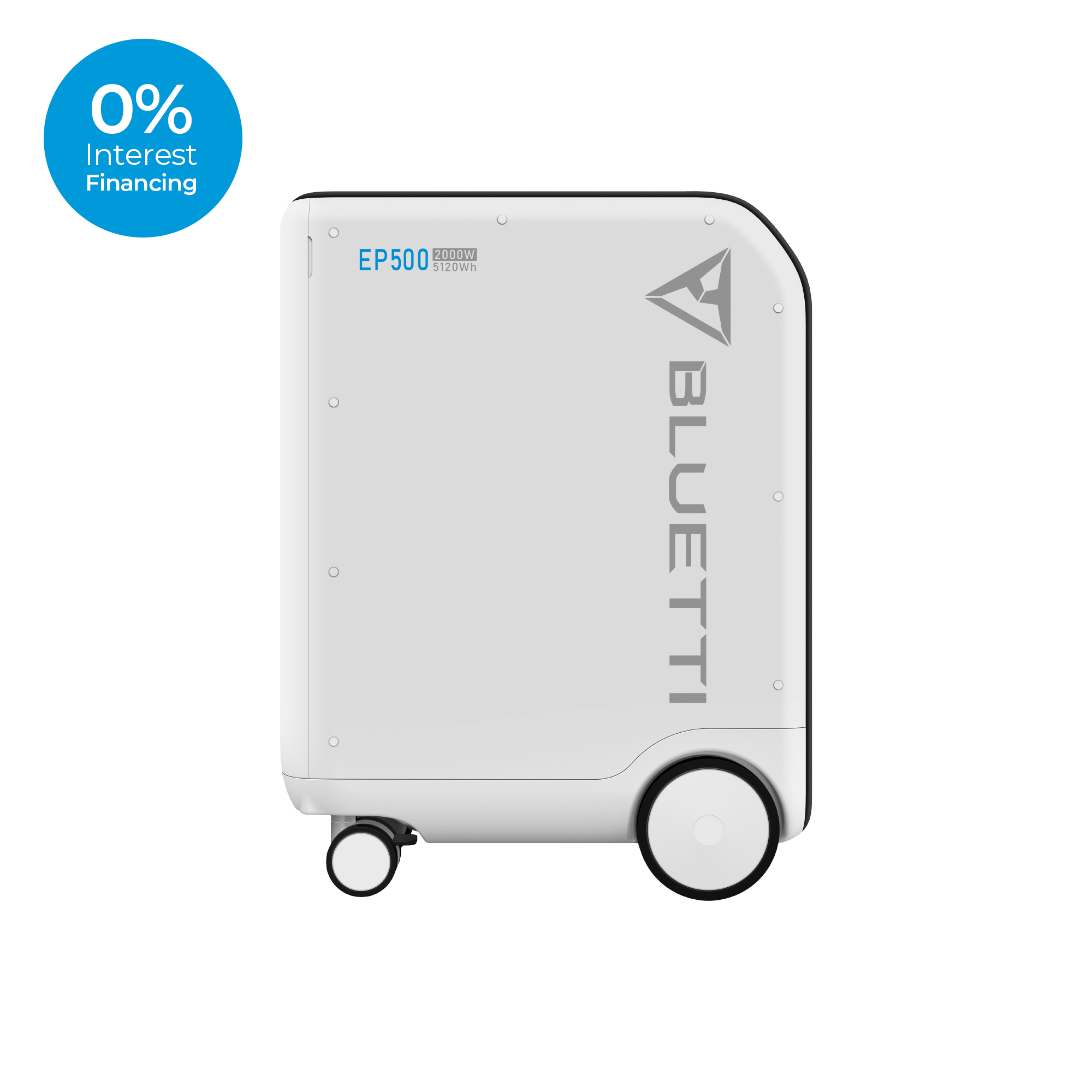
BLUETTI EP500
$2,999.00
$2,999.00 · direct from BLUETTI
Last checked 16 days ago. Prices move — check before you buy.
Prices may vary by retailer and are subject to change.