Head-to-head test
EcoFlow DELTA Pro 3 vs BLUETTI Apex 300 + B500K
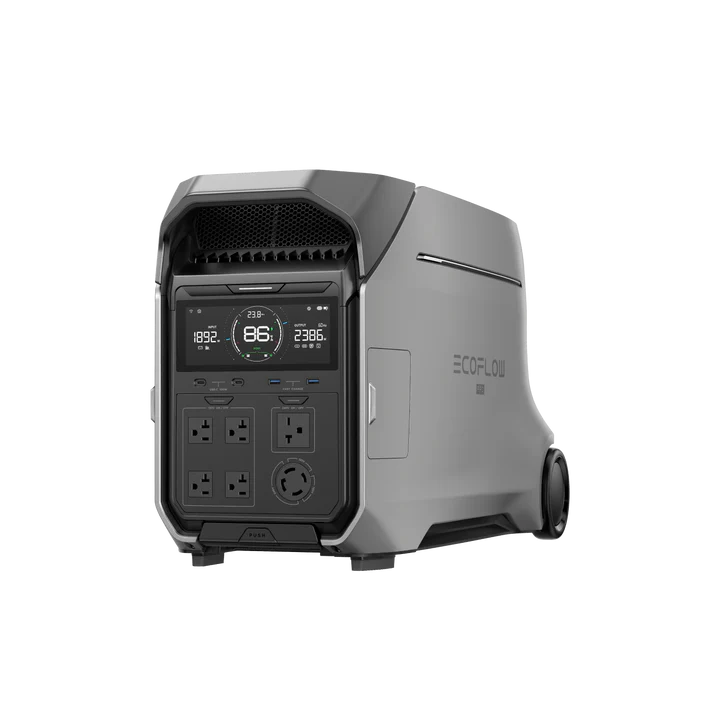
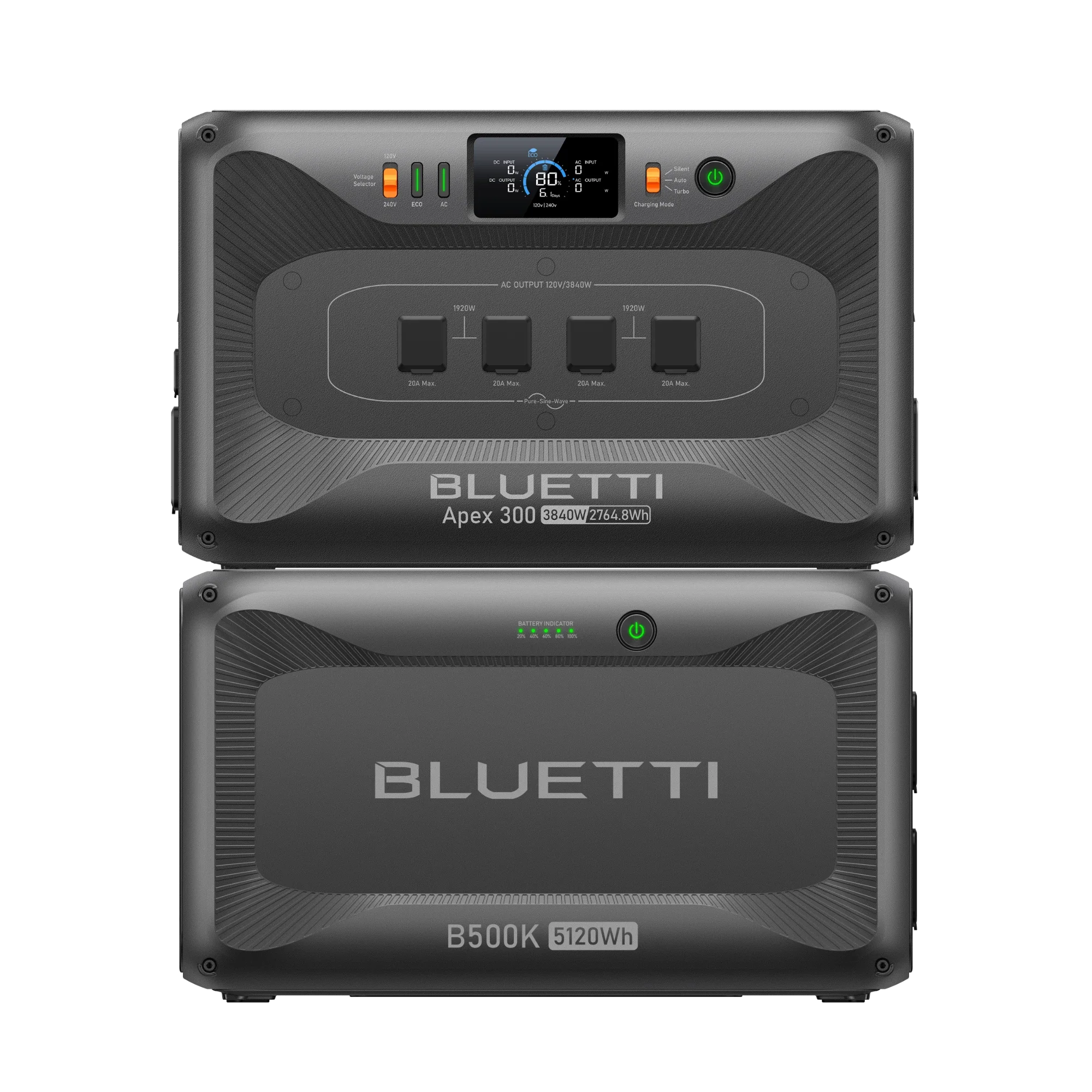
Same $3,199 price tag, but the Apex 300 + B500K stuffs in nearly double the energy for less per watt-hour — the DELTA Pro 3 earns that gap back by being the one you can actually lift, hear less of, and plug a phone into without buying a separate hub.
Full profiles: EcoFlow DELTA Pro 3 → · BLUETTI Apex 300 + B500K →

Written by Gunner GustafsonUpdated
Whole-Home Backup Tester, Station Arena Test Desk
$2,799.00 · direct from EcoFlow
Last checked 1 day ago. Prices move — check before you buy.
$3,299.00 · direct from BLUETTI
Last checked 1 day ago. Prices move — check before you buy.
Spec deltas
Both of these cost exactly $3,199, which strips away the usual budget question and leaves a straight fight over what that money buys. The Apex 300 + B500K answers with nearly double the energy tank; the DELTA Pro 3 answers with a unit that weighs 70.6 lbs less, runs 15dB quieter, and comes with USB ports built in.
The Apex isn't really trying to be portable. It ships as six AC outlets and high-voltage connectors with no native USB or DC output, which tells you EcoFlow and Bluetti built these for different jobs even though the price tag matches. One is a box you carry to the truck; the other is a box you bolt to the wall and forget about.
That framing decides most of this comparison before a single spec gets argued. If the unit needs to leave its closet, the DELTA Pro 3 wins outright. If it's staying put for the life of the warranty, the case for the Apex's bigger tank gets real.
What the Numbers Reveal
Each conclusion stated first — the numbers behind it on one line, the full analysis below.
weight
One owner described it as too heavy to carry more than a few feet, unable to even lift it onto a tableB11. Pair that with the missing ports and the Apex is telling you where it's going to live before you've unboxed it: a permanent spot near the panel, not a truck bed.
DELTA Pro 3 weighs 112.4 lbs with 4 USB-A and 2 USB-C ports built inApex 300 + B500K weighs 183 lbs and ships with no native USB or DC ports, only AC outlets and high-voltage connectorsB12
Why it mattersAnyone who wants one box that covers both a camping trip and a blackout should default to the DELTA Pro 3; anyone building a fixed whole-home closet setup can treat the Apex's weight as irrelevant.
Capacity
That cheaper energy comes from a pairing the community is still shaking out: owners on the DIY Solar forum report the base unit and B500K charging at mismatched rates instead of together, with unofficial parallel-wiring workarounds standing in for an official fixB3B4. The $0.12 rate assumes the hardware behaves as advertised; right now that's not guaranteed.
DELTA Pro 3 capacity is 4,096Wh at a $0.20 lifetime cost per kWhApex 300 + B500K capacity is 7,884.8Wh at a $0.12 lifetime cost per kWh, for the identical $3,199
Why it mattersBuyers chasing the cheapest kWh should go in accepting early-adopter risk on the charging behavior; anyone who wants a unit that just works pays the extra $0.08 per kWh for the DELTA Pro 3's proven charge controller.
Reviewers do call its fan tuning tame for a unit of its output class, with an even pitch and no rattle even under loadB1B2B13. Both things are true at once: quiet for its class, and still 15dB louder than the DELTA Pro 3's spec sheet number.
DELTA Pro 3 is rated at 30dB(A) noiseApex 300 + B500K is rated at 45dB(A) noise, a spec the engine flags directly
Why it mattersIf this is living in or near a bedroom or home office, the DELTA Pro 3's number wins the argument regardless of how flattering the Apex's owner praise reads.
The Apex, for all its rough edges, has the raw capacity to just absorb a full day of induction cooking, fridge, and laptop use without a midday top-up. That's a structural win, not a marketing one.
Van Life Daily needs 4,685Wh: the DELTA Pro 3 would need 135% of its own tank to cover it and can'tThe Apex 300 + B500K covers the same day using 70% of its capacity
Why it mattersVan-lifers running a genuinely heavy daily load should default to the Apex's bigger tank; weekenders and blackout buyers should stick with the DELTA Pro 3.
The specific dimensions that decide these two units — everything else is a tie.
Portability & Form Factor
Selected because: 70.6 lb weight gap plus the Apex's missing native ports is the clearest hands-on difference between these two.
weight
112.4 lbs against 183 is the difference between a two-person carry and a unit that, per one owner, couldn't be lifted onto a table at allB11. The DELTA Pro 3 ships with a full port loadout — 4 USB-A, 2 USB-C at up to 100W — while the Apex skips USB and DC entirely in favor of six AC outlets, which means charging a phone off it means running a wall wart through an AC plug instead of a cable straight into the unitB12.
Neither approach is wrong, but they're not aimed at the same buyer. The DELTA Pro 3 is a unit you could still take camping. The Apex, missing basic device charging and hard to relocate once it's in place, reads as a panel that happens to be portable in name only.
Lifetime Value
Selected because: Identical price but very different cost-per-kWh — the engine's own numbers say the Apex is technically cheaper to own.
cost / lifetime kWh
Both units cost $3,199 up front and, remarkably, both work out to the same $640 per warranty-year — the identical price and 5-year term cancel out the capacity difference on that particular measure. Where they actually split is cost per lifetime kWh: $0.20 for the DELTA Pro 3 against $0.12 for the Apex, because the Apex's tank is nearly double the size for the same money.
That $0.08 gap is real, but it's buying into a battery pairing the community is still debugging — mismatched charge rates between the base unit and B500K show up in forum threads with owner-devised workarounds standing in for an official patchB3B4. Cheaper per kWh only holds if the hardware behaves; right now that's a bet, not a guarantee.
Your Life, Your Pick
Selected because: Van Life Daily is the one scenario the DELTA Pro 3 fails outright and the Apex clears with room to spare.
Weekend Camping, the 8-Hour Blackout, and Remote Workday all go to the Apex on paper — it finishes each with more capacity in reserve, from 31% used on a camping weekend to 70% used on a full van-life day. CPAP Overnight and Tailgate Party are functional ties: both units clear either job using well under a quarter of their tank, so there's no power reason to pick one over the other there.
Van Life Daily is the deciding scenario. At 4,685Wh needed, the DELTA Pro 3 would require 135% of its own capacity and simply can't do the job in one charge, while the Apex covers it using 70%. If your actual daily draw looks anything like that, the tank size argument beats every other consideration on this page.
What the Specs Don't Tell You
Selected because: Weight, noise, and surge ratio are the concrete tiebreakers once price is removed from the equation.
rated cycles
Weight and noise both point the same direction. The Apex is 70.6 lbs heavier and rated 15dB louder under load — real numbers, not marketing spin, even though reviewers praise its fan tuning as tame for a unit pushing this much powerB1B2B13. The DELTA Pro 3's 30dB spec is the one you'd actually forget is running.
Surge ratio flips the script, though: the Apex's 7,680W surge against its 3,840W continuous rating works out to double, versus the DELTA Pro 3's 6,000W surge over 4,000W continuous — a smaller 1.5x cushion. For starting a compressor-heavy fridge or window AC, the Apex has more headroom above its rated output, which partly explains why it's positioned as home backup rather than a unit you'd carry.
Brand Trust
Selected because: EcoFlow's mature support network against Bluetti's newer, more inconsistent one matters more here given the Apex's early-firmware history.
EcoFlow runs the larger, more established support network here — phone, email, and chat, with a Reddit community north of 31,000 members — though outcomes still split between smooth prepaid-label replacements and longer waits depending on where you bought. Bluetti's support leans email-only with real timezone delays, and buying direct from Bluetti tends to produce better outcomes than third-party retailers.
That gap matters more than usual on this particular pair, given the Apex's active firmware and charge-sync threads in Bluetti's own community forumB7B8B9B10. A newer, less mature product benefits more from responsive support than an established one does, and that's the side where EcoFlow currently has the edge.
Strengths & trade-offs
EcoFlow DELTA Pro 3
Strengths
- +Costs $500 less
- +Lighter by 70.6 lb
- +Higher AC output
Trade-offs
- –Very heavy unit that may be difficult for one person to lift.
- –Shorter-lived battery — rated for 4,000 charge cycles vs the Apex 300 + B500K's 6,000, so it wears out sooner.
BLUETTI Apex 300 + B500K
Strengths
- +Larger battery capacity
- +Faster solar charging
- +Rated for 6,000 charge cycles — much longer battery lifespan
Trade-offs
- –Significantly heavier (+70.6 lbs), making it harder to move.
- –Very heavy unit that may be difficult for one person to lift.
Will It Power Your Gear?
Scenario math and per-appliance runtimes, modeled from the spec record.
Scenario verdicts
We ran the math on six real-world scenarios. Here's which unit survives your actual life.
SCN-01 · 2 nights · needs 2,100Wh
Weekend Camping
Two nights off-grid with essential comfort
Neither unit
Scoring these two at a campsite is a category error: neither travels — the DELTA Pro 3 is 112.4 lbs and the Apex 300 + B500K 183 lbs, and at those weights they roll off a truck bed if they go anywhere at all. The 2,100Wh here is trivial for either — it's the going that doesn't happen. If you need power away from the building, you're shopping the wrong class.
Battery budget usedlower = more headroom
LOAD Phone Charger 15W×6h · LED Lights 40W×8h · Box Fan 75W×14h · CPAP Machine 40W×16h
SCN-02 · 8 hours · needs 1,645Wh
8-Hour Blackout
Keep the essentials running through a night without power
Apex 300 + B500K
Both survive the night. The Apex 300 + B500K finishes at 25% used with 5,057Wh left — 3.1 more nights like it. The DELTA Pro 3 finishes at 47% with 1,837Wh, 1.1 more nights like it. If your outages tend to run past one evening, that difference is the whole argument between them.
Battery budget usedlower = more headroom
LOAD Fridge 150W×8h · Router + Modem 20W×8h · LED Lights (4 bulbs) 40W×6h · Phone Charger 15W×3h
SCN-03 · 8 hours · needs 320Wh
CPAP Overnight
Sleep therapy without interruption — the #1 medical use case
DELTA Pro 3
A CPAP is about 40W for eight hours, so both of these cover the night several times over — capacity isn't the question here, and the percentages are a formality. What matters is the box next to your pillow, and the only published difference is a rating: the DELTA Pro 3 is rated 30dB against the Apex 300 + B500K's 45dB. Each is the maker's own published rating, and the makers do not measure the same way, some quoting a best case and some a figure under load, so neither number describes a 40W draw and the two are not really comparable. Treat them as a reason to look for hands-on reports before either one goes next to a bed, not as a difference you can count on hearing.
Battery budget usedlower = more headroom
LOAD CPAP Machine 40W×8h
SCN-04 · 8 hours · needs 910Wh
Remote Workday
Full work day off-grid without power anxiety
Apex 300 + B500K
The Apex 300 + B500K clears the workday at 14% used, banking 5,792Wh — late work, extra calls, or a second laptop charge without arithmetic. The DELTA Pro 3 at 26% also finishes, with 2,572Wh of slack for the unplanned.
Battery budget usedlower = more headroom
LOAD Laptop 60W×8h · External Monitor 30W×8h · Router + Modem 20W×8h · Phone Charger 15W×2h
SCN-05 · 4 hours · needs 670Wh
Tailgate Party
Game day power for the crew
Neither unit
Scoring these two at a tailgate is a category error: neither travels — the DELTA Pro 3 is 112.4 lbs and the Apex 300 + B500K 183 lbs, and at those weights they roll off a truck bed if they go anywhere at all. The 670Wh here is trivial for either — it's the going that doesn't happen. If you need power away from the building, you're shopping the wrong class.
Battery budget usedlower = more headroom
LOAD Blender 400W×0.5h · LED TV (55") 80W×4h · Bluetooth Speaker 15W×4h · Phone Charger (×3) 45W×2h
SCN-06 · 24 hours · needs 4,685Wh
Van Life Daily
A full day of mobile living — the ultimate endurance test
Apex 300 + B500K
The DELTA Pro 3 doesn't finish — 3,482Wh usable against the 4,685Wh this needs leaves it 1,203Wh short, about 74% of the scenario covered. The Apex 300 + B500K covers it with 2,017Wh to spare.
Battery budget usedlower = more headroom
LOAD Mini-Fridge 150W×24h · Laptop 60W×4h · Phone Charger 15W×3h · LED Lights 40W×5h · Fan 75W×8h
The Load Test
RUNTIME = (Wh × 0.85) ÷ LOAD
None of the scenarios above exactly yours? Build it. Toggle what you'd plug in; both units are tested against the combined draw.
Essentials
Comfort & Convenience
High-Draw Appliances
Test duration
8h
Continuous draw
205W
Projected runtime
For this load: Apex 300 + B500K runs 32.7h vs 17h.
$3,299 list · direct from BLUETTI
Modeled from the spec record — same math as the tables below. Methodology
Runtime by appliance
Real-world runtime estimates for common appliances, modeled at 85% inverter efficiency.¹
Essentials
The basics you need runningscale 0–446.8hComfort & Convenience
Makes off-grid life actually enjoyablescale 0–89.4hHigh-Draw Appliances
These reveal the real limitsscale 0–6.7h¹ Runtime = (capacity × 0.85) ÷ appliance watts. Within each group, all bars share one time scale (the group's longest runtime), so lengths are comparable across appliances; identical runtimes collapse into a single blue/orange bar. Actual runtime varies with battery age, temperature, and simultaneous loads — see methodology.
Conclusion
July 14, 2026
Verdict: the DELTA Pro 3
Buy the Apex 300 + B500K if it's going to live bolted in one spot for the rest of its life and pure capacity per dollar is the whole argument — the lifetime math genuinely favors it. Buy the DELTA Pro 3 for everyone else. At 112.4 lbs against 183, it's the only one of the two you can move without a second person, it ships with a full port loadout instead of six AC outlets and a hub you buy separately, and it doesn't carry the Apex's early-firmware turbulence. The honest catch: if you never intend to relocate the unit and the B500K's charge-sync bugs get ironed out, the Apex is the better spreadsheet. For a unit you're actually going to live with day to day, the DELTA Pro 3 is the safer buy.
Editor-assigned confidence, based on cited owner research and spec analysis.
List prices as of July 14, 2026. The links below open EcoFlow's and BLUETTI's current prices.
$2,799.00 · direct from EcoFlow
Last checked 1 day ago. Prices move — check before you buy.
or check the Apex 300 + B500K price$3,299.00 list
Written by Gunner Gustafson, Whole-Home Backup Tester · Station Arena Test Desk · Updated July 14, 2026
Measured Data
Benchmark scores and the full spec record, side by side.
Benchmark scores
Not rated for both units (minimum threshold unmet): RV Living, Solar Generator.
Full specifications
ᵈ Derived: price ÷ rated capacity. See the data behind our comparisons →
Comparison ToolAdd more power stations, side by sideOpen Tool →How these numbers are produced
Numeric verification
Every figure on this page traces to our spec database or arithmetic on it — no estimated numbers.
Owner claims
Statements about owner experience are cited to published reviews — see Sources & Research Notes below.
Runtime model
Runtime = (rated capacity × 0.85 inverter efficiency) ÷ device wattage. Solar recharge estimates assume panels deliver 70% of rated output. Cold weather, battery age, and stacked loads reduce real-world results.
Power Score
Computed from 14 published spec dimensions, weighted per use-case bench. Higher is better; a unit must meet a bench's minimum threshold to be rated.
See the full weight table and data sourcing on our methodology page →Class ranking (the star rating)
Each unit's star score is a category ranking, not customer reviews — no buyer opinions feed it. We score every station on size-independent quality (value, output, portability, endurance, ports, warranty, and more), then percentile-rank it against the other units in its capacity class, so a class-leading compact unit and a class-leading whole-home unit can both earn 5★. Here, DELTA Pro 3 rates 4.0/5 (40th percentile of 16 Home Backup-class units), and Apex 300 + B500K rates 3.5/5 (11th percentile of 29 Whole-Home / Off-Grid-class units).
How the class ranking is computed →Test Notes & Caveats
Hidden gotchas and advantages we spotted that you won't find on the product page.
70.6 Pounds Is the Whole Decision for Some Buyers
The DELTA Pro 3's 112.4 lbs is still a real lift, but the Apex 300 + B500K's 183 lbs is a different category entirely — closer to moving a small appliance than a power station. If the unit needs to leave its install spot even occasionally, that number should end the conversation.
Apex 300 + B500K: 45dB Published
45dB is about as loud as a running refrigerator. The DELTA Pro 3 is rated 30dB — lower, but published by a different maker measuring its own way, so the two figures are not a like-for-like gap. For most people, fan noise around 45dB and up is where sleep starts to suffer.
The Apex Has More Headroom Above Its Rated Output
7,680W surge over 3,840W continuous is a 2x cushion; the DELTA Pro 3's 6,000W over 4,000W is 1.5x. For starting a compressor-heavy fridge or window AC unit, the Apex's inverter has more room to spike before it complains — one of the few specs where its home-backup design pays off directly.
Warranty: No Difference
Both units carry the same 5-year warranty, so coverage isn't a tiebreaker here. The Apex 300 + B500K's figure is a maximum rather than a guarantee — it depends on buying direct from BLUETTI or registering the unit, since reseller purchases carry a shorter term.
Battery Lifespan in Real Years
The Apex 300 + B500K is rated for 6,000 cycles vs 4,000. In real life: at daily use, that's 16.4 vs 11 years. At weekend use (twice a week), it's 58 vs 38 years. One caution reading years across different sizes: a cycle is 7,885Wh on the Apex 300 + B500K and 4,096Wh on the DELTA Pro 3, so count lifetime energy — roughly 47,309 kWh against 16,384 kWh over the rated life. After hitting the cycle limit, the battery doesn't die — it drops to ~80% of original capacity, which is still very usable.
Full record above — the Test Desk pick is the DELTA Pro 3.
Check DELTA Pro 3 price →or check the Apex 300 + B500K priceOwnership Analysis
What happens after you buy — true cost of ownership, brand trust, and growth potential.
Lifetime value
Service lifeyears at one full cycle per day
Lifetime energy delivered
Cost per delivered kWh
│ warranty ends · Reaching the cycle rating means ~80% capacity remains — degraded, not dead.
Analyst note
The DELTA Pro 3 is cheaper to buy, but the Apex 300 + B500K is cheaper to own. At $0.07/kWh over its lifetime vs $0.17/kWh, the Apex 300 + B500K's higher cycle life and capacity make each dollar go further over the years.
Brand trust
EcoFlow
Ecosystem
Largest in portable power — 12-15 models across DELTA Pro, DELTA 3, and RIVER 3 series, plus solar panels and smart home panels
Support
US-based phone/email/chat support (1-800-368-8604). Experiences are polarized — many report hassle-free prepaid-label replacements, but others report long waits and refurbished units sent for new claims. Pro tip: buying from Costco or Amazon gives you a stronger return safety net.
Community
Largest community in the space — Reddit r/Ecoflow_community (~31K members), multiple Facebook groups, and an official community forum
App experience
Rated 4.6/5 iOS (~8,400 ratings) · 4.2/5 Android (~17,000 ratings)
Unique strength
Fastest-charging technology (X-Stream), deepest product ecosystem, and most active innovation cadence. At the very top of the range, the DELTA Pro Ultra platform stacks batteries and inverters into whole-home backup — a flagship path, not a line-wide feature.
Worth knowing
EcoFlow's support network is the more established of the two here, with phone, chat, and email options and a Reddit community over 31,000 members — useful if something needs troubleshooting.
BLUETTI
Ecosystem
One of the broadest lineups — 15-20+ models from budget (AC2A) to flagship portable (Apex 300, 2764.8Wh). Includes specialized products: vehicle solar hubs, sodium-ion cold-weather units, and balcony storage systems.
Support
The most inconsistent support in the space. Heavily email-based with China timezone delays. Some users get smooth, efficient service; others report weeks of troubleshooting runarounds, being offered discounts on new units instead of repairs, and confusing third-party purchase claim processes. Buying direct from Bluetti's website tends to produce better support outcomes.
Community
Active and growing — Reddit r/bluetti has a dedicated community. Second-largest after EcoFlow in engagement.
App experience
Rated 4.5/5 iOS and Android — tied for best app experience in the category. V3.0 UI redesign was well-received.
Unique strength
Among the best capacity-to-price ratios available — several Elite and Apex units are the lowest $/Wh in the catalog. Widest product diversity including industry-firsts like sodium-ion cold-weather units and dual solar+alternator vehicle hubs. LFP across the rest of the range, though rated cycle life spans 2,500 (EB3A) to 6,000, and it varies WITHIN the Elite range rather than tracking it — the Elite 300 and Elite 200 V2 are rated 6,000 while the Elite 30 V2, Elite 10 Mini, Elite 320 and Elite 400 are rated 3,000+ and the Elite 100 V2 4,000+, so check the specific model. Dual-voltage (120V/240V) in flagships.
Worth knowing
Bluetti support leans email-only with real timezone delays, and outcomes improve noticeably when you buy direct from Bluetti rather than a third-party retailer.
Analyst note
This gap matters more than it would on a settled product line, since the Apex is still working through active firmware and charge-sync reports in its own community forum. A newer product benefits disproportionately from responsive support, and that's the side EcoFlow currently wins.
Growth path
DELTA Pro 3
EXPANDABLESupports EcoFlow expansion batteries, so you can add capacity later without replacing the base unit — useful if your needs may climb past 4,096Wh.
Accepts up to 2,000W of solar. Enough for a serious multi-panel array.
Generous port selection supports complex multi-device setups.
Expansion batteries are EcoFlow-specific. You're investing in the EcoFlow ecosystem.
Apex 300 + B500K
EXPANDABLESupports BLUETTI expansion batteries, so you can add capacity later without replacing the base unit — useful if your needs may climb past 7,885Wh.
Accepts up to 2,400W of solar. Enough for a serious multi-panel array.
Generous port selection supports complex multi-device setups.
Expansion batteries are BLUETTI-specific. You're investing in the BLUETTI ecosystem.
Realistic full solar rechargeat 70% of rated panel output — see methodology
Analyst note
Both expand, so neither locks you out of growth — decide on capacity, price, and the rest, not the expansion checkbox.
What Owners Report
Patterns from published owner reports and long-term reviews — every claim cited to its source below.
EcoFlow DELTA Pro 3
Reviewers already treat the DELTA Pro 3 as a gold-standard whole-home backup unitA4, and the field data backs that reputation up: LiFePO4 cells rated past 4,000 cycles with an IP65 battery housing, plus a dual-voltage 120V/240V output that expands well beyond its base 4,096Wh if the household grows into needing moreA1A2.
The recharge story draws consistent praise too — reviewers clock it reaching 80% in under an hour on fast input, full in under two, which matters most in the exact van-life scenario where its tank runs shortA3. The one honest tradeoff nobody disputes: at 112.4 lbs it's still a unit you plan a lift around, even if it's the lighter of these two by a wide margin.
“4,096Wh LFP battery with 4,000W continuous AC output (6,000W with X-Boost) and dual-voltage 120V/240V, expandable to 48kWh.”
Sources
ecoflow.com · amazon.com · homedepot.com · thepowerpick.com · outboundpower.com · techradar.com · thesolarlab.com
BLUETTI Apex 300 + B500K
Coverage of this exact Apex 300 + B500K pairing is thin — most of what's available comes from Bluetti's own community forum, a DIY solar forum, and press units rather than long-term owners, so treat the following as early signal, not a settled verdict. What repeats across independent reviewers is that the fan tuning is unusually even and quiet for a unit pushing this much output, with no distracting pitch even under loadB1B2B13.
What also repeats is friction: firmware and app updates have locked units into the wrong mode, thrown inverter error codes, and required support intervention or a follow-up patch before resolvingB7B8B9. Running the base unit and B500K together, owners report mismatched charge rates that the official app doesn't yet handle cleanly, with community workarounds filling the gapB3B4. Add one owner's report that it was too heavy to move more than a few feet or lift onto a table, and a design that skips native USB and DC ports entirelyB11B12, and this reads as a capable but genuinely unfinished product.
“Turns out the Apex 300's noise control is on par with the quietest power stations on the market, like those on offer from EcoFlow and DJI.”
Sources & Research Notes
Every owner claim in this report is traceable to a published source. The bracketed references above resolve here.
Recurring owner themes
- Huge 4,096Wh LFP capacity, 4,000W dual-voltage output, very fast charging, and big expandability are the standout praise; it's heavy at ~113 lbs. [DELTA Pro 3 · 2 entries]
- Multiple independent reviewers describe the dual-fan cooling as noticeably quiet/even for a unit of this output class, even under load. [Apex 300 + B500K · 3 entries]
- Firmware and app updates have repeatedly caused mode-lock, download failures, or inverter error codes; several threads show the issue eventually resolved after further updates or support contact. [Apex 300 + B500K · 4 entries]
- When running multiple Apex 300 units or expansion batteries in parallel, owners report uneven charge rates between units, with community-devised (unofficial) workarounds needed to keep them in sync. [Apex 300 + B500K · 2 entries]
- The stripped-down, modular design draws criticism for real-world handling: extreme weight makes it hard to move, and lack of native USB/DC ports forces reliance on a separate paid hub accessory. [Apex 300 + B500K · 2 entries]
- A1
“4,096Wh LFP battery with 4,000W continuous AC output (6,000W with X-Boost) and dual-voltage 120V/240V, expandable to 48kWh.”
ecoflow.com / amazon.com — DELTA Pro 3 · 2026 · [positive]
- A2
“LiFePO4 rated for 4,000+ cycles to 80% (10+ years), with an IP65 battery rating.”
homedepot.com / thepowerpick.com — DELTA Pro 3 review · 2026 · [positive]
- A3
“Multi-charge technology reaches 0-80% in about 50 minutes using up to 7,000W input, with a full charge in roughly 90 minutes; up to 2,600W solar.”
outboundpower.com / techradar.com — DELTA Pro 3 review · 2026 · [positive]
- A4
“Weighs about 113.5 lbs; reviewers call it a gold-standard whole-home backup unit for 2026.”
techradar.com / thesolarlab.com — DELTA Pro 3 review · 2026 · [positive]
- B1
“Turns out the Apex 300's noise control is on par with the quietest power stations on the market, like those on offer from EcoFlow and DJI.”
The Solar Lab — "Bluetti Apex 300 Review: Cheap, Practical Home Backup?" · unknown · [positive]
- B2
“Some units sound like small jet engines under load, but the Apex 300's fans are relatively tame.”
Techspective — "Bluetti Apex 300 with B300K Review" · 2025-09 · [positive]
- B3
“The Apex 300 have some major charging problems... When the units are charging from the grid they charge at different rates and not together.”
DIY Solar Power Forum — "Bluetti Apex 300 problems" · 2025-09 · [negative]
- B4
“I have found a simple way to get around some of the solar charging limitations with multiple APEX 300s hooked up in parallel... So far, I have not had any problems with my setup.”
DIY Solar Power Forum — "Bluetti Apex 300 problems" · 2025-09 · [mixed]
- B7
“I updated my Apex 300 to the latest firmware yesterday. Now it's stuck in 'Backup' mode... when I go into the app to try to change it back, it flashes to...”
BLUETTI Community — "Apex 300 stuck in Backup mode after last firmware update" · 2025-11 · [negative]
- B8
“There was an update on my Apex 300 a few days ago IOT v8026.12... Problem is every time I connect to the power st[ation]... Edit - This seems fixed now hooray!”
BLUETTI Community — "Check For Update App issue" · 2025-09 · [mixed]
- B9
“After the update completed, the charging stopped and I received Error 004... I have error E004 Inverter Output Failure.”
BLUETTI Community — "Error E004 Apex 300" · 2025-11 · [negative]
- B10
“I had a power outage in the middle of the night, so I hooked everything (Hub A1 and all 300's) back up and now HA is populating. YEA!!!”
GitHub bluetti-official/bluetti-home-assistant — "APEX 300 and Hub A1 now working" (Issue #95) · 2026-05 · [mixed]
- B11
“it's so heavy I can hardly carry it more than a few feet at a time and have been unable to lift it onto a table.”
T3 — "Bluetti Apex 300 review: transform your off-grid life" · 2025-11 · [negative]
- B12
“The Apex 300 doesn't have USB ports, DC ports, or much of anything beyond its six AC plugs and high-voltage connectors.”
The Solar Lab — "Bluetti Apex 300 Review: Cheap, Practical Home Backup?" · unknown · [negative]
- B13
“Fan noise remains even, with no distracting pitch or rattle. This makes the Apex 300 usable near sleeping areas or indoor workspaces without disturbance.”
Yanko Design — "BLUETTI Apex 300 Review" · 2025-05 · [positive]
Research compiled July 14, 2026.
Who Should Buy Which
Buy the DELTA Pro 3 if you…
- →You need to move the unit — camping trips, a garage-to-porch relocation during an outage, anything that isn't a single permanent install.
- →You want proven charging behavior and a full port loadout without waiting for firmware updates to settle a newer product's rough edges.
Buy the Apex 300 + B500K if you…
- →The unit is going into one fixed spot for the life of the warranty and never needs to move again.
- →Your daily draw is genuinely close to 4,685Wh — the one scenario where the smaller tank simply can't keep up regardless of how fast it recharges.
If neither fits
If your real need is a fridge and a router through a few hours of outage, both of these are serious overkill at 4,000+ Wh and $3,199. Look at a compact 1,000-2,000Wh unit instead — you'll spend a fraction of the money and never notice the difference.
The Bottom Line
Strip away the price, since both cost exactly $3,199, and this comes down to what the unit is for. The Apex 300 + B500K wins on raw capacity per dollar and would clear a van-life day the DELTA Pro 3 can't, but it does that as a 183-lb fixed installation with no native ports and a firmware history still working itself out.
For most buyers — anyone who might move the unit, wants proven charging behavior, or just wants it quiet in a bedroom-adjacent closet — the DELTA Pro 3's 70.6 fewer pounds and built-in ports are worth more than the extra capacity. Save the Apex for the one buyer it's actually built for: a permanent, high-capacity backup that's never leaving its spot.
Frequently Asked Questions
Answers drawn from the spec record and cited owner research.
Is the Bluetti Apex 300 + B500K actually cheaper than the EcoFlow DELTA Pro 3?
They cost the same $3,199 up front, but the Apex holds nearly double the energy, so its lifetime cost per kWh comes out to $0.12 against the DELTA Pro 3's $0.20. On pure value per watt-hour, the Apex wins — the tradeoff is weight, missing native USB ports, and a newer product with some unresolved firmware reports.
Why doesn't the Apex 300 + B500K have USB ports?
It ships with six AC outlets and high-voltage connectors and no native USB or DC output, which points to it being designed as fixed home backup rather than a portable unit. If you need to charge phones or laptops directly, you'll be running a separate charger off one of its AC plugs.
Which one is quieter?
The DELTA Pro 3, by spec: 30dB against the Apex's 45dB, a meaningful gap given the logarithmic scale. Reviewers do describe the Apex's fan tuning as tame for its output class, but that's relative to other high-output units, not to the DELTA Pro 3's own number.
Can either of these handle full-time van life?
Only the Apex 300 + B500K, and even then it's using 70% of its capacity on a 4,685Wh day. The DELTA Pro 3 would need 135% of its own tank to cover the same load and simply can't do it without a midday recharge.
Is the Apex 300 + B500K reliable?
It's too new to say with confidence. Owner reports in Bluetti's community forum describe firmware updates causing mode lock and inverter error codes, plus mismatched charge rates between the base unit and the B500K expansion battery, though most threads show the issues eventually resolving. Treat it as early-adopter territory rather than a proven long-term track record.
Brand matchup
EcoFlow vs BLUETTI: measured across every matchup →Where to buy
EcoFlow DELTA Pro 3Pick
$2,799.00
$2,799.00 · direct from EcoFlow
Last checked 1 day ago. Prices move — check before you buy.
BLUETTI Apex 300 + B500K
$3,299.00
$3,299.00 · direct from BLUETTI
Last checked 1 day ago. Prices move — check before you buy.
Prices may vary by retailer and are subject to change.