Head-to-head test
BLUETTI Apex 300 + B300K vs BLUETTI Apex 300 + B500K
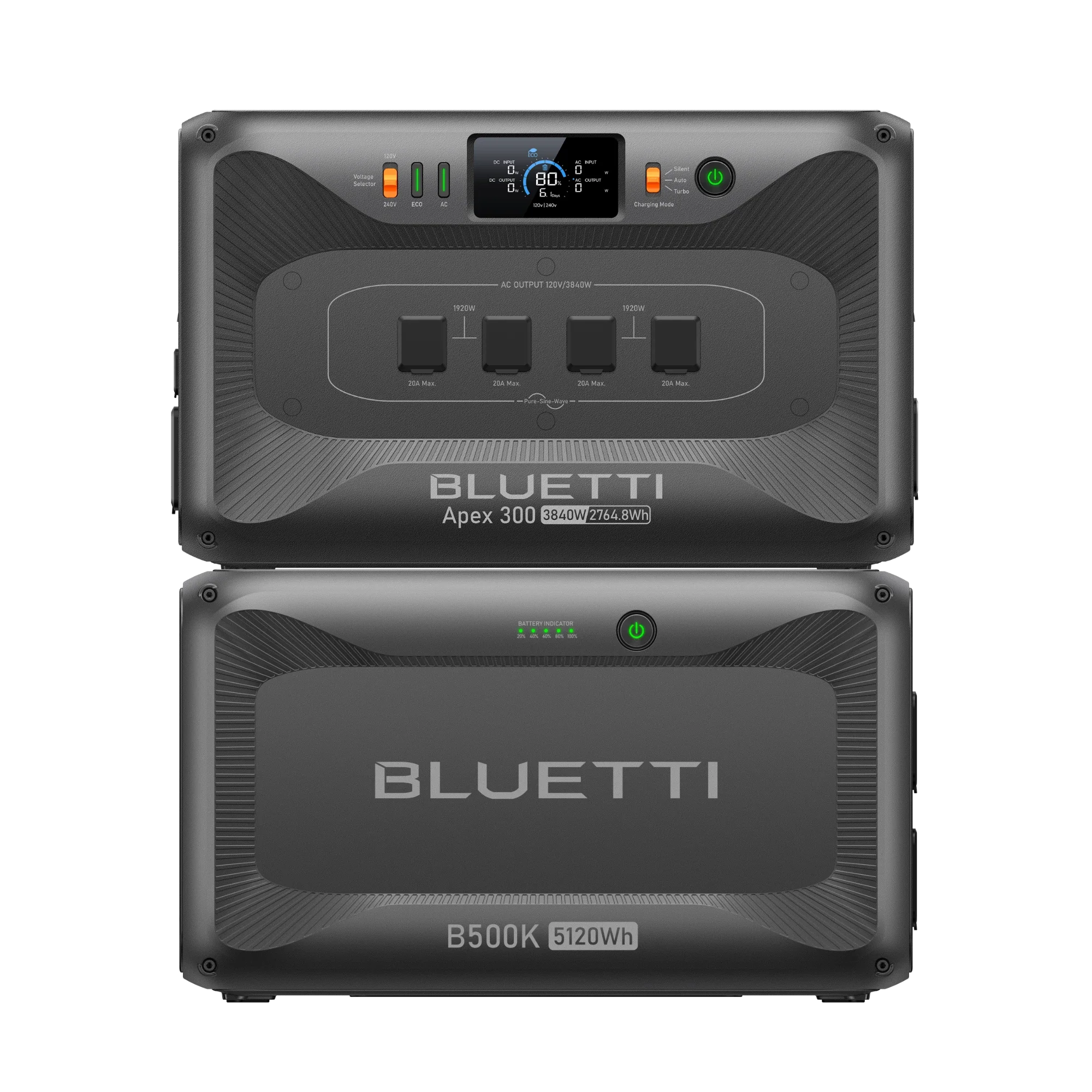
BLUETTI Apex 300 + B300K vs BLUETTI Apex 300 + B500K: the same 3,840W continuous, the same 7,680W surge, the same 2,400W of solar; only the battery changes, 7,884.8Wh against 5,529.6Wh, and a 24-hour van-life day draws 70% of the B500K against all of the B300K. Buy the B500K build if this is a daily driver.
Full profiles: BLUETTI Apex 300 + B300K → · BLUETTI Apex 300 + B500K →

Written by Gunner GustafsonUpdated
Whole-Home Backup Tester, Station Arena Test Desk

$2,599.00 · direct from BLUETTI
Last checked 1 day ago. Prices move — check before you buy.
$3,299.00 · direct from BLUETTI
Last checked 1 day ago. Prices move — check before you buy.
Spec deltas
The Apex 300 + B500K build costs $700 more than the Apex 300 + B300K, and that $700 buys 2,355.2Wh of extra battery — a marginal price of about $0.25 per watt-hour, well under the base build's $0.47/Wh blended rate. Buying bigger here is buying cheaper.
Everything else on these two is identical: the same 3,840W inverter, 7,680W surge, 3,500-cycle LFP cells, 2,400W of solar input, and a 10ms UPS switchover. The only variable is battery size — 5,529.6Wh in the smaller build, 7,884.8Wh in the larger — which is also why the B500K wins on cost per lifetime kWh, $0.12 against $0.13.
The gap that actually matters shows up off the spec sheet: modeled against a full 24-hour van-life day, the B300K build uses all of its usable capacity just to get through it, while the B500K finishes with about 30% still in reserve. The B500K weighs 34 more pounds for that margin, but both are 148-plus-pound installs you park once rather than carry, so weight is a weak reason to pass on the extra battery.
What the Numbers Reveal
Each conclusion stated first — the numbers behind it on one line, the full analysis below.
Capacity
$700 for 2,355.2Wh works out to about $0.25 per added watt-hour, roughly half the base build's $0.47/Wh — so upgrading isn't paying a premium for more capacity, it's buying that capacity at a discount, which is exactly why the blended rate drops from $0.47/Wh to $0.41/Wh even as the sticker price climbs.
B300K build is $2,599 for 5,529.6Wh; B500K build is $3,299 for 7,884.8Whthe price gap is $700 for 2,355.2Wh more capacitythe base build's own rate is $0.47/Wh
Why it mattersIf the extra $700 is in budget, it's the more efficient dollar on this page, not just a bigger battery.
Finishing at 100% usable capacity means the B300K build has zero margin for a longer night, a colder morning that pulls more from the heater, or a cloudy recharge day — the B500K's 30% cushion is exactly the buffer you'd want for any of those, not a luxury.
a modeled 24-hour van-life load needs 4,685Whthe B300K build uses 100% of its usable capacity to cover itthe B500K build uses only 70%, leaving 30% in reserve
Why it mattersAnyone running this as a daily driver, not an occasional backup, should pay for the cushion.
weight
Reviewers call the base unit too heavy for most people to lift alone even before any battery is attachedA14, so the 34 lbs separating these two builds changes nothing about how you handle either one — you're using a trolley or a second set of hands regardless, which makes weight the wrong reason to pick the smaller, pricier-per-Wh build.
the B500K build weighs 183 lbs against the B300K build's 148.8 lbs, a 34.2-lb gapreviewers already describe the bare base unit as too heavy for most people to carry aloneA14both builds stack a battery on top of that same base
Why it mattersDecide on capacity and lifetime cost, not the 34-pound difference — neither build is ever a one-person carry.
The specific dimensions that decide these two units — everything else is a tie.
Lifetime Value
Selected because: The core argument: the B500K's extra capacity is priced below the base build's own rate.
cost / lifetime kWh
Strip away the shared base and this comparison is one number: dollars per watt-hour. The B300K build runs $0.47/Wh; the B500K runs $0.41/Wh. The $700 gap between them buys 2,355.2Wh, which prices the added battery at about $0.25/Wh — cheaper than either build's blended rate — so the B500K isn't a premium option, it's the better-value one.
That advantage carries through to ownership cost: $0.12 per lifetime kWh against $0.13. The gap is a single cent, but it points the same direction as every other number here, and there's no metric on this page where the smaller build comes out ahead.
Your Life, Your Pick
Selected because: Van Life Daily is the one load that actually separates these two builds.
At everyday loads, capacity headroom is academic: a full 8-hour blackout uses 35% of the B300K build and 25% of the B500K, a remote workday 19% and 14%, a tailgate 14% and 10%. Both builds handle any of these without strain.
The one scenario that actually separates them is Van Life Daily. A modeled 24-hour load uses all of the B300K build's usable capacity and only 70% of the B500K's, so a buyer running this every day — not just on weekends — is the one who feels the difference between finishing empty and finishing with a third of the tank still there.
What the Specs Don't Tell You
Selected because: Weight is the only real spec gap, and it's largely moot given both are stationary installs.
The only spec that moves between these builds is weight: 148.8 lbs against 183, a 34.2-lb gap. On paper that looks meaningful; in practice, reviewers already call the lighter bare base too heavy for most people to lift aloneA14, so neither build was ever a one-person carry to begin with. You're parking either of these once and leaving it.
Noise is identical on both — a 45dB rating under load, the same fan hardware behind the same base unit — so it does nothing to break the tie. Between the two flagged items here, only weight is even theoretically a factor, and it's a weak one on a unit that never gets picked up after installation.
Growth Path
Selected because: Both expand identically, so growth doesn't decide this — worth saying plainly.
Both builds sit on the same expandable Apex 300 platform, so neither one locks you out of adding more BLUETTI battery later. That makes growth path a wash — it doesn't argue for either build over the other.
The real decision is upfront: buy the bigger battery now at its better per-Wh rate, or start smaller and expand later at whatever the platform costs at that point. Given the B500K's capacity already prices below the base build's own rate, there's little financial reason to defer it if the $700 is available today.
Strengths & trade-offs
BLUETTI Apex 300 + B300K
Strengths
- +Costs $700 less
- +Lighter by 34.2 lb
Trade-offs
- –Very heavy unit that may be difficult for one person to lift.
BLUETTI Apex 300 + B500K
Strengths
- +Larger battery capacity
Trade-offs
- –Significantly heavier (+34.2 lbs), making it harder to move.
- –Very heavy unit that may be difficult for one person to lift.
Will It Power Your Gear?
Scenario math and per-appliance runtimes, modeled from the spec record.
Scenario verdicts
We ran the math on six real-world scenarios. Here's which unit survives your actual life.
SCN-01 · 2 nights · needs 2,100Wh
Weekend Camping
Two nights off-grid with essential comfort
Neither unit
Scoring these two at a campsite is a category error: neither travels — the Apex 300 + B300K is 148.8 lbs and the Apex 300 + B500K 183 lbs, and at those weights they roll off a truck bed if they go anywhere at all. The 2,100Wh here is trivial for either — it's the going that doesn't happen. If you need power away from the building, you're shopping the wrong class.
Battery budget usedlower = more headroom
LOAD Phone Charger 15W×6h · LED Lights 40W×8h · Box Fan 75W×14h · CPAP Machine 40W×16h
SCN-02 · 8 hours · needs 1,645Wh
8-Hour Blackout
Keep the essentials running through a night without power
Apex 300 + B500K
Both survive the night. The Apex 300 + B500K finishes at 25% used with 5,057Wh left — 3.1 more nights like it. The Apex 300 + B300K finishes at 35% with 3,055Wh, 1.9 more nights like it. If your outages tend to run past one evening, that difference is the whole argument between them.
Battery budget usedlower = more headroom
LOAD Fridge 150W×8h · Router + Modem 20W×8h · LED Lights (4 bulbs) 40W×6h · Phone Charger 15W×3h
SCN-03 · 8 hours · needs 320Wh
CPAP Overnight
Sleep therapy without interruption — the #1 medical use case
Either unit
A CPAP is about 40W for eight hours, so both cover the night many times over and the capacity margin is a formality. Both happen to list 45dB — the same published figure twice, not a measured tie — so there is nothing in the noise column to separate them either. Buy whichever is cheaper or easier to carry.
Battery budget usedlower = more headroom
LOAD CPAP Machine 40W×8h
SCN-04 · 8 hours · needs 910Wh
Remote Workday
Full work day off-grid without power anxiety
Either unit
Both power your workstation all day without strain, and their USB-C output is a wash — pick on weight, ports, or price.
Battery budget usedlower = more headroom
LOAD Laptop 60W×8h · External Monitor 30W×8h · Router + Modem 20W×8h · Phone Charger 15W×2h
SCN-05 · 4 hours · needs 670Wh
Tailgate Party
Game day power for the crew
Neither unit
Scoring these two at a tailgate is a category error: neither travels — the Apex 300 + B300K is 148.8 lbs and the Apex 300 + B500K 183 lbs, and at those weights they roll off a truck bed if they go anywhere at all. The 670Wh here is trivial for either — it's the going that doesn't happen. If you need power away from the building, you're shopping the wrong class.
Battery budget usedlower = more headroom
LOAD Blender 400W×0.5h · LED TV (55") 80W×4h · Bluetooth Speaker 15W×4h · Phone Charger (×3) 45W×2h
SCN-06 · 24 hours · needs 4,685Wh
Van Life Daily
A full day of mobile living — the ultimate endurance test
Apex 300 + B500K
The Apex 300 + B300K uses 100% of its battery on a full day, leaving 15Wh — miss a solar day and that is the entire cushion. The Apex 300 + B500K at 70% keeps 2,017Wh in hand, a far more forgiving rhythm for full-time living.
Battery budget usedlower = more headroom
LOAD Mini-Fridge 150W×24h · Laptop 60W×4h · Phone Charger 15W×3h · LED Lights 40W×5h · Fan 75W×8h
The Load Test
RUNTIME = (Wh × 0.85) ÷ LOAD
None of the scenarios above exactly yours? Build it. Toggle what you'd plug in; both units are tested against the combined draw.
Essentials
Comfort & Convenience
High-Draw Appliances
Test duration
8h
Continuous draw
205W
Projected runtime
For this load: Apex 300 + B500K runs 32.7h vs 22.9h.
$3,299 list · direct from BLUETTI
Modeled from the spec record — same math as the tables below. Methodology
Runtime by appliance
Real-world runtime estimates for common appliances, modeled at 85% inverter efficiency.¹
Essentials
The basics you need runningscale 0–446.8hComfort & Convenience
Makes off-grid life actually enjoyablescale 0–89.4hHigh-Draw Appliances
These reveal the real limitsscale 0–6.7h¹ Runtime = (capacity × 0.85) ÷ appliance watts. Within each group, all bars share one time scale (the group's longest runtime), so lengths are comparable across appliances; identical runtimes collapse into a single blue/orange bar. Actual runtime varies with battery age, temperature, and simultaneous loads — see methodology.
Conclusion
July 15, 2026
Verdict: the BLUETTI Apex 300 + B500K
Both are the identical Apex 300 base — 3,840W continuous, 7,680W surge, 3,500 cycles, 2,400W of solar, a 10ms switchover — with only the battery changing. The B300K build is $2,599 for 5,529.6Wh ($0.47/Wh); the B500K build is $3,299 for 7,884.8Wh ($0.41/Wh). The extra $700 buys 2,355.2Wh, which works out to about $0.25 per added watt-hour, well under the base build's blended rate, and it's also cheaper to own over its life ($0.12 vs $0.13 per lifetime kWh). It shows up in real use, too: a modeled 24-hour van-life day uses all of the B300K build's usable capacity but only 70% of the B500K's, leaving genuine reserve for a bad-weather day. The B500K's only real cost is 34 extra pounds on a unit you install once and never carry. Skip the upgrade only if you're confident your loads stay well under the B300K build's ceiling and you'd rather save the $700 today.
Editor-assigned confidence, based on cited owner research and spec analysis.
List prices as of July 15, 2026. The links below open BLUETTI's current price.
$3,299.00 · direct from BLUETTI
Last checked 1 day ago. Prices move — check before you buy.
or check the Apex 300 + B300K price$2,599.00 list
Written by Gunner Gustafson, Whole-Home Backup Tester · Station Arena Test Desk · Updated July 15, 2026
Measured Data
Benchmark scores and the full spec record, side by side.
Benchmark scores
Not rated for both units (minimum threshold unmet): Solar Generator.
Full specifications
ᵈ Derived: price ÷ rated capacity. See the data behind our comparisons →
Comparison ToolAdd more power stations, side by sideOpen Tool →How these numbers are produced
Numeric verification
Every figure on this page traces to our spec database or arithmetic on it — no estimated numbers.
Owner claims
Statements about owner experience are cited to published reviews — see Sources & Research Notes below.
Runtime model
Runtime = (rated capacity × 0.85 inverter efficiency) ÷ device wattage. Solar recharge estimates assume panels deliver 70% of rated output. Cold weather, battery age, and stacked loads reduce real-world results.
Power Score
Computed from 14 published spec dimensions, weighted per use-case bench. Higher is better; a unit must meet a bench's minimum threshold to be rated.
See the full weight table and data sourcing on our methodology page →Class ranking (the star rating)
Each unit's star score is a category ranking, not customer reviews — no buyer opinions feed it. We score every station on size-independent quality (value, output, portability, endurance, ports, warranty, and more), then percentile-rank it against the other units in its capacity class, so a class-leading compact unit and a class-leading whole-home unit can both earn 5★. Here, Apex 300 + B300K rates 4.4/5 (67th percentile of 16 Home Backup-class units), and Apex 300 + B500K rates 3.5/5 (11th percentile of 29 Whole-Home / Off-Grid-class units).
How the class ranking is computed →Test Notes & Caveats
Hidden gotchas and advantages we spotted that you won't find on the product page.
Weight Reality Check
Neither unit is grab-and-go. The Apex 300 + B300K (148.8 lbs) is spread across its boxes — no single lift, but nothing you reposition on a whim. The Apex 300 + B500K (183 lbs) is spread across its boxes — no single lift, but nothing you reposition on a whim. That's a 34 lb difference.
Fan Noise: Line Ball
Both units are rated at the same 45dB — like a running refrigerator. One published figure, twice, so noise shouldn't decide this one.
Warranty: No Difference
Both units carry the same 5-year warranty, so coverage isn't a tiebreaker here. Both figures are maximums rather than guarantees — they depend on buying direct from BLUETTI or registering the unit, since reseller purchases carry a shorter term. Worth saying because the per-dollar framing can suggest otherwise: the Apex 300 + B300K works out at 1.9 years of cover per $1,000 spent against the Apex 300 + B500K's 1.5, but that spread is the price gap, not the terms.
Full record above — the Test Desk pick is the Apex 300 + B500K.
Check Apex 300 + B500K price →or check the Apex 300 + B300K priceOwnership Analysis
What happens after you buy — true cost of ownership, brand trust, and growth potential.
Lifetime value
Service lifeyears at one full cycle per day
Lifetime energy delivered
Cost per delivered kWh
│ warranty ends · Reaching the cycle rating means ~80% capacity remains — degraded, not dead.
Analyst note
The Apex 300 + B300K is cheaper to buy, but the Apex 300 + B500K is cheaper to own. At $0.07/kWh over its lifetime vs $0.08/kWh, the Apex 300 + B500K's higher cycle life and capacity make each dollar go further over the years. One thing to know reading the table: both carry the same 6,000-cycle rating, so the lifetime rows are sticker price and capacity in disguise — the wear horizon is identical and decides nothing here.
Growth path
Apex 300 + B300K
EXPANDABLESupports BLUETTI expansion batteries, so you can add capacity later without replacing the base unit — useful if your needs may climb past 5,530Wh.
Accepts up to 2,400W of solar. Enough for a serious multi-panel array.
Generous port selection supports complex multi-device setups.
Expansion batteries are BLUETTI-specific. You're investing in the BLUETTI ecosystem.
Apex 300 + B500K
EXPANDABLESupports BLUETTI expansion batteries, so you can add capacity later without replacing the base unit — useful if your needs may climb past 7,885Wh.
Accepts up to 2,400W of solar. Enough for a serious multi-panel array.
Generous port selection supports complex multi-device setups.
Expansion batteries are BLUETTI-specific. You're investing in the BLUETTI ecosystem.
Realistic full solar rechargeat 70% of rated panel output — see methodology
Analyst note
Both expand, so neither locks you out of growth — decide on capacity, price, and the rest, not the expansion checkbox.
What Owners Report
Patterns from published owner reports and long-term reviews — every claim cited to its source below.
BLUETTI Apex 300 + B300K
BLUETTI Apex 300 + B300K commentary centers on tradeoffs rather than a clean verdict. The base ships with no USB or DC ports beyond its AC outletsA1, and adding them means the roughly $300 Hub D1 accessoryA2 — an unadvertised add-on cost stacked on top of the $2,599 stickerA3. Recharge speed drew consistent praise: one reviewer called it 'astonishing,' back to full in under an hourA12, and another said it's one of the few systems that could genuinely replace a generator without the noise or fumesA4.
Load testing backs the capacity claims: one wash cycle took a unit from 100% down to 65%A9, and a heat-pump dryer pushed it further to 20% over 90 minutesA10 — real numbers against real appliances. The one consistent knock across reviewers is bulk: even the lighter bare base draws comments that it's too heavy for most people to carry aloneA14.
“The Apex 300 doesn't have USB ports, DC ports, or much of anything beyond its six AC plugs and high-voltage connectors.”
Sources
thesolarlab.com · techspective.net · digitalreviews.net · thesolarpit.com · cleantechnica.com · trustedreviews.com
BLUETTI Apex 300 + B500K
Genuine field data on the exact Apex 300 + B500K pairing is thin — this is a new, niche configuration, and most of what's documented traces back to the shared Apex 300 platform rather than owners specifically running this battery. What is consistent across reviewers is the cooling: multiple independent sources call the dual-fan setup notably tame for its output classB1B2B13. On the platform side, firmware updates have occasionally locked units into 'Backup' mode or thrown inverter error codes, with owners reporting the issues resolved after a further update or a support ticketB7B9.
One reviewer testing a unit in this weight class reported it 'so heavy I can hardly carry it more than a few feet' and being unable to lift it onto a tableB11 — consistent with the base unit's reputation for bulk. Treat this ledger as early-adopter commentary rather than a mature owner track record; there isn't yet a body of six-month-plus reports to draw on for this specific build.
“Turns out the Apex 300's noise control is on par with the quietest power stations on the market, like those on offer from EcoFlow and DJI.”
Sources & Research Notes
Every owner claim in this report is traceable to a published source. The bracketed references above resolve here.
Recurring owner themes
- Reviewers consistently flag that the base Apex 300 has no USB/DC ports and requires a separate paid Hub D1 accessory, which some feel is overpriced for what it offers. [Apex 300 + B300K · 3 entries]
- Multiple sources note the extreme weight/bulk of the stacked Apex 300 + B300K system, making 'portable' a stretch despite handles/trolley options. [Apex 300 + B300K · 2 entries]
- Reviewers praise fast recharge and the system's ability to genuinely replace a generator for home backup and heavy loads like washers/dryers. [Apex 300 + B300K · 4 entries]
- Multiple independent reviewers describe the dual-fan cooling as noticeably quiet/even for a unit of this output class, even under load. [Apex 300 + B500K · 3 entries]
- Firmware and app updates have repeatedly caused mode-lock, download failures, or inverter error codes; several threads show the issue eventually resolved after further updates or support contact. [Apex 300 + B500K · 4 entries]
- When running multiple Apex 300 units or expansion batteries in parallel, owners report uneven charge rates between units, with community-devised (unofficial) workarounds needed to keep them in sync. [Apex 300 + B500K · 2 entries]
- The stripped-down, modular design draws criticism for real-world handling: extreme weight makes it hard to move, and lack of native USB/DC ports forces reliance on a separate paid hub accessory. [Apex 300 + B500K · 2 entries]
- A1
“The Apex 300 doesn't have USB ports, DC ports, or much of anything beyond its six AC plugs and high-voltage connectors.”
thesolarlab.com — Bluetti Apex 300 Review: Cheap, Practical Home Backup? · unknown (2025/2026) · [mixed]
- A2
“That Bluetti D1 Power Hub that gives you your DC and USB ports costs about $300, which is a steep price for what you're getting.”
thesolarlab.com — Bluetti Apex 300 Review: Cheap, Practical Home Backup? · unknown (2025/2026) · [negative]
- A3
“The bundle runs nearly $2,700, which puts it solidly in "serious investment" territory—and that is not including the Hub D1 or foldable trolley if you want the full package.”
techspective.net — Bluetti Apex 300 with B300K Review · 2025-09-21 · [mixed]
- A4
“It's one of the few systems I've tested that feels like it could genuinely replace a generator, without the noise, fumes, or maintenance.”
techspective.net — Bluetti Apex 300 with B300K Review · 2025-09-21 · [positive]
- A9
“Results: 1 wash took about 1 hour and drained the Apex from 100% down to 65%.”
digitalreviews.net — Bluetti Apex 300 Power Station Tests (Australia) Part II · 2025-09 · [positive]
- A10
“Just for fun we then turned on our heat pump dryer to see that over 1½ hours it would further drain it down to 20%.”
digitalreviews.net — Bluetti Apex 300 Power Station Tests (Australia) Part II · 2025-09 · [mixed]
- A12
“During my testing, the recharge speed was astonishing. In under an hour, I had a system ready to go again.”
thesolarpit.com — Bluetti Apex 300 Review · 2025-10-28 · [positive]
- A14
“As will you: it weighs in at 38kg, and is probably much too big and heavy for most people to carry alone.”
trustedreviews.com — Bluetti Apex 300 Review · 2025-10-10 · [negative]
- B1
“Turns out the Apex 300's noise control is on par with the quietest power stations on the market, like those on offer from EcoFlow and DJI.”
The Solar Lab — "Bluetti Apex 300 Review: Cheap, Practical Home Backup?" · unknown · [positive]
- B2
“Some units sound like small jet engines under load, but the Apex 300's fans are relatively tame.”
Techspective — "Bluetti Apex 300 with B300K Review" · 2025-09 · [positive]
- B7
“I updated my Apex 300 to the latest firmware yesterday. Now it's stuck in 'Backup' mode... when I go into the app to try to change it back, it flashes to...”
BLUETTI Community — "Apex 300 stuck in Backup mode after last firmware update" · 2025-11 · [negative]
- B9
“After the update completed, the charging stopped and I received Error 004... I have error E004 Inverter Output Failure.”
BLUETTI Community — "Error E004 Apex 300" · 2025-11 · [negative]
- B11
“it's so heavy I can hardly carry it more than a few feet at a time and have been unable to lift it onto a table.”
T3 — "Bluetti Apex 300 review: transform your off-grid life" · 2025-11 · [negative]
- B13
“Fan noise remains even, with no distracting pitch or rattle. This makes the Apex 300 usable near sleeping areas or indoor workspaces without disturbance.”
Yanko Design — "BLUETTI Apex 300 Review" · 2025-05 · [positive]
Research compiled July 15, 2026.
Who Should Buy Which
Buy the Apex 300 + B300K if you…
- →You want the lowest entry price into the Apex 300 platform — $2,599 for 5,529.6Wh.
- →Your heaviest daily loads stay comfortably under the B300K build's usable range.
- →You'd rather save $700 now than pay for capacity you're not sure you'll use.
Buy the Apex 300 + B500K if you…
- →You're running this as a daily driver — a 24-hour van-life load leaves the B300K build with zero margin but the B500K with 30% still in the tank.
- →You want the better per-watt-hour price on the extra capacity, about $0.25/Wh marginal versus the base build's $0.47/Wh.
- →34 extra pounds is irrelevant because the unit lives in one spot and never gets carried.
If neither fits
If your daily draw is well under 2,000Wh, both of these are oversized for the job — a much smaller power station in the 2,000-3,000Wh class covers most weekend and blackout needs for a fraction of the price and weight.
The Bottom Line
Buy the Apex 300 with the B500K battery. It costs $700 more, but that money buys 2,355.2Wh at roughly $0.25 per watt-hour — cheaper than the smaller build's own rate — and it's the only configuration that finishes a full van-life day with any capacity left in reserve.
The B300K build isn't a bad choice, just a smaller one: it's the right pick if your loads stay well under its ceiling and you want the lower $2,599 entry price. Everything else on these two — power, surge, noise, solar, switchover speed — is identical, so there's no spec advantage waiting on the cheaper build to make up for the capacity it gives up.
Frequently Asked Questions
Answers drawn from the spec record and cited owner research.
Apex 300 with B300K or B500K — which battery should I get?
For most buyers, the B500K. It's $700 more but holds 2,355.2Wh more energy, and that extra capacity prices out at about $0.25 per watt-hour, cheaper than the base build's own $0.47/Wh rate. It's also a cent cheaper per lifetime kWh, $0.12 versus $0.13.
Is the extra $700 for the B500K actually worth it?
Usually. Modeled against a full 24-hour van-life day, the smaller B300K build uses all of its usable capacity just to finish, while the B500K finishes with about 30% left. If you're using this daily rather than occasionally, that reserve is the point of paying more.
How much heavier is the B500K build?
34.2 lbs — 183 lbs against 148.8. That sounds like a lot, but reviewers already describe the bare base unit as too heavy for most people to carry alone before any battery is attached, so both builds are stationary installs either way.
Do both builds support the same output and charging?
Yes. Every spec besides battery size is identical: 3,840W continuous, 7,680W surge, 3,500-cycle cells, 2,400W of solar input, and a 10ms switchover. This comparison really is just capacity and price.
Where to buy
BLUETTI Apex 300 + B300K
$2,599.00
$2,599.00 · direct from BLUETTI
Last checked 1 day ago. Prices move — check before you buy.
BLUETTI Apex 300 + B500KPick
$3,299.00
$3,299.00 · direct from BLUETTI
Last checked 1 day ago. Prices move — check before you buy.
Prices may vary by retailer and are subject to change.