Head-to-head test
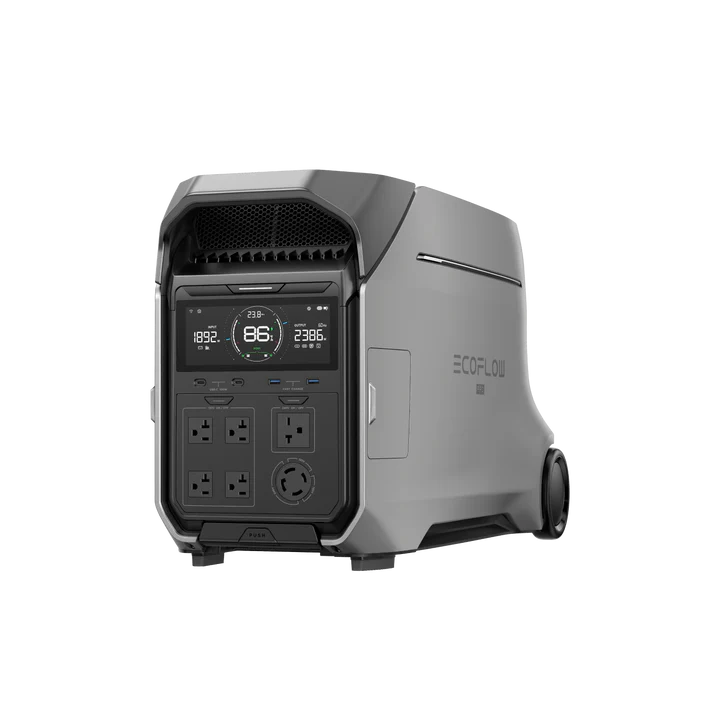
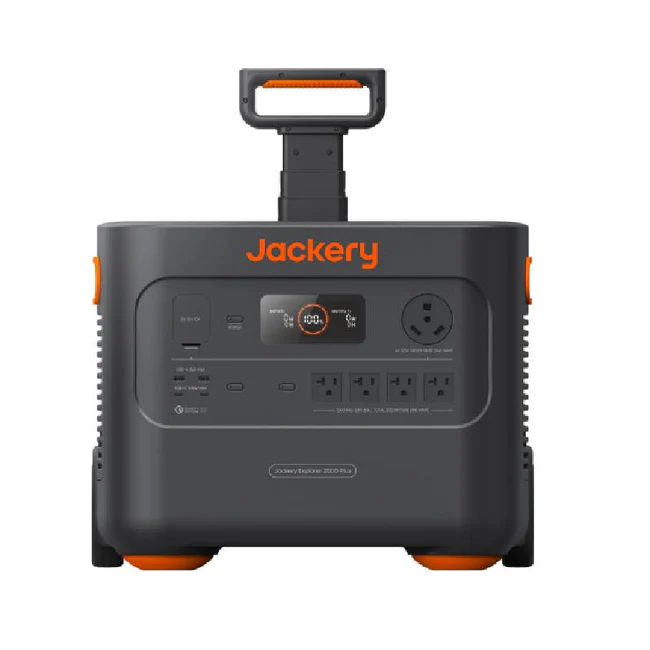
EcoFlow DELTA Pro 3 vs Jackery Explorer 2000 Plus
The Explorer 2000 Plus does almost everything the DELTA Pro 3 does for a third of the money, and the exceptions are specific: 240V output, a 30A RV socket, and the second night of a blackout.
Full profiles: EcoFlow DELTA Pro 3 → · Jackery Explorer 2000 Plus →

Written by Gunner GustafsonUpdated
Whole-Home Backup Tester, Station Arena Test Desk
$2,799.00 · direct from EcoFlow
Last checked 1 day ago. Prices move — check before you buy.
No longer sold
Jackery no longer sells the Explorer 2000 Plus as a standalone unit — the listing now carries only kits, the add-on battery and a refurbished unit. Its successor in the line is the HomePower 2000 Plus v2: the same 2 kWh class with a 2,400W inverter in the newer design.
HomePower 2000 Plus v2 · $1,199.00Spec deltas
The Explorer 2000 Plus costs $899 and the DELTA Pro 3 costs $2,799, and the difference does not buy a bigger version of the same box. It buys two 240V outlets, a 30A RV socket, 1,000 more watts of continuous output, and a unit our record lists as stationary, because 112.4 lb goes where you put it and then stays there.
Most of what people actually plug into these, the Explorer handles. A CPAP night costs it under a fifth of its battery. A remote workday leaves nearly another workday in reserve. An eight-hour outage evening it finishes at 95% used, which is the honest catch: it gets you through the night with almost nothing left for a second one.
So the question is not which unit is better. It is whether your list has something on it the Explorer cannot do at any price: feed a 30A shore cord, run a 240V appliance, hold more than 3,000W, or carry an outage into a second night. If it does, only one of these two answers. If it does not, you are paying for headroom you will never reach.
What the Numbers Reveal
Each conclusion stated first — the numbers behind it on one line, the full analysis below.
Capacity
Cycle life does not rescue that, because both packs carry the same 4,000-cycle rating, so the bigger box has no longevity advantage to amortise the premium against. The DELTA Pro 3 delivers twice the lifetime energy, 16,384 kWh against 8,171, and still costs more per unit of it: 17 cents a lifetime kilowatt-hour against 11. It is the more expensive unit at the till, per watt-hour, and per watt-hour over its whole life.
DELTA Pro 3: $2,799 for 4,096Wh, or $0.68 per WhExplorer 2000 Plus: $899 for 2,042.8Wh, or $0.44 per Whboth packs are rated for a minimum of 4,000 cycles
Why it mattersIf your reason for wanting the DELTA Pro 3 is more battery, you are overpaying for battery. The reasons that hold up are the things the Explorer has no socket for.
Add the continuous ratings and the split gets cleaner: 4,000W against 3,000W, so the DELTA Pro 3 is the one that holds a heavy load after the compressor kicks over, and the only one with an outlet a 240V circuit or an RV pigtail recognises. No adapter, expansion battery or firmware update adds a socket that is not on the box.
Explorer 2000 Plus ports: 240V outlets 0, 30A RV outlet 0DELTA Pro 3 ports: two 240V outlets, one 30A RV outletboth units surge to the same 6,000W
Why it mattersAnyone with a 30A shore cord, a well pump or a dryer on their list should stop comparing watt-hours. The Explorer cannot take the plug, and that is the one difference here money cannot close later.
Recharging is the way out of that, and it favours the same unit twice over: the DELTA Pro 3 takes up to 2,000W of solar against the Explorer's 1,200W, so the box with more left in it is also the box that puts more back the next day. In a two or three day outage the gap widens every morning instead of closing.
an eight-hour outage evening draws 1,645WhExplorer finishes it at 95% used, 91Wh leftDELTA Pro 3 finishes it at 47% used, 1,837Wh left
Why it mattersIf your outages are the single-evening kind, the Explorer is enough and the rest is insurance you are buying twice. If they routinely run past one night, this is the scenario where the DELTA Pro 3's price stops looking absurd.
weight
It gets worse for the heavy one in the row it should win: full-time van draw is 4,685Wh a day, and the DELTA Pro 3 is still 1,203Wh short of that. So the unit that cannot travel also cannot cover the largest travelling load, while both units accept expansion batteriesA1B2, which is the actual fix for both rows. Starting from the cheaper base leaves the expansion battery inside the same budget.
DELTA Pro 3: 112.4 lb, recorded as stationaryExplorer 2000 Plus: 61.5 lb, and reviewers note wheels and a handleB3Weekend Camping needs 2,100Wh; the Explorer comes up 364Wh short
Why it mattersCampers and van dwellers should buy the unit that can get to the campsite and plan on expansion, rather than buying the bigger box and hoping it fits in the trunk.
The specific dimensions that decide these two units — everything else is a tie.
Lifetime Value
Selected because: The cheaper unit is also the cheaper one to own: 11 cents per lifetime kilowatt-hour against 17, on the same rated 4,000 cycles.
cost / lifetime kWh
Cheap to buy and cheap to own point the same direction here, which is rarer than it sounds. Over the 4,000 cycles both packs are rated for, the Explorer works out to 11 cents per lifetime kilowatt-hour against the DELTA Pro 3's 17. The bigger unit does deliver twice the lifetime energy, 16,384 kWh against 8,171, and it still charges more for each unit of it.
The per-year framing is worth one glance and then a shrug. The DELTA Pro 3 costs $560 for each year of its warranty term, the Explorer $180. That is the price tag divided differently, not a difference in what the two companies are promising.
Your Life, Your Pick
Selected because: Two of the six rows go to neither unit, and the way the other four split is the whole argument between these two.
Two rows here belong to neither unit, and neither failure is about energy. The weekend campsite wants 2,100Wh: the DELTA Pro 3 has it and cannot come, the Explorer comes and lands 364Wh short. Full-time van living wants 4,685Wh a day and beats both, the DELTA Pro 3 by 1,203Wh and the Explorer by 2,949Wh. Read those as partial cover, not as a contest.
Where they do split, the pattern is consistent: the DELTA Pro 3 takes the rows that run long, the Explorer takes the row that has to travel. The CPAP row lands on both, and it is the most instructive line on the page, because it is the single job these units get bought for most often and it does not need either unit's headroom.
Portability & Form Factor
Selected because: 112.4 lb against 61.5 lb settles two scenario rows before capacity gets a vote.
weight
Our record calls the DELTA Pro 3 stationary and 112.4 lb is the reason. That is a two-person lift into position, once, after which it is furniture. Perfect for a utility room next to the panel. Disqualifying for a trunk, a tailgate or a set of basement stairs you would rather not negotiate twice.
The Explorer is not light either and pretending otherwise would be doing you a favour you did not ask for. What it is, is movable by one determined adult on flat ground. That is the whole difference between owning a power station and owning a standby generator that happens to run on lithium.
What the Specs Don't Tell You
Selected because: Four flags fire here, and three of them land closer to a tie than the spec columns suggest.
Three of the four flags on this page are closer to a dead heat than the columns imply. Both units peak at 6,000W, so the Explorer's flashier surge ratio is division rather than muscle. Both list five-year terms. The UPS figures differ by one class, no worse than 10ms against no worse than 20ms, and both of those are ceilings a maker published rather than times anyone put a scope on.
The flag that decides something is weight, and it is the only one you cannot fix with a registration form or a firmware update.
Growth Path
Selected because: Both take expansion batteries, so what matters is which ceiling you are growing into and how fast you can refill it.
solar input
Both units take expansion batteries, which quietly answers the two scenarios neither covers alone. The Explorer's own ceiling runs to 12kWh for one unit and 24kWh for a pairB2, already more than double the biggest daily load anywhere on this page. The DELTA Pro 3 reaches further still, to 48kWhA1, which is more capacity than most houses know what to do with.
The DELTA Pro 3's real growth advantage is on the input side rather than the storage side. A wider solar ceiling means more panels feeding a bigger bank, and off-grid growth is limited by how fast you refill as much as by how much you hold. If the plan is to keep adding panels for years, that is the growth argument worth paying for. If the plan is one expansion battery and a couple of panels, both paths get you there and only one of them leaves money for the panels.
Strengths & trade-offs
EcoFlow DELTA Pro 3
Strengths
- +Larger battery capacity
- +Higher AC output
- +Faster solar charging
Trade-offs
- –Substantially more expensive (+$1,900) than the Explorer 2000 Plus.
- –Significantly heavier (+50.9 lbs), making it harder to move.
- –Very heavy unit that may be difficult for one person to lift.
Jackery Explorer 2000 Plus
Strengths
- +Costs $1,900 less
- +Lighter by 50.9 lb
Trade-offs
- –Weaker inverter (-1,000W) limits appliance compatibility.
Will It Power Your Gear?
Scenario math and per-appliance runtimes, modeled from the spec record.
Scenario verdicts
We ran the math on six real-world scenarios. Here's which unit survives your actual life.
SCN-01 · 2 nights · needs 2,100Wh
Weekend Camping
Two nights off-grid with essential comfort
Neither unit
Neither unit gives you a powered weekend, and neither failure is about energy. The DELTA Pro 3 has 3,482Wh of usable capacity against the 2,100Wh the weekend wants, and at 112.4 lb it is not coming with you. The Explorer comes willingly and runs out 364Wh from the finish, somewhere around Sunday breakfast. Trim the load or add an expansion battery, because the base units both miss this one from opposite directions.
Battery budget usedlower = more headroom
LOAD Phone Charger 15W×6h · LED Lights 40W×8h · Box Fan 75W×14h · CPAP Machine 40W×16h
SCN-02 · 8 hours · needs 1,645Wh
8-Hour Blackout
Keep the essentials running through a night without power
DELTA Pro 3
Both units see the night through, and only one of them is still standing afterwards. The DELTA Pro 3 ends the evening at 47% used with 1,837Wh banked, which is another full night and a bit. The Explorer ends at 95% with 91Wh, roughly 6% of a second night. If your outages stop when the sun comes up, that gap costs you nothing. If they do not, it is the entire argument between these two.
Battery budget usedlower = more headroom
LOAD Fridge 150W×8h · Router + Modem 20W×8h · LED Lights (4 bulbs) 40W×6h · Phone Charger 15W×3h
SCN-03 · 8 hours · needs 320Wh
CPAP Overnight
Sleep therapy without interruption — the #1 medical use case
Either unit
Eight hours of CPAP is about 320Wh, and both units cover it so far over that the capacity column stops meaning anything. The Explorer's 1,736Wh of usable energy is five nights of it. The DELTA Pro 3's 3,482Wh is nearly eleven. Almost nobody is off-grid with a CPAP for five consecutive nights, so buy on price and on which one you can actually carry to the bedroom.
Battery budget usedlower = more headroom
LOAD CPAP Machine 40W×8h
SCN-04 · 8 hours · needs 910Wh
Remote Workday
Full work day off-grid without power anxiety
DELTA Pro 3
The DELTA Pro 3 clears the 910Wh workday at 26% used and banks 2,572Wh, which is late calls, a second laptop and no arithmetic. The honest version of its win: the Explorer also finishes, at 52% used with 826Wh left, and that is about 91% of another whole workday. This row goes to the bigger unit on margin, not on capability.
Battery budget usedlower = more headroom
LOAD Laptop 60W×8h · External Monitor 30W×8h · Router + Modem 20W×8h · Phone Charger 15W×2h
SCN-05 · 4 hours · needs 670Wh
Tailgate Party
Game day power for the crew
Explorer 2000 Plus
This row is decided in the parking lot, not on the spec sheet. Both units start the 400W peak identically, because both surge to the same 6,000W. But the DELTA Pro 3 is 112.4 lb and does not get itself over a tailgate, so the day belongs to the Explorer, which covers the 670Wh draw and still has 1,066Wh in hand when everyone goes home.
Battery budget usedlower = more headroom
LOAD Blender 400W×0.5h · LED TV (55") 80W×4h · Bluetooth Speaker 15W×4h · Phone Charger (×3) 45W×2h
SCN-06 · 24 hours · needs 4,685Wh
Van Life Daily
A full day of mobile living — the ultimate endurance test
Neither unit
Full-time van living wants 4,685Wh a day and neither base unit gets there: the DELTA Pro 3 covers about three quarters of it, the Explorer a little over a third. Read this as partial cover for the essentials in the list, not the whole list. Both units accept expansion batteries, and for a van that is the real answer, alongside the small matter of which of these two you could get through the door.
Battery budget usedlower = more headroom
LOAD Mini-Fridge 150W×24h · Laptop 60W×4h · Phone Charger 15W×3h · LED Lights 40W×5h · Fan 75W×8h
The Load Test
RUNTIME = (Wh × 0.85) ÷ LOAD
None of the scenarios above exactly yours? Build it. Toggle what you'd plug in; both units are tested against the combined draw.
Essentials
Comfort & Convenience
High-Draw Appliances
Test duration
8h
Continuous draw
205W
Projected runtime
For this load: DELTA Pro 3 runs 17h vs 8.5h.
$2,799 list · direct from EcoFlow
Modeled from the spec record — same math as the tables below. Methodology
Runtime by appliance
Real-world runtime estimates for common appliances, modeled at 85% inverter efficiency.¹
Essentials
The basics you need runningscale 0–232.1hComfort & Convenience
Makes off-grid life actually enjoyablescale 0–46.4hHigh-Draw Appliances
These reveal the real limitsscale 0–3.5h¹ Runtime = (capacity × 0.85) ÷ appliance watts. Within each group, all bars share one time scale (the group's longest runtime), so lengths are comparable across appliances; identical runtimes collapse into a single blue/orange bar. Actual runtime varies with battery age, temperature, and simultaneous loads — see methodology.
Conclusion
September 13, 2026
Verdict: the Jackery Explorer 2000 Plus
Buy the Explorer 2000 Plus at $899 unless your list contains something it physically cannot do. It clears a CPAP night, a remote workday and a single-evening outage, it is the only one of the two that travels, and over the same rated 4,000 cycles it costs 11 cents per lifetime kilowatt-hour against the DELTA Pro 3's 17. The DELTA Pro 3 is the stronger machine and the right buy for a narrow group: anyone feeding a 30A RV cord or a 240V appliance, anyone whose outages run into a second day, and anyone installing it once in a utility room where its 112.4 lb stops mattering the moment it lands. If none of that describes you, the extra battery is $1,900 of headroom you will rarely reach.
Editor-assigned confidence, based on cited owner research and spec analysis.
List prices as of September 13, 2026. The links below open EcoFlow's and Jackery's current prices.
$899.00 · direct from Jackery
Last checked 21 days ago. Prices move — check before you buy.
or check the DELTA Pro 3 price$2,799.00 list
Written by Gunner Gustafson, Whole-Home Backup Tester · Station Arena Test Desk · Updated September 13, 2026
Measured Data
Benchmark scores and the full spec record, side by side.
Benchmark scores
Not rated for both units (minimum threshold unmet): UPS, Tailgating, Apartment Balcony.
Full specifications
ᵈ Derived: price ÷ rated capacity. See the data behind our comparisons →
Comparison ToolAdd more power stations, side by sideOpen Tool →How these numbers are produced
Numeric verification
Every figure on this page traces to our spec database or arithmetic on it — no estimated numbers.
Owner claims
Statements about owner experience are cited to published reviews — see Sources & Research Notes below.
Runtime model
Runtime = (rated capacity × 0.85 inverter efficiency) ÷ device wattage. Solar recharge estimates assume panels deliver 70% of rated output. Cold weather, battery age, and stacked loads reduce real-world results.
Power Score
Computed from 14 published spec dimensions, weighted per use-case bench. Higher is better; a unit must meet a bench's minimum threshold to be rated.
See the full weight table and data sourcing on our methodology page →Class ranking (the star rating)
Each unit's star score is a category ranking, not customer reviews — no buyer opinions feed it. We score every station on size-independent quality (value, output, portability, endurance, ports, warranty, and more), then percentile-rank it against the other units in its capacity class, so a class-leading compact unit and a class-leading whole-home unit can both earn 5★. Here, DELTA Pro 3 rates 4.0/5 (40th percentile of 16 Home Backup-class units), and Explorer 2000 Plus rates 4.5/5 (68th percentile of 26 Large-class units).
How the class ranking is computed →Test Notes & Caveats
Hidden gotchas and advantages we spotted that you won't find on the product page.
Weight: one lift, or every trip
Neither of these is a grab-and-go box. At 61.5 lb the Explorer is a bent-knees solo lift on flat ground and a two-person job on stairs. At 112.4 lb the DELTA Pro 3 is a two-person job everywhere. The 50.9 lb between them is a price you pay once if the heavy one lives beside the breaker panel, and on every single outing if it does not.
Surge: same ceiling, flattering arithmetic
Both units peak at 6,000W, so they give the same answer on whether your fridge compressor will start. The Explorer's better-looking 2x surge ratio comes from dividing that shared ceiling by a smaller continuous rating, 3,000W against the DELTA Pro 3's 4,000W. Starting a load is a tie. Holding it afterwards is not.
UPS: two ratings, no stopwatch
Both list a UPS mode, and both figures are rated ceilings rather than measurements. The DELTA Pro 3 is rated no worse than 10ms, the Explorer no worse than 20ms. Routers, TVs and most electronics ride through either one on paper. A desktop with unsaved work is the one load where the tighter class earns attention, and even then, treat it as a specification and not as a result.
Warranty: matched on paper, conditional in practice
Five years on both, so this column decides nothing between them. The part that does matter on a Saturday: Jackery's five is three years plus two you have to claim by registering the unit, so the protection you think you bought only exists once you fill in the form. And the flattering per-dollar version of this stat is just the price gap wearing a different hat.
Full record above — the Test Desk pick is the Explorer 2000 Plus.
Check Explorer 2000 Plus price →or check the DELTA Pro 3 priceOwnership Analysis
What happens after you buy — true cost of ownership, brand trust, and growth potential.
Lifetime value
Service lifeyears at one full cycle per day
Lifetime energy delivered
Cost per delivered kWh
│ warranty ends · Reaching the cycle rating means ~80% capacity remains — degraded, not dead.
Analyst note
The Explorer 2000 Plus wins on both sticker price and long-term value. At $0.11/kWh over its lifetime, it's meaningfully cheaper to own. Clear value winner. One thing to know reading the table: both carry the same 4,000-cycle rating, so the lifetime rows are sticker price and capacity in disguise — the wear horizon is identical and decides nothing here.
Brand trust
EcoFlow
Ecosystem
Largest in portable power — 12-15 models across DELTA Pro, DELTA 3, and RIVER 3 series, plus solar panels and smart home panels
Support
US phone, email and chat, with outcomes that split hard: prepaid label and a quick replacement for some, long waits and a refurbished unit for others. Buying through Costco or Amazon gives you a return window that does not depend on which of those you get.
Community
About 31,000 on Reddit plus an official forum, which in practice means somebody has already posted your error code and been answered.
App experience
Rated 4.6/5 iOS (~8,400 ratings) · 4.2/5 Android (~17,000 ratings)
Unique strength
Fastest-charging technology (X-Stream), deepest product ecosystem, and most active innovation cadence. At the very top of the range, the DELTA Pro Ultra platform stacks batteries and inverters into whole-home backup — a flagship path, not a line-wide feature.
Worth knowing
EcoFlow floated a subscription for advanced app features in early 2025 and backed off after the community pushed back. Out of warranty there are no parts and no service, so plan on the warranty being the whole safety net.
Jackery
Ecosystem
12-15+ models across Explorer (portable) and HomePower (home backup) series, plus SolarSaga panel ecosystem and innovative form factors
Support
The weaker of the two desks here: slow and scripted replies, strict receipt requirements, and refurbished replacements on units that failed outright. On the cheaper of these two boxes the retailer's return policy is worth more than the warranty page, so buy where returns are painless.
Community
About 2,000 on Reddit, the smallest of the major brands, so troubleshooting leans on YouTube rather than on people who own your exact unit.
App experience
Rated 2.3-3.3/5 iOS and Android — the weakest app experience of the major brands. Multiple confusing apps (Jackery app vs Jackery Home) and mandatory login even offline.
Unique strength
The Toyota of power stations: proven, widely recognised, and physically on a shelf at Costco, Home Depot, Best Buy and Amazon. That distribution is also the practical workaround for the support desk.
Worth knowing
The app is the weakest of the major brands at 2.3 to 3.3 stars, split across two apps that do similar things, with a mandatory login even when you are standing next to the unit.
Analyst note
Neither support desk is a reason to buy, and the same advice applies to both: get it from a retailer with a real return window. Where they actually differ is software and crowd size. EcoFlow's app is well rated and has a large forum behind it; Jackery's app is the weakest of the majors and its subreddit is a fraction of the size. If the unit is going to sit in a utility room and get touched twice a year, that gap is noise. If you plan to run it from your phone, it is not.
Growth path
DELTA Pro 3
EXPANDABLESupports EcoFlow expansion batteries, so you can add capacity later without replacing the base unit — useful if your needs may climb past 4,096Wh.
Accepts up to 2,000W of solar. Enough for a serious multi-panel array.
Generous port selection supports complex multi-device setups.
Expansion batteries are EcoFlow-specific. You're investing in the EcoFlow ecosystem.
Explorer 2000 Plus
EXPANDABLESupports Jackery expansion batteries, so you can add capacity later without replacing the base unit — useful if your needs may climb past 2,043Wh.
Accepts up to 1,200W of solar. Enough for a serious multi-panel array.
Adequate ports for most setups, but heavy users may want a power strip.
Expansion batteries are Jackery-specific. You're investing in the Jackery ecosystem.
Realistic full solar rechargeat 70% of rated panel output — see methodology
Analyst note
Both expand, but the DELTA Pro 3's higher solar ceiling (2,000W vs 1,200W) gives it the stronger off-grid growth path — more panels can feed a bigger bank as it grows.
What Owners Report
Patterns from published owner reports and long-term reviews — every claim cited to its source below.
EcoFlow DELTA Pro 3
Field data on the DELTA Pro 3 is thinner than its profile suggests. What exists is review-site and retailer coverage rather than owners who have lived with one through a winterA0A4. What that coverage agrees on is the charging: multi-charge is reported to take it from empty to 80% in about 50 minutes and to full in roughly 90A3. That is the kind of number that matters in an outage nobody scheduled.
The pack is rated 4,000-plus cycles to 80% with an IP65 battery ratingA2, and reviewers treat it as whole-home backup rather than something you carryA4, which matches what its weight already tells you. Take the durability story as a rating and a reputation, not a track record, because this ledger has no long-term owners in itA0.
“4,096Wh LFP battery with 4,000W continuous AC output (6,000W with X-Boost) and dual-voltage 120V/240V, expandable to 48kWh.”
Sources
ecoflow.com · amazon.com · homedepot.com · thepowerpick.com · outboundpower.com · techradar.com · thesolarlab.com
Jackery Explorer 2000 Plus
The Explorer 2000 Plus reads as the boring-in-a-good-way one. Reviewers describe it as dependable and easy to use, quiet enough to be worth remarking on even under a 3,000W load, and happy to run anything from a CPAP to an electric grillB1. The app is the weak spot people actually raise: it covers the essentials and even surfaces cycle counts and efficiency graphs, and it still needs polishB4.
On weight the field note is more useful than the number. Around 61 to 62 lb, with wheels and a handle that help on smooth ground and a two-person lift the moment stairs are involvedB3. The build gets consistent praise, IP65 dust and water resistance on key ports and two MPPT solar inputsB5, though coverage puts its solar ceiling anywhere from about 1,200W to 1,400W while our record uses the lower of thoseB0B5.
“Reviewers describe it as dependable, easy to use, and relatively quiet even under a 3000W load, with universal compatibility for powering everything from CPAP machines to electric grills.”
Sources
outdoorgearlab.com · thesolarpit.com · jackery.com · voltagebasics.com · storagereview.com · thesolarlab.com · tipselite3s.com
Sources & Research Notes
Every owner claim in this report is traceable to a published source. The bracketed references above resolve here.
Recurring owner themes
- Huge 4,096Wh LFP capacity, 4,000W dual-voltage output, very fast charging, and big expandability are the standout praise; it's heavy at ~113 lbs. [DELTA Pro 3 · 2 entries]
- Standout expandability (up to 24kWh dual), a rugged IP65 build with wheels, and dependable quiet operation are the praise; the heavy weight and an app that needs polish are the caveats. [Explorer 2000 Plus · 3 entries]
- A1
“4,096Wh LFP battery with 4,000W continuous AC output (6,000W with X-Boost) and dual-voltage 120V/240V, expandable to 48kWh.”
ecoflow.com / amazon.com — DELTA Pro 3 · 2026 · [positive]
- A2
“LiFePO4 rated for 4,000+ cycles to 80% (10+ years), with an IP65 battery rating.”
homedepot.com / thepowerpick.com — DELTA Pro 3 review · 2026 · [positive]
- A3
“Multi-charge technology reaches 0-80% in about 50 minutes using up to 7,000W input, with a full charge in roughly 90 minutes; up to 2,600W solar.”
outboundpower.com / techradar.com — DELTA Pro 3 review · 2026 · [positive]
- A4
“Weighs about 113.5 lbs; reviewers call it a gold-standard whole-home backup unit for 2026.”
techradar.com / thesolarlab.com — DELTA Pro 3 review · 2026 · [positive]
- B1
“Reviewers describe it as dependable, easy to use, and relatively quiet even under a 3000W load, with universal compatibility for powering everything from CPAP machines to electric grills.”
outdoorgearlab.com / thesolarpit.com — Jackery Explorer 2000 Plus review · 2026 · [positive]
- B2
“Massive expandability — each unit's battery expands up to 12kWh, and pairing two units gives 6000W output and up to 24kWh total, ideal for RVs, home backup, or serious off-grid setups.”
jackery.com / thesolarpit.com — Explorer 2000 Plus review · 2026 · [positive]
- B3
“Not light at around 61-62 lbs — included wheels and a handle help on smooth surfaces, but it still demands a two-person lift for stairs.”
outdoorgearlab.com / voltagebasics.com — Explorer 2000 Plus review · 2026 · [mixed]
- B4
“The app nails the essentials with pro-level insights like cycle counts and efficiency graphs, but it lacks some of the bells and whistles of rivals and still needs polishing.”
storagereview.com / thesolarlab.com — Explorer 2000 Plus review · 2026 · [mixed]
- B5
“Strong solar with two MPPT inputs (up to ~1,200-1,400W), plus a tank-like build with IP65 dust and water resistance on key ports.”
storagereview.com / tipselite3s.com — Explorer 2000 Plus review · 2026 · [positive]
Research compiled September 13, 2026.
What Owners Actually Report
Drawn from 60 comments on independent review channels — not from retailer reviews, which skew to the first week of ownership. Each line is our summary of one commenter's claim, linked to the original. We record what they said, including where it contradicts the spec sheet.
EcoFlow DELTA Pro 3
74 claims from 50 comments · 50 from owners · 22 with figures
- Charging
- 8 · 30% negative
- Runtime
- 7 · 0% negative
- Price & value
- 11 · 3% negative
- Expandability
- 7 · 97% negative
- Warranty & support
- 8 · 69% negative
What owners complain about
His DP3 can only charge from an external 120V source while outputting 240V.
Chargingowner7 agreedsource →
At almost 120 lb he would not call the DP3 portable.
Size & weightmeasuredowner3 agreedsource →
Regrets buying the DP3 over the F3800 because it lacks 240V passthrough.
Expandabilityowner4 agreedsource →
What owners praise
Recharges in about 70 minutes at 3400W from a 240V generator inlet.
Chargingmeasuredowner57 agreedsource →
Ran lights, fans, modem, fridge and a 1300W air conditioner through a 5-day hurricane outage.
Runtimemeasuredowner30 agreedsource →
Costco sells a DELTA Pro 3 twin pack at $4,999, dropping to $4,499 on sale.
Price & valuemeasuredowner6 agreedsource →
Jackery Explorer 2000 Plus
15 claims from 10 comments · 11 from owners · 2 with figures
- Expandability
- 3 · 48% negative
- Solar input
- 2 · 0% negative
- Warranty & support
- 3 · 100% negative
- Price & value
- 2 · 88% negative
- Charging
- 1 · 100% negative
What owners complain about
The pairing connector box is way overpriced at $200.
Price & valuemeasuredownersource →
Has contacted Jackery too many times across four units and calls their support bad.
Warranty & supportownersource →
The 2000 Plus parallel kit did not do what he needed despite the spec talk.
Expandabilityownersource →
What owners praise
Feeds 4800W into the system across 8 DC ports; any input backfeeds and charges everything.
Solar inputmeasuredowner100 agreedsource →
Each expansion battery has its own controller, giving MPPT redundancy in a grid-down scenario.
Expandabilityowner100 agreedsource →
Switching his decision to Jackery on the reviewer's A grade over the AC300's A- and Delta's B-.
Other17 agreedsource →
Claims are weighted by how specific they are, whether the commenter owns the unit, and how many readers agreed. Comments that mention a product under a rival's review count for more, because the commenter had no reason to be there. This is what buyers report, not our test results — for measurements we ran ourselves, see the methodology.
Who Should Buy Which
Buy the DELTA Pro 3 if you…
- →You have a 30A shore-power cord on an RV, or a 240V load in the house: a well pump, a dryer, a big workshop tool. The Explorer has no outlet for either, and nothing you buy later adds one.
- →Your outages run into a second and third day. One evening's load leaves the DELTA Pro 3 most of the way full, and it accepts far more solar the next morning, so day two becomes a problem you can actually solve.
- →The unit is going to live in one spot, next to the panel or in the garage, and the only person who ever lifts it is the one who delivers it.
- →You run loads above 3,000W continuously. Both units start the same appliances; only one holds 4,000W afterwards.
Buy the Explorer 2000 Plus if you…
- →You are buying for the single-evening blackout: fridge, lights, phones, router, a fan. The Explorer gets you through that night. Go in knowing you finish it nearly empty, which is fine when the lights come back and not fine when they do not.
- →You are running a CPAP. A full night costs you under a fifth of this unit, so the DELTA Pro 3's extra battery is margin you will never once see.
- →The box has to arrive somewhere: a tailgate, a campsite, a job site, a friend's house after a storm. Only one of these two travels.
- →You want the cheapest route to a big bank later. The Explorer's expansion ceiling is far past anything on this pageB2, and you start from a third of the price.
This is you — check the Explorer 2000 Plus price
If neither fits
If your real load is a full-time van at 4,685Wh a day, or a house with 240V circuits you need running for days rather than hours, both of these are the wrong shape of purchase. Look at a stacked home-backup system or a properly sized wired-in bank instead, and treat a box like one of these as the portable you add afterwards rather than the backbone you build on.
The Bottom Line
Get the Explorer 2000 Plus. It covers the nights people actually buy these for, it is the only one of the pair that can reach a campsite or a tailgate, and over the same rated life it costs less per unit of energy delivered. The one thing it genuinely cannot do is carry an outage into a second evening, and it tells you so honestly by finishing the first one nearly empty.
The DELTA Pro 3 is less the loser here than the answer to a different question. Two 240V outlets, a 30A socket, a thousand more watts held, and most of the battery still there in the morning are not things the Explorer can grow into, and if any of them are on your list the price stops being the point. If none of them are, buy the cheaper box, register it the week it lands, and spend the difference on panels.
Frequently Asked Questions
Answers drawn from the spec record and cited owner research.
Is the EcoFlow DELTA Pro 3 worth three times the price of the Jackery Explorer 2000 Plus?
Only if you need something the Explorer cannot do at any price: 240V output, a 30A RV socket, more than 3,000W held continuously, or a second blackout night without a recharge. If your list is a fridge, a router, laptops, a CPAP and lights for one evening at a time, the Explorer does all of it for $899. The DELTA Pro 3 is the better machine. It is the better buy for a narrow group of people.
Can the Jackery Explorer 2000 Plus run a 30-amp RV hookup?
Not from a shore-power cord. Our record lists no 30A RV outlet and no 240V outlet on the Explorer, so you would be plugging appliances into its five AC sockets one at a time rather than feeding the rig's panel. The DELTA Pro 3 lists one 30A RV outlet and two 240V outlets, and that is the least substitutable difference between these two units.
Will either one run a CPAP all night?
Both, comfortably. A CPAP is about 40W for eight hours, which lands in single digits as a share of the DELTA Pro 3 and under a fifth of the Explorer. Capacity is not the deciding factor for this job, so decide on price and on whether the unit ever has to leave the bedroom.
Which one should I buy for a two-day power outage?
The DELTA Pro 3, and this is the scenario that justifies it. A typical eight-hour outage evening uses under half of its battery and nearly all of the Explorer's, so the second evening depends entirely on how much you can put back during the day, and the Explorer accepts less solar to do it with. For outages that end the same night, the Explorer is the sensible buy.
Do both really come with a 5-year warranty?
Both list five years, but Jackery's is three years plus two more you only get by registering the unit, so do that the week it arrives. Because the terms match, the warranty column is not a tiebreaker here in either direction. Whichever you buy, buy it somewhere with an easy return window, which is the cheapest insurance available on a purchase this size.
Check Explorer 2000 Plus price →
Brand matchup
EcoFlow vs Jackery: measured across every matchup →Where to buy
EcoFlow DELTA Pro 3
$2,799.00
$2,799.00 · direct from EcoFlow
Last checked 1 day ago. Prices move — check before you buy.
Jackery Explorer 2000 PlusPick
$899.00
$899.00 · direct from Jackery
Last checked 21 days ago. Prices move — check before you buy.
Prices may vary by retailer and are subject to change.