Head-to-head test
EcoFlow DELTA 3 vs Anker SOLIX C2000 Gen 2
The SOLIX C2000 Gen 2 costs $371 more, but for that money you get exactly double the battery and a lower price per watt-hour than the DELTA 3, on a pack rated for the same 4,000 cycles — the rare 'expensive' pick that's also the better deal, unless the extra 14.7 lbs is the part you can't absorb.
Full profiles: EcoFlow DELTA 3 → · Anker SOLIX C2000 Gen 2 →

Written by Ian SchneiderUpdated
Solar & Off-Grid Tester, Station Arena Test Desk

$629.00 · direct from EcoFlow
Last checked 1 day ago. Prices move — check before you buy.
$999.99 · direct from Anker
Last checked 1 day ago. Prices move — check before you buy.
Spec deltas
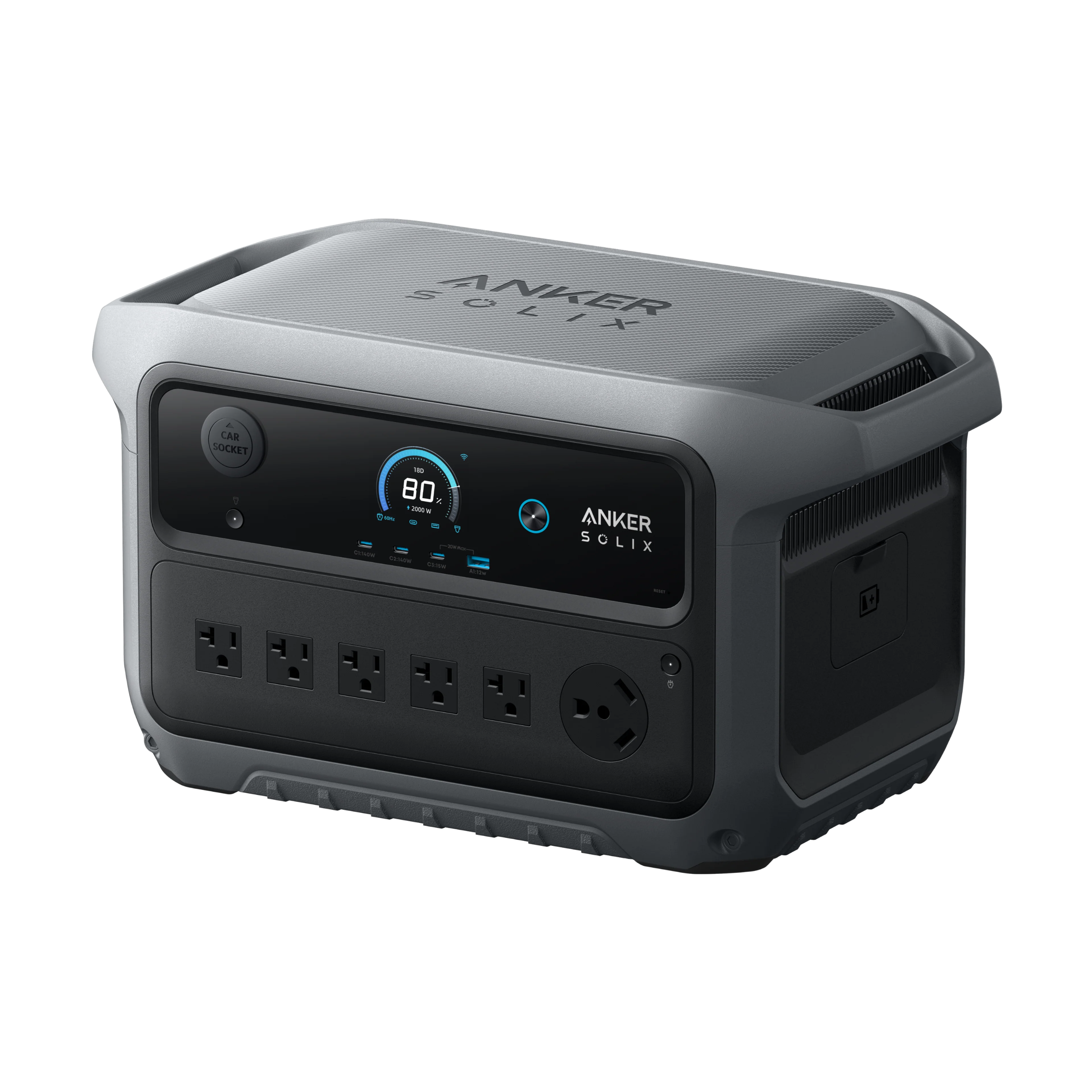
Two power stations at very different price points, and the pricier one is the better watt-hour deal. The DELTA 3 lists at $629 for 1,024Wh; the SOLIX C2000 Gen 2 lists at $1,000 (officially $1,000) for exactly double that, 2,048Wh. Divide it out and the more expensive unit comes to $0.49 per watt-hour against the DELTA 3's $0.54 — you're not paying a premium for the extra capacity, you're getting it at a discount.
That gap holds up in daily use too. The SOLIX handles four of the six real-world loads this site tests — an 8-hour blackout, a CPAP overnight, a full remote workday, and a tailgate party — while the DELTA 3 finishes only two of those same six on its own: the CPAP night and the tailgate party. It isn't built for more cycles, though: both are rated at 4,000, which at daily use works out to roughly 11 years of service either way.
None of that makes the DELTA 3 a bad buy. At 27 lbs it's light enough for one person to move without thinking about it; the SOLIX's 41.7 lbs is not. The DELTA 3's inverter also actually carries more surge cushion above its own rating than the SOLIX's does. The question this page answers is which argument matters more for your specific evenings: bigger and cheaper to run, or lighter and cheaper to buy.
What the Numbers Reveal
Each conclusion stated first — the numbers behind it on one line, the full analysis below.
Capacity
That discount compounds over the unit's life: full lifetime cost works out to $0.12 per kWh for the SOLIX against $0.13 for the DELTA 3, so the bigger unit both starts ahead and gets cheaper to run the longer you keep it.
DELTA 3: $629 for 1,024Wh, or $0.54 per watt-hourSOLIX C2000 Gen 2: $1,000 for 2,048Wh, or $0.49 per watt-hour
Why it mattersIf you can absorb the price gap upfront, you're not paying a premium — you're buying the better per-watt-hour deal outright.
continuous output
Motor-driven loads like fridge compressors and power tools briefly draw 2 to 3 times their rated wattage on startup, so the unit with more proportional headroom is the one less likely to trip when that spike hits — and on that specific measure, it's the smaller, cheaper DELTA 3 that's built with more margin.
DELTA 3: 3,600W surge over an 1,800W continuous ratingSOLIX C2000 Gen 2: 4,000W surge over a 2,400W continuous rating
Why it mattersIf you're running a single compressor-heavy appliance near either unit's rated ceiling, the DELTA 3's deeper proportional surge cushion is the more forgiving inverter, price and capacity aside.
weight
Every scenario the DELTA 3 loses outright, it loses by running short, not by a close margin. The SOLIX clears both with real room left over.
DELTA 3 can't finish the 8-Hour Blackout or Remote Workday scenarios on a single charge; the SOLIX clears bothSOLIX weighs 41.7 lbs against the DELTA 3's 27 lbs
Why it mattersIf your real use case is an overnight outage or a full day of remote work off-grid, the extra weight is the cost of actually finishing the job.
What still favors the SOLIX is the lower lifetime cost per kWh, and it earns that on pack size rather than cycle life: it's the unit built to be run hard and often, while the DELTA 3's economics make more sense for a battery that mostly sits in a closet between camping trips and outages.
DELTA 3: 4,000 cycles, $0.13 per lifetime kWhSOLIX C2000 Gen 2: 4,000 cycles, $0.12 per lifetime kWh
Why it mattersDaily users — van life, daily office backup — should weight capacity heavily toward the SOLIX, but not cycle life, which is a tie. Weekend or emergency-only owners can ignore the column entirely since both units will outlast the need.
The specific dimensions that decide these two units — everything else is a tie.
Lifetime Value
Selected because: Nearly double the sticker price is the single biggest hesitation here; cost-per-kWh and cost-per-warranty-year settle whether that premium is real or just size.
cost / lifetime kWh
Buy price and lifetime price point in different directions here, but not the direction you'd guess. The SOLIX's $1,000 looks like the splurge next to the DELTA 3's $629, yet spread across everything the battery will ever store, the SOLIX comes out to $0.12 per kWh against the DELTA 3's $0.13. Bigger pack, same 4,000 cycles, lower cost per use: the premium is front-loaded, not permanent.
The one figure that cuts the other way is cost per warranty-year: $110 for the DELTA 3 against $200 for the SOLIX, simply because both carry the same 5-year term at different prices. It's a real number, but it mostly measures the price gap you already know about rather than telling you anything new about how well either brand honors that warranty.
Your Life, Your Pick
Selected because: Six real-world loads separate these two more clearly than the spec sheet does; the DELTA 3 only clears two of them on its own.
Line up all six loads and the split is stark. The SOLIX covers an 8-hour blackout, a CPAP night, a full remote workday, and a tailgate party; the DELTA 3 only covers the CPAP night and the tailgate party on its own. Neither unit touches a full weekend of camping or a van-life day; those need multiples of what's here, not a bigger single unit.
The CPAP and tailgate results are the tell. Both units clear those loads comfortably, and the SOLIX still wins the assignment by using less of its own capacity to do it, leaving more buffer for whatever runs longer than planned.
What the Specs Don't Tell You
Selected because: Surge ratio and warranty-per-dollar both quietly favor the DELTA 3, worth surfacing since every headline number points to the SOLIX.
Two of the three spec quirks that separate these units actually favor the DELTA 3, easy to miss when every headline number points to the SOLIX. Its inverter carries a 3,600W surge over an 1,800W continuous rating, a full 2x margin, while the SOLIX's 4,000W surge sits at roughly 1.7x its 2,400W rating. For a single hard-starting compressor or power tool, that's proportionally more forgiveness on the cheaper unit.
The DELTA 3 also technically returns more warranty-years per dollar spent, since both carry the same 5-year term at a lower price. Treat that one skeptically; it's really just the price gap restated in different units, not a sign either brand stands behind its warranty more. And cycle life, the number you'd expect to carry real weight, doesn't break the tie either: both are rated for 4,000 cycles, roughly eleven years of service at daily use on either unit.
Portability & Form Factor
Selected because: 14.7 lbs is a real one-hand-vs-two-hands difference and the DELTA 3's strongest remaining argument once cost-per-kWh is settled.
weight
At 27 lbs the DELTA 3 is one-person-forever gear: off a shelf, into a trunk, up a flight of stairs, no second thought required. The SOLIX's 41.7 lbs — 14.7 lbs more — is still liftable solo, but it's the kind of heavier that makes you set your coffee down first and use your knees.
That weight buys real capacity, not padding, so it's not a wasted trade-off; it's the same battery-size logic driving the price and the scenario numbers. If the unit lives in one spot — a closet, a truck bed, a garage shelf — the extra weight barely registers. If you're the one carrying it up basement stairs every trip, the DELTA 3's 27 lbs is the more honest daily companion.
Brand Trust
Selected because: Cross-brand pair with a real gap in ecosystem size and a recent EcoFlow recall on a different model worth knowing about either way.
EcoFlow is the bigger ecosystem by a wide margin — more models, the largest owner community in the category — but it's also the brand with the more recent black mark. EcoFlow issued a recall on the DELTA Max 2000 in October 2025 over an overheating risk. That's a different model, not this one, but it's a fair data point on the brand's manufacturing track record.
Anker brings the halo of a parent company millions already trust for chargers and cables, plus what reviewers describe as an unusually clean, no-fuss setup experienceB2. Its support reputation is the trend line moving the wrong direction: historically excellent, now increasingly leaning on AI-driven responses for a heavier, harder-to-ship product.
Strengths & trade-offs
EcoFlow DELTA 3
Strengths
- +Costs $371 less
- +Lighter by 14.7 lb
Trade-offs
- –Weaker inverter (-600W) limits appliance compatibility.
Anker SOLIX C2000 Gen 2
Strengths
- +Larger battery capacity
- +Higher AC output
- +Faster solar charging
Trade-offs
- –Substantially more expensive (+$371) than the DELTA 3.
- –Significantly heavier (+14.7 lbs), making it harder to move.
Will It Power Your Gear?
Scenario math and per-appliance runtimes, modeled from the spec record.
Scenario verdicts
We ran the math on six real-world scenarios. Here's which unit survives your actual life.
SCN-01 · 2 nights · needs 2,100Wh
Weekend Camping
Two nights off-grid with essential comfort
Neither unit
A real weekend of camping draws more than either unit carries. The SOLIX gets closer — it would need to be pushed roughly a fifth past its own capacity to cover it — while the DELTA 3 would need more than double what it holds. Neither is the right single unit for this; plan on a bigger station or an expansion battery for a full weekend away.
Battery budget usedlower = more headroom
LOAD Phone Charger 15W×6h · LED Lights 40W×8h · Box Fan 75W×14h · CPAP Machine 40W×16h
SCN-02 · 8 hours · needs 1,645Wh
8-Hour Blackout
Keep the essentials running through a night without power
SOLIX C2000 Gen 2
This is where the extra capacity earns its keep. The SOLIX covers a full night of fridge, router, lights, and phone charging with room left over, while the DELTA 3 comes up short and would need a recharge partway through the outage. For anyone in a storm-prone area, that's the scenario worth planning around.
Battery budget usedlower = more headroom
LOAD Fridge 150W×8h · Router + Modem 20W×8h · LED Lights (4 bulbs) 40W×6h · Phone Charger 15W×3h
SCN-03 · 8 hours · needs 320Wh
CPAP Overnight
Sleep therapy without interruption — the #1 medical use case
Either unit
Both units are seriously overqualified for a single CPAP machine overnight; this load barely dents either battery. The SOLIX technically finishes with more of its capacity untouched, but honestly, for this scenario alone the DELTA 3's lower price makes it the more sensible buy. Save the difference for a second battery if multi-night trips are the real concern.
Battery budget usedlower = more headroom
LOAD CPAP Machine 40W×8h
SCN-04 · 8 hours · needs 910Wh
Remote Workday
Full work day off-grid without power anxiety
SOLIX C2000 Gen 2
A full remote workday — laptop, monitor, router, and a phone charger — pushes right past what the DELTA 3 can deliver on a single charge, while the SOLIX handles it with plenty in reserve. If you're working off this thing regularly rather than occasionally, that's a real functional gap, not just a numbers-on-paper one.
Battery budget usedlower = more headroom
LOAD Laptop 60W×8h · External Monitor 30W×8h · Router + Modem 20W×8h · Phone Charger 15W×2h
SCN-05 · 4 hours · needs 670Wh
Tailgate Party
Game day power for the crew
SOLIX C2000 Gen 2
Both units handle a tailgate spread comfortably; this is a light enough load that capacity isn't the deciding factor for either. The SOLIX again finishes with more room to spare, but for a single game day, the DELTA 3's lighter weight matters more in a parking lot than the extra buffer does.
Battery budget usedlower = more headroom
LOAD Blender 400W×0.5h · LED TV (55") 80W×4h · Bluetooth Speaker 15W×4h · Phone Charger (×3) 45W×2h
SCN-06 · 24 hours · needs 4,685Wh
Van Life Daily
A full day of mobile living — the ultimate endurance test
Neither unit
Full-time van life pulls far more than either single unit provides. The SOLIX would need to be drained well over twice its own capacity to cover one day, and the DELTA 3 more than five times over. This isn't a single-unit scenario for either brand; van-lifers running this kind of daily load typically stack multiple batteries or step up to a much larger system.
Battery budget usedlower = more headroom
LOAD Mini-Fridge 150W×24h · Laptop 60W×4h · Phone Charger 15W×3h · LED Lights 40W×5h · Fan 75W×8h
The Load Test
RUNTIME = (Wh × 0.85) ÷ LOAD
None of the scenarios above exactly yours? Build it. Toggle what you'd plug in; both units are tested against the combined draw.
Essentials
Comfort & Convenience
High-Draw Appliances
Test duration
8h
Continuous draw
205W
Projected runtime
For this load: SOLIX C2000 Gen 2 runs 8.5h vs 4.2h.
$999.99 list · direct from Anker
Modeled from the spec record — same math as the tables below. Methodology
Runtime by appliance
Real-world runtime estimates for common appliances, modeled at 85% inverter efficiency.¹
Essentials
The basics you need runningscale 0–116.1hComfort & Convenience
Makes off-grid life actually enjoyablescale 0–23.2hHigh-Draw Appliances
These reveal the real limitsscale 0–1.7h¹ Runtime = (capacity × 0.85) ÷ appliance watts. Within each group, all bars share one time scale (the group's longest runtime), so lengths are comparable across appliances; identical runtimes collapse into a single blue/orange bar. Actual runtime varies with battery age, temperature, and simultaneous loads — see methodology.
Conclusion
July 28, 2026
Verdict: the SOLIX C2000 Gen 2, on Power Score margin
Anker's SOLIX C2000 Gen 2 wins on the numbers that matter over the life of the unit: it's the cheaper way to store a watt-hour long-term ($0.12 per lifetime kWh against the DELTA 3's $0.13), it's the outright winner in four of the six real-world scenarios this site tests, and it carries a PowerScore of 4,157 against the DELTA 3's 3,196. None of that erases the DELTA 3's real case — it's $371 cheaper to buy, 14.7 lbs lighter, and its inverter actually has more surge headroom over its own rating. Buy the SOLIX if you'll use the extra capacity; the two tie at 4,000 cycles, so longevity isn't the reason. Buy the DELTA 3 if the lighter box and the lower sticker matter more to you than headroom you might not need.
Editor-assigned confidence, based on cited owner research and spec analysis.
List prices as of July 28, 2026. The links below open EcoFlow's and Anker's current prices.
$999.99 · direct from Anker
Last checked 1 day ago. Prices move — check before you buy.
or check the DELTA 3 price$629.00 list
Written by Ian Schneider, Solar & Off-Grid Tester · Station Arena Test Desk · Updated July 28, 2026
Measured Data
Benchmark scores and the full spec record, side by side.
Benchmark scores
Full specifications
ᵈ Derived: price ÷ rated capacity. See the data behind our comparisons →
Comparison ToolAdd more power stations, side by sideOpen Tool →How these numbers are produced
Numeric verification
Every figure on this page traces to our spec database or arithmetic on it — no estimated numbers.
Owner claims
Statements about owner experience are cited to published reviews — see Sources & Research Notes below.
Runtime model
Runtime = (rated capacity × 0.85 inverter efficiency) ÷ device wattage. Solar recharge estimates assume panels deliver 70% of rated output. Cold weather, battery age, and stacked loads reduce real-world results.
Power Score
Computed from 14 published spec dimensions, weighted per use-case bench. Higher is better; a unit must meet a bench's minimum threshold to be rated.
See the full weight table and data sourcing on our methodology page →Class ranking (the star rating)
Each unit's star score is a category ranking, not customer reviews — no buyer opinions feed it. We score every station on size-independent quality (value, output, portability, endurance, ports, warranty, and more), then percentile-rank it against the other units in its capacity class, so a class-leading compact unit and a class-leading whole-home unit can both earn 5★. Here, DELTA 3 rates 4.4/5 (65th percentile of 27 Everyday-class units), and SOLIX C2000 Gen 2 rates 4.1/5 (48th percentile of 26 Large-class units).
How the class ranking is computed →Test Notes & Caveats
Hidden gotchas and advantages we spotted that you won't find on the product page.
The Bigger Surge Number Isn't the Better Surge Margin
The SOLIX C2000 Gen 2 has the larger absolute surge peak at 4,000W, but relative to its own 2,400W continuous rating that's roughly 1.7x headroom. The DELTA 3's 3,600W surge over an 1,800W rating is a full 2x, proportionally the deeper cushion of the two. Motor-driven loads like fridge compressors and power tools briefly pull well above their rated wattage on startup, so the unit with more headroom over its own ceiling is the one less likely to trip when that spike hits.
Same Warranty Term, Different Price Tag
Both units carry a 5-year warranty, so in absolute coverage it's a tie. Measured as warranty-years per $1,000 spent, the DELTA 3 comes out ahead simply because it costs less for the same term. That's really the price gap wearing a different unit of measurement, not a sign either brand stands behind its warranty more firmly. Worth knowing, not worth deciding on by itself.
Full record above — the Test Desk pick is the SOLIX C2000 Gen 2.
Check SOLIX C2000 Gen 2 price →or check the DELTA 3 priceOwnership Analysis
What happens after you buy — true cost of ownership, brand trust, and growth potential.
Lifetime value
Service lifeyears at one full cycle per day
Lifetime energy delivered
Cost per delivered kWh
│ warranty ends · Reaching the cycle rating means ~80% capacity remains — degraded, not dead.
Analyst note
The DELTA 3 is cheaper to buy, but the SOLIX C2000 Gen 2 is cheaper to own. At $0.12/kWh over its lifetime vs $0.15/kWh, the SOLIX C2000 Gen 2's higher cycle life and capacity make each dollar go further over the years. One thing to know reading the table: both carry the same 4,000-cycle rating, so the lifetime rows are sticker price and capacity in disguise — the wear horizon is identical and decides nothing here.
Brand trust
EcoFlow
Ecosystem
The deepest lineup in the category: DELTA, DELTA Pro, and RIVER series covering nearly every capacity tier, plus solar panels and home backup panels if you ever want to grow past a single portable unit.
Support
Support experience is polarized. Some claims move fast with a prepaid replacement; others stall into long waits or a refurbished unit instead of a new one. Buying through a major retailer with its own return policy is the safer hedge either way.
Community
Largest community in the space — Reddit r/Ecoflow_community (~31K members), multiple Facebook groups, and an official community forum
App experience
Rated 4.6/5 iOS (~8,400 ratings) · 4.2/5 Android (~17,000 ratings)
Unique strength
Fastest charging in the category and the deepest expansion ecosystem. If you think you'll outgrow a single unit, EcoFlow gives you the most paths to do it.
Worth knowing
EcoFlow issued a recall on the DELTA Max 2000 in October 2025 over an overheating risk, a different model from the DELTA 3, but a fair data point on the brand's manufacturing track record.
Anker
Ecosystem
A tighter lineup than EcoFlow's; the SOLIX C-series and F-series cover fewer capacity points, but Gen 2 pricing undercuts most of the category on a pure dollar-per-Wh basis.
Support
Historically the strongest reputation for hassle-free replacements in the category, though recent signals point to more AI-driven responses and heavier return logistics for a unit this size. Still solid, just trending in the wrong direction.
Community
Moderate — active Reddit (r/Anker, r/AnkerSOLIXCommunity) and growing. Benefits from Anker's massive consumer electronics brand awareness.
App experience
Rated 4.5/5 iOS (~1,100 ratings) · 4.3/5 Android
Unique strength
Rides on Anker's much larger consumer-electronics reputation, and the Gen 2 pricing is genuinely aggressive for the capacity — one of the better dollar-per-Wh values in this class.
Worth knowing
Its expansion ecosystem is smaller than EcoFlow's, worth factoring in if you already know you'll want to add capacity down the line.
Analyst note
EcoFlow wins on breadth: more models, more community, more paths to expand. Anker wins on this specific matchup's economics: more capacity, more cycles, a lower cost per watt-hour. Neither brand is a risk-free pick. EcoFlow is working through a recent recall on a different model, and Anker's support quality is drifting from its historically excellent reputation. Weigh the brand tradeoff the same way you weigh the spec tradeoff: deliberately, not by default to the bigger name.
Growth path
DELTA 3
EXPANDABLESupports EcoFlow expansion batteries, so you can add capacity later without replacing the base unit — useful if your needs may climb past 1,024Wh.
Accepts up to 500W of solar. Suitable for a 1-2 panel setup.
Generous port selection supports complex multi-device setups.
Expansion batteries are EcoFlow-specific. You're investing in the EcoFlow ecosystem.
SOLIX C2000 Gen 2
EXPANDABLESupports Anker expansion batteries, so you can add capacity later without replacing the base unit — useful if your needs may climb past 2,048Wh.
Accepts up to 800W of solar. Suitable for a 1-2 panel setup.
Generous port selection supports complex multi-device setups.
Expansion batteries are Anker-specific. You're investing in the Anker ecosystem.
Realistic full solar rechargeat 70% of rated panel output — see methodology
Analyst note
Both expand, but the SOLIX C2000 Gen 2's higher solar ceiling (800W vs 500W) gives it the stronger off-grid growth path — more panels can feed a bigger bank as it grows.
What Owners Report
Patterns from published owner reports and long-term reviews — every claim cited to its source below.
EcoFlow DELTA 3
Field reports on the base DELTA 3 are thin by themselves; most published testing actually covers the Plus, Max, and Ultra variants, which differ in capacity and, on the Plus, fan behavior. What is attributable to this exact model is the low-load fan behavior: at light draws the fans reportedly stay off entirely, and even under moderate use they're barely audible a few feet awayA1. The 10ms UPS switchover spec is shared with a sibling model, and that sibling handled a power cut fast enough in testing that routers didn't reset and CPAP therapy kept running without interruptionA2, a reasonable expectation for the DELTA 3 given the identical spec, but not yet confirmed on the standard unit itself.
“At low loads (under 200W) the fans often stay completely off, making the Delta 3 effectively silent; under moderate load (500–800W) the fans are barely audible from three feet away.”
Sources
portablepowernerd.com · thesolarlab.com · outputreport.com
Anker SOLIX C2000 Gen 2
Independent coverage of the C2000 Gen 2 is consistent and largely glowing. Reviewers across multiple outlets converge on the same three things: it runs quieter under load than other high-power Anker units, it charges fast with a genuinely plug-and-play setup, and the build quality reads as premium rather than budgetB1B2B4. The companion app draws specific praise for making Bluetooth and Wi-Fi monitoring useful rather than gimmickyB3.
One caveat on scope: this coverage comes from hands-on review outlets, not yet from long-term owner forums, so nothing here speaks to how the unit ages past the first few months. Separately worth noting, reviewers flag the Gen 2 as substantially lighter than its own predecessor, the original C2000B5, a real generational improvement, even though next to the DELTA 3 it's still the heavier unit in this specific matchup.
“Even at full power it's far quieter than any other powerful Anker station tested — the fans never rise above a subdued, easily-backgrounded whirr, working largely silently and only occasionally reaching a pleasantly quiet ~35 dB at 1 m under high load.”
Sources
notebookcheck.net · thesolarlab.com · trustedreviews.com · androidguys.com
Sources & Research Notes
Every owner claim in this report is traceable to a published source. The bracketed references above resolve here.
Recurring owner themes
- Reviewers consistently praise quiet operation, fast charging, premium build, and no-fuss plug-and-play simplicity. [SOLIX C2000 Gen 2 · 3 entries]
- A1
“At low loads (under 200W) the fans often stay completely off, making the Delta 3 effectively silent; under moderate load (500–800W) the fans are barely audible from three feet away.”
portablepowernerd.com — EcoFlow Delta 3 Tested: 2026 Hands-On Review; thesolarlab.com · 2026 · [positive]
- A2
“UPS switchover works as advertised — a power cut results in a ~10ms handoff, fast enough that routers don't reset, fridges don't skip a compressor cycle, and CPAP machines don't interrupt therapy.”
outputreport.com / thesolarlab.com — DELTA 3 line UPS testing (observed on DELTA 3 Plus, which shares the 10ms UPS spec) · 2026 · [positive]
- B1
“Even at full power it's far quieter than any other powerful Anker station tested — the fans never rise above a subdued, easily-backgrounded whirr, working largely silently and only occasionally reaching a pleasantly quiet ~35 dB at 1 m under high load.”
notebookcheck.net / thesolarlab.com — Anker SOLIX C2000 Gen 2 review · 2026 · [positive]
- B2
“Really simple to use — no need to download firmware or deal with weird voltage drops; you just turn it on, plug in, and go. Rapid charging and premium build.”
trustedreviews.com / thesolarlab.com — Anker SOLIX C2000 Gen 2 review · 2026 · [positive]
- B3
“The Anker Solix app is a good way to monitor the station during charging and use over Bluetooth or Wi-Fi; reviewers appreciated the monitoring functionality.”
androidguys.com — Anker SOLIX C2000 Gen 2 review · 2026 · [positive]
- B4
“Delivers a convincing performance with few points of criticism — undoubtedly one of the most attractive 2 kWh power stations on the market.”
notebookcheck.net — Anker SOLIX C2000 Gen 2 review · 2026 · [positive]
- B5
“Substantially lighter than its predecessor — the Gen 2 shed a large amount of weight versus the original C2000, making it notably easier to carry for its capacity.”
notebookcheck.net — '11.6 kg lighter than its predecessor' review · 2026 · [positive]
Research compiled July 28, 2026.
What Owners Actually Report
Drawn from 34 comments on independent review channels — not from retailer reviews, which skew to the first week of ownership. Each line is our summary of one commenter's claim, linked to the original. We record what they said, including where it contradicts the spec sheet.
EcoFlow DELTA 3
34 claims from 26 comments · 17 from owners · 7 with figures
- Solar input
- 5 · 27% negative
- Runtime
- 3 · 66% negative
- Price & value
- 4 · 11% negative
- Build quality
- 2 · 100% negative
- Inverter & surge
- 2 · 0% negative
What owners complain about
At 30% charge it ran a 12V cool box for only 30 minutes against a claimed 12 hours at full charge.
Runtimemeasuredowner1 agreedsource →
AC-port surge protection is rated only 150 joules versus 1,800 on his UPS, so he chained both.
Build qualitymeasuredownersource →
Four 12V 100W panels in series give an overload error despite a 60V input rating.
Solar inputmeasuredownersource →
What owners praise
The same pressure washer ran on their DELTA 3 with no errors.
Inverter & surgemeasuredowner1 agreedsource →
Charges 0-100% in 1 hour on 1,000W of solar; 800W takes only 20 minutes longer.
Solar inputmeasuredowner1 agreedsource →
Bought a DELTA 3 from a Costco sale for $389 to replace a 1500VA UPS.
Price & valuemeasuredownersource →
Anker SOLIX C2000 Gen 2
15 claims from 8 comments · 11 from owners · 4 with figures
- Expandability
- 2 · 0% negative
- Size & weight
- 1 · 0% negative
- Price & value
- 3 · 0% negative
- Idle drain
- 2 · 0% negative
- App & firmware
- 1 · 0% negative
What owners complain about
Says the 800W max claim is limited by a 60V, 17A window, so real peak input is well under the rating.
Solar input2 agreedsource →
What owners praise
Claims are weighted by how specific they are, whether the commenter owns the unit, and how many readers agreed. Comments that mention a product under a rival's review count for more, because the commenter had no reason to be there. This is what buyers report, not our test results — for measurements we ran ourselves, see the methodology.
Who Should Buy Which
Buy the DELTA 3 if you…
- →Buy the DELTA 3 if $629 and 27 lbs are the two numbers that matter most to you. It's the one-person-carry, lower-commitment pick for CPAP overnight backup or a tailgate setup, both loads it clears on its own without issue.
- →It's also the pick if you're specifically worried about starting a single hard-starting appliance like a fridge compressor: its inverter's proportional surge cushion runs deeper than the SOLIX's, spec for spec.
Buy the SOLIX C2000 Gen 2 if you…
- →Buy the SOLIX C2000 Gen 2 if your real use case is an overnight blackout or a full remote workday off-grid; those are exactly the two scenarios where the DELTA 3 runs short and the SOLIX doesn't.
- →It's also the better buy for anyone who'll cycle the battery hard and often — daily commuting power, a home-office backup used weekly — since the lower cost per lifetime kWh rewards heavy, repeated use. That edge comes from its bigger pack, not from cycle life, where the two tie at 4,000.
If neither fits
Skip both if your actual plan is a full weekend of camping or living in a van full time. Weekend Camping needs around 2,100Wh and Van Life Daily needs around 4,685Wh, and even the bigger SOLIX falls well short of either on its own. Look at a higher-capacity station instead, or plan on stacking an expansion battery from day one rather than hoping either of these covers it solo.
The Bottom Line
The SOLIX C2000 Gen 2 costs $371 more and weighs 14.7 lbs more, and it's still the better deal: double the capacity, a lower cost per watt-hour, and a cheaper cost per lifetime kWh than the DELTA 3 it's priced against. It also clears real overnight and workday loads the DELTA 3 can't finish alone.
The DELTA 3 isn't a consolation prize. It's $371 lighter on your card and 14.7 lbs lighter in your hands, with a deeper proportional surge cushion for anyone starting a single hard appliance off it. Buy the SOLIX if you'll use the extra capacity. Buy the DELTA 3 if the lower price and the lighter box are the constraint that actually matters to you.
Frequently Asked Questions
Answers drawn from the spec record and cited owner research.
Is the Anker SOLIX C2000 Gen 2 worth $371 more than the EcoFlow DELTA 3?
For most of what these units get bought for, yes. The SOLIX has exactly double the capacity, a lower cost per watt-hour ($0.49 against $0.54), and a lower cost per lifetime kWh ($0.12 against $0.13) despite the higher sticker. The DELTA 3 earns its lower price back in weight and a couple of spec quirks, but on pure economics the SOLIX is the better-value unit, not just the bigger one.
Which one should I get for an extended power outage?
The SOLIX C2000 Gen 2. It's the one that actually clears the 8-hour blackout scenario this site tests, running a fridge, router, lights, and phone charging for the full stretch. The DELTA 3 comes up short on that same load and would need a recharge partway through. If your outages regularly run past a single evening, the extra capacity is the whole point.
Is the EcoFlow DELTA 3 more portable than the SOLIX C2000 Gen 2?
Yes, noticeably. The DELTA 3 weighs 27 lbs against the SOLIX's 41.7 lbs, a 14.7 lb difference that's the clearest remaining reason to pick the smaller unit once you've accepted its lower capacity. If you're the one lifting it in and out of a trunk every trip, that difference is real.
Can either of these run a full weekend of camping or power a van full-time?
No, not on their own. A typical weekend-camping load needs around 2,100Wh and van-life daily use needs around 4,685Wh. The SOLIX's 2,048Wh comes close to the camping number but neither unit reaches it, and both fall far short of the van-life figure. For those use cases, look at a higher-capacity station or plan to add an expansion battery from the start.
Do both of these charge from solar panels?
Yes, both accept solar input, but the SOLIX's ceiling is markedly higher: 800W against the DELTA 3's 500W, a 300W gap. That matters most during multi-day outages, where a bigger panel array refills the SOLIX's larger tank meaningfully faster relative to its size than a small setup would refill the DELTA 3.
Where to buy
EcoFlow DELTA 3
$629.00
$629.00 · direct from EcoFlow
Last checked 1 day ago. Prices move — check before you buy.
Anker SOLIX C2000 Gen 2Pick
$999.99
$999.99 · direct from Anker
Last checked 1 day ago. Prices move — check before you buy.
Prices may vary by retailer and are subject to change.