Head-to-head test
Anker SOLIX C2000 Gen 2 vs Anker SOLIX F2000
Anker SOLIX C2000 Gen 2 vs Anker SOLIX F2000: The F2000's hundred-dollar discount costs you a thousand charge cycles and twenty-five extra pounds every time the unit moves.
Full profiles: Anker SOLIX C2000 Gen 2 → · Anker SOLIX F2000 →

Written by Gunner GustafsonUpdated
Whole-Home Backup Tester, Station Arena Test Desk
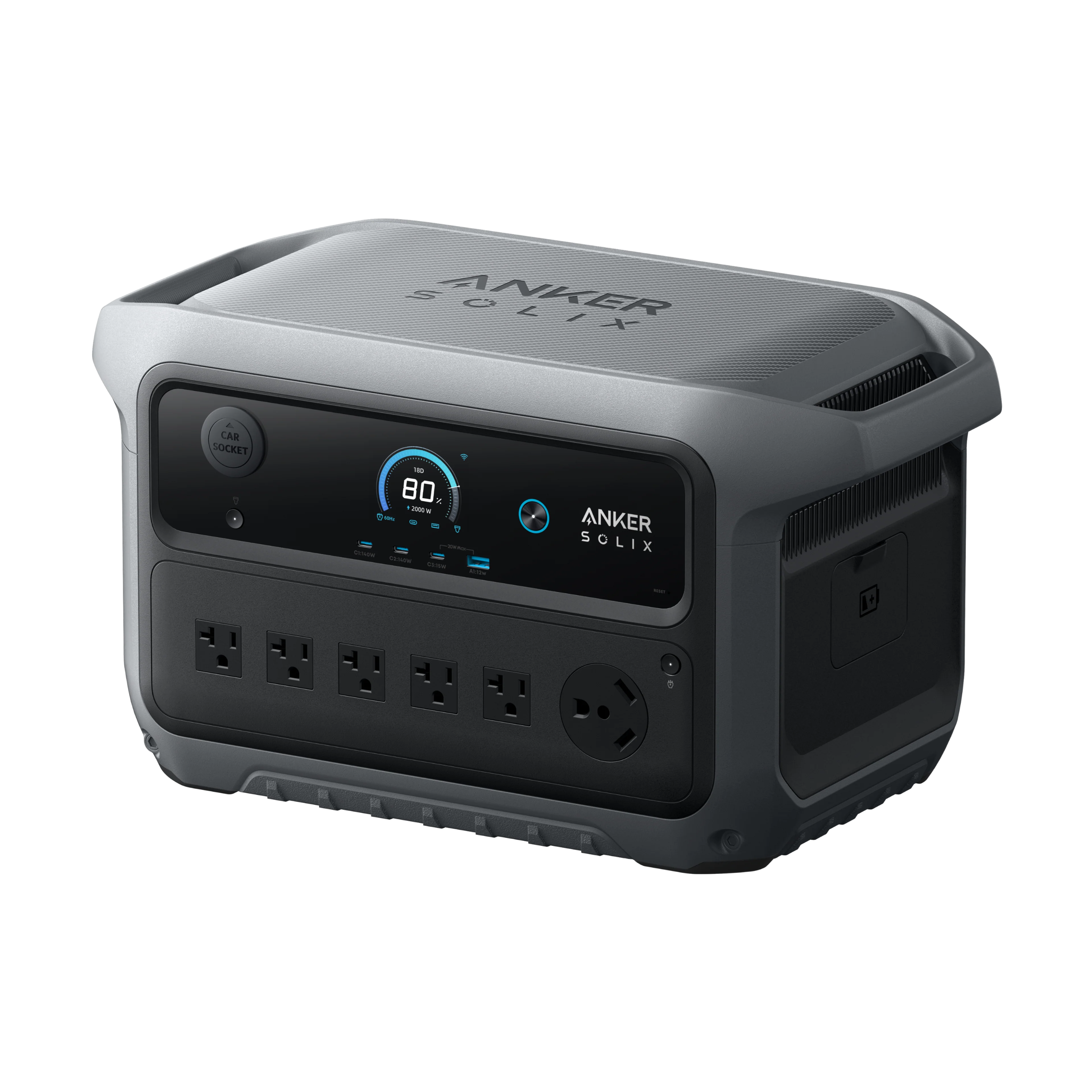
$999.99 · direct from Anker
Last checked 1 day ago. Prices move — check before you buy.
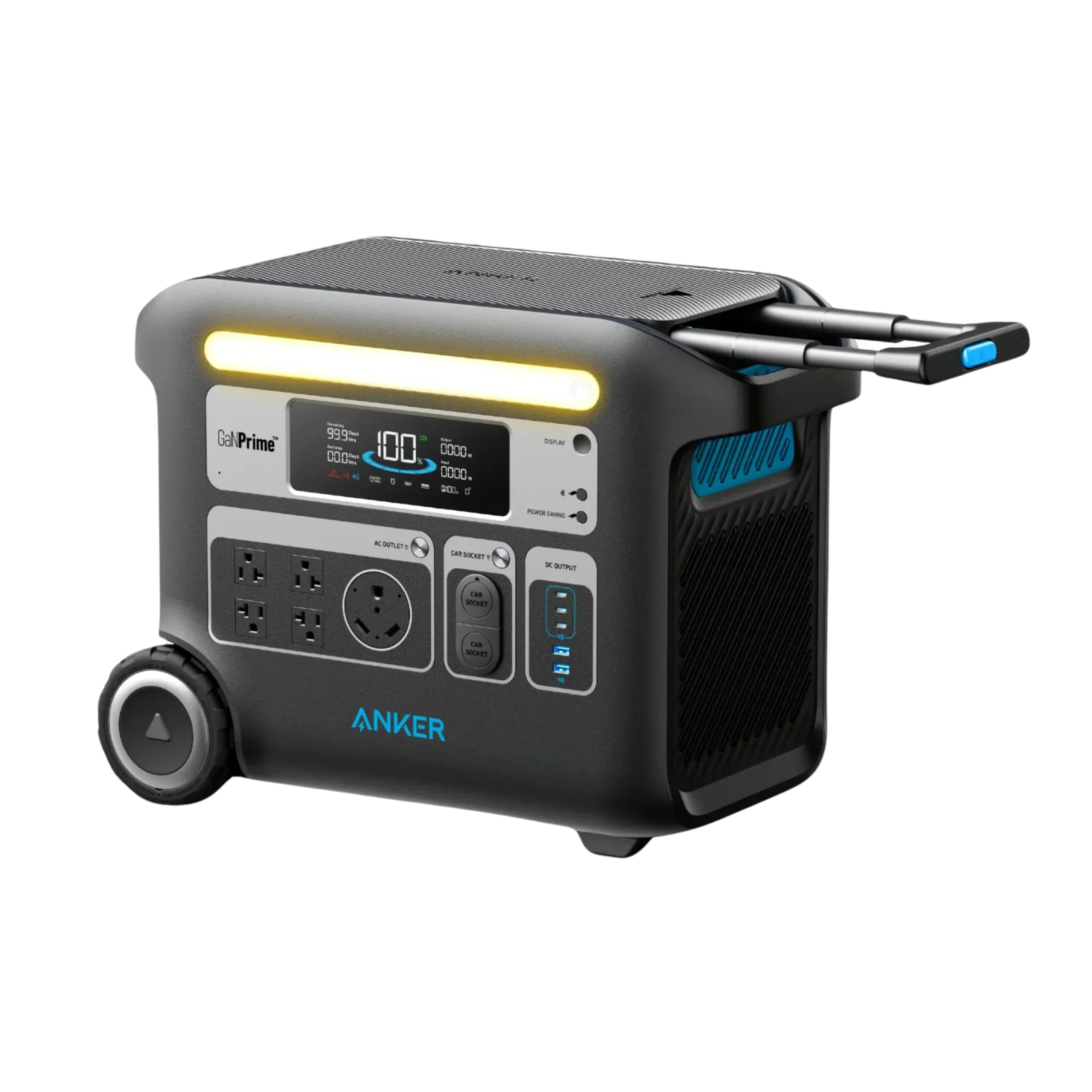
No longer sold
Anker no longer sells the SOLIX F2000 (PowerHouse 767). Its natural replacement is the SOLIX C2000 Gen 2 — the same 2,048Wh capacity and 2,400W output in a newer design.
SOLIX C2000 Gen 2 · $999.99Spec deltas
These are the same battery. Both hold 2,048Wh, both run 2,400W continuous, both carry a five-year warranty, and both accept Anker expansion batteries. Every scenario on this page resolves to the identical percentage for both units, because the energy in the box is identical. So the question was never what they can power.
The C2000 Gen 2 asks $1,000 and gives you 4,000 charge cycles, 41.7 lbs, 4,000W of surge and a 30 dBA rating on the spec sheet. The F2000 asks $900 and gives you 3,000 cycles, 67.2 lbs, 2,800W of surge and no published noise figure. One of those lists is worth a hundred dollars more than the other, and it isn't the one with the lower price.
The F2000 does have a real answer, and it isn't the sticker. It rolls on wheels with a retractable handle, and reviewers repeatedly name those as the reason they chose it over similar-spec competitorsB1. At 67.2 lbs that's less a feature than a necessity, but on a driveway or an RV pad it genuinely works. Everywhere the ground isn't flat, 41.7 lbs is the feature.
What the Numbers Reveal
Each conclusion stated first — the numbers behind it on one line, the full analysis below.
rated cycles
The hundred dollars between them buys those 2,048 kWh, so the upgrade prices out at roughly five cents a kilowatt-hour ($100 divided by 2,048 kWh). Across the full lifespan the C2000 Gen 2 lands at $0.12 per kWh and the F2000 at $0.15. The cheaper sticker is the more expensive battery.
C2000 Gen 2: 4,000 cycles, $1,000F2000: 3,000 cycles, $900Both packs: 2,048Wh
Why it mattersIf you'll cycle this thing more than a handful of times a year, pay the hundred. If it sits charged in a closet waiting for one storm a decade, cycle life never sends you a bill and the discount is real money.
weight
Wheels are excellent on a driveway, an RV pad, a campground road. They do nothing on basement stairs, over a tailgate, or lifting into a trunk, which is where 67.2 lbs becomes a job you recruit help for and 41.7 lbs stays a job you just do. The F2000 solves horizontal distance. The C2000 Gen 2 solves vertical distance, and vertical is the part that hurts.
F2000: 67.2 lbsC2000 Gen 2: 41.7 lbsReviewers cite the F2000's wheels and retractable handle as the top reason they chose itB1
Why it mattersIf the unit rolls from garage to patio and back, weigh the wheels seriously. If it ever goes up, down, or into anything, take the lighter box.
Fridge and freezer compressors spike hard for the half second the motor starts, well past their running draw, and that spike lands on top of whatever else is already plugged in. With 400W of margin the F2000 has to be managed: one appliance at a time, kettle off before the compressor cycles. With 1,600W it mostly manages itself.
Both rated 2,400W continuousC2000 Gen 2 surge: 4,000WF2000 surge: 2,800W
Why it mattersIf one unit is carrying the fridge plus whatever else the household reaches for during an outage, surge headroom is the spec that decides whether the inverter rides it out or trips.
solar input
Half an hour, and only on the perfect day where panels actually hit their rating, which they don't. Derate both sides for real sun and the absolute gap widens a little while the ranking never moves. You'd be trading half an hour of charging speed for everything the C2000 Gen 2 wins on.
F2000 solar input: 1,000WC2000 Gen 2 solar input: 800WBoth packs: 2,048Wh
Why it mattersSolar-first buyers shouldn't let the 1,000W headline settle this. If input speed is genuinely your constraint, that's an argument for more panels, not for this unit.
The specific dimensions that decide these two units — everything else is a tie.
Lifetime Value
Selected because: the $100 sticker gap and the 1,000-cycle gap point in opposite directions, and only one of them is the price you actually pay.
cost / lifetime kWh
Spread across the warranty, the F2000 costs $180 a year and the C2000 Gen 2 costs $200, and that is the last place the F2000 looks like the cheaper unit. Push past the warranty into what the cells will actually deliver and the ranking inverts. Cycled daily, the C2000 Gen 2's pack has about 11 years in it against 8.2 for the F2000. Nearly three extra years, on identical capacity, for a hundred dollars.
The honest counterweight: cycle life only bills the people who spend the cycles. A unit that lives charged in a closet and gets deployed twice a year will never see the far end of 3,000, and for that buyer the C2000 Gen 2's endurance is a number on a page while the F2000's discount is money in a pocket. Everyone who actually runs the thing lands on the other side of that line.
Portability & Form Factor
Selected because: 67.2 lbs against 41.7 lbs is the difference you live with every single time the unit moves.
weight
67.2 lbs is past the point where you pick something up without thinking about your back, and Anker clearly knew it. The F2000 rolls on wheels with a retractable handle, which reviewers name over and over as the reason they bought itB1. On a driveway, a campground loop or an RV pad, it's the better-designed unit and there's no argument to have.
The argument starts the moment the ground stops being flat. Wheels don't climb stairs, don't clear a tailgate, and don't help you lift anything over a trunk lip. Reviewers also flag how much weight the Gen 2 shed against the model it replacedA5, and the 25.5 lbs between it and the F2000 is what you feel every time the unit changes floors. Buy the wheels if your terrain is horizontal. Buy the lighter box if it's ever vertical.
What the Specs Don't Tell You
Selected because: identical 2,400W ratings hide a 4,000W-versus-2,800W surge gap and one missing noise spec.
rated cycles
Both units advertise 2,400W and then behave differently the instant a motor starts. That's the surge gap doing the work, and it's the least visible line on the spec table with the largest consequence in an actual blackout. The switchover figures matter far less than they look: 10ms against 20ms is double on paper, but both sit inside the window a desktop PC or a router rides through without noticing. Treat it as a tiebreak, not a reason.
The noise line is the one worth pausing on. Anker publishes 30 dBA for the C2000 Gen 2 and publishes nothing for the F2000. Reviewers describe the C2000 Gen 2 as working largely silently, with the fans reaching only about 35 dB a meter away under heavy load and staying quieter than any other high-output Anker station they had testedA1. The F2000 gets described as usually quiet on typical RV loadsB3. One of those is a measurement you can hold Anker to. The other is an impression.
Your Life, Your Pick
Selected because: both units carry the same 2,048Wh, so every scenario lands identically and the decision has to come from somewhere else.
Every row resolves to the same number for both units, which is the most useful thing this section has to say. 2,048Wh is 2,048Wh, and no amount of inverter difference changes how long the energy lasts. The blackout row is the one to read closely: 1,645Wh of demand consumes 94% of what either unit can actually deliver, so both pass on paper with nothing spare. Plan on the fridge and the essentials, not the fridge and everything else.
The two failures are shared as well. A camping weekend wants 2,100Wh and a day of van living wants 4,685Wh, which work out to 121% and 269% of deliverable capacity for both units. Both accept Anker expansion batteries, so both have the identical escape route, which means the expansion checkbox settles nothing here. It's a reason to budget for a second battery, not a reason to pick one of these over the other.
Strengths & trade-offs
Anker SOLIX C2000 Gen 2
Strengths
- +Lighter by 25.5 lb
- +Rated for 4,000 charge cycles — much longer battery lifespan
Trade-offs
- –No major technical downsides compared to rival.
Anker SOLIX F2000
Strengths
- +Costs $100 less
- +Faster solar charging
Trade-offs
- –Significantly heavier (+25.5 lbs), making it harder to move.
- –Shorter-lived battery — rated for 3,000 charge cycles vs the SOLIX C2000 Gen 2's 4,000, so it wears out sooner.
Will It Power Your Gear?
Scenario math and per-appliance runtimes, modeled from the spec record.
Scenario verdicts
We ran the math on six real-world scenarios. Here's which unit survives your actual life.
SCN-01 · 2 nights · needs 2,100Wh
Weekend Camping
Two nights off-grid with essential comfort
Neither unit
Neither, and for the same reason. A weekend wants 2,100Wh, which is 121% of what either unit can actually deliver, so both run out before Sunday on identical 2,048Wh packs. If you go anyway, the F2000's 1,000W solar input refills a little quicker than the C2000 Gen 2's 800W, but the real fix is an expansion battery rather than a different box.
Battery budget usedlower = more headroom
LOAD Phone Charger 15W×6h · LED Lights 40W×8h · Box Fan 75W×14h · CPAP Machine 40W×16h
SCN-02 · 8 hours · needs 1,645Wh
8-Hour Blackout
Keep the essentials running through a night without power
Either unit
Both clear it, with nothing left over. 1,645Wh of demand eats 94% of what either unit delivers, so this is a pass on paper and a squeeze in the kitchen. Break the tie on surge: 4,000W against 2,800W is what matters when the fridge compressor kicks in with the coffee maker already going.
Battery budget usedlower = more headroom
LOAD Fridge 150W×8h · Router + Modem 20W×8h · LED Lights (4 bulbs) 40W×6h · Phone Charger 15W×3h
SCN-03 · 8 hours · needs 320Wh
CPAP Overnight
Sleep therapy without interruption — the #1 medical use case
Either unit
Both, comfortably. A night of CPAP is 320Wh, about 18% of what either unit delivers, so capacity isn't the question here. What's a couple of feet from your head at 3 a.m. is. Anker publishes 30 dBA for the C2000 Gen 2 and publishes nothing for the F2000, and at this load you'd rather have the number than the benefit of the doubt.
Battery budget usedlower = more headroom
LOAD CPAP Machine 40W×8h
SCN-04 · 8 hours · needs 910Wh
Remote Workday
Full work day off-grid without power anxiety
Either unit
Both power your workstation all day without strain. At these utilization levels the real difference is USB-C for direct laptop charging — 140W on the SOLIX C2000 Gen 2 against 100W — which beats the inverter for convenience and wastes less energy.
Battery budget usedlower = more headroom
LOAD Laptop 60W×8h · External Monitor 30W×8h · Router + Modem 20W×8h · Phone Charger 15W×2h
SCN-05 · 4 hours · needs 670Wh
Tailgate Party
Game day power for the crew
Either unit
Both handle game day easily. Since capacity isn't the deciding factor, weight is: at 41.7 lbs the SOLIX C2000 Gen 2 is the one you'll be glad you brought. Fan noise under load is worth a listen too — it's audible in the lulls between songs.
Battery budget usedlower = more headroom
LOAD Blender 400W×0.5h · LED TV (55") 80W×4h · Bluetooth Speaker 15W×4h · Phone Charger (×3) 45W×2h
SCN-06 · 24 hours · needs 4,685Wh
Van Life Daily
A full day of mobile living — the ultimate endurance test
Neither unit
Neither, and not narrowly. A full day of van living wants 4,685Wh, which is 269% of what either unit delivers. You'd be recharging twice a day and still coming up short. This is a two-unit problem or an expansion-battery problem, not a choice between these two.
Battery budget usedlower = more headroom
LOAD Mini-Fridge 150W×24h · Laptop 60W×4h · Phone Charger 15W×3h · LED Lights 40W×5h · Fan 75W×8h
The Load Test
RUNTIME = (Wh × 0.85) ÷ LOAD
None of the scenarios above exactly yours? Build it. Toggle what you'd plug in; both units are tested against the combined draw.
Essentials
Comfort & Convenience
High-Draw Appliances
Test duration
8h
Continuous draw
205W
Projected runtime
Dead heat — both run this 205W load for roughly 8.5h. Pick on price, weight, or ports.
Modeled from the spec record — same math as the tables below. Methodology
Runtime by appliance
Real-world runtime estimates for common appliances, modeled at 85% inverter efficiency.¹
Essentials
The basics you need runningscale 0–116.1hComfort & Convenience
Makes off-grid life actually enjoyablescale 0–23.2hHigh-Draw Appliances
These reveal the real limitsscale 0–1.7h¹ Runtime = (capacity × 0.85) ÷ appliance watts. Within each group, all bars share one time scale (the group's longest runtime), so lengths are comparable across appliances; identical runtimes collapse into a single blue/orange bar. Actual runtime varies with battery age, temperature, and simultaneous loads — see methodology.
Conclusion
August 9, 2026
Verdict: the Anker SOLIX C2000 Gen 2
Buy the C2000 Gen 2 at $1,000. It's the same 2,048Wh battery behind the same 2,400W inverter as the $900 F2000, so nothing about what these two can run is in dispute. Everything wrapped around the cells is: 4,000 cycles against 3,000, 41.7 lbs against 67.2, 4,000W of surge against 2,800W, 140W of USB-C against 100W, and a published 30 dBA noise rating against no published figure at all. The extra hundred dollars buys 2,048 more kilowatt-hours of lifetime energy, which prices the upgrade at about five cents a kilowatt-hour. The F2000 earns its discount in exactly one place: it rolls, and reviewers name the wheels and the retractable handle as the reason they picked it over similar-spec rivalsB1. If your unit lives on flat ground and never meets a staircase, that's a fair trade. Everywhere else the cheaper box is the more expensive one.
Editor-assigned confidence, based on cited owner research and spec analysis.
List prices as of August 9, 2026. The links below open Anker's current price.
$999.99 · direct from Anker
Last checked 1 day ago. Prices move — check before you buy.
or check the SOLIX F2000 price$899.99 list
Written by Gunner Gustafson, Whole-Home Backup Tester · Station Arena Test Desk · Updated August 9, 2026
Measured Data
Benchmark scores and the full spec record, side by side.
Benchmark scores
Not rated for both units (minimum threshold unmet): CPAP, Camping.
Full specifications
ᵈ Derived: price ÷ rated capacity. See the data behind our comparisons →
Comparison ToolAdd more power stations, side by sideOpen Tool →How these numbers are produced
Numeric verification
Every figure on this page traces to our spec database or arithmetic on it — no estimated numbers.
Owner claims
Statements about owner experience are cited to published reviews — see Sources & Research Notes below.
Runtime model
Runtime = (rated capacity × 0.85 inverter efficiency) ÷ device wattage. Solar recharge estimates assume panels deliver 70% of rated output. Cold weather, battery age, and stacked loads reduce real-world results.
Power Score
Computed from 14 published spec dimensions, weighted per use-case bench. Higher is better; a unit must meet a bench's minimum threshold to be rated.
See the full weight table and data sourcing on our methodology page →Class ranking (the star rating)
Each unit's star score is a category ranking, not customer reviews — no buyer opinions feed it. We score every station on size-independent quality (value, output, portability, endurance, ports, warranty, and more), then percentile-rank it against the other units in its capacity class, so a class-leading compact unit and a class-leading whole-home unit can both earn 5★. Here, SOLIX C2000 Gen 2 rates 4.1/5 (48th percentile of 26 Large-class units), and SOLIX F2000 rates 3.7/5 (24th percentile of 26 Large-class units).
How the class ranking is computed →Test Notes & Caveats
Hidden gotchas and advantages we spotted that you won't find on the product page.
25.5 lbs Is Where the Ground Stops Being Flat
67.2 lbs against 41.7 lbs lands right on the line between a one-person lift and a two-person one. At 67.2 lbs the F2000 is something you plan a route for before you pick it up. At 41.7 lbs the C2000 Gen 2 is something you grab on the way past. Neither number changes what the unit powers; both change how often it actually leaves the garage.
1,600W of Headroom Against 400W
Both units run 2,400W continuous, which makes the spec table look matched. Surge is where they separate: 4,000W on the C2000 Gen 2 leaves 1,600W of room above rated output, while the F2000's 2,800W leaves 400W. Compressors, pumps and power tools spike hard for the instant they start, and that margin decides whether the inverter carries the spike or cuts out mid-load.
10ms Against 20ms: A Tiebreak, Not a Reason
The C2000 Gen 2 hands over in 10ms and the F2000 in 20ms. Double on paper, but both sit inside the gap a desktop power supply or a router rides through without noticing, so this is a tiebreak rather than a deciding spec. If you're protecting something that genuinely cannot blink, neither of these replaces a dedicated online UPS.
Warranty: No Difference
Both units carry the same 5-year warranty, so coverage isn't a tiebreaker here.
4,000 Cycles Against 3,000, Counted in Years
Cycled once a day, 4,000 cycles is about 11 years of service and 3,000 is about 8.2. Nobody cycles daily forever, but the ratio holds at any duty: the C2000 Gen 2's pack has a third more life in it on identical 2,048Wh capacity. The counterweight is real, though. If this unit spends most of its life charged and idle waiting for an outage, you'll never spend those cycles and the F2000's lower price is straightforwardly the better deal.
One Unit Publishes a Number. One Doesn't.
Anker rates the C2000 Gen 2 at 30 dBA. There's no published figure for the F2000, which isn't evidence that it's loud, but it does mean there's nothing to hold them to. If the unit is going in a bedroom, a van, or anywhere within earshot of someone asleep, the missing spec is the spec.
Full record above — the Test Desk pick is the SOLIX C2000 Gen 2.
Check SOLIX C2000 Gen 2 price →or check the SOLIX F2000 priceOwnership Analysis
What happens after you buy — true cost of ownership, brand trust, and growth potential.
Lifetime value
Service lifeyears at one full cycle per day
Lifetime energy delivered
Cost per delivered kWh
│ warranty ends · Reaching the cycle rating means ~80% capacity remains — degraded, not dead.
Analyst note
The SOLIX F2000 is cheaper to buy, but the SOLIX C2000 Gen 2 is cheaper to own. At $0.12/kWh over its lifetime vs $0.15/kWh, the SOLIX C2000 Gen 2's higher cycle life and capacity make each dollar go further over the years.
Growth path
SOLIX C2000 Gen 2
EXPANDABLESupports Anker expansion batteries, so you can add capacity later without replacing the base unit — useful if your needs may climb past 2,048Wh.
Accepts up to 800W of solar. Suitable for a 1-2 panel setup.
Generous port selection supports complex multi-device setups.
Expansion batteries are Anker-specific. You're investing in the Anker ecosystem.
SOLIX F2000
EXPANDABLESupports Anker expansion batteries, so you can add capacity later without replacing the base unit — useful if your needs may climb past 2,048Wh.
Accepts up to 1,000W of solar. Enough for a serious multi-panel array.
Generous port selection supports complex multi-device setups.
Expansion batteries are Anker-specific. You're investing in the Anker ecosystem.
Realistic full solar rechargeat 70% of rated panel output — see methodology
Analyst note
Both expand, so neither locks you out of growth — decide on capacity, price, and the rest, not the expansion checkbox.
What Owners Report
Patterns from published owner reports and long-term reviews — every claim cited to its source below.
Anker SOLIX C2000 Gen 2
The C2000 Gen 2's field record is short and unusually clean. Reviewers describe it as working largely silently, with fans climbing only to roughly 35 dB at a meter under high load, quieter than any other powerful Anker station they'd testedA1. The rest of the sentiment runs the same direction: plug it in and it works, no firmware ritual, no odd voltage behavior, rapid charging, build quality that matches the moneyA2. The Solix app earns credit for genuinely useful monitoring over Bluetooth or Wi-FiA3, one review called it among the most attractive 2kWh stations on the market with few points of criticismA4, and the weight it shed against the model it replaced comes up repeatedlyA5.
The caveat is what that record isn't. It's hands-on review coverage rather than long-term ownership, and nothing here comes from someone who has lived with the unit for six months or moreA1A2A4. Treat the durability picture as the 4,000-cycle rating plus a five-year warranty, not as proven history.
“Even at full power it's far quieter than any other powerful Anker station tested — the fans never rise above a subdued, easily-backgrounded whirr, working largely silently and only occasionally reaching a pleasantly quiet ~35 dB at 1 m under high load.”
Sources
notebookcheck.net · thesolarlab.com · trustedreviews.com · androidguys.com
Anker SOLIX F2000
Owners keep coming back to the wheels. The durable wheels and the retractable EasyTow handle get named again and again as the reason people chose the F2000 over similar-spec competitors, in spite of it being big and full of heavy batteriesB1. For the loads RVers actually run, fridge, CPAP, lights, fans, internet and a TV, it's described as quiet, capable and quick to deployB3. The app draws praise on this side too, and a meaningful number of owners report Anker proactively resolving problems with firmware updates or outright replacementsB2.
The LFP pack gets cited for the same reliability as the rest of the Anker line, rated past 3,000 cyclesB4, which is accurate and also the whole point: 3,000 is where the F2000 stops and the C2000 Gen 2 keeps going. Worth knowing that a chunk of this coverage leans on Anker's own materialsB2B4, so the wheels praise, which shows up independently across reviewsB1B3, is the part of the record to weight most heavily.
“It's big and full of heavy batteries, but the durable 4.72-inch wheels and retractable EasyTow handle make it surprisingly easy to lug around — most positive reviews cite the wheels and telescoping handle as a top reason owners chose it over similar-spec competitors.”
Sources
rvoutfitting.com · trustedreviews.com · ankersolix.com · storagereview.com · generatorpeak.com
Sources & Research Notes
Every owner claim in this report is traceable to a published source. The bracketed references above resolve here.
Recurring owner themes
- Reviewers consistently praise quiet operation, fast charging, premium build, and no-fuss plug-and-play simplicity. [SOLIX C2000 Gen 2 · 3 entries]
- The wheels + retractable handle are the standout, repeatedly-cited reason owners pick the F2000; app monitoring and responsive Anker support are also praised. [SOLIX F2000 · 2 entries]
- A1
“Even at full power it's far quieter than any other powerful Anker station tested — the fans never rise above a subdued, easily-backgrounded whirr, working largely silently and only occasionally reaching a pleasantly quiet ~35 dB at 1 m under high load.”
notebookcheck.net / thesolarlab.com — Anker SOLIX C2000 Gen 2 review · 2026 · [positive]
- A2
“Really simple to use — no need to download firmware or deal with weird voltage drops; you just turn it on, plug in, and go. Rapid charging and premium build.”
trustedreviews.com / thesolarlab.com — Anker SOLIX C2000 Gen 2 review · 2026 · [positive]
- A3
“The Anker Solix app is a good way to monitor the station during charging and use over Bluetooth or Wi-Fi; reviewers appreciated the monitoring functionality.”
androidguys.com — Anker SOLIX C2000 Gen 2 review · 2026 · [positive]
- A4
“Delivers a convincing performance with few points of criticism — undoubtedly one of the most attractive 2 kWh power stations on the market.”
notebookcheck.net — Anker SOLIX C2000 Gen 2 review · 2026 · [positive]
- A5
“Substantially lighter than its predecessor — the Gen 2 shed a large amount of weight versus the original C2000, making it notably easier to carry for its capacity.”
notebookcheck.net — '11.6 kg lighter than its predecessor' review · 2026 · [positive]
- B1
“It's big and full of heavy batteries, but the durable 4.72-inch wheels and retractable EasyTow handle make it surprisingly easy to lug around — most positive reviews cite the wheels and telescoping handle as a top reason owners chose it over similar-spec competitors.”
rvoutfitting.com / trustedreviews.com — Anker SOLIX F2000 (PowerHouse 767) review · 2025-2026 · [positive]
- B2
“WiFi and Bluetooth app lets you monitor battery, charging, and customize power usage; a meaningful number of owners reported Anker proactively solving issues with firmware updates or replacements.”
ankersolix.com / storagereview.com — F2000 review · 2025-2026 · [positive]
- B3
“For the loads RVers run most — fridge, CPAP, lights, fans, internet, TV, small kitchen appliances — the F2000 is usually quiet, capable, and easy to deploy fast.”
rvoutfitting.com — Anker SOLIX F2000 review · 2026 · [positive]
- B4
“Uses the same long-lasting LFP battery reliability as Anker's other models, rated over 3,000 cycles for years of off-grid or backup use.”
trustedreviews.com / generatorpeak.com — F2000 review · 2025-2026 · [positive]
Research compiled August 9, 2026.
What Owners Actually Report
Drawn from 20 comments on independent review channels — not from retailer reviews, which skew to the first week of ownership. Each line is our summary of one commenter's claim, linked to the original. We record what they said, including where it contradicts the spec sheet.
Anker SOLIX C2000 Gen 2
15 claims from 8 comments · 11 from owners · 4 with figures
- Expandability
- 2 · 0% negative
- Size & weight
- 1 · 0% negative
- Price & value
- 3 · 0% negative
- Idle drain
- 2 · 0% negative
- App & firmware
- 1 · 0% negative
What owners complain about
Says the 800W max claim is limited by a 60V, 17A window, so real peak input is well under the rating.
Solar input2 agreedsource →
What owners praise
Anker SOLIX F2000
21 claims from 12 comments · 13 from owners · 3 with figures
- Price & value
- 6 · 10% negative
- Runtime
- 1 · 0% negative
- Solar input
- 3 · 100% negative
- Noise
- 2 · 0% negative
- Inverter & surge
- 1 · 0% negative
What owners complain about
The 60V solar charging limit is the main bummer holding it back.
Solar inputowner3 agreedsource →
Reconnecting grid power briefly shut down all AC outputs, so he returned it.
UPS switchoverowner1 agreedsource →
His two-year-old SOLIX F2000 died last week and cannot be owner-diagnosed or repaired.
Durabilityownerafter 24 months1 agreedsource →
What owners praise
Ordered the F2000 with three 400W panels, each piece over 30% off on Black Friday.
Price & valuemeasuredowner5 agreedsource →
With the expansion battery it ran a small fan for two days and powers a gaming setup 8-10 hours.
Runtimemeasuredowner3 agreedsource →
Runs anything in the 1-2400W range with roughly 3000W surge.
Inverter & surgeowner3 agreedsource →
Claims are weighted by how specific they are, whether the commenter owns the unit, and how many readers agreed. Comments that mention a product under a rival's review count for more, because the commenter had no reason to be there. This is what buyers report, not our test results — for measurements we ran ourselves, see the methodology.
Who Should Buy Which
Buy the SOLIX C2000 Gen 2 if you…
- →You'll cycle it weekly or more. Regular use is what converts 4,000 cycles into money, and at that duty cycle the C2000 Gen 2 is the cheaper box the moment you count energy instead of sticker.
- →The unit moves between floors, into a trunk, or over a tailgate. 41.7 lbs is a lift you make without recruiting anyone or planning a route.
- →You're covering a fridge plus whatever else the house plugs in during an outage. 1,600W of surge headroom above the rated 2,400W is the margin that keeps the inverter running when the compressor kicks in.
- →You're sleeping within arm's reach of it. Anker publishes 30 dBA for this unit and reviewers back that upA1; the F2000 has no published figure to check against.
- →You charge a 140W-class laptop over USB-C and would rather not carry a second brick to do it.
Buy the SOLIX F2000 if you…
- →The unit lives on flat ground, garage to patio to driveway, and gets towed rather than lifted. The wheels and handle are the reason owners pick it, and on that terrain they earn every dollarB1.
- →It's effectively an RV house battery, running fridge, CPAP, lights, fans and a TV, which reviewers describe it handling quietly and setting up fast forB3.
- →You want the lowest price on 2,048Wh of LFP with a five-year warranty and you'll deploy it a few times a year. At that duty cycle you'll never reach the far end of 3,000 cycles, and the $100 stays in your pocket.
This is you — check the SOLIX F2000 price
If neither fits
Close the tab if your actual list is a full weekend of camping (2,100Wh) or a day of van living (4,685Wh). Those are 121% and 269% of what either unit delivers, and hoping to squeak by is how people end up making coffee on a dead battery. Either buy into a larger class of unit up front, or budget for an expansion battery from day one, since both of these take one and neither has an advantage there.
The Bottom Line
Take the C2000 Gen 2. The two units hold the same energy behind the same inverter under the same warranty, so the decision runs entirely on what surrounds the cells, and that's a sweep: a thousand more charge cycles, 25.5 fewer pounds, 1,200W more surge, 40W more USB-C, and a published noise figure instead of silence on the subject. The $100 the F2000 saves you costs 2,048 kilowatt-hours of lifetime energy, which is about five cents a kilowatt-hour to give away.
The F2000 keeps one honest claim and it's a good one: it rolls, and the people who bought it say the wheels are exactly whyB1. If your unit's whole life is garage to patio and back a few times a year, buy it and enjoy never lifting anything. For everyone whose unit goes up a staircase, into a truck bed, or through 4,000 cycles, the extra hundred is the cheapest thing on this page.
Frequently Asked Questions
Answers drawn from the spec record and cited owner research.
Is the C2000 Gen 2 worth $100 more than the F2000?
Yes, if you're going to use it. Same 2,048Wh and the same 2,400W inverter on both, but the C2000 Gen 2 is rated for 4,000 cycles against 3,000, which is 2,048 kWh more energy over the pack's life for that $100. It also weighs 25.5 lbs less and surges to 4,000W instead of 2,800W. The one case where the F2000's discount genuinely wins is low-duty backup, where you'll never reach the cycle limit anyway.
Which one is easier to move around?
Terrain decides it. The F2000 is 67.2 lbs but rolls on wheels with a telescoping handle, which reviewers cite as the top reason they bought it. The C2000 Gen 2 is 41.7 lbs and you just pick it up. Flat ground favors the F2000; stairs, trunks and tailgates favor the C2000 Gen 2, because wheels don't climb.
Can either one run a refrigerator through a blackout?
Both will, and the C2000 Gen 2 has more margin doing it. They're both rated 2,400W continuous, but surge tops out at 4,000W on the C2000 Gen 2 against 2,800W on the F2000, and a compressor's startup spike is what actually trips inverters. In an eight-hour blackout profile, 1,645Wh of demand uses 94% of what either unit can deliver, so budget for the fridge and the essentials rather than the fridge and everything else.
Which charges faster from solar?
The F2000, by roughly half an hour. It accepts 1,000W of solar input against the C2000 Gen 2's 800W, so a full 2,048Wh refill takes about 2 hours at full input versus about 2.5. Real panels rarely hit their rating, so both figures stretch in practice. Half an hour isn't a reason to accept 25.5 more pounds and 1,000 fewer cycles.
Do either of these work as a UPS for a computer?
Both do. The C2000 Gen 2 switches over in 10ms and the F2000 in 20ms, and desktop power supplies and network gear ride through gaps in that range without dropping. Use it as a tiebreak, not a deciding spec. If you're protecting something that genuinely cannot blink, buy a dedicated online UPS rather than choosing between these two on switchover time.
Where to buy
Anker SOLIX C2000 Gen 2Pick
$999.99
$999.99 · direct from Anker
Last checked 1 day ago. Prices move — check before you buy.
Anker SOLIX F2000
$899.99
$899.99 · direct from Anker
Last checked 50 days ago. Prices move — check before you buy.
Prices may vary by retailer and are subject to change.