Head-to-head test
EcoFlow DELTA 3 Max vs Anker SOLIX S2000
The DELTA 3 Max's surge advantage is its output advantage printed a second time, and against that the SOLIX S2000 puts up a lower price, 15 fewer pounds and two and a half times the cycle life.
Full profiles: EcoFlow DELTA 3 Max → · Anker SOLIX S2000 →

Written by Gunner GustafsonUpdated
Whole-Home Backup Tester, Station Arena Test Desk
Spec deltas
The SOLIX S2000 costs less, weighs 15 lbs less, and is rated for two and a half times as many cycles as the DELTA 3 Max on a battery within 38.4Wh of the same size. That's the page. Everything EcoFlow has to say in reply comes down to one number: 2,400W of continuous output where the Anker gives you 1,500W.
The surge columns look like a second argument and aren't. EcoFlow publishes 4,800W peak on a 2,400W inverter; Anker publishes 3,000W on a 1,500W one. Both figures are exactly double their own unit's rated output, so the 1,800W gap between the peaks is the 900W gap between the inverters told twice. There is one output difference on this page, and it's the smaller of those two numbers.
So buy the S2000 unless you can name the thing you plan to plug in that pulls more than 1,500W, or you already suspect 2kWh isn't the end of it. The DELTA is the only one of the two that takes an expansion battery, and that's a real card rather than a consolation. It just isn't a card most of these buyers ever play.
What the Numbers Reveal
Each conclusion stated first — the numbers behind it on one line, the full analysis below.
continuous output
That collapses the surge column into decoration for this pair. The biggest startup draw anywhere on the page is the 400W tailgate, and the Anker's peak sits seven and a half times above it, so nothing on this page is decided by peak headroom. Whatever you conclude about output has to come from the continuous rating, and that's 2,400W against 1,500W: a real 900W, and the only version of this difference worth paying for.
DELTA 3 Max: 2,400W rated output, 4,800W published peakSOLIX S2000: 1,500W rated output, 3,000W published peakAcross all six load profiles on this page the largest startup draw is 400W, and both units are computed to start and sustain every one of them
Why it mattersIf you came looking for the unit that starts what the other one stalls on, neither of these is that unit. Ask instead whether anything on your list draws more than 1,500W while it runs.
rated cycles
The limit on that is who actually cycles a pack daily. At two discharges a week the DELTA is rated for 38 years, well past the point where the number means anything, so for a weekend camper the longevity gap is free and irrelevant. It's the van, the boat and the off-grid cabin that drain a battery every night, and that buyer would be starting their third DELTA before the Anker reached its rated limit.
SOLIX S2000: 10,000 cycles on 2,009.6Wh, or 20,096 kWh of rated throughputDELTA 3 Max: 4,000 cycles on 2,048Wh, or 8,192 kWhAt daily cycling that's 27.4 years against 11; at two cycles a week it's 96 years against 38
Why it mattersDaily cyclers have their answer in this row alone. Weekend and blackout buyers can ignore the cycle column entirely and decide on price and weight, which land on the Anker anyway.
That's the honest case for spending more on the DELTA, and it's narrower than it looks. A 359Wh camping miss is closed by leaving one high-draw item at home, or by a panel and a sunny afternoon. A 2,944Wh daily miss is closed by more battery and nothing else. So expansion earns its premium for the buyer whose deficit runs to thousands of watt-hours, and stays a port you never open for the buyer whose worst night is the 8-hour blackout both units already pass.
The DELTA 3 Max accepts EcoFlow expansion batteries; the SOLIX S2000 is sealed at 2,009.6WhVan Life Daily asks 4,685Wh a day and neither unit covers it: the DELTA is 2,944Wh short, the Anker 2,977WhWeekend Camping asks 2,100Wh and both miss, by 359Wh and 392Wh against the flat 85% usable derate
Why it mattersBuy the DELTA if you can already name the load that breaks 2kWh and intend to add a battery for it. Otherwise expansion is a line on the invoice, not a feature.
The specific dimensions that decide these two units — everything else is a tie.
Lifetime Value
Selected because: 10,000 cycles against 4,000 on batteries within 38.4Wh of each other, and the cheaper unit is the one holding the bigger number.
cost / lifetime kWh
Three cents a kilowatt-hour against eleven. That's $700 spread over 20,096 kWh of rated throughput on one side and $899 over 8,192 kWh on the other, and it is the widest real gap on this page. Read it once and you have it.
The honest limit on that math is how long anyone keeps one of these. At two cycles a week the DELTA is rated for 38 years, which is longer than you'll own a power station, so for a weekend buyer the longevity gap never gets a vote. It doesn't need one. The S2000 is also the cheaper unit up front, by $199. The cycle rating is the reason a daily cycler should stop looking, not the reason everyone else should.
Growth Path
Selected because: Expansion is the DELTA 3 Max's one unmatched card, and the two scenarios neither unit covers are the only place it cashes.
solar input
Sealed at 2,009.6Wh means exactly what it says, and the S2000 is a finished unit rather than a starter kit. The DELTA 3 Max begins 38.4Wh higher and, unlike the Anker, has somewhere to go from there: EcoFlow expansion batteries push it toward partial-home backup, which is a different product than either of these is out of the box.
Where that actually lands is the Van Life row. A 4,685Wh day leaves the DELTA 2,944Wh short and the Anker 2,977Wh short, and the 33Wh between them is rounding. Nothing except more battery fixes a deficit that size, and only one of these takes more battery. If that's your list, the price gap stops being the story.
Portability & Form Factor
Selected because: 15 lbs separates them, and every flight of stairs charges you that difference again.
weight
50.7 lbs is a bent-knees, both-hands, set-it-down-before-the-stairs lift. 35.7 lbs is an overloaded suitcase. That 15 lbs is the difference between a unit that lives where you first put it and one that comes along, and at this capacity nothing else on the spec sheet changes as much about how you'll use the thing.
The catch is that the Anker doesn't convert all 15 lbs into ease. Two independent hands-on reviews flagged the same problem: no dedicated grab handle for a one-hand carry, and a second handle would be welcome for stairsB7B8. So the lighter box is also the more awkward one to hold. Take the 15 lbs, but plan on both hands either way.
Your Life, Your Pick
Selected because: Six load profiles, the same two failures, and a largest startup draw of 400W that neither inverter notices.
Both units start every load in all six profiles, and the biggest startup draw among them is the 400W tailgate. That's the whole surge story for this pair: two inverters that never get asked a hard question. The rows that separate anything are the two neither unit passes.
The 8-Hour Blackout is closer to the edge than it looks. The profile wants 1,645Wh, and after the flat 85% usable derate this site applies to every unit there's 1,741Wh in the DELTA and 1,708Wh in the Anker, so you finish the night with 96Wh and 63Wh in hand. Both pass, and neither has a spare hour in it. That makes refill the interesting spec in an outage rather than capacity, and there the DELTA's 500W solar ceiling takes a quarter more panel than the Anker's 400W.
Brand Trust
Selected because: Expansion means buying into a range rather than a box, so which range it is belongs in the decision.
The expansion argument is a brand argument underneath. EcoFlow runs the deepest range in portable power, 12 to 15 models plus panels and smart home panels, and the expansion batteries the DELTA takes are part of it. Anker's SOLIX line is 7 to 8 stations plus the X1 home system, and the S2000 sits inside it as a complete product rather than a rung on a ladder.
Neither support story is a reason to switch picks. EcoFlow's is polarized, prepaid-label replacements on one side and long waits and refurbished units on the other, with nothing sold out of warranty at all. Anker's SOLIX support is drifting down from the no-hassle standard the parent brand built, with generic AI-agent responses and hazmat logistics to arrange on a heavy return. Both carry five years, so the retailer you buy from does more for you here than either warranty page.
Strengths & trade-offs
EcoFlow DELTA 3 Max
Strengths
- +Larger battery capacity
- +Higher AC output
- +Faster solar charging
Trade-offs
- –Significantly heavier (+15 lbs), making it harder to move.
- –Shorter-lived battery — rated for 4,000 charge cycles vs the SOLIX S2000's 10,000, so it wears out sooner.
Anker SOLIX S2000
Strengths
- +Costs $199 less
- +Lighter by 15 lb
- +Rated for 10,000 charge cycles — much longer battery lifespan
Trade-offs
- –Weaker inverter (-900W) limits appliance compatibility.
- –Sealed capacity — the DELTA 3 Max can add batteries to grow past 2,009.6Wh; this one can't.
Will It Power Your Gear?
Scenario math and per-appliance runtimes, modeled from the spec record.
Scenario verdicts
We ran the math on six real-world scenarios. Here's which unit survives your actual life.
SCN-01 · 2 nights · needs 2,100Wh
Weekend Camping
Two nights off-grid with essential comfort
Neither unit
Neither unit covers the 2,100Wh weekend, which is the useful thing to know before you pack. The DELTA finishes 359Wh short and the Anker 392Wh, both against the flat 85% usable derate, so you're at roughly four-fifths of the list either way. Drop one high-draw item or bring a panel and both of them make it. This isn't the row to choose on.
Battery budget usedlower = more headroom
LOAD Phone Charger 15W×6h · LED Lights 40W×8h · Box Fan 75W×14h · CPAP Machine 40W×16h
SCN-02 · 8 hours · needs 1,645Wh
8-Hour Blackout
Keep the essentials running through a night without power
Either unit
Both get through the night and neither has a spare hour. The profile wants 1,645Wh against 1,741Wh and 1,708Wh of derated usable capacity, so the margins are 96Wh and 63Wh. Both publish a switchover no worse than 10ms, a manufacturer ceiling rather than a stopwatch result. If your outages run longer than one night, the deciding spec is refill: 500W of solar input against 400W.
Battery budget usedlower = more headroom
LOAD Fridge 150W×8h · Router + Modem 20W×8h · LED Lights (4 bulbs) 40W×6h · Phone Charger 15W×3h
SCN-03 · 8 hours · needs 320Wh
CPAP Overnight
Sleep therapy without interruption — the #1 medical use case
Either unit
A CPAP night is 320Wh, and both units hold more than five times that after the derate, so capacity is settled before you start and this pair is overbuilt for the job. If the CPAP is the entire reason you're shopping, the honest answer is a smaller station. If it's one load among several, take the cheaper and lighter of these two and use the headroom on everything else.
Battery budget usedlower = more headroom
LOAD CPAP Machine 40W×8h
SCN-04 · 8 hours · needs 910Wh
Remote Workday
Full work day off-grid without power anxiety
Either unit
A 910Wh desk day leaves 831Wh in the DELTA and 798Wh in the Anker, so this row comes down to furniture rather than electricity. The DELTA gives you one more AC outlet, 6 against 5, and one more USB-A, 2 against 1. The Anker gives you 15 lbs less to move when the desk does. Take the outlets if the desk stays put, the weight if it doesn't.
Battery budget usedlower = more headroom
LOAD Laptop 60W×8h · External Monitor 30W×8h · Router + Modem 20W×8h · Phone Charger 15W×2h
SCN-05 · 4 hours · needs 670Wh
Tailgate Party
Game day power for the crew
Either unit
400W is the biggest startup draw anywhere on this page, and the Anker's peak sits seven and a half times above it, so game day never troubles either inverter. That leaves weight, and 35.7 lbs against 50.7 lbs is the difference across a parking lot at the end of the night. The Anker is the one you'll be glad you brought.
Battery budget usedlower = more headroom
LOAD Blender 400W×0.5h · LED TV (55") 80W×4h · Bluetooth Speaker 15W×4h · Phone Charger (×3) 45W×2h
SCN-06 · 24 hours · needs 4,685Wh
Van Life Daily
A full day of mobile living — the ultimate endurance test
Neither unit
This is the row where the expansion port stops being theoretical. A 4,685Wh day leaves the DELTA 2,944Wh short and the Anker 2,977Wh, and a deficit that size isn't closed by trimming loads or adding a panel. It's closed by more battery, and only the DELTA takes more battery. Neither unit is a full-time van solution as sold. One of them can become part of one.
Battery budget usedlower = more headroom
LOAD Mini-Fridge 150W×24h · Laptop 60W×4h · Phone Charger 15W×3h · LED Lights 40W×5h · Fan 75W×8h
The Load Test
RUNTIME = (Wh × 0.85) ÷ LOAD
None of the scenarios above exactly yours? Build it. Toggle what you'd plug in; both units are tested against the combined draw.
Essentials
Comfort & Convenience
High-Draw Appliances
Test duration
8h
Continuous draw
205W
Projected runtime
Dead heat — both run this 205W load for roughly 8.5h. Pick on price, weight, or ports.
Planning for more than this? Describe your whole setup and get it sized →
Modeled from the spec record — same math as the tables below. Methodology
Runtime by appliance
Real-world runtime estimates for common appliances, modeled at 85% inverter efficiency.¹
Essentials
The basics you need runningscale 0–116.1hComfort & Convenience
Makes off-grid life actually enjoyablescale 0–23.2hHigh-Draw Appliances
These reveal the real limitsscale 0–1.7h¹ Runtime = (capacity × 0.85) ÷ appliance watts. Within each group, all bars share one time scale (the group's longest runtime), so lengths are comparable across appliances; identical runtimes collapse into a single blue/orange bar. Actual runtime varies with battery age, temperature, and simultaneous loads — see methodology.
Conclusion
September 19, 2026
Verdict: the SOLIX S2000, on Power Score margin
Take the SOLIX S2000. It's the cheaper of the two, it's 15 lbs lighter, it's rated for 10,000 cycles against 4,000, and it's the higher-scoring of the two on our composite. The DELTA 3 Max's reply is 2,400W continuous against 1,500W plus an expansion port, and both of those are real. Neither shows up in any of the six load profiles this page models, where the largest startup draw is 400W and both units start and sustain every one. So the DELTA earns the premium in exactly two situations: you can name a load that pulls more than 1,500W, or you already know 2kWh isn't your ceiling. Short of those, you're paying $199 more for headroom you'll never reach.
Editor-assigned confidence, based on cited owner research and spec analysis.
List prices as of September 19, 2026. The links below open EcoFlow's and Anker's current prices.
Sold on Amazon · today’s price is on the listing
or check the DELTA 3 Max price$899.00 list
Written by Gunner Gustafson, Whole-Home Backup Tester · Station Arena Test Desk · Updated September 19, 2026
Black Friday · 38 days out
Price to beat:DELTA 3 Max $829
The lowest we have recorded. A Black Friday price above it is a sale this unit has already had.
Measured Data
Benchmark scores and the full spec record, side by side.
Benchmark scores
Not rated for both units (minimum threshold unmet): RV Living, Food Truck, Camping.
Full specifications
ᵈ Derived: price ÷ rated capacity. See the data behind our comparisons →
Comparison ToolAdd more power stations, side by sideOpen Tool →How these numbers are produced
Numeric verification
Every figure on this page traces to our spec database or arithmetic on it — no estimated numbers.
Owner claims
Statements about owner experience are cited to published reviews — see Sources & Research Notes below.
Runtime model
Runtime = (rated capacity × 0.85 inverter efficiency) ÷ device wattage. Solar recharge estimates assume panels deliver 70% of rated output. Cold weather, battery age, and stacked loads reduce real-world results.
Power Score
Computed from 14 published spec dimensions, weighted per use-case bench. Higher is better; a unit must meet a bench's minimum threshold to be rated.
See the full weight table and data sourcing on our methodology page →Class ranking (the star rating)
Each unit's star score is a category ranking, not customer reviews — no buyer opinions feed it. We score every station on size-independent quality (value, output, portability, endurance, ports, warranty, and more), then percentile-rank it against the other units in its capacity class, so a class-leading compact unit and a class-leading whole-home unit can both earn 5★. Here, DELTA 3 Max rates 4.2/5 (52nd percentile of 26 Large-class units), and SOLIX S2000 rates 5.0/5 (99th percentile of 26 Large-class units).
How the class ranking is computed →Test Notes & Caveats
Hidden gotchas and advantages we spotted that you won't find on the product page.
The S2000's ceiling is the number on the box
2,009.6Wh is what you get, permanently. That isn't a flaw in a sealed unit built to be complete, and across most of what this pair gets bought for it never bites. It bites on the daily van list, where the shortfall runs to thousands of watt-hours and the only fix is another battery. The DELTA 3 Max takes one, and at this capacity that path points toward partial-home backup rather than a slightly longer weekend.
Five years each, and the per-dollar math is a mirage
Same term, same coverage, no tiebreaker. The only reason warranty shows up on this page at all is that cover-per-dollar flatters the cheaper unit, and that spread is the price gap talking rather than the terms. The thing actually worth knowing is separate: EcoFlow sells no parts or service once the term is up.
What happens at cycle 4,001
The DELTA doesn't stop working when it reaches its rated 4,000 cycles. LFP packs fade to roughly 80% of original capacity around the rating and carry on, so read 4,000 against 10,000 as when each pack starts giving you less, not when it dies. That's the fair version of the gap, and the Anker still wins it: 27.4 years of daily cycling against 11 before the conversation even starts.
Full record above — the Test Desk pick is the SOLIX S2000.
Check SOLIX S2000 price →or check the DELTA 3 Max priceOwnership Analysis
What happens after you buy — true cost of ownership, brand trust, and growth potential.
Lifetime value
Service lifeyears at one full cycle per day
Lifetime energy delivered
Cost per delivered kWh
│ warranty ends · Reaching the cycle rating means ~80% capacity remains — degraded, not dead.
Analyst note
The SOLIX S2000 wins on both sticker price and long-term value. At $0.03/kWh over its lifetime, it's meaningfully cheaper to own. Clear value winner.
Brand trust
EcoFlow
Ecosystem
The deepest range in portable power, and the reason expansion is on the table here at all: DELTA Pro, DELTA 3 and RIVER 3 stations, panels, smart home panels, and add-on batteries that turn one box into the start of a system.
Support
US-based phone/email/chat support (1-800-368-8604). Experiences are polarized — many report hassle-free prepaid-label replacements, but others report long waits and refurbished units sent for new claims. Pro tip: buying from Costco or Amazon gives you a stronger return safety net.
Community
Largest community in the space — Reddit r/Ecoflow_community (~31K members), multiple Facebook groups, and an official community forum
App experience
Rated 4.6/5 iOS (~8,400 ratings) · 4.2/5 Android (~17,000 ratings)
Unique strength
Fastest-charging technology (X-Stream), deepest product ecosystem, and most active innovation cadence. At the top of the range sit two whole-home paths: the TITAN line, one 5 kWh unit that grows to 30 kWh, and the DELTA Pro Ultra platform, which stacks batteries and inverters further — flagship paths, not line-wide features.
Worth knowing
EcoFlow tested paywalling advanced app features in early 2025 and paused the plan after backlash, and it offers no parts or service once your warranty is up.
Anker
Ecosystem
7-8 SOLIX portable power stations across C-series (compact) and F-series (flagship), plus the X1 home energy system
Support
Anker's consumer-electronics reputation was built on no-hassle replacements, and SOLIX support is drifting from it: generic AI-agent responses, and hazmat shipping to arrange if a heavy unit has to go back.
Community
Moderate — active Reddit (r/Anker, r/AnkerSOLIXCommunity) and growing. Benefits from Anker's massive consumer electronics brand awareness.
App experience
Rated 4.5/5 iOS (~1,100 ratings) · 4.3/5 Android
Unique strength
Strong dollars per watt-hour in the mid and large sizes, and the InfiniPower cycle life that decides this page.
Worth knowing
Support quality appears to be declining from its historically excellent level. Firmware updates have removed features without warning. Expansion ecosystem is smaller than EcoFlow's.
Analyst note
You're picking a range as much as a box. EcoFlow sells the ladder, Anker sells the finished product, which is this matchup restated at brand level. Support is a wash in the unhappy direction, EcoFlow's polarized and Anker's sliding from a high base, so buy from a retailer whose returns desk you'd trust.
Growth path
DELTA 3 Max
EXPANDABLESupports EcoFlow expansion batteries, so you can add capacity later without replacing the base unit — useful if your needs may climb past 2,048Wh.
Accepts up to 500W of solar. Suitable for a 1-2 panel setup.
Adequate ports for most setups, but heavy users may want a power strip.
Expansion batteries are EcoFlow-specific. You're investing in the EcoFlow ecosystem.
SOLIX S2000
FIXED CAPACITYFixed at 2,010Wh — a sealed, complete system rather than a starting point. There's no expansion port, so that figure is the ceiling: check it against your longest unplugged stretch before you buy.
Accepts up to 400W of solar. Suitable for a 1-2 panel setup.
Adequate ports for most setups, but heavy users may want a power strip.
Realistic full solar rechargeat 70% of rated panel output — see methodology
Analyst note
The SOLIX S2000 is sealed at 2,010Wh, which is fine if that covers you. The DELTA 3 Max starts at 2,048Wh and can grow beyond it with EcoFlow expansion batteries — real headroom the SOLIX S2000 doesn't have if your needs climb toward partial-home backup.
What Owners Report
Patterns from published owner reports and long-term reviews — every claim cited to its source below.
EcoFlow DELTA 3 Max
Field evidence on the DELTA 3 Max comes from hands-on review sites rather than long-term owner threads, and some sources conflate it with the Max Plus variant, so treat line-wide claims as firmer than variant-specific figuresA0. What's there is consistent: quiet under moderate load, with an app that adds a low-power quiet mode and a custom charge-speed limit if the fans bother youA1A2. The EcoFlow app is itself cited as a main reason people migrate into the ecosystemA2.
The most useful entry is the durability one. Measured capacity held steady between a one-month and a three-month check, and the unit came through truck-bed transport, storage in a roughly 105°F garage and operation near 34°F without incidentA3. One reviewer scored it 8.5 out of 10 and called its mix of fast recharge and LFP longevity among the best value in the 2kWh classA4.
“Whisper-quiet under moderate load — essentially silent at conversational distance; the app adds a low-power quiet mode and a custom charge-speed limit if fan noise bothers you. Fans rise under heavy load but stay quieter than most competitors in the 2kWh class.”
Sources
backuppowerhub.com · thesolarlab.com · androidguys.com
Anker SOLIX S2000
The S2000 launched on June 2, 2026, so every claim about it is weeks old rather than months, and no long-term owner threads exist yetB0. Two independent hands-on tests agree on idle behaviour: silent when nothing is happening, fans up only under heavy load or the fastest charging modeB1B2. Both measured standby draw in single-digit watts, about 6W with AC ports live but unused and 2W with everything offB3B4, and one saw a full recharge from a 20-amp household circuit reach 80% in about 1.2 hours and finish in roughly 1.7B5. A fridge plus kitchen gadgets ran over 60 hours on one chargeB12, and simulated grid loss passed through to connected office gear without a flickerB9B10.
Two complaints, both minor and both worth knowing. Reviewers at two outlets independently flagged the carry handle: there's no dedicated one-hand grip, and one asked for a second handle for stairsB7B8. One also noticed a warm-electronics smell within a few feet of the unit during the first several hours of sustained AC load, which faded after a day with no safety concernB6.
“Fans only spin up under real load or fast charging, and at idle the unit is silent.”
Sources
ess-news.com · geardiary.com
Sources & Research Notes
Every owner claim in this report is traceable to a published source. The bracketed references above resolve here.
Recurring owner themes
- Reviewers consistently praise practical quietness (with app-based quiet/charge-limit modes) and the EcoFlow app/ecosystem as differentiators. [DELTA 3 Max · 2 entries]
- Two independent hands-on reviews both found near-silent idle operation, with fans spinning up only under heavy load or the fastest charging mode. [SOLIX S2000 · 2 entries]
- OptiSave's low-idle-draw claim held up under independent testing, with both reviewers separately measuring single-digit-watt standby draw. [SOLIX S2000 · 2 entries]
- Both reviewers praised fast, reliable UPS switchover that connected electronics didn't notice. [SOLIX S2000 · 2 entries]
- Despite otherwise solid build quality, reviewers from two different outlets independently flagged the single/absent carry handle as awkward for one-person transport. [SOLIX S2000 · 2 entries]
- A1
“Whisper-quiet under moderate load — essentially silent at conversational distance; the app adds a low-power quiet mode and a custom charge-speed limit if fan noise bothers you. Fans rise under heavy load but stay quieter than most competitors in the 2kWh class.”
backuppowerhub.com — EcoFlow DELTA 3 Max Review; thesolarlab.com — DELTA 3 Max Review · 2026 · [positive]
- A2
“The EcoFlow app is one of the main reasons people migrate to the ecosystem: deep control including a custom charge-speed limit and quiet mode, well beyond the on-device interface.”
androidguys.com / thesolarlab.com — EcoFlow DELTA 3 Max line · 2026 · [positive]
- A3
“Capacity stayed consistent between 1-month and 3-month tests (within measurement error). The unit survived truck-bed transport, storage in a ~105°F garage, and operation near freezing (~34°F) without issue.”
backuppowerhub.com — EcoFlow DELTA 3 Max Review (hands-on) · 2026 · [positive]
- A4
“Rated 8.5/10 overall — strong across nearly every metric in the 2kWh class, with fast recharge and LFP longevity called one of the best value propositions in the segment.”
backuppowerhub.com — EcoFlow DELTA 3 Max Review · 2026 · [positive]
- B1
“Fans only spin up under real load or fast charging, and at idle the unit is silent.”
ess-news.com — Anker Solix S2000 review: 2 kWh power station built for the long haul · 2026-05 · [positive]
- B2
“The fans only spin up when pulling a heavy load or using the fastest charging mode — otherwise it stays very quiet.”
geardiary.com — Anker SOLIX S2000 Review · 2026-07 · [positive]
- B3
“Charged fully, disconnected from wall power with AC output enabled and no loads attached, then monitored for 10 hours: state of charge dropped only to 99%, implying about 2W average draw — matching Anker's spec.”
ess-news.com — Anker Solix S2000 review: 2 kWh power station built for the long haul · 2026-05 · [positive]
- B4
“With AC ports on but unused, consumption is about 6W; with everything disabled it drops to just 2W.”
geardiary.com — Anker SOLIX S2000 Review · 2026-07 · [positive]
- B5
“Real-world recharge from a standard 20-amp household circuit hit 80% in roughly 1.2 hours and full capacity in about 1.7 hours, matching the manufacturer's claims.”
ess-news.com — Anker Solix S2000 review: 2 kWh power station built for the long haul · 2026-05 · [positive]
- B6
“Under sustained AC load in a small, closed home office there was a slight warm-electronics smell within a few feet of the unit during the first several hours of operation; it faded after one day with no safety concern.”
ess-news.com — Anker Solix S2000 review: 2 kWh power station built for the long haul · 2026-05 · [mixed]
- B7
“At 35.7 lbs the weight is manageable but noticeable — a second handle would be welcome for carrying it up stairs.”
ess-news.com — Anker Solix S2000 review: 2 kWh power station built for the long haul · 2026-05 · [mixed]
- B8
“Lacks a dedicated handle for carrying with one hand, making transport less convenient despite the relatively compact 35.7 lb weight.”
geardiary.com — Anker SOLIX S2000 Review · 2026-07 · [negative]
- B9
“In a simulated outage, connected office equipment rode through the switchover without interruption.”
ess-news.com — Anker Solix S2000 review: 2 kWh power station built for the long haul · 2026-05 · [positive]
- B10
“A 10ms switchover time means a computer or internet router won't even flicker if the grid goes down.”
geardiary.com — Anker SOLIX S2000 Review · 2026-07 · [positive]
- B12
“Easily powered a fridge and various kitchen gadgets for over 60 hours without needing a recharge.”
geardiary.com — Anker SOLIX S2000 Review · 2026-07 · [positive]
Research compiled September 19, 2026.
Who Should Buy Which
Buy the DELTA 3 Max if you…
- →You can name the appliance. If something on your list draws more than 1,500W while it runs, the S2000 can't power it at any price and the DELTA's 2,400W can. This is the one reason on the page that money doesn't answer.
- →You already know 2kWh isn't the end of it. The expansion port is the only route here from a portable box toward partial-home backup, and it's worth the premium the day you intend to use it.
- →You refill from panels. 500W of solar input against 400W is a quarter more array the DELTA can actually take on the morning you need the battery back before noon.
Buy the SOLIX S2000 if you…
- →You cycle it every night. Van, boat, cabin: 10,000 cycles works out to 27.4 years of daily use against 11, and daily use is the only pattern where a cycle rating turns into money.
- →You carry it. At 35.7 lbs against 50.7 lbs, this is the difference that matters most between these two if the unit moves from house to car to campsite and back.
- →Your worst night is a blackout or a camping weekend. Both units clear the 8-hour outage and both miss the camping profile, so what separates them is price and weight, and both go the Anker's way.
If neither fits
If your real number is the Van Life list at 4,685Wh a day, neither of these is your unit. Either start with the expandable one and budget a second battery from the beginning, or shop a size class up instead of stretching 2kWh across a full day. And if a CPAP is the whole reason you're shopping, note that the overnight profile is 320Wh and both units hold more than five times that after the derate: a much smaller station does that job for less money and less weight.
The Bottom Line
Take the SOLIX S2000. It costs less, it's 15 lbs lighter, it's the higher-scoring of the two, and it's rated for two and a half times the cycles of a battery within 38.4Wh of the same size. The DELTA 3 Max's answer is 2,400W continuous and an expansion port, and the surge figure that looks like a third argument is the first one doubled.
That leaves the DELTA two buyers, and they know who they are: the one with a load above 1,500W, and the one who already suspects 2kWh won't hold the line. Everyone else is paying $199 for headroom they'll never touch. Get the Anker and spend the difference on a panel.
Frequently Asked Questions
Answers drawn from the spec record and cited owner research.
Does the DELTA 3 Max start appliances the SOLIX S2000 can't?
Not on the strength of its surge rating, no. EcoFlow publishes 4,800W peak on a 2,400W inverter and Anker publishes 3,000W on a 1,500W one, each exactly double its own rated output, so the peak gap is the output gap counted twice rather than a separate capability. The difference that is real is continuous: anything drawing over 1,500W is outside the S2000 and inside the DELTA's 2,400W. Every startup draw modelled on this page tops out at 400W, and both units handle all of them.
Is the Anker's 10,000-cycle rating actually worth anything?
It's worth a lot to a daily cycler and close to nothing to a weekend user. Cycled daily it works out to 27.4 years against the DELTA's 11. At two cycles a week the DELTA is already rated for 38 years, longer than anyone keeps a power station. And a cycle limit isn't an expiry date: the pack settles to roughly 80% of its original capacity at the rating and keeps working.
Which one is better in a power outage?
Both clear the 8-hour profile and neither does it comfortably. It asks 1,645Wh, and after the flat 85% usable derate the DELTA has 1,741Wh and the Anker 1,708Wh, leaving margins of 96Wh and 63Wh. Both list a switchover no worse than 10ms, which is a manufacturer ceiling rather than a measured result. For an outage that runs past one night, the DELTA's 500W solar input against 400W matters more than either battery.
Can the SOLIX S2000 be expanded later?
No. It's sealed at 2,009.6Wh and that figure is the ceiling. The DELTA 3 Max accepts EcoFlow expansion batteries, so if there's a chance your needs climb past 2kWh it's the only one of these with a route. Check 2,009.6Wh against your longest unplugged stretch before deciding that doesn't matter to you.
Which is easier to carry?
The Anker, by 15 lbs, with one caveat. 35.7 lbs against 50.7 lbs is the difference between one person moving it and one person regretting it. But two independent hands-on reviews both flagged the S2000's lack of a proper one-hand grab handle, and one asked for a second handle for stairs, so the weight saving doesn't fully arrive as convenience.
Where to buy

EcoFlow DELTA 3 Max
$899.00
$899.00 · direct from EcoFlow
Last checked 16 days ago. Prices move — check before you buy.
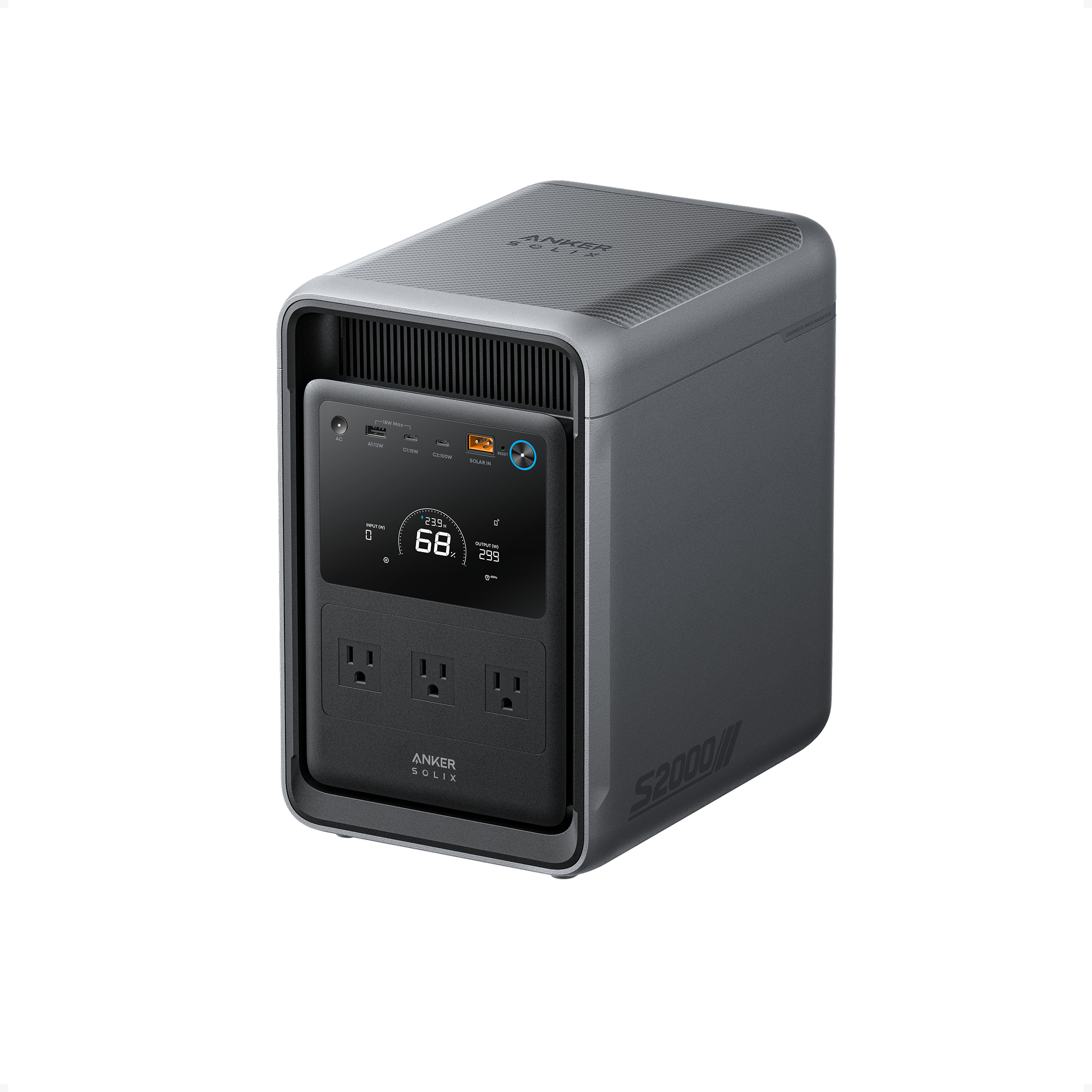
Anker SOLIX S2000Pick
Sold on Amazon · today’s price is on the listing
Prices may vary by retailer and are subject to change.