Head-to-head test
EcoFlow DELTA 3 Ultra vs Anker SOLIX F2000
The SOLIX F2000 runs out of battery before the weekend does — it needs 121% of its own 2,048Wh to cover a typical camping trip, where the DELTA 3 Ultra uses 80% and still comes home with a fifth in reserve.
Full profiles: EcoFlow DELTA 3 Ultra → · Anker SOLIX F2000 →

Written by Gunner GustafsonUpdated
Whole-Home Backup Tester, Station Arena Test Desk

$1,399.00 · direct from EcoFlow
Last checked 1 day ago. Prices move — check before you buy.
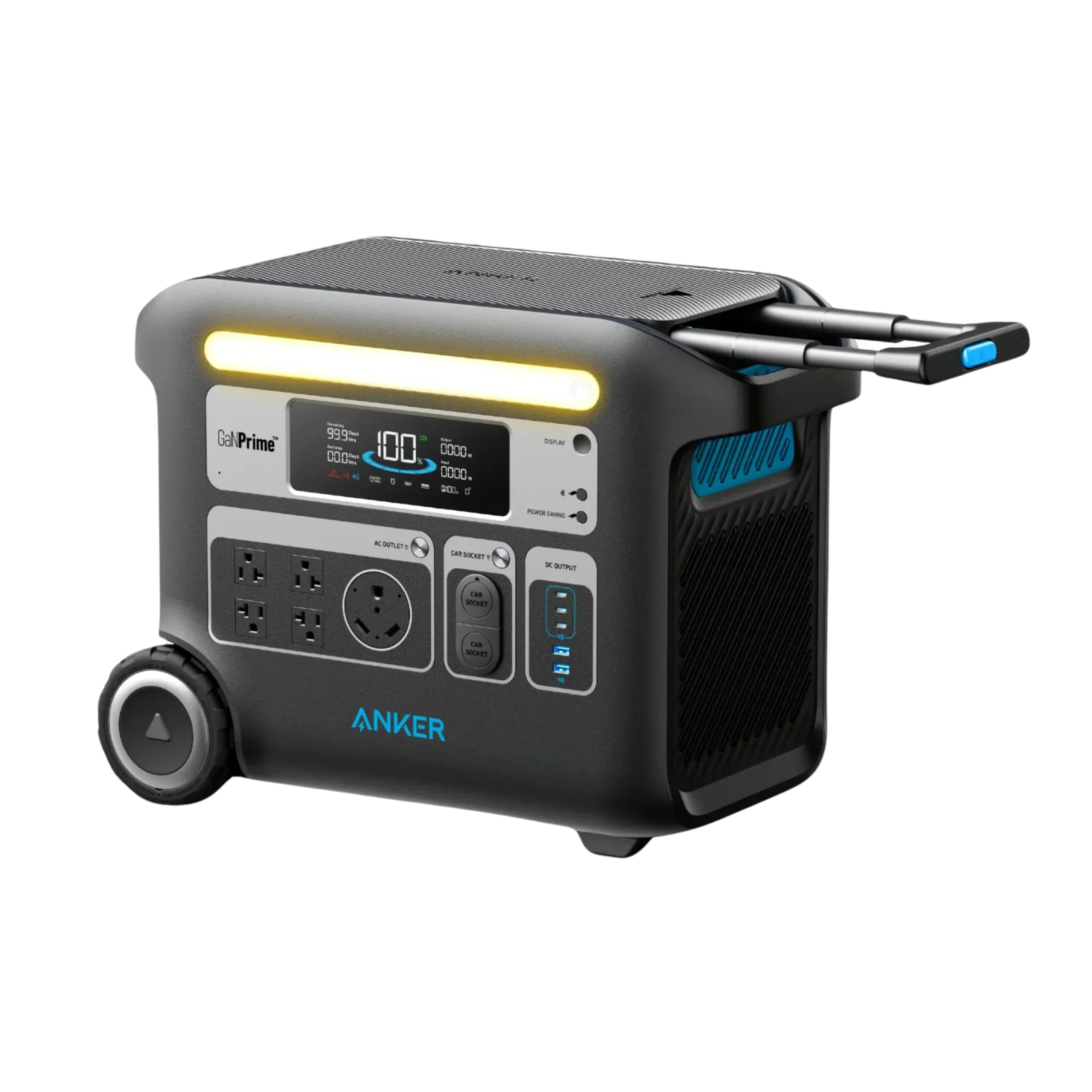
No longer sold
Anker no longer sells the SOLIX F2000 (PowerHouse 767). Its natural replacement is the SOLIX C2000 Gen 2 — the same 2,048Wh capacity and 2,400W output in a newer design.
SOLIX C2000 Gen 2 · $999.99Spec deltas
The EcoFlow DELTA 3 Ultra costs $1,399, and the Anker SOLIX F2000 costs $900 — a real $499 gap. For that money the Ultra holds 3,072Wh against the F2000's 2,048Wh, 50% more, and outputs 3,600W continuously against 2,400W, also 50% more.
That gap shows up hardest in the one scenario that should be routine: a 2,100Wh camping weekend. The F2000 needs 121% of its own rated capacity to cover it and can't finish without a mid-trip recharge; the Ultra needs 80% and still has a fifth of its battery left. A battery that runs out on its own signature use case is a bigger problem than a battery that costs more.
The F2000 does win two real points, though: its 1,000W solar input beats the Ultra's 800W, and it's the only one of the two with a path to more capacity later. Neither is decisive by itself. At 800W, refilling the Ultra's 3,072Wh tank from empty takes about 4 hours of peak sun (3,072 ÷ 800); the F2000's smaller 2,048Wh tank takes about 2 hours (2,048 ÷ 1,000) at 1,000W. And that extra capacity only matters if you'd actually outgrow 3,072Wh — short of that, a first expansion battery on the F2000 mostly buys back what the Ultra already ships with.
What the Numbers Reveal
Each conclusion stated first — the numbers behind it on one line, the full analysis below.
Capacity
Usable energy runs below rated watt-hours once inverter losses are counted, and nobody drains a battery to 0% anyway, so a unit needs headroom above a job's raw draw, not just parity with it. The Ultra's 3,072Wh clears the same weekend at 80% used with real reserve; the F2000 was short before losses even entered the picture.
Weekend Camping needs 2,100WhAnker SOLIX F2000: 2,048Wh rated capacity, 121% neededDELTA 3 Ultra: 3,072Wh rated capacity, 80% needed
Why it mattersIf a full weekend without a mid-trip recharge is the actual use case, the F2000's rated capacity alone disqualifies it. This isn't a marginal call.
cost / lifetime kWh
1,000 fewer rated cycles stacked on 1,024Wh less capacity means the F2000 does meaningfully less total lifetime work, and the per-kWh math already prices that in.
DELTA 3 Ultra: $1,399, 4,000 cycles, $0.11 per lifetime kilowatt-hourAnker SOLIX F2000: $900, 3,000 cycles, $0.15 per lifetime kilowatt-hour
Why it mattersA buyer optimizing for total cost of ownership, not just the number on the box, should run the lifetime-kWh math before taking the cheaper unit.
continuous output
A thin surge margin matters most exactly when you can't verify how the unit behaves under that load in your own living room, since a tighter margin usually means the fans are working harder to compensate, and there's no published number to check that against.
DELTA 3 Ultra surge-to-continuous ratio: 7,200W over 3,600WAnker SOLIX F2000 surge-to-continuous ratio: 2,800W over 2,400WSOLIX F2000 noise level: not disclosed
Why it mattersIf you're running anything with a real startup surge, a fridge, a compressor, the F2000's tighter headroom and undisclosed noise rating are two separate reasons to test it in person before buying, not one.
solar input
Neither converts into a real edge. The solar gap only saves a couple of hours refilling a tank that's already a third smaller. And 'expandable' undersells what it actually requires here: the F2000's first add-on battery has to clear 1,024Wh, the gap it started behind, before it's contributed a single new watt-hour. Expandability only counts once the expanded ceiling actually beats the rival's, and there's no published number showing the F2000's first expansion step gets there.
Anker SOLIX F2000 solar input: 1,000WDELTA 3 Ultra solar input: 800WDELTA 3 Ultra: not expandable, fixed 3,072Wh; SOLIX F2000: expandable
Why it mattersDon't let 'expandable' alone decide this. It only becomes the deciding fact for a buyer who can already see themselves needing more than 3,072Wh — everyone else is paying for a growth path they'd use once, just to get back to where the Ultra started.
The specific dimensions that decide these two units — everything else is a tie.
Lifetime Value
Selected because: Despite a higher sticker price, the Ultra's $0.11 per lifetime kilowatt-hour against the F2000's $0.15 is the number that actually explains the value case here.
cost / lifetime kWh
$0.11 per lifetime kilowatt-hour on the Ultra against $0.15 on the F2000 is the number that actually explains the price gap. The Ultra's 4,000 rated cycles against the F2000's 3,000 works out to 11 years of daily use against 8.2, a real difference in ownership window, not a rounding error.
Per warranty year, both carry five years of coverage, but that coverage costs $260 on the Ultra and $180 on the F2000, a line where the cheaper unit wins outright. It's worth $80 a year, real money, but it doesn't erase the per-kWh gap above it.
Your Life, Your Pick
Selected because: Weekend Camping is where the F2000 outright can't finish on one charge (121% of its own battery); every other scenario shows the same directional gap.
Weekend Camping is the scenario that actually separates these two: the F2000 needs 121% of its battery and can't finish, the Ultra needs 80% and comes home with real reserve. The 8-Hour Blackout tells the same story at a smaller scale, 94% used on the F2000 against 63% on the Ultra, running the smaller unit close to empty on a single bad day.
Remote Workday and Tailgate Party both stay inside the F2000's range, 52% and 38% used, so day-trip and short-outage loads aren't where this comparison gets decided. Van Life Daily needs 4,685Wh and neither unit is close, 269% on the F2000, 179% on the Ultra, so full-time off-grid living is off the table for both.
What the Specs Don't Tell You
Selected because: Seven cards fire here: four favor the Ultra on surge margin, switchover speed, cycle life, and a published noise rating, and the other three split toward the F2000 on weight, warranty cost, and its one real expansion path.
rated cycles
Four of the seven cards favor the Ultra. Its surge ratio clears 2 times its continuous rating against the F2000's tighter margin, its UPS switches over in 10ms against 20ms, and its cycle rating stretches ownership to 11 years of daily use against 8.2. Anker also doesn't disclose a noise rating for the F2000 at all, where the Ultra is rated 30dBA. Not proof the F2000 is loud, just one fewer number you get to check before buying it.
The other three split the other way, or don't split at all. The F2000 is lighter, 67.2 lbs against 72.1, though at a 4.9-lb gap that's a minor edge, not a real differentiator. Both still need the cart. Its warranty costs less per year to carry, $180 against the Ultra's $260. And the Ultra's fixed 3,072Wh draws the 'no expansion' card, which reads worse than it is: it's already a complete, sealed system with more capacity than the F2000 even starts with.
Growth Path
Selected because: The F2000 is the only one of these two that can add capacity later, but its 2,048Wh starting point means a first expansion battery mostly buys back what the Ultra already includes.
solar input
The Ultra's 3,072Wh is fixed. No expansion port, no add-on battery, what you buy is the ceiling. The F2000 can grow: it supports Anker's expansion batteries, so a buyer whose needs are climbing has a real path the Ultra doesn't offer.
That path is less decisive than it sounds. The F2000 starts at 2,048Wh, a full 1,024Wh below the Ultra's fixed capacity, so a first expansion battery mostly buys back capacity the Ultra already ships with, before it adds anything new. It only pulls ahead once your real needs exceed 3,072Wh. Short of that line, the Ultra's larger built-in capacity is the simpler, cheaper-per-kWh way to get there.
Brand Trust
Selected because: Different brands with genuinely different support and ecosystem profiles worth naming directly before a $1,399 or $900 purchase.
EcoFlow runs the larger ecosystem here, more models, the biggest community in the category, and the fastest charging tech, but that scale comes with its own baggage worth knowing before you buy in.
Anker brings the halo of a much bigger consumer electronics brand and a genuinely strong value story across the SOLIX line, though the F2000's own support experience has reportedly been trending in the wrong direction lately.
Strengths & trade-offs
EcoFlow DELTA 3 Ultra
Strengths
- +Larger battery capacity
- +Higher AC output
- +Rated for 4,000 charge cycles — much longer battery lifespan
Trade-offs
- –Substantially more expensive (+$499) than the SOLIX F2000.
Anker SOLIX F2000
Strengths
- +Costs $499 less
- +Lighter by 4.9 lb
- +Faster solar charging
Trade-offs
- –Weaker inverter (-1,200W) limits appliance compatibility.
- –Shorter-lived battery — rated for 3,000 charge cycles vs the DELTA 3 Ultra's 4,000, so it wears out sooner.
Will It Power Your Gear?
Scenario math and per-appliance runtimes, modeled from the spec record.
Scenario verdicts
We ran the math on six real-world scenarios. Here's which unit survives your actual life.
SCN-01 · 2 nights · needs 2,100Wh
Weekend Camping
Two nights off-grid with essential comfort
DELTA 3 Ultra
This is where the capacity gap turns into a real failure, not just a smaller number. The F2000 needs 121% of its own battery to cover a 2,100Wh weekend and can't finish without a mid-trip recharge; the Ultra needs 80% and comes home with a fifth to spare. If a real weekend away is the use case, this scenario alone decides it.
Battery budget usedlower = more headroom
LOAD Phone Charger 15W×6h · LED Lights 40W×8h · Box Fan 75W×14h · CPAP Machine 40W×16h
SCN-02 · 8 hours · needs 1,645Wh
8-Hour Blackout
Keep the essentials running through a night without power
DELTA 3 Ultra
Both units survive the full 8 hours, but the F2000 finishes at 94% used, essentially running on fumes, while the Ultra finishes at 63% with real room for a second short outage the same week.
Battery budget usedlower = more headroom
LOAD Fridge 150W×8h · Router + Modem 20W×8h · LED Lights (4 bulbs) 40W×6h · Phone Charger 15W×3h
SCN-03 · 8 hours · needs 320Wh
CPAP Overnight
Sleep therapy without interruption — the #1 medical use case
Either unit
A CPAP is about 40W for eight hours, so both cover the night with room to spare and capacity decides nothing. Fan noise would — but SOLIX F2000 doesn't publish a figure, so there's nothing to hold it to. Buy on price, weight, and whether you can live with a fan you haven't heard.
Battery budget usedlower = more headroom
LOAD CPAP Machine 40W×8h
SCN-04 · 8 hours · needs 910Wh
Remote Workday
Full work day off-grid without power anxiety
DELTA 3 Ultra
The DELTA 3 Ultra clears the workday at 35% used, banking 1,701Wh — late work, extra calls, or a second laptop charge without arithmetic. The SOLIX F2000 at 52% also finishes, with 831Wh of slack for the unplanned.
Battery budget usedlower = more headroom
LOAD Laptop 60W×8h · External Monitor 30W×8h · Router + Modem 20W×8h · Phone Charger 15W×2h
SCN-05 · 4 hours · needs 670Wh
Tailgate Party
Game day power for the crew
DELTA 3 Ultra
Both handle game day; the DELTA 3 Ultra keeps more in reserve (26% used vs 38%). Tailgating is a light load, though, so the number you'll feel is weight: 67.2 lbs for the SOLIX F2000 against 72.1 lbs for the DELTA 3 Ultra, from the trunk to the setup spot.
Battery budget usedlower = more headroom
LOAD Blender 400W×0.5h · LED TV (55") 80W×4h · Bluetooth Speaker 15W×4h · Phone Charger (×3) 45W×2h
SCN-06 · 24 hours · needs 4,685Wh
Van Life Daily
A full day of mobile living — the ultimate endurance test
Neither unit
Neither unit is built for this. A full van-life day needs 4,685Wh, and the F2000 hits 269% of capacity while the Ultra hits 179%. Anyone living off-grid full time should be pricing a bigger base unit plus expansion batteries, not choosing between these two.
Battery budget usedlower = more headroom
LOAD Mini-Fridge 150W×24h · Laptop 60W×4h · Phone Charger 15W×3h · LED Lights 40W×5h · Fan 75W×8h
The Load Test
RUNTIME = (Wh × 0.85) ÷ LOAD
None of the scenarios above exactly yours? Build it. Toggle what you'd plug in; both units are tested against the combined draw.
Essentials
Comfort & Convenience
High-Draw Appliances
Test duration
8h
Continuous draw
205W
Projected runtime
For this load: DELTA 3 Ultra runs 12.7h vs 8.5h.
$1,399 list · direct from EcoFlow
Modeled from the spec record — same math as the tables below. Methodology
Runtime by appliance
Real-world runtime estimates for common appliances, modeled at 85% inverter efficiency.¹
Essentials
The basics you need runningscale 0–174.1hComfort & Convenience
Makes off-grid life actually enjoyablescale 0–34.8hHigh-Draw Appliances
These reveal the real limitsscale 0–2.6h¹ Runtime = (capacity × 0.85) ÷ appliance watts. Within each group, all bars share one time scale (the group's longest runtime), so lengths are comparable across appliances; identical runtimes collapse into a single blue/orange bar. Actual runtime varies with battery age, temperature, and simultaneous loads — see methodology.
Conclusion
August 1, 2026
Verdict: the DELTA 3 Ultra, on Power Score margin
Take the DELTA 3 Ultra unless price is a hard limit. It holds 1,024Wh more than the F2000 (3,072Wh against 2,048Wh), runs 1,000 more rated cycles, and costs $0.11 per lifetime kilowatt-hour against the F2000's $0.15. That capacity gap is why the F2000 needs 121% of its own battery to cover a 2,100Wh camping weekend and simply can't finish it, while the Ultra uses 80% and comes home with a fifth left. The F2000 answers with a real case: a lower price, a 200W solar edge, and an actual path to more capacity later, where the Ultra's 3,072Wh is a fixed ceiling. That path only pays off once you'd outgrow 3,072Wh — short of that, the Ultra is the unit that actually finishes the job.
Editor-assigned confidence, based on cited owner research and spec analysis.
List prices as of August 1, 2026. The links below open EcoFlow's and Anker's current prices.
$1,399.00 · direct from EcoFlow
Last checked 1 day ago. Prices move — check before you buy.
or check the SOLIX F2000 price$899.99 list
Written by Gunner Gustafson, Whole-Home Backup Tester · Station Arena Test Desk · Updated August 1, 2026
Measured Data
Benchmark scores and the full spec record, side by side.
Benchmark scores
Not rated for both units (minimum threshold unmet): Apartment Balcony.
Full specifications
ᵈ Derived: price ÷ rated capacity. See the data behind our comparisons →
Comparison ToolAdd more power stations, side by sideOpen Tool →How these numbers are produced
Numeric verification
Every figure on this page traces to our spec database or arithmetic on it — no estimated numbers.
Owner claims
Statements about owner experience are cited to published reviews — see Sources & Research Notes below.
Runtime model
Runtime = (rated capacity × 0.85 inverter efficiency) ÷ device wattage. Solar recharge estimates assume panels deliver 70% of rated output. Cold weather, battery age, and stacked loads reduce real-world results.
Power Score
Computed from 14 published spec dimensions, weighted per use-case bench. Higher is better; a unit must meet a bench's minimum threshold to be rated.
See the full weight table and data sourcing on our methodology page →Class ranking (the star rating)
Each unit's star score is a category ranking, not customer reviews — no buyer opinions feed it. We score every station on size-independent quality (value, output, portability, endurance, ports, warranty, and more), then percentile-rank it against the other units in its capacity class, so a class-leading compact unit and a class-leading whole-home unit can both earn 5★. Here, DELTA 3 Ultra rates 4.7/5 (80th percentile of 26 Large-class units), and SOLIX F2000 rates 3.7/5 (24th percentile of 26 Large-class units).
How the class ranking is computed →Test Notes & Caveats
Hidden gotchas and advantages we spotted that you won't find on the product page.
Weight Reality Check
Neither unit is grab-and-go. The SOLIX F2000 (67.2 lbs) is manageable solo but heavier than a large checked suitcase. The DELTA 3 Ultra (72.1 lbs) is noticeably heavier. That's a 5 lb difference.
Fixed capacity is the complete system, not a missing feature
The Ultra ships at 3,072Wh with no expansion port. What you buy is the ceiling. The F2000 can add capacity later, but it starts 1,024Wh behind that ceiling, so its first expansion battery spends itself catching up before it adds a single new watt-hour. Expandability only wins here if you'd actually grow past 3,072Wh.
Twice the rated output against barely clearing it
The Ultra's inverter surges to 7,200W on a 3,600W continuous rating, exactly double. The F2000 surges to 2,800W on 2,400W continuous, only a sliver above its own rating. On a fridge or compressor start, that's the difference between comfortable margin and almost none.
UPS Switchover: ≤10ms vs ≤20ms
Both list a UPS mode, at different rated speeds. The DELTA 3 Ultra is rated ≤10ms — quick enough on paper that desktop PCs and routers should ride through, treating that as the rating it is. The SOLIX F2000 is rated ≤20ms — fine on paper for routers and most electronics; the fussiest PC power supplies sit right at this line. If a computer with unsaved work is the thing being protected, the stated class is worth the attention; nothing here is a lab result.
Five years each, but the F2000 is cheaper to carry per year
Both units carry a 5-year warranty. Spread over that window, the coverage costs $260 a year on the Ultra and $180 on the F2000, the one line on this page where the cheaper unit wins outright.
Battery Lifespan in Real Years
The DELTA 3 Ultra is rated for 4,000 cycles vs 3,000. In real life: at daily use, that's 11 vs 8.2 years. At weekend use (twice a week), it's 38 vs 29 years. One caution reading years across different sizes: a cycle is 3,072Wh on the DELTA 3 Ultra and 2,048Wh on the SOLIX F2000, so count lifetime energy — roughly 12,288 kWh against 6,144 kWh over the rated life. After hitting the cycle limit, the battery doesn't die — it drops to ~80% of original capacity, which is still very usable.
One side wrote the number down
The Ultra publishes a 30dBA noise rating. Anker doesn't publish one for the F2000 at all. That's not proof the F2000 runs loud, it's proof there's one fewer number to check before you commit to it.
Full record above — the Test Desk pick is the DELTA 3 Ultra.
Check DELTA 3 Ultra price →or check the SOLIX F2000 priceOwnership Analysis
What happens after you buy — true cost of ownership, brand trust, and growth potential.
Lifetime value
Service lifeyears at one full cycle per day
Lifetime energy delivered
Cost per delivered kWh
│ warranty ends · Reaching the cycle rating means ~80% capacity remains — degraded, not dead.
Analyst note
The SOLIX F2000 is cheaper to buy, but the DELTA 3 Ultra is cheaper to own. At $0.11/kWh over its lifetime vs $0.15/kWh, the DELTA 3 Ultra's higher cycle life and capacity make each dollar go further over the years.
Brand trust
EcoFlow
Ecosystem
Largest in portable power — 12-15 models across DELTA Pro, DELTA 3, and RIVER 3 series, plus solar panels and smart home panels
Support
US-based phone/email/chat support (1-800-368-8604). Experiences are polarized — many report hassle-free prepaid-label replacements, but others report long waits and refurbished units sent for new claims. Pro tip: buying from Costco or Amazon gives you a stronger return safety net.
Community
Largest community in the space — Reddit r/Ecoflow_community (~31K members), multiple Facebook groups, and an official community forum
App experience
Rated 4.6/5 iOS (~8,400 ratings) · 4.2/5 Android (~17,000 ratings)
Unique strength
EcoFlow runs the deepest expansion ecosystem in this category and the fastest charging tech of the two, though neither shows up on this particular unit, since the Ultra itself is the sealed, non-expandable model in the lineup.
Worth knowing
The brand's scale cuts both ways: it's also the company behind a 2025 recall on an unrelated model over overheating risk, and a subscription-paywall experiment it walked back after pushback. Neither touches this unit directly, but it's part of what you're buying into.
Anker
Ecosystem
7-8 SOLIX portable power stations across C-series (compact) and F-series (flagship), plus the X1 home energy system
Support
US-based support. Historically known for incredible no-hassle replacements, but recent reports describe AI-driven support agents giving generic responses and complex return logistics for heavy units (hazmat shipping). The Anker brand reputation is still strong, but SOLIX-specific support quality is trending down.
Community
Moderate — active Reddit (r/Anker, r/AnkerSOLIXCommunity) and growing. Benefits from Anker's massive consumer electronics brand awareness.
App experience
Rated 4.5/5 iOS (~1,100 ratings) · 4.3/5 Android
Unique strength
Anker's SOLIX line is a genuinely strong value story, and the parent brand's reach in consumer electronics gives it a trust halo EcoFlow can't match. The F2000 itself backs that up with real expansion batteries and a solar edge over the Ultra.
Worth knowing
Support quality for this specific line has reportedly been sliding from Anker's historically excellent standard, with more generic automated responses and clunkier return logistics for a unit this heavy.
Analyst note
Both brands offer real expansion paths at the product-line level, and both back this pair with five-year warranties. EcoFlow's is the bigger, faster-moving ecosystem, though not on the Ultra itself; Anker's is the better-known consumer name attached to a smaller, currently less consistent support operation, but the one that actually ships an expandable unit here.
Growth path
DELTA 3 Ultra
FIXED CAPACITYFixed at 3,072Wh — a sealed, complete system rather than a starting point. There's no expansion port, so that figure is the ceiling: check it against your longest unplugged stretch before you buy.
Accepts up to 800W of solar. Suitable for a 1-2 panel setup.
Generous port selection supports complex multi-device setups.
SOLIX F2000
EXPANDABLESupports Anker expansion batteries, so you can add capacity later without replacing the base unit — useful if your needs may climb past 2,048Wh.
Accepts up to 1,000W of solar. Enough for a serious multi-panel array.
Generous port selection supports complex multi-device setups.
Expansion batteries are Anker-specific. You're investing in the Anker ecosystem.
Realistic full solar rechargeat 70% of rated panel output — see methodology
Analyst note
Don't read the SOLIX F2000's expandability as a straight win here: it starts at 2,048Wh, below the DELTA 3 Ultra's 3,072Wh, so a first expansion battery largely buys back capacity the DELTA 3 Ultra already includes. It only pulls ahead if you'd grow past 3,072Wh — short of that, the DELTA 3 Ultra's larger fixed capacity is the simpler value.
What Owners Report
Patterns from published owner reports and long-term reviews — every claim cited to its source below.
EcoFlow DELTA 3 Ultra
Almost everything published so far on this tier comes from professional review outlets testing early units, and several of them were specifically testing the Ultra Plus, EcoFlow's expansion-capable sibling, rather than this plain UltraA1A7. The two share their 3,072Wh capacity and 3,600W output, so performance-under-load impressions likely carry over, but treat this as directional, not confirmed on this exact unit. On that shared inverter, reviewers reported the fans staying unobtrusive even pushed to full output, with no dips or shutdowns switching over from wall powerA1A2A5A6.
One reviewer pulling 300-600W on a GPU benchmark got a little over 4.5 hours out of it, and a full eight-hour remote workday left 40% still on the gaugeA7A8. The honest catch: at least one reviewer had to cup their hands over the screen to read it in direct sunA11.
“Even when you're pushing it hard, the DELTA 3 Ultra Plus runs much quieter than older EcoFlow models, like the DELTA 2 Max.”
Sources
thesolarlab.com · postperspective.com · appleinsider.com · digitaltrends.com · popsci.com
Anker SOLIX F2000
Owners consistently cite the wheels and retractable EasyTow handle as the reason they picked the F2000 over similarly specced competitors, a big, heavy unit that's still genuinely easy to moveB1. The app gets real credit too, monitoring charging and usage remotely, with Anker reportedly proactive about resolving issues through firmware updates or replacements when something goes wrongB2. For the loads RVers actually run, fridge, CPAP, lights, fans, a laptop, reviewers describe it as quiet and easy to deploy fastB3, backed by the same LFP reliability Anker uses across its other models, rated past 3,000 cyclesB4.
“It's big and full of heavy batteries, but the durable 4.72-inch wheels and retractable EasyTow handle make it surprisingly easy to lug around — most positive reviews cite the wheels and telescoping handle as a top reason owners chose it over similar-spec competitors.”
Sources
rvoutfitting.com · trustedreviews.com · ankersolix.com · storagereview.com · generatorpeak.com
Sources & Research Notes
Every owner claim in this report is traceable to a published source. The bracketed references above resolve here.
Recurring owner themes
- Reviewers consistently praise the quiet fan operation of the Ultra-tier unit compared to older EcoFlow models, though this is described in professional test conditions rather than long-term ownership. [DELTA 3 Ultra · 2 entries]
- UPS/switchover performance is repeatedly called seamless with no observed dips or shutdowns during power interruption tests. [DELTA 3 Ultra · 3 entries]
- The unit's substantial 74 lb weight is flagged across multiple reviews as a portability drawback, mitigated somewhat by wheels and handle design. [DELTA 3 Ultra · 2 entries]
- Build quality/durability (casing, cable, port covers) is repeatedly highlighted as premium and well-engineered. [DELTA 3 Ultra · 2 entries]
- The wheels + retractable handle are the standout, repeatedly-cited reason owners pick the F2000; app monitoring and responsive Anker support are also praised. [SOLIX F2000 · 2 entries]
- A1
“Even when you're pushing it hard, the DELTA 3 Ultra Plus runs much quieter than older EcoFlow models, like the DELTA 2 Max.”
thesolarlab.com — EcoFlow DELTA 3 Ultra Plus Review: The Ultimate DELTA? · 2025-09/10 (approx) · [positive]
- A2
“Even when you're pushing the inverter to its maximum output, the fans never become annoying or distracting.”
thesolarlab.com — EcoFlow DELTA 3 Ultra Plus Review: The Ultimate DELTA? · 2025-09/10 (approx) · [positive]
- A5
“Over my career I have become accustomed to APC batteries immediately switching on when there is a power hit or power shut-off, and the EcoFlow Delta 3 Ultra Plus works in the exact same way.”
postperspective.com — Review: EcoFlow Delta 3 Ultra Plus Portable Power Station · 2026-04 · [positive]
- A6
“I didn't experience any shut-offs or dips when I unplugged the EcoFlow from the wall.”
postperspective.com — Review: EcoFlow Delta 3 Ultra Plus Portable Power Station · 2026-04 · [positive]
- A7
“Using Maxon's Cinebench 2026 GPU benchmark, I was pulling between 300W and 600W on one of the AC outputs... the EcoFlow Delta 3 Ultra Plus would last a little over 4.5 hours.”
postperspective.com — Review: EcoFlow Delta 3 Ultra Plus Portable Power Station · 2026-04 · [positive]
- A8
“I was able to work remotely for an eight-hour day with 40% power left, which included running my laptop, desktop workstation and monitors.”
postperspective.com — Review: EcoFlow Delta 3 Ultra Plus Portable Power Station · 2026-04 · [positive]
- A11
“But, while facing the sun, I had to employ the classic "cup hands cover" maneuver to get a clear look at the screen status.”
appleinsider.com — EcoFlow Delta 3 Ultra Plus review: Premium, but solid power · 2025-11-16 · [negative]
- B1
“It's big and full of heavy batteries, but the durable 4.72-inch wheels and retractable EasyTow handle make it surprisingly easy to lug around — most positive reviews cite the wheels and telescoping handle as a top reason owners chose it over similar-spec competitors.”
rvoutfitting.com / trustedreviews.com — Anker SOLIX F2000 (PowerHouse 767) review · 2025-2026 · [positive]
- B2
“WiFi and Bluetooth app lets you monitor battery, charging, and customize power usage; a meaningful number of owners reported Anker proactively solving issues with firmware updates or replacements.”
ankersolix.com / storagereview.com — F2000 review · 2025-2026 · [positive]
- B3
“For the loads RVers run most — fridge, CPAP, lights, fans, internet, TV, small kitchen appliances — the F2000 is usually quiet, capable, and easy to deploy fast.”
rvoutfitting.com — Anker SOLIX F2000 review · 2026 · [positive]
- B4
“Uses the same long-lasting LFP battery reliability as Anker's other models, rated over 3,000 cycles for years of off-grid or backup use.”
trustedreviews.com / generatorpeak.com — F2000 review · 2025-2026 · [positive]
Research compiled August 1, 2026.
Who Should Buy Which
Buy the DELTA 3 Ultra if you…
- →You want a full weekend of camping covered without a mid-trip recharge. The Ultra clears it at 80% capacity where the F2000 needs 121% and can't finish.
- →You're optimizing for total cost of ownership, not sticker price. At $0.11 per lifetime kilowatt-hour against $0.15, the pricier unit is the cheaper one to actually run.
- →You want a published noise number before you buy. The Ultra is rated 30dBA; the F2000 doesn't disclose one at all.
Buy the SOLIX F2000 if you…
- →Price is a real constraint and your loads stay inside an overnight or a short blackout. The F2000 handles CPAP Overnight, Remote Workday, and Tailgate Party comfortably.
- →You're planning to grow your system past 3,072Wh eventually and want a unit that can add capacity instead of being replaced outright. The F2000's expansion path is real, even if a first battery mostly buys back what the Ultra already includes below that line.
- →You want the faster solar refill and the lighter unit. 1,000W of solar input against 800W, and 67.2 lbs against 72.1.
This is you — check the SOLIX F2000 price
If neither fits
If your actual loads are phones, a router, and a lamp through short outages, both of these are more unit than you need, a smaller 1kWh-class box covers that job for less. And if you're planning to live off-grid full time, Van Life Daily needs 4,685Wh and neither unit gets close, so start pricing a bigger base unit plus expansion batteries instead.
The Bottom Line
The Anker SOLIX F2000 costs less and edges the Ultra on solar input and expandability. Everything else on this page points the other way: 1,024Wh more capacity, 1,000 more rated cycles, $0.11 per lifetime kilowatt-hour against $0.15, and a battery that actually finishes a camping weekend instead of needing 121% of what it holds.
If price is a genuine limit, the F2000 is a capable unit for overnight and short-outage use, and a real one if you already know you'll outgrow 3,072Wh. If it isn't, the DELTA 3 Ultra is the one that doesn't run out on the trip it was bought for.
Frequently Asked Questions
Answers drawn from the spec record and cited owner research.
Is the EcoFlow DELTA 3 Ultra worth $499 more than the Anker SOLIX F2000?
For most buyers, yes. It holds 1,024Wh more, runs 1,000 more rated cycles, and costs $0.11 per lifetime kilowatt-hour against the F2000's $0.15. The clearest proof is Weekend Camping: the F2000 needs 121% of its own battery and can't finish a 2,100Wh weekend, while the Ultra needs 80% and has real reserve left.
Can the Anker SOLIX F2000 handle a full camping weekend?
Not on one charge. A typical camping weekend draws about 2,100Wh, and the F2000's 2,048Wh rated capacity means it needs 121% of what it holds, more than it has. The DELTA 3 Ultra's larger 3,072Wh battery covers the same weekend at 80% used.
Which has the higher solar input, the DELTA 3 Ultra or the SOLIX F2000?
The F2000 does, 1,000W against the Ultra's 800W. On paper that means faster refills: topping the F2000's smaller 2,048Wh tank from empty takes about 2 hours of peak sun against about 4 hours for the Ultra's larger 3,072Wh tank. The Ultra's bigger capacity means you need the sun less often to begin with.
Is the DELTA 3 Ultra expandable?
No, it's a sealed, fixed-capacity unit at 3,072Wh with no expansion port. The SOLIX F2000 does support add-on batteries, but it starts at 2,048Wh, so a first expansion battery mostly buys back capacity the Ultra already includes. The F2000's expansion path only becomes the deciding factor if your needs would eventually exceed 3,072Wh.
Which one is quieter, the DELTA 3 Ultra or the SOLIX F2000?
The Ultra is rated at 30dBA. Anker doesn't publish a decibel rating for the F2000 at all, so there's no official number to compare it against. Reviewers describe the Ultra's fans as staying unobtrusive even under heavy inverter load, though that testing was on its Ultra Plus sibling. With no published figure for the F2000, testing it in person is the only way to know for sure.
Where to buy
EcoFlow DELTA 3 UltraPick
$1,399.00
$1,399.00 · direct from EcoFlow
Last checked 1 day ago. Prices move — check before you buy.
Anker SOLIX F2000
$899.99
$899.99 · direct from Anker
Last checked 50 days ago. Prices move — check before you buy.
Prices may vary by retailer and are subject to change.