Head-to-head test
EcoFlow DELTA 3 Plus vs Anker SOLIX C2000 Gen 2
For $281 more, the Anker SOLIX C2000 Gen 2 doesn't just out-battery the EcoFlow DELTA 3 Plus, it doubles it exactly, and still ends up the cheaper unit to actually own.
Full profiles: EcoFlow DELTA 3 Plus → · Anker SOLIX C2000 Gen 2 →

Written by Ian SchneiderUpdated
Solar & Off-Grid Tester, Station Arena Test Desk

$719.00 · direct from EcoFlow
Last checked 1 day ago. Prices move — check before you buy.
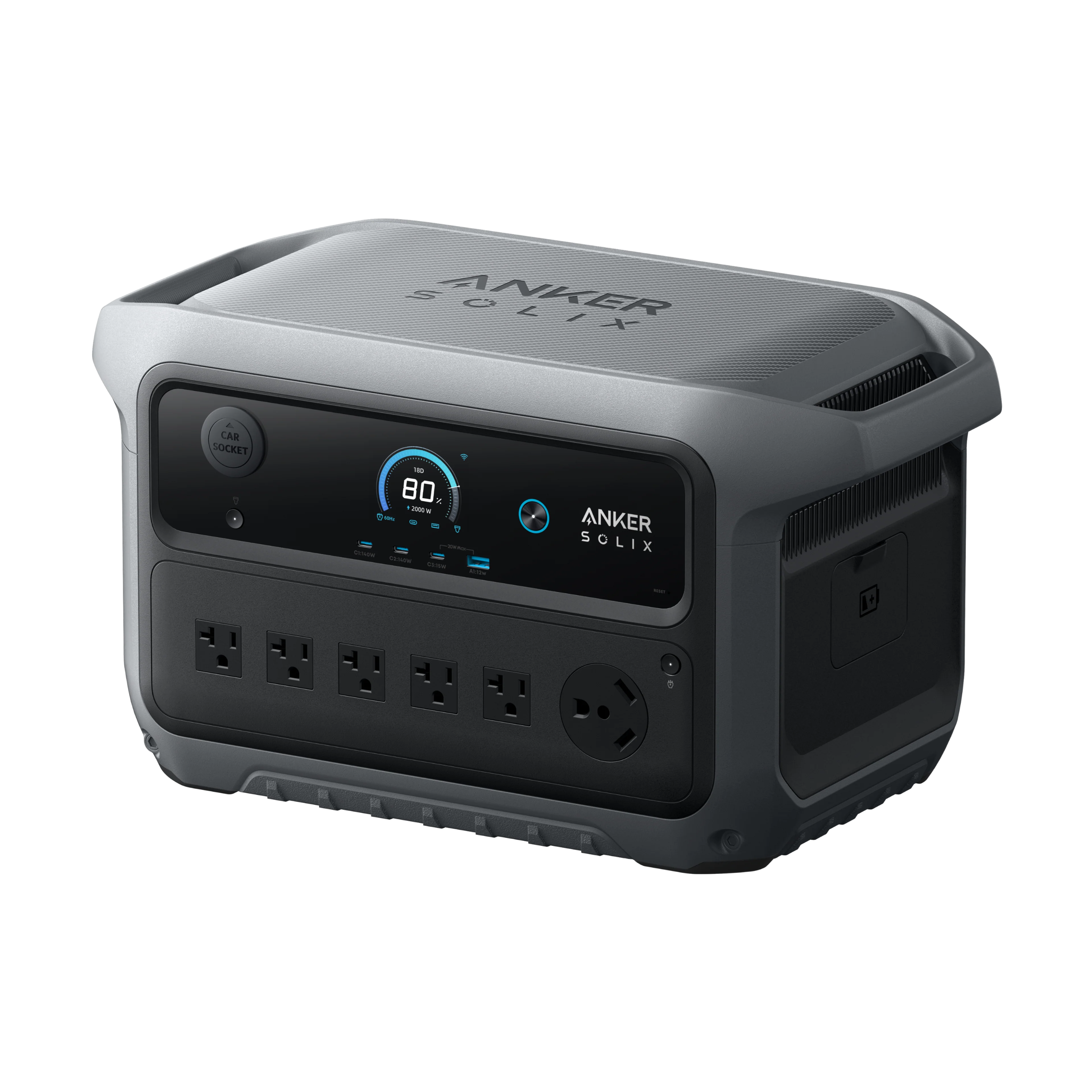
$999.99 · direct from Anker
Last checked 1 day ago. Prices move — check before you buy.
Spec deltas
The Anker SOLIX C2000 Gen 2 holds 2,048Wh to the EcoFlow DELTA 3 Plus's 1,024Wh - not a bump, an exact double - for $281 more ($1,000 against $719). It also carries a 600W-higher continuous ceiling (2,400W vs 1,800W) and a stronger USB-C port (140W vs 100W).
Run the ownership math and the bigger unit is also the cheaper one to actually own: $0.12 per lifetime kWh against $0.17 for the EcoFlow, on identical 5-year warranties and identical 4,000-cycle ratings. Across six real-world scenarios tested here, the Anker wins outright in four - an 8-hour blackout, a CPAP night, a remote workday, and a tailgate - and both units run out of energy on the two heaviest draws, Weekend Camping and Van Life Daily, though the Anker always runs out by less.
None of that makes the EcoFlow a bad buy. It's the lighter unit by 14.7 lbs (27 vs 41.7), the cheaper one to swipe a card for today, and its inverter actually has the deeper surge cushion relative to its own rating (2.0x vs 1.7x) - genuinely useful if you're starting a compressor-driven appliance right at the edge of either unit's ceiling. But for anyone buying real blackout resilience rather than a lighter box, the extra capacity is the point.
What the Numbers Reveal
Each conclusion stated first — the numbers behind it on one line, the full analysis below.
Capacity
The EcoFlow's lower sticker price is the only column where it's actually cheaper - per Wh, per lifetime kWh, and per warranty year ($138 vs $200), the Anker wins every efficiency measure there is.
EcoFlow DELTA 3 Plus costs $719 for 1,024Wh; Anker SOLIX C2000 Gen 2 costs $1,000 for 2,048Wh - exactly double the capacity for $281 more.Both are rated for 4,000 cycles, so lifetime energy scales the same way: 4,096 total kWh for the EcoFlow over its life, 8,192 for the Anker.Cost per lifetime kWh comes out to $0.17 for the EcoFlow and $0.12 for the Anker.
Why it mattersA buyer choosing the EcoFlow to save $281 upfront is paying more for every kWh they'll ever pull from it - worth doing on purpose, not by defaulting to the smaller number on the price tag.
The Anker's extra capacity isn't wasted headroom for these use cases, it's the difference between finishing the workday or the blackout and not - the two scenarios most people are actually buying a backup power station for.
Across six real-world scenarios, the Anker wins outright in four: 8-Hour Blackout, CPAP Overnight, Remote Workday, and Tailgate Party.In the 8-Hour Blackout test (1,645Wh needed), the EcoFlow uses 189% of its usable capacity and can't finish; the Anker uses 94% and finishes with room left.In Remote Workday (910Wh needed) the EcoFlow needs 105% of what it has - just short - while the Anker needs only 52%.
Why it mattersBuyers shopping specifically for overnight backup power or a full remote workday should treat the EcoFlow's 1,024Wh as genuinely too small for the job, not just less convenient.
continuous output
For a compressor-driven load right at the edge of what either unit can run continuously, the EcoFlow's proportionally deeper surge margin makes it the one less likely to trip on startup, even though its absolute numbers are smaller across the board.
EcoFlow's inverter is rated 1,800W continuous with a 3,600W surge - exactly 2.0x.Anker's inverter is rated 2,400W continuous with a 4,000W surge - about 1.7x.Fridge and AC compressors briefly draw 2 to 3 times their running wattage on startup.
Why it mattersAnyone planning to start a fridge or window AC near either unit's rated ceiling should check the surge ratio, not just the peak-watt number on the box - a bigger surge rating doesn't automatically mean more headroom.
The EcoFlow's marketed quiet-running claim is exactly the spec reviewers say it fails to hold up to in practiceA1A2, while the Anker's tested behavior at full load reportedly beats what its identical spec number would suggestB1.
The EcoFlow is spec'd at 30dBA, identical to the Anker's 30dBA rating.Independent reviewers report the EcoFlow's fans activate even under low loads and cycle on and off erratically, undercutting its near-silent marketingA1A2.Reviewers of the Anker report it stays quiet even at full power, describing the fans as a subdued, easily-backgrounded whirr rather than anything disruptiveB1.
Why it mattersAnyone buying specifically for quiet overnight or CPAP use should weigh the reviewer reports over the matching dBA specA1A2B1 - on paper this is a tie, in the field it reportedly isn't.
The specific dimensions that decide these two units — everything else is a tie.
Lifetime Value
Selected because: Real per-Wh and lifetime cost gap, plus identical warranty/cycle terms, is the core value argument for this pair.
cost / lifetime kWh
Spend the extra $281 and you're not just buying a bigger battery, you're buying a second EcoFlow's worth of one: the Anker's 2,048Wh is exactly double the DELTA 3 Plus's 1,024Wh, down to the watt-hour. That kind of clean doubling is rare enough to be worth pausing on - this isn't a modest bump dressed up as a big one.
Run the number all the way to the end of each unit's life and the Anker still wins. The same 4,000-cycle rating on both means the EcoFlow delivers 4,096 total kWh over its life and the Anker 8,192 - and at $0.17 per lifetime kWh for the EcoFlow against $0.12 for the Anker, the bigger unit is also the more efficient one to own, not just the pricier one to buy. The EcoFlow's only real win in this section is the number on the price tag itself; every other way of measuring cost points the other way.
Runtime: Will It Power Your Gear?
Selected because: 600W continuous gap and a flipped surge-to-rated ratio both matter for what each unit can actually run.
continuous output
A 600W gap in continuous output (2,400W for the Anker vs 1,800W for the EcoFlow) is the difference between running one or two things and running a small household's worth at once - the kind of gap that matters the moment you're stacking a space heater, a fridge, and a laptop charger on the same unit instead of picking one. The USB-C port tells the same story at a smaller scale: 140W on the Anker will fast-charge a power-hungry laptop that the EcoFlow's 100W port charges more slowly.
Surge tells a different story, and it's worth knowing before assuming bigger numbers mean a bigger cushion everywhere. The Anker's 4,000W surge beats the EcoFlow's 3,600W in absolute terms, but relative to what each inverter is rated for continuously, the EcoFlow's is the deeper cushion - 2.0x its continuous rating against the Anker's 1.7x. Raw wattage decides how much you can run at once; that ratio decides whether a fridge compressor trips the inverter on the way to running at all.
Your Life, Your Pick
Selected because: Anker wins 4 of 6 real-world tests outright; the 2 shared misses need an honest energy-vs-wattage explanation.
Four of six real-world tests go to the Anker outright, and the closest is the one that matters most for daily use: Remote Workday needs about 910Wh, which is 52% of the Anker's usable capacity and 105% of the EcoFlow's - just short. That's not a rounding error, it's a laptop-and-monitor setup that runs out before quitting time on the smaller unit.
The two scenarios neither unit clears - Weekend Camping and Van Life Daily - both fail on energy, not wattage. The EcoFlow would need 241% and 538% of its usable capacity respectively, the Anker 121% and 269%; the inverters in both units could power everything each scenario throws at them, there's simply not enough battery behind either one for a full unplugged weekend or a full day of van-life draw. The Anker always fails by less, but less still means bring a way to recharge.
What the Specs Don't Tell You
Selected because: Only 2 gotchas fire and both technically favor the cheaper unit - worth surfacing plainly rather than skipping since gotchas are thin.
Only two Test Notes fire for this pair, and both cut in the cheaper unit's favor, worth saying plainly rather than burying it. The EcoFlow's inverter surges to exactly 2.0x its own continuous rating; the Anker's bigger 4,000W surge number is only about 1.7x its continuous rating. For a compressor load riding right at the edge of what either unit can run, the EcoFlow's proportionally deeper cushion is the more reassuring spec, even though it loses on every raw wattage number on this page.
The second is a warranty-value note that reads bigger than it is: $138 a year of coverage for the EcoFlow against $200 a year for the Anker. Both warranties run the identical 5 years - this card isn't measuring generosity, it's measuring the same price gap covered elsewhere on this page, just divided by 5 instead of shown as a lump sum.
Brand Trust
Selected because: Cross-brand pair with a real ledger split (EcoFlow's fan-noise flaw vs Anker's clean reviews) plus diverging support trajectories.
This is a cross-brand matchup, and the ecosystems aren't close in size: EcoFlow fields 12 to 15 models across its DELTA Pro, DELTA 3, and RIVER 3 lines plus its own solar panels and home panels, while Anker's SOLIX lineup runs 7 to 8 stations across two series. EcoFlow also has the bigger crowd behind it - a ~31K-member Reddit community versus a smaller, more brand-diffuse following for Anker. Neither edge changes the capacity-and-price math above, but it matters if you value a bigger secondhand market and more accessories down the line.
Support is the more interesting split. EcoFlow's support experience is described as polarized: prepaid-label replacements that go smoothly for some, long waits or refurbished swaps for others, which is exactly the kind of thing a retailer return window exists to backstop. Anker's SOLIX support was historically considered close to no-hassle, but recent reports describe more generic, AI-driven responses and thornier return logistics for a unit this heavy. Same 5-year warranty term on both, so this is a trajectory difference, not a paper one - EcoFlow's reputation is holding steady with mixed reviews, Anker's is drifting down from a higher starting point.
Strengths & trade-offs
EcoFlow DELTA 3 Plus
Strengths
- +Costs $281 less
- +Lighter by 14.7 lb
- +Faster solar charging
Trade-offs
- –Weaker inverter (-600W) limits appliance compatibility.
Anker SOLIX C2000 Gen 2
Strengths
- +Larger battery capacity
- +Higher AC output
Trade-offs
- –Substantially more expensive (+$281) than the DELTA 3 Plus.
- –Significantly heavier (+14.7 lbs), making it harder to move.
Will It Power Your Gear?
Scenario math and per-appliance runtimes, modeled from the spec record.
Scenario verdicts
We ran the math on six real-world scenarios. Here's which unit survives your actual life.
SCN-01 · 2 nights · needs 2,100Wh
Weekend Camping
Two nights off-grid with essential comfort
Neither unit
A full weekend off-grid needs about 2,100Wh by this estimate, and neither unit holds enough: the EcoFlow would need to draw 241% of its usable capacity and the Anker 121%. Both numbers describe running out of energy, not hitting a wattage ceiling - the load itself is well within what either inverter can output, there's just not enough battery behind it for three full days unplugged. The Anker gets meaningfully closer, but closer still means bringing a way to recharge before the trip is over.
Battery budget usedlower = more headroom
LOAD Phone Charger 15W×6h · LED Lights 40W×8h · Box Fan 75W×14h · CPAP Machine 40W×16h
SCN-02 · 8 hours · needs 1,645Wh
8-Hour Blackout
Keep the essentials running through a night without power
SOLIX C2000 Gen 2
An 8-hour outage draws down about 1,645Wh. The Anker uses roughly 94% of its usable capacity and gets through it; the EcoFlow would need about 189% of what it has and runs dry before the power comes back. Again this is a capacity shortfall, not a power problem - the EcoFlow's inverter can run the same devices, it just can't hold enough charge to run them for the full 8 hours.
Battery budget usedlower = more headroom
LOAD Fridge 150W×8h · Router + Modem 20W×8h · LED Lights (4 bulbs) 40W×6h · Phone Charger 15W×3h
SCN-03 · 8 hours · needs 320Wh
CPAP Overnight
Sleep therapy without interruption — the #1 medical use case
Either unit
A CPAP is a light, steady load - about 320Wh for the night - and both units clear it easily: 37% of usable capacity for the EcoFlow, 18% for the Anker. This one's a genuine pass for either unit; the Anker's extra margin buys a second night before recharging, which is the real difference, not whether it works.
Battery budget usedlower = more headroom
LOAD CPAP Machine 40W×8h
SCN-04 · 8 hours · needs 910Wh
Remote Workday
Full work day off-grid without power anxiety
SOLIX C2000 Gen 2
A full remote workday needs about 910Wh, and this is the closest race on the page: the EcoFlow needs 105% of its usable capacity, just short, while the Anker needs only 52%. That 105% is a real shortfall, not a rounding error - plan on a midday top-up if this is the EcoFlow's job every day.
Battery budget usedlower = more headroom
LOAD Laptop 60W×8h · External Monitor 30W×8h · Router + Modem 20W×8h · Phone Charger 15W×2h
SCN-05 · 4 hours · needs 670Wh
Tailgate Party
Game day power for the crew
SOLIX C2000 Gen 2
A tailgate setup draws about 670Wh. The EcoFlow gets there using about 77% of what it has, and the Anker using about 38%. Both finish the party; the Anker just does it with more than twice the spare capacity left over if the game goes to overtime.
Battery budget usedlower = more headroom
LOAD Blender 400W×0.5h · LED TV (55") 80W×4h · Bluetooth Speaker 15W×4h · Phone Charger (×3) 45W×2h
SCN-06 · 24 hours · needs 4,685Wh
Van Life Daily
A full day of mobile living — the ultimate endurance test
Neither unit
Full-time van life is the heaviest draw tested here, about 4,685Wh a day, and it's out of reach for both: the EcoFlow would need 538% of its usable capacity and the Anker 269%. Neither number is close - this is a job for a larger house battery or a real solar array, not a mid-size portable station, regardless of brand.
Battery budget usedlower = more headroom
LOAD Mini-Fridge 150W×24h · Laptop 60W×4h · Phone Charger 15W×3h · LED Lights 40W×5h · Fan 75W×8h
The Load Test
RUNTIME = (Wh × 0.85) ÷ LOAD
None of the scenarios above exactly yours? Build it. Toggle what you'd plug in; both units are tested against the combined draw.
Essentials
Comfort & Convenience
High-Draw Appliances
Test duration
8h
Continuous draw
205W
Projected runtime
For this load: SOLIX C2000 Gen 2 runs 8.5h vs 4.2h.
$999.99 list · direct from Anker
Modeled from the spec record — same math as the tables below. Methodology
Runtime by appliance
Real-world runtime estimates for common appliances, modeled at 85% inverter efficiency.¹
Essentials
The basics you need runningscale 0–116.1hComfort & Convenience
Makes off-grid life actually enjoyablescale 0–23.2hHigh-Draw Appliances
These reveal the real limitsscale 0–1.7h¹ Runtime = (capacity × 0.85) ÷ appliance watts. Within each group, all bars share one time scale (the group's longest runtime), so lengths are comparable across appliances; identical runtimes collapse into a single blue/orange bar. Actual runtime varies with battery age, temperature, and simultaneous loads — see methodology.
Conclusion
July 28, 2026
Verdict: the SOLIX C2000 Gen 2, on Power Score margin
The Anker SOLIX C2000 Gen 2 wins on nearly every measure except the checkout price: exactly double the capacity (2,048Wh vs 1,024Wh) for $281 more, a lower cost per lifetime kWh ($0.12 vs $0.17), a 600W-higher continuous ceiling, and outright wins in four of six real-world scenarios, including the 8-hour blackout the EcoFlow can't finish. Reviewers also describe a cleaner ownership experience - consistently quiet at full loadB1 against reported complaints that the EcoFlow's near-silent marketing doesn't hold up, with fans that reportedly activate at low loads and cycle erraticallyA1A2. The EcoFlow claws back real ground on price, weight (27 lbs vs 41.7), and a proportionally deeper surge cushion for compressor starts (2.0x vs 1.7x) - genuine reasons to pick it if a single CPAP night or one tailgate is really the whole job. For anyone buying multi-day resilience or a heavier daily workload, the Anker's extra capacity is the difference between finishing and running out.
Editor-assigned confidence, based on cited owner research and spec analysis.
List prices as of July 28, 2026. The links below open EcoFlow's and Anker's current prices.
$999.99 · direct from Anker
Last checked 1 day ago. Prices move — check before you buy.
or check the DELTA 3 Plus price$719.00 list
Written by Ian Schneider, Solar & Off-Grid Tester · Station Arena Test Desk · Updated July 28, 2026
Measured Data
Benchmark scores and the full spec record, side by side.
Benchmark scores
Full specifications
ᵈ Derived: price ÷ rated capacity. See the data behind our comparisons →
Comparison ToolAdd more power stations, side by sideOpen Tool →How these numbers are produced
Numeric verification
Every figure on this page traces to our spec database or arithmetic on it — no estimated numbers.
Owner claims
Statements about owner experience are cited to published reviews — see Sources & Research Notes below.
Runtime model
Runtime = (rated capacity × 0.85 inverter efficiency) ÷ device wattage. Solar recharge estimates assume panels deliver 70% of rated output. Cold weather, battery age, and stacked loads reduce real-world results.
Power Score
Computed from 14 published spec dimensions, weighted per use-case bench. Higher is better; a unit must meet a bench's minimum threshold to be rated.
See the full weight table and data sourcing on our methodology page →Class ranking (the star rating)
Each unit's star score is a category ranking, not customer reviews — no buyer opinions feed it. We score every station on size-independent quality (value, output, portability, endurance, ports, warranty, and more), then percentile-rank it against the other units in its capacity class, so a class-leading compact unit and a class-leading whole-home unit can both earn 5★. Here, DELTA 3 Plus rates 4.2/5 (54th percentile of 27 Everyday-class units), and SOLIX C2000 Gen 2 rates 4.1/5 (48th percentile of 26 Large-class units).
How the class ranking is computed →Test Notes & Caveats
Hidden gotchas and advantages we spotted that you won't find on the product page.
The Bigger Surge Number Isn't the Better Cushion
The Anker's 4,000W surge rating beats the EcoFlow's 3,600W in raw terms, but scale each against its own continuous rating and the picture flips: the EcoFlow surges to exactly 2.0x its 1,800W continuous output, while the Anker surges to about 1.7x its 2,400W continuous output. A compressor-driven load - a fridge or a window AC - can briefly draw 2 to 3 times its running wattage on startup, so the ratio, not the peak number, predicts whether the inverter trips. On that measure the smaller, cheaper unit has the deeper cushion.
Same 5-Year Term, Different Price Tag
Both units carry an identical 5-year warranty, so this card is really the price gap wearing a different unit: $719 spread over 5 years works out to $138 a year of coverage for the EcoFlow, versus $200 a year for the $1,000 Anker. That's a real gap in dollars, but it isn't a difference in how generous either warranty actually is - the term length is identical, only the price underneath it moved.
Full record above — the Test Desk pick is the SOLIX C2000 Gen 2.
Check SOLIX C2000 Gen 2 price →or check the DELTA 3 Plus priceOwnership Analysis
What happens after you buy — true cost of ownership, brand trust, and growth potential.
Lifetime value
Service lifeyears at one full cycle per day
Lifetime energy delivered
Cost per delivered kWh
│ warranty ends · Reaching the cycle rating means ~80% capacity remains — degraded, not dead.
Analyst note
The DELTA 3 Plus is cheaper to buy, but the SOLIX C2000 Gen 2 is cheaper to own. At $0.12/kWh over its lifetime vs $0.18/kWh, the SOLIX C2000 Gen 2's higher cycle life and capacity make each dollar go further over the years. One thing to know reading the table: both carry the same 4,000-cycle rating, so the lifetime rows are sticker price and capacity in disguise — the wear horizon is identical and decides nothing here.
Brand trust
EcoFlow
Ecosystem
EcoFlow runs the largest lineup in portable power, spanning the DELTA Pro, DELTA 3, and RIVER 3 families plus its own solar panels and smart home panels.
Support
US-based phone, email, and chat support. Experience is reported as polarized - some customers describe hassle-free prepaid-label replacements, others describe long waits or refurbished swaps. Buying through a retailer like Costco or Amazon adds a return safety net on top of the manufacturer warranty.
Community
The largest owner community in the category - a roughly 31K-member Reddit community plus multiple Facebook groups and an official forum.
App experience
Rated 4.6/5 iOS (~8,400 ratings) · 4.2/5 Android (~17,000 ratings)
Unique strength
Fastest-charging technology in its lineup (X-Stream) and the deepest expansion ecosystem, scaling all the way up on EcoFlow's flagship modular systems.
Worth knowing
EcoFlow tested a subscription paywall for advanced app features in early 2025 before community pushback paused the plan - worth knowing if app features factor into your decision.
Anker
Ecosystem
Anker's SOLIX lineup is smaller - 7 to 8 portable stations across the compact C-series and flagship F-series, plus the X1 home energy system.
Support
US-based support that was historically known for easy, no-hassle replacements. Recent reports describe more AI-driven, generic responses and complicated return logistics for heavier units. The broader Anker name still carries strong consumer-electronics trust even as SOLIX-specific support reports trend down.
Community
A smaller but active community - Reddit's r/Anker and r/AnkerSOLIXCommunity - that leans on Anker's broad name recognition rather than a dedicated power-station following.
App experience
Rated 4.5/5 iOS (~1,100 ratings) · 4.3/5 Android
Unique strength
InfiniPower cell technology aimed at long cycle life, and Gen 2 pricing that lands among the best dollar-per-Wh value in the category.
Worth knowing
Anker's expansion ecosystem is smaller than EcoFlow's, and some firmware updates have reportedly removed features without warning - worth checking current firmware notes before buying for a specific feature.
Analyst note
Same 5-year warranty term on both, so the real brand question is ecosystem size against support trajectory: EcoFlow offers more expansion room and a bigger community, Anker offers a leaner lineup with support quality that's reportedly softening from a historically strong bar. Neither brand risk is severe enough to override the capacity and price math above.
Growth path
DELTA 3 Plus
EXPANDABLESupports EcoFlow expansion batteries, so you can add capacity later without replacing the base unit — useful if your needs may climb past 1,024Wh.
Accepts up to 1,000W of solar. Enough for a serious multi-panel array.
Generous port selection supports complex multi-device setups.
Expansion batteries are EcoFlow-specific. You're investing in the EcoFlow ecosystem.
SOLIX C2000 Gen 2
EXPANDABLESupports Anker expansion batteries, so you can add capacity later without replacing the base unit — useful if your needs may climb past 2,048Wh.
Accepts up to 800W of solar. Suitable for a 1-2 panel setup.
Generous port selection supports complex multi-device setups.
Expansion batteries are Anker-specific. You're investing in the Anker ecosystem.
Realistic full solar rechargeat 70% of rated panel output — see methodology
Analyst note
Both expand, so neither locks you out of growth — decide on capacity, price, and the rest, not the expansion checkbox.
What Owners Report
Patterns from published owner reports and long-term reviews — every claim cited to its source below.
EcoFlow DELTA 3 Plus
EcoFlow markets the DELTA 3 Plus as near-silent, but reviewers report the opposite in practice: the fans reportedly activate even under low loads and cycle on and off erratically, which undercuts its value as a quiet UPSA1. That erratic cycling is flagged as more than an annoyance - reviewers connect it to a real overheating risk once the unit is actually working a heavy load, since the fans aren't consistently doing their jobA2.
It's not all bad news. The same reviewers praise genuinely fast recharge times and a sub-10ms UPS switchover with no perceptible gap in powerA3. And the fan behavior reads as a plausible firmware bug rather than a hardware flaw - reviewers note EcoFlow has resolved similar issues on other units with a software update before, and expect the same fix path hereA4.
“Otherwise well-designed, with very fast recharge times and a seamless sub-10ms UPS switchover for uninterrupted power.”
Sources
thesolarlab.com
Anker SOLIX C2000 Gen 2
Reviewers are close to unanimous on the C2000 Gen 2: it runs quiet even at full power, with fans reviewers describe as a subdued, easily-backgrounded whirr rather than anything disruptiveB1. It's also praised as refreshingly simple to live with - no firmware fiddling or odd voltage drops, just plug in and go, with rapid charging and a build quality that feels premiumB2.
The companion app draws specific praise for making it easy to monitor charging and usage over Bluetooth or Wi-FiB3, and reviewers call the overall package one of the most convincing 2kWh stations on the market with few real complaintsB4. One more field note worth knowing: this Gen 2 model is reported as substantially lighter than its predecessor generation, a meaningful redesign rather than a repackagingB5. Worth flagging plainly: this coverage comes from launch-window hands-on reviews, not long-term ownership reports, so durability past the first few months isn't yet documented either way.
“Even at full power it's far quieter than any other powerful Anker station tested — the fans never rise above a subdued, easily-backgrounded whirr, working largely silently and only occasionally reaching a pleasantly quiet ~35 dB at 1 m under high load.”
Sources
notebookcheck.net · thesolarlab.com · trustedreviews.com · androidguys.com
Sources & Research Notes
Every owner claim in this report is traceable to a published source. The bracketed references above resolve here.
Recurring owner themes
- The DELTA 3 Plus's headline weakness is fan behavior — fans run even at low load and cycle erratically, undercutting its quiet-UPS marketing. [DELTA 3 Plus · 3 entries]
- Reviewers consistently praise quiet operation, fast charging, premium build, and no-fuss plug-and-play simplicity. [SOLIX C2000 Gen 2 · 3 entries]
- A1
“Marketed as near-silent, but real-world fan performance is a significant flaw: the fans activate even under low loads and cycle on and off erratically, which limits its effectiveness as a quiet UPS.”
T3 — EcoFlow DELTA 3 Plus review: Lightning-fast charging with a noisy flaw; thesolarlab.com — DELTA 3 Plus Review · 2026 · [negative]
- A2
“Part of why it stays quiet is that the internal fans aren't always doing their job properly — the erratic cycling raises the risk of the unit overheating when running heavy loads.”
thesolarlab.com — EcoFlow DELTA 3 Plus Review: Amazing, but One Big Quirk? · 2026 · [negative]
- A3
“Otherwise well-designed, with very fast recharge times and a seamless sub-10ms UPS switchover for uninterrupted power.”
T3 / thesolarlab.com — DELTA 3 Plus reviews · 2026 · [positive]
- A4
“Reviewers note EcoFlow should be able to resolve the fan behavior with a software update, as it has done for other power stations after release.”
thesolarlab.com — DELTA 3 Plus Review · 2026 (dated claim — may be partially addressed by firmware) · [mixed]
- B1
“Even at full power it's far quieter than any other powerful Anker station tested — the fans never rise above a subdued, easily-backgrounded whirr, working largely silently and only occasionally reaching a pleasantly quiet ~35 dB at 1 m under high load.”
notebookcheck.net / thesolarlab.com — Anker SOLIX C2000 Gen 2 review · 2026 · [positive]
- B2
“Really simple to use — no need to download firmware or deal with weird voltage drops; you just turn it on, plug in, and go. Rapid charging and premium build.”
trustedreviews.com / thesolarlab.com — Anker SOLIX C2000 Gen 2 review · 2026 · [positive]
- B3
“The Anker Solix app is a good way to monitor the station during charging and use over Bluetooth or Wi-Fi; reviewers appreciated the monitoring functionality.”
androidguys.com — Anker SOLIX C2000 Gen 2 review · 2026 · [positive]
- B4
“Delivers a convincing performance with few points of criticism — undoubtedly one of the most attractive 2 kWh power stations on the market.”
notebookcheck.net — Anker SOLIX C2000 Gen 2 review · 2026 · [positive]
- B5
“Substantially lighter than its predecessor — the Gen 2 shed a large amount of weight versus the original C2000, making it notably easier to carry for its capacity.”
notebookcheck.net — '11.6 kg lighter than its predecessor' review · 2026 · [positive]
Research compiled July 28, 2026.
What Owners Actually Report
Drawn from 52 comments on independent review channels — not from retailer reviews, which skew to the first week of ownership. Each line is our summary of one commenter's claim, linked to the original. We record what they said, including where it contradicts the spec sheet.
EcoFlow DELTA 3 Plus
70 claims from 44 comments · 58 from owners · 26 with figures
- Solar input
- 10 · 26% negative
- Price & value
- 8 · 19% negative
- Runtime
- 6 · 12% negative
- Durability
- 8 · 69% negative
- App & firmware
- 8 · 50% negative
What owners complain about
The 60V and 15A per-port limits stop him putting three 195W panels on each solar input.
Solar inputmeasuredowner14 agreedsource →
Draws about 30W just to convert, so a 70W load actually pulls closer to 100W.
Idle drainmeasuredowner7 agreedsource →
Unit, extra battery, panels, stands and cables came to about $2,000 total.
Price & valuemeasuredowner7 agreedsource →
What owners praise
Swapped a DELTA Pro for four DELTA 3 Plus at 27 lb each for portability and redundancy.
Size & weightmeasuredowner34 agreedsource →
Each DELTA 3 Plus has two 500W solar inputs.
Solar inputmeasuredowner34 agreedsource →
Bought four at $649 each and runs a fridge, 8000 BTU AC, dehumidifier and office.
Price & valuemeasuredowner34 agreedsource →
Anker SOLIX C2000 Gen 2
15 claims from 8 comments · 11 from owners · 4 with figures
- Expandability
- 2 · 0% negative
- Size & weight
- 1 · 0% negative
- Price & value
- 3 · 0% negative
- Idle drain
- 2 · 0% negative
- App & firmware
- 1 · 0% negative
What owners complain about
Says the 800W max claim is limited by a 60V, 17A window, so real peak input is well under the rating.
Solar input2 agreedsource →
What owners praise
Claims are weighted by how specific they are, whether the commenter owns the unit, and how many readers agreed. Comments that mention a product under a rival's review count for more, because the commenter had no reason to be there. This is what buyers report, not our test results — for measurements we ran ourselves, see the methodology.
Who Should Buy Which
Buy the DELTA 3 Plus if you…
- →Buy the EcoFlow DELTA 3 Plus if $281 and 14.7 lbs actually change your decision - it's the one-person lift at 27 lbs against the Anker's 41.7, and the cheaper unit to swipe a card for today. If your real use case is a single CPAP night (320Wh needed, well inside the EcoFlow's range) or one tailgate afternoon (670Wh), the smaller battery gets the job done and you pocket the difference.
- →It's also the pick if you're routinely refilling from a small solar setup rather than a wall outlet: its 1,000W solar input refuels a 1,024Wh battery faster than the Anker's 800W input refuels a 2,048Wh one, simply because there's less to fill. And if you're running something compressor-driven right at the edge of either unit's continuous rating, its inverter's 2.0x surge-to-continuous ratio is the more forgiving spec to lean on.
Buy the SOLIX C2000 Gen 2 if you…
- →Buy the Anker SOLIX C2000 Gen 2 if the job is a real blackout, not a weekend accessory. It clears the 8-hour outage test at 94% of usable capacity where the EcoFlow runs dry at 189%, and it covers a full remote workday at 52% against the EcoFlow's 105% - the difference between finishing the day and hunting for an outlet in the afternoon.
- →It's also the buy if you've priced this out past the checkout screen: $0.12 per lifetime kWh against $0.17, and reviewers report a quieter, more consistent experience at full load with no fan-behavior asteriskB1, against reviewer complaints that the EcoFlow's marketed near-silent running doesn't hold up under loadA1A2. The extra 14.7 lbs and $281 buy real capacity and, per the review record, real peace of mind.
If neither fits
Skip both if your actual need is Weekend Camping or Van Life Daily load levels - a full unplugged weekend needs about 2,100Wh and full-time van life about 4,685Wh, and neither unit holds enough: the EcoFlow would need 241% and 538% of its usable capacity for those two, the Anker 121% and 269%. That's not a close miss, that's a different category - look at a larger-capacity station built for multi-day power, or a built-in vehicle house-battery system, instead of either of these.
The Bottom Line
Same 30dBA spec, same 5-year warranty, same 4,000-cycle rating, and the same expansion option - on paper these two start closer than they finish. In practice, the Anker SOLIX C2000 Gen 2 holds exactly double the energy for $281 more, costs less doing it ($0.12 vs $0.17 per lifetime kWh), and wins four of six real-world scenarios outright, including the 8-hour blackout the EcoFlow can't finish. Station Arena's own PowerScore agrees: 4,157 for the Anker against 3,225 for the EcoFlow.
The EcoFlow claws back real points on price, weight (27 lbs vs 41.7), and a deeper surge cushion for compressor starts (2.0x vs 1.7x) - real reasons to buy it if your actual need is one CPAP night or one tailgate, not a genuine blackout or a full workday. For anyone buying resilience rather than a lighter box, the Anker is the one built for it.
Frequently Asked Questions
Answers drawn from the spec record and cited owner research.
Is the Anker SOLIX C2000 Gen 2 worth $281 more than the EcoFlow DELTA 3 Plus?
For most buyers, yes. The extra $281 ($1,000 against $719) buys exactly double the battery - 2,048Wh vs 1,024Wh - plus a 600W-higher continuous ceiling, and it still costs less to own: $0.12 per lifetime kWh against $0.17, and $138 vs $200 per year of identical 5-year warranty coverage. It also wins outright in four of the six real-world scenarios tested here.
Can either of these run a CPAP all night?
Yes. A CPAP pulls about 320Wh overnight, which is only 37% of the EcoFlow's usable capacity and 18% of the Anker's - both clear a single night easily. The real difference is reported fan behavior: reviewers say the EcoFlow's fans can activate even at the low, steady draw a CPAP pulls and cycle unpredictably, while the Anker is reported to stay quiet under any load - worth weighing if the unit is sitting two feet from your head all night.
Which one is better for a power outage?
The Anker. An 8-hour blackout draws down about 1,645Wh; the Anker uses roughly 94% of its usable capacity and gets through it, while the EcoFlow would need about 189% of what it has and runs dry before the power comes back. That's a capacity shortfall, not a wattage problem - the EcoFlow's 1,800W inverter can run the same devices, it just can't hold enough charge to run them for the full 8 hours.
Can I add more battery to either one later if I outgrow it?
Yes, both expand. The EcoFlow adds capacity past its 1,024Wh with EcoFlow's own expansion batteries, and the Anker does the same past 2,048Wh with Anker's - so expansion capability isn't what should decide between these two. Decide on today's capacity, price, and weight, and treat the expansion slot as a bonus, not a tiebreaker.
They're both spec'd at 30dBA - is one actually quieter?
Not necessarily the one the spec sheet suggests. Reviewers report the Anker stays subdued even at full load, while the EcoFlow's fans are reported to kick on even at low loads and cycle erratically, undercutting its near-silent marketing. Matching numbers on the spec sheet, apparently different results in the room.
Where to buy
EcoFlow DELTA 3 Plus
$719.00
$719.00 · direct from EcoFlow
Last checked 1 day ago. Prices move — check before you buy.
Anker SOLIX C2000 Gen 2Pick
$999.99
$999.99 · direct from Anker
Last checked 1 day ago. Prices move — check before you buy.
Prices may vary by retailer and are subject to change.