Head-to-head test
EcoFlow DELTA 3 Max vs EcoFlow DELTA Pro Ultra
EcoFlow DELTA 3 Max vs EcoFlow DELTA Pro Ultra: The DELTA Pro Ultra is exactly three DELTA 3 Maxes' worth of energy and output for 4.7 times the money, so the only thing that settles this pair is whether you need one 7,200W circuit that never blinks, or just the watt-hours.
Full profiles: EcoFlow DELTA 3 Max → · EcoFlow DELTA Pro Ultra →

Written by Gunner GustafsonUpdated
Whole-Home Backup Tester, Station Arena Test Desk

$899.00 · direct from EcoFlow
Last checked 1 day ago. Prices move — check before you buy.
$4,199.00 · direct from EcoFlow
Last checked 1 day ago. Prices move — check before you buy.
Spec deltas
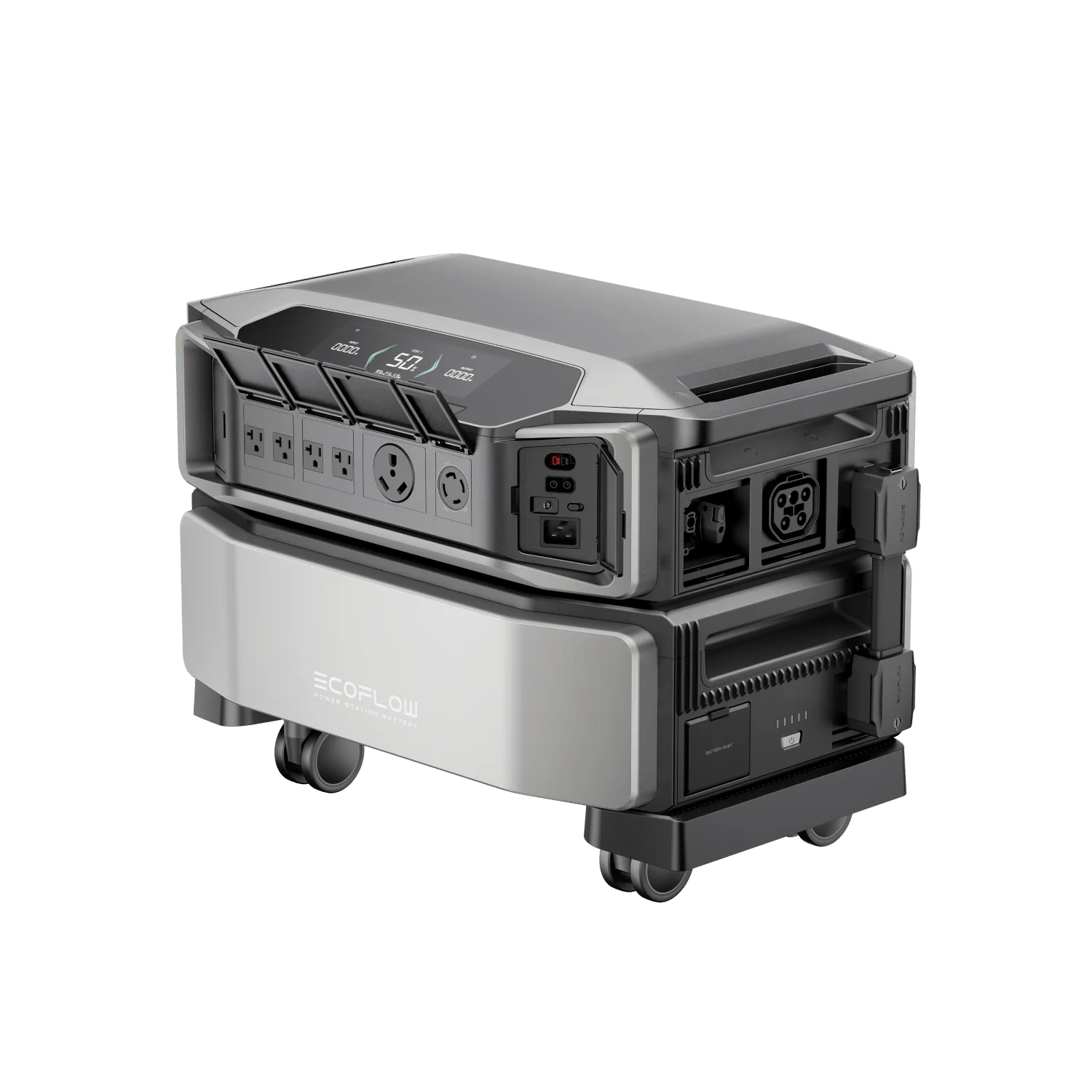
This page compares two EcoFlow units and only two: the DELTA 3 Max, a 2,048Wh, 2,400W portable at $899, and the DELTA Pro Ultra, a 6,144Wh, 7,200W install-class system at $4,199. Not the DELTA 3 Max Plus. Not the DELTA 3, the DELTA 3 Plus or the DELTA 3 Ultra. Not the DELTA Pro or the DELTA Pro 3. EcoFlow's naming makes those trivially easy to confuse, and every figure below belongs to the two units just named.
The arithmetic between them is almost suspiciously clean. Capacity: three times. Continuous output: three times. Price: 4.7 times. Three DELTA 3 Maxes cost $2,547 and add up to the same 6,144Wh and the same 7,200W of inverter, which puts a $1,452 premium on the DELTA Pro Ultra over buying the numbers three times over. That premium isn't energy. It's integration: one inverter instead of three, one surge ceiling at 10,800W instead of three separate 4,800W ones, 5,600W of solar input instead of 3,000W spread across three roofs' worth of gear, and a warranty that runs ten years instead of five.
So the honest framing isn't cheap-versus-expensive, it's portable-versus-installed. The DELTA 3 Max is 50.7 lbs and goes where you go. The DELTA Pro Ultra is 181.8 lbs and goes where you put it, once. Most people reading this want the first thing and are being tempted by the second, which is why the verdict lands where it does.
What the Numbers Reveal
Each conclusion stated first — the numbers behind it on one line, the full analysis below.
continuous output
That $1,452 is the price of the wiring you don't have to do. Three boxes give you three separate 2,400W inverters and three separate 4,800W surge ceilings, which is useless the moment one appliance wants more than 2,400W. The DELTA Pro Ultra puts all of it behind one 7,200W output with a 10,800W surge ceiling, and adds 5,600W of solar input against the 1,000W each DELTA 3 Max accepts. You're not buying watt-hours at a markup. You're buying them consolidated onto one circuit.
DELTA 3 Max: $899, 2,048Wh, 2,400W continuousDELTA Pro Ultra: $4,199, 6,144Wh, 7,200W continuous6,144 divided by 2,048 is exactly 3; 7,200 divided by 2,400 is exactly 3$4,199 divided by $899 is 4.7
Why it mattersIf your problem is total energy, buy capacity cheaply and accept multiple boxes. If your problem is one big load on one circuit, no number of DELTA 3 Maxes solves it and the premium is the actual product.
solar input
For a single evening the 96Wh doesn't matter, because the grid comes back and you plug in. For anything longer the question stops being capacity and becomes refill rate, and there the gap widens rather than narrows: at rated input the DELTA Pro Ultra puts 6,144Wh back in about an hour (6,144 divided by 5,600), while the DELTA 3 Max needs roughly two hours for its 2,048Wh at 1,000W, before any real-world loss. Day two of an outage is won by whoever recharges faster in the same amount of sun, not by whoever started bigger.
8-Hour Blackout scenario needs 1,645WhDELTA 3 Max usable energy is 1,741Wh (2,048Wh derated 85% for inverter losses)That leaves the DELTA 3 Max a 96Wh margin; the DELTA Pro Ultra finishes with 3,577WhSolar input: 1,000W on the DELTA 3 Max, 5,600W on the DELTA Pro Ultra
Why it mattersSingle-evening outages: the DELTA 3 Max is genuinely enough. Multi-day outages in a storm-prone area: buy the recharge speed, and stop thinking of this as a capacity purchase.
weight
Strip the travel assumption out and the scoreboard says something different and more useful. The DELTA 3 Max covers every single-day and single-night load in the set, including the tailgate it supposedly loses. Where it genuinely breaks is multi-day off-grid draw: 2,944Wh short on a full van-life day, and 359Wh short of a two-night camping load. The split isn't mobile versus stationary. It's one day versus several.
DELTA Pro Ultra weighs 181.8 lbs; DELTA 3 Max weighs 50.7 lbsThe scenario engine hands the DELTA Pro Ultra Weekend Camping (40% of usable capacity against 121%) and Tailgate Party (13% against 38%)Tailgate Party needs 670Wh, which the DELTA 3 Max clears with 1,071Wh spareVan Life Daily needs 4,685Wh; the DELTA 3 Max is 2,944Wh short
Why it mattersDon't read four wins out of six as the DELTA Pro Ultra being better at camping. Read it as the DELTA Pro Ultra being the only one of the two that survives more than one day unplugged, in a place it can stay.
rated cycles
The one column that runs the other way is coverage, and it runs a long way: ten years against five. But per dollar even that inverts, because $899 buys 5.9 warranty years per $1,000 spent and $4,199 buys 2.5. So the DELTA Pro Ultra is never the economical choice and doesn't need to be. It's a capability purchase that happens to come with a decade of coverage, which is a reasonable thing to want from something you bolt into a house and don't move again.
Cost per stored watt-hour: $899 divided by 2,048Wh is $0.41; $4,199 divided by 6,144Wh is $0.65Lifetime energy: 4,000 cycles times 2,048Wh is 8,192 kWh; 3,500 cycles times 6,144Wh is 21,504 kWhCost per lifetime kWh: $0.10 for the DELTA 3 Max, $0.19 for the DELTA Pro UltraWarranty: 5 years against 10 years, at $170 and $400 per warranty year
Why it mattersAnyone shopping this pair on cost per watt-hour has already found their answer and should stop reading. The DELTA Pro Ultra only makes sense to someone buying an output rating or a solar ceiling, not a battery.
The specific dimensions that decide these two units — everything else is a tie.
Lifetime Value
Selected because: The price gap is $3,300 and the capacity gap is exactly three times, so the first thing to settle is what the extra money buys per stored watt-hour: $0.41 on the DELTA 3 Max against $0.65 on the DELTA Pro Ultra.
cost / lifetime kWh
Ten cents a lifetime kilowatt-hour against nineteen, and the cheaper unit is also the longer-lived one at 4,000 cycles against 3,500. That's an unusual combination. Normally the expensive machine at least buys you endurance; here it buys you scale, and you pay for the scale twice, once at the till and again every time you cycle it.
The warranty is the honest counterweight and it's a real one. Ten years of coverage on something you install and forget is worth more than ten years on something you throw in a truck bed, because the failure you're insuring against is the one you can't work around. Just don't mistake it for value: at $400 per covered year against $170, you're buying peace of mind at retail.
Your Life, Your Pick
Selected because: The DELTA Pro Ultra takes four of the six load scenarios, but two of those four assume the unit travels, and it weighs 181.8 lbs.
Four wins out of six looks decisive until you check what two of them are made of. Weekend Camping and Tailgate Party both assume a unit that gets to the destination, and this scoring model has no class for an installed system, so a 181.8 lb appliance is scored as if someone carries it across a parking lot. It doesn't, and nobody does. Treat those two rows as arithmetic about energy, not advice about camping.
What's left after that correction is clean. Every single-day and single-night load in the set falls inside the DELTA 3 Max's 1,741Wh of usable energy, most of them with room to spare. The two it genuinely can't do are the two that run for days without a recharge. One caution on the cold end, since neither unit's charge-temperature floor is in our spec record: both are LFP, and LFP won't take a charge below freezing. The DELTA 3 Max has been run at around 34 degrees in hands-on testing without troubleA3, which is close to that line but on the right side of it. Don't extrapolate either unit past it.
Portability & Form Factor
Selected because: 50.7 lbs against 181.8 lbs isn't a convenience difference. It's the difference between a unit you carry and one you place once.
weight
50.7 lbs is a two-hands, bent-knees lift that one adult manages out of a trunk. 181.8 lbs is a hand truck, a second person, and a conversation about whether it clears the basement door. The difference between them is 131.1 lbs, but the number that governs your day is 181.8, because that's what actually has to get through the doorway.
That makes the DELTA Pro Ultra a placement decision rather than a packing decision, and placement decisions are made once. Pick the spot before you order: near the circuits you actually care about, on something you don't mind marking, with the ports still reachable after it lands. The DELTA 3 Max you can just move if you got it wrong.
What the Specs Don't Tell You
Selected because: Three rows separate these units in ways the headline specs hide: 0ms against 10ms transfer time, a 10,800W against 4,800W surge ceiling, and ten years of warranty against five.
rated cycles
The surge row is the one worth understanding properly, because two things are being measured and they point opposite ways. The DELTA 3 Max keeps the better ratio, holding twice its continuous rating in reserve against the DELTA Pro Ultra's one and a half. The DELTA Pro Ultra holds the higher absolute ceiling at 10,800W. A compressor draws a fixed number of watts at switch-on, not a multiple of somebody's rating, so on the question of what will actually start, the ceiling is what you look at and the ratio is what you look at afterwards to know how hard the inverter is working at rest.
The USB-C row is a genuine dead heat at 100W apiece, which is worth saying out loud because it's one of the few places a $3,300 gap buys nothing at all. The transfer-time row separates them on paper by 10ms, and on a live page that number deserves the caveat in the note beside it.
Growth Path
Selected because: Both accept expansion batteries and neither has swappable packs, so the real growth difference is solar: 5,600W of input on the DELTA Pro Ultra against 1,000W on the DELTA 3 Max.
solar input
Both units take expansion batteries and neither offers hot-swappable packs, so growth here means adding, not carrying spares. The difference is what you can pour in: 5,600W of solar against 1,000W. On a bank that grows, input ceiling is the constraint that bites first, because a bigger battery you can't refill in a day is just a heavier battery.
One thing we won't quote you is how far the DELTA Pro Ultra platform actually expands. The figures in circulation for it contradict each other, our own spec record carries only that it's expandable, and the ledger entry we hold describes the platform rather than this specific single-battery configurationB1. If your purchase turns on a whole-home ceiling number, get it in writing for your exact build before you spend $4,199 on the assumption.
Strengths & trade-offs
EcoFlow DELTA 3 Max
Strengths
- +Costs $3,300 less
- +Lighter by 131.1 lb
Trade-offs
- –Weaker inverter (-4,800W) limits appliance compatibility.
EcoFlow DELTA Pro Ultra
Strengths
- +Larger battery capacity
- +Higher AC output
- +Longer warranty
- +Faster solar charging
Trade-offs
- –Substantially more expensive (+$3,300) than the DELTA 3 Max.
- –Significantly heavier (+131.1 lbs), making it harder to move.
- –Very heavy unit that may be difficult for one person to lift.
Will It Power Your Gear?
Scenario math and per-appliance runtimes, modeled from the spec record.
Scenario verdicts
We ran the math on six real-world scenarios. Here's which unit survives your actual life.
SCN-01 · 2 nights · needs 2,100Wh
Weekend Camping
Two nights off-grid with essential comfort
Neither unit
On energy this goes to the DELTA Pro Ultra and it isn't close. The two-night load is 2,100Wh, the DELTA 3 Max has 1,741Wh usable after the 85% derate, and 359Wh short is short. The DELTA Pro Ultra finishes with 3,122Wh in hand. Read the win narrowly, though: this scoring model has no category for an installed system, so it grades a 181.8 lb appliance as if it rides to the campsite. The useful version of this row is that the DELTA 3 Max can't quite cover two nights, and the thing that can weighs more than most of the people carrying it.
Battery budget usedlower = more headroom
LOAD Phone Charger 15W×6h · LED Lights 40W×8h · Box Fan 75W×14h · CPAP Machine 40W×16h
SCN-02 · 8 hours · needs 1,645Wh
8-Hour Blackout
Keep the essentials running through a night without power
DELTA Pro Ultra
Both units finish the eight hours. The difference is what's left when they do. The DELTA 3 Max clears the 1,645Wh load with 96Wh of its 1,741Wh usable energy remaining, which is a pass with nothing behind it, and nothing at all if the outage runs to a second evening. The DELTA Pro Ultra ends with 3,577Wh spare, enough to do the same night twice more. Single-evening outages: the smaller unit is fine. Storm country, where the lights stay off into day two: this is the row you're buying.
Battery budget usedlower = more headroom
LOAD Fridge 150W×8h · Router + Modem 20W×8h · LED Lights (4 bulbs) 40W×6h · Phone Charger 15W×3h
SCN-03 · 8 hours · needs 320Wh
CPAP Overnight
Sleep therapy without interruption — the #1 medical use case
Either unit
A dead heat, and a comfortable one. The 320Wh night leaves the DELTA 3 Max with 1,421Wh and the DELTA Pro Ultra with 4,902Wh, which is another four nights on one and another fifteen on the other before either needs a recharge. Noise won't break it either: both are listed at the same 30 dBA, so there's no difference to prefer. What does break it is everything else in the row. $899 against $4,199, and 50.7 lbs against 181.8 for something that has to share a bedroom. On this scenario alone the cheaper unit wins on the tiebreaks.
Battery budget usedlower = more headroom
LOAD CPAP Machine 40W×8h
SCN-04 · 8 hours · needs 910Wh
Remote Workday
Full work day off-grid without power anxiety
DELTA Pro Ultra
The DELTA Pro Ultra clears the workday at 17% used, banking 4,312Wh — late work, extra calls, or a second laptop charge without arithmetic. The DELTA 3 Max at 52% also finishes, with 831Wh of slack for the unplanned.
Battery budget usedlower = more headroom
LOAD Laptop 60W×8h · External Monitor 30W×8h · Router + Modem 20W×8h · Phone Charger 15W×2h
SCN-05 · 4 hours · needs 670Wh
Tailgate Party
Game day power for the crew
DELTA 3 Max
The DELTA Pro Ultra takes this on reserve, using 13% of its usable capacity against the DELTA 3 Max's 38%, and that's correct arithmetic on a 670Wh load. It's also headroom on a load both units clear without effort, since the DELTA 3 Max still walks away with 1,071Wh spare. Worth knowing before you weight it: this scoring model has no category for an installed system, so a 181.8 lb unit gets scored on a scenario that assumes it reaches the parking lot. Weight isn't in this row. For tailgating it's the row that matters.
Battery budget usedlower = more headroom
LOAD Blender 400W×0.5h · LED TV (55") 80W×4h · Bluetooth Speaker 15W×4h · Phone Charger (×3) 45W×2h
SCN-06 · 24 hours · needs 4,685Wh
Van Life Daily
A full day of mobile living — the ultimate endurance test
DELTA Pro Ultra
The DELTA 3 Max isn't in this one. The daily load is 4,685Wh against 1,741Wh usable, a 2,944Wh shortfall, and no amount of careful budgeting closes a gap that size. The DELTA Pro Ultra covers it, but only just: 90% of usable capacity, 537Wh left at the end of the day. A load that deep every day makes recharge the real spec, which is where the 5,600W solar ceiling earns its price. At rating it puts 6,144Wh back in about an hour, against roughly two hours for the DELTA 3 Max's 2,048Wh at 1,000W, before real-world losses.
Battery budget usedlower = more headroom
LOAD Mini-Fridge 150W×24h · Laptop 60W×4h · Phone Charger 15W×3h · LED Lights 40W×5h · Fan 75W×8h
The Load Test
RUNTIME = (Wh × 0.85) ÷ LOAD
None of the scenarios above exactly yours? Build it. Toggle what you'd plug in; both units are tested against the combined draw.
Essentials
Comfort & Convenience
High-Draw Appliances
Test duration
8h
Continuous draw
205W
Projected runtime
For this load: DELTA Pro Ultra runs 25.5h vs 8.5h.
$4,199 list · direct from EcoFlow
Modeled from the spec record — same math as the tables below. Methodology
Runtime by appliance
Real-world runtime estimates for common appliances, modeled at 85% inverter efficiency.¹
Essentials
The basics you need runningscale 0–348.2hComfort & Convenience
Makes off-grid life actually enjoyablescale 0–69.6hHigh-Draw Appliances
These reveal the real limitsscale 0–5.2h¹ Runtime = (capacity × 0.85) ÷ appliance watts. Within each group, all bars share one time scale (the group's longest runtime), so lengths are comparable across appliances; identical runtimes collapse into a single blue/orange bar. Actual runtime varies with battery age, temperature, and simultaneous loads — see methodology.
Conclusion
August 9, 2026
Verdict: the EcoFlow DELTA 3 Max
Buy the DELTA 3 Max at $899 unless you can name the reason you need the other one. The DELTA Pro Ultra carries exactly three times the capacity (6,144Wh against 2,048Wh) and exactly three times the continuous output (7,200W against 2,400W) for 4.7 times the price, and it's the more expensive machine on every energy measure here: $0.65 per stored watt-hour against $0.41 ($4,199 divided by 6,144, and $899 divided by 2,048), and $0.19 per lifetime kWh against $0.10. Four tripwires flip that. A load over 2,400W continuous. A day that needs more than 1,741Wh of usable energy before you can recharge. A solar array bigger than 1,000W. Or equipment with a documented transfer-time limit tighter than 10ms. Hit one and the DELTA Pro Ultra is the only one of the two that does the job, and it does it well. Hit none and the $3,300 difference buys a lot of panels.
Editor-assigned confidence, based on cited owner research and spec analysis.
List prices as of August 9, 2026. The links below open EcoFlow's current price.
$899.00 · direct from EcoFlow
Last checked 1 day ago. Prices move — check before you buy.
or check the DELTA Pro Ultra price$4,199.00 list
Written by Gunner Gustafson, Whole-Home Backup Tester · Station Arena Test Desk · Updated August 9, 2026
Measured Data
Benchmark scores and the full spec record, side by side.
Benchmark scores
Not rated for both units (minimum threshold unmet): UPS, RV Living, CPAP, Solar Generator, Tailgating, Apartment Balcony.
Full specifications
ᵈ Derived: price ÷ rated capacity. See the data behind our comparisons →
Comparison ToolAdd more power stations, side by sideOpen Tool →How these numbers are produced
Numeric verification
Every figure on this page traces to our spec database or arithmetic on it — no estimated numbers.
Owner claims
Statements about owner experience are cited to published reviews — see Sources & Research Notes below.
Runtime model
Runtime = (rated capacity × 0.85 inverter efficiency) ÷ device wattage. Solar recharge estimates assume panels deliver 70% of rated output. Cold weather, battery age, and stacked loads reduce real-world results.
Power Score
Computed from 14 published spec dimensions, weighted per use-case bench. Higher is better; a unit must meet a bench's minimum threshold to be rated.
See the full weight table and data sourcing on our methodology page →Class ranking (the star rating)
Each unit's star score is a category ranking, not customer reviews — no buyer opinions feed it. We score every station on size-independent quality (value, output, portability, endurance, ports, warranty, and more), then percentile-rank it against the other units in its capacity class, so a class-leading compact unit and a class-leading whole-home unit can both earn 5★. Here, DELTA 3 Max rates 4.3/5 (60th percentile of 26 Large-class units), and DELTA Pro Ultra rates 4.9/5 (93rd percentile of 16 Home Backup-class units).
How the class ranking is computed →Test Notes & Caveats
Hidden gotchas and advantages we spotted that you won't find on the product page.
181.8 lbs is a placement decision, not a packing decision
The DELTA Pro Ultra weighs 181.8 lbs against the DELTA 3 Max's 50.7, a difference of 131.1 lbs. The number that governs your day is 181.8, because that's what has to get through the doorway. One person moves the DELTA 3 Max. Two people and a hand truck move the DELTA Pro Ultra, once, to the spot it will live for years. Choose that spot before you order: near the circuits you care about, on a floor you don't mind marking, and close enough to reach the ports afterwards.
Surge Power: Ratio and Ceiling Disagree
The DELTA 3 Max holds the higher surge-to-continuous ratio (2× vs 1.5×), but the DELTA Pro Ultra holds the higher absolute surge ceiling — 10,800W against 4,800W. These measure different things. The ratio says how much headroom an inverter keeps above its own rating; the ceiling says how big a startup spike it can actually swallow. A motor draws a number of watts at switch-on, not a multiple of someone else's rating, so on raw starting ability the DELTA Pro Ultra is the stronger unit here — while the DELTA 3 Max is the one running further below its own limit at steady state.
0ms against 10ms, and what it's actually worth
The DELTA Pro Ultra's transfer time is listed at 0ms and the DELTA 3 Max's at 10ms. Read that 0 as a class rather than a stopwatch reading, since a zero in a spec table is also what an unpublished figure looks like. Either way the gap is 10ms, and desktops, NAS boxes and routers ride out 10ms on their own internal capacitors without noticing. If you own equipment whose datasheet names a transfer-time limit tighter than 10ms, the DELTA Pro Ultra is the only one of these two that clears it. If you don't, this row shouldn't move any money.
Warranty: 10 Years vs 5
The DELTA Pro Ultra is covered for 10 years against the DELTA 3 Max's 5 years. The cheaper DELTA 3 Max does buy more warranty per dollar (5.6 years per $1,000 against 2.4), but that is a statement about price, not about coverage — if a fault appears in year 6, only one of these is still covered. An underrated factor if you're keeping this unit for years.
Full record above — the Test Desk pick is the DELTA 3 Max.
Check DELTA 3 Max price →or check the DELTA Pro Ultra priceOwnership Analysis
What happens after you buy — true cost of ownership, brand trust, and growth potential.
Lifetime value
Service lifeyears at one full cycle per day
Lifetime energy delivered
Cost per delivered kWh
│ warranty ends · Reaching the cycle rating means ~80% capacity remains — degraded, not dead.
Analyst note
The DELTA 3 Max wins on both sticker price and long-term value. At $0.11/kWh over its lifetime, it's meaningfully cheaper to own. Clear value winner. One caution on the lifespan row: the DELTA 3 Max takes longer to reach its cycle rating, but a cycle moves a different amount of energy on each unit — the DELTA Pro Ultra still delivers more over its shorter horizon (21,504 vs 8,192 kWh). Years measure wear, not usefulness.
Growth path
DELTA 3 Max
EXPANDABLESupports EcoFlow expansion batteries, so you can add capacity later without replacing the base unit — useful if your needs may climb past 2,048Wh.
Accepts up to 1,000W of solar. Enough for a serious multi-panel array.
Generous port selection supports complex multi-device setups.
Expansion batteries are EcoFlow-specific. You're investing in the EcoFlow ecosystem.
DELTA Pro Ultra
EXPANDABLESupports EcoFlow expansion batteries, so you can add capacity later without replacing the base unit — useful if your needs may climb past 6,144Wh.
Accepts up to 5,600W of solar. Enough for a serious multi-panel array.
Adequate ports for most setups, but heavy users may want a power strip.
Expansion batteries are EcoFlow-specific. You're investing in the EcoFlow ecosystem.
Realistic full solar rechargeat 70% of rated panel output — see methodology
Analyst note
Both expand, but the DELTA Pro Ultra's higher solar ceiling (5,600W vs 1,000W) gives it the stronger off-grid growth path — more panels can feed a bigger bank as it grows.
What Owners Report
Patterns from published owner reports and long-term reviews — every claim cited to its source below.
EcoFlow DELTA 3 Max
Field coverage for the DELTA 3 Max is review-desk rather than long-haul owner, so read the durability picture as promising rather than provenA3A4. What testing exists holds up well: measured capacity stayed consistent between one-month and three-month checks, and the unit came through truck-bed transport, storage in a roughly 105-degree garage, and operation down around 34 degrees without complaintA3. The overall verdict was 8.5 out of 10, with LFP longevity and fast recharge singled out as the value case in the 2kWh classA4.
The two things reviewers keep coming back to are noise and the app, and they're the same storyA1A2. Under moderate load it's described as essentially silent at conversational distance, and when the fans do come up on a hard charge, the app offers a quiet mode and a custom charge-speed limit to bring them back downA1A2. One caution on reading any of it: our coverage note flags that several sources conflate the DELTA 3 Max with the DELTA 3 Max Plus, so the line-wide app and ecosystem claimsA2 travel more safely than any figure pinned to one variant.
“Whisper-quiet under moderate load — essentially silent at conversational distance; the app adds a low-power quiet mode and a custom charge-speed limit if fan noise bothers you. Fans rise under heavy load but stay quieter than most competitors in the 2kWh class.”
Sources
backuppowerhub.com · thesolarlab.com · androidguys.com
EcoFlow DELTA Pro Ultra
The DELTA Pro Ultra's evidence needs a label before it needs a summary. The ledger we hold is a platform ledger spanning one- to four-battery configurations, so its capacity, weight and charge-time entries may describe a different build than the single-battery 6,144Wh unit priced hereB1B3. The fast-charging entry, for instance, times two batteries rather than oneB3. Treat those as facts about the platform, not measurements of this configuration.
What does transfer cleanly is the ownership experience: owners describe a straightforward whole-home backup with quick setup, strong solar input and solid app monitoring, and report the 7,200W inverter running a 3-ton central air conditionerB4. Starting a compressor that size is a question for the surge ceiling rather than the continuous rating, so read that as evidence it runs the load, not proof of what it will start. The cell rating lines up with our spec record at over 3,500 cycles to 80%B2. One entry we won't carry across: it calls the unit silent below 2,000W, which our own 30 dBA figure doesn't supportB3.
“6,144Wh per battery with 7,200W continuous output (10.8kW surge), expandable to 90kWh across a system for a household — over 30 days of essential backup.”
Sources
ecoflow.com · homedepot.com · autoboosting.com · ecogadgethub.com
Sources & Research Notes
Every owner claim in this report is traceable to a published source. The bracketed references above resolve here.
Recurring owner themes
- Reviewers consistently praise practical quietness (with app-based quiet/charge-limit modes) and the EcoFlow app/ecosystem as differentiators. [DELTA 3 Max · 2 entries]
- Whole-home scale (to 90kWh), 7,200W output, online UPS, silent operation under load, and industry-fast charging are the standout features. [DELTA Pro Ultra · 2 entries]
- A1
“Whisper-quiet under moderate load — essentially silent at conversational distance; the app adds a low-power quiet mode and a custom charge-speed limit if fan noise bothers you. Fans rise under heavy load but stay quieter than most competitors in the 2kWh class.”
backuppowerhub.com — EcoFlow DELTA 3 Max Review; thesolarlab.com — DELTA 3 Max Review · 2026 · [positive]
- A2
“The EcoFlow app is one of the main reasons people migrate to the ecosystem: deep control including a custom charge-speed limit and quiet mode, well beyond the on-device interface.”
androidguys.com / thesolarlab.com — EcoFlow DELTA 3 Max line · 2026 · [positive]
- A3
“Capacity stayed consistent between 1-month and 3-month tests (within measurement error). The unit survived truck-bed transport, storage in a ~105°F garage, and operation near freezing (~34°F) without issue.”
backuppowerhub.com — EcoFlow DELTA 3 Max Review (hands-on) · 2026 · [positive]
- A4
“Rated 8.5/10 overall — strong across nearly every metric in the 2kWh class, with fast recharge and LFP longevity called one of the best value propositions in the segment.”
backuppowerhub.com — EcoFlow DELTA 3 Max Review · 2026 · [positive]
- B1
“6,144Wh per battery with 7,200W continuous output (10.8kW surge), expandable to 90kWh across a system for a household — over 30 days of essential backup.”
ecoflow.com / homedepot.com — DELTA Pro Ultra · 2026 · [positive]
- B2
“LFP chemistry rated for over 3,500 cycles to 80% (10+ years of use).”
ecoflow.com / autoboosting.com — DELTA Pro Ultra review · 2026 · [positive]
- B3
“Industry-fast 8,800W charging tops up two batteries in about 2 hours; an online UPS protects sensitive electronics round the clock, and it runs at 0 dB (silent) for draws under 2,000W.”
ecoflow.com / ecogadgethub.com — DELTA Pro Ultra review · 2026 · [positive]
- B4
“Owners call it a powerful, easy-to-use whole-home backup with quick setup, strong solar input, and good app monitoring; its 7,200W inverter can power a 3-ton central AC.”
homedepot.com owner reviews — DELTA Pro Ultra · 2026 · [positive]
Research compiled August 9, 2026.
Who Should Buy Which
Buy the DELTA 3 Max if you…
- →You want backup for evening outages and the occasional weekend, and you'd rather put the $3,300 difference into panels than into watt-hours you'll never cycle.
- →You rent, or you move, or the unit needs to live in a different room next year. 50.7 lbs goes wherever you decide it goes.
- →Your biggest load is under 2,400W continuous, which covers a fridge, a router, lights, laptops and a coffee maker that isn't running while the microwave is.
- →You're running a CPAP. The night costs 320Wh and leaves 1,421Wh behind, so capacity is a formality and you're really choosing on price and on what sits beside your bed.
Buy the DELTA Pro Ultra if you…
- →You're wiring backup into a panel and need one 7,200W circuit rather than three appliances each with their own outlet.
- →You live off-grid or in a van full time, where the daily draw is 4,685Wh and nothing smaller finishes the day.
- →Your solar array is already bigger than 1,000W, or will be. The 5,600W input ceiling is the single hardest thing on this page to replicate with cheaper units.
- →You have equipment with a documented transfer-time limit under 10ms and a datasheet that says so. This is the only unit of the two that clears it.
If neither fits
Anyone who's actually going camping with this. The two-night load in our scenario set is 2,100Wh, which needs roughly 2,471Wh of nameplate capacity once you allow the 85% inverter derate (2,100 divided by 0.85), and the DELTA 3 Max only has 2,048Wh. The DELTA Pro Ultra has plenty and weighs 181.8 lbs, which settles it from the other direction. If the box has to travel and last two nights, shop portables rated comfortably above that 2,471Wh figure that one person can still lift, and skip both of these. Skip both as well if you're buying on a whole-home expansion ceiling: the numbers quoted for this platform disagree with each other, and that belongs in your installer's quote rather than on any comparison page.
The Bottom Line
The arithmetic that opened this page is the arithmetic that closes it. Three times the capacity, three times the output, 4.7 times the price. What the $1,452 premium over three DELTA 3 Maxes actually buys isn't energy, it's consolidation: one inverter, one surge ceiling, one solar input big enough to matter, and a warranty that runs twice as long. That's a real product and some people genuinely need it. It just isn't a better battery.
So the DELTA 3 Max at $899 is the default, and the DELTA Pro Ultra is the exception you should be able to justify in one sentence. A load over 2,400W. A day that runs past 1,741Wh with no chance to recharge. An array bigger than 1,000W. Gear with a transfer limit under 10ms on its datasheet. If one of those is your life, spend the $4,199 and decide where it lives before the pallet shows up, because 181.8 lbs is a decision you make exactly once. If none of them is, go get the DELTA 3 Max and put the difference on the roof.
Frequently Asked Questions
Answers drawn from the spec record and cited owner research.
Is the DELTA 3 Max the same as the DELTA 3 Max Plus?
No, and the naming catches people out constantly. This page compares the 2,048Wh DELTA 3 Max at $899 against the 6,144Wh DELTA Pro Ultra at $4,199, and every number here belongs to those two units. EcoFlow sells several near-identically-named siblings, including a DELTA 3 Max Plus, a DELTA 3 Ultra, a DELTA Pro and a DELTA Pro 3, all with different capacities and prices. If the box in your cart doesn't say DELTA 3 Max or DELTA Pro Ultra, the figures on this page don't describe it.
Is the DELTA Pro Ultra worth 4.7 times the price of the DELTA 3 Max?
Only if you need the output or the solar input, never for the energy. It carries exactly three times the capacity for 4.7 times the money, which works out to $0.65 per stored watt-hour against $0.41. What the premium actually buys is one 7,200W inverter instead of three smaller ones, a 10,800W surge ceiling, 5,600W of solar input against 1,000W, and ten years of warranty against five. If none of those four is something you can point at in your own house, buy the DELTA 3 Max.
Which one should I get for power outages?
For a single evening, the DELTA 3 Max. It clears a standard eight-hour outage of 1,645Wh with 96Wh of its 1,741Wh usable energy still in the tank, which is thin but sufficient when the grid comes back overnight. For outages that routinely run into a second or third day, the DELTA Pro Ultra, and the reason is recharge rather than capacity: 5,600W of solar input refills it in roughly an hour at rating, against about two hours for the DELTA 3 Max at 1,000W.
Can the DELTA 3 Max run everything the DELTA Pro Ultra can?
No. The DELTA 3 Max tops out at 2,400W continuous with a 4,800W surge ceiling; the DELTA Pro Ultra runs 7,200W continuous and peaks at 10,800W. That's the difference between running a fridge, lights and a laptop, and running a central air conditioner. Buying three DELTA 3 Maxes gets you the same 6,144Wh and the same 7,200W on paper for $2,547, but as three separate 2,400W inverters, which doesn't help the one appliance that wants more than 2,400W.
How much can the DELTA Pro Ultra expand to?
We won't give you a number, because the published figures for this platform contradict each other and our own spec record carries only that it's expandable. The ledger entry we hold describes the platform across its one- to four-battery configurations rather than the single 6,144Wh unit priced here. If the expansion ceiling is the reason you're buying, get the figure for your exact configuration in writing from the seller or installer before you commit.
Where to buy
EcoFlow DELTA 3 MaxPick
$899.00
$899.00 · direct from EcoFlow
Last checked 1 day ago. Prices move — check before you buy.
EcoFlow DELTA Pro Ultra
$4,199.00
$4,199.00 · direct from EcoFlow
Last checked 1 day ago. Prices move — check before you buy.
Prices may vary by retailer and are subject to change.