Head-to-head test
EcoFlow DELTA 3 Classic vs Anker SOLIX C2000 Gen 2
Pay $531 more today for the SOLIX C2000 Gen 2, and it pays you back: a lower cost per lifetime kilowatt-hour than the DELTA 3 Classic, plus the only one of these two units that actually clears an 8-hour blackout.
Full profiles: EcoFlow DELTA 3 Classic → · Anker SOLIX C2000 Gen 2 →
Looking for a different matchup? EcoFlow DELTA 3 Max vs Anker SOLIX C2000 Gen 2 · EcoFlow DELTA 3 vs Anker SOLIX C2000 Gen 2 · EcoFlow DELTA 3 vs Anker SOLIX S2000

Written by Ian SchneiderUpdated
Solar & Off-Grid Tester, Station Arena Test Desk

$559.00 · direct from EcoFlow
Last checked 1 day ago. Prices move — check before you buy.
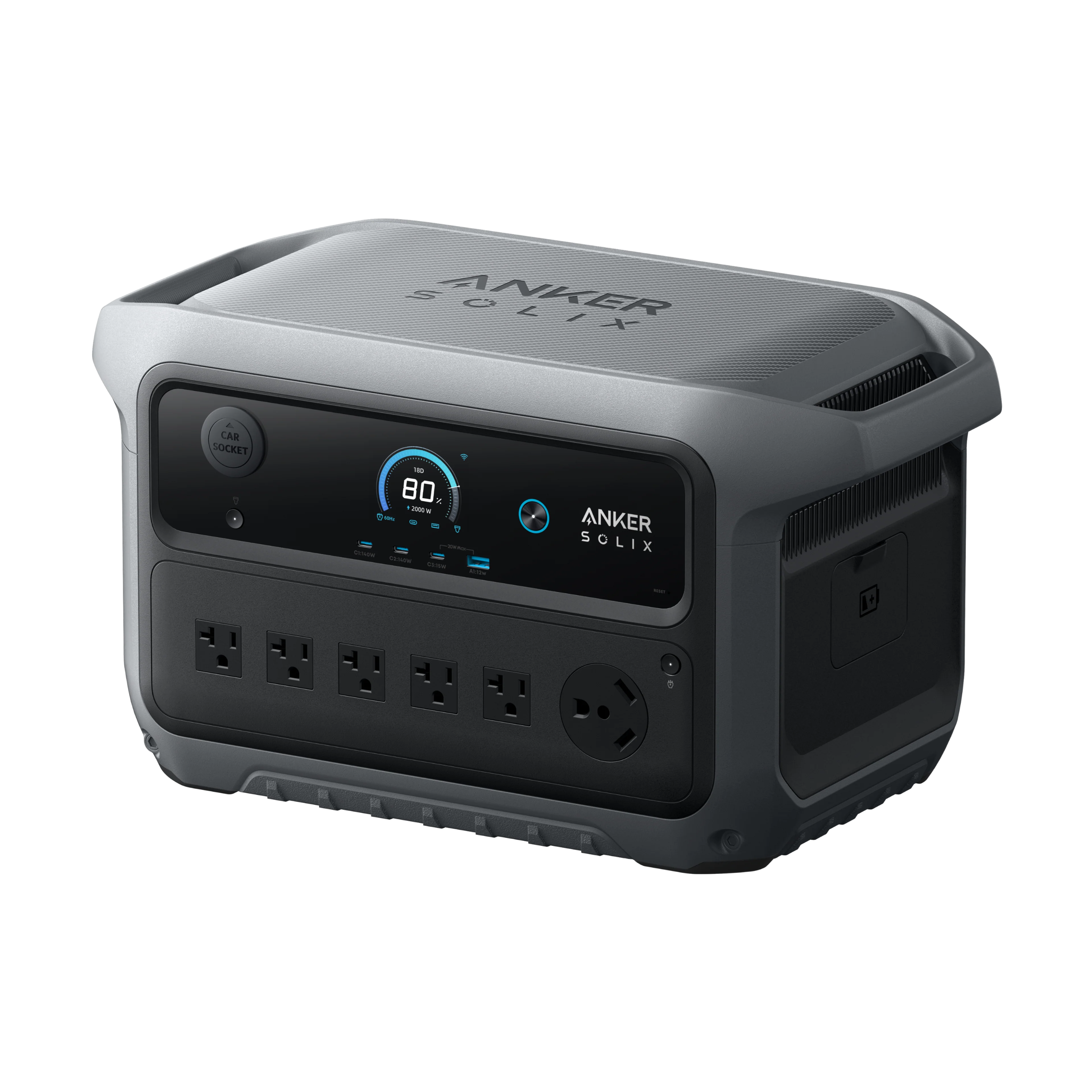
$999.99 · direct from Anker
Last checked 1 day ago. Prices move — check before you buy.
Spec deltas
The SOLIX C2000 Gen 2 costs $1,000 against the DELTA 3 Classic's $469, and it's still the cheaper battery to own. Divide price by every kWh each unit will deliver over its life and the DELTA 3 Classic works out to $0.15 per kWh; the C2000 Gen 2 comes in at $0.12. A bigger cycle count on a bigger battery, 4,000 cycles across 2,048Wh against 3,000 cycles across 1,024Wh, does more to lower the real cost than a smaller price tag ever could.
Capacity is also where these two actually split. The DELTA 3 Classic runs a CPAP overnight or a tailgate afternoon without trouble, using well under half its usable capacity for either job. Ask it for a full remote workday, though, and it comes up just short at 105% of usable capacity. Ask it for an 8-hour blackout and it isn't close: that load needs 189% of what it can supply. The C2000 Gen 2 clears all four jobs with real room to spare.
Buy the C2000 Gen 2 if your use case looks like real outage prep, a full home-office day, or a solar setup you plan to grow. Buy the DELTA 3 Classic if it's strictly CPAP or tailgate duty and the $531 matters more than headroom you won't use. Neither one is built for a full camping weekend or daily van life, so don't stretch either past what it holds.
What the Numbers Reveal
Each conclusion stated first — the numbers behind it on one line, the full analysis below.
rated cycles
The unit that costs $531 more on the shelf is the cheaper one to own once you count every kWh it will ever push through its cells. The sticker price is measuring the wrong thing.
DELTA 3 Classic: $469, 1,024Wh capacity, 3,000 cycles (3,072 lifetime kWh)SOLIX C2000 Gen 2: $1,000, 2,048Wh capacity, 4,000 cycles (8,192 lifetime kWh)
Why it mattersA buyer comparing these on up-front price alone is optimizing for the number that matters least; anyone planning to actually cycle the battery for years should budget by cost per kWh instead.
105% of usable capacity is a battery that runs dry with the laptop still open near the end of the day. 189% is a battery that's dead before the outage is half over. One is a rounding error, the other is a design mismatch.
Remote Workday needs 910Wh; DELTA 3 Classic uses 105% of usable capacity there (can't cover it), SOLIX C2000 Gen 2 uses 52%8-Hour Blackout needs 1,645Wh; DELTA 3 Classic uses 189% of usable capacity (can't cover it), SOLIX C2000 Gen 2 uses 94%
Why it mattersA buyer whose real load looks like a single home-office day should treat the DELTA 3 Classic as close, not disqualified. A buyer prepping for an actual multi-appliance outage should treat that same unit as the wrong tool.
solar input
The C2000 Gen 2 carries double the battery but takes only about 30 minutes longer to refill from empty on a good solar day, because its solar input scaled up almost as fast as its capacity did.
DELTA 3 Classic: 1,024Wh capacity, 500W max solar inputSOLIX C2000 Gen 2: 2,048Wh capacity, 800W max solar input
Why it mattersAn off-grid buyer who assumes a bigger battery always means a slower refill can drop that assumption here. The C2000 Gen 2 isn't trading refill speed for capacity, it's keeping both.
weight
It isn't dead weight. Those extra cells are what let the C2000 Gen 2 clear the Blackout and Remote Workday scenarios the lighter unit can't touch; you're carrying the 15 lbs specifically so the thing works when you need it to.
DELTA 3 Classic weighs 26.7 lbsSOLIX C2000 Gen 2 weighs 41.7 lbs
Why it mattersSomeone who only ever hauls this unit to a tailgate or a campsite chair, never a real multi-appliance outage, should weigh those 15 lbs against how often they'd actually cash in the extra headroom.
The specific dimensions that decide these two units — everything else is a tie.
Your Life, Your Pick
Selected because: This pair's whole story is capability: the C2000 Gen 2 clears every scenario where the two units actually differ, so showing that split is the core argument.
Two of the four scenarios where these units actually differ split clean in the DELTA 3 Classic's favor on paper: it runs a CPAP overnight using 37% of its usable capacity and a tailgate afternoon at 77%, comfortable margins on both. Ask it for a full remote workday, though, and it's asking a 1,024Wh battery to cover 910Wh of draw with almost nothing left over: 105% of what it can supply. An 8-hour blackout needs even more, 189% of its usable capacity, not close.
The SOLIX C2000 Gen 2 clears all four with room to spare, from 18% of usable capacity on the CPAP night up to 94% on the blackout. That headroom is the actual case for the extra $531. It isn't paying for a bigger number on a spec sheet, it's paying for the gap between an outage you ride out and one you don't.
Lifetime Value
Selected because: The twist that the $531-pricier unit is actually cheaper per kWh is the strongest receipt for the verdict.
cost / lifetime kWh
Run the math and the pricier unit is the cheaper one: $469 buys 3,072 lifetime kWh from the DELTA 3 Classic at $0.15 per kWh, while $1,000 buys 8,192 lifetime kWh from the SOLIX C2000 Gen 2 at $0.12. A bigger cycle count (4,000 against 3,000) spread across a bigger battery (2,048Wh against 1,024Wh) does more to lower the real cost than a smaller price tag ever could.
The one place the math doesn't favor the pricier unit is cost per warranty year. Both carry a 5-year warranty, but that coverage runs $94 a year on the DELTA 3 Classic against $200 a year on the SOLIX C2000 Gen 2. If you're pricing the warranty term itself as insurance rather than the battery as a tool, the cheaper unit is the better bet on that one narrow measure.
What the Specs Don't Tell You
Selected because: Surge ratio, warranty, and cycle life all fire for this pair and explain the mechanics behind both the scenario split and the cost inversion.
rated cycles
The DELTA 3 Classic actually has the more generous surge cushion by ratio: 1,800W rated output that surges to 3,600W is a full 2x, against the SOLIX C2000 Gen 2's 2,400W rated to 4,000W surge, a 1.67x ratio. In absolute terms the C2000 Gen 2 still surges higher, 4,000W against 3,600W, and both numbers clear a typical fridge or window AC compressor's startup draw with room to spare. It's a detail for the spec-sheet reader, not a reason to change your pick.
Cycle life is the more consequential of the three gotchas here. 3,000 cycles against 4,000 is the entire reason the pricier unit ends up cheaper per kWh. Translated into calendar years at a twice-a-week pace, that's about 28.8 years for the DELTA 3 Classic against 38.5 for the SOLIX C2000 Gen 2, both so far past any realistic ownership window that the real edge is the cost math above, not which one wears out first.
Growth Path
Selected because: The 500W vs 800W solar ceiling matters most to the off-grid or blackout-prep buyer this page is actually for.
solar input
Both units take expansion batteries, so neither owner is locked into their base capacity forever. Where they actually separate is solar: 500W max input on the DELTA 3 Classic against 800W on the SOLIX C2000 Gen 2. Do the arithmetic and a full-sun refill from empty runs about 2 hours for the DELTA 3 Classic and about 2.5 hours for the SOLIX C2000 Gen 2, barely 30 minutes slower despite carrying twice the battery.
That's the case for the C2000 Gen 2 as the off-grid pick. As a panel array grows, its higher solar ceiling absorbs more of it before hitting a wall. The DELTA 3 Classic's 500W cap means extra panels sit idle sooner if that setup ever scales up.
Strengths & trade-offs
EcoFlow DELTA 3 Classic
Strengths
- +Costs $531 less
- +Lighter by 15 lb
Trade-offs
- –Weaker inverter (-600W) limits appliance compatibility.
- –Sealed capacity — the SOLIX C2000 Gen 2 can add batteries to grow past 1,024Wh; this one can't.
- –Shorter-lived battery — rated for 3,000 charge cycles vs the SOLIX C2000 Gen 2's 4,000, so it wears out sooner.
Anker SOLIX C2000 Gen 2
Strengths
- +Larger battery capacity
- +Higher AC output
- +Faster solar charging
- +Rated for 4,000 charge cycles — much longer battery lifespan
Trade-offs
- –Substantially more expensive (+$531) than the DELTA 3 Classic.
- –Significantly heavier (+15 lbs), making it harder to move.
Will It Power Your Gear?
Scenario math and per-appliance runtimes, modeled from the spec record.
Scenario verdicts
We ran the math on six real-world scenarios. Here's which unit survives your actual life.
SCN-01 · 2 nights · needs 2,100Wh
Weekend Camping
Two nights off-grid with essential comfort
Neither unit
A full camping weekend draws about 2,100Wh in this model, and neither unit has it. The DELTA 3 Classic covers roughly 41% of that load, and the SOLIX C2000 Gen 2 covers about 83%, closer but still short. If your trip actually looks like this, bring a solar panel to close the gap or size up to a larger unit rather than stretching either of these.
Battery budget usedlower = more headroom
LOAD Phone Charger 15W×6h · LED Lights 40W×8h · Box Fan 75W×14h · CPAP Machine 40W×16h
SCN-02 · 8 hours · needs 1,645Wh
8-Hour Blackout
Keep the essentials running through a night without power
SOLIX C2000 Gen 2
An 8-hour outage draws about 1,645Wh here. The DELTA 3 Classic's usable capacity covers only about 53% of that, so it's dead well before the power comes back. The SOLIX C2000 Gen 2 clears the same load with about 6% of its usable capacity still in reserve. This is the scenario the extra capacity was built for.
Battery budget usedlower = more headroom
LOAD Fridge 150W×8h · Router + Modem 20W×8h · LED Lights (4 bulbs) 40W×6h · Phone Charger 15W×3h
SCN-03 · 8 hours · needs 320Wh
CPAP Overnight
Sleep therapy without interruption — the #1 medical use case
Either unit
Both handle a CPAP's roughly 320Wh overnight draw without trouble: the DELTA 3 Classic uses about 37% of its usable capacity, the SOLIX C2000 Gen 2 about 18%. Neither runs out on you, so this comes down to headroom. The C2000 Gen 2 leaves more than four-fifths of its capacity free for whatever else is plugged in beside the CPAP, a fan, a phone, a nightlight, without pushing it toward empty.
Battery budget usedlower = more headroom
LOAD CPAP Machine 40W×8h
SCN-04 · 8 hours · needs 910Wh
Remote Workday
Full work day off-grid without power anxiety
SOLIX C2000 Gen 2
A full remote workday pulls about 910Wh running a laptop and peripherals. The DELTA 3 Classic can't quite cover it: that's 105% of its usable capacity, just over the line. The SOLIX C2000 Gen 2 uses about half its usable capacity for the same day, with plenty left if the day runs long.
Battery budget usedlower = more headroom
LOAD Laptop 60W×8h · External Monitor 30W×8h · Router + Modem 20W×8h · Phone Charger 15W×2h
SCN-05 · 4 hours · needs 670Wh
Tailgate Party
Game day power for the crew
SOLIX C2000 Gen 2
A tailgate setup draws about 670Wh in this model. Both units can run it: the DELTA 3 Classic at 77% of usable capacity, the SOLIX C2000 Gen 2 at 38%. The C2000 Gen 2's extra headroom is the difference between cutting it close and having room for one more speaker or a second cooler running late into the game.
Battery budget usedlower = more headroom
LOAD Blender 400W×0.5h · LED TV (55") 80W×4h · Bluetooth Speaker 15W×4h · Phone Charger (×3) 45W×2h
SCN-06 · 24 hours · needs 4,685Wh
Van Life Daily
A full day of mobile living — the ultimate endurance test
Neither unit
Full-time van life draws around 4,685Wh a day in this model, a different order of magnitude from anything else here. The DELTA 3 Classic covers roughly 19% of that, and the SOLIX C2000 Gen 2 about 37%. Neither is a daily driver for this. That's a job for a dedicated van power system or a much larger bank, not either of these two.
Battery budget usedlower = more headroom
LOAD Mini-Fridge 150W×24h · Laptop 60W×4h · Phone Charger 15W×3h · LED Lights 40W×5h · Fan 75W×8h
The Load Test
RUNTIME = (Wh × 0.85) ÷ LOAD
None of the scenarios above exactly yours? Build it. Toggle what you'd plug in; both units are tested against the combined draw.
Essentials
Comfort & Convenience
High-Draw Appliances
Test duration
8h
Continuous draw
205W
Projected runtime
For this load: SOLIX C2000 Gen 2 runs 8.5h vs 4.2h.
$999.99 list · direct from Anker
Modeled from the spec record — same math as the tables below. Methodology
Runtime by appliance
Real-world runtime estimates for common appliances, modeled at 85% inverter efficiency.¹
Essentials
The basics you need runningscale 0–116.1hComfort & Convenience
Makes off-grid life actually enjoyablescale 0–23.2hHigh-Draw Appliances
These reveal the real limitsscale 0–1.7h¹ Runtime = (capacity × 0.85) ÷ appliance watts. Within each group, all bars share one time scale (the group's longest runtime), so lengths are comparable across appliances; identical runtimes collapse into a single blue/orange bar. Actual runtime varies with battery age, temperature, and simultaneous loads — see methodology.
Conclusion
July 26, 2026
Verdict: the SOLIX C2000 Gen 2, on Power Score margin
Buy the SOLIX C2000 Gen 2 unless your load is strictly CPAP overnight or tailgate power on a tight budget. It costs $531 more today ($1,000 against $469), but it comes out cheaper per lifetime kWh ($0.12 versus $0.15), and it's the only one of the two that clears an 8-hour blackout (needs 1,645Wh; the DELTA 3 Classic sits at 189% of its usable capacity there) or a full remote workday (910Wh, where the DELTA 3 Classic misses by a hair at 105%). If your real load is lighter, a CPAP machine or a tailgate cooler, the DELTA 3 Classic already handles it with capacity to spare, and the extra $531 buys headroom you'd likely never use. For anything closer to real outage prep or daily off-grid work, the extra capacity is buying exactly the margin you'll need.
Editor-assigned confidence, based on cited owner research and spec analysis.
List prices as of July 26, 2026. The links below open EcoFlow's and Anker's current prices.
$999.99 · direct from Anker
Last checked 1 day ago. Prices move — check before you buy.
or check the DELTA 3 Classic price$559.00 list
Written by Ian Schneider, Solar & Off-Grid Tester · Station Arena Test Desk · Updated July 26, 2026
Measured Data
Benchmark scores and the full spec record, side by side.
Benchmark scores
Full specifications
ᵈ Derived: price ÷ rated capacity. See the data behind our comparisons →
Comparison ToolAdd more power stations, side by sideOpen Tool →How these numbers are produced
Numeric verification
Every figure on this page traces to our spec database or arithmetic on it — no estimated numbers.
Owner claims
Statements about owner experience are cited to published reviews — see Sources & Research Notes below.
Runtime model
Runtime = (rated capacity × 0.85 inverter efficiency) ÷ device wattage. Solar recharge estimates assume panels deliver 70% of rated output. Cold weather, battery age, and stacked loads reduce real-world results.
Power Score
Computed from 14 published spec dimensions, weighted per use-case bench. Higher is better; a unit must meet a bench's minimum threshold to be rated.
See the full weight table and data sourcing on our methodology page →Class ranking (the star rating)
Each unit's star score is a category ranking, not customer reviews — no buyer opinions feed it. We score every station on size-independent quality (value, output, portability, endurance, ports, warranty, and more), then percentile-rank it against the other units in its capacity class, so a class-leading compact unit and a class-leading whole-home unit can both earn 5★. Here, DELTA 3 Classic rates 4.5/5 (73rd percentile of 27 Everyday-class units), and SOLIX C2000 Gen 2 rates 4.1/5 (48th percentile of 26 Large-class units).
How the class ranking is computed →Test Notes & Caveats
Hidden gotchas and advantages we spotted that you won't find on the product page.
DELTA 3 Classic: Fixed Capacity
The DELTA 3 Classic is sealed at 1,024Wh — fine if that covers you, but it's the ceiling. By contrast the SOLIX C2000 Gen 2 can add expansion batteries, though the first thing it has over the DELTA 3 Classic is its own 2,048Wh base — expansion is the step after that, for the buyer who would outgrow 2,048Wh as well.
Surge Ratio: A Detail That Doesn't Change the Verdict
The DELTA 3 Classic actually has the more generous ratio on paper: 1,800W rated output surging to 3,600W is a full 2x, versus the SOLIX C2000 Gen 2's 2,400W rated to 4,000W, a 1.67x ratio. Absolute surge capacity still favors the C2000 Gen 2 (4,000W beats 3,600W), and both numbers comfortably clear the startup draw of a typical fridge or window AC compressor. Read the ratio for what it is, an engineering curiosity, not a reason to change your pick.
Same 5-Year Warranty, Different Price of Admission
Both units carry a 5-year warranty, but the coverage costs different amounts: $469 over 5 years works out to $94 a year for the DELTA 3 Classic, against $200 a year for the SOLIX C2000 Gen 2 ($1,000 over 5 years). If you're pricing the warranty term itself as insurance rather than the battery as a tool, the DELTA 3 Classic is the cheaper policy. It's the one place in this comparison where the pricier unit doesn't come out ahead.
Cycle Life: The Number Behind the Cost-per-kWh Gap
3,000 cycles against 4,000 is the entire reason the SOLIX C2000 Gen 2 ends up cheaper per kWh despite its higher price. At a twice-weekly cycling pace that's about 28.8 years for the DELTA 3 Classic against 38.5 years for the SOLIX C2000 Gen 2, both well past any realistic ownership window. In practice this is a cost-math advantage, not a durability difference you'll ever actually witness.
Full record above — the Test Desk pick is the SOLIX C2000 Gen 2.
Check SOLIX C2000 Gen 2 price →or check the DELTA 3 Classic priceOwnership Analysis
What happens after you buy — true cost of ownership, brand trust, and growth potential.
Lifetime value
Service lifeyears at one full cycle per day
Lifetime energy delivered
Cost per delivered kWh
│ warranty ends · Reaching the cycle rating means ~80% capacity remains — degraded, not dead.
Analyst note
The DELTA 3 Classic is cheaper to buy, but the SOLIX C2000 Gen 2 is cheaper to own. At $0.12/kWh over its lifetime vs $0.15/kWh, the SOLIX C2000 Gen 2's higher cycle life and capacity make each dollar go further over the years.
Brand trust
EcoFlow
Ecosystem
The largest catalog in portable power: 12 to 15 models across DELTA Pro, DELTA 3, and RIVER 3, plus solar panels and home panels. If you might grow into a bigger ecosystem later, EcoFlow gives you more to grow into.
Support
US-based phone, email, and chat support. Experiences are polarized: plenty of hassle-free prepaid-label replacements, but also reports of long waits and refurbished units sent back for new claims. Buying through Costco or Amazon adds a stronger return safety net on top of the manufacturer warranty.
Community
The biggest community in this category: a roughly 31,000-member Reddit community, several active Facebook groups, and an official forum. If you want other owners to troubleshoot with, EcoFlow has the most of them.
App experience
Rated 4.6/5 iOS (~8,400 ratings) · 4.2/5 Android (~17,000 ratings)
Unique strength
Fastest-charging tech in the category (X-Stream) and the deepest expansion ecosystem, up to 180kWh with the DELTA Pro Ultra X for buyers who eventually outgrow a single unit entirely.
Worth knowing
EcoFlow tested a subscription paywall for advanced app features in early 2025 before backing off after community pushback, and it doesn't offer out-of-warranty parts or service. Once the 5-year clock runs out, a broken unit is a new purchase, not a repair.
Anker
Ecosystem
A tighter lineup: 7 to 8 SOLIX stations across the compact C-series and flagship F-series, plus the X1 home energy system. Smaller than EcoFlow's, backed by Anker's much larger footprint in consumer electronics generally.
Support
US-based support that was historically excellent, no-hassle-replacement territory. Recent reports describe more AI-driven responses and heavier return logistics for larger units like this one (hazmat shipping). The wider Anker name still carries weight; the SOLIX-specific experience is the part trending down.
Community
Smaller and newer than EcoFlow's: active but growing Reddit communities (r/Anker, r/AnkerSOLIXCommunity), riding on Anker's broad brand recognition rather than a dedicated power-station following.
App experience
Rated 4.5/5 iOS (~1,100 ratings) · 4.3/5 Android
Unique strength
InfiniPower tech is doing real work here: the C2000 Gen 2's 4,000-cycle rating is the reason it's cheaper per kWh despite costing more upfront, and Gen 2 pricing broadly is some of the best dollar-per-Wh value in the category.
Worth knowing
Support quality is reportedly sliding from Anker's historic standard, and past firmware updates have removed features without warning. The expansion catalog is also smaller than EcoFlow's, worth factoring in if a multi-unit setup is part of the plan.
Analyst note
EcoFlow wins on scale: more models, a bigger community, a deeper expansion catalog. Anker leans on its much larger parent-brand reputation and a genuinely strong cycle-life number in this specific unit. Neither brand edge decides this matchup, though; the capacity and cost-per-kWh math above does that on its own.
Growth path
DELTA 3 Classic
FIXED CAPACITYFixed at 1,024Wh, with no expansion — so size it for your needs up front rather than planning to add capacity later.
Accepts up to 500W of solar. Suitable for a 1-2 panel setup.
Generous port selection supports complex multi-device setups.
SOLIX C2000 Gen 2
EXPANDABLESupports Anker expansion batteries, so you can add capacity later without replacing the base unit — useful if your needs may climb past 2,048Wh.
Accepts up to 800W of solar. Suitable for a 1-2 panel setup.
Generous port selection supports complex multi-device setups.
Expansion batteries are Anker-specific. You're investing in the Anker ecosystem.
Realistic full solar rechargeat 70% of rated panel output — see methodology
Analyst note
The DELTA 3 Classic is sealed at 1,024Wh, which is fine if that covers you. The SOLIX C2000 Gen 2 starts at 2,048Wh and can grow beyond it with Anker expansion batteries — real headroom the DELTA 3 Classic doesn't have if your needs climb toward partial-home backup.
What Owners Report
Patterns from published owner reports and long-term reviews — every claim cited to its source below.
EcoFlow DELTA 3 Classic
The DELTA 3 Classic only launched in March 2026, so there's no real owner community yet. Most of what's here comes from hands-on reviewers testing it in the first weeks, not people who've lived with it for a year. Within that window, the pattern that repeats is that it's quieter than its price point suggests, with low idle drawA2A3.
Reviewers flagged the 500W solar cap as a real limiting factor for a 2026-era releaseA5A9, which lines up with the slower off-grid ceiling above. One review also noted it loses roughly 5-10% of its charge a month sitting unusedA14, worth knowing if you're keeping it topped off for storm season rather than running it regularly.
“In our tests, the DELTA 3 Classic charged from empty to full plugged into a standard wall outlet in just shy of 55 minutes.”
Sources
thesolarlab.com · vantour.net · smartenergyedge.com · walmart.com
Anker SOLIX C2000 Gen 2
Independent review coverage is consistent and largely positive, though it's also short on long-term owner reports rather than a mature community. Reviewers repeatedly single out quiet operation, fast charging, and premium build as the standout traitsB1B2B4.
One review notes it's substantially lighter than the original C2000 it replacesB5, which doesn't change today's 41.7 lb spec but does say Anker aimed this redesign at the same weight complaint. The app earns credit for straightforward Bluetooth and Wi-Fi monitoring, per one reviewB3, with no reports yet of firmware quirks or return-process complaints specific to this unit.
“Even at full power it's far quieter than any other powerful Anker station tested — the fans never rise above a subdued, easily-backgrounded whirr, working largely silently and only occasionally reaching a pleasantly quiet ~35 dB at 1 m under high load.”
Sources
notebookcheck.net · thesolarlab.com · trustedreviews.com · androidguys.com
Sources & Research Notes
Every owner claim in this report is traceable to a published source. The bracketed references above resolve here.
Recurring owner themes
- Multiple independent reviewers note the unit is quieter than expected for its price point, with low idle drain. [DELTA 3 Classic · 2 entries]
- The 500W solar input cap is flagged as a limiting factor by more than one review outlet, seen as low for a 2026-era release. [DELTA 3 Classic · 2 entries]
- Reviewers praise the app and Storm Guard/smart features as standout software elements. [DELTA 3 Classic · 2 entries]
- Reviewers consistently praise quiet operation, fast charging, premium build, and no-fuss plug-and-play simplicity. [SOLIX C2000 Gen 2 · 3 entries]
- A2
“We measured the idle draw to be roughly 17W per hour.”
thesolarlab.com — EcoFlow DELTA 3 Classic Review: Cheap, Quiet & Useful? · unknown (post-launch 2026) · [positive]
- A3
“we expected the cooling fans to break that trend given the price point for this unit”
thesolarlab.com — EcoFlow DELTA 3 Classic Review: Cheap, Quiet & Useful? · unknown (post-launch 2026) · [positive]
- A5
“the screen only showed 500 W input”
vantour.net — EcoFlow Delta 3 Classic: Our review, test and promo code · 3 weeks ago (~June 2026) · [negative]
- A9
“EcoFlow pushes the fast charging hard, but the DELTA 3 Classic is capped at 500W solar input”
smartenergyedge.com — EcoFlow DELTA 3 Classic Review: Better Than the DELTA 2? · 1 week ago (~July 2026) · [negative]
- A14
“Loses about 5-10% charge per month when not in use.”
walmart.com — Customer reviews for EF EcoFlow DELTA 3 Classical 1000 (aggregated pros/cons summary) · unknown · [negative]
- B1
“Even at full power it's far quieter than any other powerful Anker station tested — the fans never rise above a subdued, easily-backgrounded whirr, working largely silently and only occasionally reaching a pleasantly quiet ~35 dB at 1 m under high load.”
notebookcheck.net / thesolarlab.com — Anker SOLIX C2000 Gen 2 review · 2026 · [positive]
- B2
“Really simple to use — no need to download firmware or deal with weird voltage drops; you just turn it on, plug in, and go. Rapid charging and premium build.”
trustedreviews.com / thesolarlab.com — Anker SOLIX C2000 Gen 2 review · 2026 · [positive]
- B3
“The Anker Solix app is a good way to monitor the station during charging and use over Bluetooth or Wi-Fi; reviewers appreciated the monitoring functionality.”
androidguys.com — Anker SOLIX C2000 Gen 2 review · 2026 · [positive]
- B4
“Delivers a convincing performance with few points of criticism — undoubtedly one of the most attractive 2 kWh power stations on the market.”
notebookcheck.net — Anker SOLIX C2000 Gen 2 review · 2026 · [positive]
- B5
“Substantially lighter than its predecessor — the Gen 2 shed a large amount of weight versus the original C2000, making it notably easier to carry for its capacity.”
notebookcheck.net — '11.6 kg lighter than its predecessor' review · 2026 · [positive]
Research compiled July 26, 2026.
Who Should Buy Which
Buy the DELTA 3 Classic if you…
- →Someone whose real load is a CPAP overnight or a tailgate cooler and radio, who wants to save $531 today and doesn't need blackout-grade capacity. Both jobs use well under half the DELTA 3 Classic's usable capacity.
- →Someone who values the lighter 26.7 lb body for hauling in and out of a trunk over the C2000 Gen 2's extra headroom.
Buy the SOLIX C2000 Gen 2 if you…
- →Anyone using this as real outage insurance or a full home-office backup. The SOLIX C2000 Gen 2 is the only one of the two that clears an 8-hour blackout or a full remote workday.
- →Anyone planning to grow a solar array over time. Its 800W ceiling has more room to absorb added panels than the DELTA 3 Classic's 500W cap.
If neither fits
Anyone whose actual need is a full weekend of camping (about 2,100Wh) or full-time van life (around 4,685Wh a day) should skip both. Even the SOLIX C2000 Gen 2 covers only about 83% of a camping weekend's load and 37% of van life's daily draw; the DELTA 3 Classic covers less of each. That's a job for a larger stationary power station or a dedicated off-grid solar setup, not either of these two.
The Bottom Line
The SOLIX C2000 Gen 2 costs $531 more today and is still the cheaper battery to own: $0.12 per lifetime kWh against $0.15 for the DELTA 3 Classic, because a 4,000-cycle, 2,048Wh unit simply delivers more energy over its life than a 3,000-cycle, 1,024Wh one does. That math alone would be reason enough, but it also happens to be the unit that clears the two scenarios that actually matter most: an 8-hour blackout and a full remote workday.
Buy the DELTA 3 Classic if your real use case is CPAP overnight or tailgate duty and the $531 matters more than headroom you won't use. Otherwise, buy the SOLIX C2000 Gen 2. It's not just cheaper per kWh over its life, it's the only one of these two that actually finishes the jobs a power station is bought for.
Frequently Asked Questions
Answers drawn from the spec record and cited owner research.
Is the Anker SOLIX C2000 Gen 2 worth $531 more than the EcoFlow DELTA 3 Classic?
Yes, for anything heavier than light camping or tailgating. It works out to $0.12 per lifetime kWh against $0.15 for the DELTA 3 Classic, and it's the only one of the two that clears an 8-hour blackout (1,645Wh needed) or a full remote workday (910Wh needed). If your load is strictly CPAP overnight or a tailgate cooler, the DELTA 3 Classic already has capacity to spare, and the extra $531 buys headroom you may never use.
Can the EcoFlow DELTA 3 Classic run a CPAP machine all night?
Yes, comfortably. A CPAP Overnight load needs about 320Wh, and the DELTA 3 Classic uses roughly 37% of its usable capacity to cover it, leaving plenty of room for a phone charger or a fan running alongside it.
Which one should I buy for a power outage?
The SOLIX C2000 Gen 2. An 8-Hour Blackout draws about 1,645Wh, close to double the DELTA 3 Classic's usable capacity (189%), so it won't make it through. The C2000 Gen 2 covers the same load with room to spare.
Can either of these power a van full-time?
No. Daily van life draws about 4,685Wh in this model, and even the larger SOLIX C2000 Gen 2 only covers about 37% of that from its usable capacity (the DELTA 3 Classic covers about 19%). Both units are built for occasional and emergency use, not as a full-time house battery. Look at a dedicated van power system instead.
How much heavier is the SOLIX C2000 Gen 2 than the DELTA 3 Classic?
15 lbs, 41.7 lbs against 26.7 lbs. That's roughly a full carry-on suitcase of extra mass, and it's the tradeoff for the doubled capacity that clears the scenarios the lighter unit can't.
Where to buy
EcoFlow DELTA 3 Classic
$559.00
$559.00 · direct from EcoFlow
Last checked 1 day ago. Prices move — check before you buy.
Anker SOLIX C2000 Gen 2Pick
$999.99
$999.99 · direct from Anker
Last checked 1 day ago. Prices move — check before you buy.
Prices may vary by retailer and are subject to change.