Head-to-head test
EcoFlow DELTA 3 1500 vs EcoFlow DELTA 3 Ultra
EcoFlow DELTA 3 1500 vs EcoFlow DELTA 3 Ultra: the 1500 is discontinued, so the Ultra is the only one you can still buy, and it doubles it in every direction. 3,072Wh and a 3,600W inverter against 1,536Wh and 1,800W, at 72.1 lbs against 36. Take the Ultra unless you came for the small light one, in which case the DELTA 3 Max is the successor to look at.
Full profiles: EcoFlow DELTA 3 1500 → · EcoFlow DELTA 3 Ultra →

Written by Gunner GustafsonUpdated
Whole-Home Backup Tester, Station Arena Test Desk
Spec deltas
EcoFlow has stopped selling the DELTA 3 1500. Its product page now forwards elsewhere in the DELTA 3 line, the one listing still standing is a sold-out bundle, and nothing in the range sits at 1,536Wh any more. That's why there's a Retired tab above this comparison and no price beside it. If you own one, this page is still for you. If you were about to buy one, you can't, and the rest of this is about what to do instead.
What EcoFlow does still sell here is the DELTA 3 Ultra, and it is the 1500 built twice over. 3,072Wh against 1,536Wh. A 3,600W inverter against 1,800W. 72.1 lbs against 36, which means the energy you gain arrives as another whole 1500 strapped to the one you were already carrying. Nothing about it is denser or cleverer. It's bigger, in the plainest way a battery can be bigger.
That doubling earns its keep in exactly two places, and they happen to be the two places people buy these units for: the weekend camping list and the 8-hour blackout, both of which the 1500 comes up short on and the Ultra finishes with reserve in the pack. It earns nothing on a CPAP night or a tailgate, where both units coast and the only number you feel is the one on the scale. So the verdict is the Ultra, with one honest exception, which is the reader who came here wanting the small light one.
What the Numbers Reveal
Each conclusion stated first — the numbers behind it on one line, the full analysis below.
solar input
An extra hour of daylight buys twice the energy. In a multi-day outage you refill every day, and what decides whether you keep up isn't how big the pack is but whether one good solar day can fill it. Both clear that bar, and the Ultra brings back double each time it does.
DELTA 3 Ultra: 3,072Wh battery, 800W solar inputDELTA 3 1500: 1,536Wh battery, 500W solar inputCapacity doubles (3,072 divided by 1,536 is 2) but solar input only rises by 1.6x (800 divided by 500)
Why it mattersAnyone sizing for a long outage on panels can stop worrying that the bigger unit will out-run its own solar. It doesn't.
If your week is a CPAP, a laptop and a string of small things, the Ultra hands you energy you never reach across a slightly narrower port panel, and charges you the difference between 72.1 lbs and 36 to keep it in the house.
CPAP Overnight asks 320Wh: 25% of the 1500's usable energy, 12% of the Ultra'sTailgate Party asks 670Wh: 51% against 26%Remote Workday asks 910Wh: 70% against 35%Both units carry six AC outlets and the same 140W USB-C; the 1500 has four USB-A, the Ultra two
Why it mattersThe light-load buyer shouldn't default upward. That person wants the smaller live EcoFlow, not this one.
Capacity
And the base unit is out of production. A growth path is a bet on a platform, and this one now runs through a host EcoFlow has stopped building.
The DELTA 3 1500 accepts expansion batteries; the DELTA 3 Ultra is sealed at 3,072WhThe 1500 starts at 1,536Wh, half the Ultra's fixed capacityThe 1500 is discontinued
Why it mattersIf you were planning to find a leftover 1500 and grow it, don't. Buy the capacity you need in one live box.
Thin and unflattering is the worst pair to buy into secondhand, because there's nothing to weigh the bad reports againstA0A1. The Ultra's own file isn't much better sourced, since most of it comes from reviews of the Ultra Plus, a different SKU sharing this one's chassis, capacity and outputB0. The difference is that the Ultra is a unit EcoFlow is still building.
Independent field data on this exact SKU is very thin: no Reddit, YouTube or Amazon material specific to the 1,536Wh/1,800W 1500, and the forum threads that discuss it wouldn't load for our researcherA0One poster's neighbour had three 1500 units fail in roughly eight monthsA1Forum consensus leaned toward the DELTA 3 line drawing more failure reports than the DELTA 2A2Posters described the 1500 as a DELTA 2 / DELTA 3 hybrid, with DELTA 2 cutover electronics in a new caseA3
Why it mattersAnyone eyeing a leftover 1500 at near-new money should read the discount as the price of that uncertainty rather than as a bargain.
The specific dimensions that decide these two units — everything else is a tie.
Your Life, Your Pick
Selected because: Two of the six loads below are the reason this comparison exists: the 1500 stops 339Wh short of an 8-hour blackout and 794Wh short of a weekend camping list, and the Ultra finishes both.
The 1500 gets you to Saturday night. A weekend camping list asks 2,100Wh and it has 1,306Wh to give, so it covers about 62% of the trip and hands back 794Wh of shortfall right where the weekend was supposed to be most fun. The Ultra finishes the same list at 80% used with 511Wh still in the pack, which is the margin that lets you stop doing arithmetic and just run the lights.
One row goes to nobody, and it's worth reading before you decide either of these is a lifestyle unit. Full-time van loads come to 4,685Wh a day. The Ultra covers 56% of that and the 1500 covers 28%, so treat both as partial cover: the fridge and the essentials, not the list. Everything else here splits the same way. Light loads are a tie on paper and a weight question in practice; heavy ones are the Ultra's by default.
Runtime: Will It Power Your Gear?
Selected because: Usable energy is what actually runs your appliances, and after the flat 85% derate that's 1,306Wh against 2,611Wh.
continuous output
The number on the box isn't the number in your cooler. Apply the flat 85% derate this site uses on every unit and the 1500 has 1,306Wh to spend against the Ultra's 2,611Wh. That derate isn't a measurement of either unit. It's a uniform allowance for conversion loss and for the fact that nobody runs a pack to zero.
Here's the cleanest way to hold the gap: after the derate, the Ultra still has more energy left than the 1500 ever held full, by 1,075Wh (2,611 minus the 1500's 1,536Wh nameplate). That's the whole case for it. The 8-hour blackout list needs 1,645Wh and the 1500 misses by 339Wh, which isn't a rationing problem so much as a timing one. It covers about 79% of the night, so the shortfall lands at the end of it, in the dark, while you're asleep and the fridge isn't.
Portability & Form Factor
Selected because: 36 lbs against 72.1 is the one axis the retired unit wins, and it's the whole reason to think twice before sizing up.
weight
36 lbs is a one-person, one-trip lift. 72.1 is a decision, and you make it once, about where the unit is going to live. Beside the desk or on a garage shelf, it stops mattering the day you stop moving it. If the point of buying it was carrying it to a campsite, it never stops mattering.
Our spec record doesn't track wheels or telescoping handles, and at this weight that's the difference between rolling it to the driveway and recruiting a second person, so check the product photos before you plan the trip. This is the one axis where the retired unit genuinely wins, which is why nobody with a working 1500 should feel upgraded out of it. Both units finish the tailgate, the workday and the CPAP night. Only one goes back to the car in one trip.
Growth Path
Selected because: The 1500 takes expansion batteries and the Ultra is sealed at 3,072Wh, which sounds decisive until you notice the 1500 starts at half that.
solar input
Expandable beats sealed, until you check where the expanding starts. The 1500 takes expansion batteries and the Ultra doesn't, but the 1500 begins at 1,536Wh, so its first battery is mostly spent climbing to the 3,072Wh the Ultra already ships with. You'd be paying to reach the other unit's starting line, and only the step after that buys you anything the Ultra can't do.
Then there's the part the spec sheet can't show: the host is discontinued. Expansion is a bet that the platform will still be there when you want the second battery, and EcoFlow has already answered that. Growth paths only count when the thing you grow into is worth having, and when you can still buy the thing you grow it from.
What the Specs Don't Tell You
Selected because: The cards below are where the sealed ceiling, the 72.1 lb lift and the two UPS ratings get their fine print.
rated cycles
Read the cards below as a set and a pattern falls out: not one of them is about whether these units work. They're all ceilings. A sealed capacity, a weight you have to plan around, a switchover rating, a term of cover. That's what two units off the same shelf at the same brand look like when you pull them apart.
Two of them need translating. The switchover figures, rated at no worse than 10ms on the Ultra and 15ms on the 1500, are ceilings the manufacturer will stand behind rather than stopwatch readings, so read them as classes and not as a measured 5ms gap. And the noise card cuts the opposite way to how it looks. The 1500 publishing no figure isn't evidence that it's louder. It's evidence there's nothing to hold it to, which is its own kind of problem if the unit is going to sit in a bedroom.
Strengths & trade-offs
EcoFlow DELTA 3 1500
Strengths
- +Lighter by 36.1 lb
Trade-offs
- –Weaker inverter (-1,800W) limits appliance compatibility.
- –Shorter-lived battery — rated for 3,000 charge cycles vs the DELTA 3 Ultra's 4,000, so it wears out sooner.
EcoFlow DELTA 3 Ultra
Strengths
- +Larger battery capacity
- +Higher AC output
- +Faster solar charging
- +Rated for 4,000 charge cycles — much longer battery lifespan
Trade-offs
- –Significantly heavier (+36.1 lbs), making it harder to move.
Will It Power Your Gear?
Scenario math and per-appliance runtimes, modeled from the spec record.
Scenario verdicts
We ran the math on six real-world scenarios. Here's which unit survives your actual life.
SCN-01 · 2 nights · needs 2,100Wh
Weekend Camping
Two nights off-grid with essential comfort
DELTA 3 Ultra
The DELTA 3 1500 doesn't finish — 1,306Wh usable against the 2,100Wh this needs leaves it 794Wh short, about 62% of the scenario covered. The DELTA 3 Ultra covers it with 511Wh to spare.
Battery budget usedlower = more headroom
LOAD Phone Charger 15W×6h · LED Lights 40W×8h · Box Fan 75W×14h · CPAP Machine 40W×16h
SCN-02 · 8 hours · needs 1,645Wh
8-Hour Blackout
Keep the essentials running through a night without power
DELTA 3 Ultra
The DELTA 3 1500 doesn't finish — 1,306Wh usable against the 1,645Wh this needs leaves it 339Wh short, about 79% of the scenario covered. The DELTA 3 Ultra covers it with 966Wh to spare.
Battery budget usedlower = more headroom
LOAD Fridge 150W×8h · Router + Modem 20W×8h · LED Lights (4 bulbs) 40W×6h · Phone Charger 15W×3h
SCN-03 · 8 hours · needs 320Wh
CPAP Overnight
Sleep therapy without interruption — the #1 medical use case
Either unit
Both cover it, and it isn't close: a CPAP asks about 320Wh overnight, a quarter of the 1500's usable energy and 12% of the Ultra's. Capacity decides nothing here, so the tiebreak is whatever you'll notice at 3 a.m., which is the fan. The Ultra publishes a noise figure and the 1500 never did, and that absence isn't evidence it's louder, only that there's nothing to hold it to. The practical tiebreak is blunter: one of these two can still be bought and set up beside your bed tonight.
Battery budget usedlower = more headroom
LOAD CPAP Machine 40W×8h
SCN-04 · 8 hours · needs 910Wh
Remote Workday
Full work day off-grid without power anxiety
DELTA 3 Ultra
The DELTA 3 Ultra clears the workday at 35% used, banking 1,701Wh — late work, extra calls, or a second laptop charge without arithmetic. The DELTA 3 1500 at 70% also finishes, with 396Wh of slack for the unplanned.
Battery budget usedlower = more headroom
LOAD Laptop 60W×8h · External Monitor 30W×8h · Router + Modem 20W×8h · Phone Charger 15W×2h
SCN-05 · 4 hours · needs 670Wh
Tailgate Party
Game day power for the crew
DELTA 3 Ultra
Both handle game day; the DELTA 3 Ultra keeps more in reserve (26% used vs 51%). Tailgating is a light load, though, so the number you'll feel is weight: 36 lbs for the DELTA 3 1500 against 72.1 lbs for the DELTA 3 Ultra, from the trunk to the setup spot.
Battery budget usedlower = more headroom
LOAD Blender 400W×0.5h · LED TV (55") 80W×4h · Bluetooth Speaker 15W×4h · Phone Charger (×3) 45W×2h
SCN-06 · 24 hours · needs 4,685Wh
Van Life Daily
A full day of mobile living — the ultimate endurance test
Neither unit
Neither unit finishes this one. A full day of van loads runs 4,685Wh on our list, and the Ultra covers 56% of it while the 1500 covers 28%, so read both as partial cover: the fridge and the essentials, not the whole list. If this really is your daily draw, you're shopping in the wrong class. You want something you can add batteries to, or alternator charging doing half the work while you drive, rather than a bigger box to carry.
Battery budget usedlower = more headroom
LOAD Mini-Fridge 150W×24h · Laptop 60W×4h · Phone Charger 15W×3h · LED Lights 40W×5h · Fan 75W×8h
The Load Test
RUNTIME = (Wh × 0.85) ÷ LOAD
None of the scenarios above exactly yours? Build it. Toggle what you'd plug in; both units are tested against the combined draw.
Essentials
Comfort & Convenience
High-Draw Appliances
Test duration
8h
Continuous draw
205W
Projected runtime
For this load: DELTA 3 Ultra runs 12.7h vs 6.4h.
$1,399 list · direct from EcoFlow
Planning for more than this? Describe your whole setup and get it sized →
Modeled from the spec record — same math as the tables below. Methodology
Runtime by appliance
Real-world runtime estimates for common appliances, modeled at 85% inverter efficiency.¹
Essentials
The basics you need runningscale 0–174.1hComfort & Convenience
Makes off-grid life actually enjoyablescale 0–34.8hHigh-Draw Appliances
These reveal the real limitsscale 0–2.6h¹ Runtime = (capacity × 0.85) ÷ appliance watts. Within each group, all bars share one time scale (the group's longest runtime), so lengths are comparable across appliances; identical runtimes collapse into a single blue/orange bar. Actual runtime varies with battery age, temperature, and simultaneous loads — see methodology.
Conclusion
September 19, 2026
Verdict: the DELTA 3 Ultra, on Power Score margin
Take the DELTA 3 Ultra, because between these two it's the only thing EcoFlow still sells. That settles the page before the specs get a vote, but the specs agree anyway: 2,611Wh of usable energy against the 1500's 1,306Wh is the difference between finishing a weekend camping list and stopping 794Wh short of it. The Ultra asks $1,399, and it's the only unit here with a price to ask. What it wants beyond that is bulk. 72.1 lbs against 36 means the extra energy arrives as a second unit's worth of weight, and if your loads are a CPAP, a laptop and a cooler fan you'll never reach the battery you carried up the stairs. That's the one case where the answer isn't this unit: EcoFlow points 1500 shoppers at the DELTA 3 Max, and that's the comparison to run before you default upward.
Editor-assigned confidence, based on cited owner research and spec analysis.
List prices as of September 19, 2026. The links below open EcoFlow's current price.
$1,349.00 · direct from EcoFlow
Last checked 16 days ago. Prices move — check before you buy.
Written by Gunner Gustafson, Whole-Home Backup Tester · Station Arena Test Desk · Updated September 19, 2026
Black Friday · 38 days out
Price to beat:DELTA 3 Ultra $1,299
The lowest we have recorded. A Black Friday price above it is a sale this unit has already had.
Measured Data
Benchmark scores and the full spec record, side by side.
Benchmark scores
Not rated for both units (minimum threshold unmet): CPAP, Apartment Balcony, Camping.
Full specifications
ᵈ Derived: price ÷ rated capacity. See the data behind our comparisons →
Comparison ToolAdd more power stations, side by sideOpen Tool →How these numbers are produced
Numeric verification
Every figure on this page traces to our spec database or arithmetic on it — no estimated numbers.
Owner claims
Statements about owner experience are cited to published reviews — see Sources & Research Notes below.
Runtime model
Runtime = (rated capacity × 0.85 inverter efficiency) ÷ device wattage. Solar recharge estimates assume panels deliver 70% of rated output. Cold weather, battery age, and stacked loads reduce real-world results.
Power Score
Computed from 14 published spec dimensions, weighted per use-case bench. Higher is better; a unit must meet a bench's minimum threshold to be rated.
See the full weight table and data sourcing on our methodology page →Class ranking (the star rating)
Each unit's star score is a category ranking, not customer reviews — no buyer opinions feed it. We score every station on size-independent quality (value, output, portability, endurance, ports, warranty, and more), then percentile-rank it against the other units in its capacity class, so a class-leading compact unit and a class-leading whole-home unit can both earn 5★. Here, DELTA 3 1500 rates 5.0/5 (99th percentile of 27 Everyday-class units), and DELTA 3 Ultra rates 4.7/5 (84th percentile of 26 Large-class units).
How the class ranking is computed →Test Notes & Caveats
Hidden gotchas and advantages we spotted that you won't find on the product page.
DELTA 3 Ultra: 72.1 lbs Is a Commitment
At 72.1 lbs, this is manageable but not fun to move. That's heavier than a large checked suitcase. How much it costs you depends on whether it rolls — wheels and a telescoping handle change the job completely at this weight, and our spec record doesn't track them, so look at the product photos before you plan on carrying it from the car.
DELTA 3 Ultra: Sealed at 3,072Wh
The honest catch on our pick: what you buy is the ceiling. There's no expansion port on the Ultra, so 3,072Wh is the number for the life of the unit. The 1500 does take expansion batteries, which reads like the better architecture until you line the two up. It starts at 1,536Wh, so its first battery is largely spent climbing to where the Ultra already stands, and only the step after that buys anything new. That path also runs through a base unit EcoFlow has discontinued. If you know your needs are heading past 3,072Wh, neither of these is the right shape and you should be looking at a system built to grow.
UPS Switchover: ≤10ms vs ≤15ms
Both list a UPS mode, at different rated speeds. The DELTA 3 Ultra is rated ≤10ms — quick enough on paper that desktop PCs and routers should ride through, treating that as the rating it is. The DELTA 3 1500 is rated ≤15ms — fine on paper for routers and most electronics; the fussiest PC power supplies sit right at this line. If a computer with unsaved work is the thing being protected, the stated class is worth the attention; nothing here is a lab result.
Warranty: Same Five Years, Different Ground Underneath
Both units carry a five-year term, identical on paper, so coverage doesn't break this tie. What differs is what stands behind the term. The Ultra is a current product, so a claim goes against a model EcoFlow is still building and stocking. The 1500 has left the range, and a warranty on a discontinued unit is worth what the service pipeline behind it is worth, which is a thing you find out at the worst possible moment. If you're looking at a secondhand one, whether any of the remaining term travels with the unit is a question to put to EcoFlow before money changes hands, not an assumption to make.
Battery Lifespan in Real Years
The DELTA 3 Ultra is rated for 4,000 cycles vs 3,000. In real life: at daily use, that's 11 vs 8.2 years. At weekend use (twice a week), it's 38 vs 29 years. One caution reading years across different sizes: a cycle is 3,072Wh on the DELTA 3 Ultra and 1,536Wh on the DELTA 3 1500, so count lifetime energy — roughly 12,288 kWh against 4,608 kWh over the rated life. After hitting the cycle limit, the battery doesn't die — it drops to ~80% of original capacity, which is still very usable.
DELTA 3 1500: Noise Level Not Disclosed
The DELTA 3 Ultra publishes its noise level (30dB); the DELTA 3 1500 doesn't publish one. That isn't evidence the DELTA 3 1500 is louder — it means there's no figure to hold it to, and no way to compare the two on this without hearing them. If you're buying for a bedroom, a CPAP, or an apartment, treat the DELTA 3 Ultra's 30dB as the only published number on the table — a spec-sheet figure, not a measurement — and look for hands-on reports of the DELTA 3 1500 before deciding.
Full record above — the Test Desk pick is the DELTA 3 Ultra.
Check DELTA 3 Ultra price →Ownership Analysis
What happens after you buy — true cost of ownership, brand trust, and growth potential.
Lifetime value
Service lifeyears at one full cycle per day
Lifetime energy delivered
Cost per delivered kWh
│ warranty ends · Reaching the cycle rating means ~80% capacity remains — degraded, not dead.
Analyst note
The DELTA 3 1500 is no longer sold, so there is no price to work its cost per kWh from, and this comparison doesn't quote one. On what you can actually buy today, the DELTA 3 Ultra works out at $0.11/kWh over its rated life. If you already own the DELTA 3 1500, the hardware comparison still holds: over its rated life the DELTA 3 1500 delivers about 4,608 kWh and the DELTA 3 Ultra about 12,288 kWh.
Growth path
DELTA 3 1500
EXPANDABLESupports EcoFlow expansion batteries, so you can add capacity later without replacing the base unit — useful if your needs may climb past 1,536Wh.
Accepts up to 500W of solar. Suitable for a 1-2 panel setup.
Generous port selection supports complex multi-device setups.
Expansion batteries are EcoFlow-specific. You're investing in the EcoFlow ecosystem.
DELTA 3 Ultra
FIXED CAPACITYFixed at 3,072Wh — a sealed, complete system rather than a starting point. There's no expansion port, so that figure is the ceiling: check it against your longest unplugged stretch before you buy.
Accepts up to 800W of solar. Suitable for a 1-2 panel setup.
Adequate ports for most setups, but heavy users may want a power strip.
Realistic full solar rechargeat 70% of rated panel output — see methodology
Analyst note
Growth only counts if you can still buy in, and the DELTA 3 1500 is no longer sold (EcoFlow points owners to the DELTA 3 Max). That leaves the DELTA 3 Ultra: it is sealed at 3,072Wh, so buy the size that covers you now. The DELTA 3 1500's expandability still matters if you already own one, but it isn't a reason to pick it over the DELTA 3 Ultra.
What Owners Report
Patterns from published owner reports and long-term reviews — every claim cited to its source below.
EcoFlow DELTA 3 1500
The thinness of the field record on this SKU is itself the findingA0. Our researcher couldn't turn up Reddit, YouTube or Amazon material specific to the 1,536Wh/1,800W 1500, and the two forum threads that do discuss it wouldn't load, so what we have is paraphrase of indexed snippets rather than quotationA0. What there is runs negative. One poster's neighbour went through three units in about eight monthsA1, and the thread consensus was that the DELTA 3 line has drawn more failure reports than the DELTA 2 did, with one poster contrasting two trouble-free DELTA 2 units of his ownA2.
The most useful thing posters said is architectural: they read the 1500 as a hybrid, DELTA 2 cutover electronics in a new case, with what one called larger grade B cellsA3. That squares with the UPS rating our record carries, which forum discussion also pegged at 15ms against a quicker cutover on the standard DELTA 3A5. Idle draw came up tooA4, argued back and forth with a firmware fix mentioned and nobody sure whether the 1500 ever got it. We cite that one for character rather than as a spec, because the source may be describing a sibling modelA4.
“Posters described the Delta 3 1500 as essentially a Delta 2/Delta 3 hybrid — UPS-cutover electronics carried over from the Delta 2, housed in a new case with what one called "larger grade B cells."”
Sources
diysolarforum.com
EcoFlow DELTA 3 Ultra
The Ultra's file needs a caveat before a word of it counts: 13 of its 15 entries come from reviews of the DELTA 3 Ultra Plus, a different SKU, filed here by mistakeB0. Capacity, output, surge and chassis are shared between the two, so what reviewers said about noise, switchover behaviour and build quality carries overB0. Anything touching solar input, expansion or weight doesn't, and those entries stay out of this page.
With that on the table: reviewers describe the fans staying civil even with the inverter pushed hard, and quieter than older EcoFlow units they'd testedB1B2. Switchover draws repeat praise, one reviewer used to rack UPS gear saying it behaved the same way, another seeing no dip at all when he pulled the wall plugB5B6. One noted the unit doesn't cap its output at its input wattage, which not every station managesB4. Build quality gets the same treatment, down to the case, the AC cable and the sliding port coversB9B15, with one complaint about reading the display in direct sunB11. None of this is long-term ownership data: it's professional review conditions, and it's secondhand for this exact unitB0.
“Even when you're pushing it hard, the DELTA 3 Ultra Plus runs much quieter than older EcoFlow models, like the DELTA 2 Max.”
Sources
thesolarlab.com · postperspective.com · appleinsider.com · digitaltrends.com · popsci.com
Sources & Research Notes
Every owner claim in this report is traceable to a published source. The bracketed references above resolve here.
Recurring owner themes
- Forum posters flagged the Delta 3 1500 as less reliable than EcoFlow's earlier Delta 2, both from direct failure reports and from its unusual hybrid Delta 2/Delta 3 hardware platform. [DELTA 3 1500 · 3 entries]
- Idle power draw and UPS cutover time are both discussed as possible regressions or open questions relative to the standard Delta 3 / Delta 3 Plus, without firm confirmation for the 1500 variant specifically. [DELTA 3 1500 · 2 entries]
- Reviewers consistently praise the quiet fan operation of the Ultra-tier unit compared to older EcoFlow models, though this is described in professional test conditions rather than long-term ownership. [DELTA 3 Ultra · 2 entries]
- UPS/switchover performance is repeatedly called seamless with no observed dips or shutdowns during power interruption tests. [DELTA 3 Ultra · 3 entries]
- The unit's substantial 74 lb weight is flagged across multiple reviews as a portability drawback, mitigated somewhat by wheels and handle design. [DELTA 3 Ultra · 2 entries]
- Build quality/durability (casing, cable, port covers) is repeatedly highlighted as premium and well-engineered. [DELTA 3 Ultra · 2 entries]
- A1
“A poster's neighbor had three separate Delta 3 1500 units fail on him over roughly eight months.”
diysolarforum.com — "Ecoflow Delta 3 1500 (the newer one), refurbed from EF for $360pt, shipped free" · 2026-02 · [negative]
- A2
“Forum consensus leaned toward the Delta 3 line seeing more failure reports than the Delta 2 — one poster said their two Delta 2 units never gave them a single issue by comparison.”
diysolarforum.com — "Ecoflow Delta 3 1500 (the newer one), refurbed from EF for $360pt, shipped free" · 2026-02 · [negative]
- A3
“Posters described the Delta 3 1500 as essentially a Delta 2/Delta 3 hybrid — UPS-cutover electronics carried over from the Delta 2, housed in a new case with what one called "larger grade B cells."”
diysolarforum.com — "Ecoflow Delta 3 1500 (the newer one), refurbed from EF for $360pt, shipped free" · 2026-02 · [mixed]
- A4
“Idle power draw for the Delta 3 line was debated — some cite roughly 25-30W, others said a firmware update cut it from about 40W to 17W — and posters weren't sure whether the 1500 specifically had received that fix.”
diysolarforum.com — "EcoFlow Delta 3 1500? Any user experiences" and "...refurbed from EF for $360pt" threads · 2026-02 to 2026-03 · [mixed]
- A5
“The Delta 3 1500's UPS cutover was pegged at 15ms in forum discussion, versus a sub-10ms cutover reported for the standard Delta 3 and Delta 3 Plus.”
diysolarforum.com — "EcoFlow Delta 3 1500? Any user experiences" · 2026-03 · [mixed]
- B1
“Even when you're pushing it hard, the DELTA 3 Ultra Plus runs much quieter than older EcoFlow models, like the DELTA 2 Max.”
thesolarlab.com — EcoFlow DELTA 3 Ultra Plus Review: The Ultimate DELTA? · 2025-09/10 (approx) · [positive]
- B2
“Even when you're pushing the inverter to its maximum output, the fans never become annoying or distracting.”
thesolarlab.com — EcoFlow DELTA 3 Ultra Plus Review: The Ultimate DELTA? · 2025-09/10 (approx) · [positive]
- B4
“Many power stations limit you to the input wattage when outputting power, but this EcoFlow power station does not.”
thesolarlab.com — EcoFlow DELTA 3 Ultra Plus Review: The Ultimate DELTA? · 2025-09/10 (approx) · [positive]
- B5
“Over my career I have become accustomed to APC batteries immediately switching on when there is a power hit or power shut-off, and the EcoFlow Delta 3 Ultra Plus works in the exact same way.”
postperspective.com — Review: EcoFlow Delta 3 Ultra Plus Portable Power Station · 2026-04 · [positive]
- B6
“I didn't experience any shut-offs or dips when I unplugged the EcoFlow from the wall.”
postperspective.com — Review: EcoFlow Delta 3 Ultra Plus Portable Power Station · 2026-04 · [positive]
- B9
“It does not feel cheap or fragile. Everything from the outer shell case to the plastic buttons and the AC cable feels substantial and durable enough to withstand day-to-day wear and tear.”
appleinsider.com — EcoFlow Delta 3 Ultra Plus review: Premium, but solid power · 2025-11-16 · [positive]
- B11
“But, while facing the sun, I had to employ the classic "cup hands cover" maneuver to get a clear look at the screen status.”
appleinsider.com — EcoFlow Delta 3 Ultra Plus review: Premium, but solid power · 2025-11-16 · [negative]
- B15
“I really love how the rear panel doors for the input ports slide into protective slots when in use.”
popsci.com — EcoFlow DELTA 3 portable power station series first impressions · 2025-09-29 · [positive]
Research compiled September 19, 2026.
Who Should Buy Which
Buy the DELTA 3 1500 if you…
- →You already own one: keep using it. At 1,306Wh usable it still finishes a remote workday with 396Wh to spare and covers a CPAP night on a quarter of its charge, and nothing about the Ultra is a reason to replace a working unit.
- →You've turned up leftover retail or refurb stock: the only thing it has over the live unit is the 36 lbs. Price it as a discontinued unit with a thin and mostly unflattering field record behind itA0A1A2, not as a deal on a current model, and know that EcoFlow now points owners toward the DELTA 3 Max.
- →You bought one planning to add expansion batteries later: reconsider the later. The host is out of production, and the first battery mostly buys back capacity a single live unit already includes.
Buy the DELTA 3 Ultra if you…
- →The blackout household that doesn't want to ration. An 8-hour outage asks 1,645Wh, which is 63% of the Ultra and leaves 966Wh in the pack, so the fridge, the router and the lights stop being a budget you manage by candlelight.
- →Anyone with a compressor or a power tool on the load list. 3,600W continuous with 7,200W of peak headroom is a different class of start than 1,800W and 3,600W, and it's the upgrade on this page that a smaller battery can't be talked into.
- →The person protecting a desktop with unsaved work. The Ultra is rated at no worse than 10ms on switchover against the 1500's 15ms. Both are ratings rather than lab results, but if a PC is the thing riding through, take the tighter class.
- →The buyer whose unit will live in one place. On a garage shelf or beside the desk, 72.1 lbs is a one-time problem, and 3,072Wh in a sealed box is a lot less fuss than a base unit plus batteries.
If neither fits
The full-time van-lifer running a real day's list. That comes to 4,685Wh and neither unit gets there, the Ultra covering 56% of it and the 1500 28%, which makes it a problem for a system you add batteries to or wire in, not for a box you carry. And if you landed here because you wanted what the 1500 was, roughly 1.5kWh in a case you can carry one-handed, neither of these is that any more. EcoFlow's named replacement for it is the DELTA 3 Max. Go price that one instead of talking yourself into 72.1 lbs.
The Bottom Line
The 1500 is off the board. That's not a knock on it, and its specs are still worth reading if you own one or find one, but a unit you can't buy can't be a recommendation. Between these two the DELTA 3 Ultra wins by default and then keeps winning on the two loads that bring people to this page: the blackout the 1500 misses by 339Wh, and the weekend it misses by 794Wh. Everything lighter than that is a tie on paper.
What the Ultra asks in return is the scale. 72.1 lbs against 36, for a doubling that is all battery and inverter and not one extra socket. If your loads are small and your stairs are steep, that's a bad trade, and the unit EcoFlow now points 1500 shoppers toward is the DELTA 3 Max. If your loads are the ones the 1500 kept coming up short on, stop shopping and get the Ultra.
Frequently Asked Questions
Answers drawn from the spec record and cited owner research.
Is the EcoFlow DELTA 3 1500 discontinued?
Yes. EcoFlow has folded it out of the range: its product page forwards elsewhere in the DELTA 3 line and the only listing left is a sold-out bundle. Nothing EcoFlow sells now sits at 1,536Wh. The unit it points shoppers toward instead is the DELTA 3 Max.
Should I buy a used or leftover DELTA 3 1500?
Only with your eyes open. The independent record on this exact SKU is very thin, thin enough that our own researcher couldn't find owner content specific to it, and what exists is unflattering: three failures in roughly eight months for one poster's neighbour, and a sense on the forums that the DELTA 3 line has drawn more failure reports than the DELTA 2. It's also now a discontinued host for the expansion batteries that were its main structural advantage. If the 36 lbs is what you're after, that's a real reason; a discount on a current-model price isn't.
Does the EcoFlow DELTA 3 Ultra take expansion batteries?
No. It's sealed at 3,072Wh and that figure is the ceiling for the life of the unit. That reads like a loss next to the 1500, which does expand, until you notice the 1500 starts at 1,536Wh: its first expansion battery is largely spent reaching the capacity the Ultra ships with. Expansion only wins the argument if you'd grow past 3,072Wh, and if you would, neither of these is the right shape.
How heavy is the DELTA 3 Ultra, really?
72.1 lbs, against 36 for the 1500. That's a two-person lift or a careful one-person one, and it decides where the unit lives more than any other spec on this page. Our spec record doesn't track whether a unit ships with wheels and a telescoping handle, which changes the job completely at this weight, so look at the product photos before you plan on carrying it from the car.
Will the DELTA 3 Ultra run my house through a blackout?
For an evening, comfortably. The 8-hour outage list we model asks 1,645Wh, which uses 63% of the Ultra's usable energy and leaves 966Wh in reserve, so fridge, lights, router and devices are not a rationing exercise. A full day of heavy off-grid living is a different question at 4,685Wh, and the Ultra covers 56% of that. Whole-house and indefinite is not what this is.
Where to buy
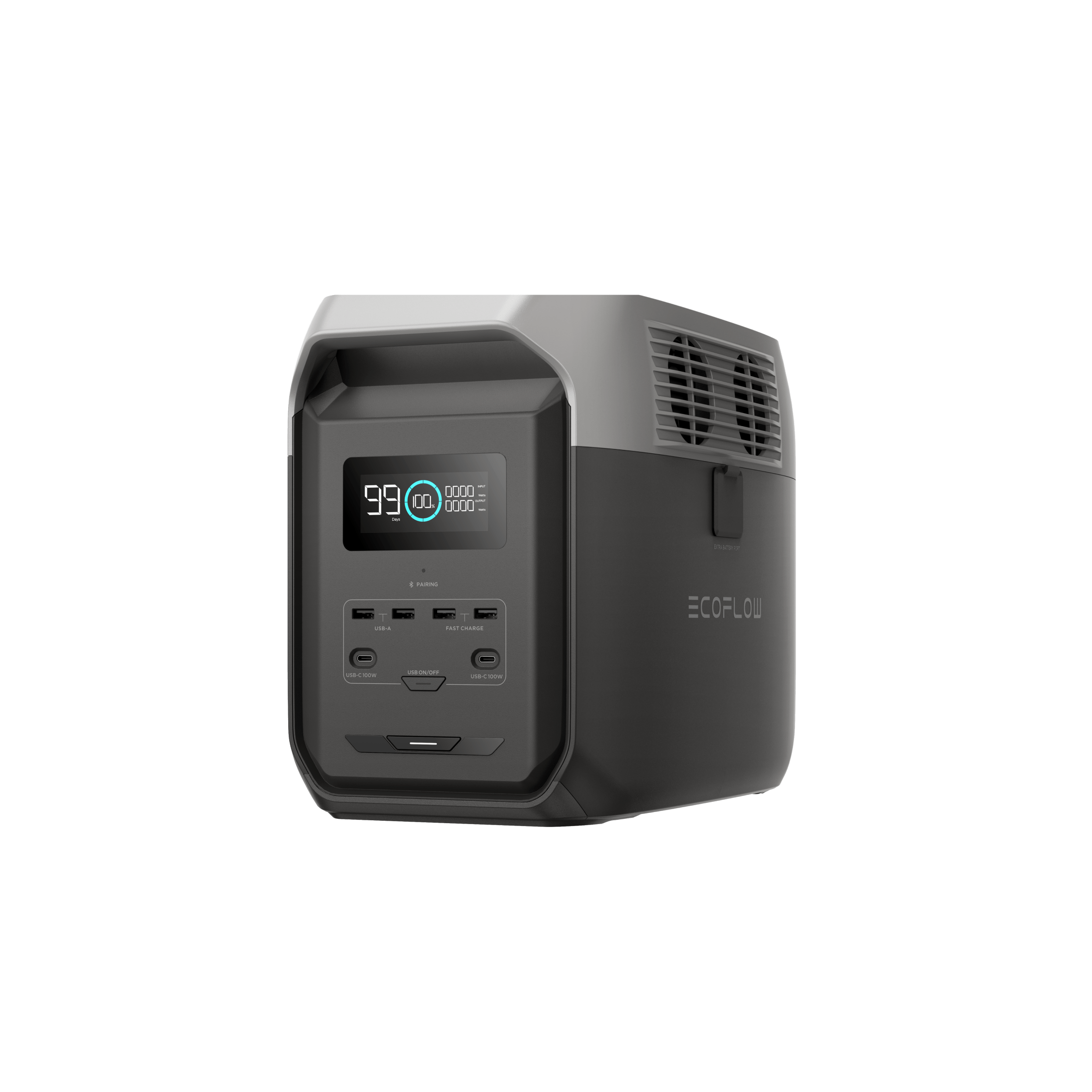
EcoFlow DELTA 3 1500
No longer sold

EcoFlow DELTA 3 UltraPick
$1,349.00
$1,349.00 · direct from EcoFlow
Last checked 16 days ago. Prices move — check before you buy.
Prices may vary by retailer and are subject to change.