Head-to-head test
EcoFlow DELTA 2 vs EcoFlow DELTA Pro Ultra
Buying up this range costs more per watt-hour rather than less, so the only thing that settles this is whether the box travels with you or gets bolted down and stays.
Full profiles: EcoFlow DELTA 2 → · EcoFlow DELTA Pro Ultra →

Written by Gunner GustafsonUpdated
Whole-Home Backup Tester, Station Arena Test Desk
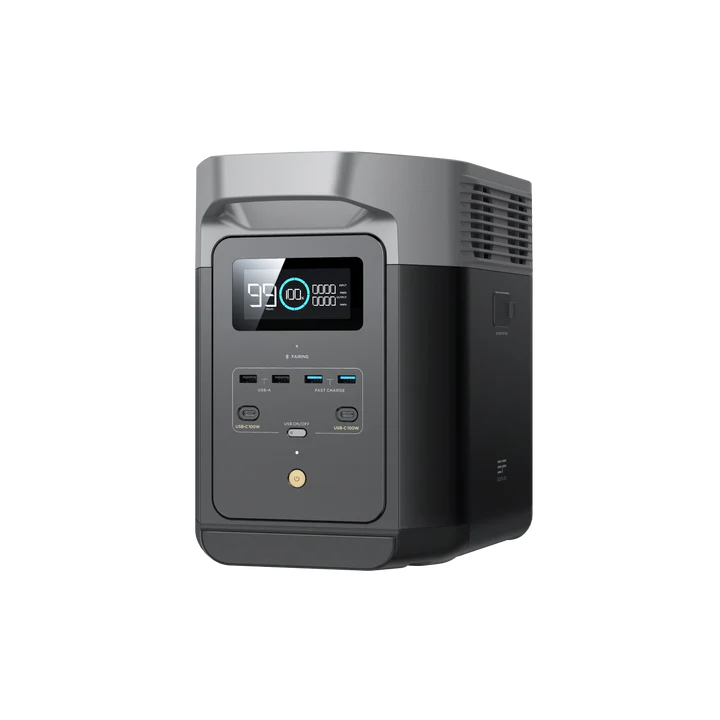
$499.00 · direct from EcoFlow
Last checked 58 days ago. Prices move — check before you buy.
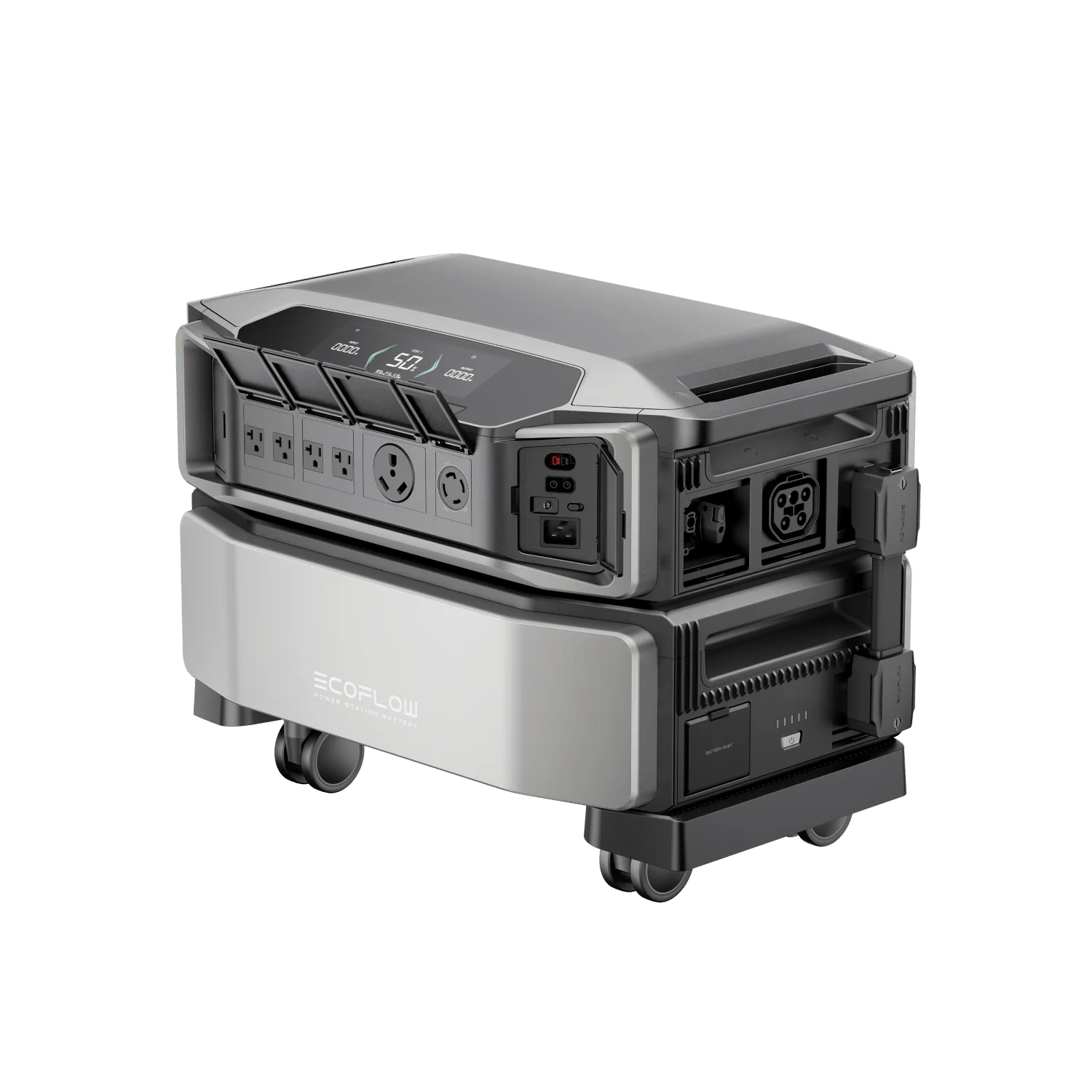
$4,199.00 · direct from EcoFlow
Last checked 1 day ago. Prices move — check before you buy.
Spec deltas
$499 against $4,199, and the expensive one costs more per watt-hour: $.65 against $.49. Eight times the price buys six times the battery, which is the arithmetic that governs everything else here. Scale arrives with no discount attached. What it does arrive with is an inverter four times the size and a machine you stop moving.
The DELTA 2 weighs 27 lbs. The Pro Ultra weighs 181.8 lbs, and that figure covers a stacked inverter-and-battery system rather than a box with a handleB1. One of these lives in your trunk. The other lives wherever you first set it down.
The Pro Ultra wins all six load scenarios on this page, which is what six times the battery buys and not much of a revelation. The number worth stopping on is the DELTA 2's: 870Wh usable against an eight-hour outage that draws 1,645Wh. That gap is the reason to size up, and it is a few hundred watt-hours wide, not a few thousand.
What the Numbers Reveal
Each conclusion stated first — the numbers behind it on one line, the full analysis below.
rated cycles
That lifetime figure, $0.16 against $0.19, is as close as these two get anywhere on the page, and it is the number that flatters the Pro Ultra most, because it only materialises if you push 3,500 full cycles through it. A whole-home backup unit that runs four times a winter never gets near that. Measure the same two boxes the way a backup buyer actually uses them, as years of sitting there ready, and it is $100 a year against $400.
DELTA 2: $499 for 1,024Wh, $.49 per WhDELTA Pro Ultra: $4,199 for 6,144Wh, $.65 per WhLifetime energy cost: $0.16 per kWh over 3,000 cycles for the DELTA 2, $0.19 per kWh over 3,500 cycles for the Pro UltraCost per warranty year: $100 for the DELTA 2, $400 for the Pro Ultra
Why it mattersIf you are buying the bigger unit because it looks like better value per watt-hour, the argument is backwards: buy it for the inverter or do not buy it.
solar input
That stops being trivia the moment you look at a full-time van day, which finishes the Pro Ultra at 90% used with 537Wh in hand. At that depth of discharge the spec deciding whether you reach day two is not capacity, it is how much sun the unit will accept, and the DELTA 2's 500W ceiling caps that no matter how many panels you bolt to the roof. The port is the limit, not the array.
DELTA 2: 500W maximum solar input into 1,024WhDELTA Pro Ultra: 5,600W maximum solar input into 6,144WhVan Life Daily draws 4,685Wh and leaves the Pro Ultra at 90% used, with 537Wh of its 5,222Wh usable left
Why it mattersAnyone recharging off solar daily should read maximum input as the headline spec; anyone charging off a wall can skip this entirely.
continuous output
Put that beside the inverter gap and the two units stop competing. 7,200W continuous is central-AC territory, and owners report it running a 3-ton central ACB4, which is a load that needs permanent wiring to be worth having in the first place. 1,800W is what one person can carry to wherever the load already is. Every advantage the Pro Ultra holds is one you need a building to spend.
DELTA 2: 27 lbsDELTA Pro Ultra: 181.8 lbsThe Pro Ultra is a modular system rated at 6,144Wh per batteryB1Output: 1,800W continuous and 2,700W surge for the DELTA 2, 7,200W and 10,800W for the Pro Ultra
Why it mattersIf there is no spot you would give up permanently, the spec-sheet gap is money you cannot convert into anything.
The Pro Ultra answers those same loads with over three times the usable energy they call for, 5,222Wh against 1,645Wh. So the two units bracket the real requirement instead of meeting it: one is a few hundred watt-hours light, the other is thousands heavy and needs an installation before it delivers any of it.
8-Hour Blackout needs 1,645Wh; the DELTA 2 has 870Wh usable and falls 775Wh shortWeekend Camping needs 2,100Wh; the DELTA 2 falls 1,230Wh shortThe Pro Ultra clears the same 1,645Wh blackout with 3,577Wh of its 5,222Wh usable untouched
Why it mattersIf backup through an outage is why you are shopping, the right unit sits between these two and buying either one means paying for the wrong thing.
The specific dimensions that decide these two units — everything else is a tie.
Portability & Form Factor
Selected because: 27 lbs against 181.8 lbs is the fork in this decision: one unit travels, the other gets an address.
weight
Twenty-seven pounds is a one-person, one-trip load: out of the trunk, across the grass, done. The Pro Ultra's 181.8 lbs is not that activity scaled up. It is a system weight covering a stacked inverter and batteryB1, our figures do not split it into modules, and the useful mental image is not two people and a bent-knee lift. It is floor space.
That decides more than convenience. A unit you site once has to earn its keep from one spot, which means it needs a panel to feed it, loads worth backing and a corner you are willing to surrender. The DELTA 2 asks nothing of your house. If the honest answer to where this lives is wherever you need it that weekend, the comparison ended before the spec table loaded.
Your Life, Your Pick
Selected because: The Pro Ultra takes all six load profiles, and the shape of the DELTA 2's misses matters more than the score.
One caveat before the grid: the scenario engine has no class for an installed system, so it grades Weekend Camping and Tailgate Party as though the Pro Ultra drove itself to the site. Read those two as load arithmetic, not as advice.
What the sweep actually shows is a bracket. The DELTA 2 clears the small loads, 320Wh overnight and 670Wh on game day against 870Wh usable after the standard 15% inverter derate, then falls away at anything resembling a household. It also lands 40Wh short of a 910Wh workday, which is a 4% miss against a modelled usable figure and closer to a coin flip than a failure. The Pro Ultra clears everything, including a 4,685Wh van day it finishes at 90% used. The unit most readers of this page are actually shopping for lives in the space between those two behaviours.
Lifetime Value
Selected because: The two land close on lifetime energy cost, $0.16 against $0.19 per kWh, and that is not the number a backup buyer should be using.
cost / lifetime kWh
$0.16 per lifetime kWh against $0.19 is the closest these two units come to each other anywhere on this page, and it is also the number least likely to describe your ownership. It assumes 3,000 and 3,500 full cycles respectively, which is a decade of draining the thing daily. Backup hardware does not live that life; it sits in a cupboard being ready.
The lens that survives contact with reality is cost per warranty year: $100 for the DELTA 2 against $400 for the Pro Ultra. The Pro Ultra's 10 years is double the DELTA 2's 5, and it still costs four times as much for each of those years. Scale is not a discount here. It is a purchase.
What the Specs Don't Tell You
Selected because: Four flags fire here, and two of them are figures that need reading rather than repeating.
rated cycles
Two of the four flags below are numbers to read rather than repeat. The Pro Ultra's transfer time is recorded as 0ms and its noise as 30dB, and in this dataset a zero carries two meanings, measured zero and never published, in the same field. Neither unit's dB figure arrives with a load condition attached, so treat 30 as unqualified rather than as a promise of silence.
The DELTA 2's 50dB is the better documented of the pair, in the sense that fan noise is the single thing field reports keep returning toA1A2A4. The detail that matters is the trigger point: the fans spin up above 120WA1, and 120W is well clear of the CPAP profile on this page, which draws 320Wh across a whole night. The 50dB number describes this unit working hard, not this unit sitting beside a bed.
Growth Path
Selected because: Both units expand, so the real question is what each can refill: 500W of solar input against 5,600W.
solar input
Both expand, so the question worth asking is what each one can refill. The DELTA 2 accepts 500W of solar; the Pro Ultra accepts 5,600W, more than eleven times as much, which is the difference between a couple of panels and a roof. Add capacity to the DELTA 2 and its input ceiling does not move with it, so the bigger bank simply takes proportionally longer to fill.
We are not printing a maximum for the Pro Ultra. Our spec sheet records only that it expands, with no ceiling, and the data we hold covers its one-battery through four-battery configurations as a single platformB1, so any headline maximum may describe a different build than the 6,144Wh unit on this page. What is safe to say is that 5,600W of input is what makes a larger bank practical instead of decorative.
Strengths & trade-offs
EcoFlow DELTA 2
Strengths
- +Costs $3,700 less
- +Lighter by 154.8 lb
Trade-offs
- –Weaker inverter (-5,400W) limits appliance compatibility.
EcoFlow DELTA Pro Ultra
Strengths
- +Larger battery capacity
- +Higher AC output
- +Longer warranty
- +Faster solar charging
Trade-offs
- –Substantially more expensive (+$3,700) than the DELTA 2.
- –Significantly heavier (+154.8 lbs), making it harder to move.
- –Very heavy unit that may be difficult for one person to lift.
Will It Power Your Gear?
Scenario math and per-appliance runtimes, modeled from the spec record.
Scenario verdicts
We ran the math on six real-world scenarios. Here's which unit survives your actual life.
SCN-01 · 2 nights · needs 2,100Wh
Weekend Camping
Two nights off-grid with essential comfort
Neither unit
A 2,100Wh weekend is more than the DELTA 2 holds. It has 870Wh usable and comes up 1,230Wh short, a gap you do not budget your way out of over two days. The Pro Ultra ends Sunday with 3,122Wh still in reserve.
Battery budget usedlower = more headroom
LOAD Phone Charger 15W×6h · LED Lights 40W×8h · Box Fan 75W×14h · CPAP Machine 40W×16h
SCN-02 · 8 hours · needs 1,645Wh
8-Hour Blackout
Keep the essentials running through a night without power
DELTA Pro Ultra
Eight hours of outage draws 1,645Wh here, and the DELTA 2's 870Wh usable covers a bit over half of it. The Pro Ultra clears the same night with 3,577Wh unused, which says something about both units at once: one is short by hundreds, the other is over by thousands.
Battery budget usedlower = more headroom
LOAD Fridge 150W×8h · Router + Modem 20W×8h · LED Lights (4 bulbs) 40W×6h · Phone Charger 15W×3h
SCN-03 · 8 hours · needs 320Wh
CPAP Overnight
Sleep therapy without interruption — the #1 medical use case
DELTA Pro Ultra
Both cover the night comfortably, a 320Wh load against 870Wh and 5,222Wh usable, so the question is how many nights rather than whether. The DELTA 2 gives you not quite three before it needs a wall; the Pro Ultra gives you about sixteen. We are breaking this on consecutive nights rather than on decibels, because neither unit's noise figure has a load condition attached to it.
Battery budget usedlower = more headroom
LOAD CPAP Machine 40W×8h
SCN-04 · 8 hours · needs 910Wh
Remote Workday
Full work day off-grid without power anxiety
DELTA Pro Ultra
The DELTA 2 lands 40Wh short of a 910Wh workday, a 4% miss against a usable figure that already assumes a 15% inverter derate. Treat that as a coin flip on the day, not a verdict. The Pro Ultra covers it with 4,312Wh spare and never comes close to noticing.
Battery budget usedlower = more headroom
LOAD Laptop 60W×8h · External Monitor 30W×8h · Router + Modem 20W×8h · Phone Charger 15W×2h
SCN-05 · 4 hours · needs 670Wh
Tailgate Party
Game day power for the crew
DELTA 2
Both do game day: 670Wh of load against 870Wh and 5,222Wh usable. The DELTA 2 finishes with 200Wh in hand, thin if the game goes long, and the Pro Ultra finishes with 4,552Wh, which is 181.8 lbs of overkill sitting in a parking lot. The metric goes to the big unit; the errand goes to the one that weighs 27 lbs.
Battery budget usedlower = more headroom
LOAD Blender 400W×0.5h · LED TV (55") 80W×4h · Bluetooth Speaker 15W×4h · Phone Charger (×3) 45W×2h
SCN-06 · 24 hours · needs 4,685Wh
Van Life Daily
A full day of mobile living — the ultimate endurance test
DELTA Pro Ultra
A 4,685Wh van day leaves the DELTA 2 3,815Wh short, so it is out of this one entirely. The number to look at is the Pro Ultra's: 90% used, 537Wh left of 5,222Wh usable. The largest unit on this page finishes a full-time van day close to empty, which is exactly why its 5,600W solar input matters more than its capacity does.
Battery budget usedlower = more headroom
LOAD Mini-Fridge 150W×24h · Laptop 60W×4h · Phone Charger 15W×3h · LED Lights 40W×5h · Fan 75W×8h
The Load Test
RUNTIME = (Wh × 0.85) ÷ LOAD
None of the scenarios above exactly yours? Build it. Toggle what you'd plug in; both units are tested against the combined draw.
Essentials
Comfort & Convenience
High-Draw Appliances
Test duration
8h
Continuous draw
205W
Projected runtime
For this load: DELTA Pro Ultra runs 25.5h vs 4.2h.
$4,199 list · direct from EcoFlow
Modeled from the spec record — same math as the tables below. Methodology
Runtime by appliance
Real-world runtime estimates for common appliances, modeled at 85% inverter efficiency.¹
Essentials
The basics you need runningscale 0–348.2hComfort & Convenience
Makes off-grid life actually enjoyablescale 0–69.6hHigh-Draw Appliances
These reveal the real limitsscale 0–5.2h¹ Runtime = (capacity × 0.85) ÷ appliance watts. Within each group, all bars share one time scale (the group's longest runtime), so lengths are comparable across appliances; identical runtimes collapse into a single blue/orange bar. Actual runtime varies with battery age, temperature, and simultaneous loads — see methodology.
Conclusion
August 9, 2026
Verdict: the EcoFlow DELTA 2
Buy the DELTA 2 unless you are wiring a house or a serious van build. At $499 it is the cheaper unit per watt-hour ($.49 against $.65), cheaper per lifetime kWh ($0.16 against $0.19) and cheaper per warranty year ($100 against $400), and at 27 lbs it is the only one of the two that can show up wherever the load is. The Pro Ultra is the better machine and it is not close: 7,200W continuous against 1,800W, 5,600W of solar input against 500W, a transfer time recorded at 0ms against 20ms. But every one of those is a capability you need a building to spend. If you have a spot you will give up permanently, an array to feed it and loads worth 7,200W, take the Pro Ultra and stop looking at the per-watt-hour math, because it will never favour you. If you do not, the DELTA 2 is the honest buy, with one caveat worth reading before you order: it does not cover an eight-hour outage.
Editor-assigned confidence, based on cited owner research and spec analysis.
List prices as of August 9, 2026. The links below open EcoFlow's current price.
$499.00 · direct from EcoFlow
Last checked 58 days ago. Prices move — check before you buy.
or check the DELTA Pro Ultra price$4,199.00 list
Written by Gunner Gustafson, Whole-Home Backup Tester · Station Arena Test Desk · Updated August 9, 2026
Measured Data
Benchmark scores and the full spec record, side by side.
Benchmark scores
Not rated for both units (minimum threshold unmet): UPS, RV Living, CPAP, Solar Generator, Tailgating, Apartment Balcony, Camping.
Full specifications
ᵈ Derived: price ÷ rated capacity. See the data behind our comparisons →
Comparison ToolAdd more power stations, side by sideOpen Tool →How these numbers are produced
Numeric verification
Every figure on this page traces to our spec database or arithmetic on it — no estimated numbers.
Owner claims
Statements about owner experience are cited to published reviews — see Sources & Research Notes below.
Runtime model
Runtime = (rated capacity × 0.85 inverter efficiency) ÷ device wattage. Solar recharge estimates assume panels deliver 70% of rated output. Cold weather, battery age, and stacked loads reduce real-world results.
Power Score
Computed from 14 published spec dimensions, weighted per use-case bench. Higher is better; a unit must meet a bench's minimum threshold to be rated.
See the full weight table and data sourcing on our methodology page →Class ranking (the star rating)
Each unit's star score is a category ranking, not customer reviews — no buyer opinions feed it. We score every station on size-independent quality (value, output, portability, endurance, ports, warranty, and more), then percentile-rank it against the other units in its capacity class, so a class-leading compact unit and a class-leading whole-home unit can both earn 5★. Here, DELTA 2 rates 4.1/5 (46th percentile of 27 Everyday-class units), and DELTA Pro Ultra rates 4.9/5 (93rd percentile of 16 Home Backup-class units).
How the class ranking is computed →Test Notes & Caveats
Hidden gotchas and advantages we spotted that you won't find on the product page.
181.8 lbs Is an Address, Not a Lift
This is a stacked inverter-and-battery system and our weight figure is the total for it, not a per-module number, so do not plan a two-person carry. Plan a permanent spot on a floor you are willing to give up. Once it is placed it stays placed, and everything the unit is good at assumes that. The DELTA 2's 27 lbs is the other end of that decision: it goes in the trunk without a second thought.
Both dB Figures Are Missing Their Load
50dB for the DELTA 2 and 30dB for the Pro Ultra are single numbers with no stated load behind them, and fan noise on units like these tracks how hard they are working. Read the DELTA 2's 50 as the sound of it busy, not the sound of it idling next to a bed. And do not read the Pro Ultra's 30 as a claim of silence under anything, because nothing in our data records the draw it was measured at.
0ms Against 20ms: One Is a Measurement, One Is a Design
The Pro Ultra's transfer time is recorded as 0ms, and in our data a zero can mean either a measured zero or a field nobody published, so read it as a design with no switchover to speak of rather than as a lab result. The DELTA 2's 20ms is a real number and most consumer gear rides straight through it. If you are backing equipment that genuinely cannot tolerate a gap, this is the one line on the page where only one of these two qualifies.
Warranty: 10 Years vs 5
The DELTA Pro Ultra is covered for 10 years against the DELTA 2's 5 years. The cheaper DELTA 2 does buy more warranty per dollar (10 years per $1,000 against 2.4), but that is a statement about price, not about coverage — if a fault appears in year 6, only one of these is still covered. An underrated factor if you're keeping this unit for years.
Full record above — the Test Desk pick is the DELTA 2.
Check DELTA 2 price →or check the DELTA Pro Ultra priceOwnership Analysis
What happens after you buy — true cost of ownership, brand trust, and growth potential.
Lifetime value
Service lifeyears at one full cycle per day
Lifetime energy delivered
Cost per delivered kWh
│ warranty ends · Reaching the cycle rating means ~80% capacity remains — degraded, not dead.
Analyst note
The DELTA 2 wins on both sticker price and long-term value. At $0.16/kWh over its lifetime, it's meaningfully cheaper to own. Clear value winner.
Growth path
DELTA 2
EXPANDABLESupports EcoFlow expansion batteries, so you can add capacity later without replacing the base unit — useful if your needs may climb past 1,024Wh.
Accepts up to 500W of solar. Suitable for a 1-2 panel setup.
Generous port selection supports complex multi-device setups.
Expansion batteries are EcoFlow-specific. You're investing in the EcoFlow ecosystem.
DELTA Pro Ultra
EXPANDABLESupports EcoFlow expansion batteries, so you can add capacity later without replacing the base unit — useful if your needs may climb past 6,144Wh.
Accepts up to 5,600W of solar. Enough for a serious multi-panel array.
Adequate ports for most setups, but heavy users may want a power strip.
Expansion batteries are EcoFlow-specific. You're investing in the EcoFlow ecosystem.
Realistic full solar rechargeat 70% of rated panel output — see methodology
Analyst note
Both expand, but the DELTA Pro Ultra's higher solar ceiling (5,600W vs 500W) gives it the stronger off-grid growth path — more panels can feed a bigger bank as it grows.
What Owners Report
Patterns from published owner reports and long-term reviews — every claim cited to its source below.
EcoFlow DELTA 2
Fan noise is the one consistent complaint about the DELTA 2, and it is well documentedA1A2A4. The fans trigger at anything above 120W, and at 1,500 to 1,800W they run continuously at roughly 48 to 55 dBA1. At 1,200W of charging one reviewer put it at gaming-laptop volume, though the app lets you slow the charge rate and quiet it downA2. EcoFlow has said it intends to address the noise in firmwareA4, which dates the complaint rather than settling it, so buy on the fan behaviour you can hear today.
Everything else about it reads well after long use: 18 months of outages, camping trips and daily home-office duty produced praise for fast charging, LiFePO4 reliability and expandabilityA3. It is a known quantity, which is worth something against a unit that is mostly known from its own brochure.
“When charging at 1200W the fans sound like a gaming laptop, though you can lower the charging speed in the app to silence it.”
Sources
portablepowerlab.com
EcoFlow DELTA Pro Ultra
The field record for the Pro Ultra is thin and mostly not from owners. Three of the four entries we hold trace back to manufacturer and retailer copy rather than long-term ownershipB1B2B3; the one genuinely owner-sourced line is that it sets up quickly, monitors well through the app, and that its 7,200W inverter runs a 3-ton central ACB4. Treat the rest as claims, not findings.
One of those claims is worth naming because we are declining to repeat it: an entry states the unit runs at 0 dB, silent, for draws under 2,000WB3. That sits against a recorded 30dB with no load condition anywhere behind it, and both cannot be true. The wider caution is that this material covers the Pro Ultra platform across its one-battery to four-battery buildsB1, so capacity, weight and charging figures quoted for it may belong to a different configuration than the one priced on this page.
“6,144Wh per battery with 7,200W continuous output (10.8kW surge), expandable to 90kWh across a system for a household — over 30 days of essential backup.”
Sources
ecoflow.com · homedepot.com · autoboosting.com · ecogadgethub.com
Sources & Research Notes
Every owner claim in this report is traceable to a published source. The bracketed references above resolve here.
Recurring owner themes
- Fan noise under moderate-to-high load is the dominant, repeatedly-cited complaint; the fan spins up above ~120W. [DELTA 2 · 3 entries]
- Whole-home scale (to 90kWh), 7,200W output, online UPS, silent operation under load, and industry-fast charging are the standout features. [DELTA Pro Ultra · 2 entries]
- A1
“Fans trigger at anything above 120 watts; at maximum load (1,500–1,800W) they run continuously at ~48–55 dB. Powering medical equipment above 120W in a bedroom means listening to the fans or running an extension cable out of the room.”
portablepowerlab.com — EcoFlow Delta 2 Review: 6 Months of Real Use; PCWorld — EcoFlow Delta 2 review · 2026 · [negative]
- A2
“When charging at 1200W the fans sound like a gaming laptop, though you can lower the charging speed in the app to silence it.”
PCWorld — EcoFlow Delta 2 power station review · 2026 · [mixed]
- A3
“After 18 months of real-world testing through multiple power outages, camping trips, and daily home-office use, the unit earned recognition for fast charging, reliable LiFePO4 battery chemistry, and expandability.”
portablepowerlab.com — EcoFlow Delta 2 Review: 6 Months of Real Use · 2026 · [positive]
- A4
“EcoFlow officials indicated they plan to address the fan noise in an upcoming firmware update, as they have for other models after release.”
portablepowerlab.com — EcoFlow Delta 2 Review · 2026 (dated claim — may be partially addressed) · [mixed]
- B1
“6,144Wh per battery with 7,200W continuous output (10.8kW surge), expandable to 90kWh across a system for a household — over 30 days of essential backup.”
ecoflow.com / homedepot.com — DELTA Pro Ultra · 2026 · [positive]
- B2
“LFP chemistry rated for over 3,500 cycles to 80% (10+ years of use).”
ecoflow.com / autoboosting.com — DELTA Pro Ultra review · 2026 · [positive]
- B3
“Industry-fast 8,800W charging tops up two batteries in about 2 hours; an online UPS protects sensitive electronics round the clock, and it runs at 0 dB (silent) for draws under 2,000W.”
ecoflow.com / ecogadgethub.com — DELTA Pro Ultra review · 2026 · [positive]
- B4
“Owners call it a powerful, easy-to-use whole-home backup with quick setup, strong solar input, and good app monitoring; its 7,200W inverter can power a 3-ton central AC.”
homedepot.com owner reviews — DELTA Pro Ultra · 2026 · [positive]
Research compiled August 9, 2026.
What Owners Actually Report
Drawn from 243 comments on independent review channels — not from retailer reviews, which skew to the first week of ownership. Each line is our summary of one commenter's claim, linked to the original. We record what they said, including where it contradicts the spec sheet.
EcoFlow DELTA 2
224 claims from 155 comments · 178 from owners · 60 with figures
- Runtime
- 32 · 13% negative
- Price & value
- 38 · 4% negative
- Charging
- 17 · 23% negative
- Durability
- 22 · 67% negative
- Warranty & support
- 22 · 59% negative
What owners complain about
Ignores solar unless he unplugs it from the wall, so he switched to the AC180.
Solar inputowner63 agreedsource →
His Delta 2 went bad three months after purchase and EcoFlow agreed it was defective.
Durabilityownerafter 3 months236 agreedsource →
Past 30 days the five-year warranty only gets a refurbished unit covered for 30 days.
Warranty & supportowner236 agreedsource →
What owners praise
DELTA 2 plus extra battery and 600W solar cost ~$1200 and paid for itself in under 2 years in California.
Price & valuemeasuredowner736 agreedsource →
Batteries still hold 98%+ capacity, ahead of the 80%-at-10-years warranty curve.
Durabilitymeasuredowner736 agreedsource →
Gets 180-190W into it from a 100Ah LiFePO4 via XT60i cable, no converter needed.
Chargingmeasuredowner106 agreedsource →
EcoFlow DELTA Pro Ultra
144 claims from 88 comments · 100 from owners · 35 with figures
- Price & value
- 22 · 18% negative
- Runtime
- 16 · 0% negative
- Expandability
- 17 · 16% negative
- Charging
- 11 · 4% negative
- Other
- 18 · 19% negative
What owners complain about
A second battery bought separately adds $1900, roughly doubling the cost.
Expandabilitymeasuredowner5 agreedsource →
After firmware updates max solar charging dropped from 7kW to 3.5kW.
App & firmwaremeasuredowner5 agreedsource →
Still charges at 7kW from a generator, so the cap looks solar-specific.
Solar inputmeasuredowner5 agreedsource →
What owners praise
Charges at 6000W from a gas generator, hitting 100% in a little over 3 hours with some sun.
Chargingmeasuredowner36 agreedsource →
Costco deal gave him the DPU with two batteries, 12kWh, for $4,500.
Price & valuemeasuredowner53 agreedsource →
Delivered with batteries manufactured less than 90 days earlier.
Shippingmeasuredowner53 agreedsource →
Claims are weighted by how specific they are, whether the commenter owns the unit, and how many readers agreed. Comments that mention a product under a rival's review count for more, because the commenter had no reason to be there. This is what buyers report, not our test results — for measurements we ran ourselves, see the methodology.
Who Should Buy Which
Buy the DELTA 2 if you…
- →The person whose real load is a CPAP, a laptop, phones and a couple of lamps. A 320Wh night against 870Wh usable is not quite three nights before it needs a wall, and the whole thing weighs 27 lbs.
- →Tailgates and day trips. 670Wh of game day against 870Wh usable leaves 200Wh in hand, which is enough if the game runs to time and one reason to charge in the car if it does not.
- →Anyone adding a backup box for the router, the laptop and the lights who accepts up front that a full household outage is out of scope at 1,024Wh.
Buy the DELTA Pro Ultra if you…
- →Someone wiring backup into a house or a serious van build, with genuinely large loads to carry. 7,200W continuous and 10,800W surge is the only inverter on this page that reaches central-AC scaleB4, and it is worth nothing until it is wired to something.
- →Solar-first installations. 5,600W of input is what turns a 6,144Wh bank around inside a morning, and it is the one specification the DELTA 2 cannot approach at any panel count.
- →Anyone running equipment that cannot tolerate a gap in supply, where a transfer time recorded at 0ms against the DELTA 2's 20ms is the deciding line.
If neither fits
The blackout buyer, which is most people who land here. The loads that decide this page are 1,645Wh and 2,100Wh; the DELTA 2 is 775Wh and 1,230Wh short of them, and the Pro Ultra clears the smaller one with 3,577Wh unused and needs an installation to do it. Buy one portable sized between those two loads, spend a fraction of $4,199, and skip both of these.
The Bottom Line
Take the DELTA 2. Not because it is the better machine, since the Pro Ultra plainly is by four times the inverter and eleven times the solar input, but because buying up this range costs more per watt-hour rather than less, and 181.8 lbs of installed system only pays back if you have somewhere to install it. The DELTA 2 does the CPAP night, the tailgate and the trunk for $499, and it is the one that can be in two places over a month.
One honest exception, and it is the likeliest reason you are reading this: if you want to ride out an eight-hour outage, neither of these is sized for it. One falls 775Wh short and the other clears it with 3,577Wh untouched and a wiring job attached. The right box sits between them, and knowing that is worth more than either verdict.
Frequently Asked Questions
Answers drawn from the spec record and cited owner research.
Is the DELTA Pro Ultra worth eight times the price of a DELTA 2?
Only if you need the inverter and have somewhere to install it. Per watt-hour it is the more expensive unit ($.65 against $.49), per lifetime kWh it is more expensive ($0.19 against $0.16), and per warranty year it costs four times as much ($400 against $100). What the money buys is 7,200W of continuous output and 5,600W of solar input, neither of which a DELTA 2 owner can get close to by any route.
Will a DELTA 2 get me through an 8-hour power cut?
Not the one modelled here. That profile draws 1,645Wh and the DELTA 2 holds 870Wh usable once the standard 15% inverter derate is applied, so it comes up 775Wh short, a bit over half the night covered. It will keep a router, a laptop and lights going comfortably; it will not carry a household load for a full working day.
Can I take the DELTA Pro Ultra camping?
Realistically, no. 181.8 lbs is a system weight for a stacked inverter and battery rather than something with a carry handle, and it is designed to be placed once and left. If a unit needs to leave the house more than about once a year, the 27 lb DELTA 2 is the only one of these two in the conversation.
How far can the DELTA Pro Ultra expand?
We are not printing a maximum, and that is deliberate. Our specification records only that it expands, with no ceiling attached, and the reference material we hold treats its one-battery through four-battery builds as one platform, so any single headline figure may describe a different configuration than the 6,144Wh unit priced here. What we can stand behind is the base capacity and the 5,600W solar input that makes growing the bank worthwhile.
Which one is quieter?
Our data says 50dB for the DELTA 2 and 30dB for the Pro Ultra, but neither figure comes with a load condition, so the comparison is weaker than it looks. What is documented is that the DELTA 2's fans trigger above 120W and reach roughly 48 to 55 dB at full load, with the app able to slow charging and quiet them. Below that trigger point, which includes CPAP-scale draws, the 50dB number is not describing what you will hear.
Where to buy
EcoFlow DELTA 2Pick
$499.00
$499.00 · direct from EcoFlow
Last checked 58 days ago. Prices move — check before you buy.
EcoFlow DELTA Pro Ultra
$4,199.00
$4,199.00 · direct from EcoFlow
Last checked 1 day ago. Prices move — check before you buy.
Prices may vary by retailer and are subject to change.