Head-to-head test
EcoFlow DELTA 2 vs BLUETTI Elite 100 mini
These two hold the same energy within 2%, so the $70 (on last listed prices) between them isn't buying watt-hours — it's buying 1,100 watts of inverter, which is the line between a box that runs an appliance and one that runs a desk.
Full profiles: EcoFlow DELTA 2 → · BLUETTI Elite 100 mini →

Written by Ian SchneiderUpdated
Solar & Off-Grid Tester, Station Arena Test Desk
Spec deltas
Capacity doesn't decide this one, because there isn't a capacity difference to speak of: 1,024Wh in the DELTA 2, 1,004.8Wh in the Elite 100 mini, a gap of 19.2Wh. Every scenario on this page ends within about 16 usable watt-hours of a tie, which is another way of saying these two run the same things for the same length of time.
The inverter is where they separate, and it isn't close. The DELTA 2 does 1,800W continuous with a 2,700W surge. The mini does 700W, and its 1,400W headline is Power Lifting, which applies to resistive loads and has to be switched on in the app, so it does nothing for a motor. An independent bench test put the mini's real cutout at 900W under loadB8.
Spend the $70 (on last listed prices) and take the DELTA 2, unless one of three things is true: you cycle the pack every day, in which case the mini's 6,000-cycle rating is worth more than any of this; you want it under a desk as a UPS, where its ≤10ms rated handoff and 140W of USB-C beat the DELTA 2's ≤20ms and 100W; or it has to live in a bedroom, where the DELTA 2's fans are a known and repeatedly documented problemA1A2.
What the Numbers Reveal
Each conclusion stated first — the numbers behind it on one line, the full analysis below.
continuous output
So the $70 (on last listed prices) buys no energy at all. It buys 1,100W of inverter, and 1,100W is the difference between a station that can take a microwave, a kettle, a hair dryer or a coffee maker one at a time and a station that declines all four. The bench test that measured the mini's cutout at 900W puts its real headroom about 200W above its 700W rating before it stopsB8.
DELTA 2: 1,024Wh, 1,800W continuous, 2,700W surge, $499 (last listed price)Elite 100 mini: 1,004.8Wh, 700W continuous, 1,400W Power Lifting surge for resistive loads only, enabled in the app, $429After the flat 15% conversion allowance they hold 870Wh and 854Wh usable, a 16Wh gap
Why it mattersIf there is any chance an appliance gets plugged into this, the $70 (on last listed prices) is the cheapest 1,100W you'll ever buy.
The honest counterweight is that nobody knows where the mini's fan comes on, because no independent noise measurement of it exists yetB0. This isn't a finding that the mini is quieter. It's a known, low, well-documented threshold on one side and a blank on the other, and EcoFlow has said it intends to address the noise in firmware, which is an admission and a promise in the same sentenceA4.
Both units publish roughly 50dB under loadThe DELTA 2's fans trigger above about 120W and run continuously at roughly 48-55dB at maximum load, with reviewers noting that running medical equipment above 120W in a bedroom means listening to them or putting a cable through the doorA1At 1,200W wall charging the DELTA 2's fans have been likened to a gaming laptop, with the charge rate adjustable in the app to quiet themA2
Why it mattersIf this unit shares a bedroom or a small van with you, either take the mini and accept the unknown, or take the DELTA 2 and plan on turning its charge rate down in the appA2.
rated cycles
It doesn't end it here because the payout schedule is the catch. Twice the lifetime energy is redeemed over 16.4 years of daily cycling against 8.2 — a real saving for a van or an off-grid cabin, and a rounding error for someone who uses this four weekends a year. Meanwhile the DELTA 2's ceiling isn't fixed the way the mini's is: guess low on capacity and you add a battery instead of buying a second station.
DELTA 2: $499 (last listed price), 3,000 cycles of 1,024Wh, 3,072 kWh over its rated life at $0.16 per lifetime kWhElite 100 mini: $429, 6,000 cycles of 1,004.8Wh, 6,029 kWh at $0.07 per lifetime kWhThe DELTA 2 accepts expansion batteries; the mini is sealed at 1,004.8Wh
Why it mattersCycle a pack daily and the mini's rating is worth more than everything else on this page; use it occasionally and you're buying capability, which is the thing the DELTA 2 has more of.
The specific dimensions that decide these two units — everything else is a tie.
Runtime: Will It Power Your Gear?
Selected because: Capacity is a dead heat at 1,024Wh against 1,004.8Wh, so what separates these is 1,800W of inverter against 700W.
continuous output
Read the runtime rows and then stop reading them, because they say the same thing six times: these two units hold the same energy and empty at the same rate. A 19.2Wh nameplate gap survives the conversion derate as a 16Wh usable gap, and 16Wh is about ten minutes of a laptop. No scenario on this page is decided by capacity.
The inverter row is the one doing the work. 1,800W against 700W isn't a matter of degree — it's the difference between the appliance list and the electronics list. The DELTA 2 will take a microwave, a kettle or a hair dryer one at a time, and its 2,700W surge is sized for a compressor's startup spike. The mini takes none of them, and the 1,400W figure sitting beside its 700W rating is Power Lifting, which works on resistive loads only and lives behind an app toggle. It is not a motor-start spec, which is what surge headroom is usually bought for.
Lifetime Value
Selected because: 6,000 rated cycles against 3,000 puts the Elite 100 mini's energy at $0.07 per lifetime kilowatt-hour against the DELTA 2's $0.16, from a purchase that costs $70 less (on last listed prices).
Seven cents a lifetime kilowatt-hour against sixteen, from the cheaper unit. That comes out of 6,000 rated cycles against 3,000 at effectively identical capacity, and it is the single strongest argument the Elite 100 mini makes anywhere on this page: about twice the energy over the rated life, for $70 less (on last listed prices) at the till.
What it's worth depends entirely on how fast you spend those cycles. Daily, it reads 16.4 years against 8.2 and is a second purchase genuinely avoided. At weekend use it reads 58 years against 29, and both of those numbers are past the point where anyone still owns a power station. There's a second discount to apply too: the DELTA 2 carries a stated five-year term and BLUETTI has published nothing for the mini, so one of these units has a decade-scale promise backed by a warranty and the other has a decade-scale promise on its own.
What the Specs Don't Tell You
Selected because: Five cards fire here, and the two that change a decision are the surge ceiling (2,700W against 1,400W) and the fan, where identical 50dB ratings hide very different behavior.
rated cycles
The surge card is the one that repays a careful read. The mini holds the better ratio, twice its own continuous rating against the DELTA 2's one and a half times, and the ratio is the wrong number to look at. A compressor draws a specific number of watts at switch-on, not a multiple of someone else's inverter rating, and the ceilings are 2,700W against 1,400W. Add that the mini's 1,400W is resistive-only Power Lifting and the starting contest isn't close.
The noise card reports both units at about 50dB and calls it a wash, which is true of the ceilings and misleading about the experience. Our research found the DELTA 2's fans coming on above roughly 120W and running continuously at around 48-55dB at full load, enough that reviewers warn against putting medical equipment above 120W in the same bedroomA1A2. Nobody has measured the mini's fan at allB0. The remaining two cards split cleanly: the mini's rated ≤10ms UPS class is the one a desktop with unsaved work wants, and its 6,000-cycle rating is the strongest number it owns.
Growth Path
Selected because: The DELTA 2 takes expansion batteries and the Elite 100 mini is sealed at 1,004.8Wh, which counts here only because the two start from the same capacity.
solar input
A sealed box isn't a flaw when it's a complete one, and the mini would get a pass on this if it started from more capacity than its rival. It doesn't. Both units start within 19.2Wh of each other, and only one of them can go further, which is the one situation where an expansion port genuinely counts.
Be precise about what it buys, though. At this size an expansion battery adds hours on the same appliances, not a new class of appliance: it doesn't lift the 1,800W inverter, doesn't add outlets, and costs real money on top of the $499 (last listed price). It matters if you already half-suspect 1,024Wh is thin for what you're planning. If 1,024Wh is comfortable, the sealed box costs you nothing at all.
Brand Trust
Selected because: EcoFlow states five years on the DELTA 2; BLUETTI has published no warranty term at all for the Elite 100 mini.
The asymmetry here is time. The DELTA 2 has been through eighteen months of documented real-world use across outages, camping trips and daily home-office duty, and came out with a reputation for fast charging and reliable chemistryA3. The Elite 100 mini has two hands-ons taken in its launch window and nothing elseB0. That's not a mark against the mini's engineering; it's a statement about what is currently knowable, and buying the unknown is a choice you should make deliberately rather than by accident.
Neither company's support record is a reason to buy. EcoFlow's is polarized, with friction-free prepaid-label replacements for some and long waits with refurbished units against new claims for others. BLUETTI's is the most inconsistent in the category, heavily email-based across a time-zone gap, and buying direct rather than through a reseller measurably improves the outcome. That last point does extra work here, because BLUETTI's terms are conditional on buying direct and registering (five years direct, two through a reseller) and no term has been published for this model yet. Get it in writing before you order.
Strengths & trade-offs
EcoFlow DELTA 2
Strengths
- +Larger battery capacity
- +Higher AC output
- +Longer warranty
- +Faster solar charging
Trade-offs
- –Shorter-lived battery — rated for 3,000 charge cycles vs the Elite 100 mini's 6,000, so it wears out sooner.
BLUETTI Elite 100 mini
Strengths
- +Lighter by 3.4 lb
- +Rated for 6,000 charge cycles — much longer battery lifespan
Trade-offs
- –Weaker inverter (-1,100W) limits appliance compatibility.
- –Sealed capacity — the DELTA 2 can add batteries to grow past 1,004.8Wh; this one can't.
Will It Power Your Gear?
Scenario math and per-appliance runtimes, modeled from the spec record.
Scenario verdicts
We ran the math on six real-world scenarios. Here's which unit survives your actual life.
SCN-01 · 2 nights · needs 2,100Wh
Weekend Camping
Two nights off-grid with essential comfort
Neither unit
Neither unit covers this scenario's 2,100Wh: the DELTA 2 comes up 1,230Wh short (about 41% covered), the Elite 100 mini 1,246Wh (41%). Treat this as partial cover — enough for the essentials in it, not the whole list.
Battery budget usedlower = more headroom
LOAD Phone Charger 15W×6h · LED Lights 40W×8h · Box Fan 75W×14h · CPAP Machine 40W×16h
SCN-02 · 8 hours · needs 1,645Wh
8-Hour Blackout
Keep the essentials running through a night without power
Neither unit
Neither unit covers this scenario's 1,645Wh: the DELTA 2 comes up 775Wh short (about 53% covered), the Elite 100 mini 791Wh (52%). Either gets you most of the way, so this is a scenario you plan around rather than one you should rule them out for.
Battery budget usedlower = more headroom
LOAD Fridge 150W×8h · Router + Modem 20W×8h · LED Lights (4 bulbs) 40W×6h · Phone Charger 15W×3h
SCN-03 · 8 hours · needs 320Wh
CPAP Overnight
Sleep therapy without interruption — the #1 medical use case
Either unit
A 40W machine for eight hours is 320Wh, and these two finish the night 16Wh apart in what's left over (550Wh against 534Wh). That's a dead heat, and both carry the same 50dB rated ceiling, so the box beside your pillow isn't the deciding factor. Break it at checkout instead: the Elite 100 mini is $70 cheaper (on last listed prices) and 3.4 pounds lighter, and if the machine is plugged into a wall that flickers, its rated ≤10ms handoff is the quicker class.
Battery budget usedlower = more headroom
LOAD CPAP Machine 40W×8h
SCN-04 · 8 hours · needs 910Wh
Remote Workday
Full work day off-grid without power anxiety
Neither unit
Neither quite finishes a 910Wh workday, and they miss it by 40Wh and 56Wh respectively — which is to say they don't differ. Both nameplates clear the load outright and the flat 15% conversion allowance is what tips both under. You'll reach the end of the working day on either one and want a top-up before the evening starts.
Battery budget usedlower = more headroom
LOAD Laptop 60W×8h · External Monitor 30W×8h · Router + Modem 20W×8h · Phone Charger 15W×2h
SCN-05 · 4 hours · needs 670Wh
Tailgate Party
Game day power for the crew
Either unit
Both handle game day easily. Since capacity isn't the deciding factor, weight is: at 23.6 lbs the Elite 100 mini is the one you'll be glad you brought. Fan noise under load is worth a listen too — it's audible in the lulls between songs.
Battery budget usedlower = more headroom
LOAD Blender 400W×0.5h · LED TV (55") 80W×4h · Bluetooth Speaker 15W×4h · Phone Charger (×3) 45W×2h
SCN-06 · 24 hours · needs 4,685Wh
Van Life Daily
A full day of mobile living — the ultimate endurance test
Neither unit
Neither unit covers this scenario's 4,685Wh: the DELTA 2 comes up 3,815Wh short (about 19% covered), the Elite 100 mini 3,831Wh (18%). This is well outside what either unit is for; the right answer here is a larger station, not a choice between these two.
Battery budget usedlower = more headroom
LOAD Mini-Fridge 150W×24h · Laptop 60W×4h · Phone Charger 15W×3h · LED Lights 40W×5h · Fan 75W×8h
The Load Test
RUNTIME = (Wh × 0.85) ÷ LOAD
None of the scenarios above exactly yours? Build it. Toggle what you'd plug in; both units are tested against the combined draw.
Essentials
Comfort & Convenience
High-Draw Appliances
Test duration
8h
Continuous draw
205W
Projected runtime
Dead heat — both run this 205W load for roughly 4.2h. Pick on price, weight, or ports.
Planning for more than this? Describe your whole setup and get it sized →
Modeled from the spec record — same math as the tables below. Methodology
Runtime by appliance
Real-world runtime estimates for common appliances, modeled at 85% inverter efficiency.¹
Essentials
The basics you need runningscale 0–58hComfort & Convenience
Makes off-grid life actually enjoyablescale 0–11.6hHigh-Draw Appliances
These reveal the real limitsscale 0–0.9h¹ Runtime = (capacity × 0.85) ÷ appliance watts. Within each group, all bars share one time scale (the group's longest runtime), so lengths are comparable across appliances; identical runtimes collapse into a single blue/orange bar. Actual runtime varies with battery age, temperature, and simultaneous loads — see methodology.
Conclusion
September 7, 2026
Verdict withdrawn: the DELTA 2 is no longer sold
We picked the DELTA 2, but it's been discontinued (EcoFlow now points buyers to the DELTA 3). The Elite 100 mini is still on sale, but that alone doesn't make it our pick. The comparison below is still accurate if you own either one.
Editor-assigned confidence, based on cited owner research and spec analysis.
Written by Ian Schneider, Solar & Off-Grid Tester · Station Arena Test Desk · Updated September 7, 2026
Black Friday · 38 days out
Price to beat:Elite 100 mini $429
We have never seen it discounted, so any real cut would be a first.
Measured Data
Benchmark scores and the full spec record, side by side.
Benchmark scores
Not rated for both units (minimum threshold unmet): RV Living, Home Backup, Food Truck.
Full specifications
ᵈ Derived: price ÷ rated capacity. See the data behind our comparisons →
Comparison ToolAdd more power stations, side by sideOpen Tool →How these numbers are produced
Numeric verification
Every figure on this page traces to our spec database or arithmetic on it — no estimated numbers.
Owner claims
Statements about owner experience are cited to published reviews — see Sources & Research Notes below.
Runtime model
Runtime = (rated capacity × 0.85 inverter efficiency) ÷ device wattage. Solar recharge estimates assume panels deliver 70% of rated output. Cold weather, battery age, and stacked loads reduce real-world results.
Power Score
Computed from 14 published spec dimensions, weighted per use-case bench. Higher is better; a unit must meet a bench's minimum threshold to be rated.
See the full weight table and data sourcing on our methodology page →Class ranking (the star rating)
Each unit's star score is a category ranking, not customer reviews — no buyer opinions feed it. We score every station on size-independent quality (value, output, portability, endurance, ports, warranty, and more), then percentile-rank it against the other units in its capacity class, so a class-leading compact unit and a class-leading whole-home unit can both earn 5★. Here, DELTA 2 rates 4.1/5 (50th percentile of 27 Everyday-class units), and Elite 100 mini rates 3.8/5 (27th percentile of 27 Everyday-class units).
How the class ranking is computed →Test Notes & Caveats
Hidden gotchas and advantages we spotted that you won't find on the product page.
Two 50s That Don't Mean the Same Thing
Both units publish about 50dB, and that matching figure is doing less work than it looks like it is. These are separate vendor claims about different fans under different conditions, not a shared measurement, and a ceiling says nothing about the threshold where each fan actually spins up — which is the number you live with. One of these has been on sale long enough for that threshold to be public knowledge and the other launched days ago. Treat the two 50s as a coincidence rather than an equivalence.
Elite 100 mini: Fixed Capacity
The Elite 100 mini is sealed at 1,005Wh, and that is the ceiling. Normally the counterpoint would be that the DELTA 2 can add expansion batteries, but that isn't a live option here: the DELTA 2 is no longer sold, and EcoFlow points owners to the DELTA 3. For a new purchase the expansion question doesn't arise between these two, so the Elite 100 mini's fixed 1,005Wh is simply what you get.
UPS Switchover: ≤10ms vs ≤20ms
Both list a UPS mode, at different rated speeds. The Elite 100 mini is rated ≤10ms — quick enough on paper that desktop PCs and routers should ride through, treating that as the rating it is. The DELTA 2 is rated ≤20ms — fine on paper for routers and most electronics; the fussiest PC power supplies sit right at this line. If a computer with unsaved work is the thing being protected, the stated class is worth the attention; nothing here is a lab result.
Twice the Cycles, on a Long Payout Schedule
6,000 against 3,000 is the Elite 100 mini's strongest card and it deserves reading in both directions. At daily use it's 16.4 years against 8.2, which is a second purchase genuinely avoided and enough on its own to change a decision. At weekend use it's 58 years against 29, and nobody collects on either. Work out which of those two buyers you are before you weigh this against anything else, because the answer is either decisive or irrelevant with very little in between.
Ownership Analysis
What happens after you buy — true cost of ownership, brand trust, and growth potential.
Lifetime value
Service lifeyears at one full cycle per day
Lifetime energy delivered
Cost per delivered kWh
│ warranty ends · Reaching the cycle rating means ~80% capacity remains — degraded, not dead.
Analyst note
The DELTA 2 is no longer sold, so there is no price to work its cost per kWh from, and this comparison doesn't quote one. On what you can actually buy today, the Elite 100 mini works out at $0.07/kWh over its rated life. If you already own the DELTA 2, the hardware comparison still holds: over its rated life the DELTA 2 delivers about 3,072 kWh and the Elite 100 mini about 6,029 kWh.
Brand trust
EcoFlow
Ecosystem
Largest in portable power — 12-15 models across DELTA Pro, DELTA 3, and RIVER 3 series, plus solar panels and smart home panels
Support
US-based phone/email/chat support (1-800-368-8604). Experiences are polarized — many report hassle-free prepaid-label replacements, but others report long waits and refurbished units sent for new claims. Pro tip: buying from Costco or Amazon gives you a stronger return safety net.
Community
Largest community in the space — Reddit r/Ecoflow_community (~31K members), multiple Facebook groups, and an official community forum
App experience
Rated 4.6/5 iOS (~8,400 ratings) · 4.2/5 Android (~17,000 ratings)
Unique strength
The deepest ecosystem in portable power, the fastest wall charging in the category, and the largest owner community anywhere in this space, which is why a unit like the DELTA 2 accumulates years of public field reports rather than a handful.
Worth knowing
Support is genuinely polarized: prepaid-label replacements handled without friction for some buyers, long waits and refurbished units against new claims for others. Buying through a retailer with a real return window gives you a path that doesn't depend on which experience you draw. Nothing is offered once the warranty runs out.
BLUETTI
Ecosystem
One of the broadest lineups — 15-20+ models from budget (AC2A) to flagship portable (Apex 300, 2764.8Wh). Includes specialized products: vehicle solar hubs, sodium-ion cold-weather units, and balcony storage systems.
Support
The most inconsistent support in the space. Heavily email-based with China timezone delays. Some users get smooth, efficient service; others report weeks of troubleshooting runarounds, being offered discounts on new units instead of repairs, and confusing third-party purchase claim processes. Buying direct from Bluetti's website tends to produce better support outcomes.
Community
Active and growing — Reddit r/bluetti has a dedicated community. Second-largest after EcoFlow in engagement.
App experience
Rated 4.5/5 iOS and Android — tied for best app experience in the category. V3.0 UI redesign was well-received.
Unique strength
Consistently the best capacity-per-dollar in the catalog, LFP chemistry across the entire lineup, and cycle ratings at the top of the class on the Elite units specifically.
Worth knowing
Support is the brand's weakest link, heavily email-based with time-zone delays and outcomes that swing from efficient to exhausting. Buying direct rather than through a reseller improves both the service and the warranty term, which matters more than usual on a model BLUETTI hasn't published a term for yet.
Analyst note
Choose on the hardware and then protect yourself at the checkout: buy the BLUETTI direct and registered, buy the EcoFlow somewhere with a genuine return window. Both apps sit at the top of the category and neither company offers anything once the warranty expires, so the meaningful brand difference here is simply how much is publicly known about each unit — years of it on one side, a launch week on the other.
Growth path
DELTA 2
EXPANDABLESupports EcoFlow expansion batteries, so you can add capacity later without replacing the base unit — useful if your needs may climb past 1,024Wh.
Accepts up to 500W of solar. Suitable for a 1-2 panel setup.
Generous port selection supports complex multi-device setups.
Expansion batteries are EcoFlow-specific. You're investing in the EcoFlow ecosystem.
Elite 100 mini
FIXED CAPACITYFixed at 1,005Wh, with no expansion — so size it for your needs up front rather than planning to add capacity later.
Accepts up to 350W of solar. Limited to a single portable panel.
Adequate ports for most setups, but heavy users may want a power strip.
Realistic full solar rechargeat 70% of rated panel output — see methodology
Analyst note
Growth only counts if you can still buy in, and the DELTA 2 is no longer sold (EcoFlow points owners to the DELTA 3). That leaves the Elite 100 mini: it is sealed at 1,005Wh, so buy the size that covers you now. The DELTA 2's expandability still matters if you already own one, but it isn't a reason to pick it over the Elite 100 mini.
What Owners Report
Patterns from published owner reports and long-term reviews — every claim cited to its source below.
EcoFlow DELTA 2
The DELTA 2 has been out long enough for real field data, and the consensus is consistent: strong reliability and value, with the fan as the one recurring complaintA0. Eighteen months of testing through multiple outages, camping trips and daily home-office use produced praise for the fast charging, the LiFePO4 chemistry and the expandabilityA3. This is a known quantity, which is worth something on its own.
The fan is the part to plan around rather than dismiss. Reviewers report it triggering above about 120 watts and running continuously at roughly 48-55dB at maximum load, with the specific warning that powering medical equipment above 120W in a bedroom means either listening to it or running an extension cable out of the roomA1. At 1,200W wall charging it's been compared to a gaming laptop, though the charge rate can be dialed down in the app to quiet itA2. EcoFlow has indicated it plans to address the noise in a firmware update, as it has done on other models after releaseA4 — treat that as a stated intention, not a fix you own today.
“When charging at 1200W the fans sound like a gaming laptop, though you can lower the charging speed in the app to silence it.”
Sources
portablepowerlab.com
BLUETTI Elite 100 mini
The Elite 100 mini's whole field record is two independent hands-ons from its launch window, so read every line of it as early rather than settledB0. The bench work is the substantial part: a capacity test pulled 903 usable watt-hours from the 1,004.8Wh nameplate, roughly 90% and above average for the classB7; the output measured as a clean sine wave with turbo wall charging around 700WB10; and a live unplug test held a triple-monitor 4K desktop through the handoffB9. The same reviewer is where the 700W rating turns into behavior, reporting a shutdown at 900W and warning the unit off kitchen appliances and two large loads at onceB8B11.
The warmest report on file is a CPAP with a heated humidifier running a full eight-hour night with the pack still showing more than twenty-four hours leftB1, which came from a review that scored the unit 10 out of 10 with no criticisms stated at all, so weigh it as launch coverageB0. Two forum posters called it a pass on the announcement alone, judging the size saved too small for the output given upB12B13, though they were reacting to a spec sheet at a pre-launch price rather than a unit in their handsB0. Nobody can yet tell you about idle drain, cold-weather behavior, firmware over time, or what BLUETTI's support does when one goes wrongB0.
“ran from the second I laid down to the second the sun came up — CPAP with heated humidifier, a full 8-hour night, and the pack still showed over twenty-four hours remaining.”
Sources
cgmagonline.com · thecooldown.com · diysolarforum.com
Sources & Research Notes
Every owner claim in this report is traceable to a published source. The bracketed references above resolve here.
Recurring owner themes
- Fan noise under moderate-to-high load is the dominant, repeatedly-cited complaint; the fan spins up above ~120W. [DELTA 2 · 3 entries]
- Independent bench testing found real-world delivery and backup behavior at or above spec: ~903Wh usable of 1,004.8Wh (~90%), clean sine wave, ~700W wall recharge, and a UPS handoff that held a 4K triple-monitor rig through a live unplug. [Elite 100 mini · 3 entries]
- The 700W inverter is the unit's defining limit — the reviewer measured shutdown at 900W and warned off kitchen appliances and multi-load use, and forum members judge the halved output the whole story of the product. [Elite 100 mini · 3 entries]
- Portability is the one attribute every independent hands-on praises without qualification — smallest and lightest 1kWh unit either reviewer had handled. [Elite 100 mini · 2 entries]
- Value against the Elite 100 V2 is the only sustained criticism: forum members reacting to the spec sheet see roughly 1kg and 10% volume saved in exchange for 700W vs 1,800W output and 350W vs 1,000W solar, and call the launch price a pass. [Elite 100 mini · 2 entries]
- A1
“Fans trigger at anything above 120 watts; at maximum load (1,500–1,800W) they run continuously at ~48–55 dB. Powering medical equipment above 120W in a bedroom means listening to the fans or running an extension cable out of the room.”
portablepowerlab.com — EcoFlow Delta 2 Review: 6 Months of Real Use; PCWorld — EcoFlow Delta 2 review · 2026 · [negative]
- A2
“When charging at 1200W the fans sound like a gaming laptop, though you can lower the charging speed in the app to silence it.”
PCWorld — EcoFlow Delta 2 power station review · 2026 · [mixed]
- A3
“After 18 months of real-world testing through multiple power outages, camping trips, and daily home-office use, the unit earned recognition for fast charging, reliable LiFePO4 battery chemistry, and expandability.”
portablepowerlab.com — EcoFlow Delta 2 Review: 6 Months of Real Use · 2026 · [positive]
- A4
“EcoFlow officials indicated they plan to address the fan noise in an upcoming firmware update, as they have for other models after release.”
portablepowerlab.com — EcoFlow Delta 2 Review · 2026 (dated claim — may be partially addressed) · [mixed]
- B1
“ran from the second I laid down to the second the sun came up — CPAP with heated humidifier, a full 8-hour night, and the pack still showed over twenty-four hours remaining.”
cgmagonline.com — "BLUETTI Elite 100 Mini Portable Power Station Review" (Marcus Kenneth) · 2026-09 · [positive]
- B7
“Capacity testing delivered 903 usable watt-hours from the advertised 1,004 watt-hours, which works out to roughly 90% efficiency and is above average.”
YouTube: There's A Trick For That — "Bluetti Elite 100 Mini — Full Test and Review", as reported by thecooldown.com · 2026-09 · [positive]
- B8
“the unit shutting down at 900 watts — reported as the upper limit in the reviewer's load test.”
YouTube: There's A Trick For That — "Bluetti Elite 100 Mini — Full Test and Review", as reported by thecooldown.com · 2026-09 · [mixed]
- B9
“This blows all the other UPSs out of the water that are dedicated for that. Check that out. Still running, no problem. — said during a live unplugging test with a triple-monitor 4K gaming setup.”
YouTube: There's A Trick For That — "Bluetti Elite 100 Mini — Full Test and Review", as reported by thecooldown.com · 2026-09 · [positive]
- B10
“The output showed a perfect pure sine wave, and turbo charging from a wall outlet reached around 700 watts.”
YouTube: There's A Trick For That — "Bluetti Elite 100 Mini — Full Test and Review", as reported by thecooldown.com · 2026-09 · [positive]
- B11
“The 700W inverter could be a challenge to navigate — not suitable for running multiple loads or kitchen appliances at the same time.”
YouTube: There's A Trick For That — "Bluetti Elite 100 Mini — Full Test and Review", as reported by thecooldown.com · 2026-09 · [negative]
- B12
“At $399 it's definitely a hard pass.”
diysolarforum.com — thread "Bluetti Elite 100 Mini announced, meh" · unknown · [negative]
- B13
“Only around 1kg lighter than the 100v2 with maybe 10% smaller volume — it is just way worse in performance while having only a slight portability gain.”
diysolarforum.com — thread "Bluetti Elite 100 Mini announced, meh" · unknown · [negative]
Research compiled September 7, 2026.
Who Should Buy Which
Buy the DELTA 2 if you…
- →Anyone who might plug in an appliance. 1,800W covers a microwave, a kettle, a coffee maker or a hair dryer one at a time; 700W covers none of them, and $70 (on last listed prices) is a low price for that gap.
- →The blackout planner with a fridge on the list. A 2,700W surge is sized for the spike a compressor pulls at switch-on, and Power Lifting on resistive loads is not.
- →The buyer who suspects they're guessing low on capacity. The DELTA 2 takes expansion batteries, so a wrong guess costs one battery instead of a whole second station.
- →The solar-first camper. 500W of panel input against 350W refills a slightly larger pack in noticeably less sun, which is what matters on day three of a trip.
Buy the Elite 100 mini if you…
- →The daily cycler, in a van or on a cabin's solar. 6,000 rated cycles against 3,000 is 16.4 years against 8.2, and that's the one buyer for whom this number is money rather than trivia.
- →The desk. A rated ≤10ms handoff against ≤20ms and 140W of USB-C against 100W make it the better always-plugged-in backup and a full-speed laptop charger at the same time.
- →Whoever is sleeping in the same room as it. The DELTA 2's fan behavior above 120W is documented and low-thresholdA1; the mini's is simply unknownB0, and an unknown beats a known problem for some people.
- →The buyer who wants this exact amount of energy for the least money and the least weight: $429 against $499 (last listed price), 23.6 lbs against 27, for capacity within 19.2Wh.
If neither fits
Anyone building toward a real off-grid day. Van life on these numbers is 4,685Wh, and the DELTA 2 is 3,815Wh short of it while the mini is 3,831Wh short — the same miss, twice, and no amount of choosing between them changes it. That's a 2,000Wh-and-up station, and if the plan is whole-home backup it isn't either of these even with expansion, since a battery here adds hours rather than circuits.
The Bottom Line
Pay the $70 (on last listed prices). With capacity a dead heat at 1,024Wh against 1,004.8Wh, that money isn't buying you a bigger battery — it's buying 1,100W of inverter, a surge rating that will start a compressor, 150W more solar input, a port to expand through, and a warranty somebody has actually written down.
The Elite 100 mini's case is real and it's narrow: it's cheaper, it's 3.4 pounds lighter, it's rated for twice the cycles, and it's the better desk UPS. Take it if you cycle a pack daily, if it lives under a monitor, or if it sleeps in your bedroom, where the DELTA 2's fan is a documented and low-threshold annoyanceA1. Otherwise buy the one that can still say yes when you plug something in.
Frequently Asked Questions
Answers drawn from the spec record and cited owner research.
The DELTA 2 costs $70 more (on last listed prices) for the same capacity — what am I actually paying for?
Inverter, mostly. 1,800W continuous against 700W, and a 2,700W surge against 1,400W, which is the difference between a station that runs kitchen appliances one at a time and one that runs electronics. You also get 500W of solar input against 350W, an expansion port the sealed Elite 100 mini doesn't have, and a stated five-year warranty. Capacity is genuinely a wash at 1,024Wh against 1,004.8Wh.
Is the Elite 100 mini's 1,400W surge comparable to the DELTA 2's 2,700W?
No, and they aren't the same kind of rating. The DELTA 2's 2,700W is a plain surge figure. BLUETTI's 1,400W is Power Lifting, which applies to resistive loads only and has to be enabled in the app, so it does nothing for a motor at switch-on. An independent bench test had the mini shut down at 900W under load, roughly 200W above its 700W continuous rating.
Which one is louder?
Both are rated around 50dB, and that tie is less informative than it looks. Reviewers report the DELTA 2's fans coming on above roughly 120W — a laptop and a monitor will do it — and running at about 48-55dB at full load, with an explicit warning about medical equipment in a bedroom. There is no independent noise measurement of the Elite 100 mini at all yet, so the fair statement is that one unit's fan behavior is documented and low-threshold and the other's is unknown.
Can either one run a microwave?
The DELTA 2, yes, one appliance at a time within its 1,800W rating. The Elite 100 mini, no — 700W isn't enough, and the Power Lifting mode won't rescue it. Bear in mind what a microwave does to a battery this size either way: at roughly 1kWh of capacity, high-wattage cooking is measured in minutes, not meals.
Does the BLUETTI Elite 100 mini come with a warranty?
BLUETTI hasn't published a term for this model yet, so don't assume it inherits one from elsewhere in the line. BLUETTI's stated terms elsewhere run to five years when you buy direct and register, and two years through a reseller. EcoFlow states five years on the DELTA 2. Ask BLUETTI directly and get the answer in writing before you order.
Brand matchup
EcoFlow vs BLUETTI: measured across every matchup →Where to buy
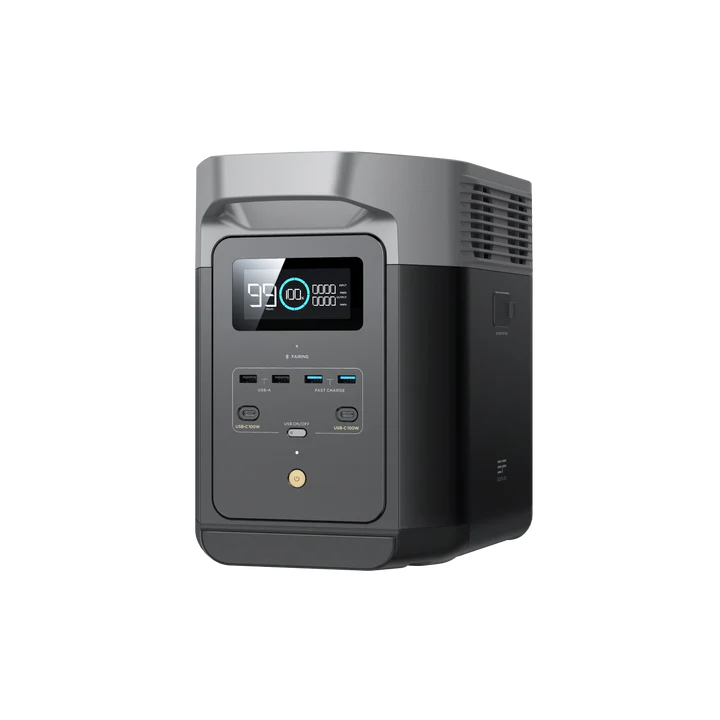
EcoFlow DELTA 2
No longer sold

BLUETTI Elite 100 mini
$429.00
$429.00 · direct from BLUETTI
Last checked 16 days ago. Prices move — check before you buy.
Prices may vary by retailer and are subject to change.