Head-to-head test
EcoFlow DELTA 2 Max vs BLUETTI Elite 200 V2
Same-size battery, half the rated lifespan, and $150 more — the DELTA 2 Max has to justify its price on surge, charging, and an expansion port, because the cheaper Elite 200 V2 wins everywhere those three don't apply.
Full profiles: EcoFlow DELTA 2 Max → · BLUETTI Elite 200 V2 →

Written by Gunner GustafsonUpdated
Whole-Home Backup Tester, Station Arena Test Desk
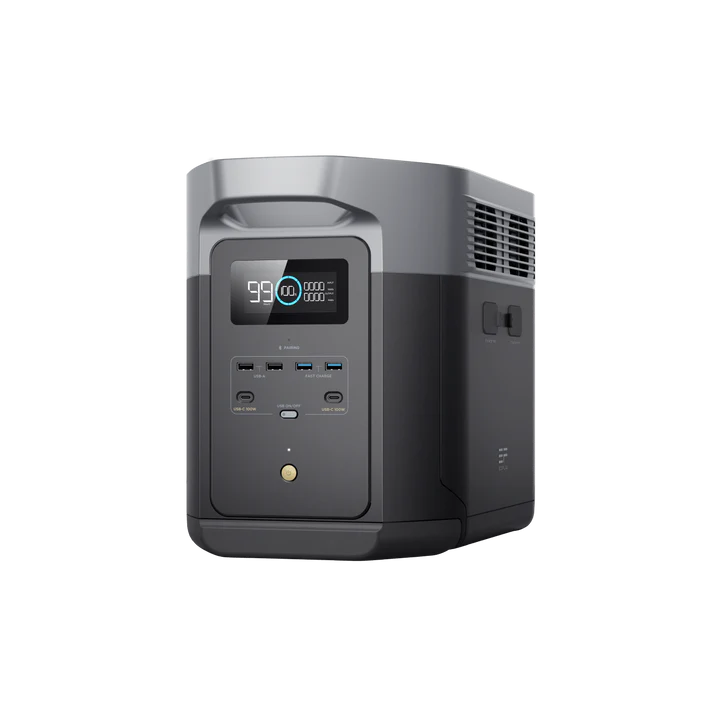
$1,049.00 · direct from EcoFlow
Last checked 1 day ago. Prices move — check before you buy.

$849.00 · direct from BLUETTI
down from $899 · 6% below usual
Last checked 1 day ago. Prices move — check before you buy.
Spec deltas
The BLUETTI Elite 200 V2 costs $899 and the EcoFlow DELTA 2 Max costs $1,049, and the twist is what the extra $150 doesn't buy: more battery. The Elite actually holds a hair more (2,073.6Wh to 2,048Wh) and is rated for 6,000 charge cycles to the DELTA's 3,000. The cheaper unit is also the bigger, longer-lived one.
So the DELTA's premium has to come from somewhere other than stored energy, and it does — three places. It surges to 4,800W where the Elite tops out at 3,900W, it fast-charges from the wall in a way reviewers single outA2, and it takes expansion batteries the sealed Elite can't. Those are real advantages. They are also narrow ones.
Here is the verdict up front: buy the Elite 200 V2 unless you can name which of those three extras you'll actually use. It's cheaper to buy, cheaper to own, and testers measured it as both more efficient and quieter than the DELTA runsB6B9. The DELTA's own reviewers call it worth buying but with caveatsA4; against a rival this much cheaper and this much longer-lived, the caveats decide it.
What the Numbers Reveal
Each conclusion stated first — the numbers behind it on one line, the full analysis below.
rated cycles
That collapses to six cents per lifetime kilowatt-hour against twenty-one. No runtime scenario lets the DELTA close it, because its battery is the smaller of the two. Every dollar of the premium therefore has to be paid back by something that isn't stored energy.
DELTA 2 Max: $1,049, 2,048Wh, rated 3,000 cyclesElite 200 V2: $899, 2,073.6Wh, rated 6,000 cyclescomputed lifetime energy: 6,144 kWh for the DELTA vs 12,442 kWh for the Elite
Why it mattersIf you can't name a non-capacity feature you'll use, you're paying the premium to store slightly less power for half as long.
The Elite runs at a 16 dBA spec and its testers call it whisper-quietB9; it simply charges at a more ordinary pace. So the DELTA wins wall-charging speed, but only in its loud mode — you get the fast charge or the quiet room, not both in the same sessionA1.
DELTA 2 Max charges 0 to 80% in about 50 minutes from the wallA2reviewers report its fans get loud under heavy load or fast chargingA1a Quiet Charging mode cuts the noise but extends the charge timeA1
Why it mattersIf the unit lives in a bedroom or a small cabin, the DELTA's best feature is the one you'll end up switching off.
continuous output
But the Elite's surge isn't fragile — testers drove it to a sustained 3,000W past its rated limitB7, enough to start most household compressors. So the DELTA's surge edge is real but narrow: it decides genuinely big motors, not the fridge-and-microwave loads most buyers actually run.
DELTA 2 Max surge: 4,800W, twice its 2,400W continuous ratingElite 200 V2 surge: 3,900W, about 1.5x its 2,600W continuous ratingreviewers pushed the Elite past its 2,600W inverter and it held a 3,000W surge for over two minutesB7
Why it mattersSize the surge column to your hardest-starting motor; if nothing in your house spikes past the Elite's proven 3,000W, that headroom is a feature you paid for and never trip.
The specific dimensions that decide these two units — everything else is a tie.
Lifetime Value
Selected because: The spine: the Elite is cheaper to buy AND cheaper to own, and it's the larger battery — the DELTA can't answer with capacity.
cost / lifetime kWh
The Elite is the cheaper purchase and the cheaper machine to own, and it's the larger battery too — a trifecta these matchups almost never hand you. Divide sticker by warranty and it works out to $160 per covered year against the DELTA's $259, and the cost-to-own gap the chain already showed only widens the more you drain it.
The DELTA never claws this back with runtime, because it stores less and is rated for half the cycles. There is exactly one lever that can bend the long-run math in its favor, and it isn't on this table — it's the expansion port, which is why the next section matters more than this one usually does.
Your Life, Your Pick
Selected because: Every scenario ties or both-lose on capacity, which proves the premium buys nothing any runtime scenario measures.
Read down the scenario table and the two units are the same column. The 8-hour blackout takes 94% of usable capacity on the DELTA and 93% on the Elite, a CPAP night sips 18% on both, and the camping weekend and van-life day overrun each by an all-but-identical margin. Capacity settles nothing here.
Which is the whole point. If no scenario on this page can tell these two apart on runtime, then the DELTA's premium is buying things no scenario measures — surge, charging speed, an expansion port, an app. Runtime is a coin flip; everything that isn't runtime is where the extra money goes.
Growth Path
Selected because: The DELTA's single strongest justification — expandability vs the Elite's sealed box; give it a fair, honest hearing.
The DELTA 2 Max can grow and the Elite can't, and that is the cleanest argument for paying more. Bolt EcoFlow's expansion batteries onto the DELTA and the base unit climbs past 2kWh without being replaced. The Elite is all-in-one: what you buy is what you getB2, so if you outgrow 2,073.6Wh your upgrade path is a second unit.
For most people that ceiling never gets touched — the scenarios above show 2kWh clearing blackouts, CPAP nights, and workdays with room to spare. But if you already know the trajectory is up (a bigger rig, longer trips, partial home backup), buying the expandable base now beats buying a whole second box in two years. Expandability is the DELTA's best card. It only counts if you're actually going to play it.
What the Specs Don't Tell You
Selected because: Five cards fire and they split unevenly: the DELTA takes only surge, the Elite takes cycle life and switchover.
rated cycles
The card sweep splits, and not down the middle. The DELTA takes exactly one, the surge ceiling the chains already covered. The Elite takes the rest: cycle life, where 6,000 rated cycles against 3,000 is the difference between a battery still working past year sixteen and one fading around year eight, and switchover, where its 10ms handoff edges the DELTA's 20ms.
The warranty card is a genuine tie — five years from both companies — so it decides nothing. The honest footnote on cycle life is the same one that always applies: run either unit a few dozen times a year as backup and both ratings outlive your interest in the hardware. That number only pays the people who cycle it hard.
Brand Trust
Selected because: Cross-brand: EcoFlow's ecosystem and app premium vs BLUETTI's value-and-inconsistent-support tradeoff.
The DELTA's premium partly buys a bigger neighborhood. EcoFlow runs the deepest bench in portable power — a dozen-plus models, solar panels, home panels — and the better-rated, more polished app of the two, a gap the Elite's own reviewers concedeB4. If you plan to expand and want the software to be pleasant, that's a real EcoFlow edge.
The counterweight is support and staleness, and it cuts both ways. EcoFlow's service runs polarized, from painless replacements to refurbished-unit runarounds, and it offers nothing out of warranty on what is, in this slot, an older-generation unit. BLUETTI's support is the most inconsistent in the category and is best approached by buying direct. Neither record should flip your verdict; both argue for registering the warranty the day the box lands.
Strengths & trade-offs
EcoFlow DELTA 2 Max
Strengths
- +Lighter by 2.7 lb
Trade-offs
- –Shorter-lived battery — rated for 3,000 charge cycles vs the Elite 200 V2's 6,000, so it wears out sooner.
BLUETTI Elite 200 V2
Strengths
- +Costs $150 less
- +Larger battery capacity
- +Higher AC output
- +Rated for 6,000 charge cycles — much longer battery lifespan
Trade-offs
- –No major technical downsides compared to rival.
Will It Power Your Gear?
Scenario math and per-appliance runtimes, modeled from the spec record.
Scenario verdicts
We ran the math on six real-world scenarios. Here's which unit survives your actual life.
SCN-01 · 2 nights · needs 2,100Wh
Weekend Camping
Two nights off-grid with essential comfort
Neither unit
A two-night load of roughly 2,100Wh overruns both — the DELTA lands at 121% of usable capacity, the Elite at 119%, a gap you'd never feel. Neither carries the weekend alone, so the tiebreak is your top-up plan, and both take the same 1,000W of solar. On runtime this is a dead heat both units lose.
Battery budget usedlower = more headroom
LOAD Phone Charger 15W×6h · LED Lights 40W×8h · Box Fan 75W×14h · CPAP Machine 40W×16h
SCN-02 · 8 hours · needs 1,645Wh
8-Hour Blackout
Keep the essentials running through a night without power
Either unit
Both clear the night on a thin margin — the modeled fridge-and-devices load takes 94% of usable capacity on the DELTA and 93% on the Elite. Both switch to battery fast enough that nothing in the house reboots. Identical outcome; settle it on the sticker price, not this row.
Battery budget usedlower = more headroom
LOAD Fridge 150W×8h · Router + Modem 20W×8h · LED Lights (4 bulbs) 40W×6h · Phone Charger 15W×3h
SCN-03 · 8 hours · needs 320Wh
CPAP Overnight
Sleep therapy without interruption — the #1 medical use case
Elite 200 V2
A CPAP sips 18% of either battery, so capacity is beside the point and both end the night nearly full. Eighteen inches from your pillow, the spec that matters is noise, and the Elite's 16 dBA floor sits well under the DELTA's 30 dBA. Both do the job; one does it quieter.
Battery budget usedlower = more headroom
LOAD CPAP Machine 40W×8h
SCN-04 · 8 hours · needs 910Wh
Remote Workday
Full work day off-grid without power anxiety
Either unit
Both power your workstation all day without strain, and their USB-C output is a wash — pick on weight, ports, or price.
Battery budget usedlower = more headroom
LOAD Laptop 60W×8h · External Monitor 30W×8h · Router + Modem 20W×8h · Phone Charger 15W×2h
SCN-05 · 4 hours · needs 670Wh
Tailgate Party
Game day power for the crew
Either unit
Both handle game day easily. Since capacity isn't the deciding factor, weight is: at 50.7 lbs the DELTA 2 Max is the one you'll be glad you brought. Fan noise under load is worth a listen too — it's audible in the lulls between songs.
Battery budget usedlower = more headroom
LOAD Blender 400W×0.5h · LED TV (55") 80W×4h · Bluetooth Speaker 15W×4h · Phone Charger (×3) 45W×2h
SCN-06 · 24 hours · needs 4,685Wh
Van Life Daily
A full day of mobile living — the ultimate endurance test
Neither unit
A full van-life day asks for about 4,685Wh, more than double what either 2kWh box usably holds, so neither is a solo answer. The DELTA can at least grow toward it on expansion batteries; the Elite would need a second unit. The better move is to shop a 3kWh-class base.
Battery budget usedlower = more headroom
LOAD Mini-Fridge 150W×24h · Laptop 60W×4h · Phone Charger 15W×3h · LED Lights 40W×5h · Fan 75W×8h
The Load Test
RUNTIME = (Wh × 0.85) ÷ LOAD
None of the scenarios above exactly yours? Build it. Toggle what you'd plug in; both units are tested against the combined draw.
Essentials
Comfort & Convenience
High-Draw Appliances
Test duration
8h
Continuous draw
205W
Projected runtime
Dead heat — both run this 205W load for roughly 8.5h. Pick on price, weight, or ports.
Modeled from the spec record — same math as the tables below. Methodology
Runtime by appliance
Real-world runtime estimates for common appliances, modeled at 85% inverter efficiency.¹
Essentials
The basics you need runningscale 0–117.5hComfort & Convenience
Makes off-grid life actually enjoyablescale 0–23.5hHigh-Draw Appliances
These reveal the real limitsscale 0–1.8h¹ Runtime = (capacity × 0.85) ÷ appliance watts. Within each group, all bars share one time scale (the group's longest runtime), so lengths are comparable across appliances; identical runtimes collapse into a single blue/orange bar. Actual runtime varies with battery age, temperature, and simultaneous loads — see methodology.
Conclusion
July 13, 2026
Verdict: the Elite 200 V2
Buy the Elite 200 V2. It costs $150 less, holds a slightly larger battery (2,073.6Wh to 2,048Wh), and is rated for 6,000 charge cycles to the DELTA's 3,000 — double the lifetime energy, and testers also clocked it as more efficient and quieter than the DELTA runsB6B9. The DELTA 2 Max's premium buys three genuine things: a higher 4,800W surge ceiling for hard-starting motors, fast wall charging reviewers single outA2, and an expansion port the sealed Elite lacks. Those matter to a specific buyer — someone who will grow past 2kWh, start a well pump or RV air conditioner, or lives inside EcoFlow's app and accessory ecosystem. For everyone else the Elite is cheaper to buy, cheaper to own, and the better-built-for-the-money box. Take the Elite unless you can name which of the DELTA's three extras you will actually use.
Today the Elite 200 V2 is $849, $50 under its typical $899. The verdict weighs typical prices, not today's. Prices checked 1 day ago.
Editor-assigned confidence, based on cited owner research and spec analysis.
List prices as of July 13, 2026. The links below open EcoFlow's and BLUETTI's current prices.
$849.00 · direct from BLUETTI
down from $899 · 6% below usual
Last checked 1 day ago. Prices move — check before you buy.
or check the DELTA 2 Max price$1,049.00 list
Written by Gunner Gustafson, Whole-Home Backup Tester · Station Arena Test Desk · Updated July 13, 2026
Measured Data
Benchmark scores and the full spec record, side by side.
Benchmark scores
Full specifications
ᵈ Derived: price ÷ rated capacity. See the data behind our comparisons →
Comparison ToolAdd more power stations, side by sideOpen Tool →How these numbers are produced
Numeric verification
Every figure on this page traces to our spec database or arithmetic on it — no estimated numbers.
Owner claims
Statements about owner experience are cited to published reviews — see Sources & Research Notes below.
Runtime model
Runtime = (rated capacity × 0.85 inverter efficiency) ÷ device wattage. Solar recharge estimates assume panels deliver 70% of rated output. Cold weather, battery age, and stacked loads reduce real-world results.
Power Score
Computed from 14 published spec dimensions, weighted per use-case bench. Higher is better; a unit must meet a bench's minimum threshold to be rated.
See the full weight table and data sourcing on our methodology page →Class ranking (the star rating)
Each unit's star score is a category ranking, not customer reviews — no buyer opinions feed it. We score every station on size-independent quality (value, output, portability, endurance, ports, warranty, and more), then percentile-rank it against the other units in its capacity class, so a class-leading compact unit and a class-leading whole-home unit can both earn 5★. Here, DELTA 2 Max rates 3.8/5 (28th percentile of 26 Large-class units), and Elite 200 V2 rates 4.5/5 (72nd percentile of 26 Large-class units).
How the class ranking is computed →Test Notes & Caveats
Hidden gotchas and advantages we spotted that you won't find on the product page.
The Elite's One Real Limit
The Elite 200 V2 is all-in-one, and that means what you buy is the ceiling. Outgrow 2,073.6Wh and your only move is a second unit, where the DELTA 2 Max simply takes an expansion battery. For the typical buyer, whose loads never approach 2kWh, this never bites. If you already know your needs are climbing, it's the single best reason on this page to pay EcoFlow's premium.
Where the DELTA's Inverter Flexes
The DELTA 2 Max surges to 4,800W, twice its continuous rating, against the Elite's 3,900W. That headroom is the DELTA's clearest spec advantage: it starts a class of hard-launching motors, like a well pump or an RV air conditioner, that the Elite's inverter has to refuse. For a fridge, a microwave, and a coffee maker, both have all the surge they need.
Both Fast, One Faster
Ten milliseconds on the Elite against twenty on the DELTA. Both are quick enough for a desktop, a router, or a fridge to ride through a grid blip without noticing. Neither is a true online UPS for lab-grade sensitive gear. Real difference, but not a reason to choose between these two.
Warranty: No Difference
Both units carry the same 5-year warranty, so coverage isn't a tiebreaker here. The Elite 200 V2's figure is a maximum rather than a guarantee — it depends on buying direct from BLUETTI or registering the unit, since reseller purchases carry a shorter term.
Twice the Runway
Rated cycle life is 6,000 against 3,000 — at a full cycle a day, a battery still working past year sixteen versus one fading around year eight. The honest footnote: cycle either unit a few dozen times a year as backup and both outlive your interest in them. This number only pays the people who actually use it.
Full record above — the Test Desk pick is the Elite 200 V2.
Check Elite 200 V2 price →or check the DELTA 2 Max priceOwnership Analysis
What happens after you buy — true cost of ownership, brand trust, and growth potential.
Lifetime value
Service lifeyears at one full cycle per day
Lifetime energy delivered
Cost per delivered kWh
│ warranty ends · Reaching the cycle rating means ~80% capacity remains — degraded, not dead.
Analyst note
The Elite 200 V2 wins on both sticker price and long-term value. At $0.07/kWh over its lifetime, it's meaningfully cheaper to own. Clear value winner.
Delivers each lifetime kWh for $0.10 less — check the Elite 200 V2 price →
Brand trust
EcoFlow
Ecosystem
The deepest bench in portable power — a dozen-plus models across the DELTA and RIVER lines, plus solar panels and home panels. If you want an expandable base that plugs into a large accessory shelf, EcoFlow has the widest one.
Support
US-based phone, email, and chat, but experiences run polarized: many report painless prepaid-label replacements, others long waits and refurbished units on new claims. Buying from a retailer with its own return window gives you a fallback.
Community
Largest community in the space — Reddit r/Ecoflow_community (~31K members), multiple Facebook groups, and an official community forum
App experience
Rated 4.6/5 iOS (~8,400 ratings) · 4.2/5 Android (~17,000 ratings)
Unique strength
X-Stream fast charging and the category's most active innovation cadence — the fastest wall top-up in this matchup, backed by the broadest ecosystem.
Worth knowing
The DELTA 2 Max is an older-generation unit, and EcoFlow offers no out-of-warranty service.
BLUETTI
Ecosystem
One of the broadest lineups anywhere, from budget units to flagships, including genuinely novel gear like sodium-ion cold-weather stations. What it doesn't offer is an expansion path for this particular model.
Support
The most inconsistent record in the category — heavily email-based with timezone delays, and outcomes that swing from smooth to weeks of runaround. Buying direct from BLUETTI tends to produce the better result.
Community
Active and growing — Reddit r/bluetti has a dedicated community. Second-largest after EcoFlow in engagement.
App experience
Rated 4.5/5 iOS and Android — tied for best app experience in the category. V3.0 UI redesign was well-received.
Unique strength
The best capacity-per-dollar in the market, full LFP standardization across the lineup, and here a cheaper, larger, longer-lived battery than the unit it's up against.
Worth knowing
Support inconsistency is the number-one risk, and the app experience lags EcoFlow's. Register the warranty and keep the receipt the day it arrives.
Analyst note
This is value versus ecosystem. BLUETTI hands you more battery, more lifespan, and a lower price, carrying the category's most uneven support. EcoFlow answers with the deeper accessory shelf, the better app, and the faster charger, at a real premium and with an older unit in this slot. If you want the box that costs less and lasts longer, it's the Elite; if you're buying into a system you'll keep expanding, EcoFlow is the neighborhood to move into.
Growth path
DELTA 2 Max
EXPANDABLESupports EcoFlow expansion batteries, so you can add capacity later without replacing the base unit — useful if your needs may climb past 2,048Wh.
Accepts up to 1,000W of solar. Enough for a serious multi-panel array.
Generous port selection supports complex multi-device setups.
Expansion batteries are EcoFlow-specific. You're investing in the EcoFlow ecosystem.
Elite 200 V2
FIXED CAPACITYFixed at 2,074Wh — a sealed, complete system rather than a starting point. There's no expansion port, so that figure is the ceiling: check it against your longest unplugged stretch before you buy.
Accepts up to 1,000W of solar. Enough for a serious multi-panel array.
Adequate ports for most setups, but heavy users may want a power strip.
Realistic full solar rechargeat 70% of rated panel output — see methodology
Analyst note
Don't read the DELTA 2 Max's expandability as a straight win here: it starts at 2,048Wh, below the Elite 200 V2's 2,074Wh, so a first expansion battery largely buys back capacity the Elite 200 V2 already includes. It only pulls ahead if you'd grow past 2,074Wh — short of that, the Elite 200 V2's larger fixed capacity is the simpler value.
What Owners Report
Patterns from published owner reports and long-term reviews — every claim cited to its source below.
EcoFlow DELTA 2 Max
The DELTA 2 Max's record is a warm reviewer record with one loud caveat. Testers praise the fast wall charging, clocking 0 to 80% in about 50 minutesA2, and the LiFePO4 build — rated past 3,000 cycles, with no structural degradation after six months of useA3. The recurring knock is the fan: under heavy load or fast charging it gets genuinely loud, and while a Quiet Charging mode helps, it trades the speed away to get quietA1.
The bottom-line read from those reviewers is 'still worth buying, with caveats' — a versatile, expandable, ecosystem-friendly unit whose main asterisk is the noiseA4. Worth flagging that this is hands-on review coverage rather than long-run ownership data.
“Fast AC wall charging — 0 to 80% in about 50 minutes and a full charge in roughly 80 minutes.”
Sources
powerstationadvisor.com · pcworld.com · thesolarlab.com · protoolsadvisor.com · trailandkale.com
BLUETTI Elite 200 V2
Field data on the Elite 200 V2 is thinner because it's a recent release, but it's consistent. Independent testers measured best-in-class efficiency at 94% and the lowest idle draw they'd seen on a unit this size, under ten wattsB5B6. Reviewers describe it as whisper-quiet at its 16 dBA specB9 and dependable through outages, keeping a home lab running start to finishB8. In real off-grid use it charged e-bikes repeatedly and ran a small fridge for daysB13B14.
The consistent nitpicks are two. There's no built-in light, which is a real annoyance when you're fumbling for a 50-plus-pound box in the darkB3, and the app and ecosystem still lag EcoFlow and AnkerB4. Honest limit on the record: no six-month-plus longevity reports exist yet, so the durability case rests on the cell rating rather than years in the field.
“It bridged the solar gap when panels weren't producing, effectively acting as a weekly "energy bank" I could fill up and live off.”
Sources
thevanconversion.com · thesolarlab.com · storagereview.com · dustinabbott.net · nsmb.com
Sources & Research Notes
Every owner claim in this report is traceable to a published source. The bracketed references above resolve here.
Recurring owner themes
- Solid LFP durability, fast charging, and ecosystem/expandability are the praise; loud fans under heavy load or charging are the recurring complaint. [DELTA 2 Max · 3 entries]
- Multiple independent reviewers report the near-instant UPS switchover works reliably for continuous device uptime during outages. [Elite 200 V2 · 2 entries]
- Reviewers who measured it independently found best-in-class efficiency and very low idle power draw for a unit of this size. [Elite 200 V2 · 2 entries]
- Owners/testers praise real-world off-grid runtime — charging e-bikes, running fridges, powering laptops/appliances for extended periods. [Elite 200 V2 · 3 entries]
- The two consistent nitpicks are the missing built-in light/flashlight and an app/ecosystem experience that lags behind Anker and EcoFlow. [Elite 200 V2 · 2 entries]
- Value proposition is repeatedly framed as 'practical rather than flashy' — strong price-to-spec ratio, though less competitive outside the US market. [Elite 200 V2 · 2 entries]
- A1
“Fan noise is a significant issue — cooling fans can get loud, around 52 dB during heavy loads or charging; a Quiet Charging mode reduces noise but extends charge time, and giving it 6 inches of clearance helps airflow.”
powerstationadvisor.com / pcworld.com — DELTA 2 Max review · 2025-2026 · [negative]
- A2
“Fast AC wall charging — 0 to 80% in about 50 minutes and a full charge in roughly 80 minutes.”
thesolarlab.com / protoolsadvisor.com — DELTA 2 Max review · 2025-2026 · [positive]
- A3
“LiFePO4 chemistry rated for 3,000+ cycles to 80% with superior thermal stability; after 6 months of real use there was no structural degradation and it felt as solid as day one.”
powerstationadvisor.com / trailandkale.com — DELTA 2 Max review · 2025-2026 · [positive]
- A4
“Reviewers say it's still worth buying but with caveats — a versatile unit with expandability and ecosystem compatibility.”
thesolarlab.com / powerstationadvisor.com — DELTA 2 Max review · 2025-2026 · [mixed]
- B2
“Elite 200 V2 has no expansion battery capability – it's an all-in-one unit focused on maximum capacity and output in a single box.”
thevanconversion.com — BLUETTI Elite 200 V2 In-Depth Review · 2026-04 · [mixed]
- B3
“For a 50+ pound unit that requires two hands to carry, it's frustrating to fumble around in the dark with a flashlight and heavy power station.”
thesolarlab.com — Bluetti Elite 200 V2 Review: A Solid Comeback? · unknown · [negative]
- B4
“It still lacks the refinement and ecosystem support that we've recently seen from EcoFlow and Anker, and the app experience could definitely be improved.”
thesolarlab.com — Bluetti Elite 200 V2 Review: A Solid Comeback? · unknown · [negative]
- B5
“Even the idle power draw was impressive, coming in at just 9.5W per hour, which is also the lowest we've seen on a unit this size.”
thesolarlab.com — Bluetti Elite 200 V2 Review: A Solid Comeback? · unknown · [positive]
- B6
“The efficiency came in at 94%, which is the highest we've ever seen in a portable power station.”
thesolarlab.com — Bluetti Elite 200 V2 Review: A Solid Comeback? · unknown · [positive]
- B7
“Even when we pushed the thing beyond its inverter's 2,600W limit, it was able to sustain a 3,000W surge for over 2 minutes.”
thesolarlab.com — Bluetti Elite 200 V2 Review: A Solid Comeback? · unknown · [positive]
- B8
“The BLUETTI Elite 200 V2 kept everything operational throughout the entire outage. It's not merely a backup solution; it provides true resilience to the home lab.”
storagereview.com — Portable Power Meets Lab-Grade Reliability: BLUETTI Elite 200 V2 Review · 2025-04 · [positive]
- B9
“Even under operation, it's whisper-quiet at just 16 dB under small loads, making it ideal for off-grid setups, RVs, or quiet workstations.”
storagereview.com — Portable Power Meets Lab-Grade Reliability: BLUETTI Elite 200 V2 Review · 2025-04 · [positive]
- B13
“The Elite 200 V2, with its 2,073.6Wh capacity, can charge the eebs a couple of times over before depleting its reserves.”
nsmb.com — Bluetti Elite 200 V2 and Handsfree 2 Power Stations reviewed · unknown · [positive]
- B14
“The Elite can power a 35-quart fridge in the heat of the summer for a few days.”
nsmb.com — Bluetti Elite 200 V2 and Handsfree 2 Power Stations reviewed · unknown · [positive]
Research compiled July 13, 2026.
What Owners Actually Report
Drawn from 73 comments on independent review channels — not from retailer reviews, which skew to the first week of ownership. Each line is our summary of one commenter's claim, linked to the original. We record what they said, including where it contradicts the spec sheet.
EcoFlow DELTA 2 Max
74 claims from 55 comments · 60 from owners · 20 with figures
- Runtime
- 13 · 0% negative
- Solar input
- 10 · 20% negative
- Price & value
- 11 · 45% negative
- Expandability
- 8 · 15% negative
- Noise
- 5 · 58% negative
What owners complain about
Its own MPPT is limited to a mere 60 VOC from solar panels.
Solar inputmeasuredowner19 agreedsource →
Delta 2 Max is promised at 30 dB but measured 42 dB in his hands.
Noisemeasuredowner5 agreedsource →
Got a 5kWh rival for less than he paid for a DELTA 2 Max with extra battery.
Price & valueowner17 agreedsource →
What owners praise
Feeding his lead-acid UPS from it stretches desktop runtime from 8 minutes to 4 hours.
Runtimemeasuredowner8 agreedsource →
Bought the Delta 2 Max for $899 on Black Friday; the Delta 2 was $399.
Price & valuemeasuredowner21 agreedsource →
Takes 500-1000W from a DIY 48V bank over XT60i, far cheaper than the official spare battery.
Expandabilitymeasuredowner19 agreedsource →
BLUETTI Elite 200 V2
24 claims from 18 comments · 18 from owners · 7 with figures
- Price & value
- 8 · 15% negative
- Runtime
- 3 · 0% negative
- Warranty & support
- 3 · 0% negative
- Solar input
- 3 · 6% negative
- Other
- 2 · 55% negative
What owners complain about
Displays 107W in and out while watt-meters read 58.6W in and 60.44W out.
App & firmwaremeasuredowner3 agreedsource →
PV priority mode does not hold off AC charging as set; suspects deliberately flattering data.
Otherowner3 agreedsource →
Bought it for $950 two months ago and says it now lists at $1,699 as tariffs kick in.
Price & valuemeasuredownerafter 2 monthssource →
What owners praise
Elite 200 V2 plus one 450W panel covers his 3.5kWh per day trailer needs.
Runtimemeasuredowner14 agreedsource →
At $700-750 on Black Friday it beats the Delta 3 Max at the same 2kW/2kWh class.
Price & valuemeasuredowner1 agreedsource →
Accepts the 25.6V battery over the solar input without issue.
Solar inputowner4 agreedsource →
Claims are weighted by how specific they are, whether the commenter owns the unit, and how many readers agreed. Comments that mention a product under a rival's review count for more, because the commenter had no reason to be there. This is what buyers report, not our test results — for measurements we ran ourselves, see the methodology.
Who Should Buy Which
Buy the DELTA 2 Max if you…
- →You already know you'll outgrow 2kWh. The DELTA takes EcoFlow expansion batteries; the Elite is sealedB2. If partial home backup or a bigger rig is on your two-year horizon, buying the expandable base now beats buying a second unit later.
- →You start hard-launching motors — a well pump, an RV air conditioner, a big shop compressor. The DELTA's 4,800W surge ceiling starts a class of loads that sits above the Elite's rated 3,900W.
- →You want the fastest wall top-up and a polished app. Reviewers clock the DELTA at 0 to 80% in about 50 minutesA2, and its ecosystem and software are the more refined of the twoB4.
Buy the Elite 200 V2 if you…
- →You want the most battery and the longest life per dollar. The Elite is hundreds less, a touch larger, and rated for double the cycles — on pure value it isn't close.
- →It's sleeping near where you sleep. At a 16 dBA spec and whisper-quiet in testingB9, it won't wake you the way a fast-charging DELTA canA1.
- →You want the box to just work and cost less. Reviewers measured best-in-class efficiency and rock-solid outage performanceB6B8, with no ecosystem homework required.
If neither fits
If your daily draw is van-life scale — pushing 4,685Wh a day — neither 2kWh box does it solo; start with a 3kWh-class base or plan an expansion battery from day one. And if you only ever run phones, a laptop, and a lamp, a 1kWh station does that for hundreds less than either of these.
The Bottom Line
Take the BLUETTI Elite 200 V2. It's the cheaper box, the slightly bigger one, and the one rated to run twice as long — cheaper to buy and cheaper to own, with the quieter operation and higher efficiency its testers measuredB6B9. The DELTA 2 Max is a good unit; against this particular rival, it's mostly an expensive one.
The flip case is honest but small. If you'll genuinely outgrow 2kWh, start motors that spike past the Elite's proven 3,000WB7, or want EcoFlow's ecosystem and fast wall chargingA2 badly enough to pay the premium, the DELTA earns it. Everyone else should buy the Elite, pocket the difference, and enjoy a power station quiet enough to forget is running.
Frequently Asked Questions
Answers drawn from the spec record and cited owner research.
Is the EcoFlow DELTA 2 Max worth $150 more than the BLUETTI Elite 200 V2?
For most buyers, no. The Elite is cheaper, slightly larger, and rated for double the cycles, which makes it cheaper both to buy and to own. The DELTA earns its premium only if you need its higher 4,800W surge ceiling, its fast wall charging, or its expansion port — otherwise you're paying more to store less energy for fewer cycles.
Which lasts longer, the DELTA 2 Max or the Elite 200 V2?
The Elite, by double the rated cycles — 6,000 to 3,000, or roughly sixteen years of daily cycling against eight. Both use LiFePO4 chemistry, so the difference is rated lifetime, not battery type. At light emergency-only use, both ratings outlast the decade and the gap stops mattering.
Which charges faster, the DELTA 2 Max or the Elite 200 V2?
The DELTA 2 Max from the wall — reviewers measured 0 to 80% in about 50 minutes on EcoFlow's X-Stream charging. The catch is noise: the fans get loud while it fast-charges, and the Quiet mode that fixes that also slows it down. Both accept the same 1,000W of solar, so their off-grid refill speed is a tie.
Can either one run a fridge through an 8-hour blackout?
Yes, both, with nearly identical margin — the modeled load takes 94% of usable capacity on the DELTA and 93% on the Elite, and both switch over fast enough (20ms and 10ms) that the fridge never notices. The Elite brings a slightly bigger battery and higher measured efficiency; the DELTA brings more surge headroom for the compressor's startup spike.
Why would anyone pay more for the DELTA 2 Max?
Three reasons, all narrow: an expansion port the sealed Elite lacks, a 4,800W surge ceiling for hard-starting motors, and EcoFlow's deeper ecosystem and better-rated app. If none of those three is on your list, the Elite does the same daily work for hundreds less.
Brand matchup
EcoFlow vs BLUETTI: measured across every matchup →Where to buy
EcoFlow DELTA 2 Max
$1,049.00
$1,049.00 · direct from EcoFlow
Last checked 1 day ago. Prices move — check before you buy.
BLUETTI Elite 200 V2Pick
$849.00
$849.00 · direct from BLUETTI
down from $899 · 6% below usual
Last checked 1 day ago. Prices move — check before you buy.
Prices may vary by retailer and are subject to change.