Head-to-head test
BLUETTI AC50B vs BLUETTI Elite 30 V2
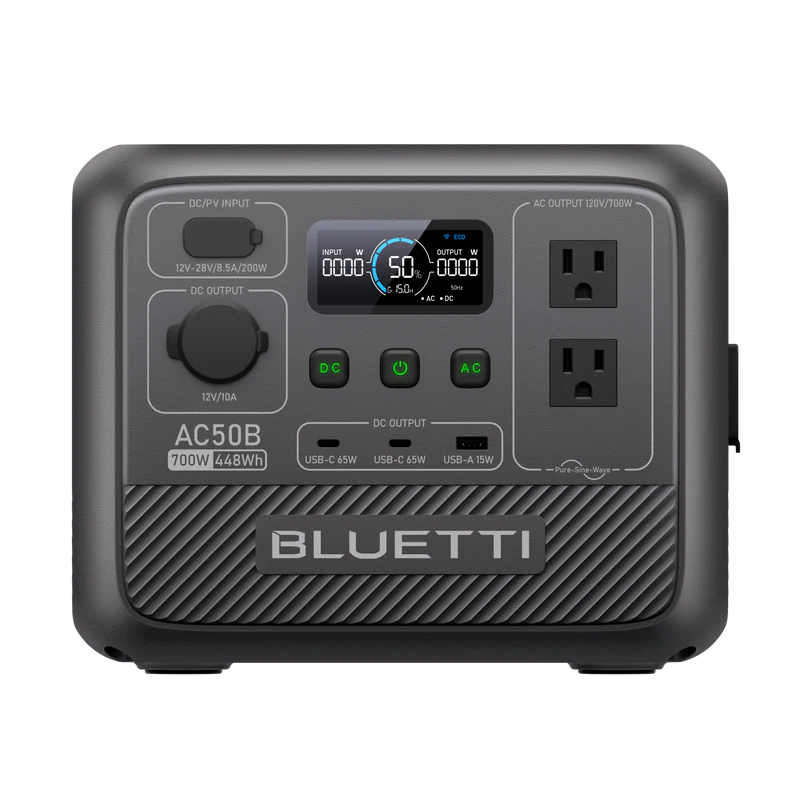
BLUETTI AC50B vs BLUETTI Elite 30 V2: the AC50B holds 448Wh against 288Wh and runs 700W against 600W, and it is the only one here that finishes an overnight CPAP load; the Elite 30 V2 answers with a 1,500W surge against 1,000W. Buy the AC50B if your job is finishing the night.
Full profiles: BLUETTI AC50B → · BLUETTI Elite 30 V2 →

Written by Wenny ZhengUpdated
Portable Power Tester, Station Arena Test Desk
$399.00 · direct from BLUETTI
Last checked 1 day ago. Prices move — check before you buy.

$249.99 · direct from BLUETTI
Last checked 1 day ago. Prices move — check before you buy.
Spec deltas
Both of these are BLUETTI units on the identical 3,000-cycle, 5-year warranty, which makes this a cleaner test of engineering choices than brand loyalty. The AC50B holds 448Wh and runs 700W continuous for $399; the Elite 30 V2 holds 288Wh and runs 600W continuous for $239.
The AC50B is the bigger, more expensive unit, and yet the Elite 30 V2 carries the higher surge rating — 1,500W against 1,000W. That's the one spec on this page that doesn't follow the size-and-price pattern, and it says something real about which unit BLUETTI tuned for peak load versus sustained draw.
Run the lifetime math and the AC50B, despite the $160 higher sticker price, actually comes out cheaper per kWh delivered over its full life: $0.22 against $0.24. The Elite 30 V2 stays the lighter, quieter, cheaper-today pick — just not the cheaper-forever one.
What the Numbers Reveal
Each conclusion stated first — the numbers behind it on one line, the full analysis below.
continuous output
One reviewer fired an electric kettle drawing 476W on the Elite 30 V2 within seconds of startupB13, the kind of sharp momentary spike a 1,500W surge is built to absorb without complaint. The AC50B's 1,000W ceiling is tuned for a higher continuous number instead, which matters more for something that runs steady for hours than for something that spikes hard for a second.
The AC50B runs 700W continuous with a 1,000W surgeThe Elite 30 V2 runs 600W continuous with a 1,500W surge
Why it mattersAnyone starting a compressor, a kettle, or another spiky load should actually prefer the smaller Elite 30 V2 over the bigger AC50B — surge headroom, not battery size, is what keeps a startup spike from tripping the inverter.
Capacity
The Elite 30 V2 isn't close on this one; it's short by about 75Wh before the CPAP even reaches morning. The AC50B has real margin left over. This is the one job on this entire comparison where the smaller unit doesn't just lose, it fails to finish.
The AC50B holds 448Wh, the Elite 30 V2 holds 288WhA CPAP running overnight draws roughly 320Wh, and usable capacity after inverter losses runs about 85% of the rated figure on either unit
Why it mattersAnyone running a CPAP through the night should default to the AC50B without debate — a quiet unit that dies at 3 a.m. is worse than a slightly louder one that doesn't.
Typical price
This flips the usual pattern on this page's sibling comparisons, where the smaller, cheaper unit is also the worse per-kWh deal. Here the pricier unit is the better one, over the full 3,000-cycle life either battery will actually see.
The AC50B costs $399, $160 more than the Elite 30 V2's $239Lifetime cost lands at $0.22 per kWh for the AC50B against $0.24 per kWh for the Elite 30 V2
Why it mattersBuyers deciding whether the extra $160 is worth it should treat it as a good rate on real capacity, not a markup — it pays for itself in lifetime cost before it pays for itself in anything else.
weight
That's the real tension in this matchup: the Elite 30 V2 is the unit you'd want two feet from your head on noise alone, but it's also the one that can't finish the job it would be sitting there for. The AC50B is the louder roommate that actually gets you to morning.
The AC50B weighs 14.8 lbs and rates 45dBA of noiseThe Elite 30 V2 weighs 10.3 lbs and rates 30dBA — 4.5 lbs lighter and 15dB quieter
Why it mattersCPAP buyers should prioritize finishing the night over the quieter fan — capacity that runs out is a bigger problem at 3 a.m. than 15 extra decibels.
The specific dimensions that decide these two units — everything else is a tie.
PowerScore Breakdown
Selected because: The reversed surge-vs-continuous-output pattern between these two is the most counterintuitive result in this whole batch.
overall power score
Normally the bigger, pricier unit wins every power spec by default. Here it wins capacity and continuous output but loses surge — 1,000W against the Elite 30 V2's 1,500W — which means BLUETTI built two genuinely different inverters for two different jobs rather than just scaling one design up.
Read as intent: the Elite 30 V2 is tuned for sharp, momentary spikes off a smaller tank; the AC50B is tuned for steady, sustained draw off a bigger one. Neither is the objectively better inverter — they're built for different loads.
Your Life, Your Pick
Selected because: CPAP Overnight is the one scenario across this entire comparison set with a real winner, not a 'neither' — worth explaining directly.
Every other scenario across this comparison lands as a wash between these two pocket-class units — both are too small for a weekend camping trip or a real multi-hour blackout, and the gap between them barely matters when both are already falling well short. CPAP Overnight breaks that pattern.
At roughly 320Wh needed for the night and about 85% usable capacity after inverter losses, the AC50B's 448Wh clears the job with real margin while the Elite 30 V2's 288Wh comes up short before morning. This is the one place on this page where 'buy the quieter one' is the wrong instinct.
Lifetime Value
Selected because: The AC50B's higher sticker price hides a better cost-per-lifetime-kWh, the opposite of the usual small-unit penalty.
cost / lifetime kWh
The AC50B's $160 premium looks like a straightforward upsell until the lifetime math runs the other way: $0.22 per kWh over its full life against the Elite 30 V2's $0.24. The bigger unit is also the better long-term deal, which doesn't happen everywhere on this page's sibling comparisons.
It isn't a clean sweep, though — cost per warranty-year actually favors the Elite 30 V2, at $42 a year against the AC50B's $60, since both share the identical 5-year term but the AC50B's higher sticker spreads over the same number of years. Pick the metric that matches how you'll actually use it: per-kWh favors the AC50B, per-year-of-ownership favors the Elite 30 V2.
What the Specs Don't Tell You
Selected because: Noise, surge ratio, and UPS speed are the firing, spec-true differentiators once battery size is factored out.
Noise is the AC50B's clearest cost of admission: 45dB under load against the Elite 30 V2's 30dB, a 15dB gap that's audible in a quiet room. Surge tells the opposite story, with the Elite 30 V2's 1,500W beating the AC50B's 1,000W despite the smaller battery underneath it.
UPS switchover follows the same pattern as surge — the Elite 30 V2 clears in 10ms against the AC50B's 20ms, twice as fast. Add it up and the Elite 30 V2 wins every spec that isn't raw capacity or sustained output; the AC50B wins those two outright.
Strengths & trade-offs
BLUETTI AC50B
Strengths
- +Larger battery capacity
- +Higher AC output
Trade-offs
- –Substantially more expensive (+$160) than the Elite 30 V2.
BLUETTI Elite 30 V2
Strengths
- +Costs $160 less
- +Lighter by 4.5 lb
Trade-offs
- –No major technical downsides compared to rival.
Will It Power Your Gear?
Scenario math and per-appliance runtimes, modeled from the spec record.
Scenario verdicts
We ran the math on seven real-world scenarios. Here's which unit survives your actual life.
SCN-01 · 2 nights · needs 2,100Wh
Weekend Camping
Two nights off-grid with essential comfort
Neither unit
Neither unit covers this scenario's 2,100Wh: the AC50B comes up 1,719Wh short (about 18% covered), the Elite 30 V2 1,855Wh (12%). This is well outside what either unit is for; the right answer here is a larger station, not a choice between these two.
Battery budget usedlower = more headroom
LOAD Phone Charger 15W×6h · LED Lights 40W×8h · Box Fan 75W×14h · CPAP Machine 40W×16h
SCN-02 · 8 hours · needs 1,645Wh
8-Hour Blackout
Keep the essentials running through a night without power
Neither unit
Neither unit covers this scenario's 1,645Wh: the AC50B comes up 1,264Wh short (about 23% covered), the Elite 30 V2 1,400Wh (15%). This is well outside what either unit is for; the right answer here is a larger station, not a choice between these two.
Battery budget usedlower = more headroom
LOAD Fridge 150W×8h · Router + Modem 20W×8h · LED Lights (4 bulbs) 40W×6h · Phone Charger 15W×3h
SCN-03 · 8 hours · needs 320Wh
CPAP Overnight
Sleep therapy without interruption — the #1 medical use case
AC50B
This is the one real split in the whole comparison. A CPAP needs roughly 320Wh to get through the night, and after the usual inverter losses, the AC50B's 448Wh clears that with room while the Elite 30 V2's 288Wh doesn't quite make it to morning. Noise usually decides a CPAP purchase; here, capacity has to decide it first.
Battery budget usedlower = more headroom
LOAD CPAP Machine 40W×8h
SCN-04 · 8 hours · needs 910Wh
Remote Workday
Full work day off-grid without power anxiety
Neither unit
Neither unit covers this scenario's 910Wh: the AC50B comes up 529Wh short (about 42% covered), the Elite 30 V2 665Wh (27%). Treat this as partial cover — enough for the essentials in it, not the whole list.
Battery budget usedlower = more headroom
LOAD Laptop 60W×8h · External Monitor 30W×8h · Router + Modem 20W×8h · Phone Charger 15W×2h
SCN-05 · 4 hours · needs 670Wh
Tailgate Party
Game day power for the crew
Neither unit
Neither unit covers this scenario's 670Wh: the AC50B comes up 289Wh short (about 57% covered), the Elite 30 V2 425Wh (36%). Treat this as partial cover — enough for the essentials in it, not the whole list.
Battery budget usedlower = more headroom
LOAD Blender 400W×0.5h · LED TV (55") 80W×4h · Bluetooth Speaker 15W×4h · Phone Charger (×3) 45W×2h
SCN-06 · 24 hours · needs 4,685Wh
Van Life Daily
A full day of mobile living — the ultimate endurance test
Neither unit
Neither unit covers this scenario's 4,685Wh: the AC50B comes up 4,304Wh short (about 8% covered), the Elite 30 V2 4,440Wh (5%). This is well outside what either unit is for; the right answer here is a larger station, not a choice between these two.
Battery budget usedlower = more headroom
LOAD Mini-Fridge 150W×24h · Laptop 60W×4h · Phone Charger 15W×3h · LED Lights 40W×5h · Fan 75W×8h
SCN-07 · an afternoon · needs 100Wh
Afternoon Off-Grid
Phones and a speaker at the park, beach, or campsite — the small-unit job description
Either unit
This is the job small stations are actually for, and both do it: the AC50B finishes at 26% used, the Elite 30 V2 at 41%. At this size the decider is what rides in the bag — 10.3 lbs for the Elite 30 V2 against 14.8 for the AC50B — and price, not the leftover watt-hours.
Battery budget usedlower = more headroom
LOAD Phone Charger (×2) 30W×2h · Bluetooth Speaker 10W×4h
The Load Test
RUNTIME = (Wh × 0.85) ÷ LOAD
None of the scenarios above exactly yours? Build it. Toggle what you'd plug in; both units are tested against the combined draw.
Essentials
Comfort & Convenience
High-Draw Appliances
Test duration
8h
Continuous draw
205W
Projected runtime
For this load: AC50B runs 1.9h vs 1.2h.
$399 list · direct from BLUETTI
Modeled from the spec record — same math as the tables below. Methodology
Runtime by appliance
Real-world runtime estimates for common appliances, modeled at 85% inverter efficiency.¹
Essentials
The basics you need runningscale 0–25.4hComfort & Convenience
Makes off-grid life actually enjoyablescale 0–5.1hHigh-Draw Appliances
These reveal the real limits¹ Runtime = (capacity × 0.85) ÷ appliance watts. Within each group, all bars share one time scale (the group's longest runtime), so lengths are comparable across appliances; identical runtimes collapse into a single blue/orange bar. Actual runtime varies with battery age, temperature, and simultaneous loads — see methodology.
Conclusion
July 14, 2026
Verdict: the BLUETTI AC50B
This is a real trade, not a rout. The AC50B costs $160 more at checkout, but it works out to $0.22 per lifetime kWh against the Elite 30's $0.24 — the extra money buys capacity at a genuinely good rate, not a premium tax. It's also the only one of these two that clears an overnight CPAP load once you account for real usable capacity after inverter losses. The Elite 30 V2 answers with a lighter chassis, a 15dB-quieter fan, a faster USB-C ceiling, and — the one genuinely odd result on this page — a bigger surge rating despite the smaller battery. If your job is finishing the night, take the AC50B and carry the extra 4.5 lbs. If it's charging phones and laptops quietly and cheaply, take the Elite 30 V2.
Editor-assigned confidence, based on cited owner research and spec analysis.
List prices as of July 14, 2026. The links below open BLUETTI's current price.
$399.00 · direct from BLUETTI
Last checked 1 day ago. Prices move — check before you buy.
or check the Elite 30 V2 price$249.99 list
Written by Wenny Zheng, Portable Power Tester · Station Arena Test Desk · Updated July 14, 2026
Measured Data
Benchmark scores and the full spec record, side by side.
Benchmark scores
Not rated for both units (minimum threshold unmet): Tailgating.
Full specifications
ᵈ Derived: price ÷ rated capacity. See the data behind our comparisons →
Comparison ToolAdd more power stations, side by sideOpen Tool →How these numbers are produced
Numeric verification
Every figure on this page traces to our spec database or arithmetic on it — no estimated numbers.
Owner claims
Statements about owner experience are cited to published reviews — see Sources & Research Notes below.
Runtime model
Runtime = (rated capacity × 0.85 inverter efficiency) ÷ device wattage. Solar recharge estimates assume panels deliver 70% of rated output. Cold weather, battery age, and stacked loads reduce real-world results.
Power Score
Computed from 14 published spec dimensions, weighted per use-case bench. Higher is better; a unit must meet a bench's minimum threshold to be rated.
See the full weight table and data sourcing on our methodology page →Class ranking (the star rating)
Each unit's star score is a category ranking, not customer reviews — no buyer opinions feed it. We score every station on size-independent quality (value, output, portability, endurance, ports, warranty, and more), then percentile-rank it against the other units in its capacity class, so a class-leading compact unit and a class-leading whole-home unit can both earn 5★. Here, AC50B rates 4.6/5 (76th percentile of 22 Personal-class units), and Elite 30 V2 rates 4.9/5 (95th percentile of 22 Personal-class units).
How the class ranking is computed →Test Notes & Caveats
Hidden gotchas and advantages we spotted that you won't find on the product page.
45dB vs 30dB Is the Real Cost of the AC50B's Extra Capacity
Fifteen decibels is audible in a quiet room, and it's the direct trade for the AC50B's 160Wh capacity advantage and higher continuous output. For anyone not sleeping near the unit, it's a non-issue; for a bedside CPAP setup, it's the honest downside of the unit that can actually finish the night.
The Smaller Battery Has the Bigger Surge
1,500W on the Elite 30 V2 against 1,000W on the AC50B, despite the AC50B holding 160Wh more capacity. This is a genuine inverter-design choice, not a size correlation — BLUETTI tuned the Elite 30 V2 for peak spikes and the AC50B for sustained draw.
UPS Switchover: ≤10ms vs ≤20ms
Both list a UPS mode, at different rated speeds. The Elite 30 V2 is rated ≤10ms — quick enough on paper that desktop PCs and routers should ride through, treating that as the rating it is. The AC50B is rated ≤20ms — fine on paper for routers and most electronics; the fussiest PC power supplies sit right at this line. If a computer with unsaved work is the thing being protected, the stated class is worth the attention; nothing here is a lab result.
Warranty: No Difference
Both units carry the same 5-year warranty, so coverage isn't a tiebreaker here. Both figures are maximums rather than guarantees — they depend on buying direct from BLUETTI or registering the unit, since reseller purchases carry a shorter term. Worth saying because the per-dollar framing can suggest otherwise: the Elite 30 V2 works out at 20.9 years of cover per $1,000 spent against the AC50B's 12.5, but that spread is the price gap, not the terms.
Full record above — the Test Desk pick is the AC50B.
Check AC50B price →or check the Elite 30 V2 priceOwnership Analysis
What happens after you buy — true cost of ownership, brand trust, and growth potential.
Lifetime value
Service lifeyears at one full cycle per day
Lifetime energy delivered
Cost per delivered kWh
│ warranty ends · Reaching the cycle rating means ~80% capacity remains — degraded, not dead.
Analyst note
Both units have similar long-term ownership costs ($0.3/kWh vs $0.28/kWh). The price difference is what you see on the sticker — neither is a hidden bargain or rip-off. One thing to know reading the table: both carry the same 3,000-cycle rating, so the lifetime rows are sticker price and capacity in disguise — the wear horizon is identical and decides nothing here.
Growth path
AC50B
FIXED CAPACITYFixed at 448Wh, with no expansion — so size it for your needs up front rather than planning to add capacity later.
Accepts up to 200W of solar. Limited to a single portable panel.
Limited ports. You'll likely need a power strip or splitter.
Elite 30 V2
FIXED CAPACITYFixed at 288Wh, with no expansion — so size it for your needs up front rather than planning to add capacity later.
Accepts up to 200W of solar. Limited to a single portable panel.
Limited ports. You'll likely need a power strip or splitter.
Realistic full solar rechargeat 70% of rated panel output — see methodology
Analyst note
Neither expands, and that's no knock on either — each is a complete unit at a fixed size. Buy the capacity that covers your needs now (the AC50B gives you the larger ceiling); you can't add to either later.
What Owners Report
Patterns from published owner reports and long-term reviews — every claim cited to its source below.
BLUETTI AC50B
The AC50B's reviewer coverage centers on it being BLUETTI's affordable entry into long-cycle LiFePO4 at this size — a 448Wh battery with 700W continuous output and 1,000W Power Lifting mode, positioned as a durable, budget-conscious pickA1. At 14.8 lbs it's noted as meaningfully lighter than BLUETTI's larger AC-series units, a genuinely portable size with real output behind itA2.
Charging speed checks out in practice too: about 3 hours on standard AC charging, dropping to roughly 1.25 hours with the optional Turbo charger, with 0-80% achievable in about 45 minutesA3. Coverage on the AC50B is comparative and spec-driven rather than long-term ownership data — worth flagging plainly rather than overstating.
“A 448Wh LiFePO4 battery with 700W output (1,000W Power Lifting), rated for 2,500+ cycles to 80% — years of reliable use.”
Sources
amazon.com · backuppowerhub.com · the-gadgeteer.com · t3.com · bluettipower.com
BLUETTI Elite 30 V2
Field tests on the Elite 30 V2's charging speed came back accurate rather than inflated — turbo mode hitting 80% in about 45 minutes, a full charge in roughly 70 minutes to 2 hours depending on mode, numbers one reviewer confirmed matched their actual usageB11B12. The 10ms UPS switchover held up in the field too, with one reviewer crediting it for stability through patchy cabin powerB10.
The honest catch, and the one most relevant to this specific matchup: at least one reviewer found real-world battery life came in a little short of expectations under demanding use, which they attributed directly to the unit's genuinely small 288Wh capacity rather than a defectB9 — the same limitation that decides the CPAP comparison against the AC50B. On the plus side, multiple independent reviewers over several months consistently describe it as quiet even under real AC loadsB4B5B6.
“The smartphone app works great allowing for customizing the settings and keeping track of the unit's status.”
Sources & Research Notes
Every owner claim in this report is traceable to a published source. The bracketed references above resolve here.
Recurring owner themes
- Affordable, genuinely portable LFP unit with 700W output, 2,500+ cycles, fast Turbo charging, and B80 expandability. [AC50B · 3 entries]
- Multiple independent reviewers, testing separately over several months, consistently describe the unit as very quiet even under load, with the fan only noticeably kicking in at higher wattages. [Elite 30 V2 · 3 entries]
- Impressions of the companion app are inconsistent between reviewers — one calls the UI rough/basic while another says it works great for monitoring and customization. [Elite 30 V2 · 2 entries]
- BLUETTI's advertised fast-charging claims (turbo to 80% in ~45 min, full charge in roughly 70 minutes to 2 hours) were verified as accurate in hands-on testing rather than just marketing numbers. [Elite 30 V2 · 2 entries]
- The three separate physical power buttons (main/DC/AC) create an extra step in normal use that at least one long-term user found unnecessary, though another reviewer described it neutrally as just how BLUETTI designs its units. [Elite 30 V2 · 2 entries]
- Reviewers who kept the unit for extended field use (months, not just an initial test) report continued satisfaction and no durability failures, despite the unit lacking a formal IP rating. [Elite 30 V2 · 2 entries]
- A1
“A 448Wh LiFePO4 battery with 700W output (1,000W Power Lifting), rated for 2,500+ cycles to 80% — years of reliable use.”
amazon.com / backuppowerhub.com — AC50B review · 2026 · [positive]
- A2
“At 14.8 lbs it's meaningfully lighter than the AC70 (21.4 lbs) — a genuinely portable sub-15-lb unit with a long-cycle battery and 700W output at an easy-to-justify price.”
backuppowerhub.com / the-gadgeteer.com — AC50B review · 2026 · [positive]
- A3
“Standard AC charging is about 3 hours, dropping to 1.25 hours with the optional 480W Turbo charger; 0-80% in 45 minutes.”
amazon.com / t3.com — AC50B review · 2026 · [positive]
- B4
“It is nearly silent when charging and when powering things like iPhones and Macs. The fan inside will kick on under higher loads, but it's still not unreasonably loud. I can hear it, but it's a noise I could sleep through.”
MacRumors — 'Bluetti Elite 30 V2 Review: A Lightweight Portable Power Station for Camping and Backup Power' · 2025-12 · [positive]
- B5
“It doesn't make much noise, which is a good thing when you're relaxing or trying to sleep.”
AllOutdoor — 'AllOutdoor Review – BLUETTI Elite 30 V2 Power Station' · 2026-07 · [positive]
- B6
“The device ran quietly, under 30 dB, so it didn't interrupt the peaceful outdoors.”
TheGadgetFlow — 'Bluetti Elite 30 V2 review: more than a mini power station, coming up at CES 2026' · 2026-01 · [positive]
- B9
“The battery life in real-world use was a little less than I expected when doing demanding editing, but that's to be expected with its small 288Wh capacity.”
AllOutdoor — 'AllOutdoor Review – BLUETTI Elite 30 V2 Power Station' · 2026-07 · [negative]
- B10
“If the mains power goes down, it switches to battery power in less than 10 milliseconds, and that was reassuring in cabins where the electricity was a bit patchy.”
AllOutdoor — 'AllOutdoor Review – BLUETTI Elite 30 V2 Power Station' · 2026-07 · [positive]
- B11
“Turbo mode can get you up to 80% in about 45 minutes, while a full charge on standard takes 2 hours and silent takes 3. I have to say those times are pretty accurate based on my usage.”
The Gadgeteer — 'Bluetti Elite 30 V2 portable power station review - Petite portable power to keep the party going' · 2025-10 · [positive]
- B12
“Plugged into a standard outlet, the Elite 30 V2 fully recharged surprisingly quickly in about 70 minutes. That's perfect for last-minute prep before a camping trip.”
TheGadgetFlow — 'Bluetti Elite 30 V2 review: more than a mini power station, coming up at CES 2026' · 2026-01 · [positive]
- B13
“I filled the kettle and fired it up. Within a few seconds the kettle was drawing 476 watts... I've never been able to use the Joulle kettle with a 288Wh power station before.”
The Digital Story — 'The Bluetti Elite 30 V2 Portable Power Station Review' · 2025-09 · [positive]
Research compiled July 14, 2026.
Who Should Buy Which
Buy the AC50B if you…
- →You're running a CPAP or any other load that needs to genuinely finish the night — the AC50B is the only one of these two sized correctly for that job.
- →You're optimizing for cost per kWh over the unit's full life and can absorb the $160 higher sticker price and the extra 4.5 lbs.
Buy the Elite 30 V2 if you…
- →You want the lightest, quietest unit of the two, and your loads are phones, laptops, and short device charging rather than an all-night draw.
- →You'll occasionally run something with a sharp startup spike — a small compressor, a kettle — where the Elite 30 V2's larger surge rating actually outperforms the bigger AC50B.
If neither fits
If you need to cover a weekend camping trip (around 2,100Wh) or an 8-hour multi-appliance blackout (around 1,645Wh), both of these fall well short — they're pocket-class units for device charging, short backup, and single-night jobs like CPAP, not multi-day power. Step up to BLUETTI's mid-size AC-class lineup instead.
The Bottom Line
This one comes down to duration, not price or brand. The AC50B costs $160 more but delivers more capacity at a better lifetime rate and is the only unit here that actually finishes an overnight CPAP load. The Elite 30 V2 answers with a lighter, quieter chassis and — the one genuinely surprising result on this page — a bigger surge rating despite the smaller battery.
Buy on the job, not the spec sheet: all-night duty goes to the AC50B, everything shorter and quieter goes to the Elite 30 V2.
Frequently Asked Questions
Answers drawn from the spec record and cited owner research.
Which BLUETTI unit is better for a CPAP overnight, the AC50B or Elite 30 V2?
The AC50B. A CPAP draws roughly 320Wh overnight, and after accounting for the standard ~85% usable capacity after inverter losses, the AC50B's 448Wh clears that with real margin while the Elite 30 V2's 288Wh comes up short. It's the one scenario in this comparison where the smaller unit doesn't just lose, it doesn't finish the job.
Why does the smaller Elite 30 V2 have a bigger surge rating than the AC50B?
BLUETTI tuned them for different jobs. The Elite 30 V2's 1,500W surge (against the AC50B's 1,000W) is built for sharp, momentary spikes — one reviewer ran an electric kettle drawing 476W on it within seconds of startup. The AC50B's inverter instead favors a higher sustained 700W continuous output over peak headroom.
Is the AC50B actually cheaper to own despite costing more?
Over its full 3,000-cycle life, yes — $0.22 per kWh delivered against the Elite 30 V2's $0.24, even with a $160 higher sticker price. That said, cost per warranty-year favors the Elite 30 V2 ($42 against $60), since both share the same 5-year term but the AC50B's higher price spreads over it. Which metric matters depends on whether you're optimizing for total energy delivered or years of ownership.
How much heavier and louder is the AC50B?
4.5 lbs heavier (14.8 lbs against 10.3) and 15dB louder under load (45dB against 30dB). That's a real difference for anyone sitting near the unit or carrying it any distance — it's the direct cost of the AC50B's extra 160Wh of capacity and higher continuous output.
Which one should I actually buy?
If you need to run something all night — a CPAP being the clearest example — take the AC50B; it's the only one of these two sized for that job, and it's actually cheaper per lifetime kWh despite the higher sticker price. If your loads are phones, laptops, and short device charging, the Elite 30 V2 is lighter, quieter, cheaper today, and has the stronger surge rating for spiky loads.
Where to buy
BLUETTI AC50BPick
$399.00
$399.00 · direct from BLUETTI
Last checked 1 day ago. Prices move — check before you buy.
BLUETTI Elite 30 V2
$249.99
$249.99 · direct from BLUETTI
Last checked 1 day ago. Prices move — check before you buy.
Prices may vary by retailer and are subject to change.