Head-to-head test
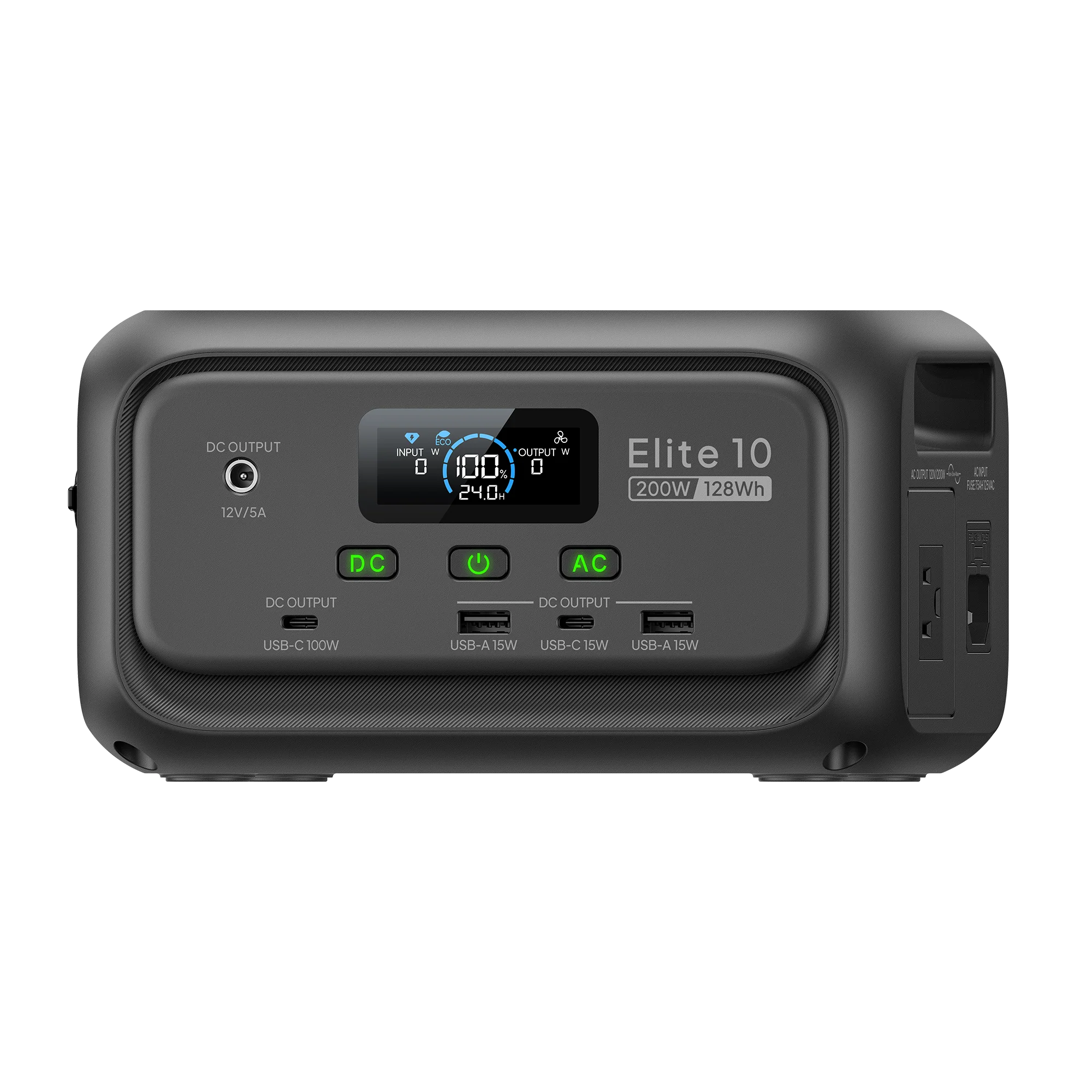
BLUETTI Elite 10 Mini vs BLUETTI Elite 30 V2
BLUETTI Elite 10 Mini vs BLUETTI Elite 30 V2: the Elite 30 V2 more than doubles the battery, 288Wh against 128Wh, and triples the outlet, 600W against 200W, with a 1,500W surge ceiling against 300W. Buy the Elite 30 V2 unless the whole job is topping off phones at 3.97 lbs.
Full profiles: BLUETTI Elite 10 Mini → · BLUETTI Elite 30 V2 →

Written by Wenny ZhengUpdated
Portable Power Tester, Station Arena Test Desk
$113.00 · direct from BLUETTI
down from $119 · 5% below usual
Last checked 1 day ago. Prices move — check before you buy.

$249.99 · direct from BLUETTI
Last checked 1 day ago. Prices move — check before you buy.
Spec deltas
The BLUETTI Elite 30 V2 costs $120 more than the Elite 10 Mini, $239 against $119, and for that money it more than doubles the battery (288Wh against 128Wh), triples the continuous output (600W against 200W), and multiplies the surge headroom by five (1,500W against 300W).
Run both through this site's six standard scenarios and every single one comes back the same verdict: neither. Even the lightest ask on the list, an 8-hour CPAP night at 320Wh, needs more than either battery can deliver after inverter losses. These are gadget chargers, not blackout boxes, and the scenario sweep says so unanimously.
So the decision isn't which one wins a scenario. It's which narrow job you actually have. The 30 V2 is the quieter, more capable charger with real surge headroom and a lower cost per lifetime kilowatt-hour. The Mini is the lightest, cheapest way to keep a phone and a laptop alive, and nothing more.
What the Numbers Reveal
Each conclusion stated first — the numbers behind it on one line, the full analysis below.
continuous output
Because both units share the same 3,000-cycle rating, that extra capacity converts directly into cheaper energy over the unit's life: $0.28 per lifetime kWh for the 30 V2 against $0.31 for the Mini. The $120 premium isn't a size tax. It undershoots what the hardware is actually worth.
Elite 10 Mini: $119, 128Wh, 200W continuous, 300W surgeElite 30 V2: $239, 288Wh, 600W continuous, 1,500W surgeboth rated for 3,000 cycles
Why it mattersAnyone assuming the bigger unit is the worse deal per dollar has the math backwards. It's the cheaper one, if you'll ever use the extra capacity.
The 30 V2 clears the ceiling at 600W, starts the blender, then runs out of battery trying to finish the rest of the game-day list anyway, landing at 274% of its usable capacity. One unit fails before it tries. The other fails only after it tries.
Elite 10 Mini outputs 200W continuousElite 30 V2 outputs 600W continuousthe Tailgate Party scenario's peak load is a 400W blenderthe Elite 30 V2 still finishes that scenario at 274% of its usable capacity
Why it mattersIf anything on your list draws over 200W, the Mini is disqualified on power delivery alone, before battery size even enters the comparison.
Both facts point the same direction: the 30 V2's extra size bought a quieter fan and an inverter with more headroom over a compressor's brief startup spike, not just more watt-hours.
Elite 10 Mini's fan hits 45dB under loadElite 30 V2 stays at 30dBElite 10 Mini's surge-to-continuous ratio is 1.5x (300W/200W)Elite 30 V2's is 2.5x (1,500W/600W)
Why it mattersAnyone planning to sleep near either unit, or run anything with a motor close to it, gets a materially better-engineered box in the 30 V2, independent of the battery-size argument.
Typical price
That's the one place in this matchup where the cheaper unit is also the better financial deal. Everywhere else, cost per lifetime kWh included, the extra money the 30 V2 asks for tracks what it delivers.
Elite 10 Mini: 3-year warranty on a $119 unit, working out to $40 per covered yearElite 30 V2: 5-year warranty on a $239 unit, working out to $48 per covered year
Why it mattersBuyers optimizing for the longest total coverage window want the 30 V2's 5 years. Buyers optimizing for the cheapest price per year of protection want the Mini, even though it's the smaller warranty.
The specific dimensions that decide these two units — everything else is a tie.
Lifetime Value
Selected because: Same chemistry and cycle life, so the ownership math is clean, and it points opposite the warranty-per-year math. That tension is worth surfacing on its own.
cost / lifetime kWh
Same chemistry, same 3,000-cycle rating, different scale. Divide each battery's watt-hours across those cycles and the Mini is rated to deliver 384 lifetime kWh, the 30 V2 864. Price each against what it actually delivers and the 30 V2 comes out cheaper to own, $0.28 per lifetime kWh against $0.31, despite costing $120 more at checkout.
The one place that flips is warranty. Counted in years, the 30 V2 wins outright, 5 against 3. Counted in dollars per covered year, the Mini wins, $40 against $48. Buy on total energy delivered and the 30 V2 is the discount. Buy on cost per year of protection and the Mini is. Both are true at once, and neither cancels the other out.
Your Life, Your Pick
Selected because: A clean sweep of six 'neither' verdicts is the finding, and Tailgate Party fails each unit for a different, worth-explaining reason.
Every one of the six standard scenarios here comes back the same verdict: neither. That's not a coin flip, it's a capacity-class mismatch. The smallest ask on the list, an 8-hour CPAP night at 320Wh, still needs 294% of what the Mini can deliver after inverter losses and 131% of what the 30 V2 can deliver. If the lightest job on the sheet is already too big for both, the heavier ones never had a chance.
Tailgate Party is the one scenario worth a closer look, because the two units fail it for completely different reasons. The Mini's 200W inverter can't start the scenario's 400W blender at all, a hard ceiling that has nothing to do with battery size. The 30 V2's 600W inverter starts the blender fine, then runs the rest of the game-day list, TV, speaker, three phones, down to 274% of its usable capacity. One fails before it tries. The other fails only after.
What the Specs Don't Tell You
Selected because: All three firing cards (noise, surge, warranty) tell a coherent story about where the bigger unit's extra size actually goes.
Three cards fire here, and two of them agree with each other. The Mini's fan hits 45dB under load against the 30 V2's 30dB, and the 30 V2 carries the wider surge cushion, 2.5x surge-to-continuous against the Mini's 1.5x. Both trace back to the same cause: the bigger unit's inverter and cooling are better engineered, not just bigger.
The third card is the warranty inversion already covered above. The 30 V2 offers more total years; the Mini offers the cheaper rate per year. Worth naming against our own pick here: choosing the 30 V2 means paying $8 more per year of coverage than the Mini charges for its own.
Portability & Form Factor
Selected because: A 2.6x weight gap is the most viscerally real difference at this size class, and it's the deciding factor for the Mini's actual buyer.
weight
Stack two and a half Minis and you've matched the 30 V2's weight, 10.3 lbs against 3.97. That's a real difference at this size class. The Mini is light enough to forget is in a bag. The 30 V2 is a decision to pack it.
Neither ships with wheels or a handle built for hauling, so weight is the whole story here. If this rides in a backpack pocket or a glovebox, the Mini disappears. If it lives semi-permanently in a vehicle or on a shelf, the 30 V2's extra 6.33 lbs buys triple the outlet power and won't be felt once it's parked.
Strengths & trade-offs
BLUETTI Elite 10 Mini
Strengths
- +Costs $120 less
- +Lighter by 6.3 lb
Trade-offs
- –No major technical downsides compared to rival.
BLUETTI Elite 30 V2
Strengths
- +Larger battery capacity
- +Higher AC output
- +Longer warranty
- +Faster solar charging
Trade-offs
- –Substantially more expensive (+$120) than the Elite 10 Mini.
Will It Power Your Gear?
Scenario math and per-appliance runtimes, modeled from the spec record.
Scenario verdicts
We ran the math on seven real-world scenarios. Here's which unit survives your actual life.
SCN-01 · 2 nights · needs 2,100Wh
Weekend Camping
Two nights off-grid with essential comfort
Neither unit
Two nights of phone charging, lights, a box fan, and a CPAP adds up to 2,100Wh, 1,930% of the Mini's usable capacity and 858% of the 30 V2's. Both units are built for one gadget at a time, not a multi-day, multi-device weekend. Bring a much bigger station or trim the list down to just the CPAP.
Battery budget usedlower = more headroom
LOAD Phone Charger 15W×6h · LED Lights 40W×8h · Box Fan 75W×14h · CPAP Machine 40W×16h
SCN-02 · 8 hours · needs 1,645Wh
8-Hour Blackout
Keep the essentials running through a night without power
Neither unit
A fridge, a router, some lights, and phone top-ups for eight hours needs 1,645Wh. The Mini needs 1,512% of its usable capacity to cover that and the 30 V2 needs 672%. Neither is a blackout box. Both are built for the phone and the router alone, not the fridge riding along with them.
Battery budget usedlower = more headroom
LOAD Fridge 150W×8h · Router + Modem 20W×8h · LED Lights (4 bulbs) 40W×6h · Phone Charger 15W×3h
SCN-03 · 8 hours · needs 320Wh
CPAP Overnight
Sleep therapy without interruption — the #1 medical use case
Neither unit
This is the lightest ask on the page, 320Wh for eight hours, and it still beats both units after inverter losses, 294% of the Mini's usable capacity and 131% of the 30 V2's. The 30 V2 gets meaningfully closer. For a full night with no recharge, look at a larger station.
Battery budget usedlower = more headroom
LOAD CPAP Machine 40W×8h
SCN-04 · 8 hours · needs 910Wh
Remote Workday
Full work day off-grid without power anxiety
Neither unit
A laptop, a monitor, a router, and phone top-ups for a workday add up to 910Wh. The Mini needs 836% of its usable capacity to cover it and the 30 V2 needs 372%, short of the mark but by a lot less. Either can keep a laptop alone charged for a good while. Neither covers the full desk setup for a full day.
Battery budget usedlower = more headroom
LOAD Laptop 60W×8h · External Monitor 30W×8h · Router + Modem 20W×8h · Phone Charger 15W×2h
SCN-05 · 4 hours · needs 670Wh
Tailgate Party
Game day power for the crew
Neither unit
This is the one scenario where the two units fail for different reasons. The Mini's 200W outlet can't start the scripted 400W blender at all, regardless of battery size. The 30 V2's 600W outlet starts it fine, then runs the rest of the game-day list, TV, speaker, three phones, down to 274% of its usable capacity. Cut the blender and both units get a lot more realistic.
Battery budget usedlower = more headroom
LOAD Blender 400W×0.5h · LED TV (55") 80W×4h · Bluetooth Speaker 15W×4h · Phone Charger (×3) 45W×2h
SCN-06 · 24 hours · needs 4,685Wh
Van Life Daily
A full day of mobile living — the ultimate endurance test
Neither unit
A mini-fridge running all day plus a laptop, lights, a fan, and phone top-ups needs 4,685Wh, over 43 times the Mini's usable capacity and over 19 times the 30 V2's. Neither of these is a van-life daily driver. They're the charger you keep in the glovebox for what the house battery doesn't cover.
Battery budget usedlower = more headroom
LOAD Mini-Fridge 150W×24h · Laptop 60W×4h · Phone Charger 15W×3h · LED Lights 40W×5h · Fan 75W×8h
SCN-07 · an afternoon · needs 100Wh
Afternoon Off-Grid
Phones and a speaker at the park, beach, or campsite — the small-unit job description
Either unit
This is the job small stations are actually for, and both do it: the Elite 10 Mini finishes at 92% used, the Elite 30 V2 at 41%. At this size the decider is what rides in the bag — 4 lbs for the Elite 10 Mini against 10.3 for the Elite 30 V2 — and price, not the leftover watt-hours.
Battery budget usedlower = more headroom
LOAD Phone Charger (×2) 30W×2h · Bluetooth Speaker 10W×4h
The Load Test
RUNTIME = (Wh × 0.85) ÷ LOAD
None of the scenarios above exactly yours? Build it. Toggle what you'd plug in; both units are tested against the combined draw.
Essentials
Comfort & Convenience
High-Draw Appliances
Test duration
8h
Continuous draw
205W
Projected runtime
Only the Elite 30 V2 can start this 205W load.
$239 list · direct from BLUETTI
Modeled from the spec record — same math as the tables below. Methodology
Runtime by appliance
Real-world runtime estimates for common appliances, modeled at 85% inverter efficiency.¹
Essentials
The basics you need runningscale 0–16.3hComfort & Convenience
Makes off-grid life actually enjoyablescale 0–3.3hHigh-Draw Appliances
These reveal the real limits¹ Runtime = (capacity × 0.85) ÷ appliance watts. Within each group, all bars share one time scale (the group's longest runtime), so lengths are comparable across appliances; identical runtimes collapse into a single blue/orange bar. Actual runtime varies with battery age, temperature, and simultaneous loads — see methodology.
Conclusion
July 28, 2026
Verdict: the Elite 30 V2, on Power Score margin
The Elite 30 V2 is the more capable unit almost everywhere it counts: 288Wh against 128Wh, 600W continuous against 200W, and a 1,500W surge ceiling against 300W, with a quieter fan under load besides, reflected in a PowerScore of 1,855 against the Mini's 1,480. It's also the cheaper unit to own over its life, $0.28 per lifetime kWh against $0.31, on identical 3,000-cycle cells, so the extra $120 at checkout buys real hardware, not a size tax. The Mini's case is real but narrower: it's $120 cheaper up front, 6.33 lbs lighter, and it actually delivers more warranty coverage per dollar, $40 a year against $48, even though its total coverage window runs two years shorter. Buy the 30 V2 for a station that can genuinely back up small-to-medium gear. Buy the Mini only if the whole job is topping off phones and laptops at the lowest possible weight and price.
Today the Elite 10 Mini is $113, $6 under its typical $119. The verdict weighs typical prices, not today's. Prices checked 1 day ago.
Editor-assigned confidence, based on cited owner research and spec analysis.
List prices as of July 28, 2026. The links below open BLUETTI's current price.
$249.99 · direct from BLUETTI
Last checked 1 day ago. Prices move — check before you buy.
or check the Elite 10 Mini price$113.00 list
Written by Wenny Zheng, Portable Power Tester · Station Arena Test Desk · Updated July 28, 2026
Measured Data
Benchmark scores and the full spec record, side by side.
Benchmark scores
Not rated for both units (minimum threshold unmet): CPAP, Solar Generator, Tailgating, Camping.
Full specifications
ᵈ Derived: price ÷ rated capacity. See the data behind our comparisons →
Comparison ToolAdd more power stations, side by sideOpen Tool →How these numbers are produced
Numeric verification
Every figure on this page traces to our spec database or arithmetic on it — no estimated numbers.
Owner claims
Statements about owner experience are cited to published reviews — see Sources & Research Notes below.
Runtime model
Runtime = (rated capacity × 0.85 inverter efficiency) ÷ device wattage. Solar recharge estimates assume panels deliver 70% of rated output. Cold weather, battery age, and stacked loads reduce real-world results.
Power Score
Computed from 14 published spec dimensions, weighted per use-case bench. Higher is better; a unit must meet a bench's minimum threshold to be rated.
See the full weight table and data sourcing on our methodology page →Class ranking (the star rating)
Each unit's star score is a category ranking, not customer reviews — no buyer opinions feed it. We score every station on size-independent quality (value, output, portability, endurance, ports, warranty, and more), then percentile-rank it against the other units in its capacity class, so a class-leading compact unit and a class-leading whole-home unit can both earn 5★. Here, Elite 10 Mini rates 4.1/5 (48th percentile of 22 Personal-class units), and Elite 30 V2 rates 4.9/5 (95th percentile of 22 Personal-class units).
How the class ranking is computed →Test Notes & Caveats
Hidden gotchas and advantages we spotted that you won't find on the product page.
The Smaller Unit Is the Louder One
The Elite 10 Mini's fan tops out at 45dB under load, about like a running refrigerator, loud enough that most people find it disruptive for sleep. The Elite 30 V2 is rated at 30dB, closer to a quiet library, which is why this card fires only on the Mini's side.
The Bigger Unit's Inverter Has More Cushion
The Elite 30 V2 can briefly deliver 2.5 times its continuous rating, 1,500W against a 600W steady output. The Elite 10 Mini's cushion is thinner, 1.5 times, 300W against 200W. That matters the moment something with a compressor or motor tries to start near either unit. The wider cushion is the one less likely to trip.
Longer Contract, or Cheaper Rate
The Elite 30 V2's warranty runs longer in total, 5 years against 3. Priced per year of coverage, though, the Elite 10 Mini is the better rate, $40 a year against $48. Neither number is wrong. They're just answering different questions about the same $120 price gap.
Full record above — the Test Desk pick is the Elite 30 V2.
Check Elite 30 V2 price →or check the Elite 10 Mini priceOwnership Analysis
What happens after you buy — true cost of ownership, brand trust, and growth potential.
Lifetime value
Service lifeyears at one full cycle per day
Lifetime energy delivered
Cost per delivered kWh
│ warranty ends · Reaching the cycle rating means ~80% capacity remains — degraded, not dead.
Analyst note
The Elite 10 Mini is cheaper to buy, but the Elite 30 V2 is cheaper to own. At $0.28/kWh over its lifetime vs $0.31/kWh, the Elite 30 V2's higher cycle life and capacity make each dollar go further over the years. One thing to know reading the table: both carry the same 3,000-cycle rating, so the lifetime rows are sticker price and capacity in disguise — the wear horizon is identical and decides nothing here.
Growth path
Elite 10 Mini
FIXED CAPACITYFixed at 128Wh, with no expansion — so size it for your needs up front rather than planning to add capacity later.
Accepts up to 100W of solar. Limited to a single portable panel.
Limited ports. You'll likely need a power strip or splitter.
Elite 30 V2
FIXED CAPACITYFixed at 288Wh, with no expansion — so size it for your needs up front rather than planning to add capacity later.
Accepts up to 200W of solar. Limited to a single portable panel.
Limited ports. You'll likely need a power strip or splitter.
Realistic full solar rechargeat 70% of rated panel output — see methodology
Analyst note
Neither expands, and that's no knock on either — each is a complete unit at a fixed size. Buy the capacity that covers your needs now (the Elite 30 V2 gives you the larger ceiling); you can't add to either later.
What Owners Report
Patterns from published owner reports and long-term reviews — every claim cited to its source below.
BLUETTI Elite 10 Mini
Independent coverage of the Elite 10 Mini converges on the same shortlist: a fast full charge with sub-10ms UPS switchover built inA2, and a footprint sized correctly for its job, good for topping off a laptop once or twice, a phone about a dozen times, or running a small LED lamp for half a day, but not appliances, fridges, or power toolsA3. Owners who bought it single out the dual USB-C setup as the feature they actually use day to day, describing it as a palm-sized companion for the car rather than a home-backup deviceA4.
That size ceiling is the design, not a flaw. It's built as a phone-and-laptop companion, not a backup generator, and the field record backs that framing up consistentlyA1A3. What's missing is longitudinal ownership data. This coverage is hands-on reviews and early buyer impressions, not multi-year field reports, so treat durability as promising rather than proven.
“A 128Wh LiFePO4 mini power station with a 200W AC outlet plus dual USB-C (100W PD and 18W), two USB-A, and a 12V DC port.”
Sources
bluettipower.com · macrumors.com · backuppowerhub.com · geardiary.com · outdoortechlab.com · irishexaminer.com · 9to5toys.com · cleantechnica.com
BLUETTI Elite 30 V2
Field data on the Elite 30 V2 leans almost entirely on review coverage rather than independent owner forums. A search across the usual prepper, van-life, solar, and CPAP communities found no dedicated threads on this exact model, and most reviewers received their unit directly from BLUETTI. With that caveat noted, the coverage agrees on one point: it runs quiet, with the fan only noticeably kicking in under heavier loads, sleep-through-it quiet rather than silentB4B5B6.
Beyond that, the record is mixed in the normal, healthy way. The companion app draws both a rough-around-the-edges complaintB1 and a works-great complimentB2. The separate AC/DC power button reads as an unnecessary extra step to one reviewerB7 and unremarkable to anotherB8. The one reviewer who logged months of real use, not a single test session, still called it handy and reasonably affordableB16, while also noting real-world battery life felt shorter than hoped during demanding workB9 and that the unit carries no official IP rating for water or dustB14.
“The smartphone app works great allowing for customizing the settings and keeping track of the unit's status.”
Sources & Research Notes
Every owner claim in this report is traceable to a published source. The bracketed references above resolve here.
Recurring owner themes
- Palm-sized LFP mini unit with a real AC outlet, fast charging, sub-10ms UPS, and dual USB-C — for gadgets, not appliances. [Elite 10 Mini · 3 entries]
- Multiple independent reviewers, testing separately over several months, consistently describe the unit as very quiet even under load, with the fan only noticeably kicking in at higher wattages. [Elite 30 V2 · 3 entries]
- Impressions of the companion app are inconsistent between reviewers — one calls the UI rough/basic while another says it works great for monitoring and customization. [Elite 30 V2 · 2 entries]
- BLUETTI's advertised fast-charging claims (turbo to 80% in ~45 min, full charge in roughly 70 minutes to 2 hours) were verified as accurate in hands-on testing rather than just marketing numbers. [Elite 30 V2 · 2 entries]
- The three separate physical power buttons (main/DC/AC) create an extra step in normal use that at least one long-term user found unnecessary, though another reviewer described it neutrally as just how BLUETTI designs its units. [Elite 30 V2 · 2 entries]
- Reviewers who kept the unit for extended field use (months, not just an initial test) report continued satisfaction and no durability failures, despite the unit lacking a formal IP rating. [Elite 30 V2 · 2 entries]
- A1
“A 128Wh LiFePO4 mini power station with a 200W AC outlet plus dual USB-C (100W PD and 18W), two USB-A, and a 12V DC port.”
bluettipower.com / macrumors.com — Elite 10 Mini review · 2026 · [positive]
- A2
“Reaches a full charge in about 70 minutes — one of the fastest in the sub-200Wh segment — and supports UPS mode with an under-10ms switchover.”
backuppowerhub.com / geardiary.com — Elite 10 Mini review · 2026 · [positive]
- A3
“128Wh is enough to charge a laptop 1-2 times, a phone 10-12 times, or run a 10W LED lamp about 13 hours; not for appliances, fridges, or power tools.”
outdoortechlab.com / irishexaminer.com — Elite 10 Mini review · 2026 · [mixed]
- A4
“Launched at $119 (down from $199); owners highlight the dual USB-C setup as a most-used feature — a palm-sized companion for drives and short trips.”
9to5toys.com / cleantechnica.com — Elite 10 Mini review · 2026 · [positive]
- B1
“My only criticism of the app is that it doesn't look overly slick and maybe a bit agricultural; it's functional but a bit rough compared to many apps.”
Digital Reviews Network — 'BLUETTI Elite 30 V2 Review: Portable Power Station with 140W USB-C & UPS for Glamping' · 2025-12 · [negative]
- B2
“The smartphone app works great allowing for customizing the settings and keeping track of the unit's status.”
The Digital Story — 'The Bluetti Elite 30 V2 Portable Power Station Review' · 2025-09 · [positive]
- B4
“It is nearly silent when charging and when powering things like iPhones and Macs. The fan inside will kick on under higher loads, but it's still not unreasonably loud. I can hear it, but it's a noise I could sleep through.”
MacRumors — 'Bluetti Elite 30 V2 Review: A Lightweight Portable Power Station for Camping and Backup Power' · 2025-12 · [positive]
- B5
“It doesn't make much noise, which is a good thing when you're relaxing or trying to sleep.”
AllOutdoor — 'AllOutdoor Review – BLUETTI Elite 30 V2 Power Station' · 2026-07 · [positive]
- B6
“The device ran quietly, under 30 dB, so it didn't interrupt the peaceful outdoors.”
TheGadgetFlow — 'Bluetti Elite 30 V2 review: more than a mini power station, coming up at CES 2026' · 2026-01 · [positive]
- B7
“The separate AC/DC button felt a bit pointless and added an extra step when quickly turning the outputs on or off.”
AllOutdoor — 'AllOutdoor Review – BLUETTI Elite 30 V2 Power Station' · 2026-07 · [negative]
- B8
“When you plug something in, you have to turn on power to the appropriate port before charging will begin. It's also a good idea to turn it off when you're done to ensure there's no power drain.”
MacRumors — 'Bluetti Elite 30 V2 Review: A Lightweight Portable Power Station for Camping and Backup Power' · 2025-12 · [mixed]
- B9
“The battery life in real-world use was a little less than I expected when doing demanding editing, but that's to be expected with its small 288Wh capacity.”
AllOutdoor — 'AllOutdoor Review – BLUETTI Elite 30 V2 Power Station' · 2026-07 · [negative]
- B14
“This station lacks an official IP rating for water or dust resistance, so it's best stored inside a tent or vehicle rather than left exposed during rainstorms.”
BackupPowerHub — 'BLUETTI Elite 30 V2 Review: Best Ultra-Portable Under $250 in 2026?' · 2026 · [mixed]
- B16
“After using the BLUETTI Elite 30 V2 Portable Power Station for months on work and camping, I've found it to be a very good and handy piece of equipment that is pretty affordable.”
AllOutdoor — 'AllOutdoor Review – BLUETTI Elite 30 V2 Power Station' · 2026-07 · [positive]
Research compiled July 28, 2026.
Who Should Buy Which
Buy the Elite 10 Mini if you…
- →Your bag already has a phone and maybe a small camera in it, and you want one more thing that tops them off without adding real weight. 3.97 lbs is closer to a water bottle than a power station.
- →You want a genuine grab-and-go backup that lives in a glovebox or a desk drawer for the rare dead-phone moment, not a planned-outage tool. A 200W outlet covers a laptop charger and a lamp, nothing with a compressor or a motor.
- →You care more about warranty-per-dollar than warranty-per-year: $40 a year of coverage against the 30 V2's $48, even though the 30 V2's contract runs two years longer in total.
Buy the Elite 30 V2 if you…
- →You want a station that can actually start something with a real motor. The Tailgate Party test case is a 400W blender, and the Mini's 200W outlet can't power it at all, at any battery size. The 30 V2's 600W outlet starts it fine.
- →It's going to sit near where you sleep or work, and fan noise matters. 30dB against the Mini's 45dB is a felt difference at three in the morning.
- →You're treating this as equipment you'll own for years, not an impulse buy. Cheaper per lifetime kWh, $0.28 against $0.31, makes the higher sticker price the better long-run math.
If neither fits
If what you actually need is to run a fridge through an 8-hour blackout, cover a full camping weekend, or power a remote workday off-grid, skip this pair entirely. Every one of the six standard scenarios on this site comes back neither for both of these, even the lightest of them. That's not a knock on either unit. It means you want at least a 1kWh-class station, not this one.
The Bottom Line
Take the Elite 30 V2 if you want a station that does more than trickle-charge gadgets: more than double the battery, triple the continuous output, five times the surge headroom, and a quieter fan, all for less money per lifetime kilowatt-hour despite the higher $239 sticker. The honest tradeoff is $120 more upfront, 6.33 lbs more to carry, and a warranty that costs $8 more per year than the Mini's, even though it runs two years longer.
Take the Elite 10 Mini only if the whole job is small: a phone, a laptop, a camera, kept alive on the move at a third of the weight and roughly half the price. It can't start a blender, and it won't get a CPAP through the night. Neither can the 30 V2, so buy the Mini for what it's actually built to do, not for what its bigger sibling still can't do either.
Frequently Asked Questions
Answers drawn from the spec record and cited owner research.
Is the BLUETTI Elite 30 V2 worth $120 more than the Elite 10 Mini?
If you need more than a phone-and-laptop charger, yes. The 30 V2 more than doubles the Mini's battery (288Wh against 128Wh), triples continuous output (600W against 200W), and works out to $0.28 per lifetime kWh against $0.31 for the Mini, on identical 3,000-cycle cells, cheaper to own despite costing more to buy. If your whole use case is small gadgets, the Mini does that job for $120 less and 6.33 lbs lighter.
Can the Elite 10 Mini or Elite 30 V2 run a CPAP through the night?
Not through a full night, on paper. An 8-hour, 40W CPAP needs about 320Wh, and after inverter losses that's 294% of the Mini's usable capacity and 131% of the 30 V2's. Both fall short, the 30 V2 by less. In practice that's roughly a third of the night from the Mini and most but not quite all of it from the 30 V2. For a full night without a recharge, look at a larger station.
Why is the smaller Elite 10 Mini louder than the Elite 30 V2?
It isn't intuitive, but the Mini's fan tops out at 45dB under load, about like a running refrigerator, against 30dB for the 30 V2, closer to a quiet library. The 30 V2's larger body has more room for cooling, which likely explains the gap.
Do either of these expand with add-on batteries?
No. Both are sealed at a fixed capacity, 128Wh for the Mini and 288Wh for the 30 V2, with no expansion battery option for either. Buy the size that covers your needs today. Neither grows into a bigger system later.
Which has the better warranty, the Elite 10 Mini or the Elite 30 V2?
Count it in years and the 30 V2 wins outright, 5 against 3. Count it in dollars per covered year and the Mini wins, $40 against $48 for the 30 V2, a rare case where the cheaper unit is also the cheaper warranty.
Where to buy
BLUETTI Elite 10 Mini
$113.00
$113.00 · direct from BLUETTI
down from $119 · 5% below usual
Last checked 1 day ago. Prices move — check before you buy.
BLUETTI Elite 30 V2Pick
$249.99
$249.99 · direct from BLUETTI
Last checked 1 day ago. Prices move — check before you buy.
Prices may vary by retailer and are subject to change.