Head-to-head test
Anker SOLIX C200 DC vs BLUETTI Elite 10 Mini
Only the Elite 10 Mini has an AC outlet, but at 128Wh it can barely feed one, so unless your gear needs a wall plug the Anker's larger tank and faster 140W charging make it the better small battery.
Full profiles: Anker SOLIX C200 DC → · BLUETTI Elite 10 Mini →

Written by Wenny ZhengUpdated
Portable Power Tester, Station Arena Test Desk
$149.99 · direct from Anker
Last checked 1 day ago. Prices move — check before you buy.
$113.00 · direct from BLUETTI
down from $119 · 5% below usual
Last checked 1 day ago. Prices move — check before you buy.
Spec deltas
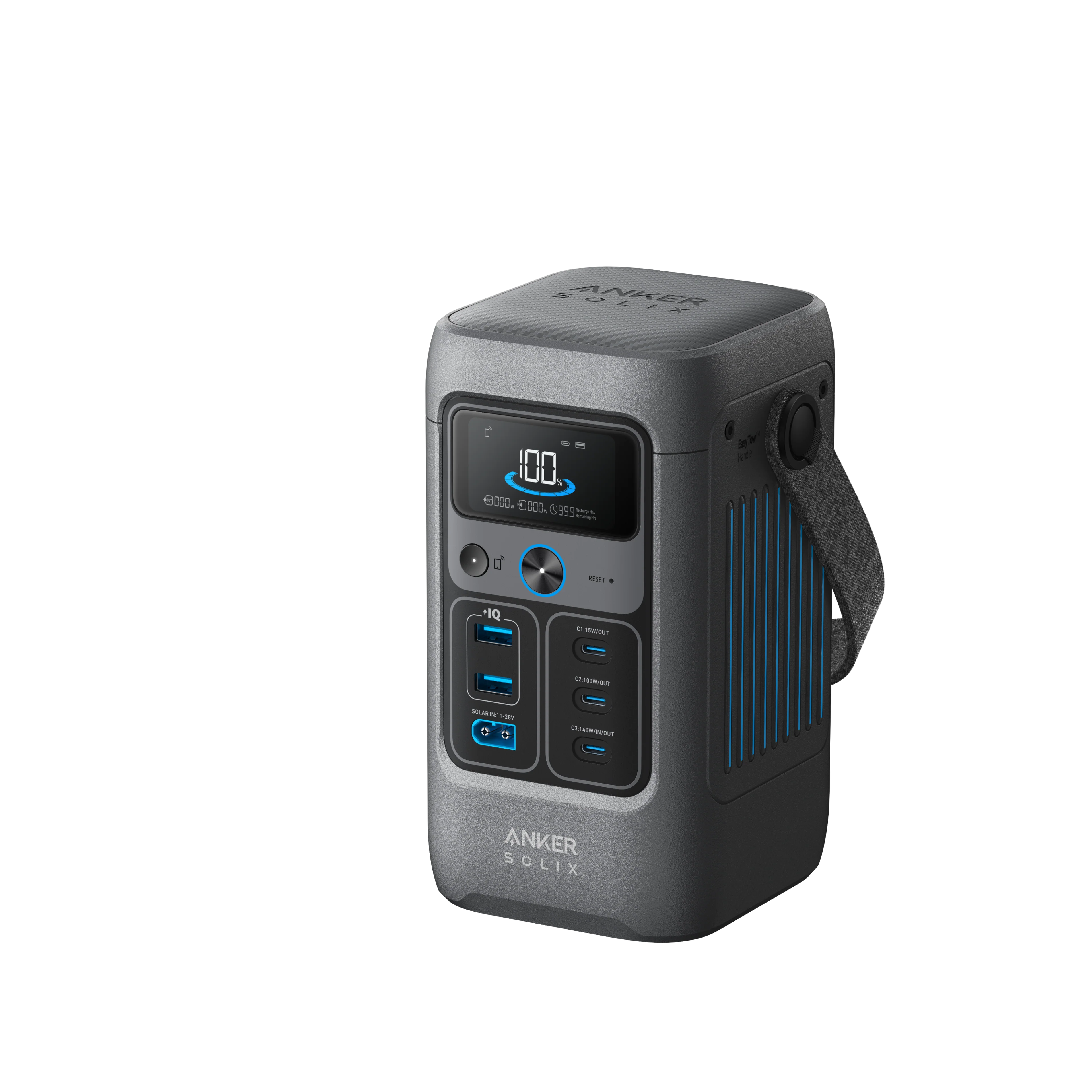
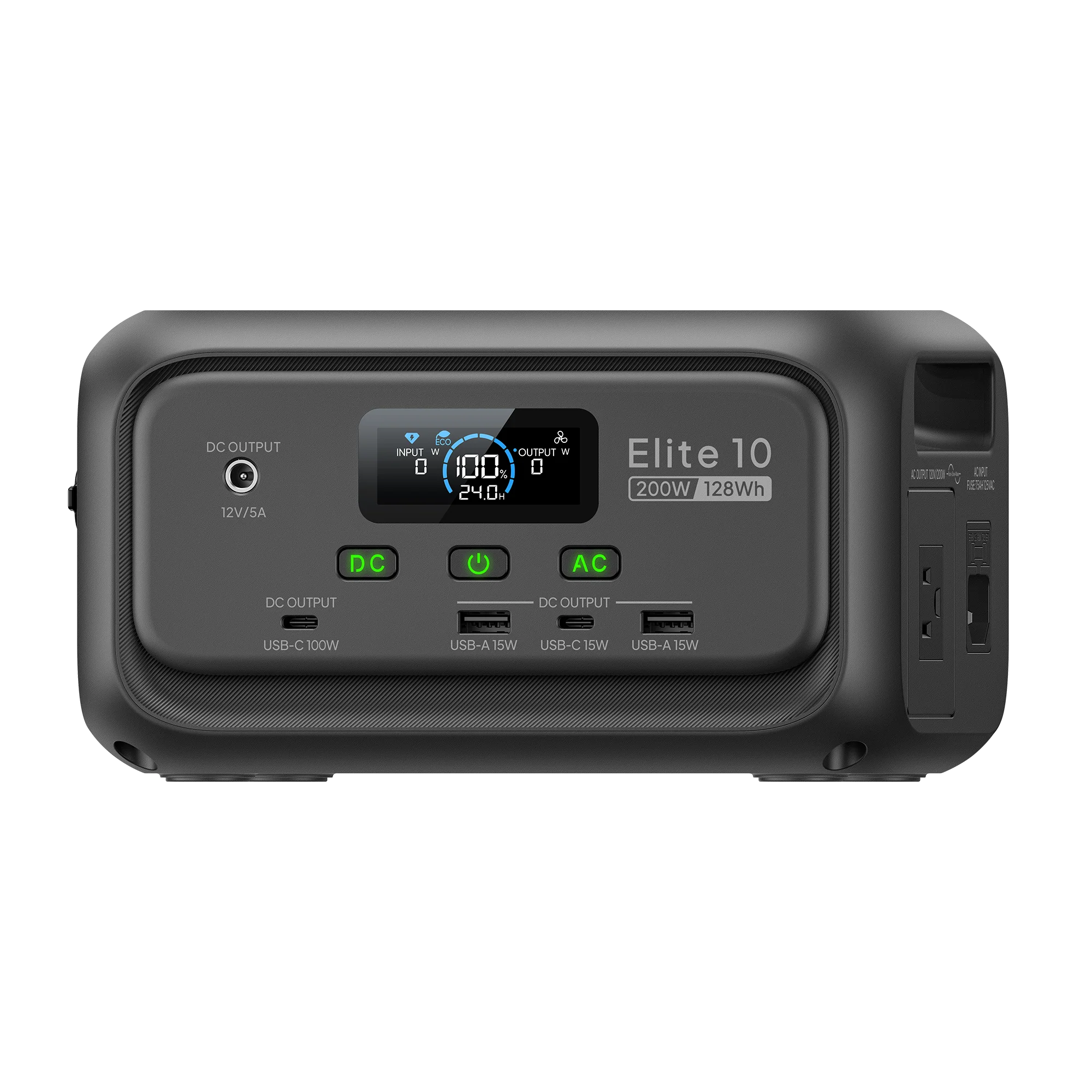
The Anker SOLIX C200 DC has no wall outlet; the BLUETTI Elite 10 Mini has one. That single fact decides most of this matchup. The Anker is a 192Wh battery with USB-C, USB-A, and 12V ports and no inverter at all, while the Elite is a smaller 128Wh unit built around one real AC socket. For the way most people use a battery this small, topping up a phone, a laptop, a camera, a Starlink Mini, the Anker is the better buy.
The Elite's outlet is its one genuine trick, and it is a real one: it can run a small wall-plug device the Anker physically cannot, and it can act as a plug-in UPS for a router or a desktop. But it is a 200W outlet fed by a very small battery, so its ceiling is low and its runtime short. Anything bigger than a compact gadget was never going to run on either of these.
Set the outlet aside and the Anker wins the job both units are actually built for. It holds more usable energy, charges faster over USB-C, and costs less per watt-hour stored despite the higher price, $140 against the Elite's $119. So the whole decision collapses to one question. If your gear needs a wall plug, or you want a plug-in UPS, buy the Elite. Otherwise, buy the Anker.
What the Numbers Reveal
Each conclusion stated first — the numbers behind it on one line, the full analysis below.
So the outlet is real but small-bore: it runs a low-watt gadget briefly, not an appliance. Its own ceiling tells the story, since 300W is the most it will pass even for an instant, which is why it cannot start the 400W blender in our tailgate test. The Anker's missing outlet only stings if your must-run device has a wall plug and no USB or 12V alternative.
SOLIX C200 DC has no AC outlet; its 200W is a DC total across USB and 12V, with no inverterElite 10 Mini has one AC outlet on a real inverter: 200W continuous, 300W surgeElite 10 Mini usable energy is about 109Wh (128Wh after the standard 85% derate)
Why it mattersDecide this one thing before anything else on the page: does the thing you are powering end in a wall plug, with no USB-C or 12V option? If yes, only the Elite qualifies. If no, the outlet is not a reason to choose it.
That makes the bigger battery pure upside. Over identical rated lives the Anker will have delivered 576 kWh of energy to the Elite's 384, while charging your laptop quicker the whole time. There is no counterargument here that the smaller one lasts longer; they wear at the same rate.
SOLIX C200 DC charges over USB-C at 140W vs the Elite 10 Mini's 100WBoth units are rated for the same 3,000 cycles (minimum)Lifetime energy is 576 kWh for the C200 DC vs 384 kWh for the Elite 10 Mini
Why it mattersIf you worried the larger pack is the one that dies first, it is not. For USB and 12V duty the Anker gives you more energy now and more over its life, with faster charging thrown in.
But a UPS is only as useful as its runtime, and this is a small battery behind a 200W outlet: it bridges a flicker or a brief cut, then wants the grid back. Treat the 10ms figure as the switchover it protects, not a promise to run your gear for hours.
Elite 10 Mini lists a UPS mode with a switchover rated no worse than 10msSOLIX C200 DC lists no UPS mode at allElite 10 Mini is a 200W AC output on a 128Wh pack
Why it mattersIf you want a set-and-forget mini-UPS for network gear, the Elite is the only one of the two that can do it. Just size your hopes to riding out a blink, not a storm.
The specific dimensions that decide these two units — everything else is a tie.
What the Specs Don't Tell You
Selected because: The one difference that outranks every number here: the Elite 10 Mini has an AC outlet and a UPS mode, and the SOLIX C200 DC has neither.
The most important line on this page is a socket, not a number: the Elite 10 Mini has one AC outlet, the SOLIX C200 DC has none. The Anker's 200W is a DC total across USB and 12V ports, not an inverter rating, so anything that ends in a wall plug, a fridge, a lamp, a coffee maker, never runs on it at any capacity. That is the design rather than a defect, since no inverter is what keeps the Anker simple and efficient for phone, laptop, camera, and 12V loads. But it is a hard gate. Guess wrong about your gear and you have bought a battery that cannot power your one device.
Two smaller flags both point toward the Elite. It lists a UPS mode with a 10ms-or-better handoff, so it can guard a router through a flicker where the Anker has none. And on noise, the Elite publishes a 45dB floor while the Anker publishes nothing, which our research reads not as the Anker being louder but as a DC unit with no fan and an official N/A ratingA0, the kind of thing owners describe as quiet next to bigger stationsA2. For a bedside or a quiet room, that silence counts.
Runtime: Will It Power Your Gear?
Selected because: In the USB and 12V job both units are built for, the Anker holds more usable energy and charges faster over USB-C.
Half again the tank. The Anker delivers 163Wh of usable energy against the Elite's 109Wh, both figures after the standard 85% derate, which in practice means more of whatever small job you are doing before you hunt for a wall. By its reviewers' own math the Elite's 128Wh is one to two laptop charges or ten-ish phone top-upsB3, and the Anker's larger pack simply buys you more of that, not a different capability.
The charging spec tilts the same way. The Anker moves 140W over USB-C to the Elite's 100W, and that shows up on both ends of the cable: a modern USB-C laptop charges faster from it, and the unit itself refills faster from a strong charger. For a battery whose whole purpose is USB-C and 12V, faster USB-C is the spec that earns its keep.
Lifetime Value
Selected because: The Elite is $119 to the Anker's $140, but the pricier Anker is the cheaper energy, which is the number that counts for a battery.
cost / lifetime kWh
The cheaper sticker and the cheaper unit are not the same one. The Elite saves you $21 up front, but that buys 64Wh less battery. Priced by stored energy, the Anker is $0.73 per watt-hour to the Elite's $0.93, and stretched across the same rated 3,000-cycle life that is $0.24 per lifetime kWh against $0.31. The bigger pack does not just hold more, it holds more for less.
One asterisk worth budgeting for, and it lands on the Anker: it ships without a wall charger, and hitting its fast 140W charging means supplying a high-wattage USB-C brick yourselfA2A7A10. One buyer returned the unit rather than track one downA7. If you already own a strong USB-C charger it is a non-issue; if you do not, add its cost to the Anker's price and the value gap narrows a little. It does not close.
Your Life, Your Pick
Selected because: Sized against real loads, both clear only a 100Wh afternoon, proof these are day-bag batteries and not backup power.
Both units fail almost every scenario on this site, and it is worth seeing the pattern before you buy either as backup. Weekend camping asks for 2,100Wh, an eight-hour blackout 1,645Wh, a remote workday 910Wh, and most of those loads run on wall plugs, so the Anker sits them out entirely while the Elite's smaller pack empties long before the load lets up. The lone benchmark both actually clear is the 100Wh afternoon off-grid: the Anker finishes with 63Wh to spare, the Elite with 9, at effectively the same weight, 4.2 pounds to 4.
The closest either comes to a serious job is a CPAP, and it is a clean illustration of the size problem. A night needs 320Wh; assuming a 12V-input CPAP, since the Anker has no AC for a wall-plug one, it still reaches only about half the night and the Elite about a third. Neither is bedside backup. The read is simple: for a small USB or 12V load, the Anker's headroom means fewer empties in a day; for a wall plug, only the Elite is in the conversation; for anything you would call backup, neither of these is the purchase.
Strengths & trade-offs
Anker SOLIX C200 DC
Strengths
- +Larger battery capacity
Trade-offs
- –No major technical downsides compared to rival.
BLUETTI Elite 10 Mini
Strengths
- +Costs $21 less
- +Lighter by 0.2 lb
Trade-offs
- –No major technical downsides compared to rival.
Will It Power Your Gear?
Scenario math and per-appliance runtimes, modeled from the spec record.
Scenario verdicts
We ran the math on seven real-world scenarios. Here's which unit survives your actual life.
SCN-01 · 2 nights · needs 2,100Wh
Weekend Camping
Two nights off-grid with essential comfort
Neither unit
The SOLIX C200 DC has no AC outlets, so the led lights and box fan in this scenario never plug in — it's a DC station for USB and 12V gear, and no wattage figure changes that, so capacity never gets a say. This is the wrong kind of unit for the job rather than a close call. The Elite 10 Mini doesn't have the energy either — 109Wh usable against 2,100Wh, 1,991Wh short — so neither route works.
Battery budget usedlower = more headroom
LOAD Phone Charger 15W×6h · LED Lights 40W×8h · Box Fan 75W×14h · CPAP Machine 40W×16h
SCN-02 · 8 hours · needs 1,645Wh
8-Hour Blackout
Keep the essentials running through a night without power
Neither unit
The SOLIX C200 DC has no AC outlets, so the fridge, router + modem and the rest in this scenario never plug in — it's a DC station for USB and 12V gear, and no wattage figure changes that, so capacity never gets a say. This is the wrong kind of unit for the job rather than a close call. The Elite 10 Mini doesn't have the energy either — 109Wh usable against 1,645Wh, 1,536Wh short — so neither route works.
Battery budget usedlower = more headroom
LOAD Fridge 150W×8h · Router + Modem 20W×8h · LED Lights (4 bulbs) 40W×6h · Phone Charger 15W×3h
SCN-03 · 8 hours · needs 320Wh
CPAP Overnight
Sleep therapy without interruption — the #1 medical use case
Neither unit
Neither unit covers this scenario's 320Wh: the SOLIX C200 DC comes up 157Wh short (about 51% covered), the Elite 10 Mini 211Wh (34%). On a CPAP that is not a shorter night — the machine stops when the battery does, partway through it. Neither is a bedside backup at this size.
Battery budget usedlower = more headroom
LOAD CPAP Machine 40W×8h
SCN-04 · 8 hours · needs 910Wh
Remote Workday
Full work day off-grid without power anxiety
Neither unit
The SOLIX C200 DC has no AC outlets, so the external monitor and router + modem in this scenario never plug in — it's a DC station for USB and 12V gear, and no wattage figure changes that, so capacity never gets a say. This is the wrong kind of unit for the job rather than a close call. The Elite 10 Mini doesn't have the energy either — 109Wh usable against 910Wh, 801Wh short — so neither route works.
Battery budget usedlower = more headroom
LOAD Laptop 60W×8h · External Monitor 30W×8h · Router + Modem 20W×8h · Phone Charger 15W×2h
SCN-05 · 4 hours · needs 670Wh
Tailgate Party
Game day power for the crew
Neither unit
The SOLIX C200 DC has no AC outlets, so the blender and led tv in this scenario never plug in — it's a DC station for USB and 12V gear, and no wattage figure changes that, and the Elite 10 Mini can't run the 400W peak at all — 300W is the most its inverter will pass even momentarily, so capacity never gets a say. This is the wrong kind of unit for the job rather than a close call.
Battery budget usedlower = more headroom
LOAD Blender 400W×0.5h · LED TV (55") 80W×4h · Bluetooth Speaker 15W×4h · Phone Charger (×3) 45W×2h
SCN-06 · 24 hours · needs 4,685Wh
Van Life Daily
A full day of mobile living — the ultimate endurance test
Neither unit
The SOLIX C200 DC has no AC outlets, so the mini-fridge, led lights and the rest in this scenario never plug in — it's a DC station for USB and 12V gear, and no wattage figure changes that, so capacity never gets a say. This is the wrong kind of unit for the job rather than a close call. The Elite 10 Mini doesn't have the energy either — 109Wh usable against 4,685Wh, 4,576Wh short — so neither route works.
Battery budget usedlower = more headroom
LOAD Mini-Fridge 150W×24h · Laptop 60W×4h · Phone Charger 15W×3h · LED Lights 40W×5h · Fan 75W×8h
SCN-07 · an afternoon · needs 100Wh
Afternoon Off-Grid
Phones and a speaker at the park, beach, or campsite — the small-unit job description
Either unit
This is the job small stations are actually for, and both do it: the SOLIX C200 DC finishes at 61% used, the Elite 10 Mini at 92%. At this size the decider is what rides in the bag — 4 lbs for the Elite 10 Mini against 4.2 for the SOLIX C200 DC — and price, not the leftover watt-hours.
Battery budget usedlower = more headroom
LOAD Phone Charger (×2) 30W×2h · Bluetooth Speaker 10W×4h
The Load Test
RUNTIME = (Wh × 0.85) ÷ LOAD
None of the scenarios above exactly yours? Build it. Toggle what you'd plug in; both units are tested against the combined draw.
Essentials
Comfort & Convenience
High-Draw Appliances
Test duration
8h
Continuous draw
205W
Projected runtime
The SOLIX C200 DC has no AC outlets for the wall-plug loads here, and the Elite 10 Mini's 200W can't hold 205W either.
Modeled from the spec record — same math as the tables below. Methodology
Runtime by appliance
Real-world runtime estimates for common appliances, modeled at 85% inverter efficiency.¹
Essentials
The basics you need runningscale 0–10.9hComfort & Convenience
Makes off-grid life actually enjoyablescale 0–1.5hHigh-Draw Appliances
These reveal the real limits¹ Runtime = (capacity × 0.85) ÷ appliance watts. Within each group, all bars share one time scale (the group's longest runtime), so lengths are comparable across appliances; identical runtimes collapse into a single blue/orange bar. Actual runtime varies with battery age, temperature, and simultaneous loads — see methodology.
Conclusion
August 30, 2026
Verdict: the Anker SOLIX C200 DC
The Anker SOLIX C200 DC takes it for the buyer both units actually fit: someone charging USB-C, USB-A, and 12V gear who does not need a wall plug. It carries more usable energy, charges faster over USB-C, and costs less per watt-hour stored, even though it is the pricier unit up front. This is a lean, not a rout. Our composite bench has the two nearly level, 1,484 to 1,461, because the Elite 10 Mini owns what the Anker cannot: a real AC outlet and a fast-switching UPS mode, and it is the cheaper box at the register. If either of those is your reason to buy, take the Elite; it is the only one of the two that qualifies. For everyone else, the Anker is the better small battery.
Today the Elite 10 Mini is $113, $6 under its typical $119. The verdict weighs typical prices, not today's. Prices checked 1 day ago.
Editor-assigned confidence, based on cited owner research and spec analysis.
List prices as of August 30, 2026. The links below open Anker's and BLUETTI's current prices.
$149.99 · direct from Anker
Last checked 1 day ago. Prices move — check before you buy.
or check the Elite 10 Mini price$113.00 list
Written by Wenny Zheng, Portable Power Tester · Station Arena Test Desk · Updated August 30, 2026
Measured Data
Benchmark scores and the full spec record, side by side.
Benchmark scores
Not rated for both units (minimum threshold unmet): UPS.
Full specifications
ᵈ Derived: price ÷ rated capacity. See the data behind our comparisons →
Comparison ToolAdd more power stations, side by sideOpen Tool →How these numbers are produced
Numeric verification
Every figure on this page traces to our spec database or arithmetic on it — no estimated numbers.
Owner claims
Statements about owner experience are cited to published reviews — see Sources & Research Notes below.
Runtime model
Runtime = (rated capacity × 0.85 inverter efficiency) ÷ device wattage. Solar recharge estimates assume panels deliver 70% of rated output. Cold weather, battery age, and stacked loads reduce real-world results.
Power Score
Computed from 14 published spec dimensions, weighted per use-case bench. Higher is better; a unit must meet a bench's minimum threshold to be rated.
See the full weight table and data sourcing on our methodology page →Class ranking (the star rating)
Each unit's star score is a category ranking, not customer reviews — no buyer opinions feed it. We score every station on size-independent quality (value, output, portability, endurance, ports, warranty, and more), then percentile-rank it against the other units in its capacity class, so a class-leading compact unit and a class-leading whole-home unit can both earn 5★. Here, SOLIX C200 DC rates 4.0/5 (43rd percentile of 22 Personal-class units), and Elite 10 Mini rates 4.1/5 (48th percentile of 22 Personal-class units).
How the class ranking is computed →Test Notes & Caveats
Hidden gotchas and advantages we spotted that you won't find on the product page.
Elite 10 Mini: 45dB Published
45dB is about as loud as a running refrigerator. It is BLUETTI's own rating rather than a reading on a shared bench — makers differ on whether they quote a best case or a figure under load, so treat it as a starting point rather than what you would hear at a bedside. For most people, fan noise around 45dB and up is where sleep starts to suffer.
SOLIX C200 DC: No AC Outlets At All
The SOLIX C200 DC's 200W is a DC port total — USB and 12V — not an inverter rating. Anything with a wall plug (a fridge, a TV, a coffee maker, most fans and lamps) never plugs in, at any wattage. That's the design, not a defect: it buys weight, silence, and efficiency for phone, laptop, camera, and 12V-CPAP loads. The Elite 10 Mini carries a real inverter behind 1 AC outlet, so it plays in both worlds. Decide which side of that line your gear lives on before weighing anything else on this page.
Only the Elite 10 Mini Lists a UPS Mode
The Elite 10 Mini can sit between the wall and your gear and hand it to battery when the grid drops — rated ≤10ms — quick enough on paper that desktop PCs and routers should ride through, treating that as the rating it is. Worth it for a router or a modem — not a CPAP: at 109Wh usable it can bridge the flicker but cannot run the night. The SOLIX C200 DC's spec sheet lists no UPS mode, so anything plugged into it rides an outage only as far as your reaction time.
Warranty: No Difference
Both units carry the same 3-year warranty, so coverage isn't a tiebreaker here.
SOLIX C200 DC: Noise Level Not Disclosed
The Elite 10 Mini publishes its noise level (45dB); the SOLIX C200 DC doesn't publish one. That isn't evidence the SOLIX C200 DC is louder — it means there's no figure to hold it to, and no way to compare the two on this without hearing them. If you're buying for a bedroom, a CPAP, or an apartment, treat the Elite 10 Mini's 45dB as the only published number on the table — a spec-sheet figure, not a measurement — and look for hands-on reports of the SOLIX C200 DC before deciding.
Full record above — the Test Desk pick is the SOLIX C200 DC.
Check SOLIX C200 DC price →or check the Elite 10 Mini priceOwnership Analysis
What happens after you buy — true cost of ownership, brand trust, and growth potential.
Lifetime value
Service lifeyears at one full cycle per day
Lifetime energy delivered
Cost per delivered kWh
│ warranty ends · Reaching the cycle rating means ~80% capacity remains — degraded, not dead.
Analyst note
The Elite 10 Mini is cheaper to buy, but the SOLIX C200 DC is cheaper to own. At $0.24/kWh over its lifetime vs $0.31/kWh, the SOLIX C200 DC's higher cycle life and capacity make each dollar go further over the years. One thing to know reading the table: both carry the same 3,000-cycle rating, so the lifetime rows are sticker price and capacity in disguise — the wear horizon is identical and decides nothing here.
Brand trust
Anker
Ecosystem
7-8 SOLIX portable power stations across C-series (compact) and F-series (flagship), plus the X1 home energy system
Support
US-based, and historically the no-hassle-replacement standard in this space. The worry is the direction of travel, with more AI-driven first-line help and clumsier logistics on heavy units taking some shine off. On a 4-pound unit that is trivial to ship back, that downside is smaller than it looks.
Community
Moderate — active Reddit (r/Anker, r/AnkerSOLIXCommunity) and growing. Benefits from Anker's massive consumer electronics brand awareness.
App experience
Rated 4.5/5 iOS (~1,100 ratings) · 4.3/5 Android
Unique strength
Parent brand trust from Anker's consumer electronics dominance. InfiniPower technology for long cycle life. Strong $/Wh value in the mid-size and larger units — the S2000, F2600 and C1000 are among the better buys per watt-hour in the catalog.
Worth knowing
Support quality appears to be declining from its historically excellent level. Firmware updates have removed features without warning. Expansion ecosystem is smaller than EcoFlow's.
BLUETTI
Ecosystem
One of the broadest lineups — 15-20+ models from budget (AC2A) to flagship portable (Apex 300, 2764.8Wh). Includes specialized products: vehicle solar hubs, sodium-ion cold-weather units, and balcony storage systems.
Support
BLUETTI's weak spot, and the clearest brand knock here. Its support is the most inconsistent in the category, heavily email-based with timezone lag, and outcomes swing from smooth to weeks of runaround. Buying direct rather than through a reseller tends to go better. On a unit this cheap you may never need them; if you do, keep expectations low.
Community
Active and growing — Reddit r/bluetti has a dedicated community. Second-largest after EcoFlow in engagement.
App experience
Rated 4.5/5 iOS and Android — tied for best app experience in the category. V3.0 UI redesign was well-received.
Unique strength
Among the best capacity-to-price ratios available — several Elite and Apex units are the lowest $/Wh in the catalog. Widest product diversity including industry-firsts like sodium-ion cold-weather units and dual solar+alternator vehicle hubs. LFP across the rest of the range, though rated cycle life spans 2,500 (EB3A) to 6,000, and it varies WITHIN the Elite range rather than tracking it — the Elite 300 and Elite 200 V2 are rated 6,000 while the Elite 30 V2, Elite 10 Mini, Elite 320 and Elite 400 are rated 3,000+ and the Elite 100 V2 4,000+, so check the specific model. Dual-voltage (120V/240V) in flagships.
Worth knowing
Customer support inconsistency is the #1 risk factor. Older/discontinued units may become unrepairable — no spare parts policy for some models. Some reports of erratic communication from support agents.
Analyst note
Neither brand's support should close the sale on a battery this size. But if a clean warranty path matters to you, Anker's US-based line, even off its former peak, is the safer bet than BLUETTI's email queue. Both companies, for what it is worth, make genuinely well-liked apps.
Growth path
SOLIX C200 DC
FIXED CAPACITYFixed at 192Wh, with no expansion — so size it for your needs up front rather than planning to add capacity later.
Accepts up to 100W of solar. Limited to a single portable panel.
Limited ports. You'll likely need a power strip or splitter.
Elite 10 Mini
FIXED CAPACITYFixed at 128Wh, with no expansion — so size it for your needs up front rather than planning to add capacity later.
Accepts up to 100W of solar. Limited to a single portable panel.
Limited ports. You'll likely need a power strip or splitter.
Realistic full solar rechargeat 70% of rated panel output — see methodology
Analyst note
Neither expands, and that's no knock on either — each is a complete unit at a fixed size. Buy the capacity that covers your needs now (the SOLIX C200 DC gives you the larger ceiling); you can't add to either later.
What Owners Report
Patterns from published owner reports and long-term reviews — every claim cited to its source below.
Anker SOLIX C200 DC
Field data on the Anker is genuinely deep and mostly happy, drawn from hundreds of verified Amazon buyers, Anker's own review widget, and a YouTube teardown's comments, though notably no organic RedditA0. The use owners found on their own that stands out is the Starlink Mini: several run one off-grid, on a boat or at a remote site, and report flawless pass-through for five or six hours on a charge with no inverter neededA4A5A15. Continuous duty holds up too, from an eight-hour delivery shift that never dropped below 75%, to a Linux single-board computer that never lost power through unplug-and-move, to two and a half days feeding an iPadA3A6A14. The steady gripe is ownership friction, not performance: no wall charger in the box, and you supply the high-wattage USB-C brick to charge it quicklyA2A7A10.
Two cautions, both thin, both worth knowing on a USB-only unit. One reviewer went through three units that each developed USB-C port failures, a single uncorroborated account rather than a patternA0A12, but it is the port everything here relies on. And one owner flagged from the spec sheet that the USB ports auto-shut-off after two hours with no way to change the timerA1, the usual low-draw cutoff, which the always-on users above never trippedA3A6. If you plan to trickle-power something tiny and unattended, test it first.
“But in the specs it says the usb ports will shut off in 2 hours and that time can't be changed... I'm deciding between it and the Jackery 240D which keeps the ports on for 12 hours. But the Anker is lighter, cheaper and has a better warranty.”
Sources
diysolarforum.com · amazon.com · ankersolix.com · judge.me
BLUETTI Elite 10 Mini
Field data on the Elite 10 Mini is thin, and honestly so: what exists comes mostly from review-site coverage rather than long-term ownersB0. The consistent picture is a palm-sized 128Wh unit with a real AC outlet, dual USB-C, and a full charge in about 70 minutes, fast for its class, plus the sub-10ms UPS modeB1B2. Reviewers peg the practical envelope at one to two laptop charges or ten-ish phone top-ups, gadgets and explicitly not appliances or fridges, and single out the dual USB-C as the port owners reach for mostB3B4. It reads as a well-made small unit; there simply is not yet a deep pool of six-months-later owner reports to test that against.
“A 128Wh LiFePO4 mini power station with a 200W AC outlet plus dual USB-C (100W PD and 18W), two USB-A, and a 12V DC port.”
Sources
bluettipower.com · macrumors.com · backuppowerhub.com · geardiary.com · outdoortechlab.com · irishexaminer.com · 9to5toys.com · cleantechnica.com
Sources & Research Notes
Every owner claim in this report is traceable to a published source. The bracketed references above resolve here.
Recurring owner themes
- No wall charger is included, and getting decent charge speed means sourcing a high-wattage (18W+, ideally 140W PD3.1) USB-C charger yourself — a recurring source of either mild annoyance or, for one reviewer who lacked a compatible charger on hand, a full return-to-sender experience. [SOLIX C200 DC · 3 entries]
- Independently of Anker's own marketing, multiple owners specifically bought and use the C200 DC to run a Starlink Mini off-grid (boat, remote site), reporting flawless pass-through power and multi-hour runtime without an inverter. [SOLIX C200 DC · 3 entries]
- Sustained, continuous-duty use (an 8-hour delivery shift, always-on passthrough to a Linux SBC, a multi-day iPad session) holds up better than owners expected, with battery percentage staying higher than they anticipated. [SOLIX C200 DC · 3 entries]
- Despite Anker's "39% smaller than peers" marketing claim, real-world size/weight impressions are split — some owners find it genuinely pocketable, others notice real heft once it's actually loaded in a bag. [SOLIX C200 DC · 2 entries]
- Palm-sized LFP mini unit with a real AC outlet, fast charging, sub-10ms UPS, and dual USB-C — for gadgets, not appliances. [Elite 10 Mini · 3 entries]
- A1
“But in the specs it says the usb ports will shut off in 2 hours and that time can't be changed... I'm deciding between it and the Jackery 240D which keeps the ports on for 12 hours. But the Anker is lighter, cheaper and has a better warranty.”
diysolarforum.com — thread "SOLIX C200 DC question" · 2025-11 · [mixed]
- A2
“It's lightweight, easy to carry, and has enough power for phones, lights, a fan, and smaller devices... I like how quiet it is compared to larger units. My only complaint is I wish it included the wall charger instead of having to buy one separately.”
amazon.com customer review (Verified Purchase, Style: Anker SOLIX C200 DC) — "Handy Little Power Station" · 2026-05 · [positive]
- A3
“I have used this unit every day as a delivery driver to keep my phone and tablet running and so far I've never gotten below 75%... over an eight hour shift with the phone plugged in constantly.”
amazon.com customer review (Verified Purchase, Style: Anker SOLIX C200 DC) — "Perfect for top ups and small emergencies" · 2025-12 · [positive]
- A4
“I bought this to power my starlink mini on my fishing boat, I used it the other day for 5 or 6 hours and it still had 40% power left, great product and works great for a mini with no need for inverter.”
amazon.com customer review (Verified Purchase, Style: Anker SOLIX C200 DC) — "Works great for starlink mini!" · 2026-06 · [positive]
- A5
“The Starlink Mini worked flawlessly utilizing the Starlink cable connected to the adapter plugged into the USB-C 100w output outlet on the Anker... the pass through charging worked with no issues. Should power the Starlink mini for 6-8 hrs without charging.”
amazon.com customer review (Verified Purchase, Style: Anker SOLIX C200 DC) — "Powers Starlink Mini" · 2026-04 · [positive]
- A6
“It has continuous pd to a linux sbc when i plug in to charge and unplug to go remote the computer never loses power. That's a big deal for performance that other batteries can't match. The WiFi battery health monitoring is also amazing.”
amazon.com customer review (Verified Purchase, Style: Anker SOLIX C200 DC) — "Best battery for continuous PD" · 2026-06 · [positive]
- A7
“Can't get this battery to charge. Just discovered I have to now spend a small fortune for a 140W adapter, which it did not come with, in order to get it to charge... The User Guide has 4 pages of warnings per language but no operational instructions.”
amazon.com customer review (Verified Purchase, Style: Anker SOLIX C200 DC) — "140W adapter needed to charge, not included." · 2025-12 · [negative]
- A10
“Holds true to its capacity. Charging to full is quick if you have correct charge block. The price was okay but you do get Anker Solix backing.”
ankersolix.com product reviews (Judge.me widget on /products/c200-dc) · 2026-03 · [positive]
- A12
“Gone through 3 of these now. All 3 developed issues with the USB-C ports.”
YouTube — "Review: Anker SOLIX C200 DC Power Bank Station (60,000mAh), 192Wh Portable Power Station" (The Breakdown With Luke) — comment · 2025 · [negative]
- A14
“If I keep the screen brightness at 50% the iPad draws 4-5 watts... at 90% brightness 14-15 watts... with screen off just sound 0-1 watt... I'm getting 2.5 days direct connected to IPad.”
YouTube — "Review: Anker SOLIX C200 DC Power Bank Station (60,000mAh), 192Wh Portable Power Station" (The Breakdown With Luke) — comment · 2025 · [positive]
- A15
“Customers find the power bank reliable, with one mentioning it works well with Starlink Mini... appreciate its fast 140W recharging capability, providing up to 10-12 hours of use... The compact size receives mixed feedback, with some finding it sufficiently large while others consider it too big.”
amazon.com "Customers say" AI-generated review summary (943 ratings, ASIN B0D62P85ZR) · unknown · [mixed]
- B1
“A 128Wh LiFePO4 mini power station with a 200W AC outlet plus dual USB-C (100W PD and 18W), two USB-A, and a 12V DC port.”
bluettipower.com / macrumors.com — Elite 10 Mini review · 2026 · [positive]
- B2
“Reaches a full charge in about 70 minutes — one of the fastest in the sub-200Wh segment — and supports UPS mode with an under-10ms switchover.”
backuppowerhub.com / geardiary.com — Elite 10 Mini review · 2026 · [positive]
- B3
“128Wh is enough to charge a laptop 1-2 times, a phone 10-12 times, or run a 10W LED lamp about 13 hours; not for appliances, fridges, or power tools.”
outdoortechlab.com / irishexaminer.com — Elite 10 Mini review · 2026 · [mixed]
- B4
“Launched at $119 (down from $199); owners highlight the dual USB-C setup as a most-used feature — a palm-sized companion for drives and short trips.”
9to5toys.com / cleantechnica.com — Elite 10 Mini review · 2026 · [positive]
Research compiled August 30, 2026.
Who Should Buy Which
Buy the SOLIX C200 DC if you…
- →You charge USB-C, USB-A, and 12V gear and nothing with a wall plug: a phone, a laptop, a camera, a Starlink Mini running off-grid on a boat or at a remote siteA4A5. This is the one built for you, with more usable energy and faster charging.
- →You want the most watt-hours per dollar in a sub-200Wh unit, and you already own or will happily buy a strong USB-C charger to feed it.
- →You keep a small load running continuously, a tablet across a long shift or a single-board computer through unplug-and-move, and want a bank that shrugs at nonstop pass-throughA3A6.
Buy the Elite 10 Mini if you…
- →Your one must-run device has a wall plug, no USB or 12V option, and draws under 200W: a specific charger, a small AC gadget. Only the Elite can power it at all.
- →You want a tiny UPS for a router, modem, or desktop that hands off the instant the grid flickers. The Anker cannot do this; the Elite is built for it.
- →You want the lower price at the register and treat the AC outlet as a bonus, knowing you are trading away a chunk of usable capacity to get it.
If neither fits
If you are shopping for real backup, a CPAP through the night, a fridge through a blackout, a weekend of camping power, neither belongs on your list. A CPAP night alone needs 320Wh and both quit well before morning. Step up a full size class, to a unit with a real inverter and several times the capacity; that is what actually runs a household load, and it is a different purchase than either of these.
The Bottom Line
The Anker SOLIX C200 DC wins the contest both of these are actually built for, charging USB and 12V gear, with more usable energy, faster charging, and a lower cost per watt-hour even though it is the pricier box. The Elite 10 Mini's reply is a single AC outlet and a fast-switching UPS, and both are real: if your must-run device has a wall plug, or you want an always-ready backup for a router, it is the only one of the two that qualifies. But that outlet sits on a battery small enough to empty in about half an hour under load, so for most people it is a capability they will rarely use, bought at the cost of a slice of capacity.
So answer the one question and stop. Does the thing you are powering plug into a wall, or into a USB port? Wall, and it is the Elite. USB or 12V, a phone, a laptop, a camera, a Starlink Mini, and it is the Anker. Just buy a USB-C charger on the way out; it ships without oneA2A7.
Frequently Asked Questions
Answers drawn from the spec record and cited owner research.
Can the Anker SOLIX C200 DC run AC appliances or anything with a wall plug?
No. The C200 DC has no AC outlet and no inverter; its 200W rating is a total across USB and 12V DC ports. A fridge, TV, coffee maker, or any wall-plug device will not run on it, at any wattage. If you need to power a wall plug, the Elite 10 Mini and its single AC outlet is the only one of these two that can, within a 200W limit.
For charging a laptop and phone, is the C200 DC or the Elite 10 Mini better?
The Anker, for most people. It holds more usable energy, 163Wh to the Elite's 109Wh, and charges over USB-C at 140W against the Elite's 100W, so a laptop tops up faster and you get more charges between refills. Both handle phones and laptops fine; the Anker just does more of it per charge.
Is the Elite 10 Mini's UPS mode actually useful?
For a router, modem, or desktop, yes. It hands off to battery in a rated 10ms or better when the grid drops, quick enough that most electronics ride through without rebooting, and the C200 DC has no UPS mode at all. Just do not expect long runtime: its small pack bridges a flicker or a short outage, it does not power a night.
Why does the Anker cost more but rate as the better value?
Because you pay for watt-hours, not the sticker. The Anker's higher price buys about 50% more capacity and a lower cost per watt-hour, so over the same rated life it delivers energy more cheaply. The one caveat: it does not include a wall charger, so budget for a USB-C one if you do not already own a fast charger.
Is either of these enough for a CPAP or a power outage?
No, both are too small for overnight or blackout backup. A CPAP night needs about 320Wh and neither covers it; the Anker reaches roughly half, the Elite about a third before it quits. For real backup, move up to a larger unit with a proper inverter. These two are day-bag batteries for gadgets, not emergency power.
Related buying guides
Where to buy
Anker SOLIX C200 DCPick
$149.99
$149.99 · direct from Anker
Last checked 1 day ago. Prices move — check before you buy.
BLUETTI Elite 10 Mini
$113.00
$113.00 · direct from BLUETTI
down from $119 · 5% below usual
Last checked 1 day ago. Prices move — check before you buy.
Prices may vary by retailer and are subject to change.