Head-to-head test
BLUETTI AC50B vs Goal Zero Yeti 500
Pay $101 more for the Yeti 500 and what you get back is 51 extra watt-hours and a 200W smaller inverter.
Full profiles: BLUETTI AC50B → · Goal Zero Yeti 500 →

Written by Wenny ZhengUpdated
Portable Power Tester, Station Arena Test Desk
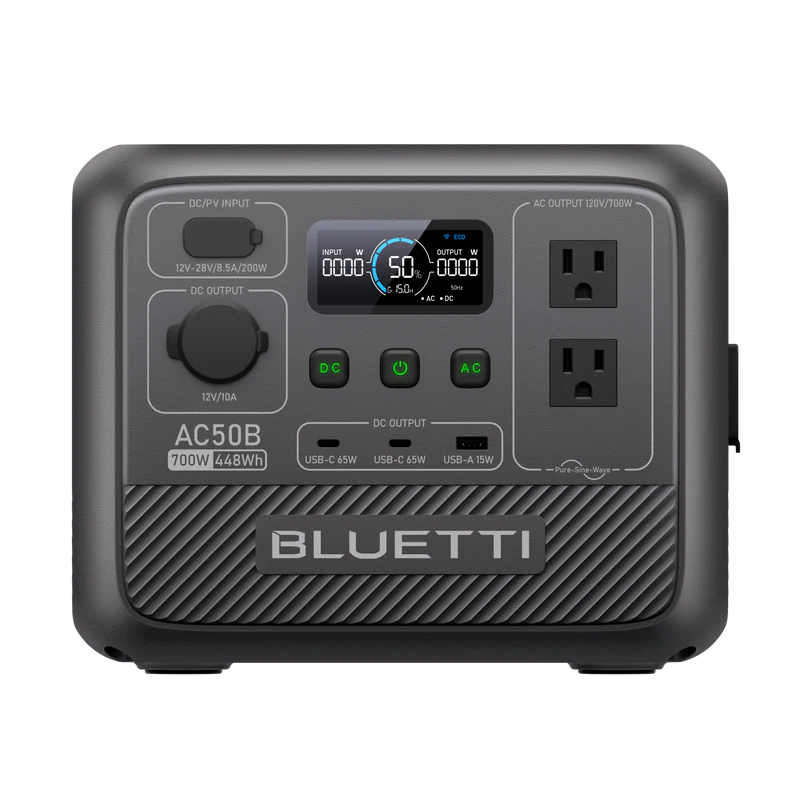
$399.00 · direct from BLUETTI
Last checked 1 day ago. Prices move — check before you buy.
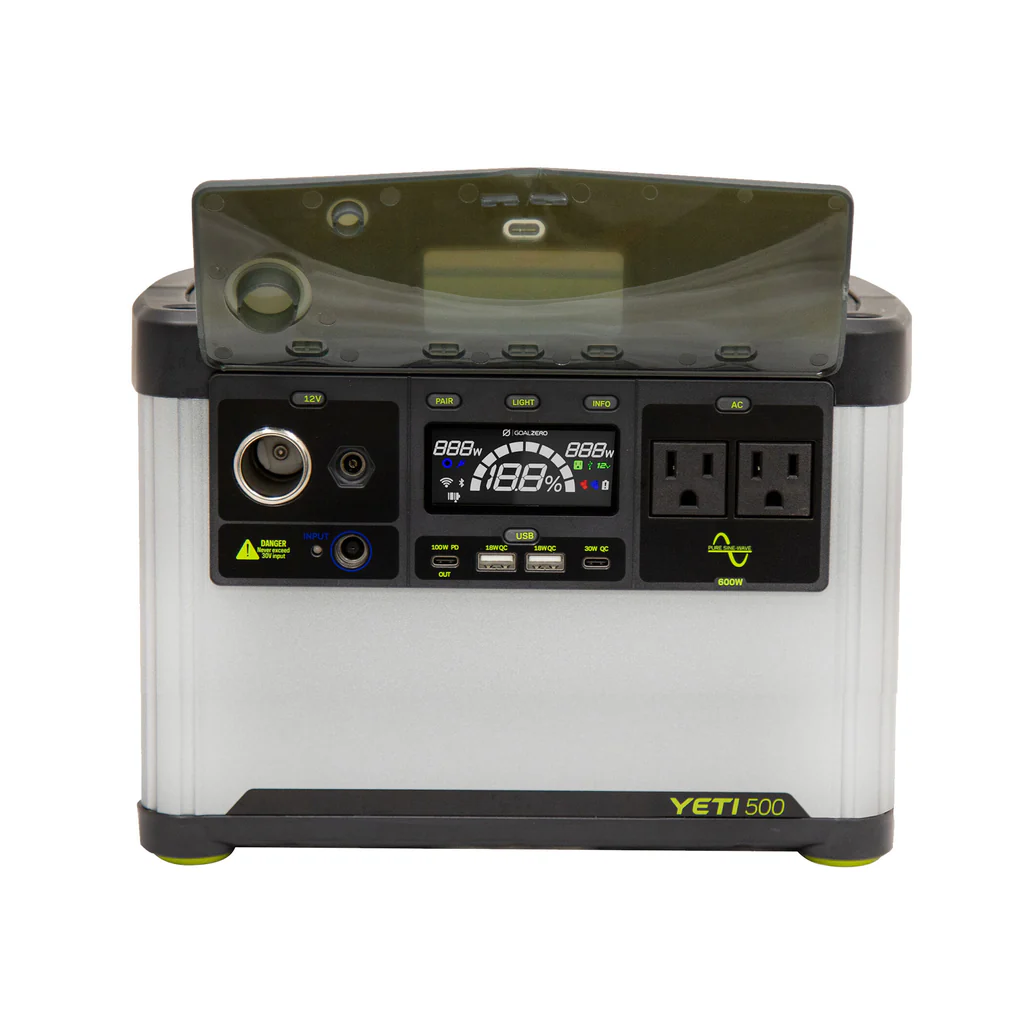
$499.95 · direct from Goal Zero
Last checked 1 day ago. Prices move — check before you buy.
Spec deltas
Take the BLUETTI AC50B. It's $399 against the Yeti 500's $500, and it holds 700W continuous where the Yeti holds 500W. The cheaper box here is also the stronger one, which is not how this normally goes.
The Yeti isn't a bad unit and it does earn some of the difference back. It carries a little more capacity, a 4,000-cycle battery against 3,000, and a USB-C port that pushes 100W where BLUETTI's pushes 65W. Read those three lines and you've read the entire case for spending more. That's the point: the case is three lines long.
Both of these are small, and that's worth settling before you settle the brand. Of the six jobs this page models, exactly one, a CPAP overnight, finishes with either unit still on. If you're shopping because of a whole-house outage or a week in a van, neither of these is the answer and everything below is a distraction.
What the Numbers Reveal
Each conclusion stated first — the numbers behind it on one line, the full analysis below.
continuous output
The identical 1,000W surge ceiling makes this sharper, not softer. Both units will start the same appliance, so the startup question is settled and can't rescue the Yeti. What differs is what happens after the motor spins up: any load that sits between 500W and 700W runs on the BLUETTI and trips the Yeti, at any price, forever.
BLUETTI AC50B: $399, 448Wh, 700W continuous outputGoal Zero Yeti 500: $500, 499Wh, 500W continuous outputBoth units surge to the same 1,000W
Why it mattersIf anything on your load list draws more than 500W continuously, the Yeti isn't a candidate and the price comparison never has to happen.
rated cycles
Almost. Divide each price by the energy it will ever deliver and the Yeti still costs 25 cents a lifetime kilowatt-hour against the AC50B's 21. It has more energy to sell you and it's still selling it at a higher rate, which means the extra cycles don't pay for themselves even in the accounting that flatters them most.
AC50B: 3,000 cycles at 448Wh works out to 1,344 kWh across its lifeYeti 500: 4,000 cycles at 499Wh works out to 1,996 kWh across its lifeAC50B costs $399, Yeti 500 costs $500
Why it mattersNobody should buy the Yeti on lifetime cost. If you want it, want it for the daily-cycling years or the USB-C port, because the value math doesn't get there.
So the deciding spec at 3 a.m. isn't the nine points of headroom, it's the fan two feet from your ear. One of these two manufacturers has committed to 45 dB in writing and the other has committed to nothing, and the one that committed is also the one that costs less. Silence on a spec sheet isn't evidence of noise, but it is a thing you can't check until the box is already on your nightstand.
CPAP Overnight draws 320Wh, which is 84% of the AC50B's usable energy and 75% of the Yeti'sBLUETTI rates the AC50B at 45 dB under loadGoal Zero publishes no decibel figure for the Yeti 500
Why it mattersCPAP buyers should take the AC50B and, if they need more than one night away from a wall, buy a bigger unit rather than the more expensive small one.
It's a real advantage with a small footprint. Neither unit holds enough for a full workday off-grid, so the fast port isn't buying you a day of untethered work, it's buying you a quicker top-up between outlets. That's a convenience, and conveniences are exactly the kind of thing you should be reluctant to pay a two-hundred-dollar premium for.
Yeti 500: 100W USB-C outputAC50B: 65W USB-C outputRemote Workday draws 910Wh, which is 239% of the AC50B's usable energy and 215% of the Yeti's
Why it mattersIf a big laptop is your only load and you charge in short windows, the Yeti's port is worth something to you. It's the strongest reason to overrule this verdict, and it's still not a strong one.
The specific dimensions that decide these two units — everything else is a tie.
Lifetime Value
Selected because: The $101 price gap and the Yeti's 1,000 extra cycles pull in opposite directions, and this is where they settle.
cost / lifetime kWh
Sixty-two cents a watt-hour against a dollar even. That's the shelf price of energy in this matchup, and it's the last number here that behaves the way you'd expect.
Run it forward and the Yeti closes most of the gap without ever shutting it, because extra cycles are worth less the later they arrive. The AC50B's rating runs out at 8.2 years of daily full cycles and the Yeti's at 11, so the Yeti's advantage doesn't start paying until year nine. Cycle on weekends instead and the ratings stretch to 28.8 years and 38.5, which are not numbers anyone should be shopping on.
Your Life, Your Pick
Selected because: Both units clear exactly one of the six jobs modeled here, so the first question isn't which one, it's whether either is big enough.
Five of the six jobs modeled here are out of range for both units, which isn't a failure so much as a category fact. These are a 448Wh box and a 499Wh box. The one job they both finish is a CPAP overnight, and they finish it once.
What confuses people is that both units can start everything on every list, because the peak draws all fit inside the surge rating. So the fridge does come on. Goal Zero rates the Yeti 500 at up to six hours on a full-size refrigeratorB2, and the AC50B, with slightly less capacity and a bigger inverter, lands in the same neighborhood. That's a fair picture of the ceiling for both: enough to save the groceries, not enough to ride out the outage.
What the Specs Don't Tell You
Selected because: One of these publishes a noise figure and one doesn't, and that gap decides the nightstand cases.
rated cycles
The most useful thing in this section is a blank. Goal Zero doesn't publish a decibel figure for the Yeti 500 and BLUETTI does, which matters most to the two buyers who care about fan noise most: the person sleeping next to it and the person working next to it. One manufacturer gave them something to check. The other gave them a shrug.
The surge card runs the other way and deserves its credit. The Yeti's inverter carries double its continuous rating on startup, which is real engineering margin and a fair point for Goal Zero. It just doesn't buy capability the AC50B lacks, because both units stop at the same number.
PowerScore Breakdown
Selected because: 211 points separate them, which is about the right size for a matchup this close on paper.
overall power score
1,983 against 1,772 is a lead, not a rout, and reading it correctly matters. The AC50B is ahead on output, weight and price; the Yeti is ahead on cycles and USB-C. The composite says the first list is worth more, and 211 points is roughly how much more.
The weight gap is 1.7 lb, which is a rounding error you will never once feel while carrying either of them. The output gap is the one you'll feel, the first time you plug in something the Yeti won't hold.
Brand Trust
Selected because: You're paying a premium for a US brand here, so it's worth knowing exactly what the premium still buys.
Goal Zero is the oldest name on this page and the only US one, run out of Salt Lake City, with a tight lineup and a genuinely integrated set of panels, coolers and vehicle kits that all talk to each other. If you already own any of that, the case for staying inside it is legitimate.
It's a closer call than it used to be. Goal Zero's support has drifted from the premium standard its pricing implies and its official community forums are gone, while BLUETTI's service is the least consistent in the category, email-based and lagged by timezone, and noticeably better when you buy direct rather than through a marketplace. Pick your risk. Neither brand column is a reason to overrule the spec sheet here.
Strengths & trade-offs
BLUETTI AC50B
Strengths
- +Costs $100.9 less
- +Lighter by 1.3 lb
- +Higher AC output
Trade-offs
- –Shorter-lived battery — rated for 3,000 charge cycles vs the Yeti 500's 4,000, so it wears out sooner.
Goal Zero Yeti 500
Strengths
- +Larger battery capacity
- +Rated for 4,000 charge cycles — much longer battery lifespan
Trade-offs
- –No major technical downsides compared to rival.
Will It Power Your Gear?
Scenario math and per-appliance runtimes, modeled from the spec record.
Scenario verdicts
We ran the math on six real-world scenarios. Here's which unit survives your actual life.
SCN-01 · 2 nights · needs 2,100Wh
Weekend Camping
Two nights off-grid with essential comfort
Neither unit
A modeled camping weekend draws 2,100Wh, more than four times what either of these holds, so neither is a camping battery in the sense people mean when they say camping battery. What they are is the phone-lantern-laptop battery, which is honestly what most weekends actually need. Bring one, and bring a stove that isn't electric.
Battery budget usedlower = more headroom
LOAD Phone Charger 15W×6h · LED Lights 40W×8h · Box Fan 75W×14h · CPAP Machine 40W×16h
SCN-02 · 8 hours · needs 1,645Wh
8-Hour Blackout
Keep the essentials running through a night without power
Neither unit
Neither unit gets you through this, and it isn't close: eight hours of the loads modeled here wants 1,645Wh. Both will start everything on the list, which is exactly the trap. Things come on. They just don't stay on. If the outage is why you're shopping, buy up a class rather than choosing between these two.
Battery budget usedlower = more headroom
LOAD Fridge 150W×8h · Router + Modem 20W×8h · LED Lights (4 bulbs) 40W×6h · Phone Charger 15W×3h
SCN-03 · 8 hours · needs 320Wh
CPAP Overnight
Sleep therapy without interruption — the #1 medical use case
Either unit
Both finish the night. Neither finishes two. A CPAP wants 320Wh, which is 84% of what the AC50B will actually hand over and 75% of the Yeti's, so the Yeti wakes up with a little more in reserve and both wake up needing a wall or a panel. At arm's length from your head the tiebreak isn't the reserve, it's the fan, and only one of these two manufacturers will tell you how loud it gets.
Battery budget usedlower = more headroom
LOAD CPAP Machine 40W×8h
SCN-04 · 8 hours · needs 910Wh
Remote Workday
Full work day off-grid without power anxiety
Neither unit
Neither unit covers this scenario's 910Wh: the AC50B comes up 529Wh short (about 42% covered), the Yeti 500 486Wh (47%). Treat this as partial cover — enough for the essentials in it, not the whole list.
Battery budget usedlower = more headroom
LOAD Laptop 60W×8h · External Monitor 30W×8h · Router + Modem 20W×8h · Phone Charger 15W×2h
SCN-05 · 4 hours · needs 670Wh
Tailgate Party
Game day power for the crew
Neither unit
Neither unit covers this scenario's 670Wh: the AC50B comes up 289Wh short (about 57% covered), the Yeti 500 246Wh (63%). Either gets you most of the way, so this is a scenario you plan around rather than one you should rule them out for.
Battery budget usedlower = more headroom
LOAD Blender 400W×0.5h · LED TV (55") 80W×4h · Bluetooth Speaker 15W×4h · Phone Charger (×3) 45W×2h
SCN-06 · 24 hours · needs 4,685Wh
Van Life Daily
A full day of mobile living — the ultimate endurance test
Neither unit
Neither unit covers this scenario's 4,685Wh: the AC50B comes up 4,304Wh short (about 8% covered), the Yeti 500 4,261Wh (9%). This is well outside what either unit is for; the right answer here is a larger station, not a choice between these two.
Battery budget usedlower = more headroom
LOAD Mini-Fridge 150W×24h · Laptop 60W×4h · Phone Charger 15W×3h · LED Lights 40W×5h · Fan 75W×8h
The Load Test
RUNTIME = (Wh × 0.85) ÷ LOAD
None of the scenarios above exactly yours? Build it. Toggle what you'd plug in; both units are tested against the combined draw.
Essentials
Comfort & Convenience
High-Draw Appliances
Test duration
8h
Continuous draw
205W
Projected runtime
For this load: Yeti 500 runs 2.1h vs 1.9h.
$499.95 list · direct from Goal Zero
Modeled from the spec record — same math as the tables below. Methodology
Runtime by appliance
Real-world runtime estimates for common appliances, modeled at 85% inverter efficiency.¹
Essentials
The basics you need runningscale 0–28.3hComfort & Convenience
Makes off-grid life actually enjoyablescale 0–5.7hHigh-Draw Appliances
These reveal the real limits¹ Runtime = (capacity × 0.85) ÷ appliance watts. Within each group, all bars share one time scale (the group's longest runtime), so lengths are comparable across appliances; identical runtimes collapse into a single blue/orange bar. Actual runtime varies with battery age, temperature, and simultaneous loads — see methodology.
Conclusion
August 2, 2026
Verdict: the AC50B
Take the AC50B. It's $399 against $500, it holds 700W continuous where the Yeti holds 500W, and it's still the cheaper unit per lifetime kilowatt-hour despite carrying a thousand fewer cycles. The Yeti's case is real but narrow: a 4,000-cycle battery and a 100W USB-C port. If you'll run this thing flat and refill it nearly every day for a decade, or your one load is a big laptop you want back to full fast, that's worth paying for. Everything else is identical on paper: same 1,000W surge ceiling, same 200W of solar input, same five-year warranty, same 20ms transfer when the grid drops. When two units match on that much, the price gap stops being a detail and becomes the argument.
Editor-assigned confidence, based on cited owner research and spec analysis.
List prices as of August 2, 2026. The links below open BLUETTI's and Goal Zero's current prices.
$399.00 · direct from BLUETTI
Last checked 1 day ago. Prices move — check before you buy.
or check the Yeti 500 price$499.95 list
Written by Wenny Zheng, Portable Power Tester · Station Arena Test Desk · Updated August 2, 2026
Measured Data
Benchmark scores and the full spec record, side by side.
Benchmark scores
Not rated for both units (minimum threshold unmet): Tailgating.
Full specifications
ᵈ Derived: price ÷ rated capacity. See the data behind our comparisons →
Comparison ToolAdd more power stations, side by sideOpen Tool →How these numbers are produced
Numeric verification
Every figure on this page traces to our spec database or arithmetic on it — no estimated numbers.
Owner claims
Statements about owner experience are cited to published reviews — see Sources & Research Notes below.
Runtime model
Runtime = (rated capacity × 0.85 inverter efficiency) ÷ device wattage. Solar recharge estimates assume panels deliver 70% of rated output. Cold weather, battery age, and stacked loads reduce real-world results.
Power Score
Computed from 14 published spec dimensions, weighted per use-case bench. Higher is better; a unit must meet a bench's minimum threshold to be rated.
See the full weight table and data sourcing on our methodology page →Class ranking (the star rating)
Each unit's star score is a category ranking, not customer reviews — no buyer opinions feed it. We score every station on size-independent quality (value, output, portability, endurance, ports, warranty, and more), then percentile-rank it against the other units in its capacity class, so a class-leading compact unit and a class-leading whole-home unit can both earn 5★. Here, AC50B rates 4.6/5 (76th percentile of 22 Personal-class units), and Yeti 500 rates 4.5/5 (71st percentile of 22 Personal-class units).
How the class ranking is computed →Test Notes & Caveats
Hidden gotchas and advantages we spotted that you won't find on the product page.
AC50B: 45dB Published
45dB is about as loud as a running refrigerator. It is BLUETTI's own rating rather than a reading on a shared bench — makers differ on whether they quote a best case or a figure under load, so treat it as a starting point rather than what you would hear at a bedside. For most people, fan noise around 45dB and up is where sleep starts to suffer.
Same Ceiling, Different Floor
The Yeti's inverter carries double its continuous rating on startup: 500W all day, 1,000W for the second a compressor kicks in. That's genuine margin and a fair point in Goal Zero's favor. Just know where it lands. The AC50B surges to the same 1,000W and simply starts from a higher floor, so both units hit an identical ceiling and only one of them can still hold 700W once the motor is spinning.
What Five Years Actually Costs
Both units carry five years, so the promise is a tie. Price the promise and it isn't: the AC50B's coverage works out to $56 a year and the Yeti's to $100. Same coverage, nearly twice the annual cost of owning the thing being covered.
A Cycle Rating Isn't a Death Date
Both figures are ratings to 80% of original capacity, not to failure. At the end of 3,000 cycles the AC50B still works, it just holds a fifth less than it did new, and the same is true of the Yeti at 4,000. That's why the cycle gap reads as a tiebreaker here rather than a headline: the choice isn't between a battery that lives and one that dies, it's between two that both outlast the reason you bought them.
No Number, No Check
Goal Zero doesn't publish a decibel figure for the Yeti 500, so there's nothing to hold up against BLUETTI's 45 dB under load. That isn't proof the Yeti is loud. It's proof you can't find out until it's already on your nightstand. If quiet is a requirement rather than a preference, buy the one that put a number in writing.
Ownership Analysis
What happens after you buy — true cost of ownership, brand trust, and growth potential.
Lifetime value
Service lifeyears at one full cycle per day
Lifetime energy delivered
Cost per delivered kWh
│ warranty ends · Reaching the cycle rating means ~80% capacity remains — degraded, not dead.
Analyst note
The AC50B is cheaper to buy, but the Yeti 500 is cheaper to own. At $0.25/kWh over its lifetime vs $0.3/kWh, the Yeti 500's higher cycle life and capacity make each dollar go further over the years.
Brand trust
BLUETTI
Ecosystem
One of the broadest lineups — 15-20+ models from budget (AC2A) to flagship portable (Apex 300, 2764.8Wh). Includes specialized products: vehicle solar hubs, sodium-ion cold-weather units, and balcony storage systems.
Support
The known weak spot. BLUETTI's service is the least consistent in the category, heavily email-based and lagged by timezone, with outcomes that vary more than they should. Buying direct from BLUETTI rather than through a marketplace tends to make a claim go smoother.
Community
Active and growing — Reddit r/bluetti has a dedicated community. Second-largest after EcoFlow in engagement.
App experience
Rated 4.5/5 iOS and Android — tied for best app experience in the category. V3.0 UI redesign was well-received.
Unique strength
Some of the best capacity per dollar in the business, across the widest catalog in it, from entry LFP units like this one up to dual-voltage flagships. The app is among the best in the category.
Worth knowing
Customer support inconsistency is the #1 risk factor. Older/discontinued units may become unrepairable — no spare parts policy for some models. Some reports of erratic communication from support agents.
Goal Zero
Ecosystem
Focused — a compact current line (6th-gen Yeti and Yeti Pro series), the previous-gen X series now out of stock across every model on Goal Zero's own store (checked 2026-09-13: 200X, 500X, 1000X, 1500X, 3000X, 6000X, some listed only as open-box), so buying one new means finding retailer stock, Sherpa power banks for the under-100Wh tier, plus Alta coolers, Nomad/Ranger solar panels, and vehicle integration kits
Support
US-based in Salt Lake City, and historically the premium-support half of the premium-price argument. That half has weakened, and the official community forums are gone.
Community
Small but loyal — strong following in overlanding and preparedness communities. Official community forums were recently shuttered, frustrating long-time users.
App experience
Rated 4.4/5 iOS (~1,200 ratings) but recent reviews skew negative — recurring connectivity issues, crashes, and stability problems.
Unique strength
The brand that started this category. A tight five-or-six model lineup, ruggedized weather-resistant designs, and a real ecosystem of panels, coolers and vehicle kits that are built to work together.
Worth knowing
Typically the priciest brand per watt-hour — though individual pairings vary, and on some pages the Yeti is the cheaper energy. Support quality has declined from its "premium" standard. Perceived as competitively stagnant vs. faster-innovating Chinese competitors. Reliability reports on newer models are concerning.
Analyst note
You're choosing between a value brand whose risk is the support queue and a premium brand whose premium is increasingly the badge. Both risks are survivable at this price, and neither is a reason to overrule the spec sheet.
Growth path
AC50B
FIXED CAPACITYFixed at 448Wh, with no expansion — so size it for your needs up front rather than planning to add capacity later.
Accepts up to 200W of solar. Limited to a single portable panel.
Limited ports. You'll likely need a power strip or splitter.
Yeti 500
FIXED CAPACITYFixed at 499Wh, with no expansion — so size it for your needs up front rather than planning to add capacity later.
Accepts up to 200W of solar. Limited to a single portable panel.
Adequate ports for most setups, but heavy users may want a power strip.
Realistic full solar rechargeat 70% of rated panel output — see methodology
Analyst note
Neither expands, and that's no knock on either — each is a complete unit at a fixed size. Buy the capacity that covers your needs now (the Yeti 500 gives you the larger ceiling); you can't add to either later.
What Owners Report
Patterns from published owner reports and long-term reviews — every claim cited to its source below.
BLUETTI AC50B
Field material on the AC50B is thin and reads more like review-desk time than long-term ownershipA1A2. What exists is consistent. At 14.8 lbs it's meaningfully lighter than BLUETTI's own AC70 at 21.4 lbs, and it lands as a genuinely one-hand unit rather than a small heavy oneA2. The charging story is the standout: about three hours on standard AC, dropping to 1.25 hours with the optional 480W Turbo charger, with 0-80% in 45 minutesA3.
One honest flag on our own pick. Review coverage of the AC50B cites a more conservative 2,500+ cycles to 80% capacityA1, which is below the 3,000 in the spec sheet. If you're buying this specifically for longevity, plan around the lower figure and the verdict still holds.
“A 448Wh LiFePO4 battery with 700W output (1,000W Power Lifting), rated for 2,500+ cycles to 80% — years of reliable use.”
Sources
amazon.com · backuppowerhub.com · the-gadgeteer.com · t3.com · bluettipower.com
Goal Zero Yeti 500
The Yeti 500 has less independent history than its badge suggests, and most of what's on record traces back to Goal Zero's own materialB1B2B3. The single real longevity data point comes from a 2026 reviewer who put 180+ charge and discharge cycles through it with minimal observed degradationB4. That's encouraging, and it's under 5% of the 4,000 cycles the rating promises, so it confirms the battery is behaving early rather than confirming the rating.
One thing worth knowing before you read listings: the LFP Yeti 500 is a different battery from the older NMC Yeti 500X, and the two get conflatedB3. If a listing quotes a few hundred cycles, it's describing the older unit, not this one.
“The Yeti 500's LiFePO4 battery is rated for 4,000+ cycles, meaning daily use for over 10 years (to 80% capacity at 75F).”
Sources
goalzero.com · rei.com · propaneva.com · portablepowernerd.com
Sources & Research Notes
Every owner claim in this report is traceable to a published source. The bracketed references above resolve here.
Recurring owner themes
- Affordable, genuinely portable LFP unit with 700W output, 2,500+ cycles, fast Turbo charging, and B80 expandability. [AC50B · 3 entries]
- High 4,000+ cycle LFP rating and outage-backup capability (including running a fridge for hours) are the standout points. [Yeti 500 · 2 entries]
- A1
“A 448Wh LiFePO4 battery with 700W output (1,000W Power Lifting), rated for 2,500+ cycles to 80% — years of reliable use.”
amazon.com / backuppowerhub.com — AC50B review · 2026 · [positive]
- A2
“At 14.8 lbs it's meaningfully lighter than the AC70 (21.4 lbs) — a genuinely portable sub-15-lb unit with a long-cycle battery and 700W output at an easy-to-justify price.”
backuppowerhub.com / the-gadgeteer.com — AC50B review · 2026 · [positive]
- A3
“Standard AC charging is about 3 hours, dropping to 1.25 hours with the optional 480W Turbo charger; 0-80% in 45 minutes.”
amazon.com / t3.com — AC50B review · 2026 · [positive]
- B1
“The Yeti 500's LiFePO4 battery is rated for 4,000+ cycles, meaning daily use for over 10 years (to 80% capacity at 75F).”
goalzero.com / rei.com — Yeti 500 LFP · 2026 · [positive]
- B2
“Acts as a backup power supply when the grid drops — you can plug a full-size refrigerator directly in for up to six hours of runtime to prevent food waste.”
goalzero.com — Yeti 500 backup · 2026 · [positive]
- B3
“Weighs about 16 lbs, upgraded to LiFePO4 battery technology from the older NMC-based Yeti 500X.”
goalzero.com / propaneva.com — Yeti 500 review · 2026 · [mixed]
- B4
“One 2026 reviewer completed 180+ charge/discharge cycles with minimal observed degradation.”
portablepowernerd.com — Yeti 500 long-term review · 2026 · [positive]
Research compiled August 2, 2026.
Who Should Buy Which
Buy the AC50B if you…
- →You want one battery that gets a CPAP through the night and keeps phones and a laptop alive on a long weekend, and you've noticed it will spend most of the year sitting in a closet. That's the strongest argument there is for buying the cheaper one.
- →Something on your list draws more than 500W continuously. The AC50B holds 700W and the Yeti stops at 500W, and this one isn't about price at all.
- →You need the charge back fast. About three hours on standard AC, or 1.25 hours with the optional 480W Turbo chargerA3, which turns a lunch break into a refill.
- →You'd rather put the price difference toward a solar panel than toward eleven percent more battery.
Buy the Yeti 500 if you…
- →You'll run this flat and refill it most days for years on end. That's the one use pattern where the 4,000-cycle rating beats 3,000 by enough to notice.
- →You charge a big laptop over USB-C and want the port to keep up while you work: 100W on the Yeti against 65W on the AC50B.
- →You already own Goal Zero panels or a Yeti-ready cooler, you want one company's ecosystem, and you've made peace with paying for it.
- →You want the slightly bigger tank on the nightstand. A CPAP night leaves the Yeti with more in reserve than the AC50B, and if that reserve is what lets you sleep, it's a fine reason.
If neither fits
If a blackout is why you're here, close both tabs. Neither unit holds a third of what an eight-hour outage draws in this page's model, and choosing carefully between them doesn't fix that. Look at stations with at least three times the capacity of either of these and an inverter to match, and treat the money you were about to spend as a down payment.
The Bottom Line
Buy the AC50B. It's the cheaper box with the bigger inverter, and the two units are otherwise close to the same machine on paper: same surge ceiling, same solar input, same warranty, same transfer time. When that much is identical, the price is not a tiebreaker, it's the whole comparison.
The Yeti's cycle rating is the one real thing the extra money buys, and it starts paying in year nine. If you're honestly the person who'll still be cycling this battery flat in year nine, take the Yeti and don't look back. Everyone else should keep the difference and put it toward a panel.
Frequently Asked Questions
Answers drawn from the spec record and cited owner research.
Is the Goal Zero Yeti 500 worth the extra money over the BLUETTI AC50B?
Only in two situations. If you'll drain and refill it nearly every day for years, its 4,000-cycle battery outlasts the AC50B's 3,000; and if you charge a laptop over USB-C, its port runs at 100W against 65W. Outside those two cases, $101 is buying you 51 watt-hours and a smaller inverter.
Which one is better for a CPAP?
The AC50B, for a reason that isn't capacity. A CPAP overnight draws about 320Wh and both units cover a single night, with the Yeti finishing with a bit more left over and neither one covering two nights. But the unit sits a couple of feet from your head, and BLUETTI publishes 45 dB under load while Goal Zero publishes no figure at all. Buy the one you can check before you buy it.
Can either of these run a refrigerator?
Start one, yes. Both surge to 1,000W, so the compressor kicks over on either. Keeping it running is the real question, and Goal Zero rates the Yeti 500 at up to six hours on a full-size fridge. The AC50B's 700W continuous gives it more room if the fridge is sharing the outlet with anything else, but for a full outage neither of these is the answer.
Which battery lasts longer, the Yeti 500 or the AC50B?
The Yeti, by 1,000 cycles: 4,000 against 3,000, with both carrying the same five-year warranty. Worth knowing that review coverage of the AC50B cites a more conservative 2,500+ cycles, so treat 3,000 as the optimistic end. If you use either one on weekends rather than daily, both ratings are theoretical and you'll replace the unit for other reasons long before the cells give out.
Can I use either one as a UPS or battery backup?
Both are specified at 20ms transfer when the grid drops, so switchover speed can't decide this matchup. What decides it is what you're backing up: the AC50B holds 700W continuous against the Yeti's 500W, and neither holds 500Wh. That makes both of these desk-and-nightstand backup rather than whole-home backup. If your gear needs to survive a long outage, size up instead of choosing between these two.
Where to buy
BLUETTI AC50BPick
$399.00
$399.00 · direct from BLUETTI
Last checked 1 day ago. Prices move — check before you buy.
Goal Zero Yeti 500
$499.95
$499.95 · direct from Goal Zero
Last checked 1 day ago. Prices move — check before you buy.
Prices may vary by retailer and are subject to change.